Home Blog Page 12

Beyond Zero: Understanding the Dead Zero Problem in Industrial Analog Signals

0
Understanding the Dead Zero Problem in Industrial Analog Signals

Analog signals continue to be the backbone of measurement and control in process industries such as oil and gas, chemical processing, power generation, pharmaceuticals, water treatment, cement, steel, and pulp and paper plants. Even with the increasing adoption of digital protocols and smart field devices, analog signals remain the most widely used and trusted method for transmitting real time process variables from the field to control systems.

Twisted pair cables explained for industrial signal transmission: Twisted Pair Cable in Industrial Signal Transmission: The Essential Guide for 4-20 mA and RS 485 Systems

The dead zero problem is one of the most important yet often underestimated problems in analog instrumentation. This problem has a direct impact on the safety of the process, the accuracy of the controls, the effectiveness of the alarms, the speed of commissioning, and the ease of troubleshooting maintenance. Instrumentation engineers, EPC designers, commissioning teams, and plant operators all need to know about this problem.

This main article is written in a way that works well with Google Discover, is optimized for featured snippets, and is clearly structured for SEO performance. It is also technically correct and useful for real process plants.

Fix common 4–20 mA loop problems easily: 4-20 mA Loop Troubleshooting with Loop Calibrators : A Practical Guide

Analog signals are electrical signals that change over time to show how process factors are changing. These signals let transmitters change physical parameters into electrical values that control systems can understand.

Live zero versus dead zero clearly explained: Understanding the Difference Between Live Zero and Dead Zero in 4 to 20 mA Signals

  • Flow rate of liquids and gases
  • Pressure and differential pressure
  • Level in tanks and vessels
  • Temperature in reactors and pipelines
  • Valve position and actuator feedback
  • Speed, density, and analytical measurements

The most widely used analog signal standards include:

  • 4 to 20 mA current signals
  • Current indications from 0 to 20 mA
  • Voltage signals from 0 to 10 volts
  • Signals with voltages from 0 to 5 volts

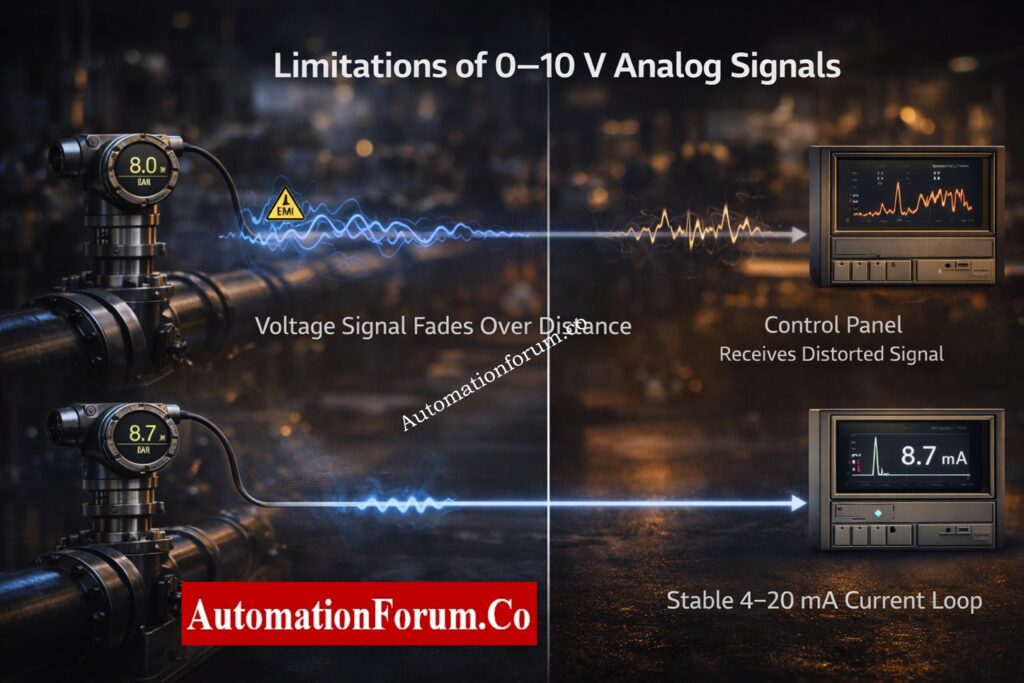
In industrial settings, current-based signals are preferable because they are stronger, less affected by noise, and work well across lengthy wire lengths.

Calculate transmitter output from 4–20 mA signals: 4 to 20 mA Transmitter Output Process Value Calculator

What Is the Dead Zero Problem in Analog Signals
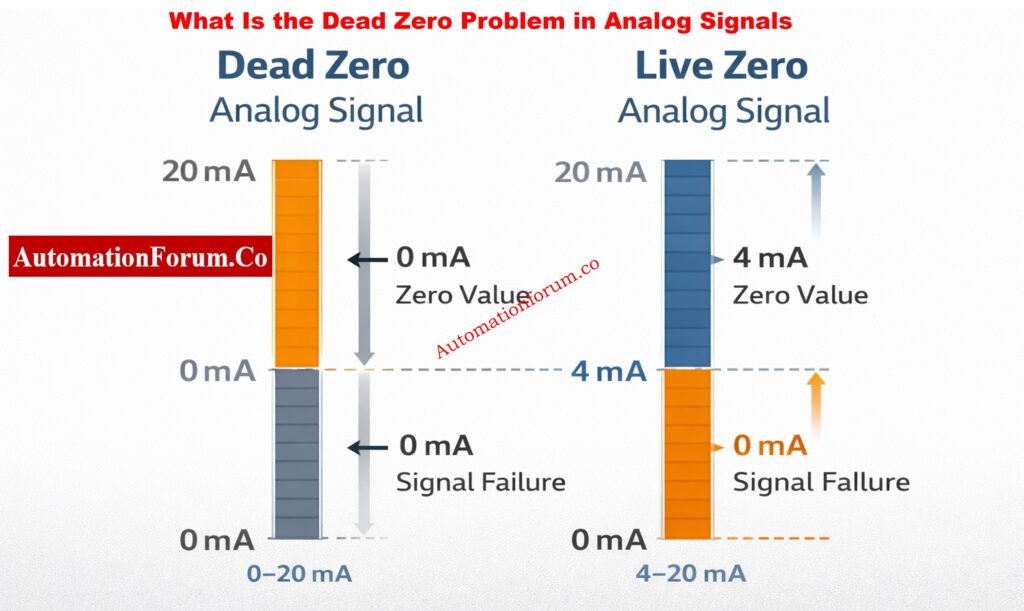
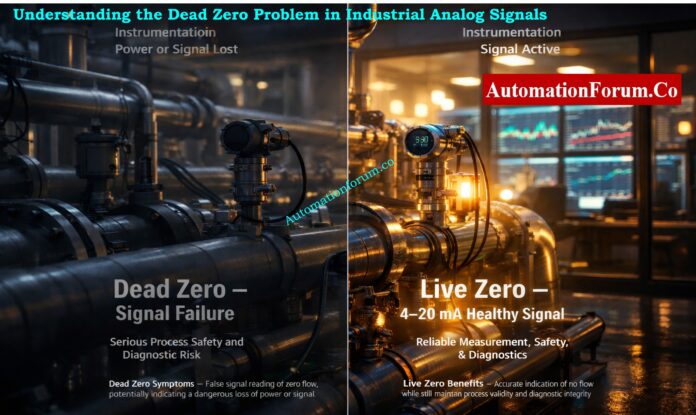
When the signal range starts at zero, the dead zero problem happens. This means that zero might mean both a good process condition and a signal failure situation.

In signal ranges such as 0 to 20 mA or 0 to 10 volt, a zero reading can indicate:

  • The process variable is genuinely at zero
  • The transmitter has lost power
  • The signal cable is broken
  • The analog loop is open
  • The instrument has failed

Because all these situations produce the same zero output, the control system cannot distinguish between a healthy process measurement and an instrumentation fault. This ambiguity is known as the dead zero problem.

Convert frequency signals to accurate 4–20 mA: Frequency(Hz) to 4 to 20 mA Signal Conversion Calculator

In process plants, zero is rarely an insignificant value. Zero flow, zero pressure, or zero level can represent normal operation, shutdown conditions, or potentially dangerous states.

If a dead zero signal doesn’t work, operators can think the process is safe when it’s not. For example, a pressure transmitter failure may display zero pressure even though the line is still pressurized. This can expose maintenance personnel to serious hazards.

Control loops depend on accurate feedback. A dead zero signal can lead to:

  • Control valves that move to dangerous places
  • Pumps and compressors that don’t start or stop when they should
  • Control loops that fluctuate or fill up

Dead zero signals might make it hard to see when an instrument breaks. The control system may not turn on low alerts because it thinks the zero reading is correct.

Calculate LRV URV and span values easily: Transmitter Calibration Span, LRV and URV Value Calculator from Measured 4 to 20 mA

A dead zero signal starts its measurement range at zero. Zero has no diagnostic meaning and cannot indicate whether the transmitter is healthy or failed.

Examples include 0 to 20 mA and 0 to 10 volt signals.

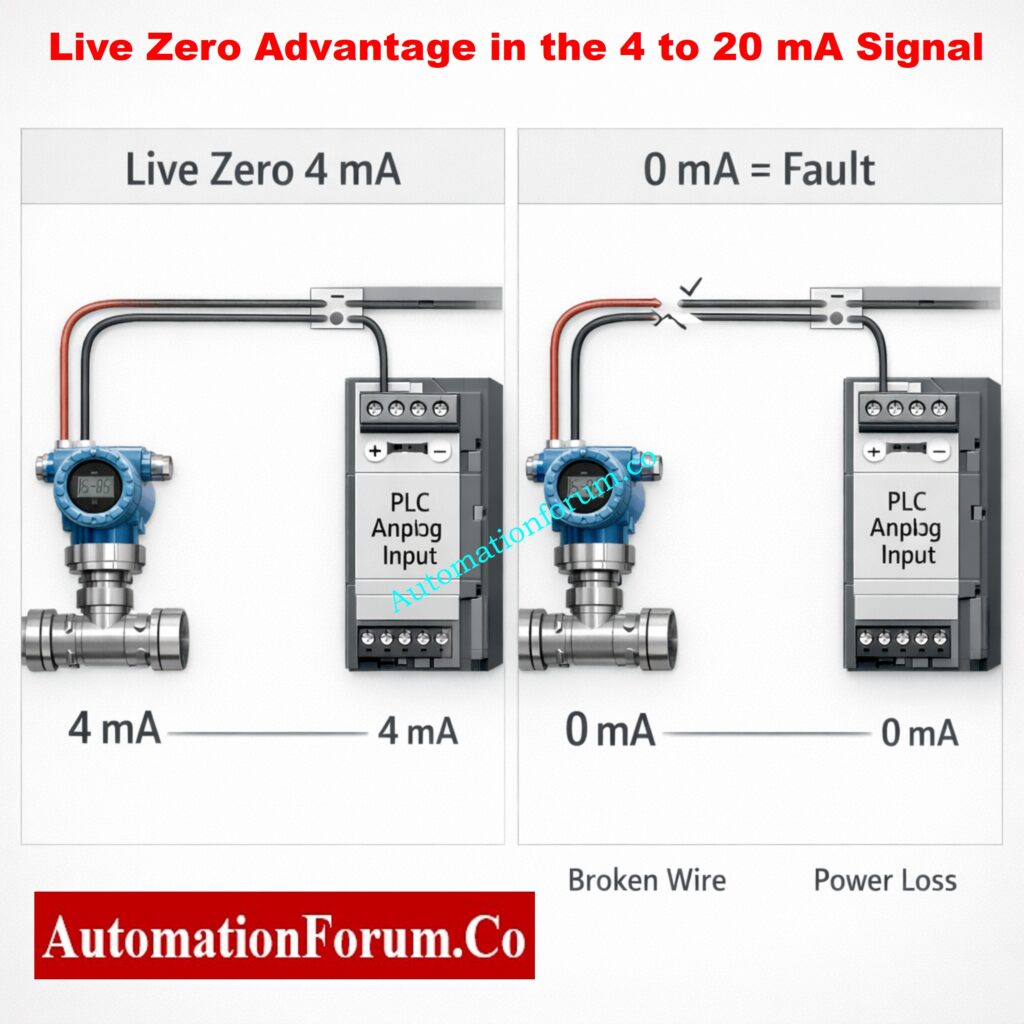
A live zero signal starts its range above zero. The most common live zero standard is 4 to 20 mA.

In a live zero system:

  • 4 mA represents the minimum process value
  • 20 mA represents the maximum process value
  • Any value significantly below 4 mA indicates a fault
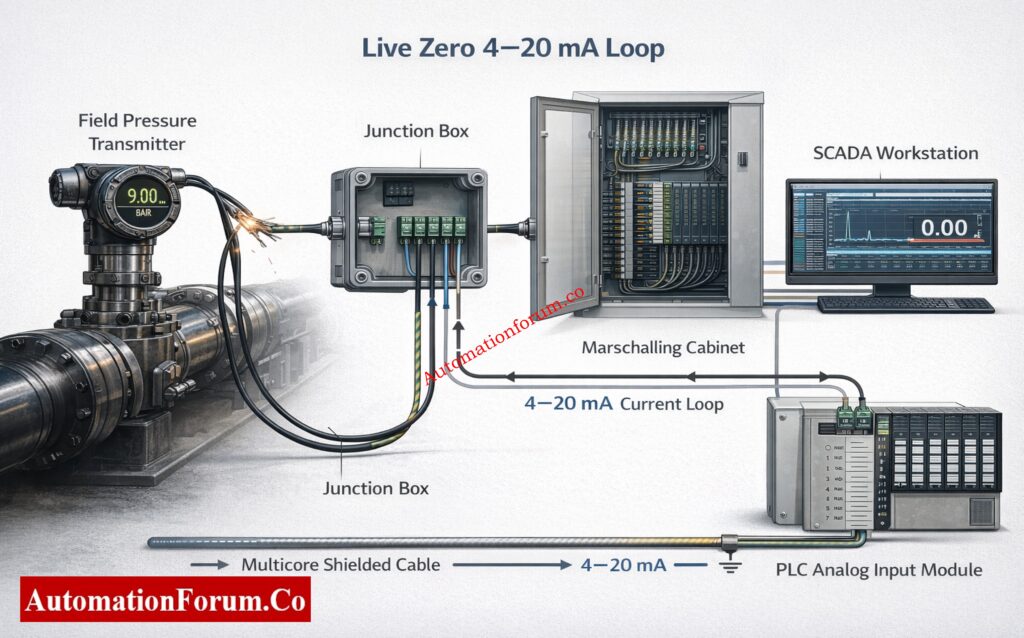
Live Zero 4 to 20 mA Loop Concept and Wiring

This simple shift allows immediate detection of signal loss, power failure, or transmitter malfunction.

Convert 4–20 mA signals to 3–15 psi: 4–20 mA to 3–15 psi Signal Conversion Calculator

Live Zero 4 to 20 mA Loop Concept and Wiring Overview 1
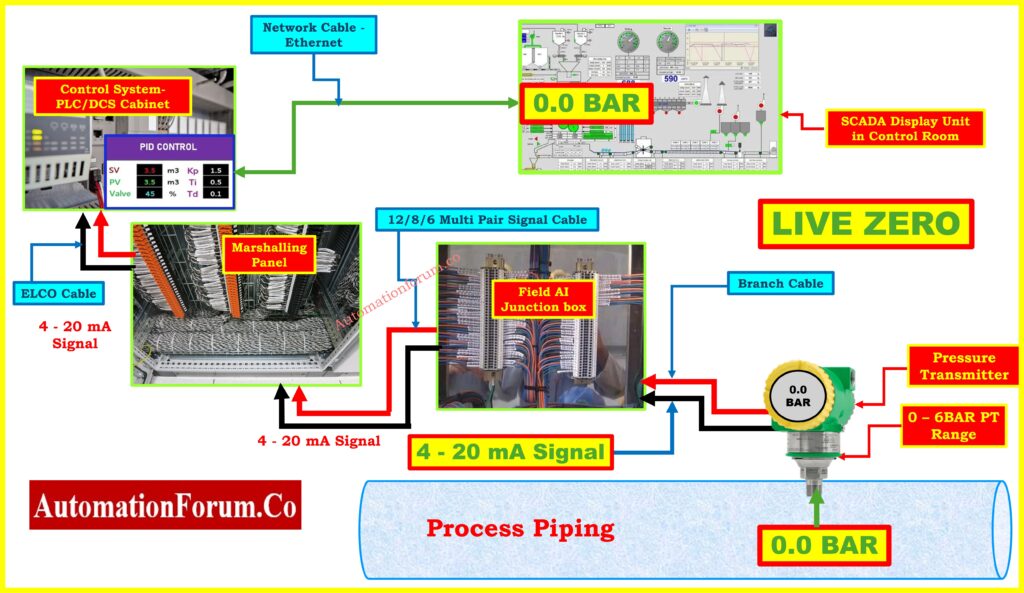
Refer the above figure Figure for a clear field level wiring layout that demonstrates how a live zero 4 to 20 mA loop is wired from the transmitter through junction box and marshalling to the PLC and SCADA, enabling immediate fault detection when the loop opens.

This diagram illustrates a properly functioning live zero 4 to 20 mA instrumentation loop from field transmitter to control and SCADA. The image shows the pressure transmitter mounted on the process piping, a short branch cable to the field analog input junction box, multi pair signal cable from the junction box back to a marshalling panel or terminal cabinet, ELCO wiring into the PLC or DCS cabinet, and the network connection to the SCADA display. The key message is that at zero process value the transmitter produces a non zero signal value, typically 4 mA, so the control system sees a live healthy loop even when the measured parameter is zero. From an operational perspective this arrangement provides immediate loop health visibility. If the transmitter loses power or the wiring opens the loop current falls to 0 mA and the DCS can immediately flag a bad PV alarm instead of interpreting the reading as a true zero. This wiring chain also supports two wire loop powering, long cable runs and HART diagnostics where available. Use this figure when explaining live zero concept, loop integrity checks and commissioning procedures. Emphasize how marshalling panels and junction boxes are used for neat wiring and isolation and how PLC input modules interpret under range values.

The widespread adoption of 4 to 20 mA is directly linked to eliminating the dead zero problem.

  • Clear separation between measurement and failure
  • Immediate detection of open circuits and power loss
  • Strong immunity to electrical noise
  • Stable signal transmission over long cable runs
  • Compatibility with smart transmitters and diagnostics

For these reasons, 4 to 20 mA remains the preferred analog signal for critical process measurements worldwide.

Learn how to simulate 4–20 mA signals: How to simulate 4-20ma signal with Loop Calibrator ?

In a cooling water flow loop using 0 to 20 mA, a zero reading may indicate no flow or a failed transmitter. Operators cannot determine the true condition without field verification. With 4 to 20 mA, zero flow still produces 4 mA, while transmitter failure produces 0 mA. This eliminates uncertainty and speeds up decision making.

A 0 to 10 volt level transmitter showing 0 V may indicate an empty tank or a failed instrument. Assuming the tank is empty when it is actually full can lead to overfilling, chemical spills, and environmental damage. Dead zero signals make voltage based level measurement especially risky in hazardous services.

A pressure transmitter using a dead zero signal may show zero pressure during a power failure. Maintenance teams may incorrectly assume the pipeline is safe to open. This example highlights how dead zero signals can create serious safety hazards.
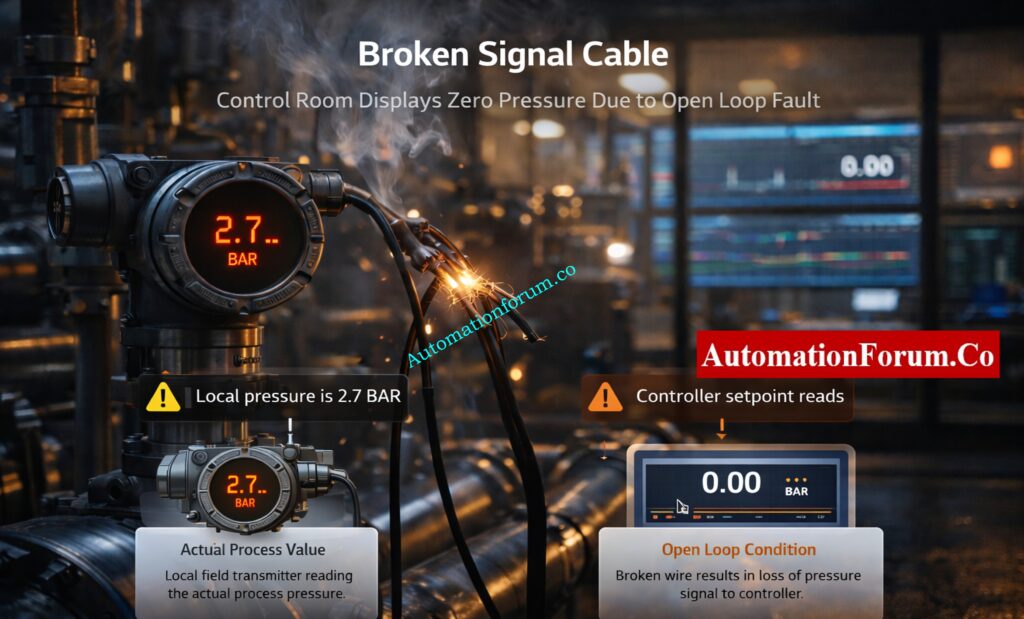
Dead Zero Issues in Voltage Based Analog Signals - broken signal cable
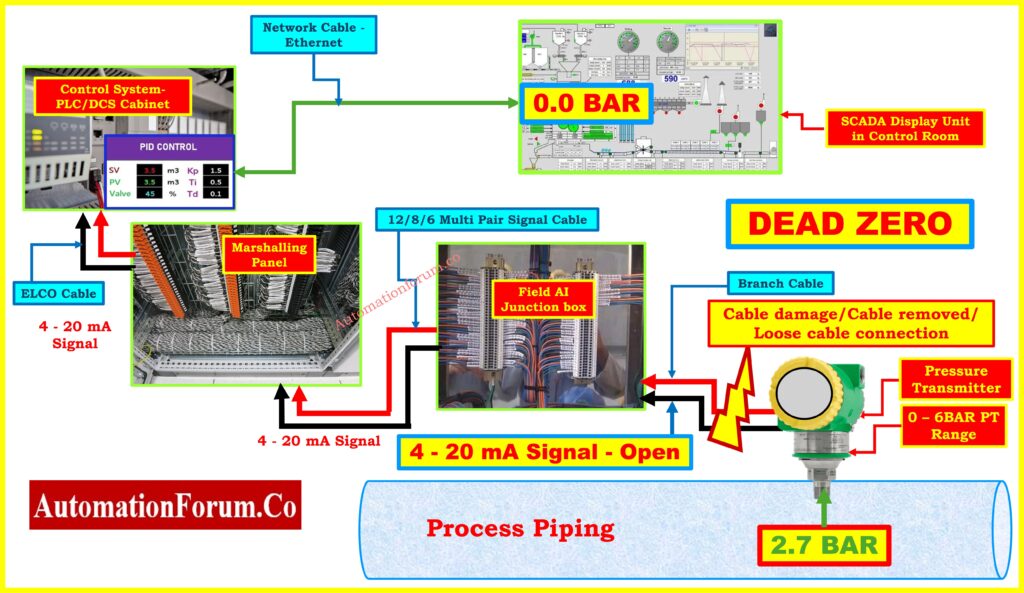
Dead Zero Issues in Voltage Based Analog Signals

The above figure  shows a real dead zero failure where cable damage or a loose connection causes the loop to go open and the DCS to display zero while the field transmitter measures a non zero value.

This diagram demonstrates the dead zero failure mode where a field transmitter reads a non zero process value while the control system displays zero due to an open or damaged signal path. The image highlights a damaged branch cable or loose connection near the transmitter and labels the system state dead zero. In the example the true process pressure is shown as 2.7 bar at the transmitter location, but the loop is open and the control system sees a 0 mA input which the DCS interprets as zero pressure. This mismatch between field reality and control display is the essence of the dead zero problem. The figure makes two practical points. First it shows how a broken cable or removed conductor anywhere in the branch, junction box or marshalling chain will produce a control room reading that hides the actual process condition. Second it demonstrates the operational risks: wrong control actions, unsafe maintenance entry, incorrect alarms and misguided troubleshooting. Use this image to illustrate causes of hidden failures and to justify design rules such as converting legacy 0 to 20 mA loops to live zero, adding under range alarms, adding redundant point level or pressure switches for safety, and performing periodic loop integrity checks.

In a reactor feed loop using 0 to 20 mA, a signal drop to zero may cause the controller to fully open the control valve. If the transmitter has failed rather than the flow stopping, this can lead to uncontrolled feed, process upset, or emergency shutdown. Use live zero and safe state logic to avoid this.
Convert 4–20 mA to PLC voltage counts: Calculator for 4-20mA Signal to 1- 5Volt and PLC 16-bit Raw Count Values

Voltage based signals are more vulnerable to dead zero issues due to:

  • Voltage drop over long cable distances
  • Electrical noise and electromagnetic interference
  • Grounding and reference problems
  • Lack of inherent fault detection

As a result, voltage signals are typically limited to short distance panel wiring or non critical applications and are avoided in harsh industrial environments.
Step by step 4–20 mA loop troubleshooting: How to do troubleshooting of a 4-20mA loop?

During loop checking and commissioning, transmitters are frequently powered on and off. In dead zero systems, it becomes difficult to confirm whether a zero reading is due to testing or an actual process condition.

When a transmitter is taken out of service, the control system may continue to display a valid zero. Operators may unknowingly operate the plant without a critical measurement, increasing operational risk and downtime.
Pressure gauge versus transmitter which one accurate: Pressure Gauge vs Pressure Transmitter: When Readings Don’t Match, Who Should You Trust?

The dead zero problem is significantly more important in safety instrumented systems.

  • A malfunctioning instrument could look like a safe zero state.
  • The logic solver may not be able to find signal loss.
  • Necessary safety measures may not be implemented.

Live zero signaling makes sure that safety systems can easily tell the difference between genuine measurements and broken instruments, which helps lower risk in a reliable way.
Test your zero elevation troubleshooting knowledge: Zero Elevation Level Measurement Troubleshooting Quiz for Process Industries (Advanced 25 MCQs with Answers)

Operators are usually the first to see readings that are out of the ordinary. If you don’t know about the dead zero problem, you can miss or misread zero values.

Some common misconceptions are:

  • Assuming that zero always signifies the process has stopped 
  • Ignoring zero readings when the power goes out
  • Putting off reporting problems with instruments

Teaching operators to investigate unusual zero readings makes response time and plant safety far better.

Safely zero DP transmitter using valve manifolds: How to Safely Zero a DP Transmitter with 3-Way Valve and 5-Way Valve Manifolds

Even in plants using digital communication protocols, analog signals are still commonly used as primary or backup outputs from smart transmitters.

If these analog outputs are configured using dead zero ranges, the benefits of digital diagnostics are reduced. When you use live zero principles, hybrid analog and digital systems will work the same way every time.

At first, dead zero signals may seem easier or cheaper, but they end up costing more in the long run.

Costs that aren’t obvious include:

  • More work to fix problems
  • More work needed for maintenance
  • Longer periods of downtime
  • Higher chance of process problems and accidents

Live zero signaling cuts these costs by making it easier to find faults and make diagnoses more quickly.

Calculate DP zero suppression for level measurement: DP calculator for Zero suppression – open tank level measurement

From an EPC and lifecycle design point of view, dead zero signals add unneeded risk to operations.

The best design practices are:

  • Setting all important analog loops to 4 to 20 mA
  • Clearly showing the ranges of signals on data sheets and loop diagrams
  • Setting up warnings for faulty signals and under range in control systems
  • Setting safe control actions to take when a signal fails

These approaches make plants more reliable and easier to maintain.

You might still find dead zero signals in:

  • Old installations
  • OEM skids in boxes
  • Utility systems that don’t cost much

In these situations, constraints must be explicitly stated, and operators must be taught to be careful when they get zero readings.

  • Always use live zero signals between 4 and 20 mA for process measurements.
  • Stay away from voltage-based signals in tough industrial settings.
  • Set up alarms for low range and weak signal
  • If you have a bad signal, go to safe state or manual mode.
  • Teach train operators and maintenance workers how to spot signal failures.

The dead zero difficulty in industrial analog signals is a basic problem with instrumentation that still affects process plants all over the world. It shows how a choice about the range of a signal that seems modest can have big effects on safety, control performance, and maintenance efficiency.

Plants may get rid of confusion and make things much more reliable by using 4 to 20 mA live zero signaling, setting up the right diagnostics, and making sure that everyone in engineering and operations knows about them.

In the process industry, a signal that can clearly indicate its own failure is just as important as one that accurately measures the process variable.

Dead zero uses a signal that starts at 0, where zero can mean either a real process value or a signal failure.
Live zero starts above zero, typically 4-20 mA.
Here, 4 mA represents zero process value, and any value below 4 mA indicates a fault.

Analog signals can suffer from noise, cable damage, power loss, and grounding issues.
Voltage drop over long distances and calibration drift are common.
Dead zero signals can hide transmitter or wiring failures.

4-20 mA avoids the dead zero problem.
In 0-20 mA, 0 mA can mean zero process value or signal failure.
With 4-20 mA, any current below 4 mA clearly indicates a fault.

limitation 0 to 10 v signal

4-20 mA is better for industrial use.
It is immune to noise, works over long distances, and detects open circuits.
0-10 V is more sensitive to noise and voltage drop.

A signal converter or signal conditioner is used.
A resistor alone gives only 2-10 V from 4-20 mA.
Active converters provide proper scaling, isolation, and accuracy.

Usually between 30 and 100 meters, depending on the quality of the cable and the amount of noise.

As the distance increases, so does the voltage loss and interference.

Hybrid Level Measurement Selection Procedure for EPC Instrumentation Engineers

0
Hybrid Level Measurement Selection Procedure for EPC Instrumentation Engineers

In modern process plants, especially those built by EPC companies that are complicated, high-risk, and safety-critical, hybrid level measurement has become an important feature of instrument design. When choosing the right level measuring technology for today’s process industries, precision is no longer the only thing that matters. It has a direct effect on the safety of the plant, the reliability of operations, the availability of resources, compliance with regulations, and the long-term cost of ownership.

In a lot of industrial settings, using a one level measurement concept isn’t enough because process conditions are always changing, the environment is quite harsh, and safety standards are very high. Different levels of temperature, pressure, density, phase behavior, foam formation, turbulence, and the shape of the inside of the vessel can all make individual level measurement methods fail or drift. In these cases, hybrid level measurement is a strong, dependable, and well-designed answer.

The article goes into great detail on how to choose a hybrid level measuring method in a way that is practical and focused on EPC. It clearly explains when and why hybrid level measurement should be used, as well as how it should be designed during the FEED, basic engineering, detailed engineering, commissioning, and handover stages of EPC projects. Instrumentation engineers, lead engineers, and project specialists who work on refinery, petrochemical, chemical, power, LNG, and offshore projects should use this information as a reference.

Capacitance vs Guided Wave Radar in Hybrid Level Measurement: Hybrid Level Measurement: Capacitance + Guided Wave Radar (GWR) Technology

What Is Hybrid Level Measurement in Instrumentation Engineering

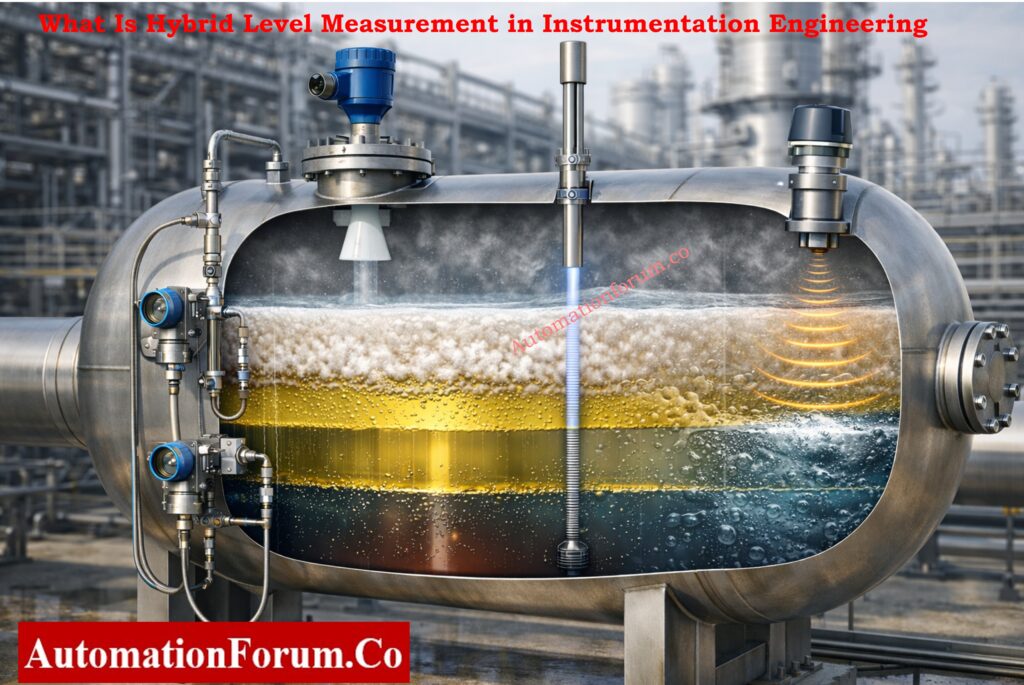
Hybrid level measurement is when two or more different level measurement technologies are used on the same vessel, tank, or process system on purpose to make the measurements more reliable, accurate, available, and safe. Diversity is the main idea behind hybrid level measuring.

Different physical principles are used by each level measurement technology. The system uses a mix of different technologies to make sure that a single process state, mechanical failure, or environmental factor doesn’t effect all measures at once. This greatly cuts down on failures caused by the same thing and makes level indication more reliable.

It is vital to tell the difference between hybrid level measurement and basic redundancy. Putting up two similar radar level transmitters or two differential pressure transmitters does not make a hybrid system. These kinds of setups merely add extra copies, not different ones. True hybrid level measurement uses a combination of technologies, such as differential pressure, non-contact radar, guided wave radar, ultrasonic, displacer, or capacitance level measuring, in a planned and structured way.

In EPC projects, hybrid level measurement is used when the conditions of the process are very harsh, change a lot, or are very important for safety, and when relying on just one measuring approach poses an unacceptable operational or safety risk.

Hybrid Level Measurement System Explained for Process Plants: What is Hybrid level measurement system?

From the point of view of EPC instrumentation design, level measurement failures are one of the most common reasons for plant problems, false alarms, safety accidents, and complaints after commissioning. Choosing the wrong or not enough level measurement can cause unstable control loops, frequent false trips, constant operator intervention, too much maintenance, and, in the worst circumstances, catastrophic vessel overfill or dry-run conditions.

EPC engineers may make their designs more durable at the design phase with hybrid level measurement, instead of having to rely on operational workarounds or retrofits after commissioning. EPC teams may greatly improve plant safety, reliability, and availability by dealing with measurement problems early in the project lifecycle.

Hybrid level measurement is especially important in EPC projects that include refineries, petrochemical complexes, chemical plants, power generation units, LNG facilities, offshore platforms, and large storage terminals. This is because process upsets can have very bad effects on safety, the environment, and the bottom line.
Radar Level Measurement Performance Checklist for Engineers: Checklist for Best Radar Level Measurement & Control System Performance

Importance of Hybrid Level Measurement in EPC Instrumentation Design

Reliability, safety, and operational continuity are the main goals of hybrid level measurement in instrumentation engineering. A well-designed hybrid level measuring system makes sure that the level indication is correct and steady in all situations, such as normal operation, startup, shutdown, and abnormal upset conditions.

From an EPC execution point of view, hybrid level measuring helps meet international safety standards, project specifications, and client needs while reducing delays in commissioning, operational issues, and changes after handover.

Tank Level Calculation Using Radar Level Transmitters: Radar Level Transmitter Calculator for Tank Level Measurement

A thorough process condition analysis is the first and most important step in choosing a hybrid level measurement. Instrumentation engineers need to look at the whole working environment of the vessel or system, not just the steady-state circumstances.

Some important factors are the operating pressure, temperature, density variation, phase changes, vapor presence, foam formation, turbulence, internal obstructions, coating potential, and fouling tendencies. Startup, shutdown, trip situations, and process upsets are examples of abnormal and temporary conditions that need extra care.

When process circumstances change in a way that impacts different measuring methods in different ways, hybrid level measurement should always be used.

Process Condition Analysis for Level Measurement Selection

There are limits to every level measurement technology. Stable fluid density and dependable impulse lines are very important for differential pressure level measurement. Foam, thick mist, condensation, or interior vessel features can all affect how radar level monitoring works. Ultrasonic level measurement is affected by variations in pressure, temperature, and the composition of the vapor. Displacer level measurement depends on buoyancy that stays the same, but changes in density and wear and tear on the machine can change it.

When no one technology can meet the needs for accuracy, dependability, and availability in all operating scenarios, hybrid level measurement is needed. It is important to find these limits early on in FEED and basic engineering in order for EPC to work.

How to Select Interface Level Measurement – 2025 Guide: Interface Level Measurement Selection Procedure – Complete 2025 Guide for Process Engineers

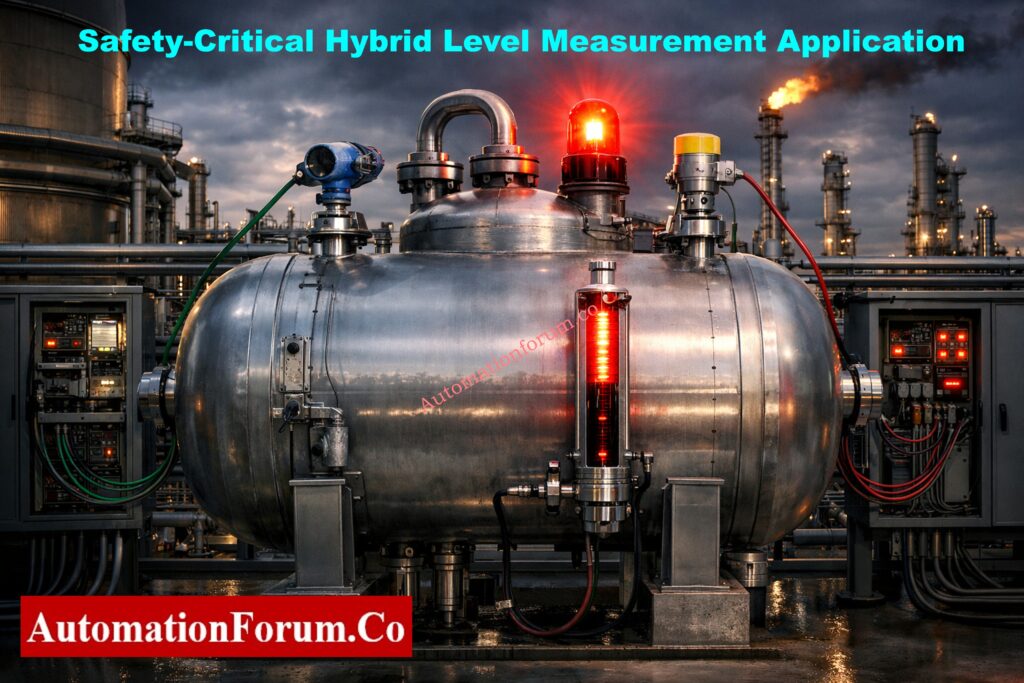
Hybrid level measurement lowers the likelihood of common-mode failure in safety instrumented systems by employing different sensing techniques. Usually, one instrument is used to regulate the main process, while a second, separate technology is employed to provide safety protection, start the shutdown or check the alert.

Every instrument in a hybrid level measuring system needs to have a clear job to do. One transmitter may be the main control input, and the other transmitter may confirm it independently, send high-high or low-low warnings, or start a safety interlock.

Clear functional separation keeps things running smoothly and stops commissioning arguments. EPC documentation must clearly state how each measurement is used and what to do when measurements don’t match.

For hybrid level measurement to work, you need to carefully choose complementary technologies that react differently to process problems and failure mechanisms. The goal is not to copy, but to be different.

Some common hybrid combinations are differential pressure with radar, radar with guided wave radar, displacer with electronic level measurement, and capacitance with radar. The choice should be based on how the process works, how the vessel is designed, how the inside is shaped, and how the company operates, not on the vendor’s desire.

What Affects Ultrasonic Level Measurement Accuracy: Understanding the Factors Influencing the Accuracy of Ultrasonic Level Measurement

Choose hybrid level measurement when the density of the fluid changes a lot because of changes in temperature, pressure, or composition. In these situations, only density-dependent devices can keep their precision.

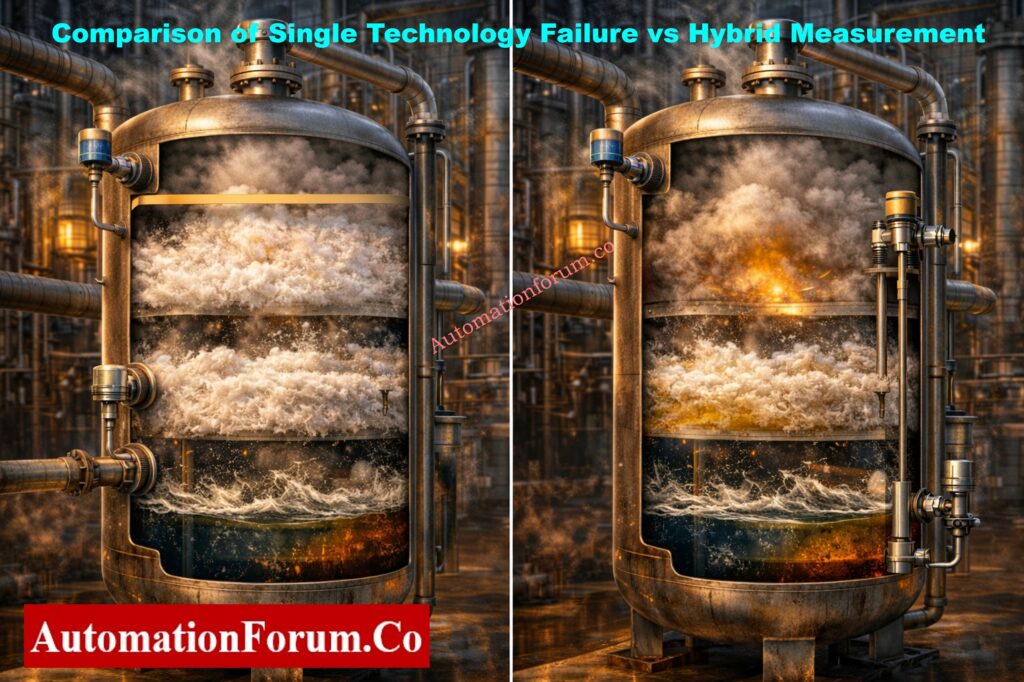
Hybrid level measurement is a good choice for applications that involve foam production, heavy vapor, or turbulent liquid surfaces. In certain situations, one technology may be affected while the other still gives accurate information.

For pressurized tanks and high-temperature services where sensors can wander or wear out over time, hybrid level measuring is very important. You should always check for hybrid level measurement on safety-critical equipment such separators, reactors, boiler drums, and tanks for storing dangerous materials.

Hybrid level measuring strategies are also very useful for batch processes, starting and stopping activities, and vessels that change their operating mode often.

Complete Overview of Industrial Level Measurement Technologies: Mastering Level Measurement Technologies: A Comprehensive Guide

Typical Hybrid Level Measurement Applications in Process Plants

Separators, surge vessels, reflux drums, distillation columns, reactors, storage tanks, and boiler drums all use hybrid level measurement a lot. These applications frequently encompass many phases, density fluctuations, foam, or interior structures.

Hybrid level measurement makes ensuring that containers with internals like trays, coils, agitators, or baffles work reliably even when signal interference affects one technology.
Why Cable Shield Grounding Is Done Only at One End: Why the Cable Shield is Grounded Only at the PLC or Control Panel Side

Simple Process Example of Hybrid Level Measurement

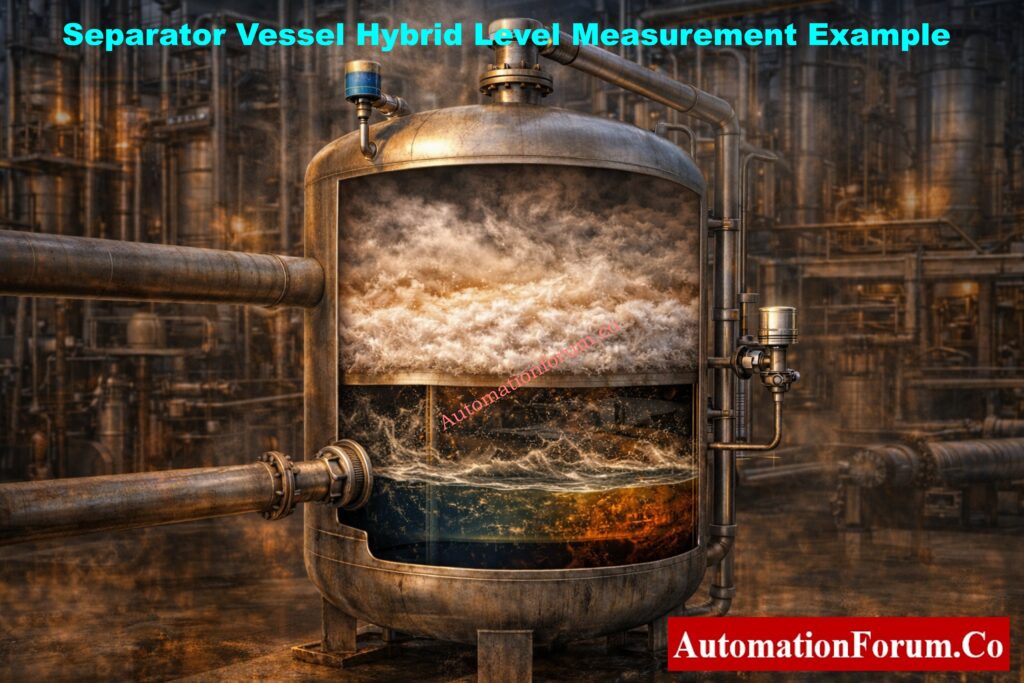
A separator vessel used in refineries, gas processing plants, and chemical plants is a typical and useful example of hybrid level measurement.

A mix of gas and liquid goes into the separator. Flow, pressure, temperature, and composition all change throughout operation, which changes the process conditions all the time. These changes make the inside of the vessel less dense, create foam, and make the surface turbulent.

When the density of the liquid varies, the level reading becomes wrong if simply a differential pressure level transmitter is utilized. Using merely a radar level transmitter can give you incorrect level readings if there is foam or heavy vapor.

A hybrid level measurement system is chosen to make sure that level measurement is accurate no matter what the operating conditions are.

A radar level transmitter measures levels continuously during normal operation, while a differential pressure level transmitter measures levels independently and is accurate even when process conditions vary.

The separator level stays accurate, steady, and safe throughout regular operation, startup, and upset conditions because it uses two independent ways to measure levels. This easy hybrid method stops overfilling, keeps downstream equipment safe, and makes the whole process more reliable.
How to Select Cable Glands for Hazardous Areas: Cable Gland Selection for Hazardous Area Installations – Complete 2025 Guide

EPC deliverables must explicitly show how to measure hybrid levels. Instrument datasheets must say what each transmitter is for. P&IDs must show the right places for nozzles and elevation references. Control philosophies must explain how measures are used and what to do when they don’t match up.

During detailed engineering, you need to think about maintenance access, isolation valves, calibration needs, and signal routing. One of the most prevalent reasons why people misuse hybrid systems while they are running is because of bad documentation.

Role of 250-Ohm Resistor in HART Communication: Why is a 250-Ohm Resistor Important for HART Communication?

To avoid conflicting control actions, hybrid level measurement must be carefully integrated into the control system. It is important to choose one measurement as the main control signal. The second measurement can be used to set off alarms for deviations, safety interlocks, or to ensure that the operator is correct.

You should not switch between measures automatically unless it is properly specified and tested. Operators need to always know which measurement is in use.

Step-by-Step Level Transmitter Selection for EPC Projects: Level Transmitter Selection Checklist for EPC Engineers – Step-by-Step Guide

Even though hybrid level measuring costs more to set up, it saves a lot of money over time by cutting down on unexpected shutdowns, making troubleshooting easier, and improving diagnostics. Hybrid systems also make calibration intervals longer and make measurements more stable over time.

This means that EPC businesses have less problems after handing over the project, fewer warranty claims, and happier clients.

Common Problems in Guided Wave Radar Level Transmitters: Guided Wave Radar Level Transmitters: Complete Troubleshooting & Maintenance Guide

It’s typical to choose two tools that use the same measurement principle. When designing, not taking into account startup and shutdown conditions can often lead to measurement failure during commissioning. Logic that is too convoluted and doesn’t have a clear practical purpose causes confusion and alarms.

During engineering, not commissioning or operations, the principle behind hybrid level measurement must be set.

EPC engineers that work on complex and safety-critical process plants need to include hybrid level measurement as a key part of their instrumentation design. It combines different level measurement methods to give you reliable, precise, and safe level indication in all situations.

EPC instrumentation engineers may create systems that work well for the whole life of the plant by following a defined process for choosing hybrid level measurement and knowing when it is needed. Hybrid level measurement is not a luxury in today’s industrial projects; it is necessary for safe, strong, and efficient plant operation.

How Boiler Drum Level Is Measured Using DP Transmitters: Understanding Boiler Drum Level Transmitters: Accurate DP Measurement Explained

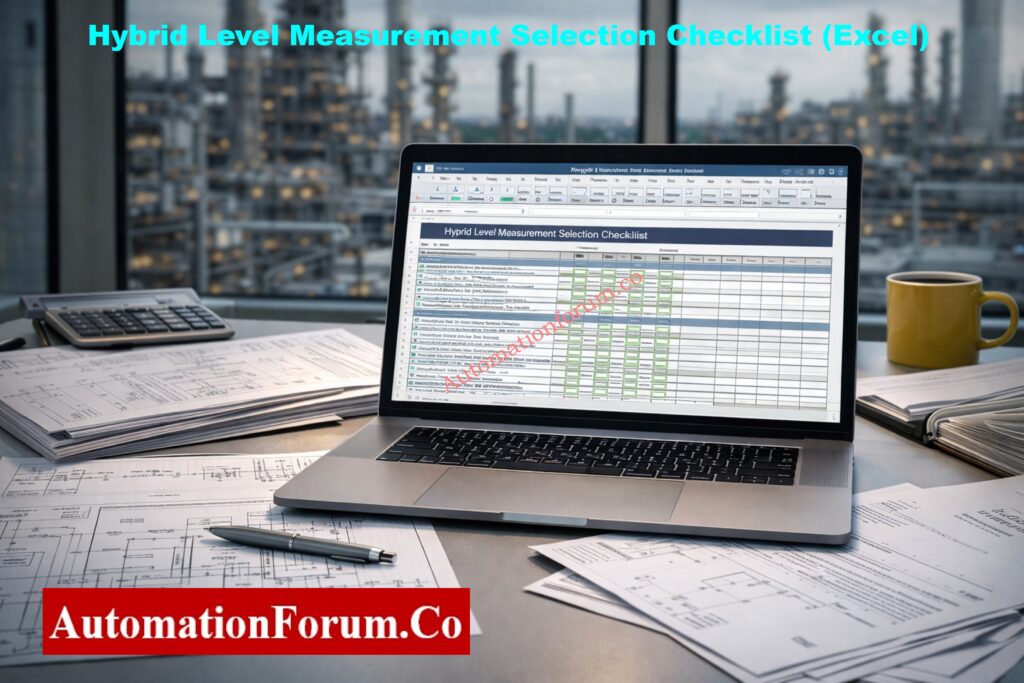
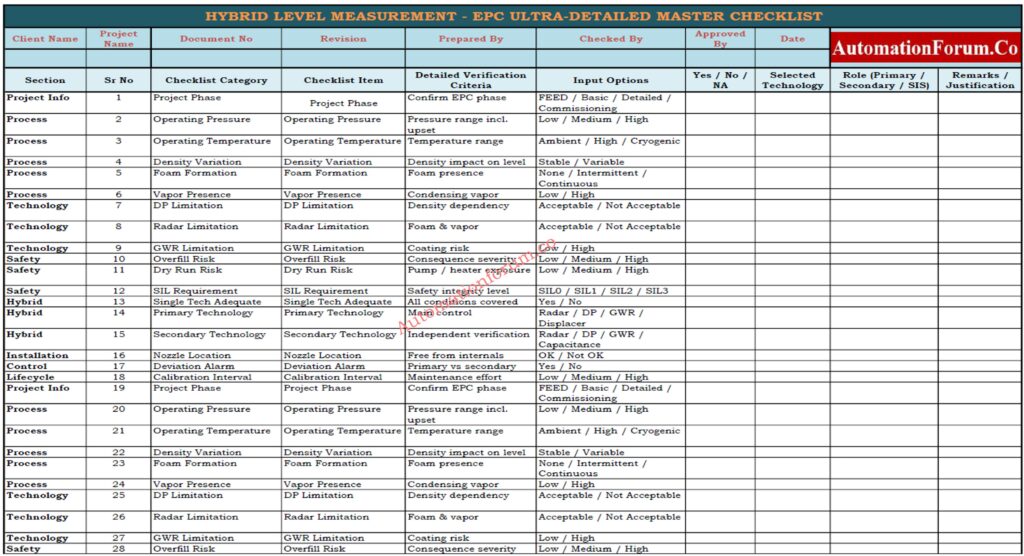
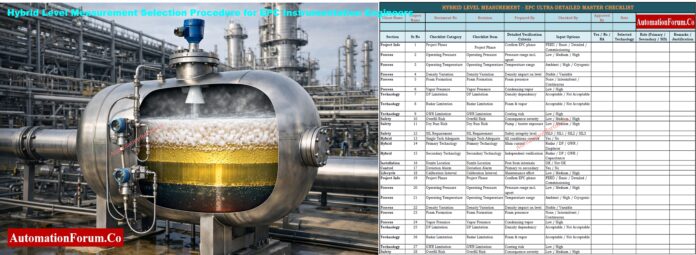
Hybrid Level Measurement Selection Checklist for EPC Engineers

In process plants, hybrid level measurement is necessary since a single level measurement system can’t always handle changing process conditions, safety threats, and operational uncertainties. This Ultra-Detailed Hybrid Level Measurement Selection Checklist helps EPC instrumentation engineers by giving them an organized and useful way to look at process conditions, technology limits, safety needs, and control strategies.

Hybrid Level Measurement Selection Checklist for EPC Engineers -1

The checklist comes as a single sheet Excel tool with built-in drop-downs, conditional formatting, SIL logic indicators, and document control fields. This makes it useful for FEED, engineering, HAZOP, SIL investigations, and commissioning.

Radar Level Transmitter Troubleshooting Steps: Step-by-Step Guide for Troubleshooting Radar Level Transmitters

When choosing a level transmitter, you need to think about things like pressure, temperature, density changes, foam, turbulence, and the shape of the vessel. First, you need to decide what the measurement is for (control, alert, or safety) and how accurate it needs to be. There is no one technique that works for all applications, thus radar, differential pressure, ultrasonic, or guided wave radar are chosen based on how well they work. For services that are really important or hazardous, hybrid level measurement is better..

There are numerous types of level measurement, such as differential pressure, radar (both non-contact and guided wave), ultrasonic, displacer, and capacitance level measurement. Other ways to monitor levels are with nuclear level measurement, magnetic level gauges, and float or conductivity switches. Combining different methods into hybrid level measurement makes them more reliable for complicated or high-risk tasks.

It’s hard to estimate the level of a flotation cell because of the froth, air bubbles, turbulence, and fluctuations in density. Because they work better with foam, non-contact radar level transmitters are often employed. Radar is widely used with pressure-based measurement in important mineral processing applications to keep level control steady.

How Tank Geometry Impacts Level Measurement Accuracy: Effect of Tank Design on Accuracy of Level Measurement

The best material will depend on the fluid and the conditions under which it is used. People utilize stainless steel a lot for everyday things. Hastelloy, Monel, or PTFE coatings are needed for corrosive services. Ceramic or hardened metals are used in abrasive slurries, while polished stainless steel with sanitary approvals is needed for hygienic uses.

Where and Why Submersible Level Transmitters Are Used: Submersible Level Transmitters: Applications, Working Principles, and Benefits

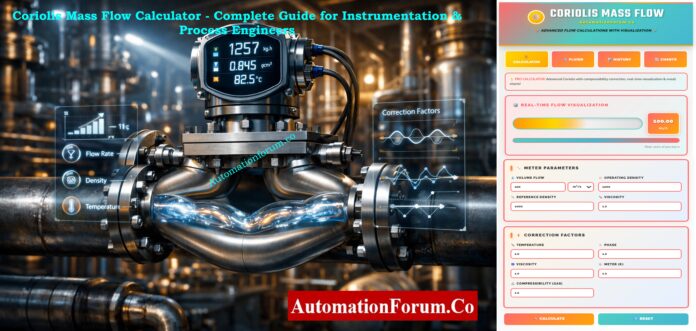
Coriolis Mass Flow Calculator – Complete Guide for Instrumentation & Process Engineers

0
Coriolis Mass Flow Calculator - Complete Guide for Instrumentation & Process Engineers
Coriolis Mass Flow Calculator – AutomationForum.co
⚙️

CORIOLIS MASS FLOW

AutomationForum.co

⚡ ADVANCED FLOW CALCULATIONS WITH VISUALIZATION ⚡

💡 PRO CALCULATOR: Advanced Coriolis with compressibility correction, real-time visualization & result charts!
📊 REAL-TIME FLOW VISUALIZATION
0.00
m³/s
Flow: 0% of 500 m³/s
🔧 METER PARAMETERS
⚡ CORRECTION FACTORS
💧 QUICK FLUID SELECTION & CUSTOM PRESETS
💾 SAVE CUSTOM PRESET
Current: Density=1000 kg/m³, Viscosity=1.0 cP
FLUID LIBRARY (20 FLUIDS)
📊 LAST 10 CALCULATIONS
📈 VISUAL ANALYSIS
Calculate first to see charts!

In modern process sectors like oil and gas, chemical processing, power generation, food and drink, water treatment, and pharmaceuticals, it is very important to quantify mass flow accurately. It is easy to measure and see volumetric flow, but it doesn’t show how much material is really moving through a system. Mass stays the same, but volume can change a lot when temperature, pressure, and density change.

For this reason, mass flow is the best process variable for figuring out material balance, energy accounting, custody transfer, batching operations, blending accuracy, and quality control.

The Coriolis Mass Flow Calculator was made to help engineers, technicians, and operators figure out corrected mass flow rates accurately utilizing real-world operating situations instead of perfect settings.

This guide tells you what the calculator does, why you need it, who should use it, when to use it, how to use it, and how the calculation works, all in a practical, field-oriented engineering way.

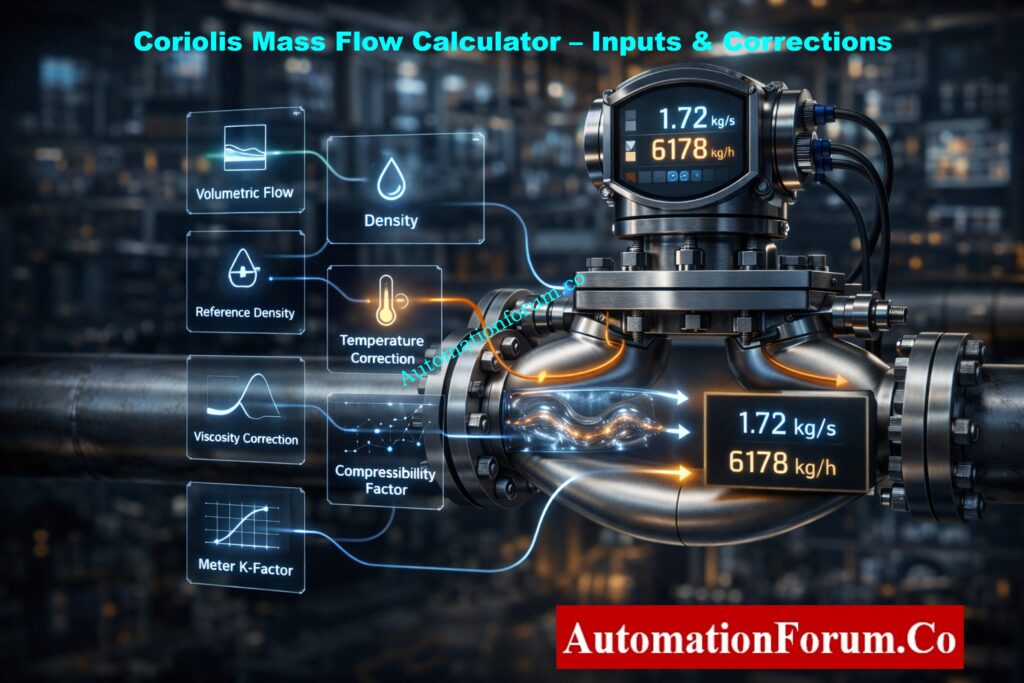
A Coriolis Mass Flow Calculator is an engineering tool that combines recorded volumetric flow with fluid characteristics and correction factors that reflect real operating conditions to find the accurate mass flow rate of a fluid.

This calculator takes into account the same factors that impact how well a real Coriolis flowmeter works in an industrial setting, unlike simple volume-to-mass converters.

Maximum PSF Calculator for Coriolis Flow Meters – Pulse Scaling Made Easy: Maximum PSF( Pulse Scaling Factor) Calculator for Coriolis Flow Meters

Volumetric Flow Rate
This shows the amount of flow measured per unit of time, like m³/s, L/s, or GPM. You can usually get this from process data, design calculations, or temporary flow measurements taken during commissioning.

Fluid Density
The real density of the process fluid at the temperature and pressure it is running at. Density has a direct effect on mass flow and is one of the most important factors in how accurate Coriolis measurements are.

Reference Density
The density at which the factory set the Coriolis meter. Any difference between the operational density and the reference density needs to be fixed.

Temperature Correction Factor
Takes into account changes in fluid characteristics caused by temperature, sensor material expansion, and tube stiffness variations.

Viscosity Correction Factor
Fluids with a lot of viscosity slow down the vibration of tubes in Coriolis meters. This factor makes up for the impacts of lower sensitivity and phase shift.

Phase Correction Factor
This is used when there is a little bit of gas entrainment, aeration, or flow that is close to two phases. These conditions can affect the stability of the meter.

Meter Calibration (K) Factor
The meter calibration (K) factor is an adjustment factor that comes from calibration certifications and is used to make sure that measured values match traceable standards.

Compressibility Factor (for gases)
Fixes the way real gases act when their density fluctuates a much with pressure and temperature.

Coriolis Flow Meter Output Frequency Calculator for Accurate Signal Scaling: Coriolis Flow Meter Output Frequency Calculator

The calculator provides:

  • Mass flow in kg/s
  • Mass flow in kg/h
  • Raw mass flow (before correction)
  • Density correction factor
  • Total correction factor applied

This layered output helps engineers not only see the final result, but also understand why it changed.

How to Maintain Coriolis Mass Flowmeters for Long-Term Accuracy: How to Maintain Coriolis Mass Flowmeters ?

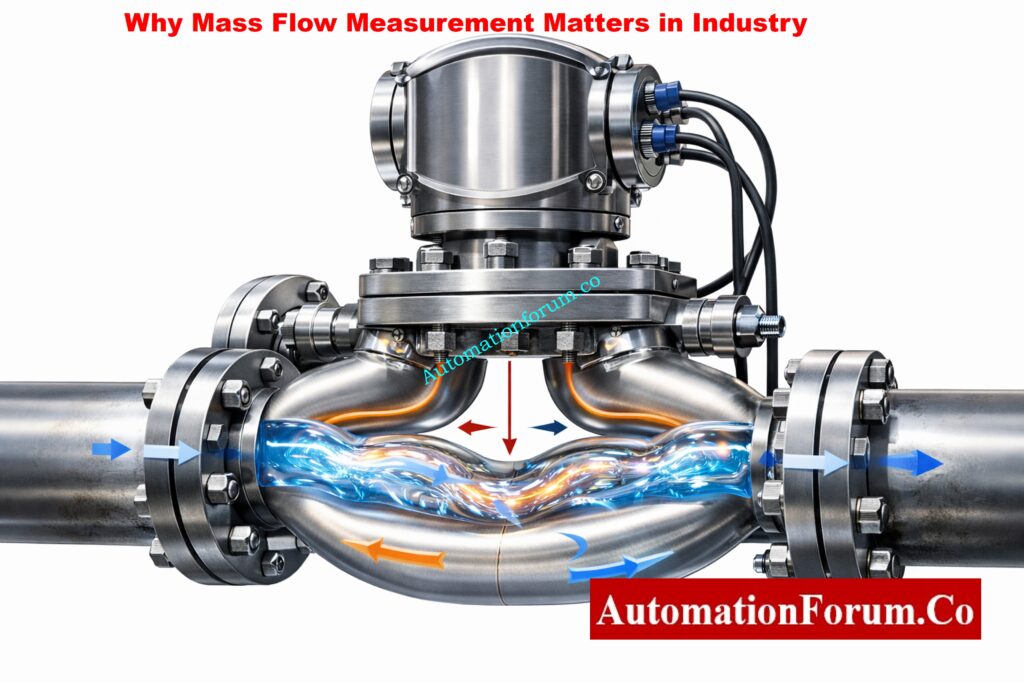
Why Mass Flow Measurement important in Industry

In industrial process control, mass, not volume, is what defines how efficient production is, how much energy is used, and how much money is made. Mass flow stays the same, while volumetric flow vary depending on the surroundings.

Important Reasons Mass flow is very important for process efficiency.

Process Efficiency
Accurate mass flow makes ensuring that reactors, furnaces, and separators get the right amount of material, which keeps them from being underfed or overfed.

Product Consistency
Mass accuracy is important for batching and blending processes to keep the quality and composition of the products the same.

Energy Balance
For accurate energy accounting, steam, fuel gas, and thermal oil calculations depend on mass flow.

Regulatory Compliance
Calculations based on mass are commonly needed for environmental reporting and emissions monitoring.

Billing and Custody Transfer
Mass is utilized in business deals to avoid problems that can come up when density or temperature changes.

Coriolis flowmeters measure mass flow directly, but engineers still need to do their own calculations throughout design, commissioning, troubleshooting, and audits. This is where the calculator becomes quite useful.
Coriolis Flow Meter Installation Guide – Best Practices for High Accuracy: Coriolis Flow Meter Installation: Best Practices for Accuracy

When you do calculations by hand or with spreadsheets, you often make mistakes because of:

  • Incorrect unit conversion
  • Missed correction factors
  • Inconsistent formulas between engineers

This calculator ensures:

  • Automatic unit normalization
  • Correct application of all correction factors
  • Consistent and repeatable results across teams

Time is very important during plant setup, FAT, and SAT. The calculator lets engineers:

  • Quickly compare expected vs actual mass flow
  • Check the adjustment for temperature and density.
  • Check the transmitter’s settings without having to recalculate them over and over.

If a Coriolis meter gives readings that are not what you anticipate, the calculator can assist you figure out if the problem is

  • Wrong density input
  • Wrong temperature adjustment
  • Wrong data for the K-factor or calibration
  • Changes in process conditions instead of instrument failure

Calculated results can be confidently used in:

What Is a Coriolis Flowmeter? Working Principle Explained: What is a Coriolis flowmeter and how does it work

Instrumentation professionals use the calculator for:

  • Choosing the right Coriolis flowmeter and checking its size
  • Checking the transmitter’s setup settings
  • Checking calibration and factory settings against each other

Process engineers rely on it for:

  • Calculations for mass balance
  • Looking at how fluid properties affect flow measurement
  • Finding the best operating conditions for steady flow control

During site activities, the calculator helps with:

  • Checking the loop and making sure it works
  • Finding configuration mistakes quickly
  • Putting design values next to field measurements

Operations teams benefit by:

  • Knowing how variations in temperature and density affect things
  • Checking the flow of mass during grade changes
  • Making better decisions about control when things go wrong

For learning purposes, the calculator helps:

  • Imagine how viscosity and density change the flow of mass.
  • Learn how Coriolis flowmeters work in the real world.
  • Bridge theory and real-world use

Coriolis Mass Flowmeter Basics – A Complete Beginner-to-Engineer Guide: Coriolis mass flowmeter basics

  • Turn volumetric flow into mass flow that is correct
  • Make sure the Coriolis meter is right for the job.
  • Look at the worst-case fluid property scenarios
  • Check that the transmitter settings match the process conditions.
  • Check the calculated mass flow against the output of the live meter.
  • Find scaling or setup mistakes early on.
  • Look into changes in mass flow
  • Look at how variations in process temperature or density affect things.
  • Help with attempts to optimize production
  • Check the accuracy of the meter after maintenance.
  • Re-confirm the things that need to be changed
  • Help with audits inside and outside the company

Differential Pressure to Flow Calculator for Process Engineers: Differential Pressure to Flow Calculator – Complete Interactive Tool for Process Engineers

How the Coriolis Mass Flow Calculation Works

All volumetric flow inputs are changed to m³/s to keep the calculations consistent and eliminate errors caused by mismatched units.

To find out how much raw mass flows, use this formula: 

Mass Flow (kg/s) = Volumetric Flow (m³/s) × Operating Density (kg/m³)

This number shows the mass flow without any changes.

Because Coriolis meters are set up to work at a certain density, a correction is needed when the operating density is different:

Density Factor = Operating Density / Reference Density

This makes the conditions in the field match those in the lab.

The calculator applies:

  • Temperature correction
  • Viscosity correction
  • Phase correction
  • Meter K-factor
  • Compressibility factor (for gases)

All of these numbers are multiplied together to provide a Total Correction Factor, which shows what the real operating circumstances are like.

Corrected Mass Flow (kg/s) = Raw Mass Flow × Total Correction Factor
The value is also converted into kg/h for operational convenience.

Mass Flow Unit Converter – lb/h to kg/h Calculator: Mass Flow Unit Conversion: Pounds per Hour (lb/h) to Kilograms per Hour (kg/h)

  1. Type in the flow rate and choose a unit
  2. Put in the operating and reference density.
  3. Enter correction factors from datasheets or calibration certificates.
  4. Click on “calculate.”
  5. Look over the raw mass flow, the correction factors, and the final mass flow values.
  6. Use the results to compare, keep records, or fix problems.

Mass Flow Controller Calibration Procedure – Step-by-Step Guide: Mass Flow Controller Calibration Procedure

Given:

  • Volumetric Flow: 0.1 m³/s
  • Operating Density: 980 kg/m³
  • Reference Density: 1000 kg/m³
  • Temperature Correction: 0.99
  • Viscosity Correction: 1.01
  • Meter Factor: 1.02

Results:

  • Raw Mass Flow = 98 kg/s
  • Density Factor = 0.98
  • Total Correction Factor ≈ 1.00
  • Final Mass Flow ≈ 98 kg/s or 352,800 kg/h

This example shows how correction factors can cancel each other out, which shows how important it is to have accurate inputs.

Thermal Mass Flow Controller Troubleshooting – Complete Practical Guide: Mastering Thermal Mass Flow Controller Troubleshooting: A Comprehensive Guide

  • Always utilize the real density when working
  • Keep reference density in line with calibration data and don’t assume correction factors.
  • Write down all of your assumptions clearly.
  • Check the calculated values against the output from the transmitter.

Thermal Mass Flow Controllers Explained – Precision Flow Control Science: Precision Control: The Science Behind Thermal Mass Flow Controllers

  • Does not take the place of authorized calibration methods
  • It may not be possible to fully model extreme two-phase flow situations.
  • The values for custody transfer must follow the rules set out in the contract.

The Coriolis Mass Flow Calculator is a helpful tool for engineers that connects theoretical concepts to real-world industrial situations. By putting volumetric flow, density, and correction factors into a clear computation, it helps people make good choices about design, commissioning, operation, and maintenance.

This calculator gives you clarity, accuracy, and consistency, which is exactly what modern process companies need. You can use it to fix a flow problem, check a meter, improve a process, or train future engineers.

What Is a Mass Flow Meter? Types, Working & Applications Explained: What is mass flow meter? What are the types of mass flow meter

The size and design of a Coriolis mass flowmeter affect how far it can work. It can usually measure flow rates from extremely low (a few grams per hour) to very high (thousands of tons per hour). Most Coriolis meters can handle both low-flow and high-flow applications since they have a turndown ratio of 20:1 to 100:1.

applications of a Coriolis flow meter

Coriolis flow meters are commonly utilized in situations necessitating high precision and direct mass measurement, including:

  • Oil and gas custody transfer
  • Chemical dosing and batching
  • Food and beverage processing
  • Pharmaceutical manufacturing
  • Slurry and viscous fluid measurement
  • Fuel, steam condensate, and gas flow measurement

A Coriolis flow meter is one kind of mass flow meter. Not all mass flow meters apply the Coriolis principle, but all Coriolis meters measure mass flow directly. Thermal mass flow meters and other mass flow technologies measure mass in a roundabout way. Most other mass flow meters can’t measure density, but Coriolis meters can.

A Coriolis flow meter should be used when:

  • High accuracy is critical
  • The control variable is mass flow.
  • The density of a fluid changes with temperature or pressure.
  • There is batching, blending, or custody transfer involved.
  • There isn’t enough space, and there aren’t any straight pipe runs.

10D and 5D are the suggested straight pipe lengths that need to be above and below specific flow meters. D is the diameter of the pipe. For instance, 10D denotes that the pipe is ten times wider upstream. Coriolis flow meters don’t usually need 10D or 5D straight runs, which makes them perfect for small spaces.

Refinery Instrumentation Quiz – Advanced Level

0
Refinery Instrumentation Quiz - Advanced Level

This advanced refinery instrumentation quiz is for people who are already experienced in developing, running, and maintaining important measurement and control systems in oil and gas refineries. It tests your knowledge of real-life plant situations, complicated process equipment instrumentation, and the best ways to do things in modern, high-risk refining environments all over the world, in a wide range of units, utilities, and safety-critical operations found in large integrated facilities.

Refinery Instrumentation Quiz – Advanced Level

The quiz focuses on sophisticated diagnostics, reasons for choosing certain options, and safety philosophies used in distillation, heat transfer, rotating equipment, and safety systems. Each question is based on real-life situations in a refinery, making them useful for engineers who are working on commissioning, troubleshooting, audits, and continuous improvement projects.Refinery Instrumentation Quiz - Advanced Level

1 / 25

Why is analyzer sample conditioning critical in refineries?

2 / 25

What is the primary function of a permissive in SIS logic?

3 / 25

Why are impulse lines heat-traced in refinery services?

4 / 25

What is the key consideration when selecting instruments for Zone 1 hazardous areas?

5 / 25

Why are vibration transmitters installed on critical compressors?

6 / 25

Which analyzer is critical for sulfur recovery units?

7 / 25

What is the main purpose of using smart valve positioners?

8 / 25

Why is impulse line slope important in DP flow measurement?

9 / 25

Which temperature sensor is preferred for very high-temperature refinery furnaces?

10 / 25

What is the primary role of a pressure safety interlock?

11 / 25

Why are redundant transmitters used in critical refinery services?

12 / 25

Which parameter is critical for pump protection instrumentation?

13 / 25

Why are intrinsically safe barriers used in analyzer shelters?

14 / 25

What is the main function of an anti-surge control system on compressors?

15 / 25

Why are control valves in refinery services often specified with metal seats?

16 / 25

Which level measurement is preferred for high-pressure separator drums?

17 / 25

Why are SIL-rated transmitters used in refinery shutdown systems?

18 / 25

What is the key instrumentation concern for fired heater flame monitoring?

19 / 25

Why are double-block-and-bleed arrangements used with pressure transmitters in hydrocarbon services?

20 / 25

Which analyzer is commonly used for monitoring hydrogen purity in hydrocrackers?

21 / 25

In heat exchangers, why are differential temperature measurements important?

22 / 25

What is the primary purpose of using a cascade control loop on reflux flow?

23 / 25

Why are remote seals commonly used in vacuum column pressure measurement?

24 / 25

Which flow measurement technology is preferred for high-temperature furnace fuel gas?

25 / 25

In a crude distillation column, why are multiple temperature measurements installed along the column height?

Your score is

The average score is 79%

0%

Access 1000+ MCQs tailored for instrumentation engineers: Instrumentation and Process Control Quiz Hub – 1000+ MCQs for Engineers

Why Engineers Still Trust the 4-20 mA Signal in Automation Systems

0
Why Engineers Still Trust the 4-20 mA Signal in Automation Systems
Why the 4-20 mA Signal Continues to Dominate Modern Plants

Technologies change quickly in the field of industrial automation. Every year, new communication protocols, smart instruments, and digital control platforms come forth. Even with all of these improvements, one signal has lasted the test of time and is still the most important in the field. The 4 to 20 mA signal is still the most dependable way to measure and control things in many businesses throughout the world.

The 4 to 20 mA current loop is still the most reliable way to send process data, whether it’s from oil and gas refineries, chemical plants, water treatment plants, or power production units. Engineers and technicians still use this basic but effective signal, even in modern factories with smart gadgets and digital networks.

It’s not because of past. The reason is performance, dependability, and usefulness in real-world industrial settings. This article talks about why the 4 to 20 mA signal won’t go away and lists 10 important elements that every technician should know in order to work with this industry standard safely and confidently.

Understanding the 4 to 20 mA Signal
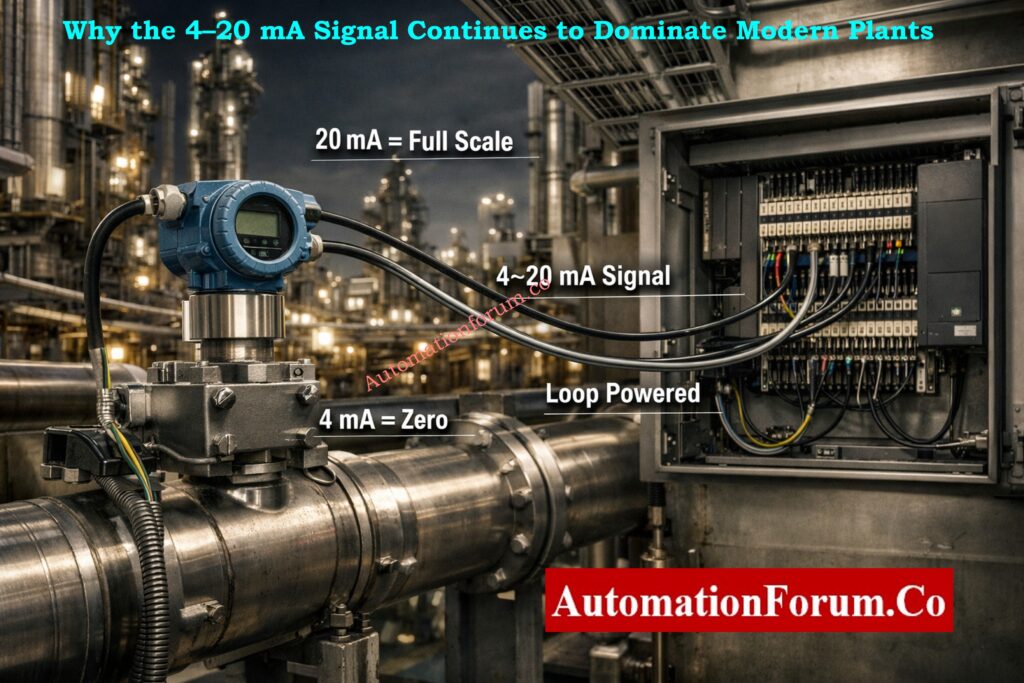
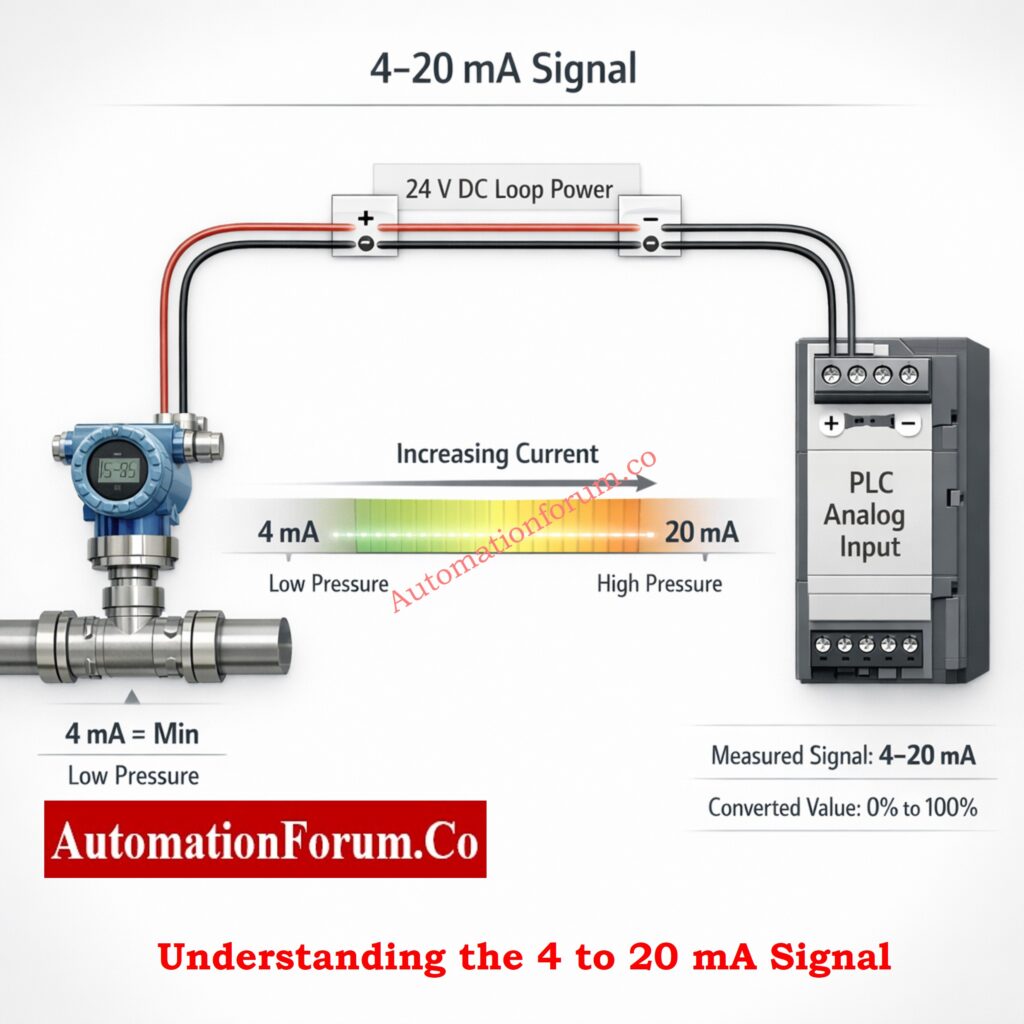
  • The 4 to 20 mA signal is an analog current signal that shows a physical process variable like pressure, temperature, flow, or level.
  • A field transmitter takes a process value and turns it into a current that is proportionate to that value, between 4 mA and 20 mA.
  • In this system, 4 mA is the lowest process value and 20 mA is the highest process value.
  • There is a linear relationship between the measured variable and any value between these two boundaries. In a pressure transmitter that goes from 0 to 10 bars, 4 mA means 0 bars and 20 mA means 10 bars.
  • The signal is based on current, not voltage, which makes it much more accurate, immune to noise, and able to be sent over long distances.
  • These traits are what have made it so successful in industrial automation for so long.

Why Twisted Pair Cables Are Critical for Reliable 4–20 mA & RS-485 Signals: Twisted Pair Cable in Industrial Signal Transmission: The Essential Guide for 4-20 mA and RS 485 Systems

Live Zero Advantage in the 4 to 20 mA Signal
  • The idea of “live zero” is one of the most significant parts of the 4 to 20 mA signal.
  • In the 4 to 20 mA system, 4 mA stands for zero process value, but in voltage signals, zero volts frequently means zero measurement.
  • This design makes it easy to tell the difference between a valid measurement and a fault state.
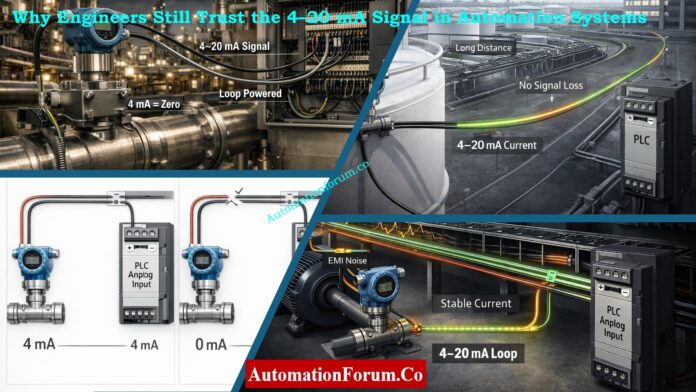
  • Even when a transmitter is working properly and measuring zero process value, it nevertheless sends out 4 mA. If the signal abruptly drops to 0 mA, it means there is a problem right away.
  • Technicians should know the following important things about live zero.
  • Even if the process value is at its lowest point, a 4 mA signal shows that the transmitter is energized and working properly.
  • A 0 mA signal usually means there is a problem with the wiring, the transmitter electronics, the cable, or the power supply.
  • This feature makes it easier to find and fix problems quickly and lowers the chance of mistaking a fault for a normal process condition.
  • In important situations, the 4 to 20 mA signal is far better than many voltage-based alternatives since it has live zero. 
Noise Immunity of the 4 to 20 mA Current Loop
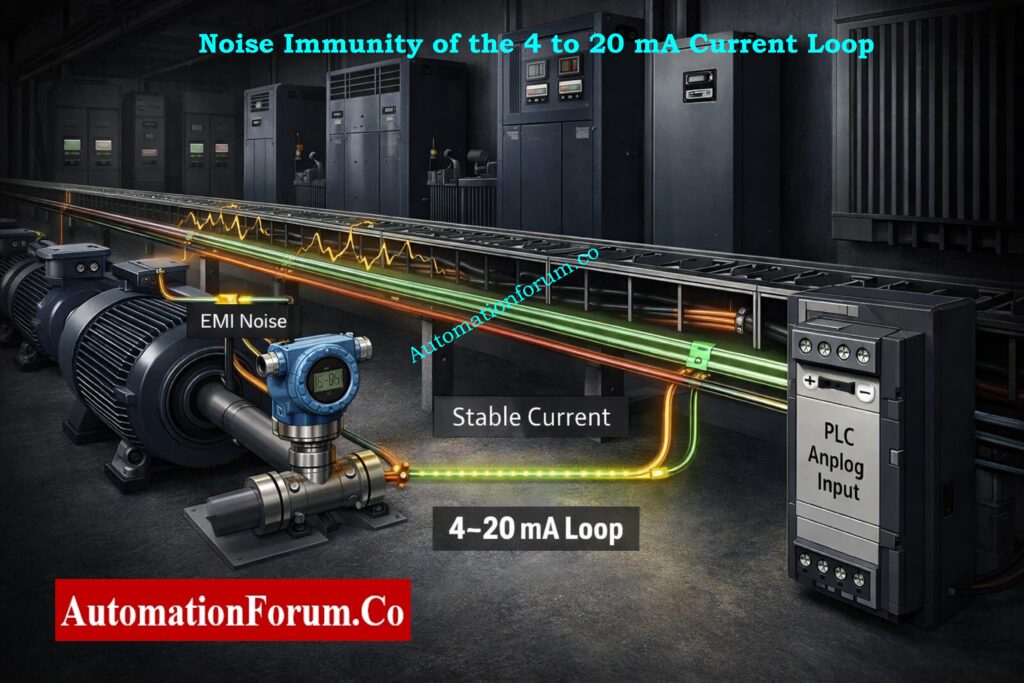
  • Electricity is really bad for industrial enterprises. Electromagnetic interference from big motors, variable frequency drives, contactors, transformers, welding machines, and high-voltage cables may quickly mess up delicate communications.
  • Voltage signals are especially weak since any voltage that is added directly changes the recorded value.
  • Even a little bit of noise can make readings unreliable and cause problems with control.
  • The 4 to 20 mA signal, on the other hand, works with current. The current stays stable as long as the loop stays intact, even if noise causes voltage to build up in the cable.
  • Some important parts of noise immunity are as follows.
  • Even when there is electromagnetic interference along the cable route, the current stays the same.
  • Even when signal wires are close to power cables or heavy electrical equipment, measurements stay the same.
  • Control systems get accurate data, which cuts down on false alarms and the need for operators to step in.
  • The 4 to 20 mA signal is preferred in industrial automation because it is naturally resistant to noise.

Why Engineers Prefer 4–20 mA Over Voltage Signals in Instrumentation: Why 4-20 mA Current Signal is Preferred Over Voltage Signal in Instrumentation?

Long Distance Transmission Capability of 4 to 20 mA Signals
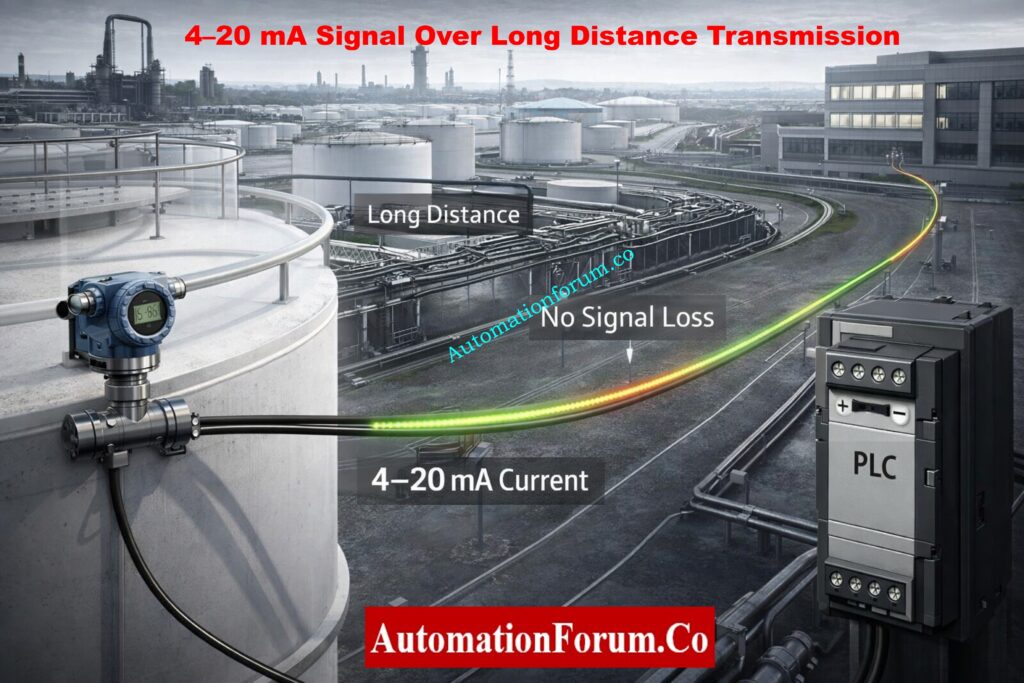
  • In a lot of factories, field instruments are set up far away from the control room or PLC panel.
  • Storage tanks, pipelines, cooling towers, and remote pump stations often need to send signals over hundreds or even thousands of meters.
  • As the length of a wire increases, voltage signals lose voltage. This leads to readings that are not correct and measurements that are not dependable.
  • This is not a problem for the 4 to 20 mA signal.
  • The following are some of the main benefits of long-distance transmission.
  • The value stays the same no matter how long the cable is, as long as the loop has enough supply voltage.
  • Even over very long cable lines, the accuracy of the measurements stays the same.
  • You can connect remote instruments without having to do complicated signal processing.
  • This feature makes the 4 to 20 mA signal perfect for big plants and installations that are spread out over a vast area.

Instant 4–20 mA Transmitter Output Calculator for Process Values: 4 to 20 mA Transmitter Output Process Value Calculator

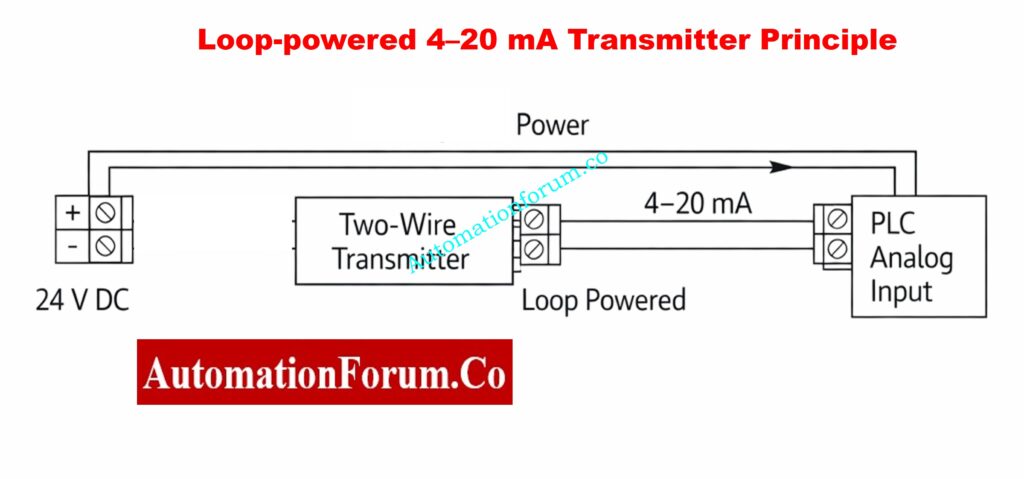
Loop Powered Transmitter Principle
  • The loop-powered transmitter idea is one of the best things about the 4 to 20 mA system. The transmitter gets its power and the measurement signal travels over the same two wires in this configuration.
  • The loop provides power to the transmitter, which then adjusts the loop current based on the detected process value.
  • Technicians should know the following benefits of loop-powered systems.
  • The wiring is easier because the transmitter doesn’t need a separate power supply cable.
  • Costs of installation go down, and the system is less complicated.
  • Safety is better, especially in dangerous places where lower power levels are better.
  • It can work safely in explosive situations since it works with intrinsic safety barriers and isolators.
Open Circuit and Fault Detection in 4 to 20 mA Loops
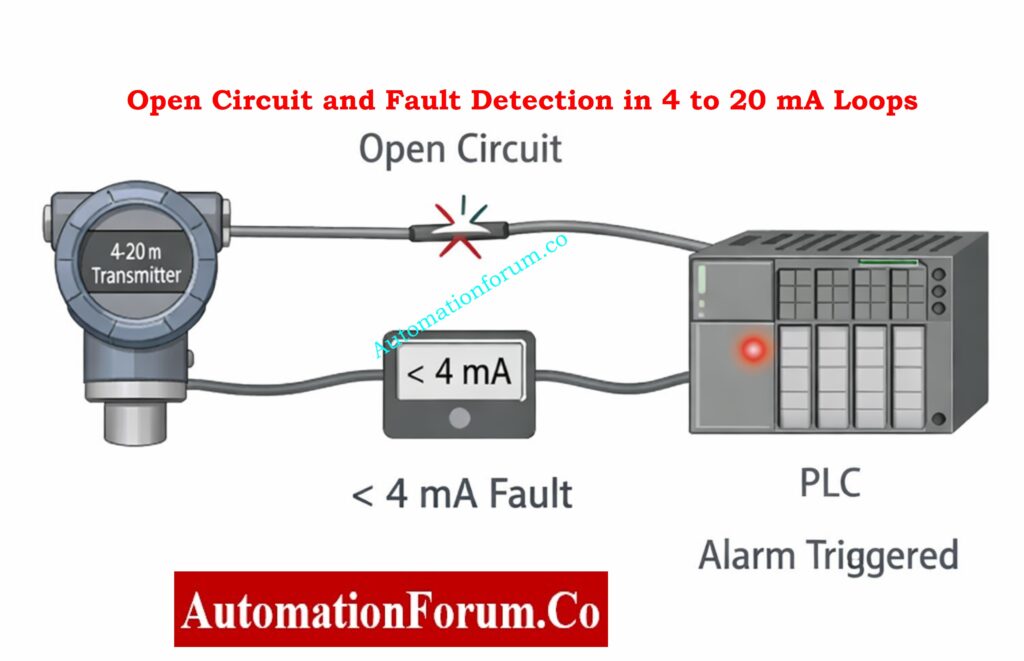
  • Another big plus of the 4 to 20 mA signal is that it may plainly show when there is an open circuit or a malfunction.
  • The signal stays between 4 mA and 20 mA when everything is working normally. If something goes wrong outside of this range, it will be obvious right away.
  • Technicians should remember the following things:
  • If the current is less than 4 mA, it usually means that there is a problem, like a damaged wire, a loose termination, or a power outage.
  • Modern PLCs and DCS systems are set up to automatically sound alarms when they detect conditions that are too low.
  • Finding problems early stops wrong control actions from happening because of bad data.
  • This built-in diagnostic feature makes the plant more reliable and safe to work in..

Hz to 4–20 mA Conversion Calculator for Speed & Flow Signals: Frequency(Hz) to 4 to 20 mA Signal Conversion Calculator

Ground Loop Risks in 4 to 20 mA Systems
  • Even if the 4 to 20 mA signal is strong, bad grounding might still cause problems.
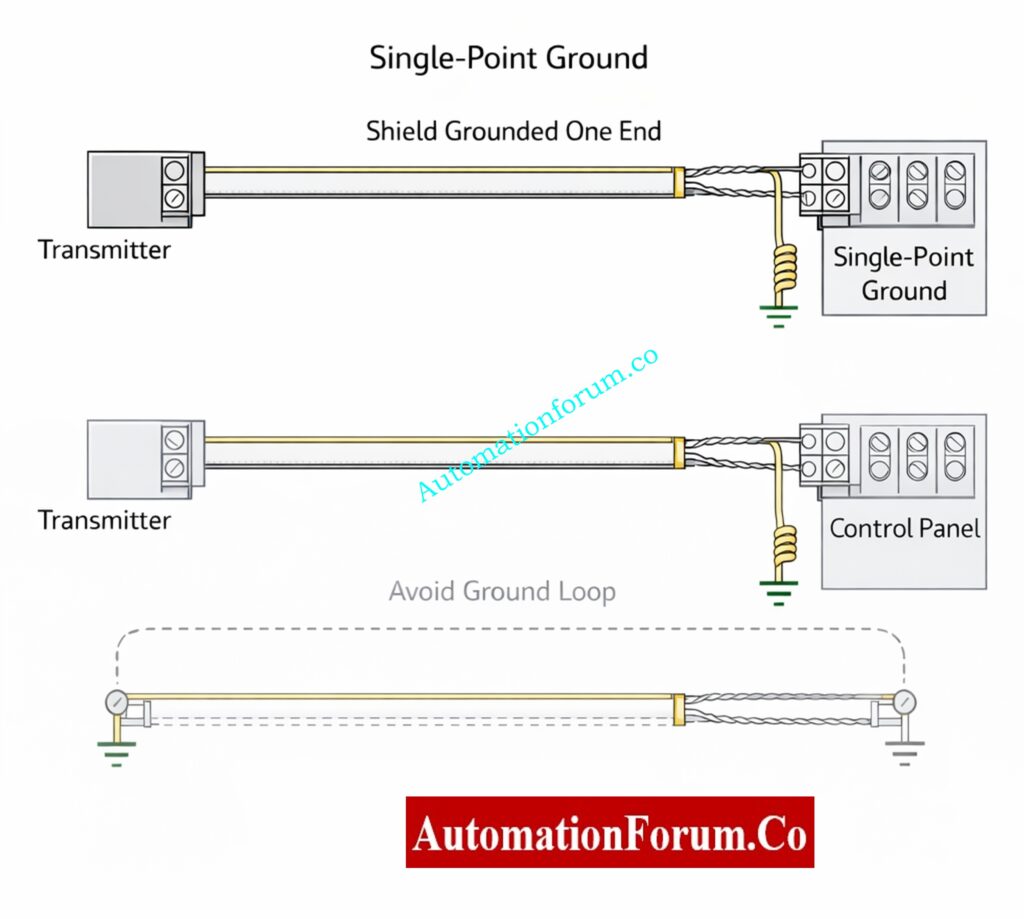
  • When the signal loop is grounded at more than one place, it creates a ground loop. This makes unwanted routes for current that mess up the measuring signal.
  • Common signs of ground loops are readings that change, signals that drift, and noise that can’t be explained.
  • To avoid problems with ground loops, technicians should do the following.
  • Make sure that the signal loop is only grounded at one location.
  • If you need to, use signal isolators or isolation barriers.
  • Don’t use ad hoc grounding methods; instead, follow the rules for plant grounding.
  • Even with a strong current loop, proper grounding is necessary for steady and accurate measurements.

4–20 mA to 3–15 psi Converter for I/P and Pneumatic Systems: 4–20 mA to 3–15 psi Signal Conversion Calculator

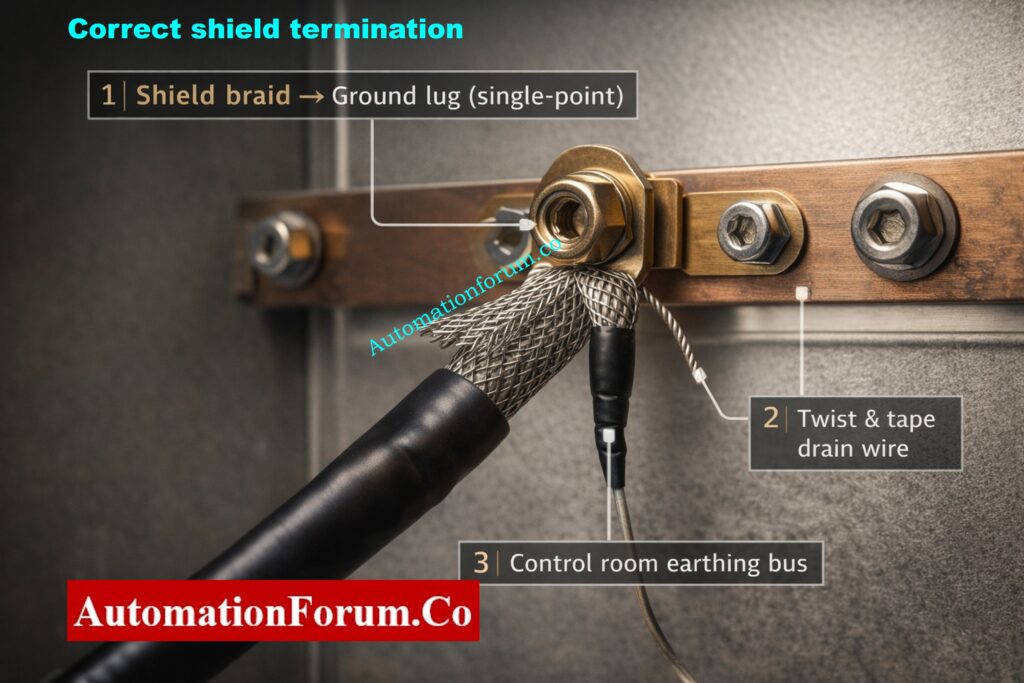
  • People often use shielded cables for 4 to 20 mA signals to keep electromagnetic interference from happening. But shielding won’t work if it’s not done well.
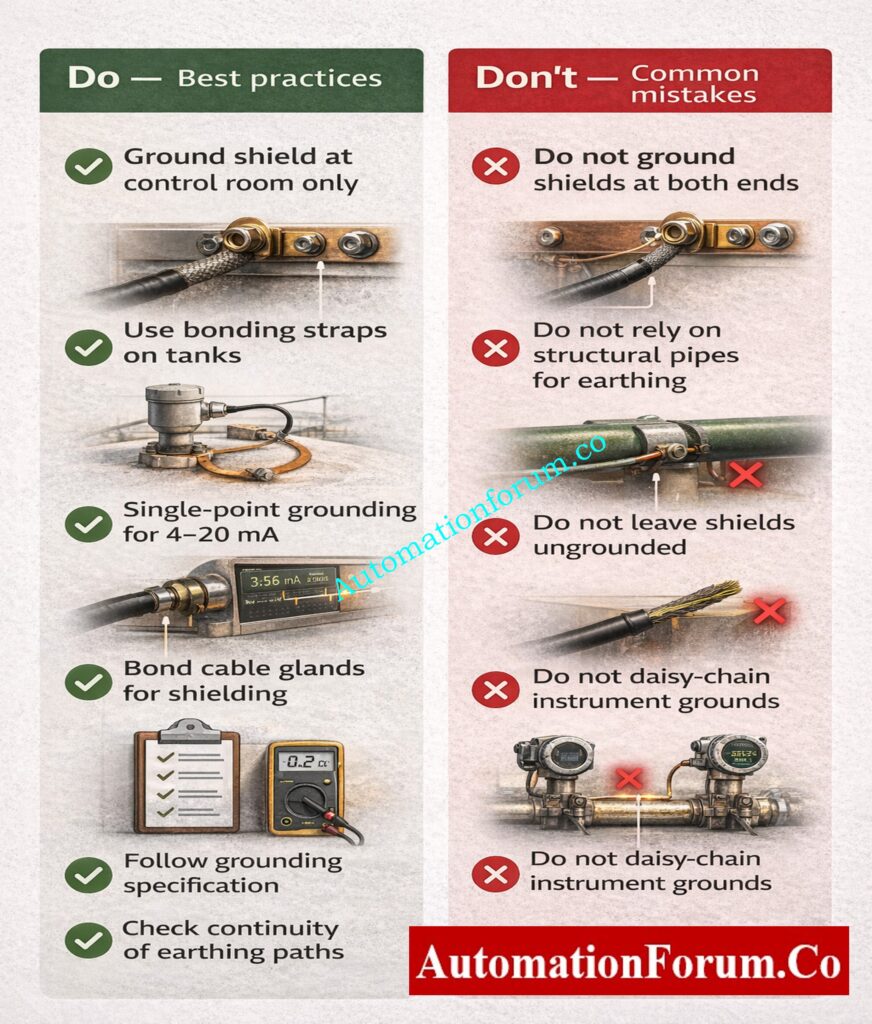
  • The most crucial guideline is to only ground the cable shield at one end, usually the control panel side.
  • Technicians should keep the following important considerations in mind.
  • If you ground both ends of the shield, you can make a ground loop through the shield itself.
  • A single point shield ground keeps noise out without causing interference.
  • The shield should stay in place all the way down the cable line.
  • Using the right shielding techniques makes signals much clearer and systems much more stable.

How to Calculate Temperature Transmitter 4–20 mA Output (With Examples): How to Calculate Temperature Transmitter 4-20mA Output Using Linear Equation and Percentage Method ?
Importance of Proper Scaling in 4 to 20 mA Signals
  • A 4 to 20 mA signal only makes sense if the transmitter and control system are set up correctly.
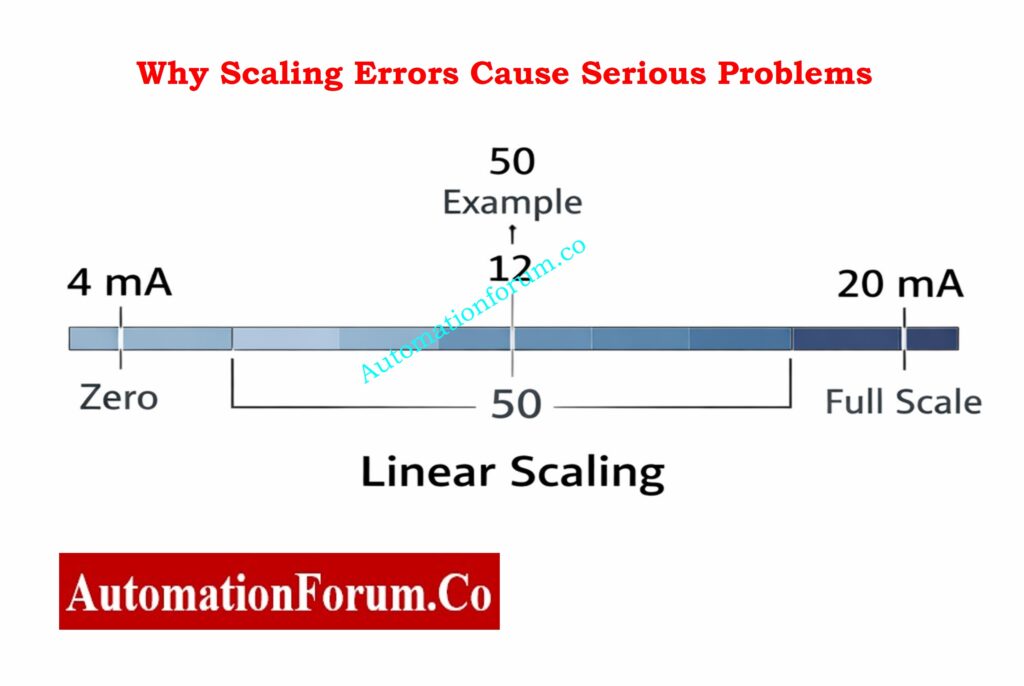
  • Scaling tells you how a certain current value relates to an engineering unit, such a bar, a degree Celsius, or a cubic meter per hour.
  • Wrong scaling can cause big difficulties with how things work.
  • Here are some important things to think about when scaling.
  • The PLC or DCS must have the same range set for the transmitter.
  • It is important to check the zero and span values during commissioning.
  • You need to compare the displayed values against known reference signals.
  • Scaling correctly makes sure that operators see the right information and that the control logic works as it should.
  • When the transmitter range and control system setup don’t match, the readings are wrong.
  • During commissioning, you need to check the zero and span.
  • Accurate scaling makes ensuring that display values are right and control actions are correct.

How to Simulate a 4–20 mA Signal Using a Loop Calibrator: How to simulate 4-20ma signal with Loop Calibrator ?

  • In voltage-based systems, the resistance of the cable has a direct effect on how accurate the signal is. Longer cables and lower conductor diameters make voltage drop and measurement inaccuracy worse.
  • In a 4 to 20 mA system, the resistance of the cable does not change the current value in the loop.
  • This has a number of useful benefits.
  • You can utilize standard industrial cables without losing accuracy.
  • Long cable runs do not change the value that is measured.
  • Because you don’t need special low-resistance wires, the cost of installation goes down.
  • However, technicians must make sure that the total loop resistance stays within the voltage range that the transmitter and power supply can handle.

Why 4–20 mA & 3–15 psi Are Used Instead of 0–20 mA & 0–15 psi: Why not use 0-20mA & 0-15psi instead of 4-20mA & 3-15psi?

  • Even though digital communication technologies have come a long way, the 4 to 20 mA signal is still the most dependable and frequently used industry standard.
  • Almost every transmitter, PLC, DCS, and indicator in the world supports it. It is straightforward to test, easy to fix, and has been used in real-world situations for decades.
  • 4 to 20 mA is still the main output for modern smart transmitters. They often use digital communication for diagnostics and settings as well.

4–20 mA to 1–5 V & PLC 16-Bit Raw Count Calculator: Calculator for 4-20mA Signal to 1- 5Volt and PLC 16-bit Raw Count Values

  • Even though digital communication protocols are growing quickly, the 4 to 20 mA signal is still the norm for analog measurement around the world.
  • There are a few reasons why it is still the best.
  • It is easy to use, dependable, and supported by everyone.
  • Using simple equipment like multimeters and loop calibrators makes it easy to fix problems.
  • It works well in tough industrial settings.
  • Most modern smart transmitters still use 4 to 20 mA as their main output. They often employ digital communication for diagnostics and settings as well.
  • The 4 to 20 mA signal will stay useful for a long time because it is both simple and reliable.

Complete Guide to Troubleshooting 4–20 mA Current Loops: How to do troubleshooting of a 4-20mA loop?

  • It’s not a coincidence that the 4 to 20 mA signal has been around for so long. It is the culmination of decades of real-world experience, safety needs, and good engineering practices.
  • Technicians that know the basics of this signal are better able to set up, test, fix, and keep industrial instrumentation equipment running.
  • Technicians can avoid making frequent mistakes and make sure that their measurements are precise, consistent, and reliable by learning about things like live zero, noise immunity, grounding, shielding, and scaling.
  • In an industry where safety and performance are important, the 4 to 20 mA signal shows that the simplest answer is often the best.

The 4 to 20 mA signal’s ongoing success is due to good engineering, not tradition. In true industrial settings, nothing else can equal its reliability, capacity to find faults, noise immunity, and ease of use.

Technicians must know these ten rules inside and out. If you know the basics of 4 to 20 mA, you’ll be able to install things better, fix problems faster, have fewer process upsets, and run your plant more safely.

The 4 to 20 mA signal shows that a simple, well-designed system may stay strong for decades in a world full of complicated technologies. 

Accurate 4–20 mA to Process Value (PV) Scaling Calculator: 4-20mA to PV scaling calculator

A 4 to 20 mA signal is an analog current signal that sends measurements of things like pressure, temperature, flow, and level in industrial automation.

In this system, 4 mA represents no value and 20 mA means full value. The current changes between these two boundaries depending on how the process is going. Many people use it because it is dependable, precise, and works well in factories.

To use a multimeter to check a 4 to 20 mA signal:

Change the multimeter to DC current (mA) mode.

Connect the multimeter in series with the circuit by opening the loop.

Turn on the loop and look at the value on the screen.

A normal signal will be between 4 mA and 20 mA.

A reading close to 0 mA usually suggests there is an issue with the wiring or the transmitter.

A 4-20 mA analog signal is a signal that is always on and off, with the current smoothly changing between 4 mA and 20 mA to show a process value.

The signal can take any value in the range, not simply ON or OFF, hence it is called analog. This is great for illustrating real changes in a process.

The current is turned into a process value such that a 4 to 20 mA signal can be read.

For example, if a transmitter range is 0 to 100 units:

  • 4 mA represents 0
  • 20 mA represents 100
  • 12 mA represents 50

PLCs and indicators do this conversion automatically when scaled correctly.

A 4 to 20 mA signal is not AC; it is DC.

It gets its power from a DC power source, which is commonly 24 V DC. The transmitter adjusts the level of the DC current to show the measurement.

The simple formula to calculate the process value is:

(Current − 4) ÷ 16 × Range

Example

If the range is 0 to 200 and the current is 12 mA:

(12 − 4) ÷ 16 × 200 = 100

This formula helps convert current into the actual measured value.

Grounding and Bonding in Instrumentation and Control Systems

0
Grounding and Bonding in Instrumentation and Control Systems

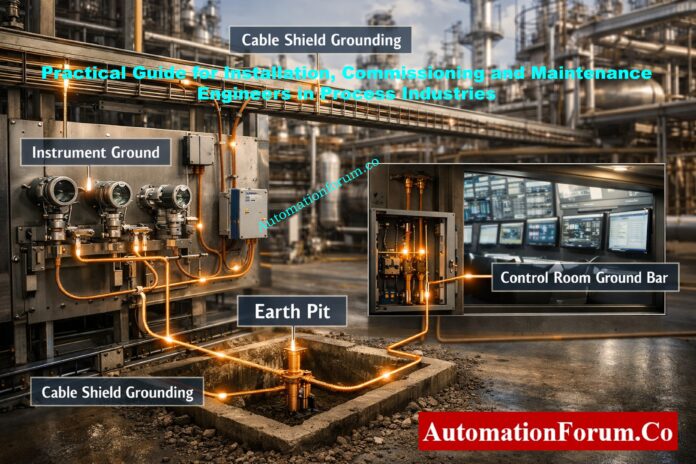
Grounding and bonding in instrumentation and control (I&C) systems in modern process industries are much more than just basic electrical safety. One of the most prevalent underlying causes of problems like unstable transmitter values, PLC analog input drift, DCS communication failures, nuisance interlocks, and unexplained control valve hunting is not grounding properly.

Grounding and bonding have a direct impact on the following for engineers who install, commission, and maintain instrumentation:

  • Measurement accuracy
  • Signal stability
  • Control system reliability
  • Personnel safety
  • Plant availability

This guide only talks about grounding and bonding from the point of view of instrumentation, using real plants as examples instead of textbook theory.

Why Grounding and Bonding Are Critical in Instrumentation Systems

Grounding in instrumentation systems is the planned connection of:

  • Instrument electronics
  • Signal reference points
  • Control system racks
  • Instrument enclosures

to a stable earth reference.

Protection of sensitive electronics
Low voltage and low signal levels are what modern smart transmitters, PLC I/O cards, analyzers, and DCS modules work with. Bad grounding makes them more likely to get damaged by surges, voltages that are too high, and early failure.

Reduction of electrical noise and interference
VFDs, motors, MCCs, welders, and switching power supplies can all be found in factories. Grounding correctly reduces EMI and RFI coupling into signals from both analog and digital instruments.

Providing a controlled fault current path
Grounding makes ensuring that fault current passes safely to the ground instead of via signal circuits or instrument housings if insulation fails.

Stabilizing analog and digital signals
A steady reference earth stops signal offset, drift, and short-term changes, notably in low-level analyzer signals and 4–20 mA loops.

The main goals of instrumentation grounding are to keep signals secure and reliable, but safety is always a must.
Learn the basic concept and different grounding methods used in practice:  What is grounding in electricity and Types of grounding

Bonding is the process of connecting all neighboring metal parts with electricity such that they all have the same electrical potential.

  • Instruments are mounted on pipes, vessels, structures, and skids
  • Signal cables go a long way through the plant.
  • Several earth spots can accidentally create noise routes.
  • Instrument housings can have touch voltage on them.
  • Ground loops are made
  • The risks of static discharge go up.

Bonding makes guarantee that there is no harmful or noise-making potential difference between metal parts, even when there are faults, lightning, or switching surges.
Refer to this critical document for safe and reliable plant operation:  Alarm & Trip Setpoint List in Instrumentation Engineering: The Most Critical Document for Plant

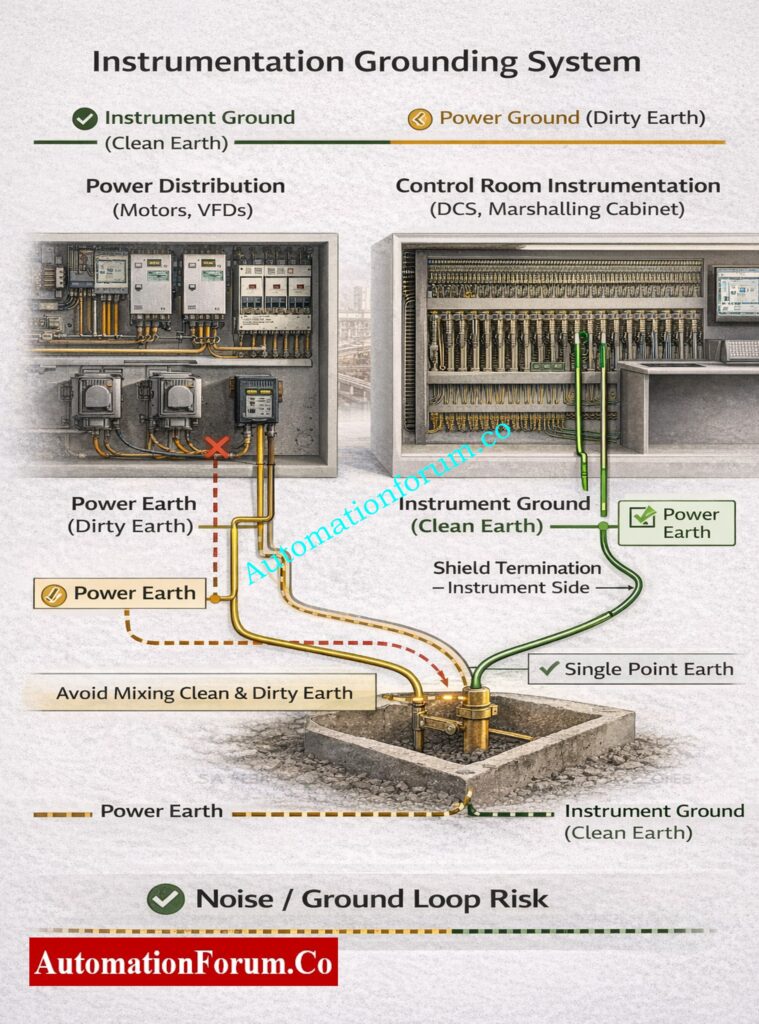
Most big process facilities use a “segregated earthing” system, which keeps separate earth systems apart to control noise and fault currents.

Common ways to separate earthing are:

  • Instrument Earth (Clean Earth) – for low-level signals
  • Electrical / Power Earth (Dirty Earth) – for motors, MCCs
  • Safety Earth – for personnel protection
  • Static Earth – for hazardous areas

Instrumentation engineers should never mix these earths at random. If you connect things incorrectly, it defeats the whole point of segregation and causes noise problems that never go away.

Instrument Earth (Clean Earth) is a low-noise grounding system made particularly for sensitive instrumentation and control equipment, such field transmitters.

It is normally:

  • Cut off from power earth
  • Connected to the main plant earth grid at only one place

This single-point connection keeps ground loops and circulating currents from happening.

Understand the difference to avoid protection and safety mistakes: Difference between Earth Fault and Ground Fault

A typical smart pressure transmitter has the following parts:

Metallic housing (Stainless Steel or Aluminum)

  • Protects internal electronics from mechanical damage and harsh environments
  • Works as an electromagnetic barrier to block electrical noise from outside.
  • Must be correctly connected to keep static from building up and contact voltage from happening.

Internal electronics (sensor, signal conditioning, communication module)

  • Changes the process pressure into a standard electrical signal
  • Very sensitive to the quality of the ground and electrical noise
  • Poor grounding has a direct impact on accuracy, stability, and long-term dependability.

Shielded signal cable (4-20 mA / HART)

  • Twisted pair reduces inductive and capacitive noise.
  • Shield stops EMI/RFI from motors, VFDs, and power lines.
  • The shield termination mechanism decides if noise is blocked or added.

Transmitter body bonded to the process pipe

  • Makes sure that the transmitter housing and the pipe have the same electrical potential
  • Keeps static charge from building up on the instrument body and gives fault currents a low-impedance path.
  • Bonded process pipe to the plant’s ground grid

Process pipe bonded to the plant earth grid

  • Safely sends fault voltage and induced currents to the ground.
  • Keeps the potential the same throughout all pipes and mounted instruments
  • Lessens the chance of getting shocked while doing maintenance

Cable shield grounded at control room end only

  • Creates a single, clear point of reference for noise currents
  • Stops currents from flowing because of variances in earth potential
  • Keeps electronics on the field side separate from loud earths

Instrument earth terminated at the Instrument Earth Bar (IEB)

  • This gives I&C systems a specialized low-noise earth reference.
  • Keeps electrical and power earths apart
  • Makes analog and digital signals more stable and consistent

Use this checklist during routine inspection and maintenance: Running Inspection Checklist of PLC Components in Control Panels

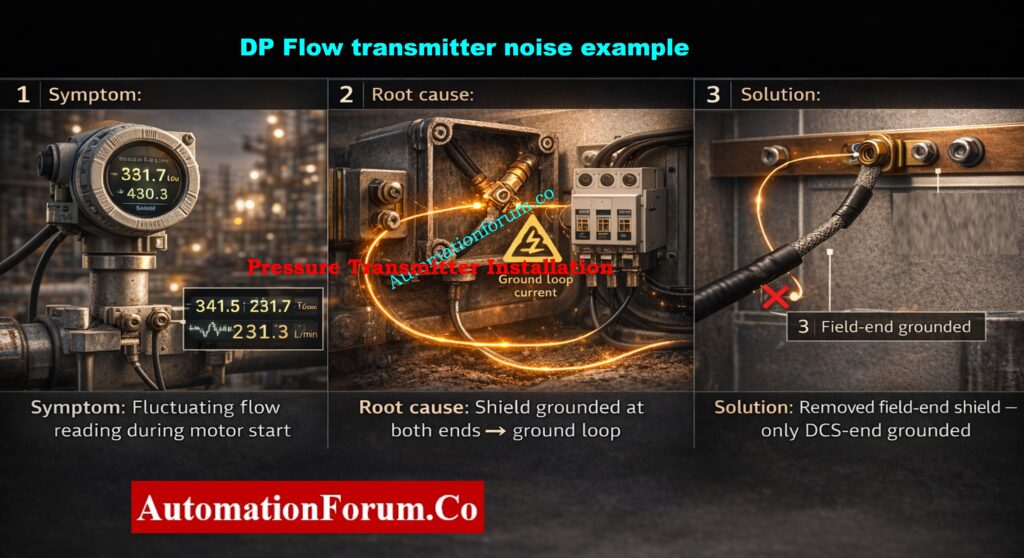
Shield grounded at both transmitter and control room ends

  • Makes more than one path to the ground for the cable shield
  • Lets minor voltage variations push current through the shield
  • It makes the shield an unintentional conductor of noise.

Consequences of Improper Shield Grounding

Ground loop formation

  • Circulating currents move between different sites on the globe.
  • Noise is put directly into the signal circuit

Fluctuating pressure readings

  • Even when the process is steady, the transmitter output becomes unstable.
  • Noise often gets louder when the motor begins or the load varies.

Unstable control loop behavior

  • The controller responds to noise instead of real changes in the process.
  • Control valves look for things they don’t need to.
  • More wear on the final control elements

Compare both methods to understand their applications and limitations: What is the difference between underground cabling and overhead lines?

Bonding Requirements for Field Instruments

Not only should each field-mounted equipment be electrically grounded, but it should also be bonded. Bonding makes the potential the same between metal parts, which makes both safety and signal quality better.

This includes:

Transmitter to pipe or mounting bracket

  • gets rid of the voltage difference between the instrument body and the surface it is mounted on.
  • Stops static discharge at the transmitter

Junction box to support structure

  • Keeps the JB enclosure at earth potential
  • Stops fault voltage from showing up on cable covers or glands

Cable tray to steel structure

  • Stops trays from being floating conductors
  • Lessens the amount of electromagnetic coupling that happens in instrument cables

Analyzer shelter to earth grid

  • Keeps a common ground for sensitive analyzer electronics
  • Makes measurements more stable and safe

No potential difference between metallic parts

  • Removes the danger of touch voltage during regular operation and problems

Fault currents bypass signal wiring

  • Keeps low-level signal circuits from getting broken

Reduced EMI pickup

  • Reduces the amount of noise that gets into instrument wires and electronics

Clear the common confusion between neutral, earth, and ground: Difference between Neutral, Earth and Ground

For a temperature sensor that is set up on a reactor nozzle:

Transmitter housing bonded to mounting bracket

  • Stops static from building up on the instrument casing
  • Makes sure that maintenance is done safely

Mounting bracket bonded to vessel shell

  • Equalizes the voltage between the transmitter and the vessel
  • Gives a short, low-impedance channel for bonding

Vessel bonded to main earth grid

  • Safely gets rid of static charges and fault currents
  • Keeps the earth connection going through the reactor structure

Risks When Bonding Is Missing

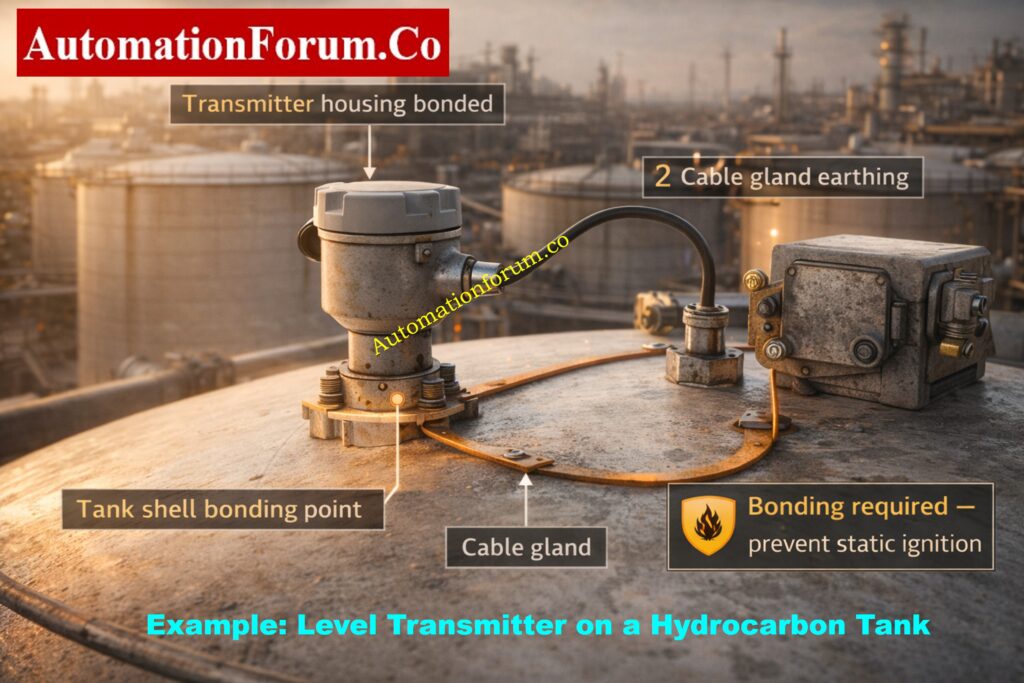
Static charge can accumulate

  • Static charge can build up, especially in dry settings or while working with hydrocarbons.

Fault voltage may appear on transmitter housing

  • Makes it dangerous for maintenance workers to get shocked

Maintenance personnel face shock risk

  • Especially when calibrating or replacing parts

Signal noise increases during process upsets

  • Readings of temperature become unstable or wander.

Select the correct cables for safe operation in hazardous areas: What Cables to Use in Ex Zones: Complete Guide for Instrumentation & Control Engineers

Grounding and bonding are required technical techniques inside I&C panels, not just something people like to do.

Some things that must be done are:

Dedicated Instrument Earth Bar (IEB)

  • Provides a clean, centralized earth reference for all I&C signals
  • Stops power and instrument earths from mingling

Bonding of panel body to earth grid

  • Keeps the enclosure at earth potential
  • Keeps people and equipment safe during problems

Door bonding straps

  • Keeps the earth connected even when the door is open
  • Stops floating panel doors from working like antennas

Bonded DIN rails

  • Makes ensuring that terminal blocks and modules have a steady earth reference

Earth terminals on terminal blocks

  • Gives shield drains and earth conductors the right places to end.

All analog commons referenced to the Instrument Earth Bar (IEB)

  • Provides a stable reference for analog measurements
  • Lessens drift and offset in PLC analog inputs

Shield drain wires terminated on earth terminals

  • Properly sends noise currents away from signal conductors

Panel enclosure bonded to plant earth

  • Ensures enclosure safety and EMC compliance

PLC analog input fluctuations

  • Readings that are not stable even though the process conditions are stable

Random alarms

  • False alarms that go off because of noise

Communication dropouts

Spurious trips during motor starts

  • High inrush currents cause noise that impacts control signals.

Bond all the metal together, ground the signal reference once, and make sure that noise only has one way to get to the ground.

Read the complete step-by-step guide here: Panel Door Earth Bonding Procedure: Ensuring Safety and Reliability

Instrumentation signal cables contain low-level analog and digital signals, which makes them very sensitive to electrical noise. If not properly insulated and grounded, these wires act like antennae in a process plant.

Wrongly terminating the shield causes:

Electromagnetic Interference (EMI)

  • Caused by motors, VFDs, transformers, and switching devices
  • Causes unnecessary voltage to flow across signal wires

Radio Frequency Interference (RFI)

  • Comes from radios, wireless devices, and switches that work at high frequencies.
  • It has a big effect on smart transmitters and digital communication.
  • Can cause communication problems that come and go

Ground loop currents

  • Happen when the shield is grounded in more than one place
  • The shield lets circulating currents through.
  • Noise is put directly into the signal reference

Key point:
A shield only functions if it is grounded properly. A shield that isn’t grounded properly is worse than no shield at all.

Follow this practical method to eliminate noise and signal instability: How to properly ground an Instrumentation System to reduce noise?

4-20 mA Analog Signals

  • Grounded shield just at the control room (DCS/PLC) end
  • Stops currents from flowing through the shield
  • Keeps electronics on the field side separate from loud earths

Thermocouple Signals

  • Grounded shield just at the receiver end
  • Stops changes in earth potential from impacting millivolt signals
  • Important for keeping the temperature right and stable
  • Fieldbus / Digital Networks
  • Grounding the shield according to the vendor’s instructions
  • Some systems need to be grounded at both ends with capacitive coupling.
  • Bad grounding makes communication unstable.

Analyzer Signals

  • Grounded at one point most of the time
  • Vendors of analyzers give specified locations for grounding
  • Drift and calibration problems happen when there are more than one grounding point.

Get a clear explanation of earth pits and their role in grounding: What is an Earth Pit?

Flow Transmitter Signal Noise - Real Plant Case Study
  • Flow reading changes every time an engine starts up nearby.
  • The trend looks noisy, but the process flow is steady.
  • Alarms may go out for a short time while the motor is running.
  • Grounded cable shield at both:
  • The starting current of the motor generates a variation in earth potential.
  • The cable shield lets fault and noise currents pass through.
  • Took away the shield grounding at the field junction box
  • Only kept shield grounding at the DCS/control room end
  • Checked that the shield drain wire was still connected
  • Reading of a stable flow
  • No noise when motors start
  • Restored control loop performance

Learn how proper earthing is implemented in real plants: Instrument Earthing Systems

Static electricity is a primary cause of fires in dangerous places. Bonding is required for safety and to follow the rules.

Key requirements:

  • No matter what kind of signal they send, all instruments must be coupled.
  • You also need to bond non-electrical tools like level gauges, thermowells, and sight glasses.
  • Static charges need to be securely sent to the ground.

If you don’t regulate static, sparks can happen even if there aren’t any electrical problems.

Understand the technical reason behind single-end shield grounding: Why the Cable Shield is Grounded Only at the PLC or Control Panel Side

Ground Loops in Instrumentation Systems  - Example: Level Transmitter on a Hydrocarbon Tank

Transmitter housing

  • Prevents static buildup on metal enclosure

Tank shell

  • Acts as the primary static discharge path

Cable gland

  • Prevents static discharge at cable entry point

Junction box

  • Ensures enclosure remains at earth potential

Static charge accumulation

  • Especially in dry or flowing hydrocarbon service

Spark during maintenance

  • When loosening cable glands or removing covers

Explosion risk

  • High risk in Zone 0 / Zone 1 hazardous areas
Ground Loops in Instrumentation Systems

A ground loop occurs when:

  • Multiple earth paths exist for the same circuit
  • Small voltage differences exist between earth points
  • Circulating currents flow through signal return paths

These currents distort low-level analog signals and digital references.

  • Analyzer shelter earth
  • DCS panel earth
  • Field junction box earth
  • Analyzer output becomes unstable
  • Calibration drifts over time
  • Poor repeatability between samples
  • Operators lose confidence in analyzer data
  • Defined single reference earth for analyzer signals
  • Bonded all metallic parts together
  • Removed duplicate grounding connections
  • Used isolation where required

During commissioning, instrumentation engineers must verify:

Bonding jumper continuity

  • All metallic parts are electrically connected

Earth resistance values

  • Instrument earth meets project specification

Correct shield termination

  • Shield grounded at the correct end only

Instrument earth segregation

  • Instrument earth kept separate from power earth

Door, gland, and tray bonding

  • Ensures continuity even when doors are opened

Warning:
A grounding mistake left during commissioning becomes a permanent maintenance headache.

View and understand a typical grounding layout used in plants: Earthing Drawing

Corroded bonding straps

  • Increased resistance and poor continuity

Painted-over earth points

  • Earth connection becomes ineffective

Loose earth terminals

  • Intermittent noise and false alarms

Broken shield drain wires

  • Shield becomes floating and useless
  • Corroded earth connection inside junction box
  • Earth resistance increased during rain
  • Noise coupled into analyzer signal
  • Cleaned all earth contact points
  • Tightened earth terminals
  • Replaced corroded bonding conductors
  • Applied anti-corrosion compound
Documentation and Tagging Best Practices for Instrument Grounding

Instrumentation drawings must clearly indicate:

Instrument earth points

  • Location and identification of IEB

Bonding jumpers

  • Length, size, and connection points

Shield termination locations

  • Field end or control room end

Earth bar references

  • Clear reference numbers and tags

Poor documentation causes people to do things wrong in the field, make the same mistakes again and over, and have problems with reliability that last a long time.

Commonly referenced grounding and bonding standards include:

  • IEC 61140 – Protection against electric shock
  • IEC 60079 – Explosive atmospheres
  • ISA RP12.6 – Control of static electricity
  • IEEE 1100 – Powering and grounding sensitive equipment
  • IS 3043 – Indian standard for earthing

Once you’ve grounded the signal, connect all the metal together, and don’t let noise have more than one way to get to earth.

In process industries, grounding and bonding are important parts of instrumentation, not only electrical formalities. Every I&C part, from field transmitters and analyzers to junction boxes and DCS panels, needs to be properly grounded to work correctly, stay stable, and be safe.

For engineers who install, test, and maintain instruments, knowing how to ground and bond things correctly gets rid of:

  • Signal noise
  • Measurement drift
  • False alarms
  • Unexplained failures

A plant that is well-grounded doesn’t talk about grounding much because nothing goes wrong.

If you don’t control the earth in instrumentation systems, the earth will control your signals.
Avoid wrong selection by understanding the key differences clearly:  Thermocouple Wire vs. Thermocouple Extension Wire: The Complete Guide for Instrumentation Engineers

Instrument earth (clean earth) is a dedicated low-noise grounding system used only for instrumentation and control equipment.
It provides a stable reference for low-level signals and is connected to the plant earth at one single point to avoid noise and ground loops.

Shield grounding is done at one end only to prevent circulating currents in the shield.
Grounding at both ends creates ground loops, which inject noise into the signal instead of blocking it.

Ground loops occur when multiple earth paths exist for the same signal circuit.
Small voltage differences between earth points cause circulating currents, which distort low-level analog and digital signals.


Method Statement for Addressable Fire Alarm System Installation, Testing and Commissioning as per NFPA 72
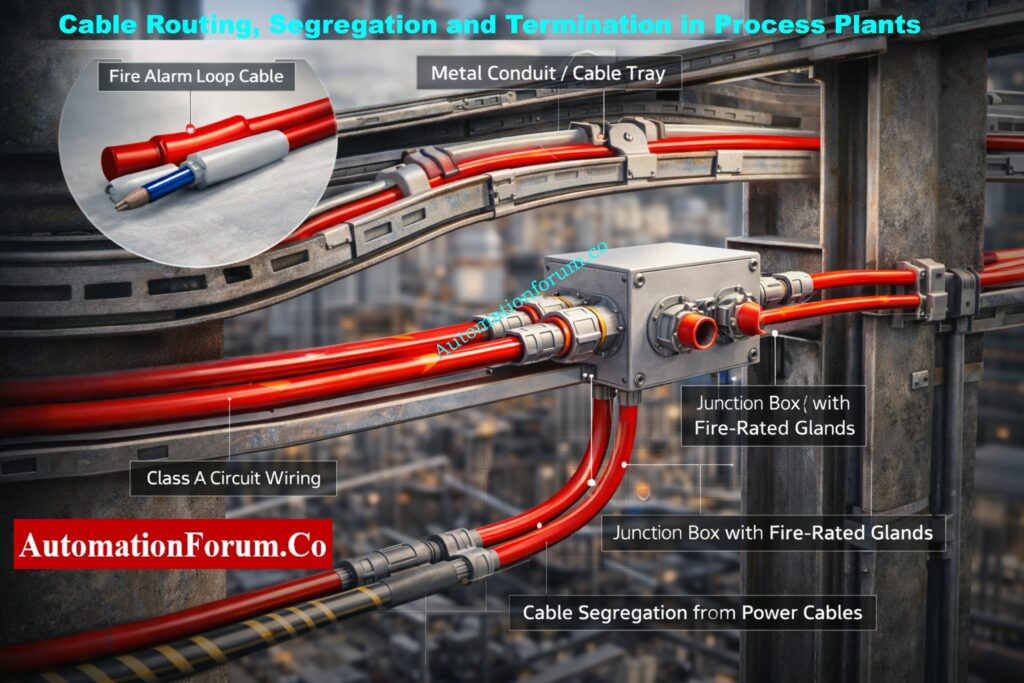
0
Method Statement for Addressable Fire Alarm System Installation, Testing and Commissioning as per NFPA 72
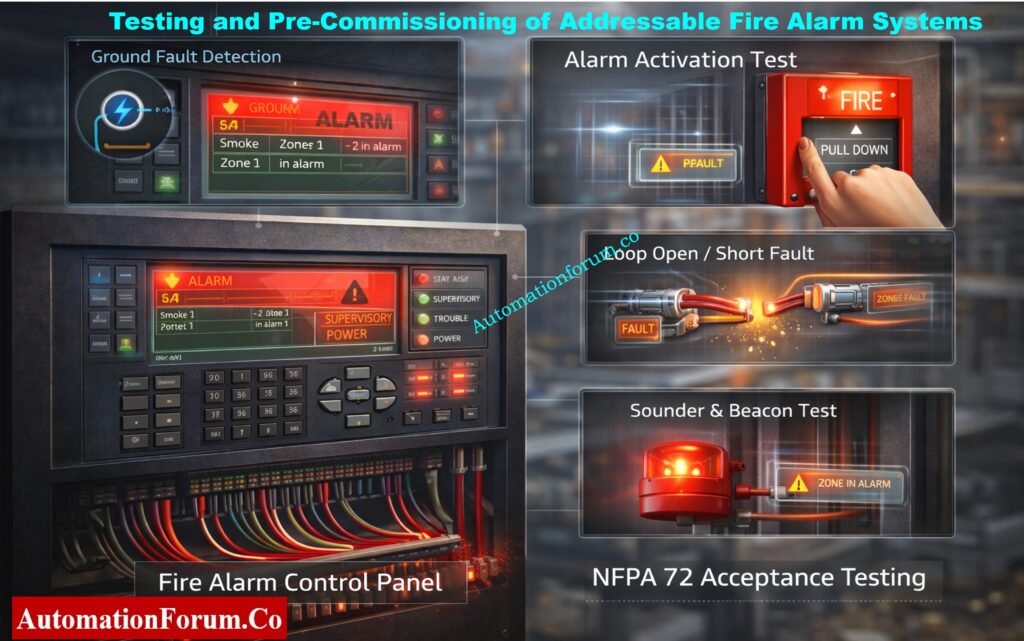
Fire detection and alarm systems are an important part of plant safety in businesses with a lot of risk, like refineries, petrochemical plants, power generation facilities, energy complexes, and metal and mining industries. These industries use addressable fire alarm systems a lot because they are reliable, can find faults accurately, and can be easily added to Fire & Gas (F&G), Emergency Shutdown (ESD), PLC, and DCS systems.

Addressable Fire Alarm Systems are Used in Refineries and Power Plants

This method statement gives a full, step-by-step guide for installing, wiring, inspecting, testing, commissioning, and handing over an addressable fire alarm system that follows NFPA 72 and worldwide EPC project standards. The document is meant to help F&G EPC engineers, instrumentation engineers, commissioning engineers, supervisors, and technicians who are working on big industrial projects.
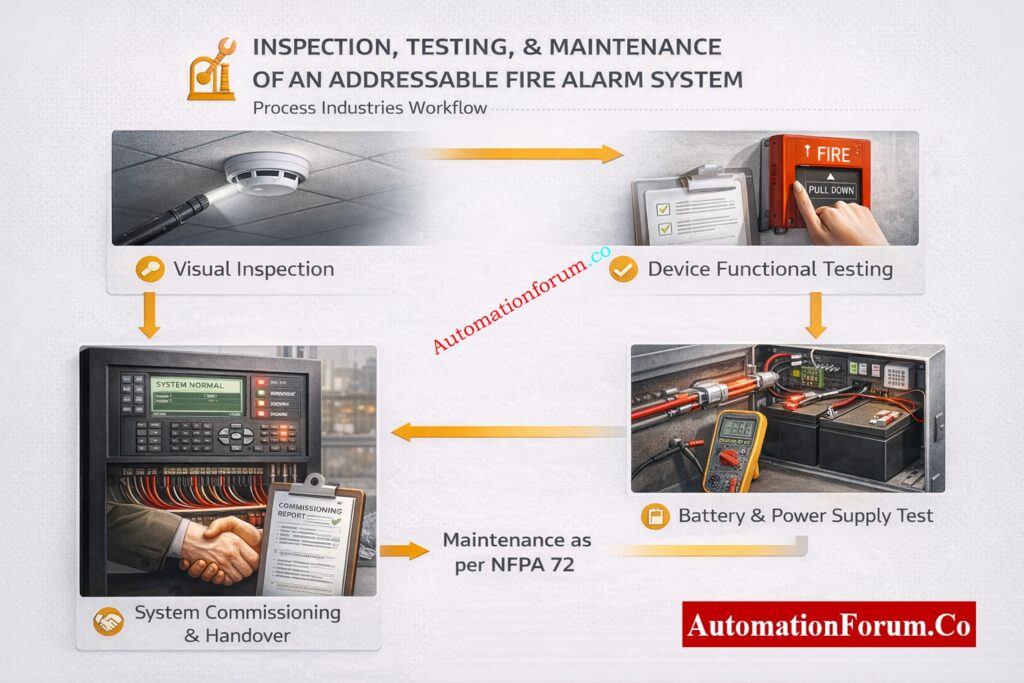
This method statement covers, but is not limited to, the following parts of a fire alarm system:
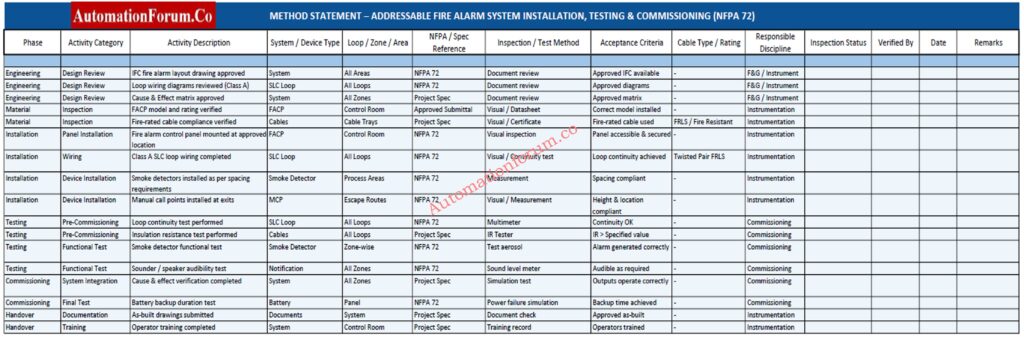
  • Addressable Fire Alarm Control Panels (FACP) with main panels, network panels, and remote annunciators
  • Smoke detectors, heat detectors, multi-criteria detectors, and specialist detectors that work well in industrial settings
  • There are manual call points at entrances, stairways, and other important places to get in.
  • Notification devices including speakers, sounders, horns, and visual alarms that go off when it’s time to leave
  • Addressable input and output modules, relay modules, and short-circuit isolator modules
  • Power supply for the main and backup systems, battery chargers, and backup batteries
  • Works with PLCs, DCS, BMS, shutdown systems, and fire and gas systems

What is an FACP? Fire Alarm Control Panel Explained – What is an FACP? (Fire Alarm Control Panel)

All installation and commissioning work must rigorously follow the following rules and standards:

  • NFPA 72 is the National Fire Alarm and Signaling Code.
  • Approved project specs and EPC contract documentation.
  • Installation, wiring, and programming guides from the manufacturer
  • Local laws and rules set by the authority having jurisdiction (AHJ)

Without official engineering clearance, deviations from established standards are not allowed.

Types of Fire Detectors and Their Industrial Uses – Types of Fire Detectors

Before work may begin on the site, the following documents must be read and approved:

  • Drawings of the layout and zoning of the fire alarm system that indicate the spacing and coverage of the detectors
  • Loop wiring schematics that show how Class A circuits are set up
  • A cause-and-effect matrix that shows what happens when an alarm goes off and what happens next
  • Drawings of cable routing and tray layouts
  • Diagrams of the control panel arrangement, termination details, and power distribution

No actual work can begin until IFC (Issued for Construction) plans have been authorized.

Fire Alarm System Components Explained Clearly – What are the components involved in a Fire Alarm system?

When the fire alarm supplies arrive on site, they will be checked for:

  • Correct type, model, and rating as per approved material submittals
  • Physical damage, moisture ingress, or corrosion
  • Valid manufacturer test certificates and compliance documents
  • Proper storage conditions for detectors, electronics, and batteries

Materials that don’t meet standards must be put in quarantine and notified.

How a Fire Alarm Control Panel Works – Simple Explanation – What is a Fire alarm control panel and how does it work?

Addressable Fire Alarm System Wiring Philosophy

supervised Signaling Line Circuit that lets the control panel and field devices talk to each other. Each device has its own address, which makes it possible to tell exactly what kind of alert, difficulty, or supervisory situation it is.

All addressable loops and initiating device circuits must be connected in Class A configuration, especially in places where processes are dangerous or critical. Class A wiring makes ensuring that:

  • The system keeps going even if one cable breaks.
  • More reliable systems for important mission-critical apps
  • Following NFPA survivability rules in factories

As part of the design, short-circuit isolators should be put in place to mitigate the effects of loop faults.

Fire Alarm Control Panel vs Sub Panel Explained – What is Fire Alarm control panel? What is Sub Fire Alarm Control Panel?

Fire Alarm Cable Selection and Installation Practices

Fire alarm systems can only use approved fire-rated cables, such as:

  • Cables that don’t catch fire, don’t make a lot of smoke, and stop flames from spreading
  • Twisted pair cables for addressable loops to cut down on noise interference
  • Shielded connections where motors or VFDs cause electromagnetic interference

Check the size of the cable against the calculations for voltage drop and loop resistance.

The best EPC methods for installing fire alarm cables are as follows:

  • Whenever possible, routed through special trays or conduits
  • Separated from power and high-voltage wires
  • Safe from heat sources, mechanical damage, and corrosive environments
  • Gland, tag, ferrule, and label all termination points correctly.

Fire detectors must be put in exactly as shown on the authorized designs and according to NFPA 72 spacing standards.

  • Height and structure of the ceiling
  • How air flows via HVAC systems
  • Dust, steam, or process fumes are present.
  • The temperature and conditions in the environment

To cut down on false alarms, heat detectors or covered detector housings should be utilized in regions with aggressive processes.

Along escape routes, manual call locations should be placed at heights that are comfortable for people. Notification devices must be set up to make sure:

  • Sound pressure levels that are high enough in all populated areas
  • Clear voice announcements for evacuation when needed
  • Extra coverage and backup in loud factories

VESDA Smoke Detection Explained: Early Warning Fire Protection – VESDA Smoke Detection: Advanced Fire Protection with Early Warning Technology

Fire alarm control panels must be put in safe, easy-to-reach places such control rooms or fire control rooms. This will make sure that:

  • Operators and maintenance workers can easily get to it.
  • Enough light and air flow
  • Keeping out dust, moisture, and vibration

A separate power supply with the right circuit protection should power the control panel. According to NFPA rules, standby batteries must be big enough to keep the system running during a power outage. To keep ground faults and false alarms from happening, the ground must be properly grounded.

Testing and Pre-Commissioning of Addressable Fire Alarm Systems

The following checks must be done before the system is turned on:

  • Testing the continuity of all loops
  • Testing the insulation resistance between conductors and the ground
  • Checking if the polarity and address are right
  • Checking the voltage levels and loop resistance

Before moving forward, any differences must be fixed.

It is important to test each gadget to make sure it works:

  • Smoke detectors that use test aerosol
  • Heat detectors that use heat sources that are safe
  • Activation of manual call points
  • Devices that let you know about sound level and clarity

All tests must be written out in reports of the inspection.

Importance of Fire and Gas Detection Systems in Industrial Safety – Importance of Fire & Gas Detection System

Common problems that come up during commissioning are:

  • Charger failure or a dead battery
  • Ground fault caused by broken insulation
  • Class A loops can have an open or short circuit.
  • Incorrect device addressing

Faults shall be isolated systematically by:

  • Reviewing panel diagnostics
  • Segmenting loops using isolator modules
  • Inspecting cable terminations and glands
  • Performing insulation resistance tests

Root cause analysis shall be documented and corrective actions recorded.

Flame Detector Testing Procedure for Industrial Plants – Testing Procedure of Flame Detector

The fire alarm panel must be set up to fit the cause and effect matrix, which includes:

Programming shall be backed up after completion.

Gas Detector Troubleshooting: Common Problems and Solutions – Gas Detectors Practical Problems and Troubleshooting

Acceptance Testing and NFPA 72 Compliance Verification - Addressable Fire Alarm Systems

The client and the authorities must be present for the final acceptance testing. This includes:

  • Full alarm activation tests
  • Fault simulation tests
  • Power failure and battery backup tests
  • Integration testing with external systems

If the task is done well, the system will be accepted and handed off.

What is Bump Testing in Gas Detectors? Simple Explanation – What is Bump Testing? 

You must provide over the following documents:

  • As-built drawings
  • Device address lists
  • Test and commissioning reports
  • Battery calculations and certificates
  • Operation and maintenance manuals

Training for Operators Operations and maintenance staff will receive training on:

  • Daily system checks
  • Fault acknowledgment and reset procedures
  • Routine maintenance requirements
  • Emergency response actions

A schedule for preventative maintenance will be set up that includes:

  • Weekly visual inspections
  • Monthly functional tests
  • Quarterly battery inspections
  • Annual full system testing

All maintenance work must be recorded and looked at from time to time.

Flame Detectors Explained: Types, Uses and Industrial Applications – Types of Flame Detectors and Their Uses in Industrial Fire Prevention (Complete Engineer’s Guide)

Download: Fire Alarm Method Statement Excel Checklist
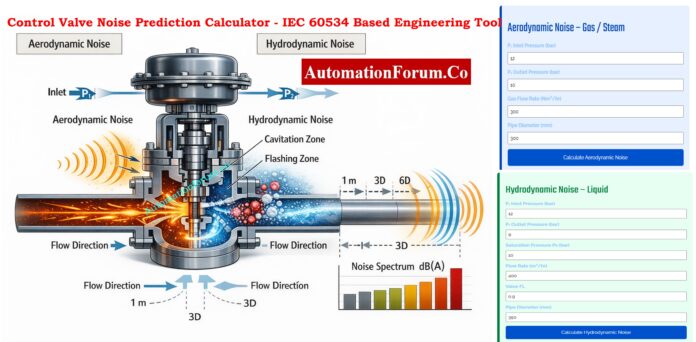
To support site execution, inspection, and commissioning activities, a downloadable Excel checklist has been prepared.
It has fields for installation inspections, loop testing records, device verification, and commissioning sign-off, all of which are made for EPC and process sector projects. 

Refer the below link to download: Fire Alarm Method Statement Excel Checklist
Fire and Gas Detectors Explained: Types, Working and Applications – Types of Fire and Gas Detectors – Working Principles and Industrial Applications
L1 to L5 describe how much area is protected by fire detectors.

  • L1 – Detectors in all areas (maximum protection)
  • L2 – Detectors in escape routes and high-risk areas
  • L3 – Detectors in escape routes and nearby rooms
  • L4 – Detectors only in escape routes
  • L5 – Detectors only in specific high-risk locations

L1 and L2 systems are commonly used in industrial plants.

  • Study approved drawings and NFPA 72 requirements
  • Install the fire alarm control panel
  • Lay fire-rated cables
  • Install detectors, call points, and alarm devices
  • Program device addresses
  • Test the system and hand over

Simple meaning of the 0.7 rule

The 0.7 spacing rule means no point in a room should be too far from a detector.

The maximum distance to the nearest detector should be 0.7 times the detector spacing.
This helps detect fire early and avoids blind spots.

Lower Explosive Limit (LEL) Explained Simply for Engineers – Understanding Lower Explosive Limit (LEL)

An addressable fire alarm system is wired in a loop.

  • Devices are connected on one loop
  • Each device has a unique address
  • The loop starts and ends at the panel

This allows easy fault detection and system reliability.

Addressable fire alarm systems use fire-rated cables.

  • Twisted pair fire-resistant cables for loops
  • Shielded cables in noisy areas
  • Fire-rated power cables for alarms

SLC (Signaling Line Circuit) connects the fire alarm panel to addressable devices and carries communication signals.

NAC (Notification Appliance Circuit) supplies power to alarm devices like sounders, horns, speakers, and strobes.

Heat Detector Testing Procedure Explained Step by Step – Heat Detector Testing Procedure

Control Valve Noise Prediction Calculator – IEC 60534 Based Engineering Tool

0
Control Valve Noise Prediction Calculator - IEC 60534 Based Engineering Tool

Control valves are one of the most important parts of any process plant. They can control flow, pressure, and temperature, but if they aren’t chosen or designed correctly, they can also make a lot of noise. Too much noise from control valves isn’t just annoying; it’s a big safety, reliability, and compliance problem.

Engineers can use the Control Valve Noise Prediction Calculator to get an accurate estimate of how much noise a valve will make during the design, review, and operating stages of a project. This calculator lets you make smart choices before problems reach the plant floor by forecasting noise levels in dB(A) using IEC 60534 methods.

Control Valve Noise Prediction – IEC 60534
AUTOMATIONFORUM.CO
Your Trusted Source for Automation Power Tools & Solutions

Control Valve Noise Prediction Tool (IEC 60534)

Aerodynamic Noise – Gas / Steam

Hydrodynamic Noise – Liquid

What Is a Control Valve Noise Prediction Calculator?

A control valve noise prediction calculator is an engineering tool that figures out how much sound pressure level a control valve will make depending on things like the pressure drop, flow rate, fluid type, and piping shape.

This calculator checks:

  • Aerodynamic noise for gas and steam services
  • Hydrodynamic noise for liquid services
  • Cavitation and flashing conditions
  • Noise propagation through piping
  • Occupational safety limits

The output is measured in dB(A), which is the standard unit in the industry for measuring how much noise people are exposed to.

Sizing Accuracy Starts Here – Why Measuring Control Valve Cv is Essential for Proper Valve Sizing ?

Uncontrolled valve noise can cause:

  • Permanent hearing loss for operators
  • Too much vibration in pipe systems
  • Failure of downstream pipe due to fatigue Erosion of valve trim at a faster rate
  • More repairs and unforeseen shutdowns
  • Not following safety rules at work

Most international safety guidelines say that 85 dB(A) is the most level of continuous exposure that workers can have. Engineering controls or personal protective equipment are needed for anything over this level.

Stop Valve Instability – What are the main causes of control valve hunting?

The calculator is structured around internationally recognized standards:

  • Works for steam and gas control valves
  • Looks at noise created by gas flow that is turbulent and fast.
  • A lot of the time, people use it in steam systems, natural gas pipelines, and compressed air services.
  • This applies to valves that control liquids.
  • Includes turbulence, cavitation, and flashing noise
  • Used a lot in services for boiler feedwater, cooling water, and hydrocarbons

These guidelines give all industries a clear and consistent way to predict noise.

Precision & Control Explained – Why You Should Use Control Valve Positioners?

Types of Control Valve Noise Covered by the Calculator

When gas or steam goes through a valve with a big pressure drop, it makes high-speed jets and turbulent eddies downstream of the trim. This is called aerodynamic noise.

  • Valves that lower steam pressure
  • Valves for controlling the flow of natural gas
  • Valves for recycling compressors
  • Control valves for venting and blowing down

The calculator uses pressure drop, flow rate, and pipe diameter to figure out the sound pressure level in dB(A) that will come from the aerodynamic noise.

Leakage Testing Demystified – Control Valve Leakage Testing, Types, and Calculation Standards

When flow turbulence, cavitation, or flashing happens inside or downstream of the valve, hydrodynamic noise happens in liquid services.

  • Valves for controlling boiler feedwater
  • Valves for controlling cooling water
  • Services for hydrocarbon liquids
  • Recirculation valves for minimum flow pumps

Hydrodynamic noise is frequently worse than aerodynamic noise since it can cause actual erosion and vibration, not just noise that you can hear.

When the pressure in a liquid drops below its vapor pressure, vapor bubbles form and then rapidly collapse. This is called cavitation. This event causes loud noise, vibration, and damage to metal.

The calculator uses the inlet pressure, output pressure, and vapor pressure to figure out the cavitation index (σ).

  • FL shows how rapidly pressure comes back downstream of the valve.
  • Every valve design has a unique FL value.
  • By comparing σ to FL, you can figure out how bad cavitation is.
  • No cavitation
  • Incipient cavitation
  • Developed cavitation

This classification helps engineers figure out if a conventional trim will work or if a specific anti-cavitation trim is needed.

Must-Have Components – Essential Control Valve Accessories for Reliable Process Control

Flashing happens when the pressure downstream stays below the liquid’s vapor pressure, which means that vapor bubbles don’t pop. This makes two-phase flow happen all the time, which makes noise and erosion a lot worse.

  • Compares outlet pressure with saturation pressure
  • Flags flashing conditions clearly
  • Applies higher acoustic power factors to reflect real plant behavior

Flashing conditions almost always require special valve designs or downstream diffusers.

As you go away from the source, the noise gets quieter. Engineers can use the calculator to measure noise at real-world locations, not simply at the valve body.

  • 1 meter (standard reference distance)
  • 3D downstream
  • 6D downstream

This is particularly useful for:

  • Operator walkways
  • Control room boundaries
  • Maintenance access platforms

Performance That Matters – Essential Control Valve Performance Parameters

How the Control Valve Noise Calculator Works

Users enter:

  • Inlet pressure (P₁)
  • Outlet pressure (P₂)
  • Flow rate (gas or liquid)
  • Pipe inside diameter
  • Saturation pressure (for liquids)
  • Valve FL value

Accurate inputs ensure reliable noise predictions.

The calculator computes acoustic power generated by the valve based on:

  • Flow energy
  • Pressure drop
  • Fluid behavior (compressible or incompressible)

Separate equations are used for aerodynamic and hydrodynamic noise.

Noise radiated to the environment depends on pipe size and stiffness.

  • Larger pipes radiate less noise
  • Smaller pipes amplify noise

The calculator applies pipe transmission loss corrections to reflect this behavior.

Distance correction is applied to convert sound power into sound pressure level at the selected location.

The final result is displayed as:

  • Sound Pressure Level – dB(A)
  • Safety classification (SAFE / CAUTION / UNSAFE)

Sizing Done Right – How to Properly Size Control Valves for Maximum Efficiency?

The calculator generates a noise spectrum across octave bands:

  • 63 Hz
  • 125 Hz
  • 250 Hz
  • 500 Hz
  • 1 kHz
  • 2 kHz
  • 4 kHz

These bands help identify dominant frequencies.

  • Y-axis unit: dB(A)
  • Represents A-weighted sound pressure level
  • Reference pressure: 20 µPa

A red dashed line indicates the 85 dB(A) occupational safety limit.

Troubleshooting Made Easy – Field Troubleshooting Guide: Control Valve Not Responding in Process Area

  • Aerodynamic section for gas or steam
  • Hydrodynamic section for liquid services

Ensure all pressure, flow, and pipe values are entered correctly.

Click the calculation button to instantly view:

  • Noise level
  • Safety classification
  • Cavitation and flashing status

Identify problematic frequency bands and safety risks.

Download a structured Excel report for documentation and sharing.

Safety & Shutdown Explained – What is Partial Stroke Test (PST)? A Complete Guide for Shutdown and Control Valves

  • Valve sizing and selection
  • Noise compliance verification
  • Design-stage risk analysis
  • Process optimization
  • Vibration and fatigue prevention
  • Silencer and insulation design
  • Occupational noise exposure assessment
  • Regulatory compliance reviews

Post-Overhaul Problems Solved – How to Troubleshoot a Control Valve Passing Problem after Overhauling: Complete Root Cause Analysis

Practical Applications in Process Plants - Control Valve Noise Calculator

Avoid selecting valves that exceed acceptable noise limits under normal operation.

Determine the need for:

  • Low-noise trims
  • Multi-stage pressure reduction
  • Acoustic insulation
  • Downstream silencers

Validate predicted noise levels before equipment installation.

Demonstrate how pressure drop, flow, and piping affect noise generation.

EPC Engineer’s Practical Guide – How to Prepare Control Valve Datasheets: A Step-by-Step Procedure for EPC Instrumentation Engineers

  • Web-based and easy to use
  • Methodology based on IEC that is clear
  • No need for tools from a specific vendor
  • A visual representation of the noise spectrum
  • Excel report export
  • Suitable for early design and screening studies

The Control Valve Noise Prediction Calculator is a great tool for engineers to make sure that process plants run safely, legally, and reliably. The program helps you choose the best valve, design it more safely, and lower the cost of the whole life cycle by forecasting both aerodynamic and hydrodynamic noise, finding cavitation and flashing dangers, and showing noise spectra.

This calculator is a must-have for engineers who work in process industries to use while designing and keeping things safe.

According to IEC, ISO, and occupational safety recommendations, the noise limit for control valves is 85 dB(A) measured 1 meter away from the valve or piping.

  • ≤ 80 dB(A): Acceptable – no action required
  • > 85 dB(A): Unsafe – noise mitigation required

In places where machines run all the time, being around sounds louder than 85 dB(A) for a long time can damage your hearing for good. Because of this, people usually use IEC 60534 noise calculation methods to figure out how loud control valves will be during the design stage.

A control valve is deemed loud if it makes sounds, vibrations, or strange acoustic characteristics while it is working.

  • A loud hissing or roaring sound (for gas or steam supply)
  • Noise that sounds like crackling or rattling (liquid cavitation)
  • Vibration of the pipe after the valve
  • The noise level goes up when the valve opens or the pressure drops.
  • People who work near the valve need to wear hearing protection.

The best approach to be sure if a valve is making noise is to measure the sound pressure level (dB(A)) or use a control valve noise calculation tool to guess how loud it will be when it’s in use.

You can lower control valve noise by using low-noise or multi-stage trims, lowering pressure drop, raising downstream pressure, adding silencers or diffusers, insulating pipes, or choosing a valve that is the right size.

A “bad” control valve doesn’t always indicate that it has broken; it could also mean that it doesn’t work well or that it is the wrong size.

  • Too much noise or vibration
  • Control that isn’t stable or hunting
  • The valve isn’t letting enough flow through.
  • Pressure drop that isn’t normal
  • Damage to the trim or need for frequent maintenance
  • Flashing or cavitation that happens normally

If the calculated noise, cavitation index (σ), or operating Cv is much outside of permissible limits, it usually means that the valve was not chosen or sized correctly, not only that it is worn out.

High pressure drop, high fluid velocity, turbulence, cavitation, flashing, blocked flow, or the wrong size of the valve can all make noise. Bad pipe layout and not enough straight length downstream can also make noise levels go up.

Rated Cv is the highest flow rate that a valve can handle, as stated by the manufacturer. Calculated Cv is the Cv that the process needs to fulfill flow and pressure conditions. If the rated and calculated Cv are very different, it can be hard to regulate the valve and it can make a lot of noise.


Top 25 Essential MCQ for Liquid Analyzer Instrument Technician Interview in Process Industries

0
Top 25 Essential MCQ for Liquid Analyzer Instrument Technician Interview in Process Industries

This technical quiz is just for instrumentation technicians, commissioning engineers, and maintenance experts that work with liquid analyzers in process industries. The questions are based on what people expect from interviews at refineries, chemical plants, power stations, pharmaceutical companies, and water treatment plants. The focus is on troubleshooting in real-life situations, making decisions about preventative maintenance, calibrating equipment, and making sure samples are reliable. Each MCQ comes with a clear explanation that follows the logic of a real plant. This helps you understand the root causes, avoid common mistakes, and speak confidently during technical interviews and tough field assignments in a variety of operating conditions and analyzer technologies used by industry around the world today.

Top 25 Essential MCQ for Liquid Analyzer Instrument Technician Interview in Process Industries

Liquid Analyzer Interview MCQ - Advanced Level

Liquid analyzer interviews check how well you can deal with real difficulties at work, not how much theory you know. Under pressure, technicians need to be able to fix unstable pH readings, sample line failures, analyzer drift, and safety problems. This quiz puts you in actual situations in the process industry and makes you make decisions based on your maintenance experience, calibration reasoning, and the problems you face every day in the field during interviews today.

1 / 25

Which practice best improves long-term analyzer reliability?

2 / 25

Why are grab samples critical during analyzer troubleshooting?

3 / 25

A pH analyzer requires frequent recalibration. What is the likely issue?

4 / 25

Why are flow alarms recommended in sample conditioning systems?

5 / 25

What is the safest maintenance practice for chlorine analyzers?

6 / 25

A sodium analyzer shows false high readings after shutdown. Why?

7 / 25

Why is grounding critical for low-level analyzer signals?

8 / 25

An analyzer repeatedly fails after washdown cleaning. What is the main issue?

9 / 25

Why are sample coolers critical for silica analyzers?

10 / 25

A turbidity analyzer shows zero despite high solids. What is likely wrong?

11 / 25

Which condition most accelerates pH electrode aging?

12 / 25

A chlorine analyzer reports low readings despite correct dosing. What should be checked first?

13 / 25

Why is flow control critical in sample conditioning systems?

14 / 25

A conductivity analyzer shows unstable readings during rain. What is the root cause?

15 / 25

A DO analyzer drifts slowly over weeks. What maintenance action prevents this?

16 / 25

Which failure most commonly causes negative ORP readings in neutral water?

17 / 25

A pH analyzer fails frequently in a hot process line. What design improvement increases reliability?

18 / 25

A sodium analyzer reads erratically after calibration. What is the most probable cause?

19 / 25

A silica analyzer shows slow response after maintenance. What was likely missed?

20 / 25

A turbidity analyzer reads high even with clear process water. What is the likely issue?

21 / 25

A chlorine analyzer repeatedly clogs its sample line. What preventive action is most effective?

22 / 25

During startup, an ORP analyzer shows unstable readings for hours. What is the best corrective action?

23 / 25

A dissolved oxygen (DO) analyzer shows zero after sensor replacement. The sample flow is normal. What is the root cause?

24 / 25

A conductivity analyzer reads lower than lab values after maintenance. What should be checked first?

25 / 25

A pH analyzer shows sudden spikes whenever a nearby pump starts. The sensor is healthy. What is the most likely cause?

Your score is

The average score is 50%

0%

Access 1000+ MCQs tailored for instrumentation engineers: Instrumentation and Process Control Quiz Hub – 1000+ MCQs for Engineers

Essential Checklist for Selecting the Right Solenoid Valve for Your Application

0
Essential Checklist for Selecting the Right Solenoid Valve for Your Application

When choosing solenoid valves for EPC projects, you can’t just look at vendor catalogs or old drawings. You have to follow a methodical engineering process. Solenoid valves have a direct effect on the reaction of actuators, the performance of safety shutdowns, the dependability of interlocks, and the availability of plants. A organized, step-by-step method makes sure that the chosen solenoid valve meets all of the process, safety, electrical, environmental, and lifespan needs.

This method is for instrumentation and control design engineers who work on FEED, detailed engineering, procurement support, and the start-up of process facilities.

This article has a full, engineering-level list of things to think about when choosing the proper solenoid valve. It is created primarily for EPC instrumentation design engineers, system integrators, and commissioning specialists who are in charge of turning control theory into dependable hardware choices.
PLC Digital Output Solenoid Valve Troubleshooting – Step-by-Step Field Guide: Step-by-Step Procedure to Troubleshooting Solenoid Valves in PLC Digital Output Loops

Why Solenoid Valve Selection Is Critical in EPC Projects

Solenoid valves are very important in EPC projects because they turn control logic into real-world action. Choosing the wrong thing might directly affect the safety of the plant, the commissioning timetable, and the long-term reliability.

From an engineering point of view, choosing the right solenoid valve affects:

  • Process safety and shutdown performance by making sure that pneumatic actuators move to the right fail-safe position when power or signal is lost.
  • Commissioning and startup by stopping problems like valves that don’t actuate, slow stroking, and repeated loop test failures
  • Operational dependability by preventing sticking valves, coil failures, and false trips caused by choosing the wrong materials or duty cycles
  • Lowering the cost of the lifecycle by cutting down on unscheduled maintenance, spare parts use, and production downtime

A organized checklist for choosing solenoid valves helps EPC teams avoid these problems early on in the design process.
Solenoid Valve vs Motorized Valve – Selection Guide for Process Automation: Solenoid Valve versus Motorized Valve

This checklist is for the engineering and execution teams that work on the EPC project from start to finish. It includes:

  • Engineers who design EPC instruments are in charge of valve specifications, datasheets, and design evaluations.
  • FEED and detailed engineering teams are working on control philosophies, pneumatic schematics, and cause-and-effect diagrams.
  • During FAT, SAT, and plant starting, system integrators and commissioning engineers check if the valve works.

Using the same checklist for all of these teams makes sure that solenoid valves are chosen in a consistent, safe, and reliable way in EPC projects.
Top Solenoid Valve Problems and Proven Field Solutions: Common problems in Solenoid Valve & its Solutions

Establish the Functional Purpose of the Solenoid Valve
  • Find out if the solenoid valve is meant for process control, sequencing, enforcing interlocks, shutting down in an emergency, or isolating utilities.
  • Check to see if the solenoid valve directly controls a pneumatic actuator, controls another control valve, or cuts off a pneumatic supply.
  • Find out if the solenoid valve works all the time, only some of the time, or only when anything goes wrong or trips.
  • Find out if the solenoid valve is part of a safety system or an automation function that doesn’t have anything to do with safety.
  • Determine how important the valve is for the operation, safety, and productivity of the plant.
  • Write down the functional requirement explicitly in the loop description, the pneumatic schematic, and the cause-and-effect documentation.
  • Make sure that the solenoid valve function is in line with the process design intent and safety philosophy.

How a Solenoid Valve Works – Operating Principle Explained Simply: Solenoid Valve Working

  • Check that the solenoid valve is letting through the right medium, like instrument air, utility air, nitrogen, water, oil, or process gas.
  • Describe the characteristics of the medium, such as how much moisture it has, how much oil it carries over, and how many solid particles it contains.
  • Find out if there are any upstream air preparation systems, including filters, dryers, or regulators.
  • Find out what the medium’s minimum, normal, and maximum working temperatures are.
  • Find out what chemicals are in the medium and if they are corrosive or reactive.
  • Check to see if the valve is likely to get contaminated if it is not used for a long time.
  • Check that the medium works with the materials used to make the valve body and seal.
  • Set any cleaning, flushing, or purging needs for maintenance or commissioning.

Emergency Shutdown Using Solenoid Valves – SIS & ESD Implementation Guide: Implementing a Solenoid Operated Valve for Emergency Shutdown

  • Find out where the valve has to be when the power goes out, the control signal goes off, or the system fails.
  • Choose whether the solenoid valve should be open or closed most of the time.
  • Check that the solenoid valve’s fail position allows for the necessary actuator fail action.
  • Check that the fail-safe action meets the requirements for process safety and hazard analysis.
  • Think about how bad fail-safe conduct can affect the safety of workers and the protection of equipment.
  • Check the fail-safe standards against cause-and-effect charts and shutdown stories.
  • Make sure that the fail-safe concept is the same for all identical services so that there is no confusion in operations.

Types of Solenoid Valves with Schematics – Complete Engineering Guide: Various types of Solenoid valves and their schematics

Select the Solenoid Valve Operating Principle
  • Find out if the application needs a solenoid valve that works directly or one that is controlled by a pilot.
  • Choose direct-acting valves for situations with low pressure, no pressure, or very low flow rates.
  • Choose pilot-operated valves for jobs that need larger flow rates and better energy efficiency.
  • Check the minimal differential pressure needed for the pilot-operated valve to work.
  • Check to see if there is enough pressure at startup, shutdown, and emergency situations.
  • Think about how pressure loss during journeys affects how valves work.
  • If you expect the pressure to drop during shutdown, don’t use pilot-operated valves.
  • Make sure that the valve’s working principle supports the needed reaction time.

AC vs DC Solenoid Valves – Which One Should You Use and Why?: Solenoid Valve: Which is better DC or AC Solenoid valve?

  • Find the highest design pressure depending on the class of piping and the design of the system.
  • Check the usual operating pressure when the system is in steady state.
  • Find out the lowest pressure that can be used during startup, shutdown, and unusual operation.
  • Think about transient pressures that happen when a regulator fails, a compressor surges, or a valve closes quickly.
  • Look at how the pressure changes and pulses in pneumatic systems.
  • Make sure the solenoid valve’s pressure rating is higher than the highest design pressure by a wide margin.
  • Check the pressure limits of internal parts like seals and diaphragms.
  • Clearly write down the pressure limitations on the valve datasheet

What Is a Solenoid Valve? Types, Working & Applications Explained:What is a solenoid valve and what are its types

Calculate Required Flow Rate and Valve Capacity
  • Find out how much air the actuator uses by multiplying its volume by its stroke length.
  • Set the minimum time it takes for the actuator to open and close, and the maximum pressure drop across the solenoid valve.
  • Find the flow rate that is needed in the worst-case scenario
  • Choose a valve with a Cv or Kv rating that is high enough to meet performance needs.
  • Check how well the flow works when the pressure is low.
  • Don’t make the actuator too small, or it will move slowly or not at all.
  • Don’t make anything too big, because that will use too much air and make too much noise.
  • Check the direction of the flow and the size of the exhaust for venting uses. 

Why Control Valve Characteristics Are Critical in EPC Instrumentation Design: Why Control Valve Characteristics Matter in EPC Instrumentation and Control Engineering

  • Use pneumatic logic to figure out how many ports and switching positions you need.
  • Choose two-port valves for simple isolation or on/off tasks.
  • If you need supply and exhaust for a single-acting actuator, choose three-port valves.
  • Choose five-port valves for double-acting actuators that need to control direction.
  • Check the port numbers and functions against the pneumatic drawings.
  • Make sure that the exhaust ports are pointing in the right direction and are safe from dirt getting in.
  • Make sure that there is no pressure trapped in fail-safe conditions.
  • Check to see if you need to mount the manifold or install it separately.

Control Valve Not Responding? Practical Field Troubleshooting Guide: Field Troubleshooting Guide: Control Valve Not Responding in Process Area

  • Choose the body material based on how well it works with the medium and how well it can handle the surroundings.
  • Use aluminum for clean pneumatic service in controlled interior spaces.
  • Brass is good for water, neutral liquids, and moderate temperatures.
  • Use stainless steel for places where there will be corrosive materials, outside, or in extreme conditions.
  • Check for corrosion threats from chemicals, humidity, or the marine environment on the outside.
  • Make sure that the materials you choose meet the project’s standards and the client’s needs.
  • Think on how strong and resistant to vibration the machine is.
  • Check to see if the seal material works with the process medium.
  • Make sure that the seal’s temperature limitations are higher than the highest operating temperature.
  • Check how well it resists oil, water, chemicals, and cleaning products.
  • Think about how well it resists wear for applications that cycle a lot.
  • Over time, look at the dangers of swelling, hardening, or becoming brittle.
  • Choose seals that will last a long time and leak very little.
  • Choose seals that fit with your maintenance philosophy and spare parts plan.

Control Valve Hunting Quiz – Test Your Advanced Loop Troubleshooting Skills: Advanced Control Valve Hunting Troubleshooting Quiz – Test Your Control Loop Expertise

Define Electrical Characteristics of the Solenoid Coil
  • Tell us the rated coil voltage and if it is AC or DC.
  • Set the range of allowable voltage tolerance
  • Check the thermal and power consumption characteristics
  • Check the criteria for inrush current and holding current.
  • Choose continuous-duty coils for valves that are powered for long periods of time.
  • Check to see if the ratings of the PLC or DCS output module are compatible.
  • Think about whether you need surge protection or flyback protection.
  • Check how well heat dissipates in the worst-case scenario.

Advanced Control Valve Troubleshooting Quiz for Process Engineers: Advanced Control Valve Troubleshooting Quiz for Process Control Engineers

Evaluate Environmental Conditions of sov
  • Find the installation site, whether it’s indoors, outside, or in a dangerous environment.
  • Check the temperature extremes and seasonal changes of the environment
  • Check for exposure to chemicals, dust, moisture, or washdown.
  • Check how much vibration is caused by rotating equipment close
  • Choose the right enclosure design and ingress protection grade.
  • Make sure the way the cable enters keeps water from building up.
  • Check if the valve’s construction can handle long-term exposure to the environment.
  • Find the right hazardous area classification for the installation. If necessary, check the explosion protection concept criteria.
  • Check that it is appropriate for functional safety or shutdown uses
  • Make ensuring that all project, client, and regulatory standards are met.
  • Check the limits and scope of the certification
  • Put all compliance criteria in datasheets and specs.
  • Make sure that certification can be traced when buying and inspecting.

Partial Stroke Test (PST) Explained – Shutdown & Control Valve Safety Guide: What is Partial Stroke Test (PST)? A Complete Guide for Shutdown and Control Valves

  • Check how easy it is to change the coil without moving the pipes.
  • Check that spare parts are available throughout the whole project life cycle.
  • Check the vendor’s capacity to provide technical support and respond.
  • Look at statistics on past reliability and performance in the field
  • Think about the overall cost of ownership, including spare parts and downtime.
  • Standardized valve models should be used throughout the plant. Maintenance procedures should be clearly written down.
Review Installation and Commissioning Requirements
  • Check that the installation direction is proper according to the manufacturer’s instructions.
  • Make sure there is enough space for operation and maintenance.
  • Check that the tube is going the right way and that the flow is going the right way.
  • Check how easy it is to get to the electrical termination and testing area.
  • Plan tests for commissioning that check for functional operation and fail-safe action.
  • Check that the leak is tight under pressure when the machine is running.
  • Write down the criteria for accepting the commissioning.
  • Make a full datasheet for the solenoid valve with all of its settings.
  • Check your choice against loop diagrams and pneumatic schematics.
  • Check to see if everything is in line with the cause-and-effect and safety documents.
  • Do a multidisciplinary engineering evaluation
  • Fix any problems and write down approvals
  • Give the final specifications for buying things
  • Keep records for future changes and audits.

A completely defined, bullet-point-driven solenoid valve selection approach gives EPC instrumentation design engineers a strategy for choosing valves that they can use again and over again, check, and trust. This disciplined method reduces problems during commissioning, makes plants safer, and guarantees long-term operational reliability on all EPC projects.

In EPC projects, solenoid valve problems often happen because of wrong assumptions or using old standards again. Some of the most typical mistakes are:

  • Choosing solenoid valves based on the size of the port instead of the flow capacity they need
  • Not paying attention to the minimum differential pressure requirements for pilot-operated valves
  • Choosing the improper fail-safe action can cause the actuator to respond in a dangerous way when the power goes out.
  • Using coils that only work part-time for applications that need to be powered all the time
  • The voltage of the solenoid coil does not match the outputs of the PLC or DCS.
  • Not enough thought given to how materials and the environment work together
  • Copying the requirements from a previous project without checking them again

Using a structured selection criteria to avoid these mistakes makes EPC projects safer, more reliable in the long run, and better at getting things done.

Control Valve Passing After Overhaul? Complete Root Cause Analysis Guide: How to Troubleshoot a Control Valve Passing Problem after Overhauling: Complete Root Cause Analysis

Solenoid Valve Engineering Selection Checklist (Excel)

You may use our professionally prepared Excel checklist right now for EPC projects, datasheet reviews, and vendor technical bid evaluations.

Download here:
Download the Solenoid Valve Engineering Selection Checklist – Excel

This Excel file includes:
Categorized engineering parameters
Space for project specific data
Verification and remarks columns
Ready for EPC documentation and audits