
- What Are Flame Detectors? (Definition, Function & Industry Importance)
- Why Flame Detectors Are Essential in Industrial F&G Systems
- Types of Flame Detectors Used in Industrial Fire & Gas Safety
- UV Flame Detectors (Ultraviolet Flame Detection Technology)
- IR Flame Detectors (Infrared Flame Detection Technology)
- UV/IR Flame Detectors (Combined Dual-Wavelength Detection)
- Multi-Spectrum IR Flame Detectors (MSIR – Advanced Multi-Wavelength IR Technology)
- Industrial use Cases for Flame Detection Systems
- Flame Detector Installation, Testing & Maintenance Best Practices
- How to Select the Best Flame Detector for Your Facility (Engineering Criteria)
- Why Flame Detectors are Critical for Industrial Safety
- FAQ on Flame Detectors
Industrial buildings, especially oil and gas plants, chemical units, LNG terminals, offshore platforms, warehouses, and power stations, are at risk of fires that may quickly grow out of control. Flame detectors are one of the most important parts of any Fire & Gas (F&G) system. They are made to find fires as soon as they start.
This article goes over how flame detectors operate, the many types where they can be used, how to install them correctly, and how to keep them in good shape. It is specifically written to help Instrumentation, Electrical & F&G engineers select the correct flame detector for any industrial environment.
What Are Flame Detectors? (Definition, Function & Industry Importance)
Flame detectors are optical fire detection devices that sense electromagnetic radiation produced by flames. They provide rapid fire identification long before heat or smoke detectors activate.
Fire & Gas Detector Types Explained: Types of Fire and Gas Detectors – Working Principles and Industrial Applications
Why Flame Detectors Are Essential in Industrial F&G Systems
- Detect fire when it first starts to stop it from getting worse.
- Trigger alarms, shut off ESD, put out fires, and start deluge systems in less than a second.
- Capable of detecting clean-burning fires (hydrogen, alcohol, solvents) invisible to the human eye.
- Operate in outdoor, dusty, foggy, vibrating, high-temperature, and hazardous areas.
- Required for ATEX, IECEx, SIL2/SIL3, NFPA, API and OSHA compliance.
- Provide dependable detection where smoke detectors fail due to airflow or ventilation.
- Reduce risk of asset loss, environmental disaster, and human injury.
VESDA Smoke Detection Explained: VESDA Smoke Detection: Advanced Fire Protection with Early Warning Technology
Types of Flame Detectors Used in Industrial Fire & Gas Safety
This section covers the four major flame detection technologies used worldwide in oil & gas, chemicals, power, marine, and high-risk industrial environments.
UV Flame Detectors (Ultraviolet Flame Detection Technology)
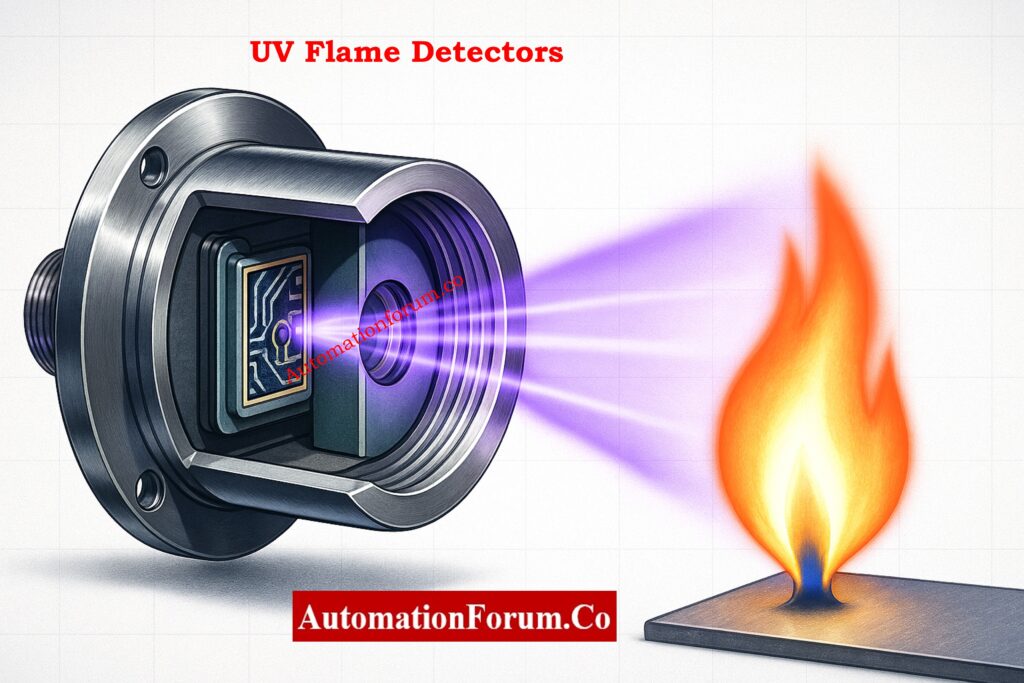
How UV Flame Detectors Work
- Detect UV radiation emitted instantly during combustion, allowing the detector to react before smoke or heat is produced. This is critical for catching fires that ignite rapidly or burn cleanly.
- Operate within the 180–260 nm ultraviolet wavelength band, an energy range where flames emit strongly but most ambient sources do not, making detection more specific.
- Respond almost instantly, usually within milliseconds, so that alarms may be switched on right away and important equipment can be turned off quickly.
- They don’t need smoke, heat, or a visible flame, therefore they’re great for flames involving gasses like hydrogen or alcohol that don’t burn with a lot of visible flame.
Advantages of UV Flame Detectors
- One of the quickest ways to find flames, able to find ignition flashes nearly instantaneously. This is helpful in places where explosions are likely to happen.
- Great for hydrogen fires, which give off a lot of UV radiation but not much visible light or IR radiation. This makes UV sensors very effective.
- UV detectors don’t respond to heat-based infrared energy, therefore they won’t go off when hot surfaces, furnaces, or sunshine reflections are present.
- Works well in clean, closed industrial spaces like indoor process rooms or instrumentation shelters where sources of UV interference are kept in check.
- Good for finding flash fires and explosions early on, especially in places where gasses can catch fire quickly.
Limitations of UV Flame Detectors
- Sensitive to UV sources that aren’t fires, which might set off false alarms if not handled correctly, such as:
- Arc welding gives off very strong UV rays.
- Lightning strikes that send off brief bursts of UV
- High-voltage equipment can cause electrical corona discharge.
- UV lamps used to kill germs or cure things
- Only works indoors or in the shade since UV rays in natural sunlight can mess with how well the detector works.
- The range of detection is shorter (usually 15 to 50 feet), thus you may need more than one device for bigger rooms or locations.
Industrial Applications of UV Flame Detectors
- Hydrogen storage, filling, and compressor stations, where it is very important to find invisible hydrogen flames early.
- Battery charging rooms such as UPS banks, EV charging bays, and forklift charging stations, which are at risk of electrical sparking and gas release.
- Analyzer shelters and instrumentation labs, especially where solvents and flammable test gases are used.
- Pharmaceutical cleanrooms and electronics assembly lines, where smoke detection is unreliable due to air filtration systems.
- Gas cabinets, fume hood areas, and enclosed process zones, which need quick detection in confined spaces.
Why Fire & Gas Detection Matters: Importance of Fire & Gas Detection System
IR Flame Detectors (Infrared Flame Detection Technology)
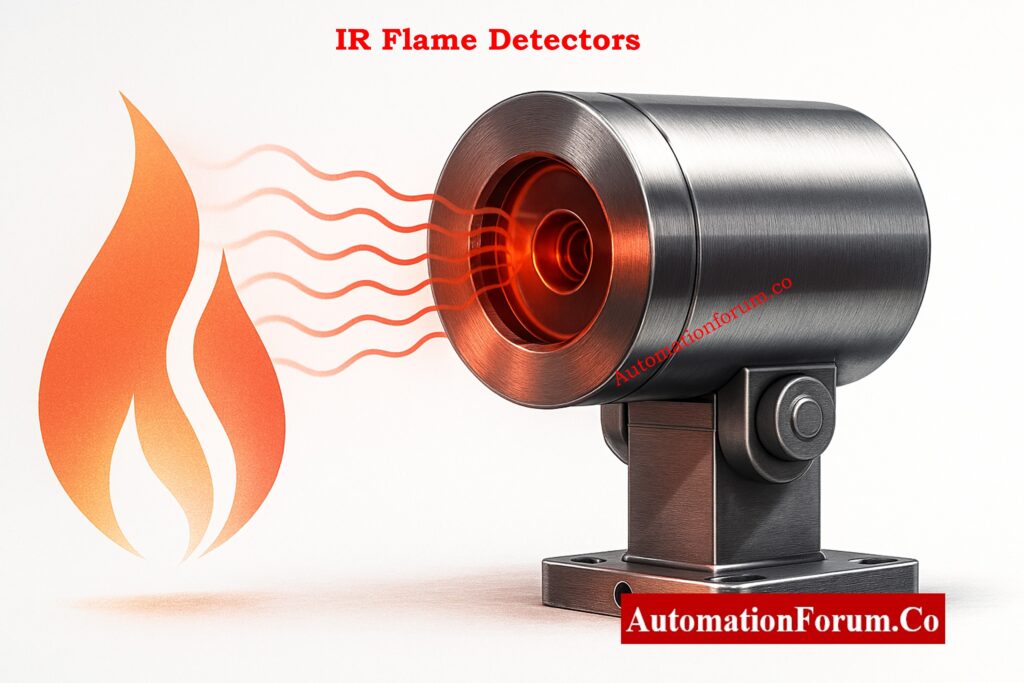
How IR Flame Detectors Work
- Detect IR radiation emitted by combustion gases, particularly the distinctive CO₂ peak at 4.3 µm which is present in most hydrocarbon fires.
- Analyze flame flicker frequency, allowing them to distinguish between dynamic flame activity and static hot objects.
- Effective through smoke, dust, mist, and moderate vapor clouds, making them reliable in process environments with poor visibility.
- Very good for outdoor settings with direct sunshine because IR detection may be set up to ignore continuous sunlight interference.
Advantages of IR Flame Detectors
- Long detection ranges—up to 150–200 ft—mean that fewer detectors are needed for broad open regions.
- Stable in bright light and sunlight, which makes it easy to find in outdoor refinery units and tank farms.
- Works very well for fires involving hydrocarbons like diesel, gasoline, LPG, LNG, crude oil, and solvents that give out intense IR radiation.
- UV-based interference sources like welding or corona discharge make false alarms less likely.
- Safe operation even in high-temperature process units, such as furnaces and reactors, as long as flicker recognition is allowed.
Limitations of IR Flame Detectors
- Can be challenged by hot machinery, whose thermal emissions may resemble IR signatures, including:
- Heaters and process stoves
- Gas turbines with high exhaust temperatures
- Boilers operating at firing conditions
- Exhaust stacks emitting hot gases
- Slightly slower response time than UV and MSIR, as IR detectors require pattern confirmation.
- Lens contamination (oil, dust, sand, moisture) can reduce signal clarity and must be cleaned regularly.
Industrial Applications of IR Flame Detectors
- Oil tank farms, loading gantries, ship berthing areas, and marine terminals, where hydrocarbon fire risk is extremely high.
- Fuel pump houses and large petrochemical process areas, which require long-range coverage.
- Gas compressor skids, LNG vaporizers, and regasification plants, where methane and hydrocarbon combustion are concerns.
- Warehouses storing flammable solvents, aerosols, adhesives, coatings, and chemical drums.
- Outdoor refinery areas that are open to the sun and dust, where UV detectors wouldn’t work.
Fire Alarm Control Panel Overview: What is an FACP? (Fire Alarm Control Panel)
UV/IR Flame Detectors (Combined Dual-Wavelength Detection)
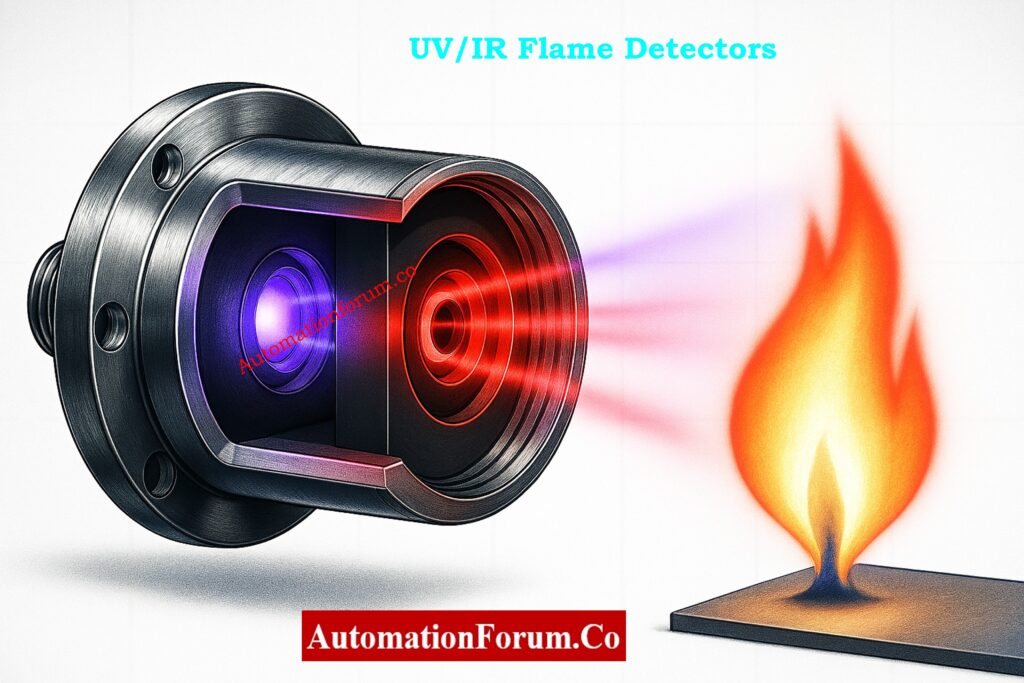
How UV/IR Flame Detectors Work
- Use UV and IR sensors simultaneously to provide cross-verification of flame activity.
- Reduce false alarms because both wavelengths must match known flame characteristics.
- Each sensor channel independently checks flame signatures, increasing reliability in mixed environments.
Advantages of UV/IR Flame Detectors
- Balanced performance in both indoor and outdoor environments, suitable for many general industrial applications.
- Much lower rates of false alarms than detectors that just use one wavelength.
- Detect fires that are both hydrocarbons and non-hydrocarbons, giving you versatile protection.
- Good for places with moderate welding, sunshine, or electrical noise, where single-spectrum detectors would not work.
- Used a lot in a wide range of process plants, such as those that make chemicals, drugs, food, and other things.
Limitations of UV/IR Flame Detectors
- Not good for hydrogen fires since they give off a lot of UV light but very little IR light.
- Both channels need to be lined up appropriately and have clean optics to make sure they both see flames.
- Dust, chemical vapors, and moisture are examples of environmental pollutants that can damage one channel and make it less accurate.
Industrial Applications of UV/IR Flame Detectors
- Chemical plants with mixed fuel hazards, including solvents, resins, and gases.
- Gas turbine enclosures and rotating machinery spaces, where welding and movement may occur.
- Pharmaceutical facilities and healthcare environments, where balanced detection is required.
- Hydrocarbon fuels are utilized in aircraft hangars, automobile bays, and repair workshops.
- Industrial structures that are locked off and need to be able to detect flames over a wide range of frequencies.
Fire Detection System Basics: Basics of Fire Detection System
Multi-Spectrum IR Flame Detectors (MSIR – Advanced Multi-Wavelength IR Technology)
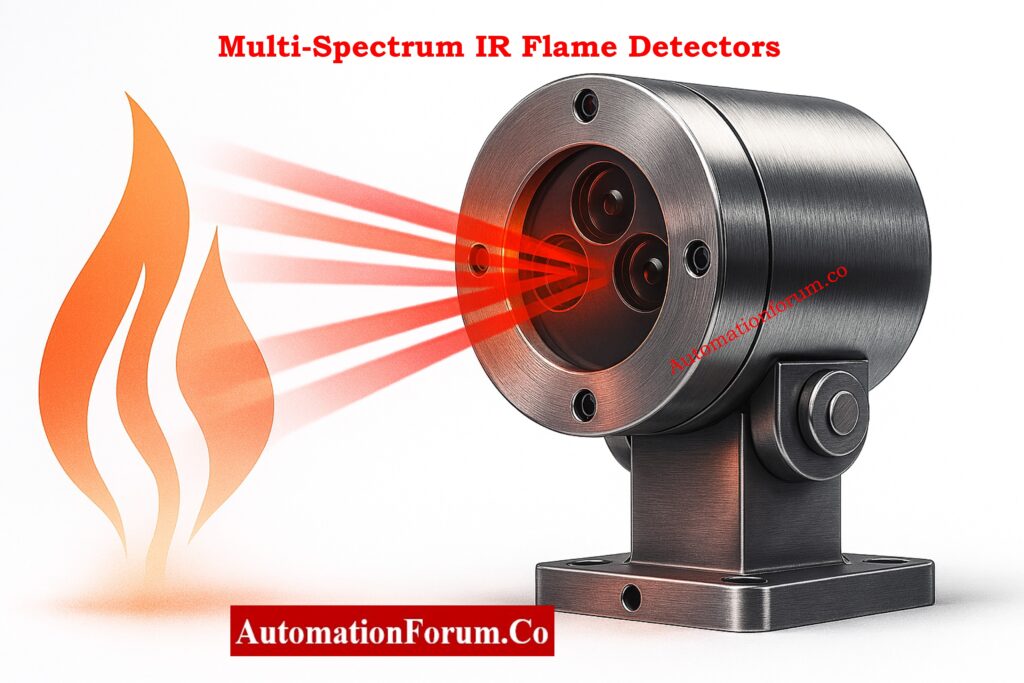
How Multi-Spectrum IR Flame Detectors Work
- Use 3 to 5 IR sensors that work at different wavelengths so they can pick up on complicated flame dynamics.
- Examine flame flicker, energy distribution, and spectral pattern identification to make detection more accurate.
- Eliminate false alarms from sunlight, equipment reflections, flare stacks, and exhaust gases by identifying only flame-specific signatures.
- Offer high immunity against environmental disturbances, including fog, dust, rain, snow, and sandstorms.
Advantages of Multi-Spectrum IR Detectors
- Highest reliability and lowest false alarm rate within all industrial flame detection technologies.
- Long detection range—up to 200 meters, making them ideal for large and open industrial zones.
- Works with safety systems that are rated SIL2 or SIL3, making sure they meet functional safety standards.
- Great for hazardous outside circumstances, like offshore sites and refineries with harsh conditions.
- Finds many kinds of fires, including chemical, hydrogen, and hydrocarbon flames.
- Works well even when the equipment is heated, the sun is shining, and there are shiny surfaces.
Limitations of Multi-Spectrum IR Detectors
- The fact that they use complex technology, multi-sensor arrays, and processing algorithms makes them more expensive.
- Needs to be professionally aligned since if it’s not, it can lose range or make blind spots bigger.
- Needs clean optics to work best in places that are dusty or oily.
- Some installations need to have their firmware updated from time to time to work at their best.
Refer the below link for the Intrinsic Safety Protection Systems: Understanding Ex ia, Ex ib, and Ex ic
Industrial Applications of MSIR Flame Detectors
- Offshore oil rigs, FPSOs, and rough marine settings, where high winds, salt spray, and bright sunshine are always a problem.
- Refineries, petrochemical plants, cracking furnaces, cat-reformers, and systems that make high-value fuel.
- LNG liquefaction and regasification terminals, areas for handling vapor, and loading stations at the jetty.
- Pumping stations for long-distance pipelines, especially in isolated areas with very hot or very cold weather.
- Power plants, such as gas turbines, hydrogen-cooled generators, and furnace fronts.
- Large storage tank farms and explosive processing zones that need long-range, high-reliability flame detection.
What Lower Explosive Limit Means: Understanding Lower Explosive Limit (LEL)
Industrial use Cases for Flame Detection Systems
Oil & Gas Refineries
- Unit heaters, crude units, reformers, and hydrocracker units.
- Gas compressor buildings and fuel pump houses.
- Tank farms storing gasoline, diesel, kerosene, and naphtha.
Offshore Platforms
- Most detectors are MSIR due to extreme sunlight and salt fog.
- Used around helidecks, wellheads, separators, and flare booms.
Chemical & Petrochemical Plants
- UV/IR ideal in areas with mixed chemicals and solvents.
- IR used in tank farms and process reactors.
Power Generation Plants
- MSIR detectors protect turbines, hydrogen cabinets, cable tunnels.
- Used around boiler fronts and burner fronts.
Warehouse & Logistic Facilities
- IR detectors can see fires in pallets, boxes, and packaging across a large area.
Food & Beverage Factories
- IR detectors that work in kitchens, fryers, and ovens without going off when the food is cooking.
Pharmaceutical Production
- UV/IR detectors suitable for cleanrooms with strict safety compliance.
How to Test Heat Detectors: Heat Detector Testing Procedure
Flame Detector Installation, Testing & Maintenance Best Practices
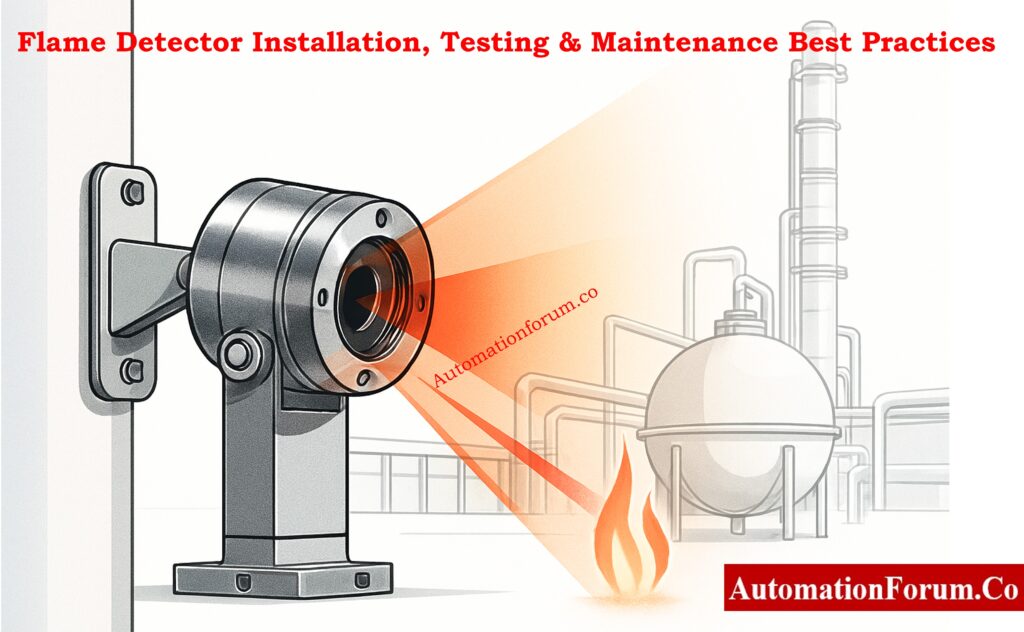
Routine Inspection Guidelines
- Check for corrosion, mechanical damage, or misalignment.
- Verify field-of-view is unobstructed by new equipment.
- Inspect housing seals, cable glands, and mounting brackets.
Lens Cleaning Requirements
- Remove dirt, sand, salt deposits, oil films, or condensation.
- Use non-abrasive optical wipes or manufacturer-approved cleaning kits.
Functional Testing Procedures
- Test using certified flame simulators—not real flames.
- Verify alarm activation, latch reset, and output statuses.
- Test relays, 4–20 mA, HART, and Modbus communication.
Calibration & Performance Verification
- Some detectors require periodic verification during turnarounds.
- Check alignment, especially in places where equipment vibrates.
- Check that everything is working right during plant shutdowns and F&G audits.
Record-Keeping & Compliance Documentation
- Keep records for NFPA 72, OSHA, insurance, and internal safety audits.
- Write down the dates of tests, failures, replacements, and maintenance.
Bump Testing Explained Simply: What is Bump Testing?
How to Select the Best Flame Detector for Your Facility (Engineering Criteria)
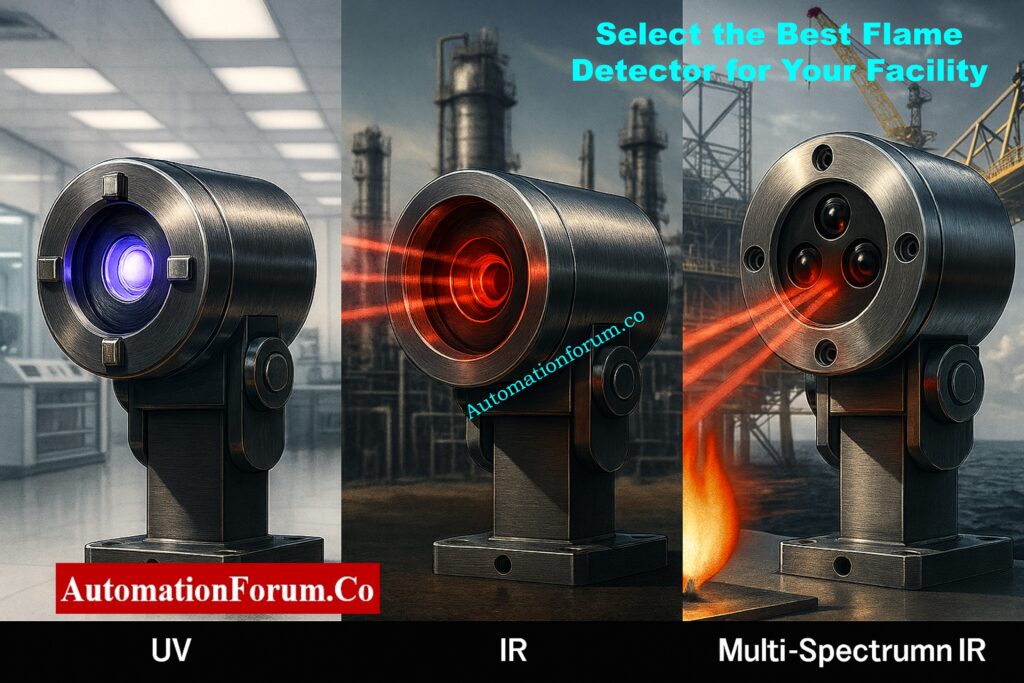
Choosing the correct flame detector depends on several engineering and operational parameters. Below are the key selection criteria explained clearly without using arrows and with full technical detail.
Selection Based on Fuel Type
- Hydrogen fires are best detected using UV flame detectors or Multi-Spectrum IR (MSIR) detectors, because hydrogen flames emit strong ultraviolet radiation and can be nearly invisible to the human eye.
- IR flame detectors or MSIR detectors work well for finding hydrocarbon fuels including diesel, gasoline, kerosene, LPG, LNG, solvents, and crude oil. This is because they respond strongly to the CO₂ emission pattern that happens when hydrocarbons combustion occurs.
- UV/IR combination detectors are the greatest way to protect mixed chemical processes that contain both hydrocarbon and non-hydrocarbon compounds. This is because they are sensitive but don’t give false alarms.
Selection Based on Environmental Conditions
- Harsh outdoor areas, such as offshore platforms, open refinery units, tank farms, and oil loading terminals, require MSIR flame detectors due to their high immunity to sunlight, weather, reflections, and environmental extremes.
- Controlled indoor environments, including cleanrooms, analyzer shelters, battery charging rooms, and enclosed industrial spaces, are well-suited for UV detectors or UV/IR detectors, which excel in environments with minimal interference.
- Locations with high-temperature process equipment, such as gas turbine enclosures, boiler fronts, reformers, and furnace areas, are best protected using UV/IR detectors or MSIR detectors, because they can discriminate between hot surfaces and real flames.
Selection Based on Distance & Coverage Requirements
- Small or confined rooms, including equipment cabinets, small compressor enclosures, and tight industrial spaces, typically require UV detectors, which are optimized for short-range, rapid flame detection.
- Large tank farms, long pump houses, big warehouses, or broad process units benefit from IR detectors or MSIR detectors, as both technologies offer long detection distances ranging from several dozen feet to over a hundred meters.
- Offshore decks and wide open marine areas, where very long-range and high-reliability flame detection is required, are strongly suited to MSIR flame detectors, which maintain performance even during fog, mist, dust, and marine atmospheric conditions.
Selection Based on False Alarm Immunity
- High-activity zones, such as welding areas, fabrication zones, compressor halls, rotating machinery spaces, and turbine modules, demand the use of MSIR detectors, which provide the strongest immunity against false alarms generated by hot surfaces, sparks, reflections, and rapid movement.
- Indoor clean facilities, like pharmaceutical buildings, electronics manufacturing, and controlled storage areas, operate reliably with UV detectors or UV/IR detectors, which provide accurate detection without unnecessary nuisance alarms.
Selection Based on Compliance and Safety Standards
- Many industrial locations need to meet certification standards including ATEX, IECEx, UL, FM, and CE. This means that it is necessary to use flame detectors that meet the required hazardous-area categories.
- MSIR flame detectors should be the first choice for facilities that need SIL2 or SIL3 functional safety levels, such as petrochemical units, offshore assets, or high-value processing lines. This is because they have SIL-certified detection reliability.
- Companies that follow NFPA, API, or OSHA rules must make sure that the flame detectors they use meet all fire safety and performance standards for installation, maintenance, and being ready to use.
How to Test Flame Detectors: Testing Procedure of Flame Detector
Why Flame Detectors are Critical for Industrial Safety
In industries with a lot of risk, flame detectors can save lives. Engineers can create the safest and most dependable fire protection system if they know the pros and cons of UV, IR, UV/IR, and MSIR detectors. The system will work perfectly in real crises if it is installed, aligned, and maintained correctly.
Questions and Answers about Flame Detectors
Gas Detector Issues & Fixes: Gas Detectors Practical Problems and Troubleshooting
FAQ on Flame Detectors
How many types of flame detectors are there?
There are four primary kinds of industrial flame detectors: UV (ultraviolet), IR (infrared), UV/IR (mixed), and Multi-Spectrum IR (MSIR). These detectors use distinct optical wavelengths to find flames. They are used in oil and gas, chemicals, power, and other high-risk industrial settings where quick flame detection is very important.
What are the three common types of fire detectors?
The three most prevalent kinds of fire detectors are smoke detectors, heat detectors, and flame detectors. Smoke detectors pick up particles in the air, heat detectors react to high temperatures or quick rises in temperature, and flame detectors find fires by picking up UV or IR radiation that flames give out.
What is a Type 4 fire alarm system?
A Type 4 fire alarm system has both automatic smoke detectors and manual call points. The system is set up to send alarm signals to a remote monitoring or receiving center on its own. It makes it easier to find things and respond quickly to emergencies in public and commercial buildings.
What are flame detectors?
Flame detectors are unique optical sensors that can tell if there are open flames by monitoring the ultraviolet (UV) or infrared (IR) light that is given off when anything burns. They provide extremely fast fire detection and are widely used in refineries, chemical plants, fuel storage areas, turbine enclosures, and other high-risk industrial zones.
What is an IR type flame detector?
An IR flame detector finds fires by picking up infrared radiation that hot combustion gasses give off. Modern IR detectors sometimes use more than one IR wavelength (dual-IR or triple-IR) to tell the difference between genuine flames and heated surfaces or sunshine. This makes them more accurate and cuts down on false alarms.
What are L1, L2, L3, and L4 fire alarm systems?
L-level fire alarm systems tell you how much automatic fire detection there is in a building:
- L1: Automatic detection in all areas (maximum life protection).
- L2: Detection in escape routes and high-risk rooms.
- L3: Detection in escape routes and all rooms that open onto them.
- L4: Detection only in escape routes and circulation areas.
These groups assist figure out how much fire safety is needed based on how the building is used and how risky it is.
Refer the below link for Why 3-Wire Type Fire and Gas Detectors are the Preferred Choice in Industrial Safety?
