
- What is a Fire Alarm Battery?
- Why Backup Power is Critical in Fire Alarm Systems?
- How to Calculate Fire Alarm Battery Size (Step-by-Step)
- Purpose of the Battery Sizing Calculator
- Download Fire Alarm Battery Size Calculator Excel Tool
- Key Inputs Required for Accurate Battery Sizing
- Outputs Delivered by the Excel Calculator
- Where and When to use this Calculator
- Best Practices for Fire Alarm System Engineers and Designers
- Common Mistakes to Avoid in Battery Sizing
- Supported Standards for Fire Alarm Battery Backup
- Use Cases Across Building Types
- Used During:
- FAQs on Fire Alarm Battery Sizing
It is a safety requirement that any fire alarm system that meets the standards must keep working even when the power goes out. NFPA 72, BS 5839, IS 2189, and EN 54-4 are some of the codes that say the system must work for a certain amount of time even if there is no utility power.
What is a Fire Alarm Battery?
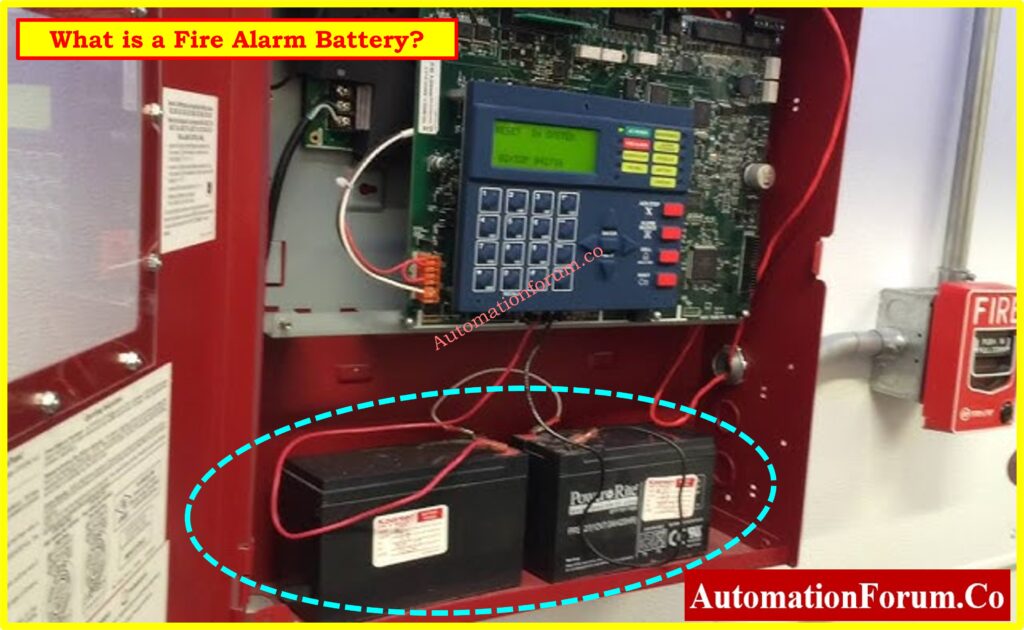
A fire alarm battery is a backup power source for fire alarm systems that keeps them working even when the main power goes out. It is very important for keeping people safe, especially during power outages, fires, or electrical problems.
Why Backup Power is Critical in Fire Alarm Systems?
- Standby Power: This keeps the fire alarm panel and linked equipment working in normal monitoring mode for 24 to 72 hours.
- Alarm Power: Gives enough power to run high-current devices like sirens, strobes, relays, and communication modules during emergency alerts, which usually last between 5 and 30 minutes.
- Required by important fire safety standards as NFPA 72, BS 5839, IS 2189, and EN 54-4.
- Failsafe Protection: Makes sure that fire detection, evacuation, and emergency actions can still happen even if the power goes out because of a fire or a blackout.
Types of Fire Alarm Battery Batteries Used:
- Sealed Lead Acid (SLA): Most common, dependable, and affordable
- Lithium-ion: Lightweight, lasts longer, and is employed in high-tech systems
- NiMH/NiCd: Not common in modern systems because of worries about the environment
Where are Fire Alarm Battery Installed?
- Inside the Fire Alarm Control Panels (FACP)
- In battery enclosures or remote power supply units
- For fire alarm systems that can be addressed or are standard
How to Calculate Fire Alarm Battery Size (Step-by-Step)
The Fire Alarm Battery Size Calculator (Excel Tool) is made for fire protection consultants, electrical design/usability live engineers, and system developers to assist them figure out the right battery ampere-hour (Ahed) capacity needed for the/or continuous operation under these conditions.
Purpose of the Battery Sizing Calculator
The calculator is meant to find out the least amount of battery ampere-hours (Ah) needed to run a fire alarm system:
- During a long period of being on standby, which is usually 24 to 72 hours
- During an alarm period, which usually lasts between 5 and 30 minutes
- With a little extra safety margin to make up for things like age, temperature changes, and inefficiencies
It makes sure that your fire alarm panel keeps working as it should during any power interruption, in accordance with local or international fire safety requirements.
This Excel-based tool is developed to:
- Accurately Size Fire Alarm Backup Batteries: Make sure the system stays up and running during both the standby and alarm periods, even in the worst-case scenarios.
- Prevent Over/Undersizing Errors: Don’t let battery undersizing cause critical failures, or battery oversizing cause extra expense and weight.
- Support Code-Compliant Designs: Make sure your designs follow important regulations including NFPA 72 in the US, BS 5839 in the UK, and IS 2189 in India.
- Reduce Engineering Time and Errors: Use real input data to automate complicated computations, making sure that your documentation is always accurate and ready for an audit.
Learn to interpret Lower Explosive Limit values for gas safety: Understanding Lower Explosive Limit (LEL)
Download Fire Alarm Battery Size Calculator Excel Tool
You can easily figure out how many batteries your fire alarm system needs for standby and alarm. This easy-to-use Excel utility makes sure that the size is correct, the code is followed, and the backup power is always there.
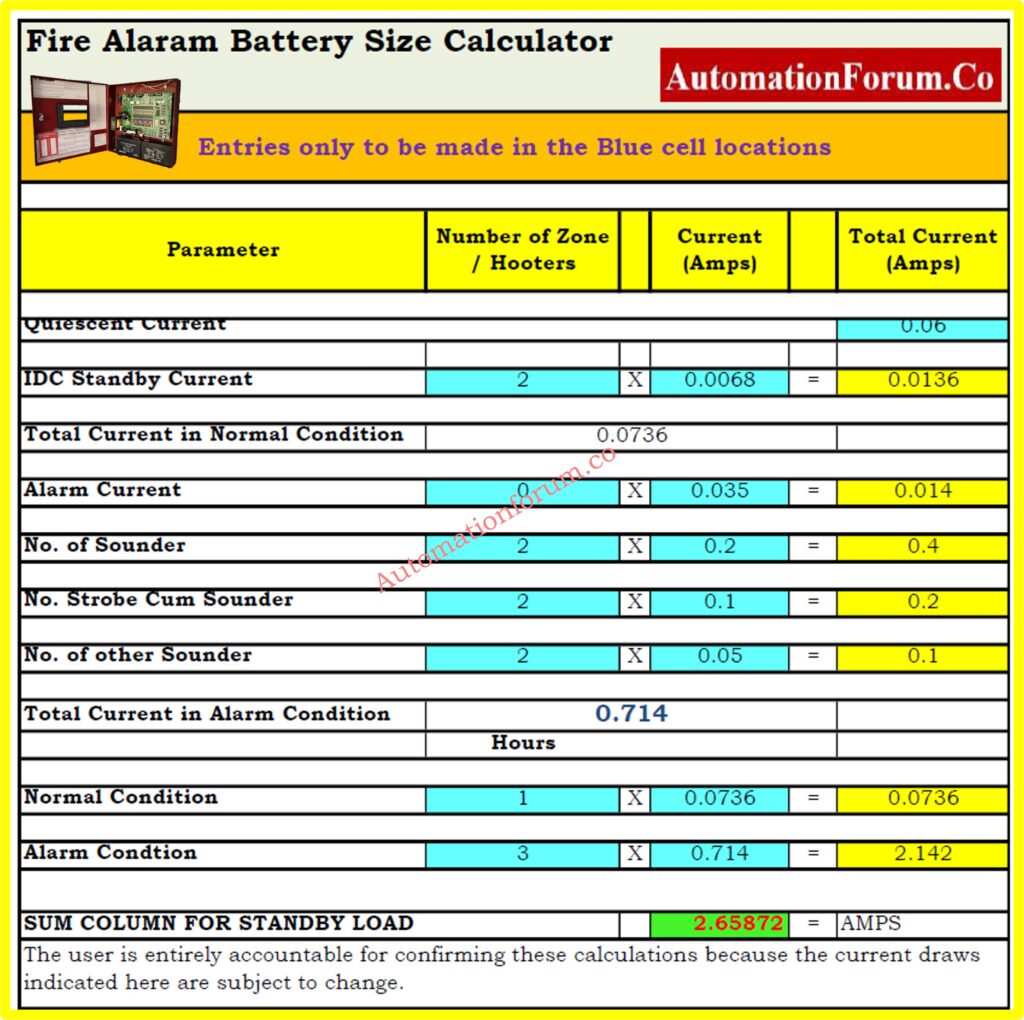
Click here for more Instrumentation Excel Form Tool Resource
Key Inputs Required for Accurate Battery Sizing
The calculator needs a few things to figure out the exact size of the battery. Each one has a different part to play in the fire alarm system’s energy profile:
Quiescent Current (Standby Current Load)
This is also called the quiescent load. It is the amount of current that the fire alarm system uses when it is in sleep mode and not sounding any alerts or having any problems. It has:
- Fire Alarm Control Panel (FACP): Always on and in charge of device communications.
- Detectors (Smoke, Heat, Flame): Continuously monitoring the environment.
- Addressable Modules:This includes input/output units, isolators, and loop interface cards.
- Repeater Panels and LCD Displays: If present, these are also always active.
Sizing normally uses the quiescent current as the baseline load, which can be anywhere from 100 mA to several amps, depending on how sophisticated and big the system is. It is used to figure out how much energy is needed for standby time.
Alarm Current Load
This is the extra current that flows when an alarm is going off. You need to be very careful when calculating this load because it has a big effect on how much battery power you need. It has:
- Audible Devices: Horns, sirens, and sounders that go off when an alarm goes off.
- Visual Devices: Strobe lights or beacons that flash to let you know something is wrong.
- Relays and Interfaces: These are used to turn off HVAC systems, open fire doors, or call elevators back.
- Emergency Communication Equipment: Emergency communication tools, such fire brigade phone systems or speakers.
Alarm current is usually 5 to 10 times the quiescent load and needs to be supplied for a short, set amount of time after standby period.
Standby Duration (Hours)
This is the amount of time the system must be able to work without primary power before an alarm goes off:
- 24 Hours: This is what NFPA 72 says most systems need.
- 48–72 Hours: This is often used in important places like hospitals, remote industrial sites, or unattended substations.
To find out how much power the battery can hold while it’s in standby mode, you just multiply this figure by the quiescent current.
Alarm Duration (Hours)
The system must keep working for a certain amount of time after the standby period ends and an alarm goes off. This time is very important for helping with evacuation and emergency response:
- Five minutes (0.083 hours): Meets NFPA 72 standards in the U.S.
- 30 Minutes (0.5 hr): Required by BS 5839 and IS 2189 to make safety margins bigger.
To find out how much energy the alarm needs during the alarm phase, multiply the alarm current by this time.
Safety Margin
A safety factor, usually 20%, is provided to make sure the system will work well for a long time and to cover any uncertainty in how it will work:
- Battery Aging: The battery’s capacity goes down with time, especially after being charged and discharged many times.
- Temperature Variations: Batteries don’t work as well whether it’s really hot or really cold outside.
- System Expansion: The extra space gives you room to add more sounders or modules in the future.
- Charging Losses: The charger-battery pair has internal resistance and isn’t very efficient.
This margin makes sure that your system will keep working even after years of use or in bad weather.
Start with the basics of fire detection systems for buildings and industrial plants: Basics of Fire Detection System
Outputs Delivered by the Excel Calculator
After you enter all of the above values, the calculator gives you:
Standby Battery Capacity (Ah)
The amount of energy needed to keep the load running for the entire standby period.
Alarm Battery Capacity (Ah)
The extra power needed to run the system in full alarm mode after the standby period.
Total Base Capacity (Ah)
This is the total amount of standby and alarm capacity before adding the safety margin..
Final Battery Capacity with Safety Factor (Ah)
Total battery size needed after adding the margin, which is used to pick a normal commercial battery size like 7 Ah, 12 Ah, 18 Ah, 26 Ah, 42 Ah, etc.
These values simplify battery procurement, planning, and documentation.
Where and When to use this Calculator
The Fire Alarm Battery Sizing Calculator is a must-have for:
- Hotels and High-Rise Buildings:Makes ensuring that alarms work fully in all voice and visual modes during outages in multiple areas.
- Industrial Plants: Backup power sizing in places where voltage drops and outages are common.
- Hospitals and Clinics: Hospitals and clinics are places where life safety systems can’t go down.
- Educational Campuses: For centralized panels in buildings with more than one wing.
- Commercial Complexes: Making sure there is enough backup for dispersed fire alarm control systems.
Step-by-step heat detector testing procedure for compliance and safety: Heat Detector Testing Procedure
Best Practices for Fire Alarm System Engineers and Designers
- Use Manufacturer-Specific Datasheet Values: Don’t guess; always look at datasheets for the most up-to-date values.
- Include Every Load Element: Don’t forget about the repeaters, interface units, and expansion cards; they all add up.
- Round Up Battery Sizes: Always choose a size that is bigger than the one you estimated that is available on the market.
- Verify Panel Charger Output: Make sure that the charger for the fire panel can handle the battery’s capacity.
- Maintain Records for AHJs: Keep calculation sheets for audits, inspections, and third-party checks.
- Design for Growth: If you plan to add more devices or expand in the future, be sure you have enough room.
Learn how VESDA technology enhances fire safety in critical environments: VESDA Smoke Detection: Advanced Fire Protection with Early Warning Technology
Common Mistakes to Avoid in Battery Sizing
- Omitting Quiescent Current: If you don’t take this baseline current into account, your standby times will be dangerously low.
- Ignoring Alarm Load: Sounders and strobes draw a lot of current, therefore not include them is a compliance violation.
- Not Using a Safety Margin: If you don’t have a buffer, your batteries can die too soon in the field.
- Mismatching Charger to Battery: Chargers need to be able to charge the battery in the time it needs to..
- Not Accounting for Non-Addressable Devices: Don’t skip these traditional systems; they frequently have different current profiles.
Explore FACP functionality and interface modules : What is an FACP? (Fire Alarm Control Panel)
Supported Standards for Fire Alarm Battery Backup
| Standard | Battery Sizing Requirement |
| NFPA 72 | 24 hrs standby + 5 mins alarm |
| BS 5839 | 24–72 hrs standby + 30 mins alarm |
| IS 2189 | Mirrors BS 5839; followed across Indian jurisdictions |
| EN 54-4 | European standard for power supplies to fire systems |
Use Cases Across Building Types
Used During:
- Designing the fire alarm system and making the BOQ
- Documents for commissioning and inspection
- Planning for regular battery replacements
- Audits of system maintenance
- Submissions to fire safety agencies
Supports All Architectures:
- Addressable and standard systems
- Control panels that are both centralized and distributed
- Hybrid setups or modifications that are just partway done
Adding quiescent current to your fire alarm battery calculations is very important to make sure that the power doesn’t go out during an emergency. This calculator makes sure that the size of the batteries for fire alarm systems in all kinds of buildings is correct, follows the rules, and doesn’t cost too much.
This Fire Alarm Battery Size Calculator should be a must-have for everyone who works on new construction, retrofits, or system extensions.
FAQs on Fire Alarm Battery Sizing
How to calculate fire alarm battery size?
To figure out the size of the fire alarm battery, you need to find out how much energy (in ampere-hours, Ah) the system needs to work when it is in standby and when it is sounding an alarm in case of a power loss. This is the general formula for the calculation:
Battery Size (Ah) = [(Standby Current × Standby Time) + (Alarm Current × Alarm Time)] × Safety Factor
Steps:
- Find the standby current (sometimes called quiescent current), which is the current that flows when the device is not in use.
- Find the alarm current, which is the current that flows when the system is fully alarmed.
- Set the times: 24 to 72 hours for standby and 5 to 30 minutes for alarm.
- Add a safety margin, which is usually 20%, to account for aging, temperature changes, and future load increases.
The result lets you choose the right size sealed lead-acid (SLA) or Li-ion battery that will work safely and according to code.
What size battery do I need for my fire alarm?
The size of the battery you need depends on:
- The total amount of power used while waiting (in amps or milliamps)
- The alert load, which is usually significantly higher than the standby load
- Time spent on standby (usually 24 hours or more)
- Length of alarm (usually 5 or 30 minutes)
- A safety buffer, which is usually 20%
Example:
If your fire alarm panel uses 0.5A in standby for 24 hours and 1.5A in alarm for 0.5 hours,
Battery Size = (0.5 × 24) + (1.5 × 0.5) = 12 + 0.75 = 12.75 Ah
With 20% margin: 12.75 × 1.2 = 15.3 Ah → Use a 17Ah or 18Ah battery
Using a fire alarm battery calculator is the best way to quickly and accurately find the right size.
Understand the importance of fire and gas detection systems in industrial safety: Importance of Fire & Gas Detection System
How to calculate the size of a battery?
We use this basic method to figure out how big a battery should be:
Battery Size (Ah) = Load Current (A) × Time (h) × Safety Factor
To size a battery:
- Find out or guess how much current the load is using (in amps).
- Set a time limit for how long the battery can handle that load.
- You should multiply the answer by a safety factor, which is usually 1.2 for 20%.
Example:
For a 2A load for 5 hours with 20% margin:
2 × 5 × 1.2 = 12 Ah
This method applies to fire alarms, security systems, lighting backup, or any DC-powered system.
What size battery do I need for my alarm system?
The size of the battery for any intrusion or fire alarm system relies on:
- Quiescent (standby) current is pulled all the time while the device is in use.
- Alarm current is only drawn when something happens that sets it off, such horns or strobes.
- Local codes say how long standby and alarm operation must last (for example, 24 hours of standby plus 5 to 30 minutes of alarm).
- Buffer or safety margin to deal with things like temperature, battery life, and future growth.
- Sealed lead-acid (SLA) or LiFePO4 batteries are what most alarm systems use. Depending on the size of the system, the normal range is between 7Ah and 42Ah.
The easiest method to be sure that your alarm panels are reliable and meet code is to use a battery sizing calculator made just for them.
Click here for 200+ Online Instrumentation Calculators Collections
