
🔬 ZIRCONIA OXYGEN ANALYZER
Nernst Voltage Calculator
⚡ QUICK PRESETS
📊 INPUT PARAMETERS
✅ OUTPUT PARAMETERS
📐 NERNST EQUATION
⚠️ NOTES & WARNINGS
- Sample O₂ must be > 0 and < Reference O₂ for positive ln(ref/sample)
- If sample ≥ reference, Nernst voltage will be zero or negative – verify inputs
- Typical zirconia cell temperatures: 500°C to 900°C
- Gas constant R = 8.31 J/mol·K
- Faraday constant F = 96485 C/mol
- Why Accurate Oxygen Measurement Matters in Process Industries
- Understanding the Zirconia Oxygen Analyzer
- The Nernst Equation Behind Oxygen Measurement
- Introducing the Zirconia O₂ Analyzer Nernst mV Output Calculator
- Why Use This Calculator?
- How the Calculator Works – Step by Step
- Practical Examples of Zirconia Analyzer Calculations
- Industrial Applications of Zirconia Oxygen Measurement
- Advanced use Cases for Engineers and Technicians
- FAQ – Zirconia Oxygen Analyzer Nernst mV Output Calculator
- Download the Free Zirconia O₂ Analyzer Calculator Excel Tool
Why Accurate Oxygen Measurement Matters in Process Industries
Accurate oxygen measurement is very important in the modern process industries to make sure that combustion is efficient, that safety is maintained, and that emission criteria are satisfied. The Zirconia Oxygen Analyzer is one of the most accurate, stable, and reliable analyzers available, even at high temperatures.
We’ve made an easy-to-use but powerful Zirconia O₂ Analyzer Nernst mV Output Calculator (Excel Tool) to make the complicated Nernst-based voltage calculations that these analyzers use easier. This free calculator does all the math for you, so engineers, technicians, and learners may quickly find out the mV output of a zirconia oxygen sensor under any process scenario.
Understanding How Paramagnetic Sensors Measure Oxygen: Oxygen Analyzer Working Principle: Paramagnetic Type
Understanding the Zirconia Oxygen Analyzer
A zirconia oxygen analyzer uses a solid-state electrochemical cell to find out how much oxygen is in a process gas. The main part of the sensor is a ceramic element made of zirconium dioxide (ZrO₂) with porous platinum electrodes on top. When heated to between 600 and 1000 degrees Celsius, zirconia becomes an oxygen-ion conductor.
The sensor makes an electrical potential (voltage) that changes based on the difference in oxygen partial pressure between:
- The reference gas is commonly air, which has 20.9% oxygen.
- The sample gas (process or flue gas with different amounts of oxygen)
The Nernst equation regulates this potential difference. It is the scientific basis for all oxygen measurements that use zirconia.
The Nernst Equation Behind Oxygen Measurement
The Nernst equation shows how the voltage changes with the oxygen concentration:
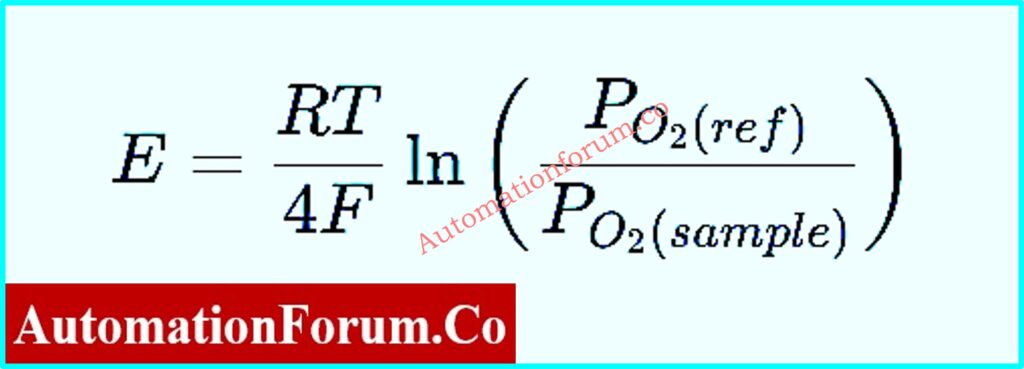
Where:
- E = EMF (Electromotive Force) in millivolts (mV)
- R = Universal gas constant (8.314 J/mol·K)
- T = Absolute temperature in Kelvin
- F = Faraday constant (96,485 C/mol)
- Pₒ₂(ref) = Oxygen partial pressure of the reference gas
- Pₒ₂(sample) = Oxygen partial pressure of the process gas
In normal circumstances, the reference gas is always the same (usually ambient air with 0.2095 atm O₂), while the sample oxygen content changes based on how the combustion or process is going.
Comprehensive Guide for Industrial and Laboratory Use: Types of Oxygen Analyzers: Applications and Measurement Methods
Introducing the Zirconia O₂ Analyzer Nernst mV Output Calculator
This Excel tool will tell you exactly how many millivolts a zirconia oxygen sensor will put out based on the temperature and the amount of oxygen in the air. This calculator gives you quick, accurate answers whether you’re constructing combustion control systems, calibrating analyzers, or learning about how to measure oxygen.
Key Features of the Calculator
- Automatically calculating the Nernst voltage for a set of process and reference conditions
- Quick access to preset settings including Air, Flue Gas, and Pure O₂
- You can set the oxygen fraction or temperature to whatever you want.
- Changing the temperature from °C to K in real time
- Easy-to-use user interface with clear formatting and fields that are automatically calculated
- No macros or add-ins are needed; it works in regular Microsoft Excel.
- Excellent for engineers, technicians, and students that work with process and combustion control
Refer the below link for the For Reliable and Precise Oxygen Measurement: 9 Step Zirconia Oxygen Analyzer Calibration Procedure
Why Use This Calculator?
It can be a pain to solve the Nernst equation by hand, especially when the temperature changes and the relationships are logarithmic. This calculator takes away the guesswork and gives you exact numbers right away.
- Saves time: No manual formula work or logging computations
- Better Correctness: Lessens mistakes in process design and calibration calculations
- Helps Training: Great for teaching Nernst ideas in the classroom or at work. It also makes troubleshooting easier. Helps check the operation of the analyzer during service or maintenance.
- Increases Process Efficiency: Allows for fast O₂ analysis for adjusting combustion and improving emissions
Optimize Combustion and Process Gas Monitoring: Exploring Zirconia Oxygen Analyzers in Industrial Applications
How the Calculator Works – Step by Step
The Zirconia O₂ Analyzer Nernst Calculator has a clear and logical approach. This is how to utilize it:
1. Input Gas Selection
- Air (21% O₂)
- Flue Gas (5% O₂)
- Pure O₂ (100%)
For easy setup, each preset automatically fills in the correct oxygen partial pressure.
If the amount of oxygen in your process gas is different, just overwrite the cell and type in your own value.
2. Set the Temperature
For example, 700°C, 800°C, or 900°C, enter the operating temperature in °C. The calculator automatically converts this to Kelvin (K) internally using the formula:
T(K)=T(°C)+273.15
3. Reference Gas Input
The reference gas is set to air (0.2095 atm O₂) by default, however you can change it if your analyzer uses a different reference atmosphere, like controlled calibration gas.
4. Get Instant Results
After the data is supplied, the calculator uses the exact values for R, F, and temperature correction to figure out the Nernst EMF (mV) output. The answer is the voltage output that the zirconia cell should give under the given conditions.
Tips for Selecting the Right Sensor System: 6 Factors to Consider When Choosing an Oxygen Analyzer for your Application
Practical Examples of Zirconia Analyzer Calculations
Here are some real-life instances of how this calculator can help:
Example 1: Measuring Flue Gas Oxygen
Conditions:
- Reference Gas = Air (0.2095 atm O₂)
- Sample Gas = Flue Gas (0.05 atm O₂)
- Temperature = 800°C (1073 K)
Calculated Output:
The calculator says about +46 mV, which means that the flue gas has less oxygen than the reference air. This helps operators get the air-to-fuel ratio just right for good combustion.
Example 2: Process Gas with 10% Oxygen
Conditions:
- Reference Gas = Air
- Sample Gas = 0.10 atm O₂
- Temperature = 750°C (1023 K)
Calculated Output:
The mV output is positive but smaller (around 29 mV), which is what you would expect since the difference in O₂ partial pressure is also less.
Example 3: Pure Oxygen as Sample Gas
Conditions:
- Reference Gas = Air (0.2095 atm O₂)
- Sample Gas = 1.00 atm O₂
- Temperature = 700°C (973 K)
Calculated Output:
The calculator shows a negative mV result (-48 mV) because the sample gas has more oxygen than the reference gas.
These outputs are what a genuine analyzer would do, and they can be used to check calibration data or field measurements.
Industrial Applications of Zirconia Oxygen Measurement
This Nernst-based oxygen computation works in several fields:
| Industry | Application | Purpose |
| Power Generation | Boiler and furnace flue gas analysis | Combustion optimization |
| Petrochemical Plants | Process heater monitoring | Energy efficiency & emission reduction |
| Cement Industry | Kiln O₂ measurement | Product quality and fuel savings |
| Steel Production | Furnace gas control | Reducing atmosphere control |
| Glass Manufacturing | Furnace O₂ balance | Clarity and defect prevention |
| Environmental Monitoring | Stack emissions | Compliance and reporting accuracy |
The Excel application lets professionals in all of these fields understand and model how O₂ measurements change without having to buy expensive simulation tools.
Identify and Fix Common Sensor Issues Quickly: Troubleshooting of Oxygen Analyzer : Paramagnetic Type
Advanced use Cases for Engineers and Technicians
- For calibration verification, compare the real analyzer voltage to the theoretical Nernst output.
- Training and Education: Show technicians how to use zirconia analyzers to turn oxygen levels into quantifiable voltages.
- Combustion tuning means adjusting the air-fuel mix in boilers, kilns, or incinerators to make them work better.
- Sensor Diagnostics: Compare field data to computed findings to quickly find drift or a problem.
Refer the below to Ensure Accuracy and Long-Term Sensor Performance: Step by Step Preventive Maintenance Procedure for Zirconia Type Oxygen Analyzer with Checklist
FAQ – Zirconia Oxygen Analyzer Nernst mV Output Calculator
1. What is the typical output range of a zirconium dioxide oxygen sensor?
A zirconium dioxide (ZrO₂) oxygen sensor usually gives an output voltage between 0 and 1 volt (V), depending on how much oxygen is in the sample gas compared to the reference air.
- At high oxygen concentration (lean mixture), the output voltage is low (0.1 V or less).
- At low oxygen concentration (rich mixture), the voltage increases up to 0.9 V.
The output of industrial zirconia analyzers can also be scaled to 4=20 mA, which is the same as the oxygen concentration or the predicted partial pressure.
2. What is the voltage of the zirconia oxygen sensor?
The Nernst equation, which connects the difference in oxygen partial pressures on both sides of the zirconia cell, is what makes the zirconia oxygen sensor’s voltage output.
Typical voltage range:
- For ordinary automotive or combustion applications, the typical voltage range is 0.0 to 1.0 V (millivolt level precision).
- The sensor EMF can be anywhere from 0 to 1200 mV, depending on the temperature (typically between 600 and 800°C) and the amount of oxygen in the air.
The logarithm of the ratio of the partial pressure of oxygen is what this voltage is based on.
3. What is the working principle of a zirconia O₂ analyzer?
The electrochemical Nernst principle is what makes a zirconia oxygen analyzer work.
The sensor has a ceramic element made of zirconium dioxide (ZrO₂) on both sides that is covered in porous platinum electrodes. When zirconia is heated to more above 600°C, it can carry oxygen ions.
Here’s how it works:
- One side of the sensor is open to a known reference gas (air), and the other side is open to the process gas.
- Oxygen ions flow through the zirconia because the concentration of oxygen is different.
- This passage of ions creates an electromotive force (EMF) that can be measured.
- After that, the Nernst equation is used to figure out the oxygen concentration or partial pressure in the sample gas from the EMF.
This approach makes zirconia analyzers very dependable for controlling combustion, keeping an eye on flue gas, and working in an inert atmosphere.
4. What is the chemical reaction of the oxygen sensor?
The chemical process that happens at the electrode surfaces of a zirconia oxygen sensor is an electrochemical redox reaction that involves oxygen molecules and ions.
At the cathode (reduction side):
O2+4e−→2O2−
At the anode (oxidation side):
2O2−→O2+4e−
As a result of these processes, oxygen ions move through the zirconia electrolyte, creating a voltage potential that depends on the difference in oxygen partial pressures between the two sides.
5. What is the output of the oxygen sensor?
A zirconia oxygen sensor gives off a voltage (EMF) signal that comes from the Nernst equation.
In practice, the sensor output can be anything from a few millivolts to roughly 1200 mV, depending on the amount of oxygen and the temperature at which it is working.
6. What is the ppm level of an oxygen analyzer?
A zirconia oxygen analyzer can find oxygen levels from very low levels (trace ppm) to very high levels (100% oxygen).
Typical measuring ranges include:
- Common measuring ranges are 0 to 1000 ppm O₂ for situations that are inert or decreasing.
- 0.1% to 25% O₂ (for controlling flue gas or combustion)
- Some analyzers can automatically switch between ranges depending on the procedure.
The ppm capability depends on the temperature of the sensor, the design of the cell, and the calibration reference gas.
7. What is the voltage of the O₂ sensor?
The voltage of the O₂ sensor is the electromotive force (EMF) that the oxygen partial pressure differential creates across the zirconia electrolyte.
- For standard automobile O₂ sensors, the range is 0.1 to 0.9 V.
- For industrial zirconia oxygen analyzers, the voltage can go up to 1200 mV (1.2 V), depending on the temperature of the sensor and the composition of the gas.
This voltage stabilizes quickly at high temperatures (around 700 – 800°C), making it possible to monitor the amount of oxygen in combustion gases or process streams in real time and with great accuracy.
Stepwise Guide for Accurate Industrial Calibration: 10 Step Oxygen Analyzer Calibration Procedure: Paramagnetic Type
Download the Free Zirconia O₂ Analyzer Calculator Excel Tool
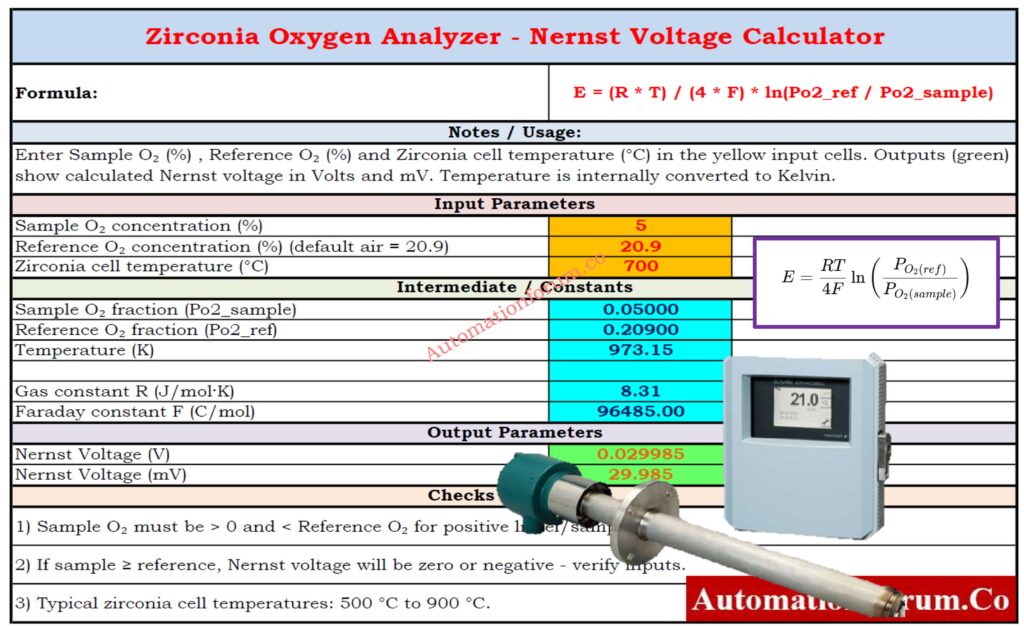
The Zirconia O₂ Analyzer Nernst mV Output Calculator is now free to download and use in your engineering, instructional, or maintenance work.
This tool combines theory and practice to make it easy to guess, understand, and check zirconia analyzer values.
Click here for more Instrumentation excel Tool Resource
The Zirconia Oxygen Analyzer Nernst mV Output Calculator is more than just an Excel sheet; it’s a useful engineering tool that connects what you learn in class with what you do in the field. This calculator makes complicated calculations easy and gives you a quick, dependable answer, whether you’re trying to enhance combustion efficiency, keep an eye on flue gas, or calibrate an oxygen analyzer.
Download it today to learn more about zirconia-based O₂ measurement and how to use the Nernst equation in real life.
