
- Why Instrument Power Consumption Calculation Important?
- Typical Instrument Power Ratings (Reference Table)
- Step-by-Step Method to Calculate Instrument Load
- Example Instrument Load Calculation
- Categories of Instrument Loads
- Best Practices for Instrument Power Calculation
- Excel Tool for Instrument Power Calculation (Free Download)
- Key Takeaway: Don’t Underestimate Instrument Loads
- Frequently Asked Questions (FAQ) on Instrument Power Consumption Calculation
Engineers who work with electricity and instrumentation in the oil and gas, petrochemical, power plant, and industrial EPC project fields know how important it is to accurately estimate power loads. Motor loads, HVAC, and lighting are usually well-documented, but the power use of instruments and control equipment is often not fully understood or ignored.
This mistake could lead to power supplies that are too little, UPS systems that are overloaded, nuisance tripping, and less safety integrity. Engineers must carefully figure out how much electricity all the instruments will use throughout the design and engineering stage to avoid these kinds of problems.
In this guide, you’ll find:
- Why it is important to calculate the load on an instrument
- A table with lots of information on common wattage ratings (based on genuine project data)
- A way for calculating things step by step with examples of how to do it
- Types of instrumentation loads and how they affect design
- Best ways to do EPC and commissioning projects
- A free Excel utility for quick, routine computations
Why Instrument Power Consumption Calculation Important?
Instrumentation devices may seem like relatively small loads when compared to motors or big process equipment. But in process plants, refineries, and power generation facilities, where thousands of transmitters, detectors, and solenoids are installed, the aggregate electrical demand is significant.
Here are some important reasons why this computation is important:
1. Correct Sizing of UPS Systems
Safety and control devices need a steady flow of DC power. If the load estimate is inaccurate, the batteries in the UPS will run out of power sooner than you think during blackouts.
2. Electrical Panel Design
Instrumentation Power Panels (IPP) and marshalling cabinets rely on accurate load estimates for:
- Breaker sizing
- Cable sizing
- Feeder protection design
3. Energy Efficiency
Even simple things like detectors (1–2 W each) add up when there are a lot of them. Optimizing power budgets helps you prevent oversizing, use less energy, and save money.
4. Standards and Compliance
Standards like IEC 60364, IEC 61508, and ISA recommendations say that instrumentation in essential safety applications should have an appropriate power budget.
5. Reliability and Safety
An undervalued design could result in:
- Undervoltage alarms
- Spurious trips
- Failure of safety loops during emergencies
n the end, few watts per device may not seem like much, but when you add them up over hundreds of devices, they determine whether your UPS and backup systems will work during a power outage.
PLC Voltage Standard: Why is 24 Volts Mostly used in Industrial PLC Systems?
Typical Instrument Power Ratings (Reference Table)
The table below shows the average power consumption values from your Excel tool and engineering project data.
| Instrument / Device | Typical Power Consumption (Watts) |
| Heat Detector | 1.5 W |
| Smoke Detector | 1.5 W |
| Flame Detector | 7 W |
| Gas Detector | 5 W |
| Fire Alarm Bell | 5 W |
| Strobe Light | 5 W |
| Sounder & Flasher | 7 W |
| On-Off Valve (Solenoid) | 18 W |
| Process Transmitter | 1 W |
| Control Valve Positioner | 10 W |
| PTZ CCTV Camera | 7 W |
| Fixed CCTV Camera | 5 W |
Please note that these are engineering reference figures that are used for rough estimates. Always check vendor datasheets for the final design.
FAT Procedure: Factory Acceptance Test(FAT) Procedure for Differential Pressure(DP) Transmitter
Step-by-Step Method to Calculate Instrument Load
To make sure that load estimation is consistent and accurate, adopt this organized plan:
Step 1: Identify All Devices
List all the tools that are part of the project, such as detectors, transmitters, solenoids, positioners, CCTV, fire alarm equipment, and so on.
Step 2: Multiply Quantity × Power Rating
For each instrument, multiply the number of units by the average wattage.
For example, 20 smoke detectors that each use 1.5 W would use 30 W.
15 solenoid valves (18 W each) = 270 W
Step 3: Apply Diversity Factor
Not every device can work at the same time. Use a diversity factor, which is usually between 0.8 and 0.9, based on the project’s concept.
Step 4: Convert to VA or kVA
Since UPS and DG systems are rated in VA (Volt-Ampere), use the power factor to change them:
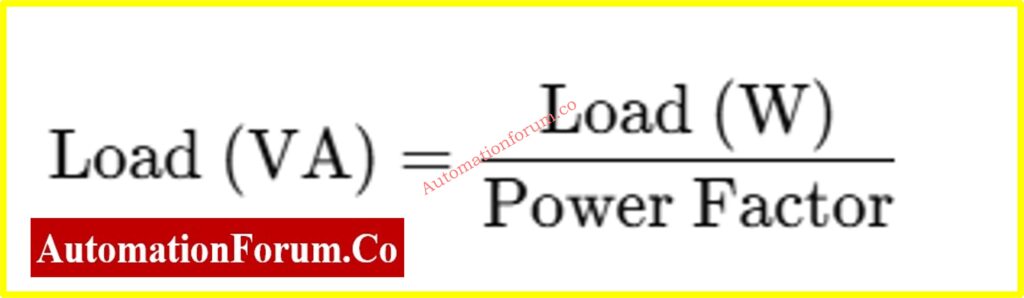
(Power Factor typically = 0.85–0.9)
Step 5: Add Spare Margin
Add 20–25% extra space to account for:
- Future expansion
- Vendor variations
- Design conservatism
Installation Checklist: Checklist for Installation of Local Instruments – PLC Voltage Standard: Complete Guide for EPC, QA/QC and Commissioning Engineers
Example Instrument Load Calculation
Think about a part of a process plant that has these machines:
- 30 transmitters, each with 1 W of power, add up to 30 W.
- Ten solenoid valves use 10 × 18 W = 180 W.
- 5 PTZ CCTV Cameras = 5 × 7 W = 35 W
- 20 smoke detectors use 1.5 W each, which adds up to 30 W.
The total load is 275 W.
Use the diversity factor (0.9): 275 × 0.9 = 248 W
To get VA, divide 248 by 0.85: 248 ÷ 0.85 ≈ 292 VA.
Add 20% extra room: 292 × 1.2 ≈ 350 VA
For this portion, the UPS should be at least 350 VA.
24VDC Troubleshooting: Why 24VDC is Not Always 24VDC – Real-World Troubleshooting for Analog and Digital Signals
Categories of Instrument Loads
For easier computation, instrumentation loads are frequently put into four groups:
Field Sensors & Detectors
- Each one uses 1 to 7 watts of power.
- Includes smoke and heat detectors, gas detectors, and transmitters
- Installed in big numbers, which means the total load is high.
Control Devices
- Includes I/P converters, positioners, and solenoid valves
- More electricity is needed (10 to 20 W per device)
Safety & Fire Alarm Systems
- Bells, strobes, and flame detectors
- Always on and important in case of an emergency
CCTV & Security Systems
- CCTV cameras with PTZ and fixed lenses (5–7 W each)
- More and more often used in dangerous and process monitoring areas
Auxiliary Equipment
- Indicators, relays, and interface modules
- Small on their own, but necessary for correct load estimation
Solenoid Valve Guide:Step-by-Step Procedure to Troubleshooting Solenoid Valves in PLC Digital Output Loops
Best Practices for Instrument Power Calculation
Check vendor datasheets for the final design
- Use diversity factors correctly (for example, fire alarms only work in emergencies).
- For UPS, include the length of time the battery will last (Load × Backup Hours = Battery Ah).
- Write down all of your assumptions (PF, diversity, spare margin) in the project deliverables.
- Leave 20–25% extra space for future instrument additions and changes.
Excel Tool for Instrument Power Calculation (Free Download)
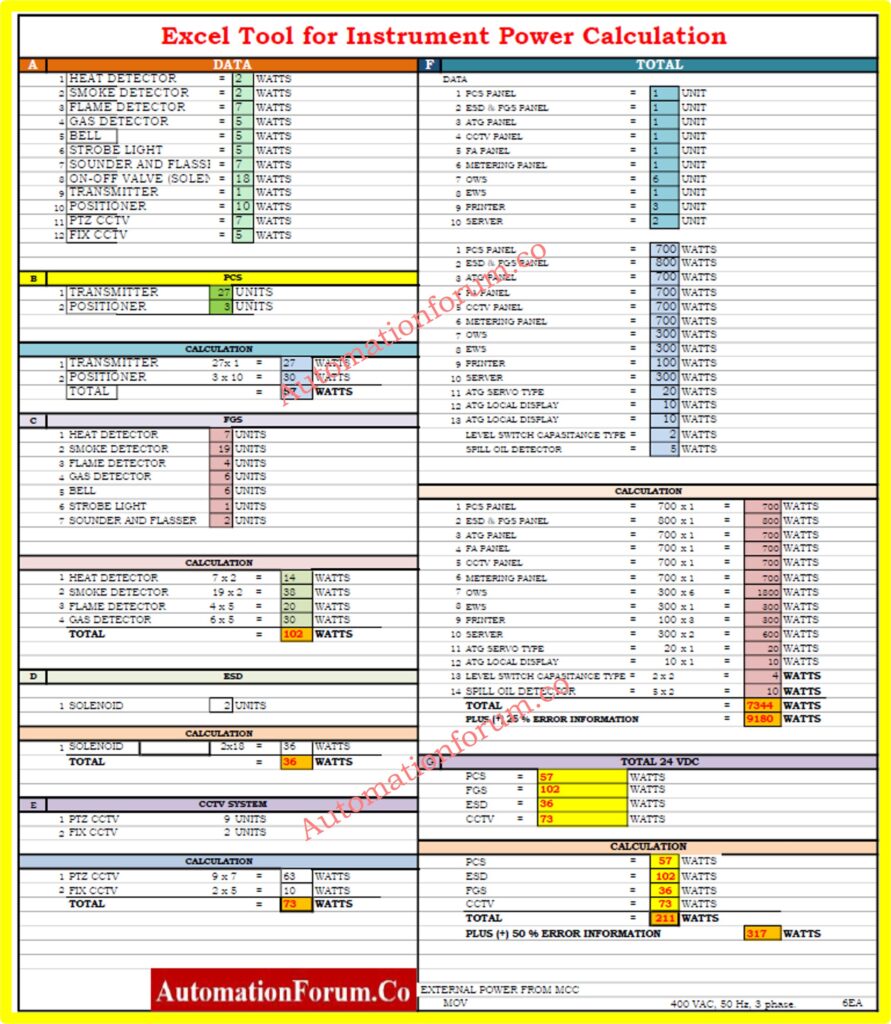
We’ve made an Excel calculator that you can use right now to make the process easier and more consistent. It has:
- Instrument wattage values already loaded from genuine project data
- Easy way to enter the number of devices
- Automatic computation of total W, VA, and kVA
- Adjustment of built-in spare margin and variety factor
- Helpful for EPC engineers, consultants, and maintenance workers
Click here for more Instrumentation excel Tool Resource
Key Takeaway: Don’t Underestimate Instrument Loads
It might seem like a tiny thing, but the amount of power that instrumentation uses has a direct effect on the size of the UPS, the design of the panel, the energy efficiency, and the overall reliability of the plant.
Engineers may create accurate load estimates throughout FEED, EPC, and commissioning by employing standard wattage references for detectors, transmitters, solenoids, and CCTV systems.
The Excel tool that comes with it makes computations faster, more precise, and in line with the best practices in the business.
The most important thing to remember is that you should never neglect instrument load. Just a few watts per device can make or break the safety and reliability of your plant.
Refer the below link for the Types of Engineering Drawings and Documents used in Instrumentation
Frequently Asked Questions (FAQ) on Instrument Power Consumption Calculation
What is the typical power consumption of a transmitter?
Depending on the type and brand, most 2-wire transmitters use roughly 1–2 W.
How much power does a solenoid valve use?
Most solenoid valves use 18 W, although other models use between 12 and 24 W.
Do detectors consume significant power?
Each detector uses only 1.5 to 7 watts, but when there are hundreds of them in a facility, the total demand becomes large.
Why add spare margin in instrument load calculation?
A spare margin of 20% to 25% allows for future growth, changes in vendors, and makes sure the UPS and panel sizes are safe.
What power factor should be considered for instrument loads?
Unless the vendor’s datasheets give exact values, use a power factor of 0.85 to 0.9.
Click here for 200+ Online Instrumentation Calculators Collections
