
- What is Air Exchange in HVAC Systems?
- Why Air Exchange is Important in Process Industry HVAC Design
- Definition of Air Change per Hour (ACH)
- Download the Air Exchange Calculation Excel Tool for HVAC Systems(Free)
- Formula for Air Exchange Calculation
- Typical ACH Guidelines for Process Industry Spaces
- Features of the Air Exchange Excel Tool
- Step-by-Step Guide to Using the Excel Tool
- Benefits of Using the Air Exchange Excel Tool
- Best Practices for HVAC Engineers in Process Industries
- FAQs on Air Exchange in HVAC Systems
HVAC systems are the most important part of safe and efficient operations in process industries like oil and gas, petrochemicals, pharmaceuticals, and specialty chemicals. The air exchange rate, or air changes per hour (ACH), is one of the most important design factors in HVAC engineering.
Air exchange shows you how often the room or enclosure’s entire volume of air is replenished with new or conditioned air. Calculating air exchange rates correctly makes sure that safety regulations are met, stops dangerous gasses from building up, keeps equipment working well, and keeps the air within safe for workers.
Design engineers often use customized tools to make this calculation easier. This post talks about a thorough Air Exchange Calculation Excel Tool that is made just for HVAC use in process industries. The tool is meant to help engineers quickly figure out how much airflow in cubic feet per minute (CFM) is needed based on the size of the room and the ACH needs.
What is Air Exchange in HVAC Systems?
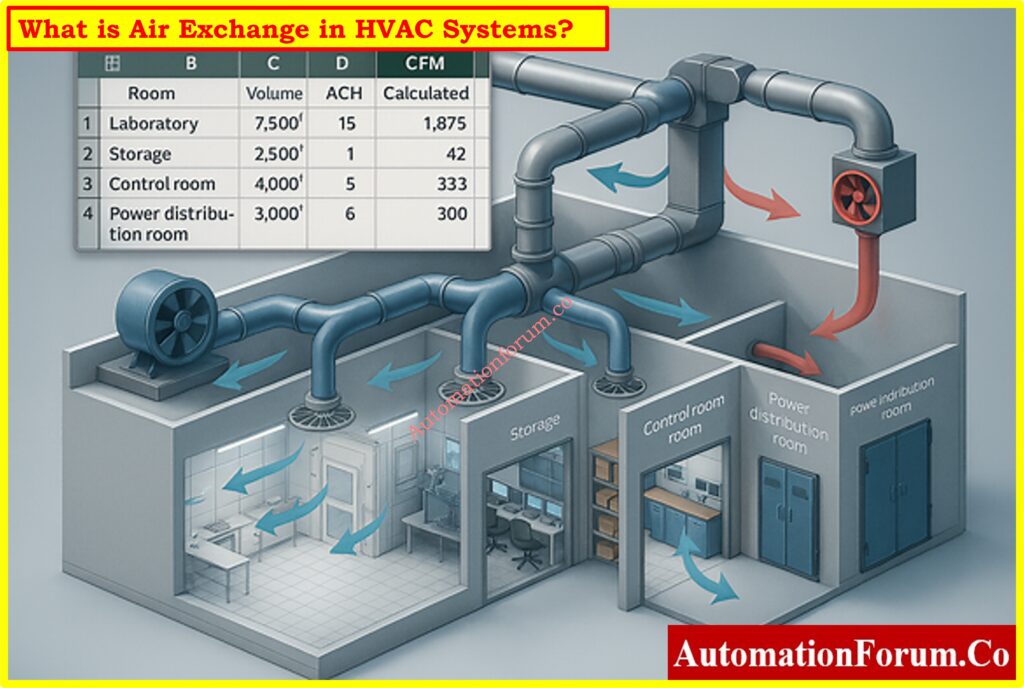
Air exchange is the process of replacing the air inside a building with fresh or conditioned air over a set amount of time. ACH, or Air Changes per Hour, is how it is measured.
- High ACH = safer air quality (labs, cleanrooms).
- Low ACH = acceptable for general spaces (warehouses, offices).
In process industries, bad air exchange design can lead to:
- Buildup of hazardous gases.
- When electrical equipment gets too hot
- Bad working conditions for operators
- Higher costs of doing business
Why Air Exchange is Important in Process Industry HVAC Design
Process organizations have settings with different needs:
- Control rooms need to keep operators comfortable and make sure that important equipment is stable.
- Laboratories need a lot of fresh air to mix and get rid of odors that could be hazardous.
- Electrical rooms need enough air flow to keep switchgear, drives, and UPS systems from getting too hot.
- To keep the quality of the products high, cleanrooms must keep stringent particle counts.
- Warehouses and storage spaces need enough air flow to keep vapors from building up and to make sure that workers are safe.
If air exchange is not constructed well, the room could fill up with hazardous or combustible gasses or get too hot. If the system is over-designed, it will use a lot of energy and cost a lot to run. So, an optimal calculation is necessary.
Refer the below link for Quickly Estimate Fan Airflow Resistance Accurately with our HVAC Fan Static Pressure Calculator – Accurate Airflow Resistance Estimator for Fan Sizing
Definition of Air Change per Hour (ACH)
Air Change per Hour (ACH) indicates you how many times the air in a room or other enclosed space is totally replaced with fresh or conditioned air in an hour. It is a key factor in HVAC design since it has a direct impact on safety, comfort, and the quality of the air inside. A greater ACH means cleaner air since it gets rid of pollutants, gases, or extra heat more often. This is important in places like labs, cleanrooms, and hospitals. In places like offices, warehouses, or storage facilities where air quality isn’t as important, lower ACH levels are usually okay.
Download the Air Exchange Calculation Excel Tool for HVAC Systems(Free)
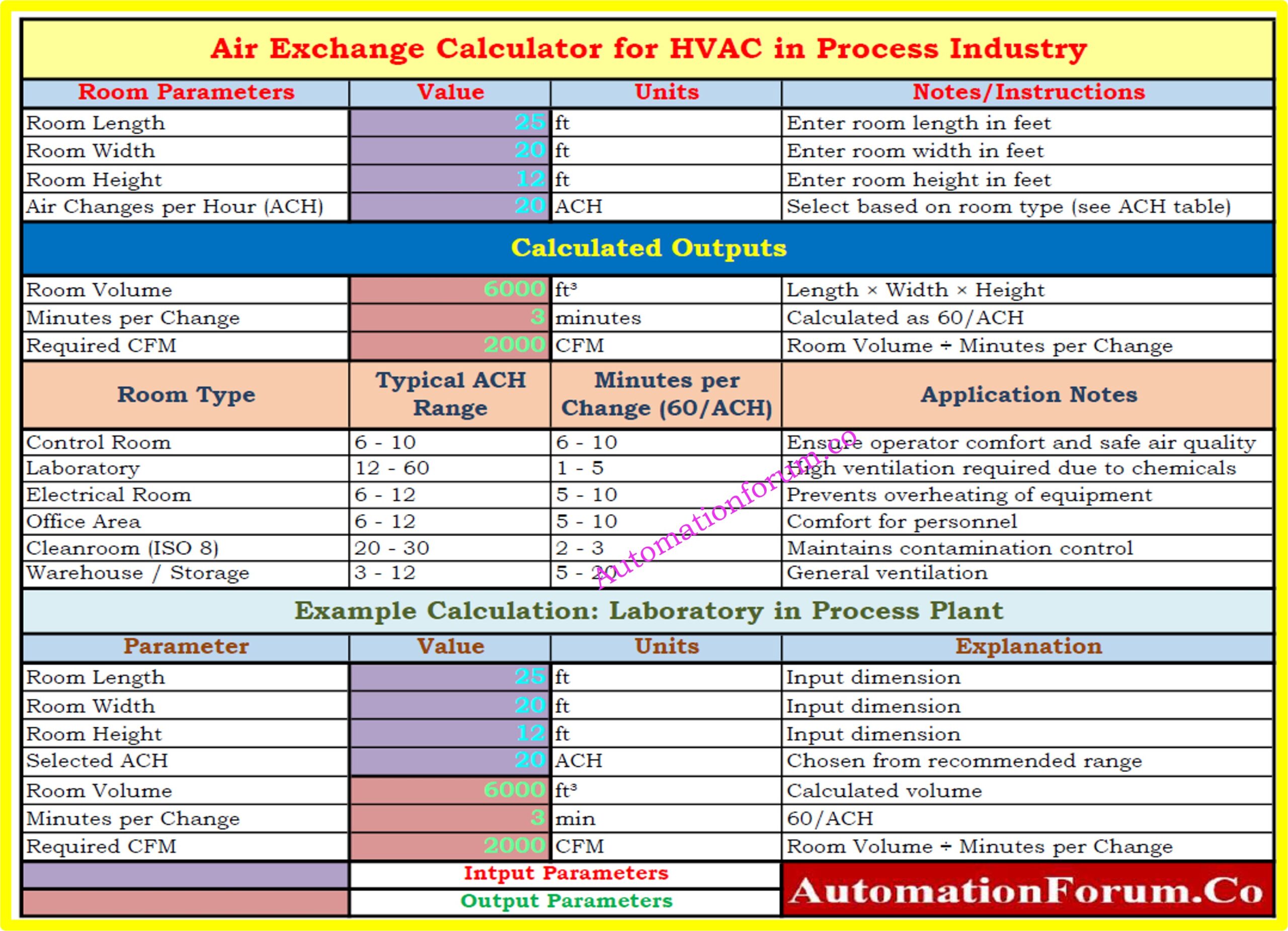
Our Air Exchange Calculation Excel Tool is ready to use and intended for process industry engineers to help you with your HVAC design process.
You can get it immediately by clicking the link below:
Click here for more Instrumentation excel Tool Resource
Formula for Air Exchange Calculation
There are two main equations that make up the Excel tool:
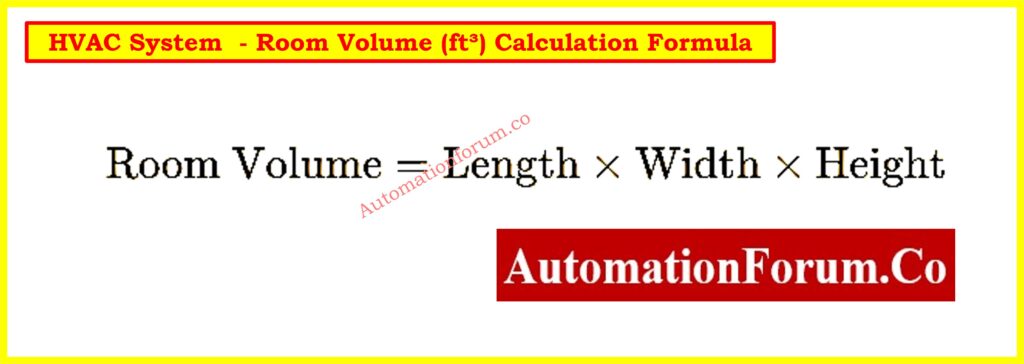
Room Volume (ft³):
Required Airflow (CFM):
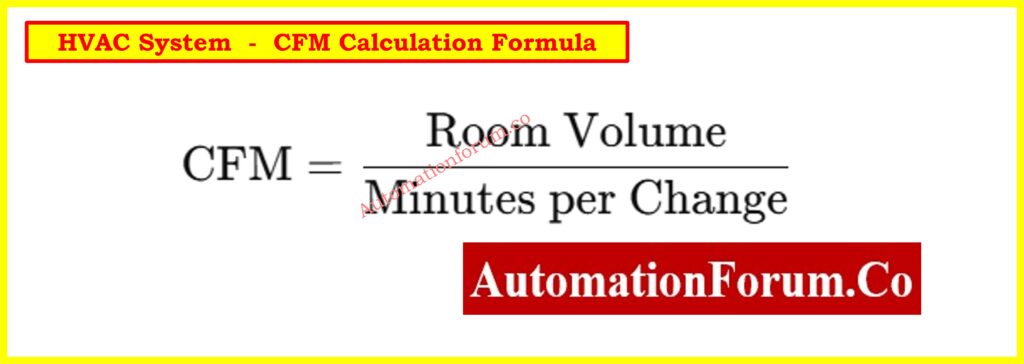
Where:
- ACH (Air Changes per Hour) determines the ventilation requirement.
- Minutes per Change is calculated as:
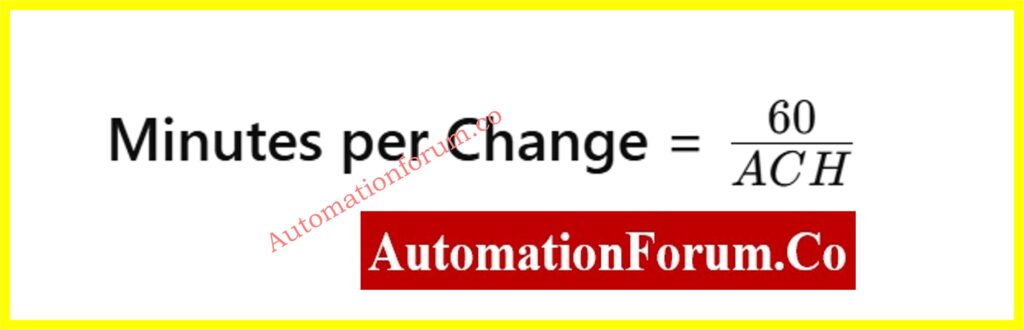
So, by entering in the room’s size and ACH, the tool automatically figures out how many CFM are needed.
Typical ACH Guidelines for Process Industry Spaces
| Room Type | ACH Range | Minutes per Change (60/ACH) | Application Notes |
| Control Room | 6 – 10 | 6 – 10 min | Ensures operator comfort and safe conditions |
| Laboratory | 12 – 60 | 1 – 5 min | Handles chemical fumes and ensures safety |
| Electrical Room | 6 – 12 | 5 – 10 min | Prevents overheating of switchgear and panels |
| Office Area | 6 – 12 | 5 – 10 min | Maintains personnel comfort |
| Cleanroom (ISO 8) | 20 – 30 | 2 – 3 min | Maintains cleanliness and product protection |
| Warehouse / Storage | 3 – 12 | 5 – 20 min | Provides general ventilation |
These ranges come from industry best practices, ASHRAE rules, and suggestions from manufacturers.
Essential HVAC Smoke Control Strategies Guide: Smoke control for HVAC system
Features of the Air Exchange Excel Tool
The Excel tool you submitted was made with the working design engineer in mind. Some of its features are:
Input Section:
- Room length, width, and height (in feet).
- Desired ACH based on room type.
Automatic Calculations:
- Room Volume (ft³).
- Minutes per Change (derived from ACH).
- Required CFM.
Reference Table:
- A built-in tool that lets you check up popular process industry rooms and their suggested ACH values.
Worked Example Section:
- Shows how to do calculations step by step in a lab, so users may check their work.
User-Friendly Formatting:
- There are color-coded headers for inputs, outputs, and reference data.
- Notes and directions to make everything clear.
- Locked computation cells so they can’t be accidentally overwritten.
Instantly Calculate Circular Duct Airflow Size: HVAC Circular Duct Size Calculator – Accurate Airflow and Diameter Sizing Tool
Step-by-Step Guide to Using the Excel Tool
- Open the Excel Tool.
The first worksheet has the calculator and cells for input and output.. - Enter Room Dimensions.
- Example: Length = 25 ft, Width = 20 ft, Height = 12 ft.
- Enter ACH.
- For a laboratory, select an ACH of 20 (within the 12–60 range).
- Review Calculations.
- Room Volume = 6,000 ft³.
- Minutes per Change = 60 ÷ 20 = 3 min.
- Required CFM = 6,000 ÷ 3 = 2,000 CFM.
- Compare with Reference Table.
- Ensure the selected ACH is appropriate for the application.
Example 1 – Laboratory Calculation
- Dimensions: 25 × 20 × 12 ft = 6,000 ft³.
- ACH selected: 20.
- Minutes per Change: 60 ÷ 20 = 3 min.
- Required CFM: 6,000 ÷ 3 = 2,000 CFM.
The HVAC system must supply at least 2,000 CFM to maintain safe air quality in the laboratory.
Example 2 – Electrical Room
- Dimensions: 30 × 15 × 12 ft = 5,400 ft³.
- ACH selected: 6.
- Minutes per Change: 60 ÷ 6 = 10 min.
- Required CFM: 5,400 ÷ 10 = 540 CFM.
This ensures adequate ventilation to prevent heat buildup around electrical equipment.
Example 3 – Cleanroom (ISO)
- Dimensions: 20 × 20 × 12 ft = 4,800 ft³.
- ACH selected: 25.
- Minutes per Change: 60 ÷ 25 = 2.4 min.
- Required CFM: 4,800 ÷ 2.4 ≈ 2,000 CFM.
This matches the high airflow requirement for contamination control.
Fast Circular Duct Air Velocity Calculator: Circular HVAC Duct Air Velocity Calculator for Engineers
Benefits of Using the Air Exchange Excel Tool
- Accuracy: Reduces the number of mistakes made when doing math by hand.
- Efficiency: It saves time while making changes to the design.
- Consistency is using the same strategy on all of your projects.
- Adaptability: Can be changed to fit different sorts of rooms.
- Documentation: Gives you computation sheets that you can keep track of for project records.
Complete Guide to HVAC Systems Explained: What is an HVAC System ?
Best Practices for HVAC Engineers in Process Industries
- Follow Standards: Always make sure you follow ASHRAE, NFPA, or your client’s rules.
- Use the Worst-Case Scenarios: Choose the lower end of Minutes per Change (greater ACH) for dangerous regions.
- Energy Efficiency: Find the right fan size to keep things safe while lowering operating costs.
- Combine Controls: Combine HVAC with gas detection, fire alarms, and systems for managing buildings.
- Check using Field Measurements: Testing after installation makes sure that the calculated CFM matches the actual airflow.
Use Reference Standards (ASHRAE, OSHA, Greenheck)
The performance of the HVAC system has a direct effect on the safety and air quality in process facilities. It is very important to get the air exchange rates right for:
- Getting rid of dust, pollutants, and vapors.
- Keeping the temperature of equipment (in electrical rooms and control rooms) constant.
- Making sure that OSHA, ASHRAE, and municipal codes are followed.
- Keeping labs and cleanrooms safe.
Balance Efficiency and Safety
In process industries, calculating air exchange is an important part of HVAC design. Engineers can make sure that systems are safe, work well, and follow the rules by figuring out the right airflow in CFM depending on the room size and ACH.
The Air Exchange Calculation Excel Tool is a useful tool for design engineers since it lets them do calculations quickly, accurately, and consistently. It connects theoretical design with real-world use by providing built-in reference tables, worked examples, and automatic formulae.
This tool is more than simply a calculator for process industry engineers who design HVAC systems. It is a decision-support system that makes sure that safety, reliability, and efficiency are maintained in a wide range of applications.
Common Questions About Air Exchange in HVAC Systems
Accurate Rectangular Duct Airflow Velocity Tool: Rectangular Duct Air Velocity Calculator for HVAC Engineers
FAQs on Air Exchange in HVAC Systems
How do you calculate air exchange?
Air exchange is measured in ACH (Air Changes per Hour).
Formula: ACH = (CFM × 60) ÷ Room Volume
Example: 800 CFM in a 4,000 ft³ room = 12 ACH.
How do you calculate air supply in HVAC?
Find the room volume, choose the recommended ACH, then use:
CFM = (ACH × Room Volume) ÷ 60
Example: A 5,000 ft³ lab at 20 ACH = 1,667 CFM.
How many CFM for air exchange?
It depends on the ACH requirement.
Example: A 4,800 ft³ cleanroom at 25 ACH = 2,000 CFM.
How to calculate air formula?
The main formula is:
CFM = (ACH × Room Volume) ÷ 60
How to calculate CFM in HVAC?
Two ways:
- From ACH to CFM = (ACH × Room Volume) ÷ 60
- From cooling load to 1 ton ≈ 400 CFM
How much CFM is in 1 ton?
Rule of thumb: 1 ton = 400 CFM
That means that 2 tons is 800 CFM and 5 tons is 2,000 CFM.
What is a good ACH for electrical rooms?
To keep against overheating, between 6 and 12 ACH.
How many air changes per hour are required for a laboratory?
Usually from 12 to 60 ACH, depending on how many chemicals are used and how safe they need to be.
Click here for 200+ Online Instrumentation Calculators Collections
