
Liquid Flow Sizing & Pressure Loss · Reference: ISO 5167-4
- Introduction to the Venturi Flowmeter Calculator
- Why Use the Venturi Flowmeter Calculator
- How the Venturi Flowmeter Calculator Works
- Understanding Every Input Used in the Venturi Flowmeter Calculator
- Understanding Every Result Produced by the Venturi Flowmeter Calculator
- Beta Ratio
- Volumetric Flow Rate
- Mass Flow Rate
- Throat Velocity
- Permanent Pressure Loss
- Engineering Principles Used by the Venturi Flowmeter Calculator
- Practical Example Using the Venturi Flowmeter Calculator
- Benefits of Using the Venturi Flowmeter Calculator
- Limitations of the Venturi Flowmeter Calculator
- Conclusion: Why the Venturi Flowmeter Calculator Simplifies Flow Sizing
- Frequently Asked Questions on Venturi Flowmeter Calculator
- How to calculate Venturi flow rate?
- How to calculate flow meter?
- How to design a Venturi flow meter?
- How to calculate velocity in Venturi meter?
- How to calculate the flow velocity?
- How does a Venturi meter measure flow rate?
- What is the Beta Ratio in a Venturi Flowmeter?
- Why is the Discharge Coefficient Important?
- Why is Permanent Pressure Loss Lower in a Venturi Tube?
- Is This Venturi Flowmeter Calculator Based on ISO 5167 Part 4?
Introduction to the Venturi Flowmeter Calculator
Choosing the right flowmeter is just one piece of the puzzle when developing an accurate flow measurement system. The selected flowmeter must also be able to measure the appropriate flow range, while retaining acceptable pressure loss and working within the guidelines of the applicable international standards. This is especially true for Venturi flowmeters, where the final measurement results depend on pipe diameter, throat diameter, fluid density, and differential pressure.
To make these engineering calculations easier for liquid applications, the Venturi Flowmeter Calculator has been developed. Instead of having to do long manual calculations using several formulae, engineers may just enter a few process parameters and quickly estimate key design variables such as Beta Ratio, Volumetric Flow Rate, Mass Flow Rate, Throat Velocity and Permanent Pressure Loss. These calculations are based on the principles given in ISO 5167 Part 4, the worldwide standard for Venturi tube flow measurement.
This calculator is meant to assist instrumentation engineers, process engineers, EPC designers, commissioning teams, maintenance workers and plant operators in preliminary flowmeter sizing and engineering evaluation. It can also be used for checking existing installations, comparing design options and understanding the implications of changing one process parameter on the overall performance of the flowmeter.
This Venturi Flowmeter Calculator, unlike many online calculators that only give a numerical output, helps engineers comprehend how input process data relates to resulting flow characteristics. Evaluating flow rate, velocity and pressure loss in parallel allows engineers to make more informed decisions during equipment selection and process optimisation.
Although the calculator is based on ISO 5167 Part 4 calculation principles the calculated values must be checked against project specifications, manufacturer recommendations and real process conditions prior to final equipment selection.
Master Accurate Mass Flow Calculations Using This Powerful Engineering Tool: Coriolis Mass Flow Calculator – Complete Guide for Instrumentation & Process Engineers
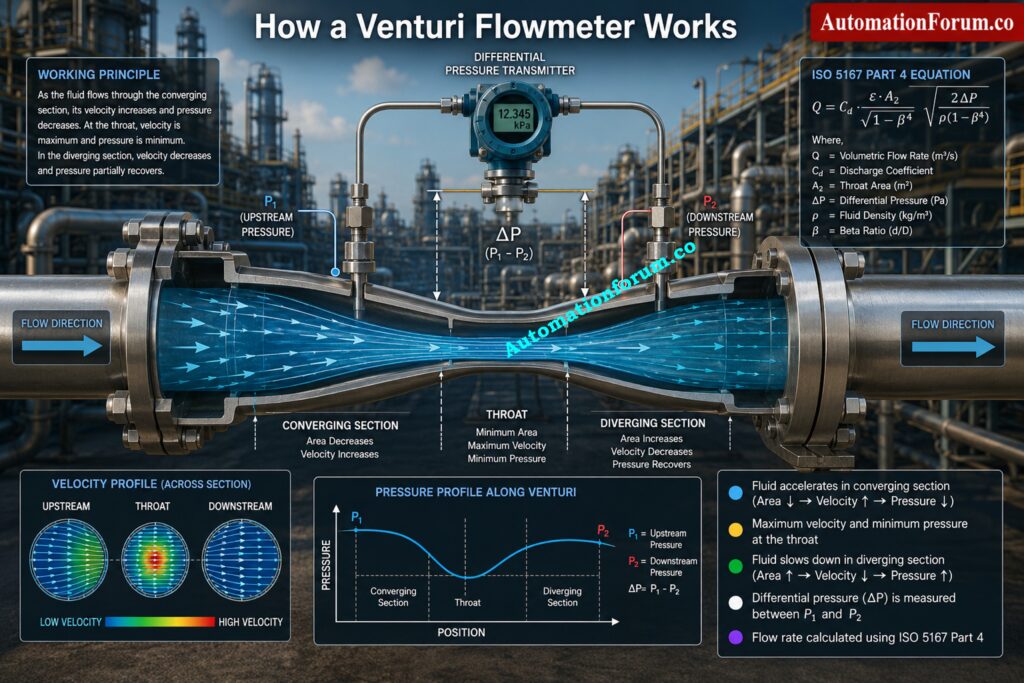
Why Use the Venturi Flowmeter Calculator
Perform Accurate Venturi Flowmeter Sizing
The manual calculation of flow through a Venturi tube involves multiple engineering equations. One needs to be careful about units, correction factors and process parameters. While experienced engineers understand these calculations, performing them repeatedly during design or troubleshooting can be time consuming and increases the possibility of calculation errors.
Support EPC Design and Engineering Projects
The Venturi Flowmeter Calculator automates these calculations and provides immediate engineering results using a simple set of process inputs.
This calculator is valuable during many stages of an engineering project.
Preliminary Flowmeter Sizing
Before purchasing a Venturi flowmeter, engineers can estimate expected flow rates and pressure losses for different pipe and throat diameters.
Equipment Selection
The various Venturi sizes can be rapidly evaluated to determine the best arrangement for the process conditions needed.
Avoid Installation Mistakes That Destroy Flow Measurement Accuracy: Electromagnetic Flow Meter Installation – Step-by-Step Guide and Checklist for Accurate Measurements
EPC Engineering
Process and instrumentation engineers may use the calculator during the design phase to assess proposed pipeline arrangements and to confirm that the selected flowmeters operate within acceptable design limits.
Commissioning
Commissioning engineers can compare actual plant measurements against calculated values to ensure correct installation and instrument functioning.
Maintenance and Troubleshooting
When the observed flow is not as predicted, the calculator provides a useful engineering reference for evaluating potential causes of the difference, such as improper differential pressure, wrong density values, or unsuitable operating conditions.
Energy Evaluation
Because the calculator estimates permanent pressure loss, engineers can assess the hydraulic impact of the selected Venturi tube and determine whether additional pump head may be required.
Refer the below link for the Turndown Ratio Calculator for Flow Meters and Process Instruments
How the Venturi Flowmeter Calculator Works
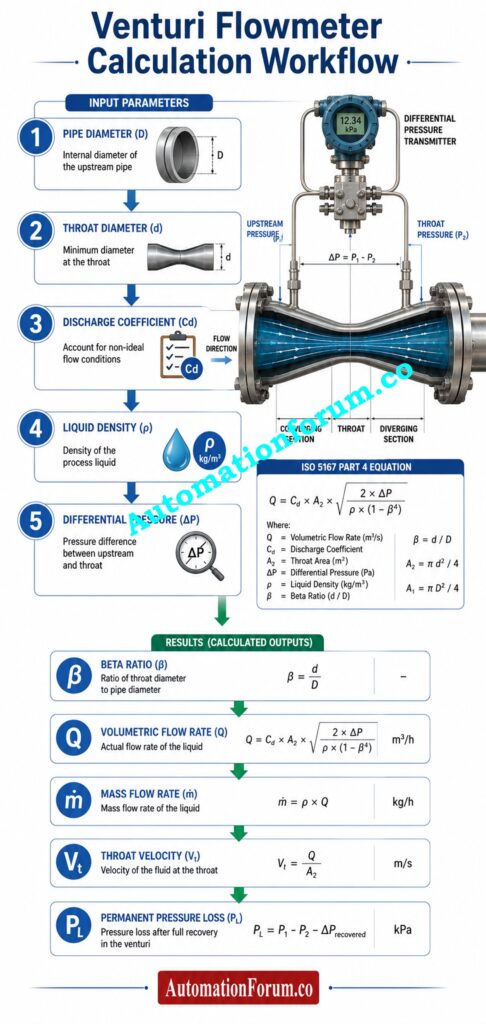
The Venturi Flowmeter Calculator performs a series of engineering calculations using five user supplied process parameters. These values are combined using the calculation principles defined in ISO 5167 Part 4 to estimate the hydraulic performance of the Venturi tube.
Rather than simply producing a flow value, the calculator evaluates several important operating characteristics that help engineers understand whether the selected Venturi tube is suitable for the application.
Step 1 Enter Pipe Internal Diameter
The first figure you enter in the calculator is the Pipe Internal Diameter.
This measurement is the actual interior diameter of the pipeline in which the Venturi tube is fitted. It also specifies the upstream flow region and is the basis for all further computations.
The pipe diameter affects:
- Speed of liquid before venturi tube
- Beta Ratio
- Generating a differential pressure
- Capacity of flow
The computed values are slightly sensitive to the pipe diameter. Thus, engineers should always use the actual internal diameter, if possible, rather than the nominal pipe size.
Step 2 Enter the Venturi Throat Diameter
The second input is the Venturi Throat Diameter .
The throat is the narrowest part of the Venturi tube where the liquid velocity increases and a pressure difference is created, which is detected by the differential pressure transmitter.
A smaller throat diameter generally produces:
- Higher liquid velocity
- Larger differential pressure
- Greater measurement sensitivity
- Higher permanent pressure loss
A larger throat diameter generally produces:
- Lower differential pressure
- Lower liquid velocity
- Reduced pressure loss
- Lower measurement sensitivity
Selecting the correct throat diameter is one of the most important design decisions when sizing a Venturi flowmeter.
Discover Which Flowmeter Performs Better Before You Make Decisions: Magnetic Flowmeter vs. Turbine Flowmeter – Complete 2025 Comparison Guide
Step 3 Enter the Discharge Coefficient
The Discharge Coefficient corrects the theoretical flow calculation to real fluid behaviour.
In real installations, the fluid does not behave exactly as anticipated by the ideal fluid equations because to friction, surface roughness, manufacturing tolerances and flow characteristics.
The discharge coefficient accounts for these variances and allows the calculated flow rate to be more accurate.
The use of an erroneous discharge coefficient might result in large inaccuracies particularly in high accuracy applications.
Step 4 Enter the Liquid Density
The next input is the Liquid Density expressed in kilograms per cubic metre.
Density is an essential property because the differential pressure produced by a Venturi tube depends on the mass of the flowing liquid.
For the most accurate results, engineers should enter the density corresponding to the actual operating temperature and pressure rather than standard reference conditions.
This value directly influences the calculated mass flow rate and contributes to the overall flow calculation.
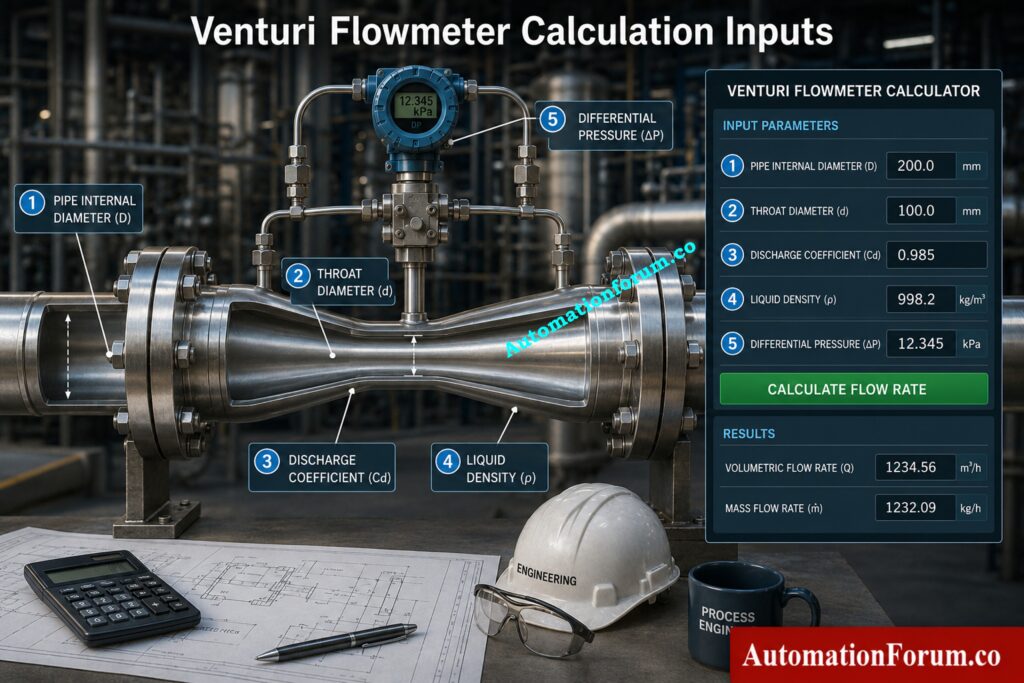
Step 5 Enter the Differential Pressure
The last input is the Differential Pressure between the upstream pressure tapping, and the throat pressure tapping.
This is the major output measured value from the Venturi flowmeter.
As the liquid flow rises, the differential pressure increases. The calculator uses this measured differential pressure and the process data that was entered earlier to calculate other flow parameters.
The differential pressure measurement is reliable if the pressure tapping points are properly installed, the impulse lines are clean and the differential pressure transmitter is suitably calibrated.
Prevent Expensive Meter Failures With These Proven Maintenance Techniques: How to Maintain Coriolis Mass Flowmeters ?
Understanding Every Input Used in the Venturi Flowmeter Calculator
Any input you type into the calculator will change one or more of the calculated outcomes. Understanding these linkages enables engineers to properly understand results and make better design decisions.
| Calculator Input | Purpose | Effect on Calculation | Engineering Consideration |
| Pipe Internal Diameter | Defines the upstream flow area | Influences beta ratio, velocity, and flow capacity | Use the actual internal pipe diameter |
| Venturi Throat Diameter | Defines the restriction area | Controls differential pressure and throat velocity | Select carefully to balance sensitivity and pressure loss |
| Discharge Coefficient | Corrects theoretical flow | Improves flow calculation accuracy | Follow ISO 5167 or manufacturer data |
| Liquid Density | Represents the operating fluid | Required for accurate mass flow calculations | Use operating density instead of standard density |
| Differential Pressure | Primary measured process variable | Used to calculate all flow related outputs | Ensure transmitter calibration and clean impulse lines |
Based on the calculation principles of ISO 5167 Part 4, the Venturi Flowmeter Calculator provides engineers with the ability to input precise process data, and to generate reliable preliminary sizing findings that can support equipment selection, commissioning and process evaluation.
Understanding Every Result Produced by the Venturi Flowmeter Calculator
By entering all the essential process inputs, the Venturi Flowmeter Calculator automatically produces five important engineering characteristics which help to evaluate both the hydraulic performance of the Venturi tube and its suitability for the application. The results give useful data in equipment sizing, process design, commissioning, troubleshooting and normal plant operation. The calculator calculates these numbers in accordance with the mathematical principles defined in ISO 5167 Part 4.
Beta Ratio
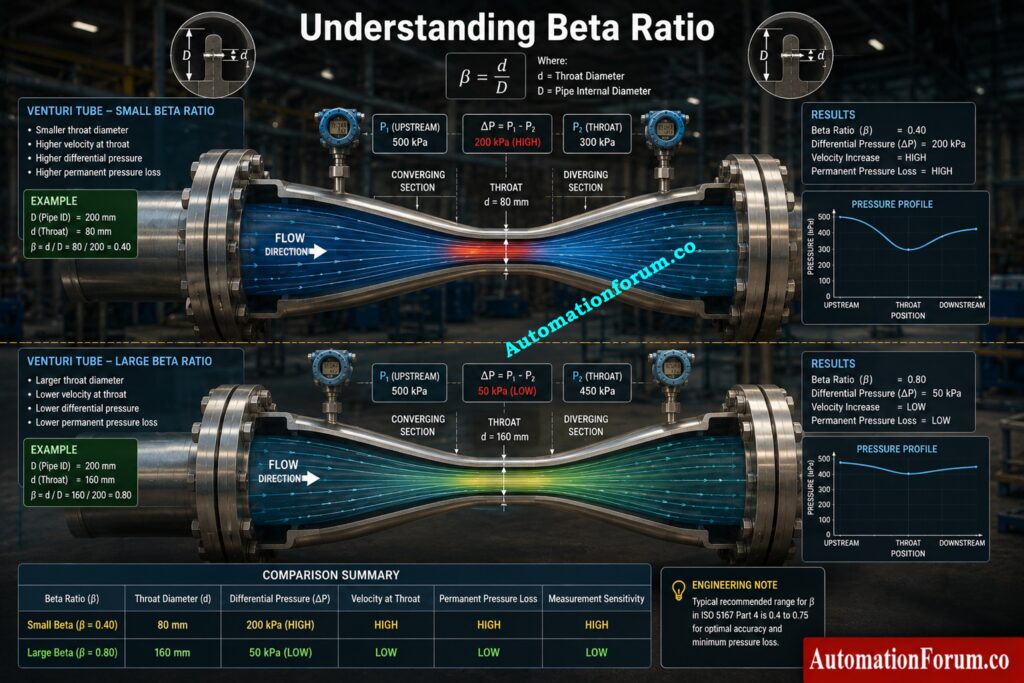
The first computed value is the Beta Ratio (β), which is the ratio between the Venturi throat diameter and the pipe internal diameter.
Formula
β = d ÷ D
Where:
- d = Venturi throat diameter
- D = Pipe internal diameter
This is a very basic calculation yet one of the most influential design elements in Venturi flow measurement.
Smaller the beta ratio gives a stronger constraint resulting in larger differential pressure and higher throat velocity. However, increasing the beta ratio reduces the pressure drop but increases the measurement sensitivity.
The beta ratio influences:
- Creation of differential pressure
- Sensitivity of flow measurement
- throat speed
- Continuous pressure drop
- Hydraulic efficiency overall
Engineers will usually compare the calculated beta ratio for different throat diameters before choosing the final Venturi tube.
Refer the below link for the Orifice Beta Ratio: Why It Falls Between 0.3 and 0.7 for Optimal Flow Measurement
Volumetric Flow Rate
Engineers will usually compare the calculated beta ratio for different throat diameters before choosing the final Venturi tube.
- m³/h
- m³/s
- L/s
This is one of the most commonly used process variables in industrial automation.
Volumetric flow rate is required for:
- Process control
- Production monitoring
- Water distribution
- Utility management
- Pipeline design
- Pump sizing
Rather, flow is calculated immediately from differential pressure and fluid characteristics . The usage of this calculator allows engineers to estimate plant operating conditions rapidly, without having to undertake lengthy manual computations.
The computed volumetric flow rate can also be compared to the data from the DCS or flow computer during commissioning to ensure that the instruments have been set up correctly.
Learn The Critical Sampling System Behind Reliable Gas Analysis: Gas Analyzer Sampling System
Mass Flow Rate
Mass Flow Rate The actual mass of the liquid flowing through the pipeline for a given period of time.
Mass flow, unlike volumetric flow, takes account of variations in fluid density.
This is especially crucial for:
- Chemical dosing
- Batch processing
- Material balance calculations
- Custody transfer
- Production accounting
For example , two liquids can have the same volumetric flow , yet different densities . Their mass flow rates would so be different.
It requires volumetric flow and liquid density, and automatically estimates mass flow . This helps engineers analyze process performance without any further calculations.
Size Orifice Plates Correctly And Minimize Pressure Drop Efficiently: Orifice Plate Sizing & Pressure-Drop Calculator (ISO 5167 Excel Download)
Throat Velocity
Another useful output from the calculator is Throat Velocity.
This is the velocity of the liquid as it passes the narrowest region of the Venturi tube.
The throat velocity is a crucial design parameter as too high speeds can cause operational problems such as:
- Increased erosion
- Cavitation
- Excessive vibration
- Higher pressure losses
- Reduced equipment life
Low throat velocity can also lead to a reduced measurement sensitivity due to the lack of generation of differential pressure.
When sizing a Venturi , engineers try to select a throat velocity that will give good measurement reliability and not too much hydraulic loss .
Simplify Complex Flowmeter Choices With Expert Engineering Strategies: Streamlining Your Flowmeter Selection Process: Tips and Insights
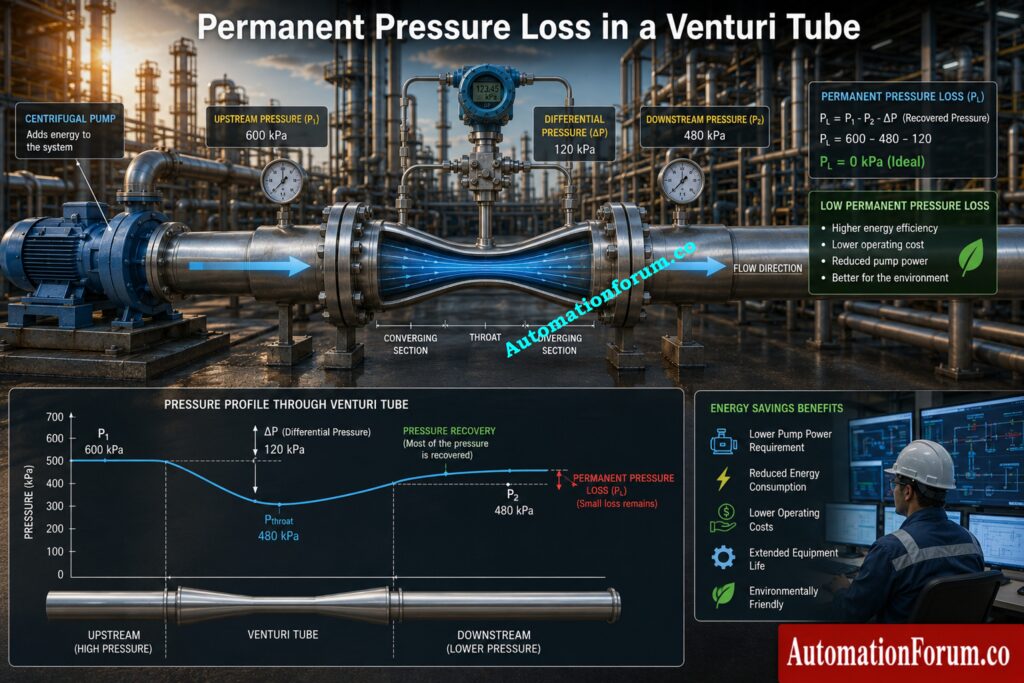
Permanent Pressure Loss
The result of the final computation is Permanent Pressure Loss.
This is the amount of pressure that cannot be recovered after the liquid passes the Venturi tube.
Most of the pressure is recovered in the diffuser portion but a small amount is lost permanently because of friction and turbulence.
This value is especially important because it directly affects:
- Pump head requirements
- Energy consumption
- Operating costs
- Overall plant efficiency
One of the key advantages of the Venturi tube is its much reduced permanent pressure loss as compared to several other differential pressure flowmeters.
In large continuous pumping systems throughout the year, even a small reduction of permanent pressure loss can lead to significant energy savings.
Follow This Proven Procedure For Highly Accurate Flow Control: Mass Flow Controller Calibration Procedure
Engineering Principles Used by the Venturi Flowmeter Calculator
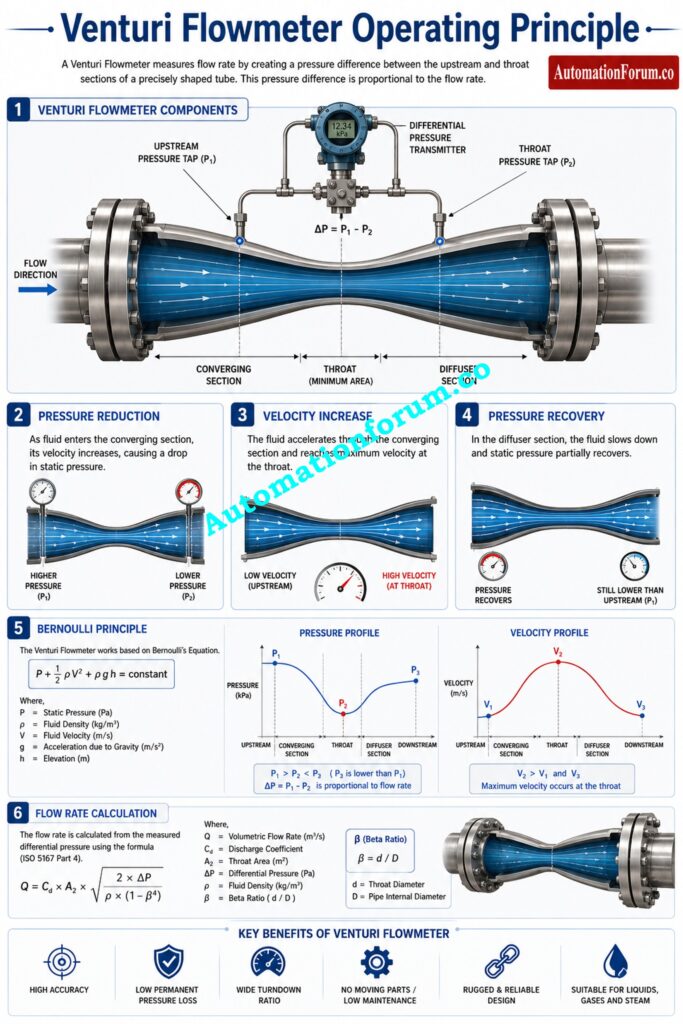
- The calculator does the calculations automatically . But the engineer has to grasp the technical principles involved to interpret the results correctly .
- The calculation begins with the Continuity Equation, which says that the flow into the Venturi tube must match the flow out of the Venturi tube.
- Inside the throat the flow area is reduced and so the liquid velocity is increased.
- The calculator then uses the Bernoulli Equation to relate the velocity and pressure .
- Static pressure falls as velocity rises.
- The differential pressure measured between the upstream section and the throat becomes the differential pressure used to calculate flow.
- The calculation additionally uses the Discharge Coefficient because actual industrial flow is slightly different than ideal theoretical flow. This correction factor includes effects like friction , surface roughness , manufacturing tolerances etc . This increases the correctness of the estimated findings .
- The computed Beta Ratio affects the differential pressure generation and pressure recovery.
- Finally, the calculator provides an estimate of the Permanent Pressure Loss, which allows the engineer to analyze the hydraulic effect of the selected Venturi tube on the pumping system.
- These technical principles together constitute a feasible approximation of genuine operating circumstances and support preliminary sizing according to ISO 5167 Part 4.
Solve Common Electromagnetic Flowmeter Problems Like An Experienced Engineer: Electromagnetic Flowmeter Troubleshooting: Identifying and Resolving Issues
Practical Example Using the Venturi Flowmeter Calculator
Consider a water distribution pipeline with the following process conditions.
| Input Parameter | Value |
| Pipe Internal Diameter | 150 mm |
| Venturi Throat Diameter | 90 mm |
| Discharge Coefficient | 0.995 |
| Liquid Density | 1000 kg/m³ |
| Differential Pressure | 25 kPa |
The engineer enters these values into the calculator. The calculator then estimates:
- Beta Ratio
- Volumetric Flow Rate
- Mass Flow Rate
- Throat Velocity
- Permanent Pressure Loss
The results enable the engineer to ascertain if the chosen venturi tube will provide sufficient differential pressure at an appropriate throat velocity and at low permanent pressure loss.
If the calculated pressure loss is too high, then a wider throat diameter may be chosen. If the differential pressure is not sufficient for reliable transmitter performance, a smaller throat diameter may be considered.
The ability to examine several design alternatives in seconds makes the calculator a useful engineering tool during project design and commissioning.
Calculate Venturi Flow Faster Using Advanced Engineering Principles: Advanced Venturi Tube Flow Calculator – Formula, Working & Applications

Benefits of Using the Venturi Flowmeter Calculator
The calculator provides a number of useful features for instrumentation and process engineers.
- Removes manual, repetitive calculations.
- Provides reliable computations according to ISO 5167 Part 4.
- Minimizes mistakes in engineering calculations .
- It supports preliminary sizing of venturi flowmeters.
- Helps to compare different combinations of pipe and throat diameters.
- Provides estimates of volumetric and mass flow rates.
- Calculates throat velocity for hydraulic analysis.
- Provides estimated permanent pressure loss for pump selection studies.
- Assists EPC engineers during detailed design.
- Helps commissioning engineers verify field performance.
- Supports troubleshooting by comparing expected and measured values.
- Saves engineering time during equipment selection and process evaluation.
See Exactly How A Venturi Flow Meter Measures Flow: Working principle of Venturi Flow Meter
Limitations of the Venturi Flowmeter Calculator
The Venturi Flowmeter Calculator gives a good first engineering calculation, but is not a replacement for full engineering design.
The final choice of equipment should also consider:
- Reynolds number limitations.
- Actual installation conditions.
- Required upstream and downstream straight pipe lengths.
- Fluid viscosity and process variations.
- Manufacturer specific calibration data.
- Project specifications and customer requirements.
- Applicable editions of ISO 5167.
- Site acceptance and commissioning test results.
The calculator is intended to support engineering decisions rather than replace professional engineering judgement.
Convert Mass Flow Units Instantly Without Manual Engineering Calculations: Mass Flow Rate Converter : Convert kg/s, lb/min, SCFM, L/h and 50+ Units
Conclusion: Why the Venturi Flowmeter Calculator Simplifies Flow Sizing
The Venturi Flowmeter Calculator provides a fast and practical method for estimating liquid flow characteristics using the calculation principles of ISO 5167 Part 4. By entering five key process inputs pipe internal diameter, throat diameter, discharge coefficient, liquid density, and differential pressure engineers can quickly obtain essential results including beta ratio, volumetric flow rate, mass flow rate, throat velocity, and permanent pressure loss.
These estimated values are helpful for engineers to assess the performance of a Venturi flowmeter during preliminary design, equipment selection, commissioning and troubleshooting. They also offer vital insight into hydraulic performance, allowing educated decisions to increase measurement accuracy and lower operating costs.
The calculator facilitates complex flow calculations, but the results should be always verified against the project parameters, manufacturer recommendations and ISO 5167 criteria. When combined with sound engineering judgement and good installation practices, this calculator becomes a powerful tool for the selection and evaluation of Venturi flowmeters in oil and gas, chemical, power generation, water treatment, food processing, pharmaceutical and other industrial applications.
Prevent Measurement Errors By Venting DP Transmitters Correctly Every Time: How to Properly Vent a Pressure or DP Transmitter in Liquid Service
Frequently Asked Questions on Venturi Flowmeter Calculator
How to calculate Venturi flow rate?
The Venturi flow rate is computed using the pressure difference between the pipe upstream and the Venturi throat, the pipe diameter, the throat diameter, the discharge coefficient and the liquid density. The Venturi Flowmeter Calculator automatically conducts these calculations in accordance with the standards of ISO 5167 Part 4, therefore no human calculations are required.
How to calculate flow meter?
Flow through a differential pressure flowmeter is measured by measuring the differential pressure caused by the restriction and using the proper flow equations with correction factors. This calculator estimates volumetric flow rate and mass flow rate using the entered process parameters and ISO 5167 based calculation methodology.
How to design a Venturi flow meter?
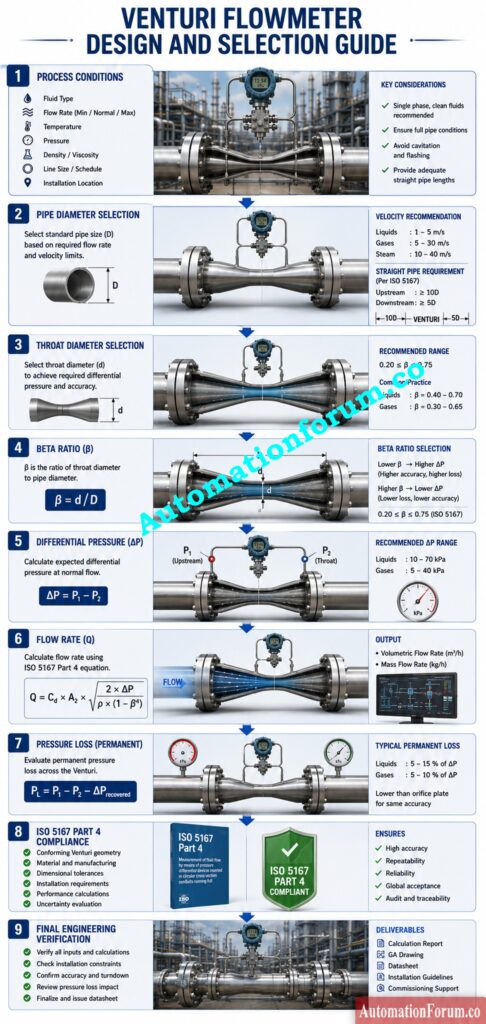
In order to design a Venturi flowmeter, the appropriate pipe diameter, throat diameter, beta ratio, discharge coefficient and differential pressure range must be selected, following the requirements of ISO 5167. Engineers should additionally examine the expected range of flow, the maximum permissible pressure loss, installation constraints and the process conditions before finishing the design.
Transform Differential Pressure Into Accurate Flow Values Within Seconds: Differential Pressure to Flow Calculator – Complete Interactive Tool for Process Engineers
How to calculate velocity in Venturi meter?
The velocity in a Venturi meter is obtained by dividing the computed flow rate by the cross sectional area of the throat section. The Venturi Flowmeter Calculator automatically calculates the throat velocity so that the engineer can make sure that the velocity is within acceptable operating limits and will not increase the risk of erosion or cavitation.
How to calculate the flow velocity?
The velocity of the flow is determined by dividing the volumetric flow rate by the cross-sectional area through which the liquid flows. This number is used by engineers to assess hydraulic performance, pipe sizing, equipment wear and overall process efficiency during system design and commissioning.
How does a Venturi meter measure flow rate?
A Venturi meter determines the flow rate by developing a pressure difference as the liquid flows past a gradually narrowing throat piece. The pressure drop is measured by the differential pressure transmitter and the Venturi FlowMeter Calculator calculates the volumetric flow rate and mass flow rate according to the calculation principles according to ISO 5167 Part 4 and the entered process data.
Achieve Reliable Flow Measurements Through Proper Calibration Practices: Electromagnetic flowmeter Calibration procedure
What is the Beta Ratio in a Venturi Flowmeter?
The beta ratio (β) is the ratio of the Venturi throat diameter to the pipe internal diameter (β = d/D). It defines the differential pressure, accuracy of flow measurement, throat velocity and the permanent pressure loss.
Why is the Discharge Coefficient Important?
The discharge coefficient (Cd) is a correction factor applied to the theoretical flow equation to take into account real fluid behaviour, friction and manufacturing tolerances. Using the correct Cd can increase the accuracy of the computed flow rate.
Why is Permanent Pressure Loss Lower in a Venturi Tube?
The Venturi tube has a smooth converging and diverging profile which recovers most of the pressure after the throat. The result is a device that consumes less energy and uses less pump power than many other differential pressure flowmeters.
Is This Venturi Flowmeter Calculator Based on ISO 5167 Part 4?
Yes. The Venturi Flowmeter Calculator calculates the beta ratio, flow rates, throat velocity and permanent pressure loss based on input process data according to the mathematical principles of ISO 5167 Part 4.
Refer the below link for the Vortex Flow Meter Calibration Procedure
