
- What Is ON OFF Control Valve Type Selection?
- ON OFF Valve Versus Control Valve
- Types of ON OFF Valves Used in EPC Projects
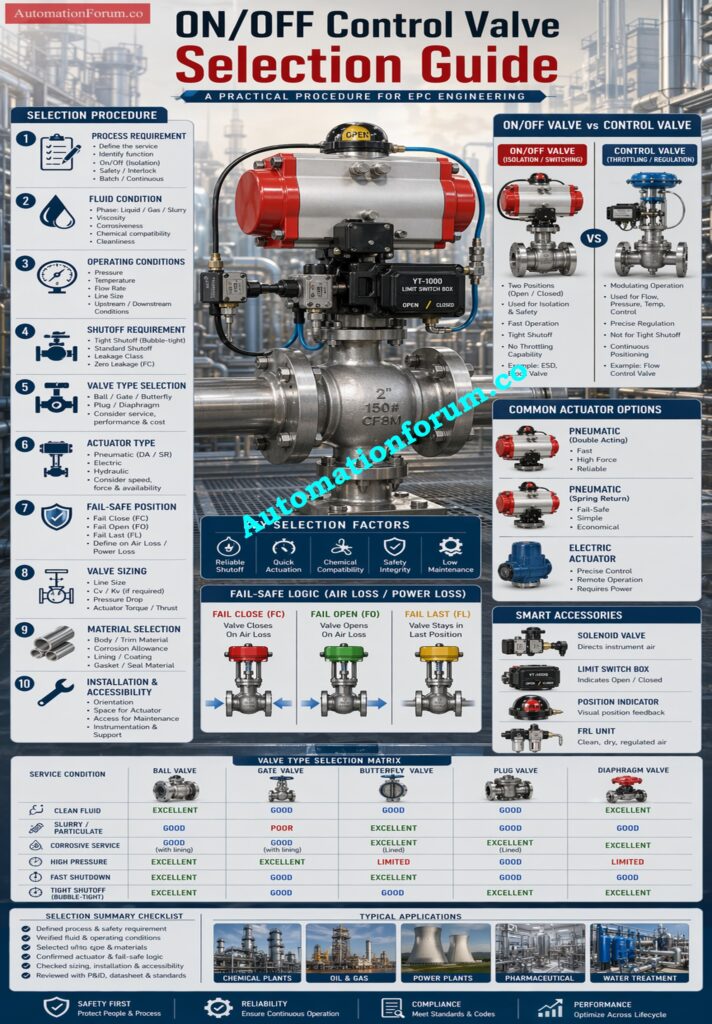
- Step by Step ON OFF Valve Selection Procedure
- Step 1: Define the process requirement
- Step 2: Study the fluid condition
- Important fluid questions
- Step 3: Confirm operating conditions
- Step 4: Define shutoff requirement
- Step 5: Choose the correct valve type
- Step 6: Select the actuator type
- Step 7: Decide fail safe position
- Step 8: Check valve sizing
- Step 9: Select the correct material
- Step 10: Review installation and accessibility
- EPC Engineering Design Workflow for ON OFF Valve Selection
- ON OFF Valve Selection Decision Table
- Common Mistakes in ON OFF Valve Selection
- Real Industrial Case Study on ON OFF Valve Selection
- Engineering Checklist for ON OFF Valve Selection
- FAQs ON OFF Control Valve Type Selection
- Download: Checklist for ON OFF Control Valve Type Selection Procedure for EPC Engineer
What Is ON OFF Control Valve Type Selection?
Meaning of ON OFF valve selection in EPC engineering
In EPC engineering, ON OFF valve selection is not a minor equipment decision. It directly affects plant safety, shutdown response, operability, maintenance, and long term reliability. These valves are commonly used where the process needs a definite open or closed position rather than continuous throttling. In practice, they are used for isolation, emergency shutdown, line switching, and interlock driven actions. The selection has to match the plant philosophy because the wrong valve can cause leakage, slow closing, pressure loss, or even failure during a trip condition.
Why ON OFF valve selection is important in process plants
Many field problems start at the design stage. A valve may be chosen only by line size or price, while actual fluid condition, shutoff requirement, and fail safe logic are ignored. That approach leads to poor performance in operation. In EPC work, the valve must support the process, the safety system, and the maintenance team. For that reason, valve selection should always be done with a structured engineering procedure.
Effect on operability and maintenance
An ON OFF valve is intended to isolate or switch flow. A control valve is intended to regulate flow continuously. This difference is very important because an ON OFF valve is expected to provide tight shutoff and quick action, while a control valve is expected to provide stable throttling. Using one in place of the other creates poor performance and unnecessary wear. ON OFF valves are primarily used for isolation and switching service.
Stop Valve Passing Problems Fast: Root Cause: How to Troubleshoot a Control Valve Passing Problem after Overhauling: Complete Root Cause Analysis
ON OFF Valve Versus Control Valve
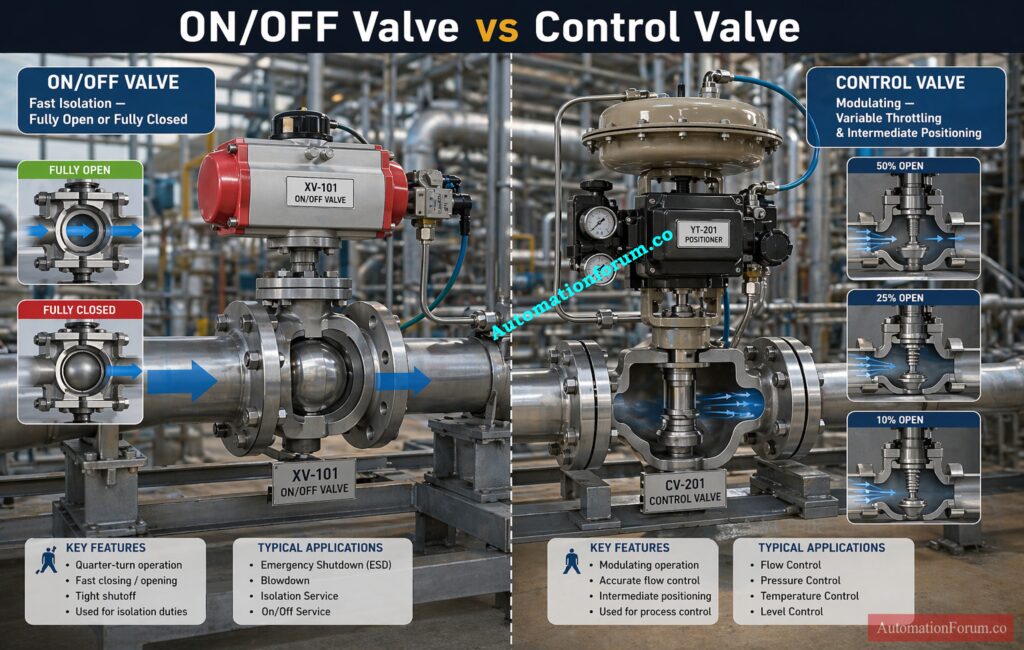
Functional difference between ON OFF and control valves
The ON OFF valve works in two positions only. It is either fully open or fully closed. The control valve, on the other hand, can stay at any position between open and closed based on the control signal.
Application difference in EPC projects
ON OFF valves are common in shutdown systems, emergency isolation, utilities, and batch transfer lines. Control valves are common in temperature, pressure, flow, and level control loops where smooth process regulation is required.
Performance expectation of ON OFF valves
For ON OFF valves, the main expectation is fast movement and dependable shutoff. For control valves, the expectation is accurate positioning and stable modulation. ON OFF valves require tight shutoff and minimal pressure drop in service, while control valves are designed for process regulation.
Master ON Delay and OFF Delay Timers: Understanding ON Delay and OFF Delay Timers in PLC Programming
ON OFF valve comparison table
| Parameter | ON OFF Valve | Control Valve |
| Main function | Isolation and switching | Modulation and regulation |
| Movement | Fully open or fully closed | Any intermediate position |
| Shutoff | Very important | Depends on duty |
| Accuracy | Not critical for control | Very important |
| Response | Fast action | Smooth and proportional |
| Typical types | Ball, gate, butterfly, plug, diaphragm | Globe, segmented ball, butterfly control type |
Control Valve Datasheets Done Right, Step by Step: How to Prepare Control Valve Datasheets: A Step-by-Step Procedure for EPC Instrumentation Engineers
Types of ON OFF Valves Used in EPC Projects
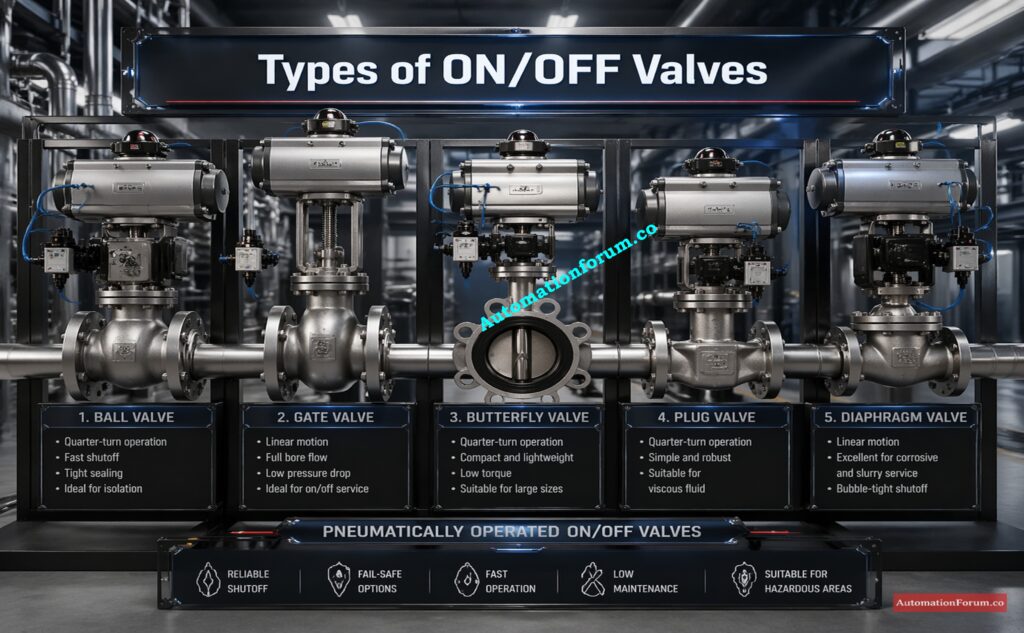
Ball valve for ON OFF service
Ball valves are widely used in process plants because they provide fast quarter turn operation, strong shutoff performance, and low pressure drop in fully open position. They are ideal for gas, clean liquid, hydrocarbon, and utility service. In shutdown duty, they are often the first choice when quick closure is needed.
Gate valve for isolation service
Gate valves are suitable for full open or full close service where low pressure drop is important. They are not ideal for frequent cycling, but they are useful in high pressure lines and larger diameter lines where open flow restriction must be minimal.
Butterfly valve for utility service
Butterfly valves are compact, economical, and suitable for large line sizes. They are commonly used in water, air, cooling systems, and other utility services. Their main advantage is lower cost and lower weight compared to some other valve types.
Codes and Standards That Control Valve Selection: Codes and Standards for Control Valve Selection in Industrial Applications
Plug valve for switching service
Plug valves are useful when fast operation and moderate resistance to difficult service are required. They are sometimes selected for hydrocarbon, chemical, and dirty service where a quarter turn action is beneficial.
Diaphragm valve for corrosive service
Diaphragm valves are preferred in corrosive or contaminated service because the process fluid is isolated from the operating parts. This makes them suitable for chemical service where chemical resistance is more important than compact cost. Diaphragm valves are often selected where fluid properties influence valve type selection strongly.
Harsh Process? Choose the Right Valve Now: Control Valve Selection and Recommended Practices for Harsh Process Conditions
Step by Step ON OFF Valve Selection Procedure
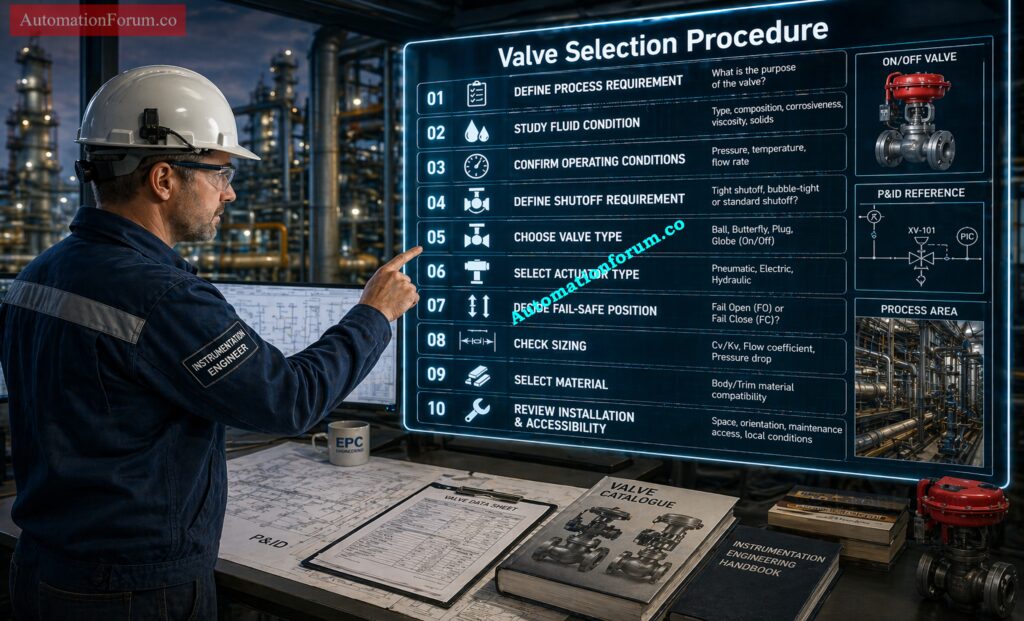
Step 1: Define the process requirement
The first engineering step is to identify the actual duty of the valve. Ask whether it is required for isolation, shutdown, interlock, emergency action, or switching between lines. Also confirm whether the process is batch or continuous. Batch processes often need repeated cycling, while continuous plants may require the valve to remain stable in one position for long periods.
Level Transmitter Selection Checklist That Prevents Failure: Level Transmitter Selection Checklist for EPC Engineers – Step-by-Step Guide
Step 2: Study the fluid condition
The next step is to understand the fluid. Is it clean, corrosive, viscous, abrasive, or slurry containing solids? Fluid condition has a major influence on valve selection. Dirty service can damage seats, while corrosive service can attack the body and trim. This is why process fluid analysis must come before final valve selection.
Important fluid questions
What is the fluid composition?
Is there suspended solids content?
Will the fluid polymerize, scale, or crystallize?
Is the service toxic, flammable, or hazardous?
Is the fluid prone to erosion or chemical attack?
Step 3: Confirm operating conditions
You must gather design pressure, operating pressure, design temperature, normal temperature, and maximum possible excursions. The selected valve must be suitable for the most severe condition expected in service. This includes pressure class, actuator force, seat design, and sealing materials.
Step 4: Define shutoff requirement
The shutoff demand must be clear in the datasheet. Some services need zero visible leakage, while others can accept a basic isolation level. Soft seat valves provide better shutoff, while metal seat valves are better for severe temperature or abrasive conditions. Leakage class should be fixed early so the vendor does not make assumptions.
Step 5: Choose the correct valve type
This is the core decision. The valve type should be selected based on speed, pressure drop, seat tightness, and maintenance needs. A ball valve is preferred for quick shutdown and tight shutoff. A gate valve is suitable when open flow resistance must be low. A diaphragm valve is better for corrosive fluids. A butterfly valve is practical for large line sizes. The final choice should not be based only on habit.
Step 6: Select the actuator type
The actuator must match process utility and required motion time.
- Pneumatic actuator: Most common in process plants. Fast, reliable, simple to integrate with solenoid valves and limit switches.
- Electric actuator: Useful where instrument air is not available or where electrical actuation is preferred for remote duty.
- Hydraulic actuator: Used where large force or heavy duty operation is needed.
Refer the below link for the Valve Actuator Sizing Calculator – Complete Engineering Guide for Torque, Safety Factor & Gear Ratio Selection
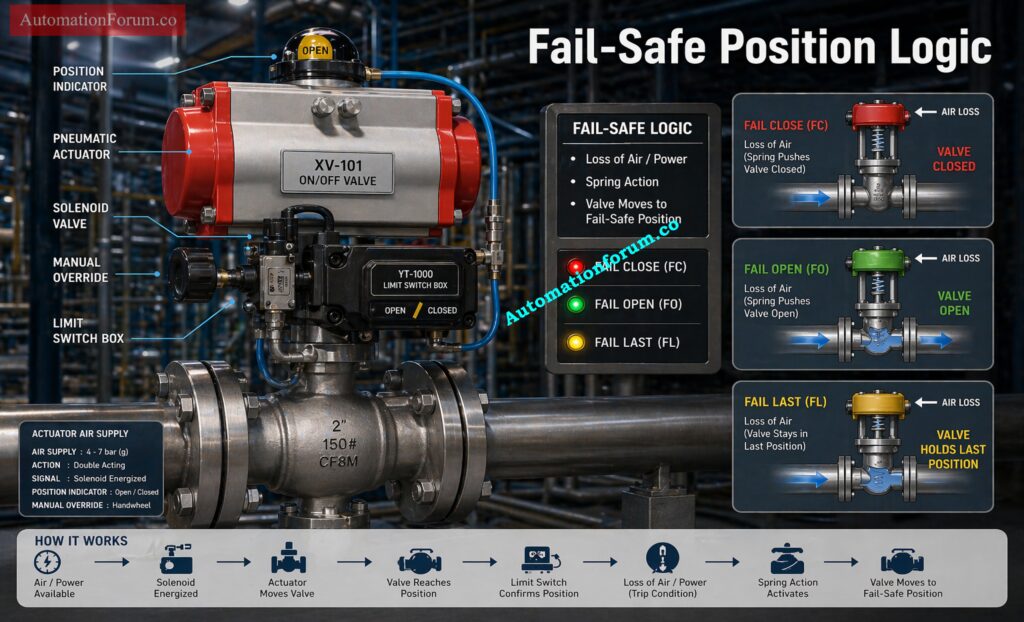
Step 7: Decide fail safe position
Every ON OFF valve must have a defined safe state. It may fail open, fail close, or fail last. This decision must be tied to the plant safety philosophy and cause and effect logic. Fail safe behavior is a critical design point in engineering.
Fail close: Used when flow must stop during loss of air or power.
Fail open: Used when loss of utility must keep the process safe or prevent overpressure.
Fail last: Used in some special cases where the valve should remain in its last valid position.
Step 8: Check valve sizing
Even ON OFF valves need sizing review. The valve should not be oversized because oversizing can cause poor seat loading, unstable action, and excessive wear. A basic Cv check and pressure drop review are essential. The selected valve should pass the required flow without creating unnecessary pressure loss.
Level Measurement Selection Guide That Cuts Errors: Interface Level Measurement Selection Procedure – Complete 2025 Guide for Process Engineers
Step 9: Select the correct material
The body, trim, seat, packing, and seals must suit the actual service. Think about things like corrosion, erosion, chloride content, sour service, and temperature range. If the metallurgy doesn’t match the fluid, a valve that looks good on paper might not work for long.
Step 10: Review installation and accessibility
The location itself is important. The valve should be accessible for maintenance, inspection, and operation. Space for actuator removal, tubing, manual override, and access to limit switches must be checked. Putting the valve in the right place makes it work better and safer.
Must-Have Control Valve Accessories That Actually Work: Essential Control Valve Accessories for Reliable Process Control
EPC Engineering Design Workflow for ON OFF Valve Selection
- P and ID stage: The P and ID usually give the first choice input. The valve tag, service, and function are identified here.
- Datasheet preparation: The instrument engineer prepares the valve datasheet with process conditions, material selection, actuator details, fail position, accessories, and special requirements.
- Vendor enquiry: The datasheet is issued to vendors during technical bidding. This is where compliance, deviations, and other options are looked at.
- Technical bid evaluation: The EPC team checks to see if the vendor’s offer meets the service conditions, shutoff class, response time, and project specifications during the technical evaluation.
- FAT and SAT: The factory acceptance test checks that the device works correctly and performs its functions. The site acceptance test checks to see how the system works in the real world.
Refer the below link for theEssential Control Valve Performance Parameters
https://automationforum.co/essential-control-valve-performance-parameters/
ON OFF Valve Selection Decision Table
| Application | Recommended Valve Type | Reason |
| Clean fluid | Ball valve | Tight shutoff |
| Slurry | Knife gate or ball | Handles solids |
| Corrosive service | Diaphragm valve | Chemical resistance |
| High pressure service | Gate valve | Strength and low pressure drop |
| Fast shutdown | Ball valve | Quick action |
Size Control Valves Correctly and Save Efficiency: How to Properly Size Control Valves for Maximum Efficiency?
Common Mistakes in ON OFF Valve Selection
- Using a control valve instead of ON OFF valve: This makes it hard to shut off and weakens isolation.
- Oversizing the valve: Valves that are too big can make the system work less reliably and the seat work less well.
- Ignoring fail safe logic: If the fail-safe position isn’t set up right, the valve could move in the wrong direction while you’re on a trip.
- Not checking cavitation and flashing: Trim and seats can be damaged by bad flow conditions, even when the service is on and off.
- Ignoring installation space: During design review, it’s easy to forget about field access and actuator clearance.
Control Valve Leakage Testing Standards Made Simple: Control Valve Leakage Testing, Types, and Calculation Standards
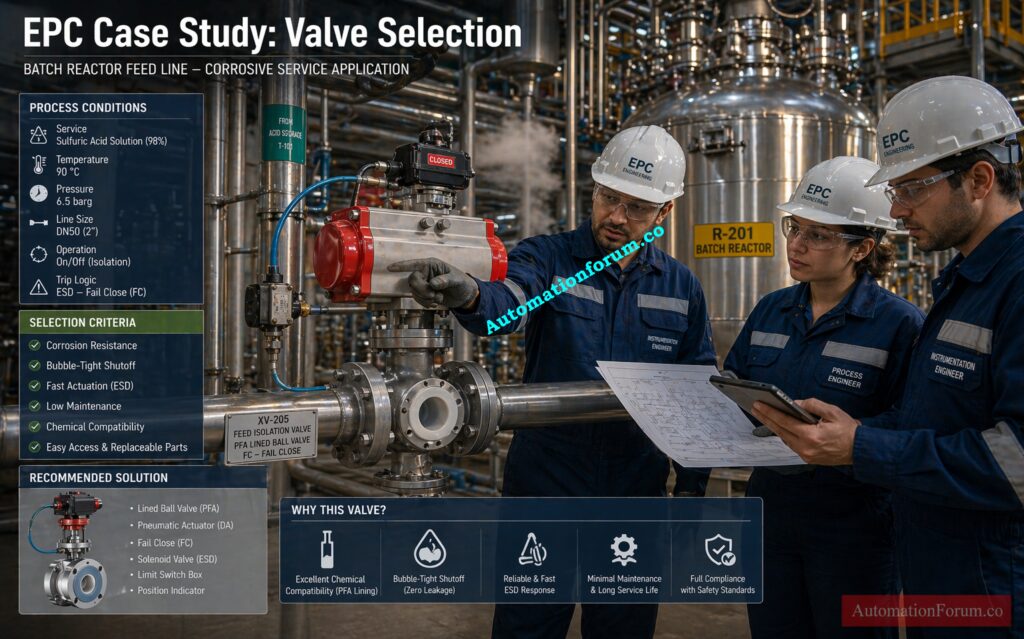
Real Industrial Case Study on ON OFF Valve Selection
Project scenario
A batch reactor feed line in a chemical plant requires an isolation valve. The valve must close immediately during a high level trip and must prevent reverse leakage into the reactor.
Engineering requirement
The valve must provide tight shutoff, quick closure, and resistance to moderately corrosive fluid. It must integrate with the trip logic and support safe shutdown.
Selection logic
The team reviews the fluid condition, pressure, temperature, and trip requirement. Since the service is corrosive, they evaluate diaphragm valve and lined ball valve options. Because the line needs quick response and strong shutoff, a fail close pneumatic ball valve with suitable lining becomes a strong candidate.
Final decision
The final choice is based on shutoff performance, chemical compatibility, actuator response, and maintenance access. This is a practical EPC example of applying the valve selection procedure rather than selecting by habit alone.
Fix Industrial Control Valve Actuator Problems Fast: Common Challenges and Solutions for Industrial Control Valve Actuators
Engineering Checklist for ON OFF Valve Selection
| Parameter | Checked | Remarks |
| Fluid type | Yes or No | |
| Pressure rating | Yes or No | |
| Temperature | Yes or No | |
| Shutoff class | Yes or No | |
| Actuator type | Yes or No | |
| Fail position | Yes or No |
Additional checklist items: You should also verify line size, valve class, body material, seat material, limit switches, solenoid valve, manual override, response time, and maintenance space.
Practical rule
Do not begin with the valve catalog. Begin with the process safe state. First define what must happen during normal operation, trip, and utility failure. Then choose valve type, actuator, and fail position. This sequence reduces rework and improves reliability.
Pick the Right Valve Bonnet Without Guessing: How to Choose Right control Valve Bonnet for your Application?
FAQs ON OFF Control Valve Type Selection
What is the main difference between ON OFF and control valves?
ON OFF valves are for isolation and switching, while control valves are for modulating flow.
Troubleshoot Shutdown Valves Before They Fail Again: How to Troubleshoot On-Off / Shutdown Valve
Which valve is best for fast shutdown?
A ball valve is often the best choice for fast shutdown because it gives quick quarter turn action and tight shutoff.
Repair Stuck Control Valves Before Production Suffers: How to do maintenance on struck control valve?
When should a diaphragm valve be used?
Use a diaphragm valve in corrosive, contaminated, or chemically aggressive service where isolation from moving parts is helpful.
Globe, Ball, Butterfly: Pick the Best Valve: Globe vs Ball vs Butterfly Control Valves Complete Comparison Guide for Flow Control Selection
Why is fail safe position important?
Fail safe position defines what the valve does on loss of air, power, or signal. It must match the plant safe state.
Choose Better Body Materials for Tough Service: Control Valve Body Material Selection Guide for EPC Design Instrumentation Engineers
Why should valve location be reviewed early?
Good location improves access, safety, maintainability, and overall valve performance during operation and shutdown.
Flow Measurement MCQs That Separate Experts Fast: Advanced Flow Measurement Selection MCQs for EPC Instrumentation Design Engineers
A proper ON OFF control valve selection procedure is a core EPC engineering task, not a routine procurement step. The best result comes from a systematic review of process duty, fluid nature, operating conditions, shutoff class, valve type, actuator logic, fail safe position, materials, and installation layout. When these factors are evaluated together, the valve becomes reliable in service and consistent with the plant safety philosophy. That is the real value of disciplined instrumentation design. In EPC execution, good valve selection protects production, improves shutdown reliability, and reduces future maintenance risk. It is one of the simplest ways to improve plant integrity at the design stage.
Advanced Flowmeter Selection Quiz for Real Engineers: Advanced Flowmeter Selection Quiz for EPC Engineers in Process Industries
Download: Checklist for ON OFF Control Valve Type Selection Procedure for EPC Engineer
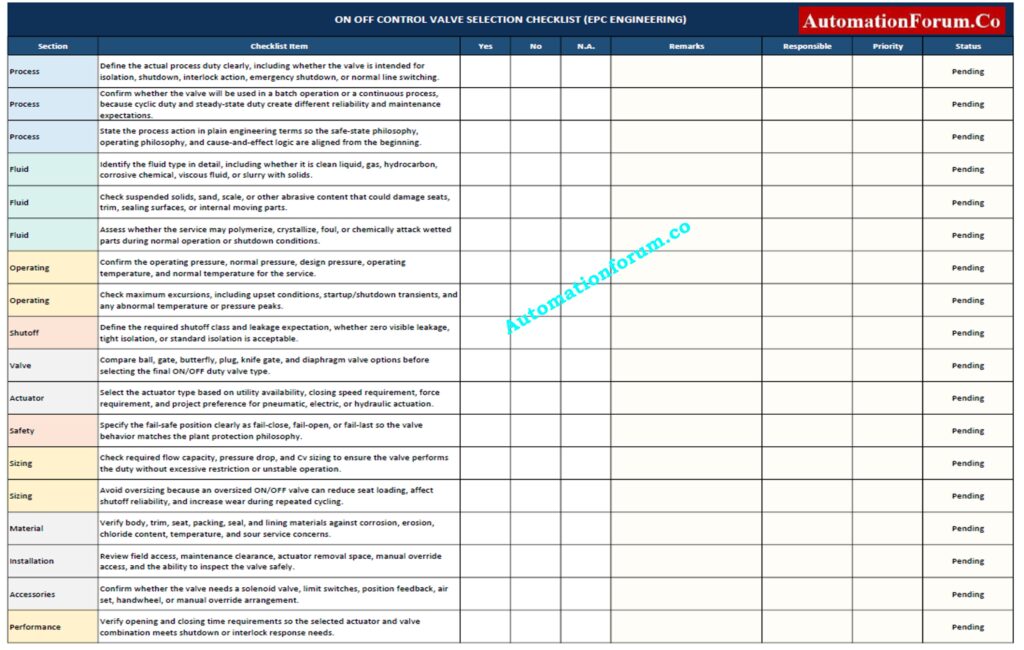
A ON OFF control valve selection checklist for EPC engineering, designed to help instrumentation and process engineers evaluate process duty, fluid condition, shutoff class, actuator type, fail-safe position, material selection, installation access, and vendor compliance in a clear and structured format.
Refer the below link for the Hybrid Level Measurement Selection Procedure for EPC Instrumentation Engineers
