
- Why Control Valve Body Material Selection Matters
- Valve Body Vs Trim Critical Distinction For Datasheets
- Epc Material Selection Workflow Feed To Detailed Engineering
- Process Parameters Influencing Material Selection
- Corrosion Mechanisms And Material Selection Implications
- Mechanical Strength and Design Code Compliance
- High Temperature and Cryogenic Considerations
- Chloride And Seawater Service Requirements
- Valve Body Material For Sour Service Nace Mr0175 And Iso 15156
- Galvanic Compatibility and Fastener Selection
- Cladding Vs Solid Alloy Bodies Selection Guidelines
- Detailed Material Comparison For Control Valve Bodies
- Three EPC Case Studies For Practical Application
- Control Valve Body Material Selection – Detailed Datasheet Checklist
- Common Mistakes In Control Valve Body Material Selection
- Procurement And Vendor Documentation Requirements
- Lifecycle Cost Reliability and Maintenance Strategy
- FAQ on Control Valve Body Material Selection
Why Control Valve Body Material Selection Matters
Control valve body material selection is a highest-impact decision in global EPC projects across oil & gas, petrochemical, chemical, power, and process industries. Wrong choices result in early field failures, unplanned shutdowns, safety incidents, and dramatically increased lifecycle cost. This control valve material selection guide is written by an instrumentation and materials engineer with EPC field experience to help engineers specify practical, standards-compliant choices during FEED and detailed engineering.
Valve Body Vs Trim Critical Distinction For Datasheets
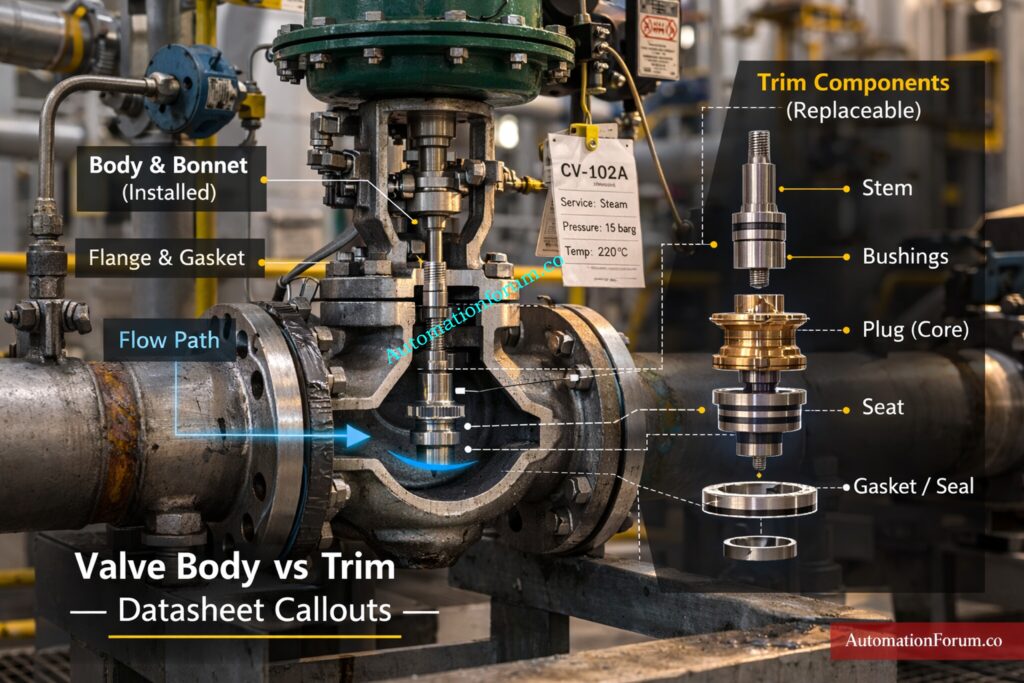
The valve body material forms the pressure-retaining pressure boundary and provides structural strength, flange/bolt interface, and gross corrosion resistance of the assembly. Trim material (plug, seat, stem, bushings) is the wetted internal working surface that determines erosion, leakage, and sealing performance. Do not conflate the two: stainless trim in a carbon body does not guarantee sour-service compliance or eliminate SSC risk in the body or HAZ. Specify body and trim explicitly in datasheets.
Avoid This Common Valve Sizing Mistake: Understanding Rangeability vs Turndown Ratio in Control Valve Sizing
Epc Material Selection Workflow Feed To Detailed Engineering
Process Definition at Feed Stage
Preliminary Material Screening and Cost Categorization
Use corrosion indices, temperature thresholds, and cost buckets (CS, low-alloy, duplex, super duplex, nickel alloys) to produce a short list of body alloys.
Early on, mark seawater, chloride-bearing, and sour-service streams for alloys that won’t corrode.
To avoid underspecification, do a preliminary comparison of the mechanical strength and the required pressure class according to ASME standards.
Risk Assessment Hazop Corrosion Review and Specialist Input
Run HAZOP corrosion nodes and consult corrosion/materials engineers for SCC, SSC, hydrogen embrittlement and cavitation risk mitigation.
Look into the history of failures in similar initiatives and use what you learnt from your clients.
Datasheet Preparation Mandatory Material And Inspection Clauses
List the body and trim materials that the state requires, the alternatives that are allowed, the NACE/ISO sour-service qualification demands, the cladding requirements, the hydrotest medium, and the ways to prevent erosion and cavitation.
Set the highest hardness limits, the coating requirements, and the locations at which inspections must stop.
Vendor Evaluation FAI And Final Engineering Sign Off
For traceability, you need vendor MTC, PMI acceptance criteria, NDE records, cladding/weld overlay procedures, and sample heat numbers.
Check the quality of the casting, the approvals from the foundry, and the steps for repair welding.
Finalize the WPS, PWHT, bolt metallurgy, and acceptance criteria. Make sure that the vendor’s FAI includes seat leakage, cycle testing, and SSC testing as necessary.
Make sure that all paperwork is put together in the valve manufacturing log book for project turnover.
Free Engineering Sizing Sheet Inside: Control Valve Sizing Calculation Worksheet for Critical and Sub-Critical Flow
Process Parameters Influencing Material Selection
- Pressure and temperature: set the limits for stresses and the grade of material to use. High temperatures lower the permitted stress and may require low-alloy chrome-moly (WC6/WC9) instead of plain CS.
- Corrosivity: the complete process chemistry (pH, chlorides, oxidants) determines whether to use austenitic, duplex, or nickel alloys.
- Velocity and solids: erosion and erosion-corrosion risk favor harder trims, erosion liners, and abrasion-resistant alloys.
- Cavitation and flashing: severe erosion risk-use anti-cavitation trims, staged pressure reduction, and consider body materials with erosion resistance.
- Slurries and solids: consider lined bodies or hardened inserts and material toughness for impact.
- Sour service: H2S presence requires compliance with NACE MR0175 and ISO 15156 rules for hardness, metallurgy, and testing.
Instant Gas Valve Conversion Tool: Cv to Cg for Gases Conversion Calculator: Control Valve Sizing
Corrosion Mechanisms And Material Selection Implications
- Uniform corrosion: predictable; mitigate with corrosion allowance or cladding.
- Pitting: a localized assault that happens in situations with chloride; duplex and super duplex resist pitting better than 304/316.
- Crevice corrosion: stay away from crevices, use materials that are resistant to crevices, and keep an eye on the materials and surface finish of gaskets.
- Stress corrosion cracking (SCC): tensile stress plus the environment; control leftover stresses and choose alloys that won’t crack under stress.
- Sulfide stress cracking (SSC) and hydrogen embrittlement are very important for streams that carry H2S. To keep hardness under NACE/ISO limits, you should utilize only approved materials.
- Erosion-corrosion: damage from both mechanical and chemical sources; you can reduce it by using hardfacing or bodies and trims that are more resistant to erosion.
One Click Liquid Valve Sizing Tool: Control Valve Sizing Excel tool Without Iteration: Liquid Application
Mechanical Strength and Design Code Compliance
- Verify allowable stresses against design temperature per code; use ASME allowable stresses for flange and wall thickness checks.
- Choose low-alloy steels (WC6/WC9) or creep-resistant grades when the temperature is high, and make sure to mention the PWHT that is needed.
- For cryogenic service, put materials with proven impact toughness at the lowest service temperature at the top of your list.
High Temperature and Cryogenic Considerations
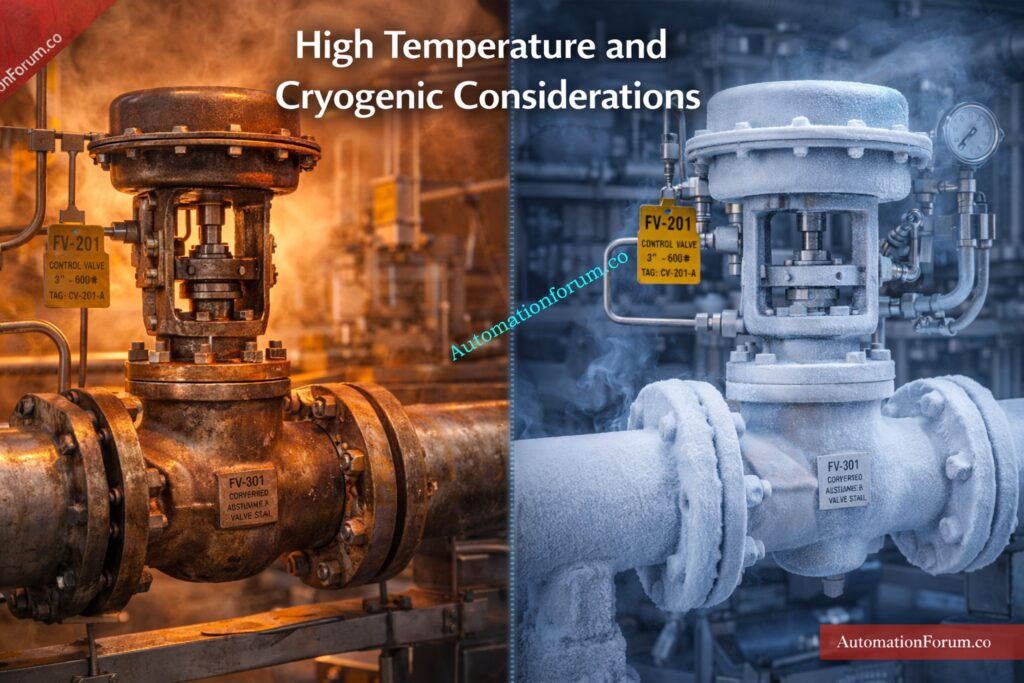
- High temperature: oxidation, carburization, and lower yield strength need alloys and heat treatment to keep strength and resistance to creep.
- Cryogenic: To avoid brittle fracture, utilize austenitic stainless steel, nickel alloys, or cryogenic-rated carbon steels that have been tested for toughness and are compatible with welding consumables.
Test Your EPC Flow Knowledge: Advanced Flow Measurement Selection MCQs for EPC Instrumentation Design Engineers
Chloride And Seawater Service Requirements
- Seawater: warm seawater causes pitting and crevice corrosion. 304/316 are often inadequate; select duplex, super duplex, or nickel-copper alloys (Monel) for long-term seawater exposure.
- Use cathodic protection and coatings only as supplementary measures – choose body alloy for primary compatibility.
Smart Level Selection Strategy for EPC: Hybrid Level Measurement Selection Procedure for EPC Instrumentation Engineers
Valve Body Material For Sour Service Nace Mr0175 And Iso 15156
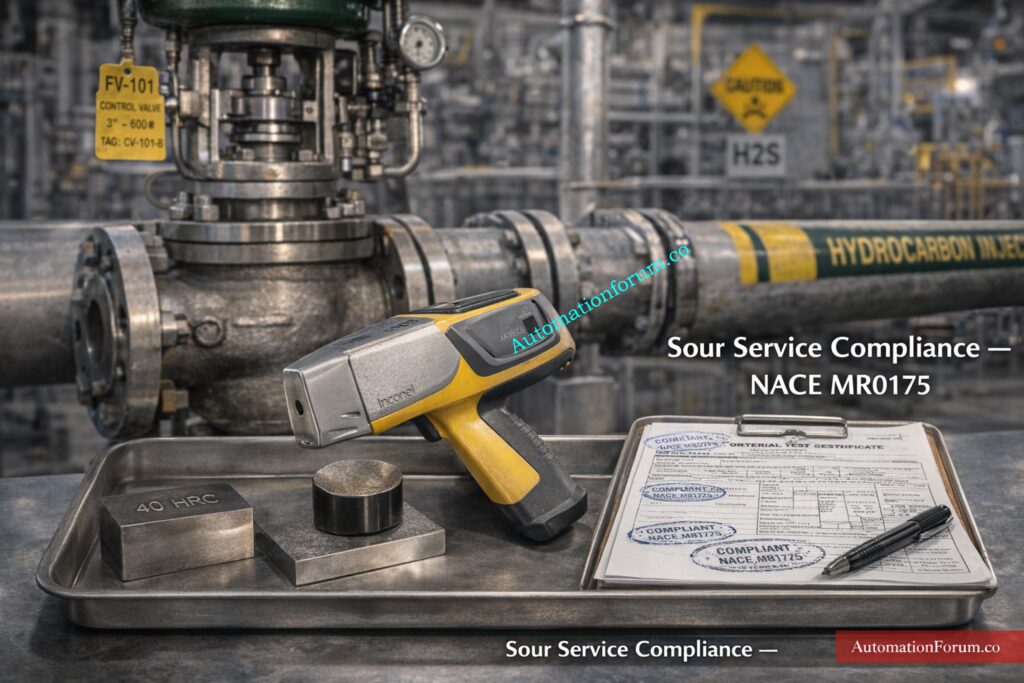
- For valve body material for sour service ensure selection, hardness limits, testing, and metallurgical controls meet NACE MR0175 and ISO 15156.
- Verify vendor SSC test reports, hardness measurements, and MTC traceability. If there is a high risk of H2S or SSC, utilize CRAs instead of just heat treatment.
Size Your Actuator Correctly the First Time: Valve Actuator Sizing Calculator – Complete Engineering Guide
Galvanic Compatibility and Fastener Selection
- Do not let different metals touch each other when they are wet or in a chloride atmosphere. Choose materials with similar electrochemical potentials or electrically isolate interfaces. Specify fastener metallurgy consistent with body materials to prevent accelerated corrosion.
Prevent Thermowell Failure in Design Stage: Thermowell Selection Procedure – Complete Guide for EPC design Engineers
Cladding Vs Solid Alloy Bodies Selection Guidelines
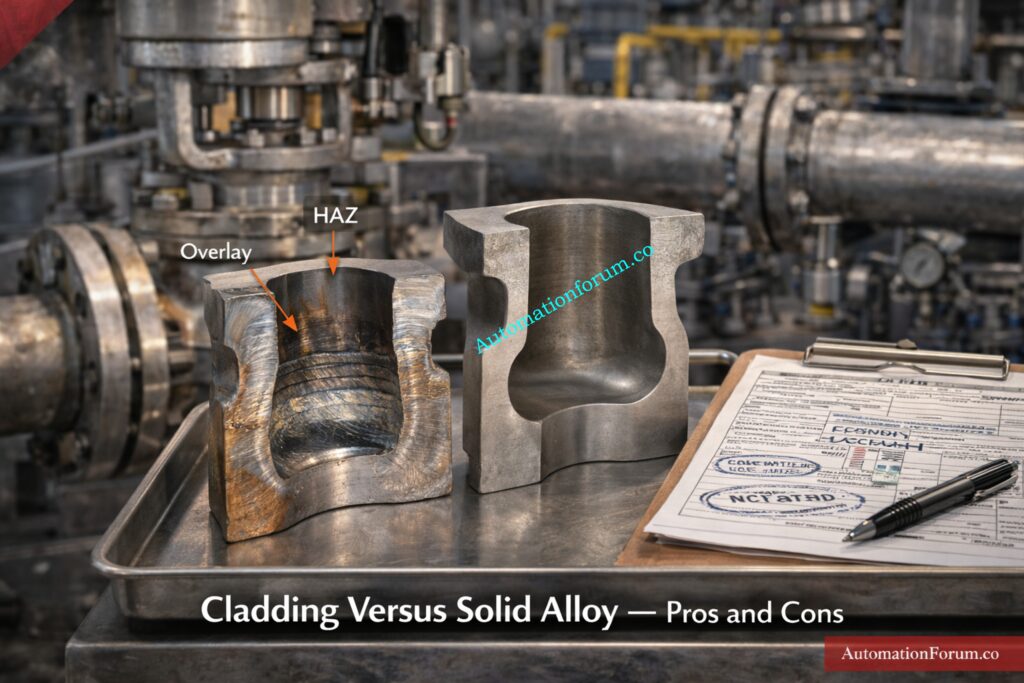
- Cladding (weld overlay) can provide corrosion resistance inside a lower-cost base metal body when mechanical loads are moderate.
- Limitations: cladding delamination, porosity, HAZ susceptibility, and potential inability to meet sour-service SSC requirements if HAZ affects base metal. For severe sour or high-mechanical loads prefer solid alloy bodies.
Refer the below link for the Select the nterface Level Measurement Selection Procedure – Complete 2025 Guide for Process Engineers
Detailed Material Comparison For Control Valve Bodies
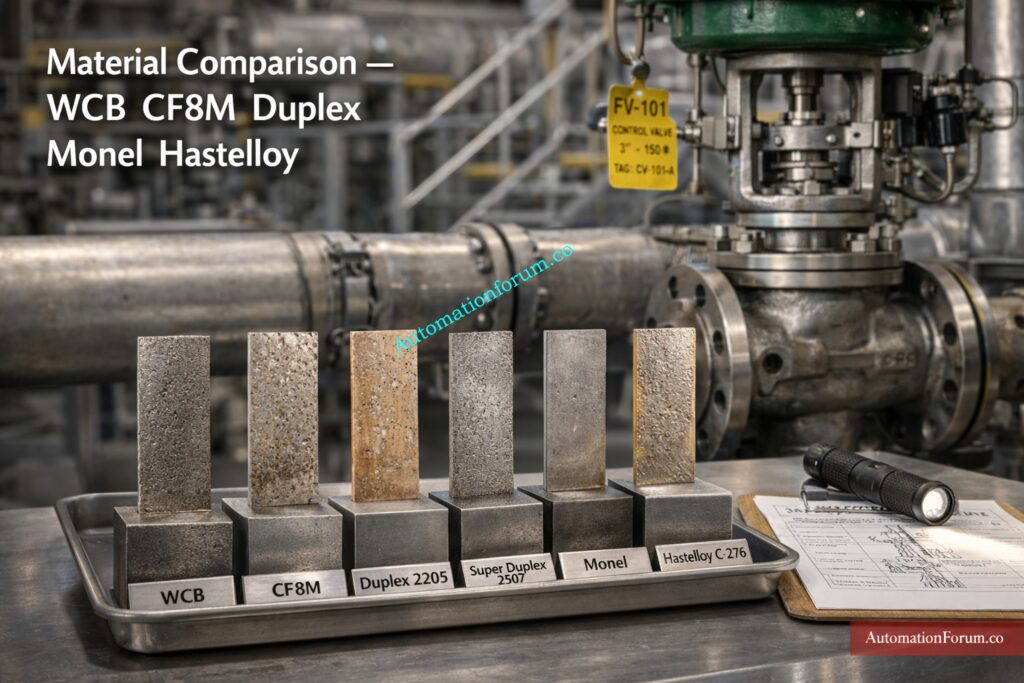
| Material | Typical application | Temperature range | Corrosion resistance level | Cost level | Limitations | EPC design / procurement notes |
| Carbon Steel (WCB) | General service, non-corrosive process lines, utility isolation valves | Cryogenic (with appropriate grade & testing) up to ~425°C (grade dependent) | Low – requires corrosion allowance or protective coating in corrosive services | Low | Poor resistance to chlorides, seawater and sour environments; not suitable for H2S unless fully qualified | Use where economy is priority and process chemistry is benign. Specify MTC, PMI for forgings, and consider internal cladding if moderate corrosion expected. |
| Low Alloy Steel (WC6 / WC9) | High-temperature steam applications, hydrocarbon services at elevated temperature | Up to ~540°C (depending on grade and thickness) | Moderate better high-temperature strength than plain CS but limited chemical resistance | Moderate | Limited chloride and H2S resistance; susceptible to scaling/oxidation at high T | Select for elevated-temperature service where creep strength is needed. Require PWHT and strict heat-treatment records (MTC + PWHT report). |
| Stainless Steel 304 / 316 / 316L | Clean water systems, mild chemicals, general corrosion-resistant applications | Cryogenic to ~400°C (316 often preferred at higher T and chloride tolerance) | Moderate – 316/316L > 304 for chlorides; susceptible to localized attack in aggressive chloride environments | Moderate | Vulnerable to pitting/crevice corrosion in warm chloride environments; SSC risk in sour service | Use when moderate corrosion resistance and weldability required. For chloride/seawater service, evaluate duplex or higher alloys. Specify hardness limits and SSC qualification if H2S present. |
| Duplex Stainless Steel (2205) | Seawater systems, chloride-bearing streams, many oil & gas wetted services | Approx. -50°C to ~300°C (good low T toughness and higher strength) | High – excellent pitting and crevice resistance vs 304/316 | High | Requires controlled welding practices and experienced fabrication; limited availability for some sizes | Good balance of strength and corrosion resistance for offshore and chloride environments. Specify PWHT avoidance, qualified WPS, PMI and heat traceability. |
| Super Duplex (2507) | Aggressive seawater, high chloride CO₂/Cl⁻ environments, high integrity oil & gas applications | Similar to duplex but often with slightly narrower service limits due to fabrication constraints | Very high – superior pitting/crevice and chloride resistance | Very high | More difficult to fabricate/weld; longer lead times; requires experienced suppliers | Use where highest chloride/pitting resistance is needed. Ensure supplier capability for forging/casting and fully documented NDE and MTC. |
| Alloy 20 | Service with acid chlorides and certain sulfuric acid applications; specialty chemical lines | Application dependent (moderate to elevated temperatures per alloy datasheet) | High for specific acidic environments (selected chemistries) | High | Not a universal solution – best for particular acidic chemistries | Specify based on detailed process chemistry. Require vendor corrosion data and MTC confirming composition. |
| Monel (Alloy 400) | Seawater systems, some acidic environments and mixed media where cu-nickel is desirable | Wide range; consult alloy data for exact limits | High resistance to seawater and many acids | Very high | Costly; magnetic and fabrication considerations | Consider where seawater corrosion plus occasional acid exposure exist. Specify PMI and fabrication experience. |
| Hastelloy (C-276 / C-22) | Highly corrosive chemistries, oxidizing and reducing acid mixtures, aggressive process chemistries | Broad service ranges per alloy – selected for severe chemical resistance | Excellent – one of the best for mixed acid/oxidizing environments | Extremely high | Very expensive; long lead times; special fabrication/welding practices | Use only when process chemistry justifies cost. Require supplier corrosion test data, full MTC, and tight welding controls. |
If you want, I can convert this table into a printable PDF or add columns for material standards (ASTM/EN), typical trim pairings, and maximum allowable hardness for sour service.
Hazardous Area Gland Selection Made Easy: Cable Gland Selection for Hazardous Area Installations – Complete 2025 Guide
Three EPC Case Studies For Practical Application
Case 1 – Offshore Cooling Water Control Valve Seawater Service
Scenario: a warm seawater cooling line on an offshore platform that runs all the time at 35–40°C and stops working for maintenance every so often.
Analysis:The first FEED step called for 316 stainless steel because the chloride concentration was low. But a thorough corrosion review found that there was a high danger of crevice corrosion at the gasket faces, bolting interfaces, and trim-body clearances. Warm, oxygenated seawater significantly increases pitting potential. Historical data from similar offshore assets showed perforation within 18-24 months for 316 bodies in stagnant sections. There was also a potential of galvanic interaction between the stainless steel body and the carbon steel piping.
Solution: The answer is a Duplex 2205 body and trim with proper welding methods, stringent heat input control, and 100% PMI. It was required to have flange isolation kits and cathodic protection integration.
Rationale: Duplex has a better pitting resistance equivalent number (PREN) and almost twice the yield strength of 316, which lets you use thinner wall sections without losing mechanical strength. Even if the initial cost of buying was higher, calculating the cost of the whole life cycle revealed that big savings could be made by not having to replace things in the middle of their lives or send somebody to work on them from abroad.
Ultimate Level Transmitter Selection Checklist: Level Transmitter Selection Checklist for EPC Engineers – Step-by-Step Guide
Case 2 – High Temperature Steam Control Valve
Scenario: In a power generation plant, superheated steam is controlled at about 450°C and 45 bar. It was assumed that the load would cycle often.
Analysis: Austenitic stainless steel was first thought of because it doesn’t rust. Mechanical design verification, on the other hand, demonstrated that the stress limit went down at high temperatures and that there was a possibility of long-term creep deformation. Thermal cycling also raised worries about tiredness.
Solution: A WC6 low-alloy chrome-moly steel body with PWHT, creep-strength testing, and hardfaced trim to protect against corrosion.
Rationale: Chrome-moly steel has better creep strength and structural stability at high temperatures for a long time. Proper heat treatment keeps metals stable and stops them from breaking down too soon. The material choice met high-temperature service criteria and made sure that the dimensions stayed stable over time, even when they were used in cycles.
Valve Selection for Extreme Process Conditions: Control Valve Selection and Recommended Practices for Harsh Process Conditions
Case 3 – Sour Hydrocarbon Injection Control Valve
Scenario: An injection control valve that handles hydrocarbons with H₂S and CO₂ and has two-phase flow and sand traces from time to time.
Analysis: There was a high danger of sulfide stress cracking, the possibility of hydrogen embrittlement, and erosion from solids that got stuck in the material. Carbon steel with a corrosion allowance was turned down because it was likely to suffer from SSC. It was necessary to manage hardness and follow metallurgical standards.
Solution: Super duplex or high-nickel alloy, depending on the partial pressure of H₂S. It must meet NACE MR0175’s SSC qualification, hardness verification, and full material traceability.
Rationale: Alloys that don’t rust lower the risk of SSC while keeping their mechanical strength. Choosing the right materials at the design stage kept future risks to integrity from happening and made sure that the sour-service project parameters were met.
Challenge Yourself with 25 Valve Questions: Top 25 MCQs on Control Valve Types, Selection, and Applications for Project Engineers
Control Valve Body Material Selection – Detailed Datasheet Checklist
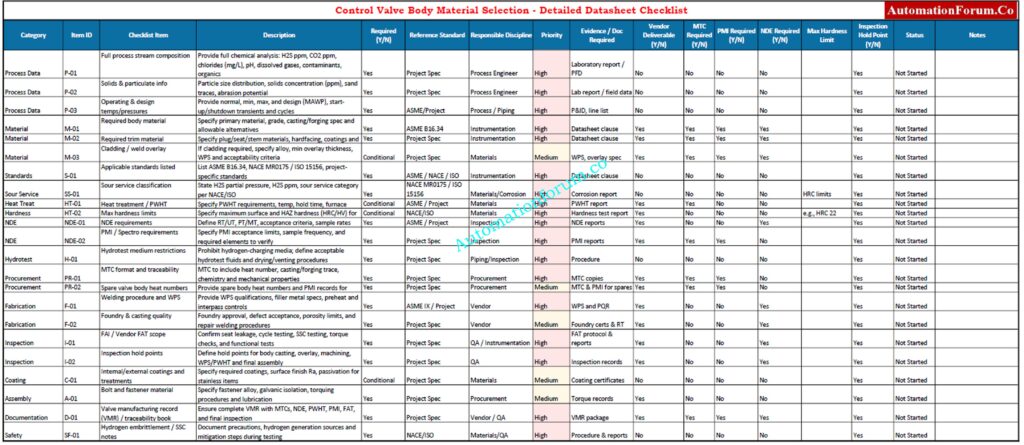
This checklist helps EPC instrumentation engineers choose the right material for control valve bodies and make datasheets during FEED and detailed engineering.
It makes sure that process data, material needs, standards compliance, inspection criteria, and vendor documentation are all properly recorded to avoid corrosion failures, sour-service non-compliance, and holes in traceability.
Common Mistakes In Control Valve Body Material Selection
- Thinking that trim will fix problems with body rust.
- Ignoring crevice conditions and corrosion caused by gaskets.
- Using 304 or 316 in warm waters without a duplex or nickel alloy up-rate.
- Accepting regular WCB bodies that don’t have sour-service qualification.
- Not paying attention to galvanic couples between the body, fasteners, and linked pipework.
Stop Oversizing Your Control Valves: Why Control Valve Characteristics Matter in EPC Instrumentation and Control Engineering
Procurement And Vendor Documentation Requirements
- Mill Test Certificates (MTC) show how heat numbers are linked to chemical and mechanical qualities.
- PMI/spectro reports on castings and forgings.
- NDE records (radiography, UT, PT/MT) with acceptance criteria.
- Hardness testing reports on body surfaces and HAZ for sour-service items.
- Welding and PWHT records linked to part heat numbers.
Lifecycle Cost Reliability and Maintenance Strategy
- Prioritize reliability where control valve body material selection impacts safety, production, or shutdown risk. Upfront alloy cost is frequently small compared to unplanned shutdown expense and repeated maintenance.
- Adopt conservative materials for chloride-bearing or sour environments: duplex stainless steel control valve bodies or higher alloys typically reduce total cost of ownership.
- Embed material checkpoints in FEED datasheets, vendor queries, FAT, and site commissioning to ensure compliance with standards, testing, and traceability.
- Verify documentation before final signoff.
Must Know Valve Codes for Engineers: Codes and Standards for Control Valve Selection in Industrial Applications
FAQ on Control Valve Body Material Selection
What are the Materials Used In Valve Body?
Common valve body materials include Carbon Steel WCB, Stainless Steel CF8 and CF8M, Duplex Stainless Steel, Low Alloy Steel WC6 WC9, Cast Iron, Bronze, Monel, Alloy 20, and Hastelloy.
Material selection depends on pressure, temperature, corrosion level, and process fluid composition.
What is CF8M Body Material?
CF8M is a cast austenitic stainless steel that is similar to AISI 316 stainless steel but has molybdenum added to make it more resistant to corrosion.
It is frequently utilized in the oil and gas and chemical industries because it is more resistant to chlorides and chemicals than CF8.
What is WCB Material For Valves?
WCB is cast carbon steel that meets the standards of ASTM A216 Grade WCB. It is often used for valve bodies in normal duty applications.
It has good mechanical strength for moderate pressure and temperature, but it doesn’t resist corrosion very well.
What are the Criteria For Control Valve Selection?
The flow rate, pressure drop, kind of fluid, temperature, risk of cavitation, noise level, and level of control accuracy all affect how to choose a control valve.
Material compatibility, pressure rating, actuator type, and safety standards are also very important.
How to Calculate Control Valve Size?
Using flow equations that take into account the needed flow rate, pressure drop, fluid characteristics, and Cv coefficient, the size of the control valve is determined.
Engineers typically use IEC or ISA sizing formulas and vendor sizing software to determine the correct valve Cv and body size.
What are the Three Types Of Control Valves?
The three main types of control valves are Globe Valves, Ball Valves, and Butterfly Valves.
Globe valves are preferred for precise control, ball valves for tight shutoff, and butterfly valves for large flow, low-pressure applications.
Refer the below link for Control Valve Noise Prediction Calculator – IEC 60534 Based Engineering Tool
