
- Understanding What Valve Characteristics Actually Represent
- Inherent vs Installed Control Valve Characteristics
- Exploring the Three Main Control Valve Characteristics in Depth
- How System Dynamics Influence the Installed Valve Characteristic
- Engineering Workflow for Selecting the Correct Control Valve Characteristic
- Real Engineering Scenarios Where Control Valve Characteristic Selection Matters
- Why Oversizing Affects Linear and Equal Percentage Valves Differently
- Advanced Engineering Considerations for Valve Characteristic Selection
- Practical Checklist for EPC Engineers Before Finalizing Valve Characteristics
- Control Valve Selection and Characteristics: Frequently Asked Questions
Many engineers don’t realize how important it is to choose the right control valve characteristic for process performance. EPC teams commonly focus on things like the right size of the valve, the right material for the actuator, the right torque for the actuator, and the right positioner. However, the characteristic curve is often not given as much attention. But in the end, the characteristic determines how the valve works under different conditions, how the flow varies when its path changes, and how the whole control loop works over time.
A PID controller that is finely tuned can’t make up for a valve characteristic that was chosen incorrectly. When the characteristic and the system dynamics don’t match, the valve acts in an unpredictable way, which can cause oscillations, overshoot, slow response, unstable control, higher energy use, and shorter equipment life.
Understanding What Valve Characteristics Actually Represent
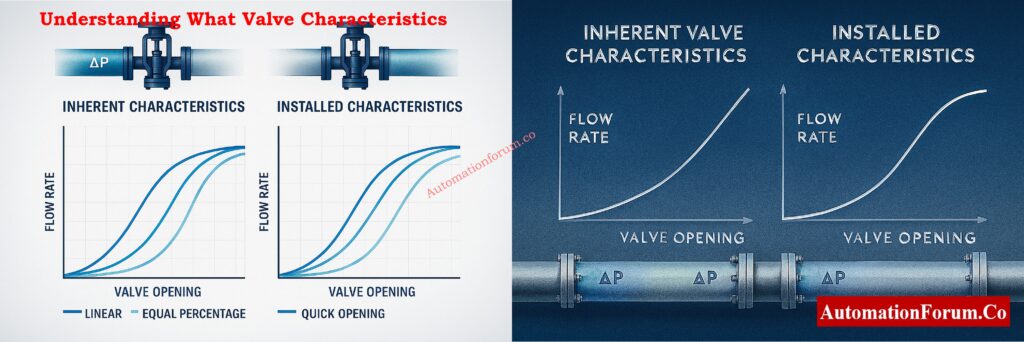
Inherent Valve Characteristics Explained
A control valve characteristic describes the relationship between valve travel and flow through the valve. Manufacturers provide inherent characteristics measured under laboratory conditions. These intrinsic curves assume that the differential pressure across the valve stays the same, which is not usually the case in real industrial processes.
Installed Valve Characteristics and Real System Behavior
Once a valve is installed in a pipeline, pump system, or steam distribution header, the pressure drop across it changes continuously with the process flow, equipment conditions, and control demand. These dynamic variations reshape the valve response into what is known as the installed characteristic.
Why EPC Engineers Must Prioritize Installed Characteristics
For EPC engineers, the installed characteristic is the reality. It determines actual process stability, loop gain, resolution near the seat, and the ability to maintain control across the operating range. Therefore, characteristic selection must be based on installed behavior rather than catalog curves.
Correct Sizing Steps, Efficiency-Driven Sizing Guide, Cv Sizing Simplified: How to Properly Size Control Valves for Maximum Efficiency?
Inherent vs Installed Control Valve Characteristics
How Linear Valves Behave Under Changing System Pressure
Inherent characteristics represent the geometric relationship between valve plug position and flow under constant pressure. Installed characteristics represent the real functional response under varying system pressures.
How Equal Percentage Valves Respond to Process Variations
A linear valve may appear predictable in the vendor’s datasheet. Yet in a system where pump head increases at lower flow rates or where friction losses change significantly with flow, the same linear valve may behave as if it were quick opening. This makes the flow alter suddenly and makes the loop less stable.An equal percentage valve may also seem like a logarithmic function in its natural state. However, when put in a steam system where the pressure drop changes a lot with the load, its logarithmic behavior works well with the system’s dynamics and keeps control stable.
Understanding this difference is fundamental for EPC designers who must predict the actual installed response during the design phase.
Download Ready Tools, Must-Have Calculators, Essential Engineering Excel Sheets: Top Essential Control Valve Calculators and Excel Tools for Instrumentation Engineers
Exploring the Three Main Control Valve Characteristics in Depth
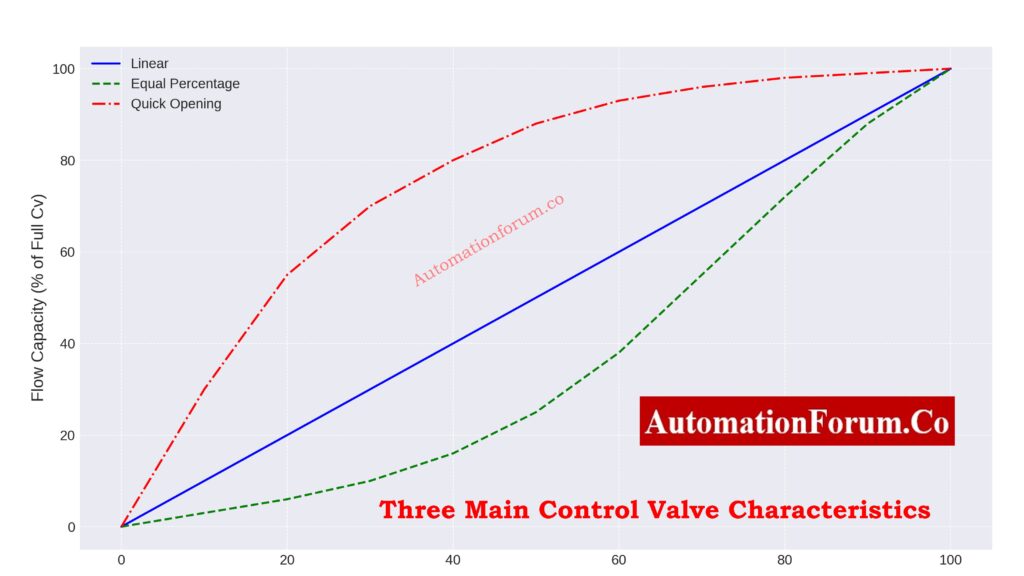
Linear Control Valve Characteristic Explained
A linear characteristic provides equal increments in flow for each incremental change in valve travel. If the valve opens thirty percent, flow increases roughly thirty percent.This characteristic works best when pressure drop across the valve remains relatively stable.
Linear valve trims are commonly used in balanced water circuits, level control systems, and applications where pressure variations are small. They provide predictable and proportional control, making them suitable for processes with stable hydraulics.
But linear trims don’t work well in systems where the pressure difference across the valve changes a lot with flow. In these situations, linear trims act strangely when the apertures are small.
Equal Percentage Control Valve Characteristic Explained
The equal percentage characteristic is the most widely applicable for modern process control. With this curve, each incremental valve travel produces a constant percentage increase in flow. This gives you a logarithmic performance that lets you control the flow very precisely near the seat and lets you make bigger flow changes as the valve opens wider.
Equal percentage valves are preferred for steam systems, gas flow control, heating applications, wide turndown processes, and applications where differential pressure varies significantly with flow. They naturally compensate for the changing pressure drop across the valve.
One of the strongest engineering advantages of equal percentage valves is their tolerance to oversizing. EPC engineers often end up selecting the next standard valve size due to fouling margins, safety factors, or limited availability. Equal percentage valves maintain controllability even when oversized, unlike linear valves which tend to lose stability.
Quick Opening Control Valve Characteristic Explained
Quick opening trims deliver maximum flow with very little valve travel. They are designed for on off service, emergency shutdowns, bypasses, relief applications, and rapid discharge requirements. Quick opening valves are not suitable for modulating control loops because their extreme sensitivity at small openings makes precise regulation impossible.
EPC engineers typically specify quick opening trims only for isolation, safety instrumented functions, depressurization tasks, and other applications where modulating control is not required.
Bench Set Importance, Actuator Setup Essentials, Why Bench Set Matters: Why is Control Valve Actuator Bench Set Important ?
How System Dynamics Influence the Installed Valve Characteristic
System dynamics play an enormous role in shaping the final installed characteristic. Ignoring these dynamics almost always results in incorrect characteristic selection.
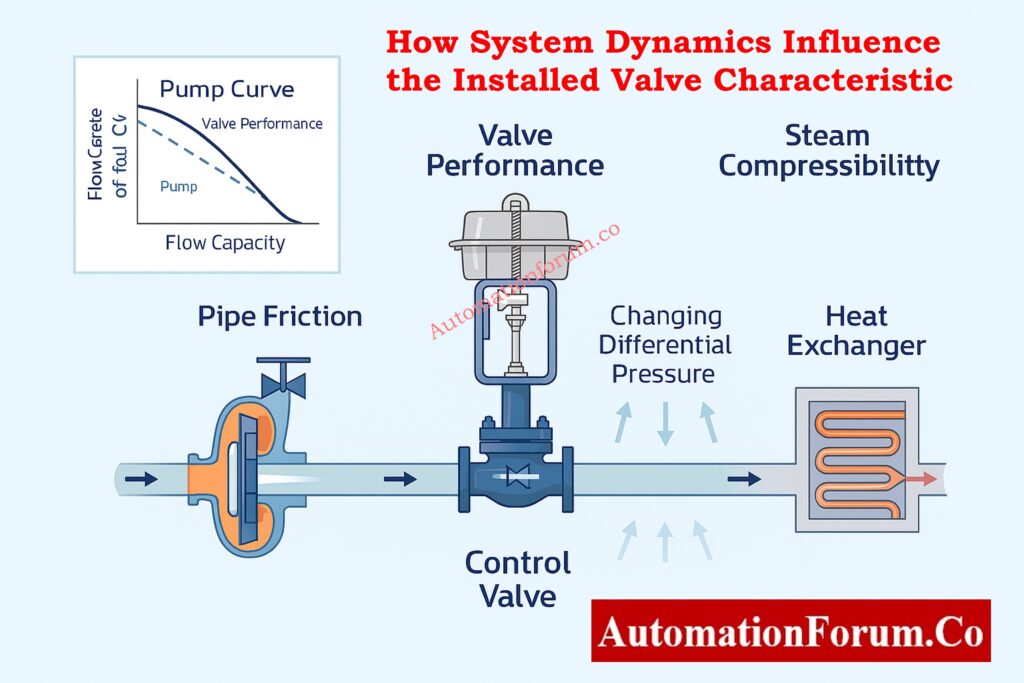
Pump Curve Effects on Valve Modulation
In centrifugal pump systems, head decreases with increasing flow and increases at lower flows. This means the differential pressure across the control valve increases as flow decreases. This effect can turn a linear valve into an extremely sensitive device at low loads.
Pipe Friction Effects on Pressure Drop
As the flow varies, frictional losses in the pipeline modify the available pressure drop at the valve in a big way. This changes how the control works and moves the installed curve.
PST Explained Simply, Safety Valve Testing Guide, Ultimate PST Overview: What is Partial Stroke Test (PST)? A Complete Guide for Shutdown and Control Valves
Steam Compressibility Influence on Valve Behavior
Steam is a fluid that can be compressed and whose pressure changes with the load. The pressure drop across the control valve reduces as heat load increases. Equal percentage valves closely align with these variations, producing smooth control in steam temperature applications.
Heat Exchanger Pressure Variations
Heat exchangers cause large variations in primary side pressure as secondary load changes. Equal percentage valves complement these changes by maintaining stable loop gain.
Valve Authority and Its Impact on Control Stability
Engineering Workflow for Selecting the Correct Control Valve Characteristic
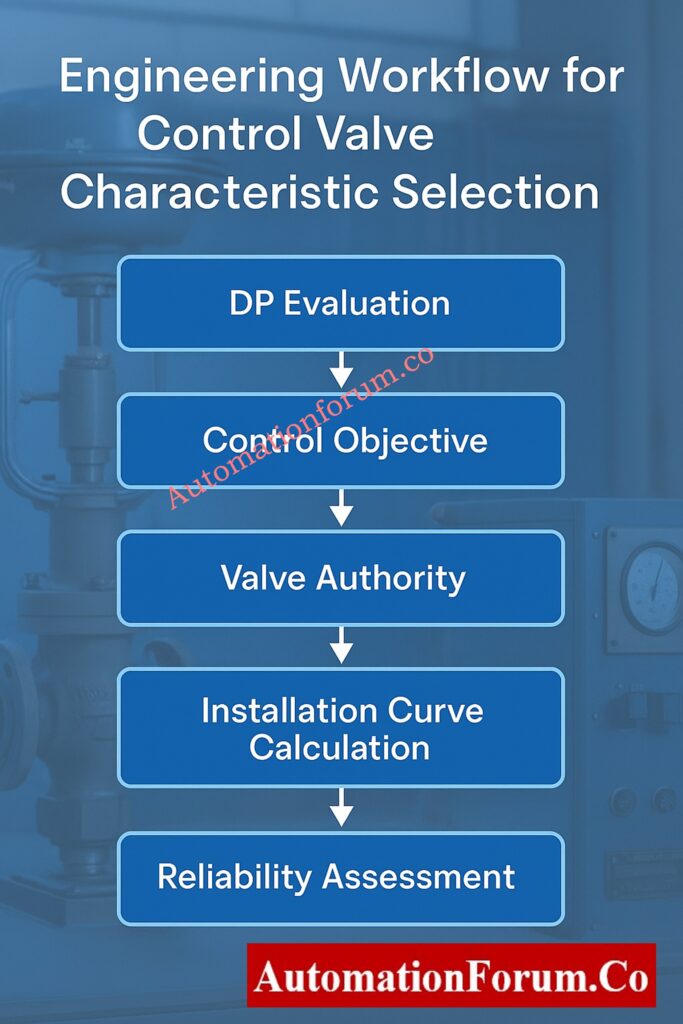
Step One: Evaluate System Pressure Behavior
Understand how differential pressure across the valve changes with flow by reviewing pump curves, steam pressures, and friction losses.
This helps you guess whether the valve will work well or become too sensitive in certain situations.
Step Two: Identify the Control Objective
To figure out the right modulation style and accuracy, you need to know what the control loop is for.
Matching the characteristic to the process variable keeps the dynamics stable and makes tuning easier.
Must-Have Accessories, Boost Valve Reliability, Process-Critical Add-Ons: Essential Control Valve Accessories for Reliable Process Control
Step Three: Assess Valve Authority
Step Four: Compute Installation Curves
To get a better idea of how well something works, calculate Kvr at different flow rates.
When you compare these values to built-in trim curves, you can find the one that gives you the most proportional response.
Step Five: Consider Reliability and Mechanical Factors
Before you finish the trim, check the risk of seat wear, the risk of erosion, the size of the actuator, and the accuracy of the positioner.
In applications with high energy or changing pressure, equal percentage trims usually last longer.
Stop Valve Hunting, Root Causes Identified, Hunting Explained Clearly: What are the main causes of control valve hunting?
Real Engineering Scenarios Where Control Valve Characteristic Selection Matters
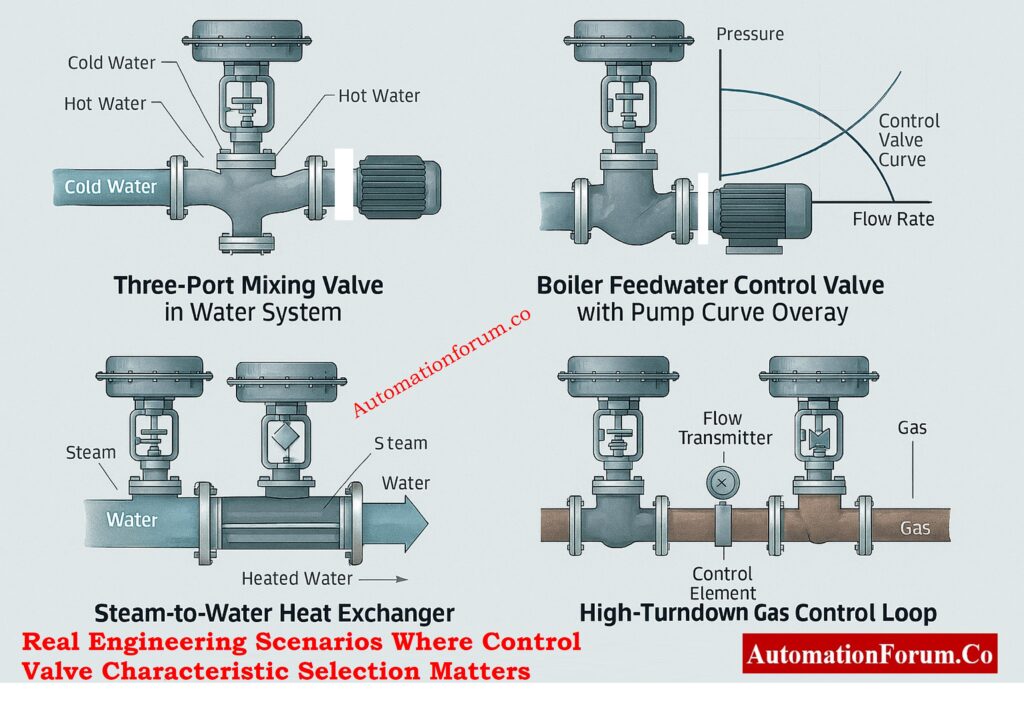
Heating Water Systems Using Three-Port Valves
Most of the time, these systems work with a stable ΔP, so linear characteristic valves are best for predictable modulation.
A linear trim makes sure that the temperature is controlled smoothly and that the control loop isn’t too sensitive.
Boiler Feedwater Control Valve Case
At low flows, the pump head rises quickly, which causes big changes in ΔP across the valve.
Equal percentage trims give you more control in the low-lift area and stop instability near the seat.
Instant Fix Guide, Real-World Troubleshooting, Solve Non-Responsive Valves Fast: Field Troubleshooting Guide: Control Valve Not Responding in Process Area
Steam to Water Heat Exchanger Temperature Control
As the load changes, the pressure of the steam changes all the time, which has a big effect on ΔP across the valve.
Equal percentage trims match these changes and help keep the outlet temperature stable without any fluctuations.
High Turndown Gas Flow Control Systems
ΔP is hard to predict across the whole operating envelope because gas can be compressed and flows can be very wide.
Equal percentage trims give you precise control at both very low and very high flows, which keeps the loop running smoothly.
Cv Importance Explained, Why Cv Matters, Accurate Sizing Starts Here: Why Measuring Control Valve Cv is Essential for Proper Valve Sizing ?
Why Oversizing Affects Linear and Equal Percentage Valves Differently
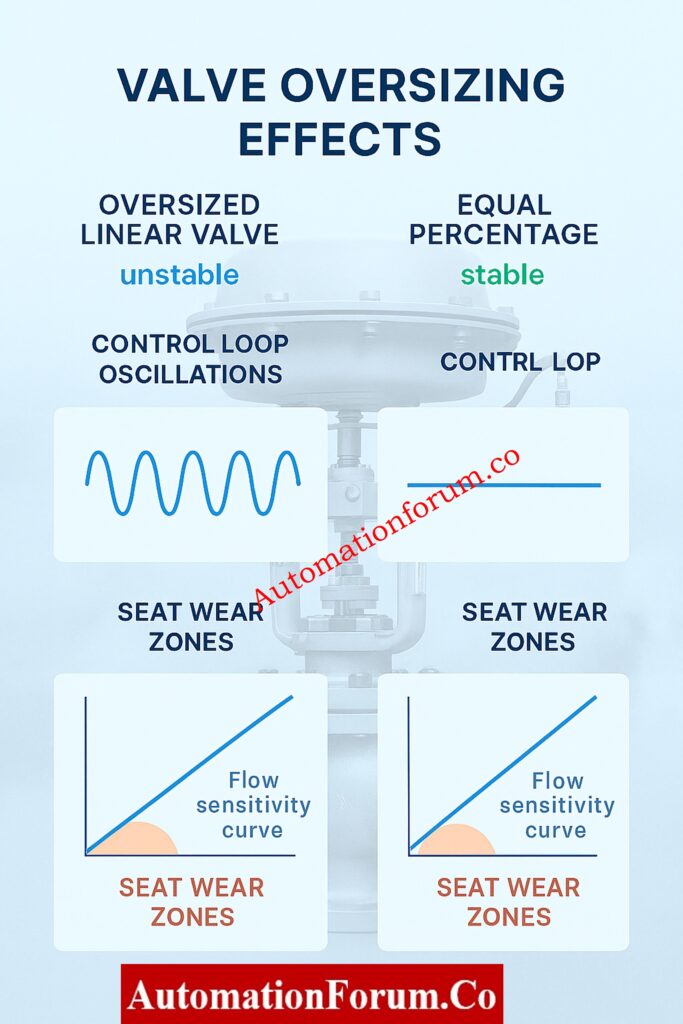
Impact of Oversizing on Linear Valves
In EPC work, it is common to oversize things.When linear valves are too big, they lose their fine resolution. Small changes in the valve can cause big changes in the flow. This leads to cycle hunting, overshooting, and loops that aren’t stable
Why Equal Percentage Valves Handle Oversizing Better
Even when they are too big, equal percentage valves keep great resolution close to the seat. The logarithmic shape makes it easy to control low flows and wide flows. This makes equal percentage much stronger in real plant conditions.
Leakage Class Guide, Full Testing Standards, Leakage Type Breakdown: Control Valve Leakage Testing, Types, and Calculation Standards
Advanced Engineering Considerations for Valve Characteristic Selection
Impact of Valve Characteristics on Control Loop Gain and Stability
The characteristics of the control valve have a direct effect on the loop gain, which is what decides how quickly the control valve reacts to changes in the process variable. When the characteristic doesn’t match, loop gain changes in an unpredictable way across the operating range. This makes the system behave erratically when the setpoint changes or there are disturbances.Equal percentage trims make the gain profile more even, which is especially helpful in systems with changing pressure drop. This helps keep proportional-integral-derivative control performance stable. Linear trims only work well when the loop gain is stable and predictable for all loads.
Relationship Between Valve Characteristics and Cavitation or Flashing
Choosing the right characteristic for liquid services with big pressure drops can help keep cavitation or flashing from happening. Equal percentage valves let you control the flow reduction better when you throttle, which lowers the chance of a sudden pressure drop inside the valve body. If you use linear trims in areas with a lot of pressure drop, the valve may get too close to cavitating conditions, especially when it is moving slowly. Choosing the right characteristic reduces mechanical damage and makes the valve last longer.
Importance of Installed Gain and Predictive Modeling
Engineers can use predictive modeling tools like installed gain curves, dynamic simulations, and Kvs-to-Kvr mapping to figure out how the valve will work across the whole range. Installed gain analysis is essential in EPC projects because it reveals nonlinearities, dead zones, excessive sensitivity, or poor resolution before the valve is installed. This makes commissioning easier, keeps loop tuning stable, and cuts down on the need for later redesign or rework.
Effect of Incorrect Characteristics on PID Tuning
The control system has to make up for wrong valve characteristics by using aggressive PID tuning.This causes the system to oscillate a lot, go too far, and become unstable during transients. Control engineers often change the tuning instead of fixing the real problem, which is that the valve characteristic doesn’t match. Choosing the right characteristic makes tuning much easier and helps the loop work faster and more consistently.
Safety and Reliability Considerations (SIS/SIL)
Practical Checklist for EPC Engineers Before Finalizing Valve Characteristics
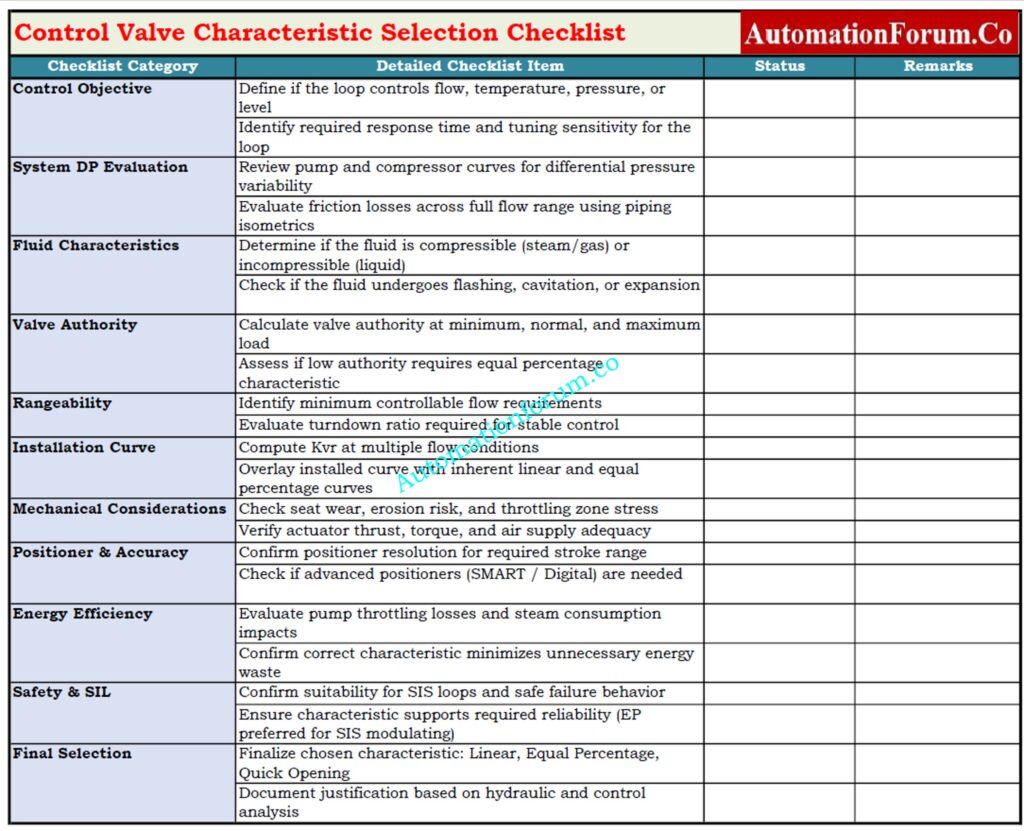
Downloadable Excel Checklist for EPC Projects
Refer the below link to Download the Detailed Control Valve Characteristic Selection Checklist (Excel)
Harsh Service Valve Guide, Best Selection Practices, Engineer’s Harsh-Duty Checklist: Control Valve Selection and Recommended Practices for Harsh Process
Control Valve Selection and Characteristics: Frequently Asked Questions
What are the criteria for selecting a control valve?
What is the characteristic of a control valve?
A valve characteristic defines how flow changes in relation to valve travel. It shows the percentage change in flow for a given percentage change in opening. Linear, equal percentage, and quick opening are all common types of valves. Each one works best with a different type of system pressure.
What is a characterized control valve?
A characterized control valve uses a plug, ball, or trim that is shaped in a certain way to create a flow curve that is easy to predict, like equal percentage or linear. This ensures stable modulation even when the valve body alone would not produce an ideal control characteristic.
Stop Valve Passing, Post-Overhaul Troubleshooting, Full Root-Cause Breakdown: How to Troubleshoot a Control Valve Passing Problem after Overhauling: Complete Root Cause Analysi
How to choose the correct valve?
Choose a valve based on the control goal, the expected pressure drop, the properties of the fluid, the accuracy needed, and the turndown.Make sure that the valve’s characteristics match how the system works and that the actuator is the right size, made of the right materials, and works well when installed.
How to calculate control valve size?
Control valve sizing uses Cv (or Kv) equations that relate flow rate, fluid properties, and differential pressure. After calculating the required Cv, engineers select a valve with a catalog Cv slightly higher and verify pressure drop, noise, cavitation risk, and control range.
Key Performance Metrics, Critical Valve Parameters, Engineer’s Performance Guide: Essential Control Valve Performance Parameters
