
- How to choose a level transmitter?
- Step 1: Evaluate the Process Medium
- Step 2: Determine Measurement Range Requirements
- Step 3: Define Accuracy and Repeatability Criteria
- Step 4: Select Appropriate Sensor Technology
- Step 5: Identify Power Supply Compatibility
- Step 6: Choose Compatible Signal Output and Communication Protocols
- Step 7: Evaluate Environmental and Process Conditions
- Step 8: Verify Certifications and Compliance
- Step 9: Assess Installation and Mounting Requirements
- Step 10: Analyze Vendor Support and Lifecycle Costs
- Step 11: Calibration and Commissioning Simplicity
- Step 12: Consider Cleaning and Maintenance Accessibility
- Level Transmitter Selection Checklist – EPC Instrumentation Engineer
- Test your Knowledge on Level Transmitter Calibration
In industrial automation and process control, level transmitters are very important. They make sure that liquids, solids, slurries, or interfaces in tanks, silos, and containers are monitored safely, accurately, and all the time. Choosing the correct level transmitter is more than just picking a model; it’s an important engineering selection that affects the success of the project, the reliability of operations, the maintenance schedule, and the safety systems.
Instrumentation engineers at Engineering, Procurement, and Construction (EPC) companies are in charge of reviewing and specifying level transmitters at several points in the process, such as FEED, detailed design, procurement, FAT (Factory Acceptance Test), and commissioning. Choosing the wrong thing might lead to wrong level readings, broken instruments, expensive rework, and potentially dangerous circumstances in the plant.
How to choose a level transmitter?
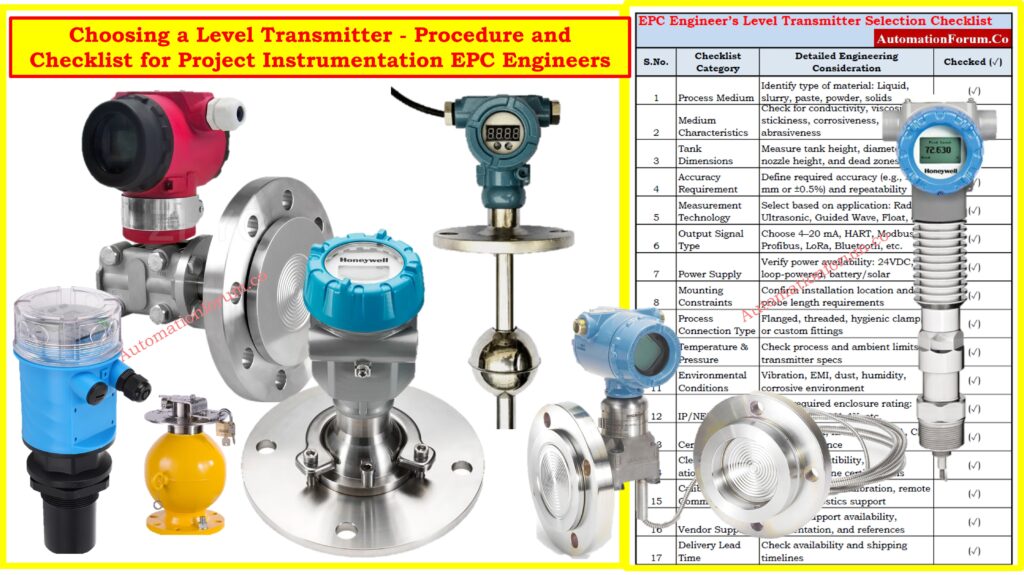
This technical documentation gives engineers a project-ready checklist to use when making decisions in real time, as well as a structured step-by-step process for choosing level transmitters and a full comparison of sensor technologies.
Step 1: Evaluate the Process Medium
The first step in choosing a transmitter is to understand what the process fluid or substance is like. Engineers should look at the following:
- Is the substance a liquid, slurry, paste, powder, or bulk solid?
- Does the medium have foam, surface turbulence, or vapors?
- Are there particular characteristics that are corrosive or abrasive?
- How dense and conductive is the product?
- Will the medium’s characteristics vary during the process because of such temperature, pressure, or phase?
Use wetted parts consisting of PTFE, PVDF, or titanium for corrosive materials. For slurries that are rough, make sure they are strong enough and protected from probes.
Auto-Calculate DP Ranges: Excel tool for DP type level and density transmitter calibration range calculation
Step 2: Determine Measurement Range Requirements
Level transmitters are made to measure in certain ranges. Choosing the wrong size can give you wrong readings.
- Find out how tall the tank or vessel is
- Find the dead zones at the top and bottom where the sensor can’t read.
- Find out if there are offsets or standpipes.
- Think about if you need to measure the whole tank or only part of it.
Float or ultrasonic sensors may be enough for small tanks. Radar or submersible pressure transmitters are often employed in big storage tanks.
Explore Submersible Benefits: Submersible Level Transmitters: Applications, Working Principles, and Benefits
Step 3: Define Accuracy and Repeatability Criteria
In applications like chemical dosing, custody transfer, and inventory control, accuracy is very important. If the readings are wrong, you could lose material or put your safety at risk.
- What is the acceptable range of error (for example, ±1 mm, ±0.5%, etc.)?
- Is the application for general monitoring or is it crucial for safety?
- How crucial is it for things to be repeatable (like getting the same readings over time)?
Both magnetostrictive and radar sensors have excellent repeatability and precision. Ultrasonic and hydrostatic transmitters work well for requirements that don’t demand very high accuracy.
Understand Boiler DP Logic: Understanding Boiler Drum Level Transmitters: Accurate DP Measurement Explained
Step 4: Select Appropriate Sensor Technology
The type of measurement principle you choose should depend on the environment, the type of medium, and the limits of engineering.
How do I choose a level sensor? – Comparison of Level Sensor Types
| Type of Sensor | Media | Advantages | Disadvantages |
| Float Sensor | Liquids | Precise, low-cost, no maintenance, unaffected by foam or viscosity | Sensitive to waves, low range (<1m), not suitable for corrosive fluids |
| Hydrostatic Sensor | Liquids | Accurate, unaffected by foam, easy to install, wide range | Maintenance required, draining needed, affected by density variation |
| Radar Sensor | Liquids, solids, pastes | Non-contact, high accuracy, handles high temp (up to 450°C), adjustable range | Sensitive to product conductivity, higher cost |
| Guided Radar | Liquids, solids, pastes | Highly accurate, not affected by vapors/foam/dust, suitable for interface measurements | Requires clean probe, not ideal for sticky materials |
| Ultrasonic Sensor | Liquids, solids | Non-contact, easy to install, maintenance-free | Affected by foam, steam, dust, and temperature fluctuations |
| Capacitive Sensor | Liquids, powders, granules | Withstands extreme temp/pressure, robust, good for adhesive/viscous materials | Calibration needed, buildup affects accuracy |
| Radiometric Sensor | All types | Works in extreme process conditions, immune to chemical/physical properties, suitable for harsh or radioactive environments | Expensive, regular calibration, radiation safety protocols needed |
Troubleshoot Radar Transmitters: Step-by-Step Guide for Troubleshooting Radar Level Transmitters
Step 5: Identify Power Supply Compatibility
Check the available power options at the installation site:
- Loop-powered (4-20 mA): Simplifies wiring; ideal for hazardous zones
- 24VDC: Standard in most control systems
- Battery-powered or solar-powered: Needed for remote or off-grid locations
When employing wireless or battery-powered transmitters, power use is an important thing to think about.
Use Free Level Tools Now: 15+ Collection of Level Measurement Calculators for Industrial Instrumentation
Step 6: Choose Compatible Signal Output and Communication Protocols
Make sure that the output from the transmitter works with your plant’s automation system:
- Analog: 4-20 mA, 0-10 V standard in legacy systems
- Digital: HART, Modbus, and Profibus smart diagnostics and remote access
- LoRaWAN, Zigbee, NB-IoT, and Bluetooth are all wireless technologies that can be used to monitor tanks from a distance.
Use devices that support HART for projects that need to be set up remotely or checked for problems before they happen.
Decode DP Hookups Quickly: How to Read the Hookup Drawing of a DP Type Level Transmitter?
Step 7: Evaluate Environmental and Process Conditions
External influences including temperature, vibrations, and electromagnetic interference (EMI) might make transmitters work less well.
- What is the range of the ambient and process temperatures?
- Are there washdowns, a corrosive environment, or vibration?
- Is the sensor going to be put in a dangerous place?
Use sensors with suitable IP/NEMA ratings, ATEX/IECEx approvals, and EMI shielding for demanding environments.
Calculate Dry Weights Easily: Displacer type interface level transmitter dry calibration weight calculator
Step 8: Verify Certifications and Compliance
Most EPC projects require full compliance with industry standards:
- SIL2 or SIL3: Safety Instrumented Functions (SIF) compliance
- ATEX / IECEx: Explosion-proof classification
- FDA / 3A: Required in food, beverage, and pharmaceutical industries
- ISO / CE / RoHS: Regional or international compliance standards
Make sure the chosen product fulfills both the client’s needs and the project’s rules.
Fix GWR Issues Easily: Guided Wave Radar Level Transmitters: Complete Troubleshooting & Maintenance Guide
Step 9: Assess Installation and Mounting Requirements
Think about how and where the sensor will be put up:
- Is it mounted on the top, the side, or under water?
- What kind of connection does the process have? (flange, thread, or hygiene)
- Is the tank open to the air or pressurized?
- Are there any things that are in the way or that make things worse?
Select compact models for confined areas and probe-type devices (e.g., guided radar) for narrow tanks.
Follow this PM Checklist: Checklist: Preventive Maintenance Procedure for Closed Tank Wet Leg Level Measurement
Step 10: Analyze Vendor Support and Lifecycle Costs
Cost is essential but so is long-term support and maintenance for the project to be a success.
- Look at the startup cost and the lifecycle cost.
- Check to see whether local services are available and if there any technical documentation.
- Look over feedback from clients and past project work.
- Make sure that training and calibration tools are available.
Don’t choose equipment just because it’s cheap, especially in dangerous or important situations.
Step 11: Calibration and Commissioning Simplicity
Field teams often have limited time for instrument commissioning. Choose transmitters that support:
- Local display for level, diagnostics, and configuration
- Remote configuration via HART communicator, Bluetooth app, or PC software
- Factory calibration certificates and documentation
▶ Note: Configuration tools like handheld communicators or mobile apps can save hours during FAT/SAT.
Calibrate Level Devices Right: Calibration Procedures for Level Measurement Devices
Step 12: Consider Cleaning and Maintenance Accessibility
In a lot of fields, such as food and beverages, pharmaceuticals, and chemical processing, routine cleaning and maintenance are not only necessary for business, but also required by law. In these kinds of places, it’s very important to use level transmitters that are easy to get to and work with cleaning-in-place (CIP) or sterilization-in-place (SIP) methods.
- To keep materials from building up, pick sensors with smooth, non-stick surfaces.
- In sanitary settings, be sure that wetted parts are constructed of materials that the FDA has approved.
- Use flush-mount or clean clamp designs on tanks that need to be cleaned often to keep residue from building up in cracks.
- Think about using smart transmitters that let you monitor and diagnose health problems from a distance in hazardous or hard-to-reach places.
for the design process, you should also think about how easy it will be to get to for maintenance. Instruments on tall tanks, in tight places, or in areas with a lot of vibration may need remote displays, handheld communicators, or diagnostic warnings to make it safer and reduce the need for people to get involved.
Tip: To make sure your project documentation matches your maintenance plans, provide the cleaning interval and technique (manual or automated).
Master Level Measurement Fast: Mastering Level Measurement Technologies: A Comprehensive Guide
Level Transmitter Selection Checklist – EPC Instrumentation Engineer
This checklist supports instrumentation engineers working in EPC projects during FEED, detailed design, procurement, FAT, and commissioning stages to evaluate and select appropriate level transmitters. It ensures comprehensive assessment across process compatibility, safety, compliance, and installation requirements.
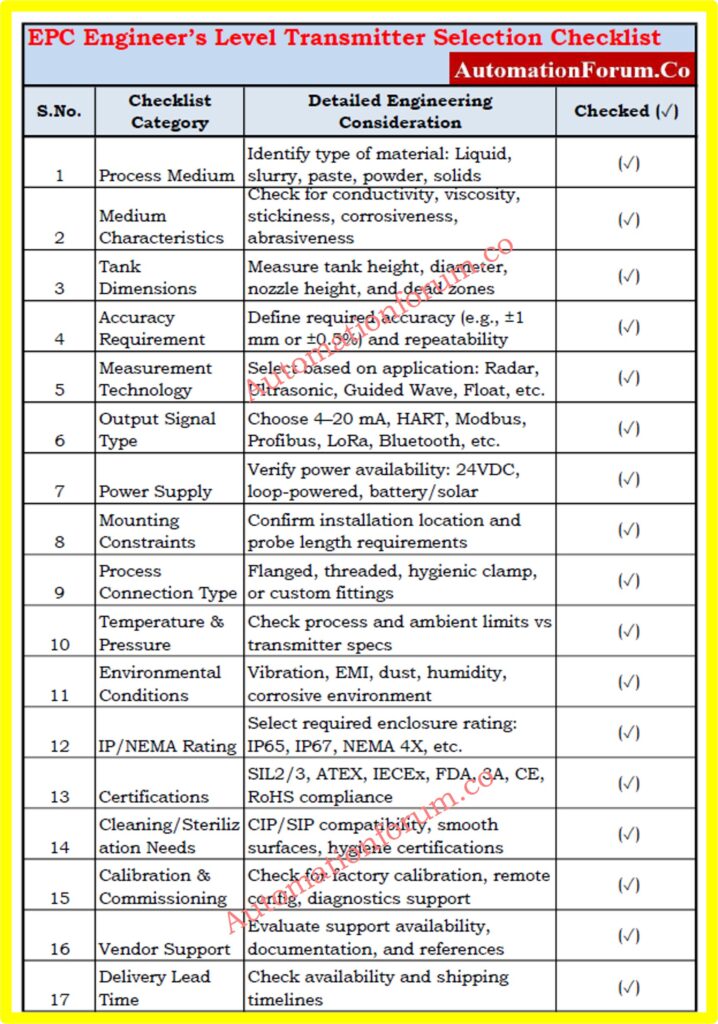
Refer the below link to download the Level Transmitter Selection Checklist – EPC Instrumentation Engineer
Choosing the correct level transmitter is a challenging engineering job that involves a good understanding of the process, the project’s limitations, and the technical standards. EPC engineers need to think about more than just the physical measurement. They also need to think about how the device will work with other systems, how safe it is, how easy it is to set up, and how reliable it will be in the long run.
Instrumentation engineers may make sure that transmitters work at their best throughout the life of the plant by following the procedures in this guide and using the selection checklist when evaluating vendors. The appropriate decision lowers risks, cuts down on downtime, and helps with operational excellence from FEED to commissioning.
Know Tank Design Impact: Effect of Tank Design on Accuracy of Level Measurement
Test your Knowledge on Level Transmitter Calibration
Refer the below link for the Level Transmitter Calibration Quiz for Instrumentation Technicians and Engineers Interview
