
- IEC 61511 Safety Bypass and Override
- Understanding Safety Bypass And Override In A Safety Instrumented System (SIS)
- Why IEC 61511 Strictly Controls Bypass And Override
- When Safety Bypass Is Justified During Maintenance
- Risk Assessment Before Applying A Bypass
- Compensatory Measures During Bypass (safety bypass management)
- Bypass Implementation and Control System Practices (SIS Maintenance Practices)
- Time Limits And Bypass Expiry Management
- Returning The Safety Function To Service (Instrumentation Maintenance Safety)
- Common Maintenance Mistakes Related to Safety Bypass
- Best Practices for Maintenance and Reliability Teams
- Disciplined Safety Bypass Management Under IEC 61511
- FAQ on IEC 61511 Safety Bypass and Override
IEC 61511 Safety Bypass and Override
Why Safety Bypass And Override Matter For Instrumentation Maintenance
Safety bypass and override activities are among the most critical and high-risk tasks performed by maintenance and reliability engineers in process plants. In oil and gas, chemical, power, and other hazardous industries, Safety Instrumented Systems are designed as independent protection layers that prevent catastrophic events such as explosions, toxic releases, fires, and major equipment damage.
Industrial Incidents Caused By Uncontrolled Safety Bypasses
History has repeatedly shown that many serious industrial incidents did not occur because safety systems were poorly designed, but because they were bypassed, overridden, or left disabled during maintenance. Forgotten bypasses, undocumented overrides, and uncontrolled temporary workarounds have resulted in loss of containment, environmental damage, and fatalities.
This article explains how maintenance teams should manage safety bypass and override activities in real plant conditions, focusing on what must be done in the field, not academic interpretations of the standard.
SIS vs SIF vs SIL Explained – What is SIS, SIF and SIL? An In-Depth Guide to Functional Safety in Process Industries
Understanding Safety Bypass And Override In A Safety Instrumented System (SIS)
Definition Of Safety Instrumented System Bypass And Safety Override
In a Safety Instrumented System, a safety bypass refers to the intentional temporary disabling of a safety instrumented function while the plant continues operating. The input signal may still be visible, but the logic solver is prevented from executing the shutdown or protective action.
A safety override typically forces a device or logic state to a predefined value regardless of actual process conditions. In practice, both bypass and override remove the automatic protective action of the SIS and therefore carry similar risks.
How HIPPS Works in Oil & Gas – How does the HIPPS system work in the Oil and gas Industry?
Difference Between Temporary Bypass And Permanent Override
The most important distinction is between temporary bypass and permanent override.
A temporary bypass is applied for a clearly defined maintenance purpose and is expected to be removed immediately after the task is completed. Some examples are skipping a pressure transmitter during calibration or turning off a shutdown valve during stroking tests.
A permanent override takes away the safety feature from normal functioning. This is not a maintenance task; it is a design change that needs a comprehensive safety analysis and management of change.
SIF PFDavg & SIL Verification Made Simple –SIF PFDavg / SIL Verification – Complete Guide + Online Calculator (IEC 61508 / 61511)
Why IEC 61511 Strictly Controls Bypass And Override
Safety Philosophy Behind Independent Protection Layers
The fundamental safety philosophy behind IEC 61511 is that each protection layer must remain effective throughout the plant lifecycle. When a safety function is bypassed, the risk reduction it provides is temporarily lost.
Uncontrolled bypass defeats the purpose of having a Safety Instrumented System. If it were easy or casual to bypass safety layers, operators would not know they were running the plant without them, which would give them a false sense of security.
Why Uncontrolled Bypass Defeats SIS Risk Reduction
IEC 61511 safety bypass and override controls are intended to ensure that:
- Bypass is deliberate, not accidental
- Bypass is visible to operations
- Bypass is time-limited
- Bypass is compensated by other risk reduction measures
The standard emphasizes that procedures alone are not sufficient. Technical controls, access restrictions, alarms, and traceability must support administrative controls.
Testing & Repair Deferral Explained –Testing and Repair Deferral – IEC Guidelines, Procedure, and Best Practices
When Safety Bypass Is Justified During Maintenance
Although bypassing safety functions is undesirable, certain maintenance situations make it necessary.
Proof Testing And Calibration Of Safety Instruments
Common justified cases include:
- Proof testing of safety transmitters and final elements where the device must be driven beyond trip limits.
- Replacement of failed transmitters, solenoids, or shutdown valves where normal signals cannot be maintained during physical work.
- Valve stroking and partial-stroke testing that intentionally moves the valve without causing a plant trip.
- Logic solver maintenance, upgrades, or troubleshooting where the system must be tested without affecting the process.
- Investigation of nuisance or false trips where temporary isolation is required to diagnose the root cause.
- Startup or shutdown activities where approved operating procedures allow controlled overrides for limited durations.
Functional Safety Terminology Explained – Functional Safety Terminology – Excel Download for Industrial Automation
Risk Assessment Before Applying A Bypass
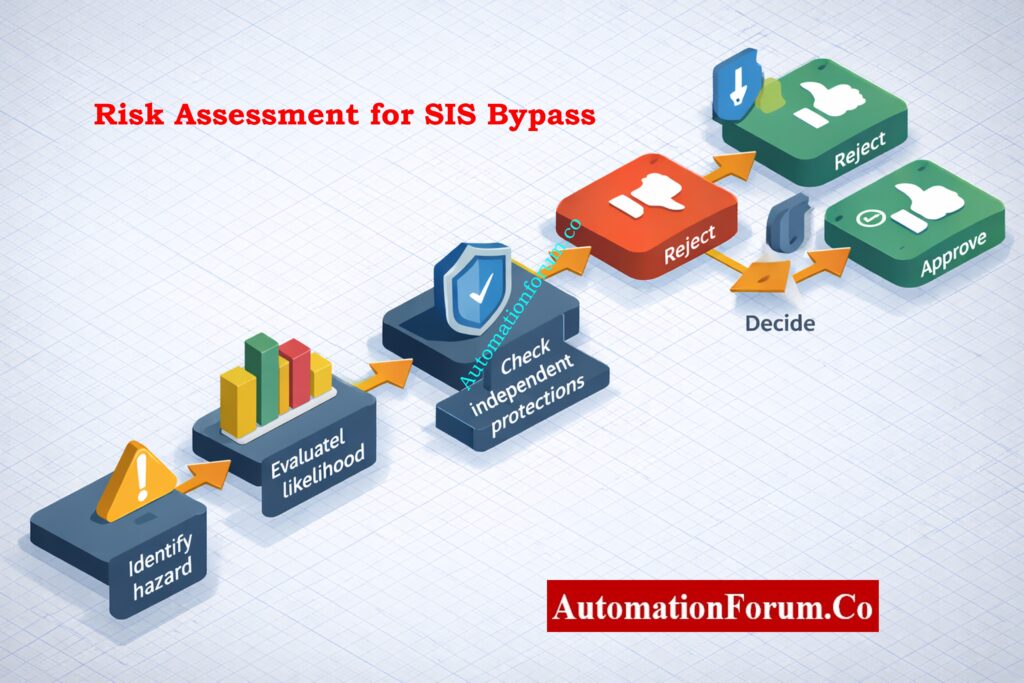
Roles Of Maintenance, Operations, SIS Engineers and Management
Before any safety bypass is applied, maintenance engineers must evaluate the process risk associated with disabling the safety function.
The risk assessment should consider:
- What hazard is normally controlled by this safety function
- What could happen if the hazard occurs during the bypass period
- How likely the initiating event is under current operating conditions
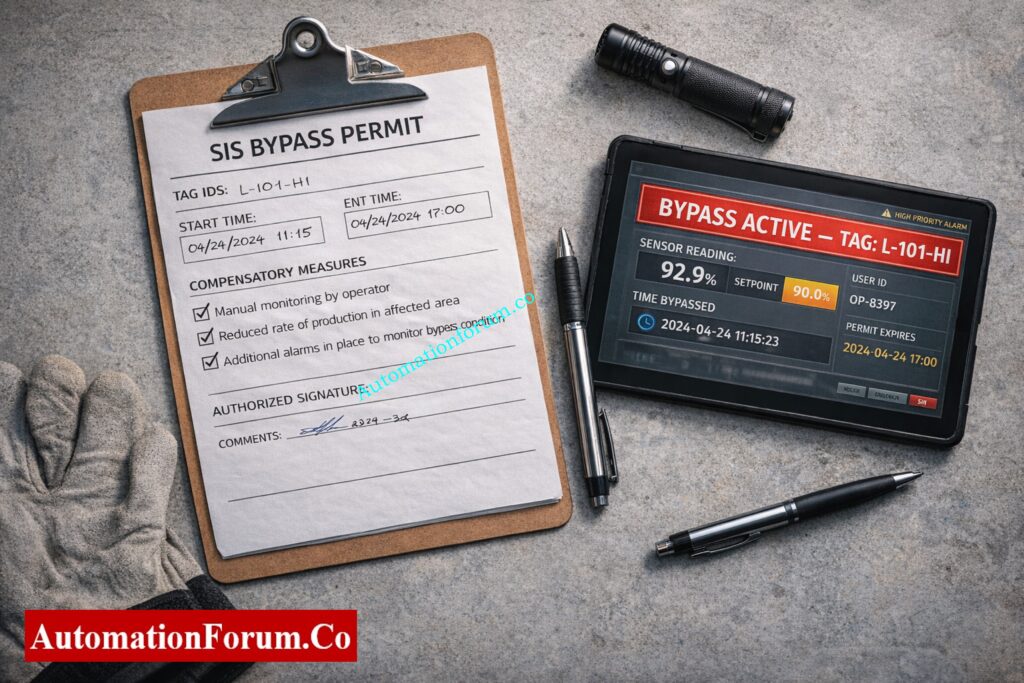
Safety Bypass Permit Content And Approval Workflow
The assessment should also identify existing independent protection layers such as relief valves, alarms, operator intervention, or physical barriers.
If the residual risk cannot be reduced to an acceptable level using compensatory measures, the bypass must not be applied and alternative maintenance methods should be considered.
This evaluation does not need to be a full hazard study, but it must be documented, reviewed, and approved before proceeding.
Integration With Permit-to-Work And Management of Change
Maintenance engineer
Suggests the bypass, defines its scope, lists the specific signals or final elements that will be affected, and outlines the intended compensatory procedures.
Operations
Checks to see if the procedure is ready, makes sure that the current operating conditions make the temporary drop in protection acceptable, and agrees to any operational limits.
SIS or safety engineer
Checks that the proposed bypass won’t accidentally turn off other levels of security, makes sure that the bypass method is technically sound, and finds any tests or diagnostics that need to be done.
Plant Management or Delegated Authority
Gives the last word on bypasses that are very risky or go beyond normal maintenance windows.
- Which safety function is bypassed
- Why the bypass is required
- Start and end time
- Compensatory measures
Only people who have been trained and given permission should be able to turn on or off the bypass.
Emergency Valve Shutdown Signals Explained – Signals for Emergency Valve Shutdown in Critical Processes
Compensatory Measures During Bypass (safety bypass management)
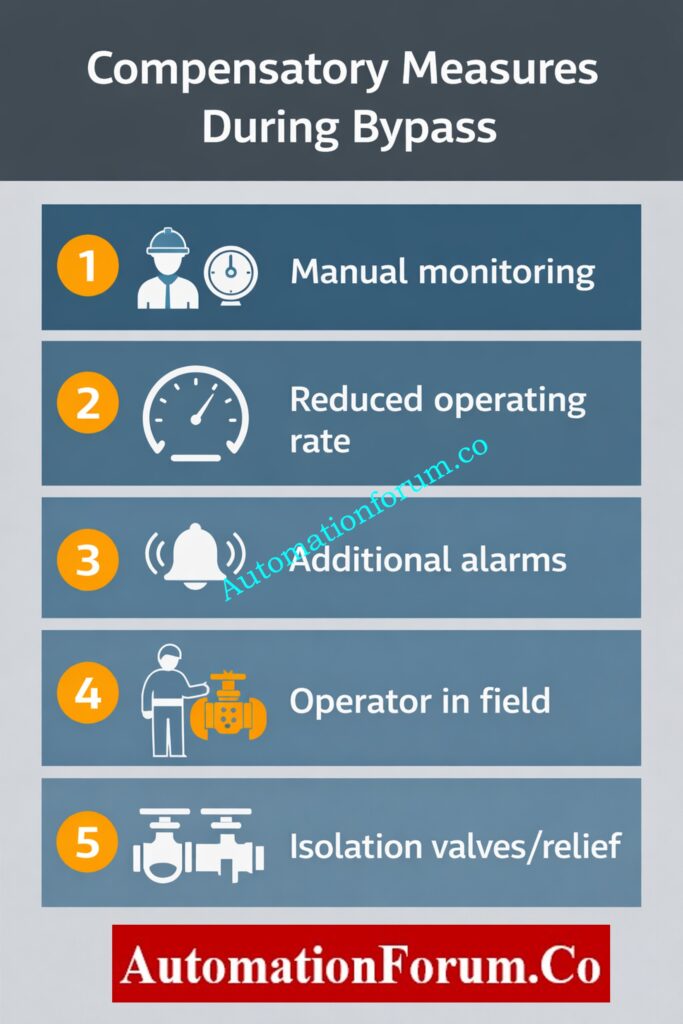
If a safety function is skipped, other safeguards must temporarily take its place to keep people safe.
Some common ways to make up for problems are:
- Having qualified operators manually monitor important process variables.
- Lowering the rate of output or working within stricter process restrictions.
- Turning on more alarms or decreasing the alarm setpoints.
- Assigning someone to stay in the field physically.
- Putting in place temporary rules or processes for how things should work.
- Making sure that other layers of independent protection work properly.
These steps need to be doable, enforced, and clearly explained to everyone who will be affected.
Test Your SIS Knowledge – Test Your Expertise in Safety Instrumented Systems (SIS): Knowledge Quiz
Bypass Implementation and Control System Practices (SIS Maintenance Practices)
Control systems should be set up and designed in a way that makes safe bypass management possible.
Some important things to do are:
HMI Indication And Visibility Of Bypassed Safety Functions
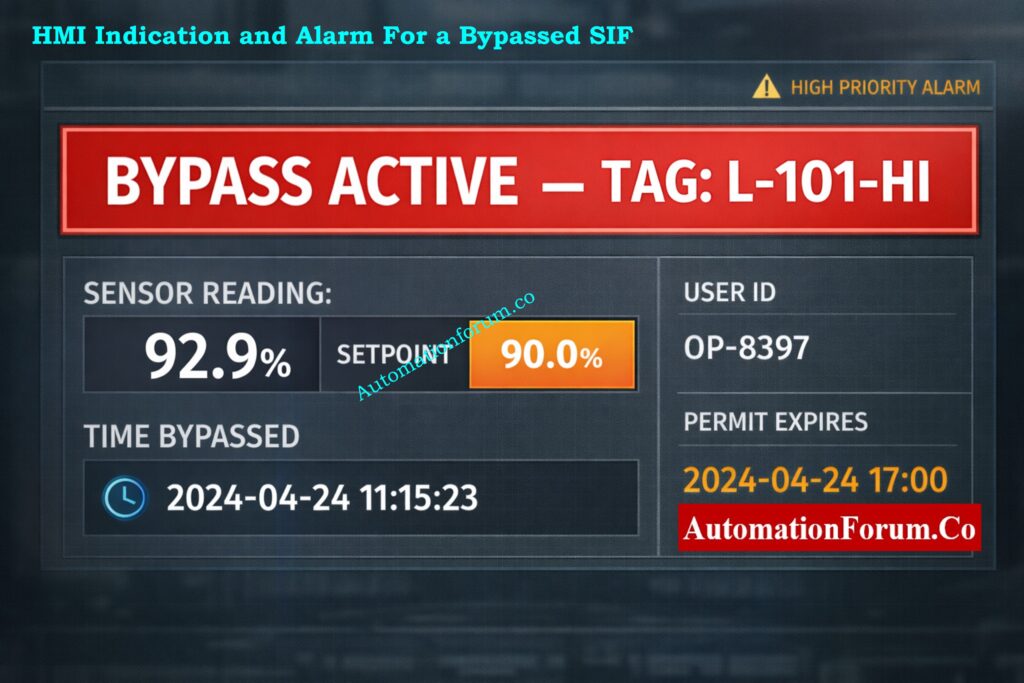
The operator interface should explicitly show any active bypass or override, name the function that is affected, and name the person who put it in place.
Alarm Management For Active Bypasses
When you use a bypass, it should set off a different alarm and put it at a high enough priority level so it can’t be easily silenced. The alarm should keep going off until the bypass is taken away and the function is checked.
Access Control Using Passwords, Roles And Key Switches
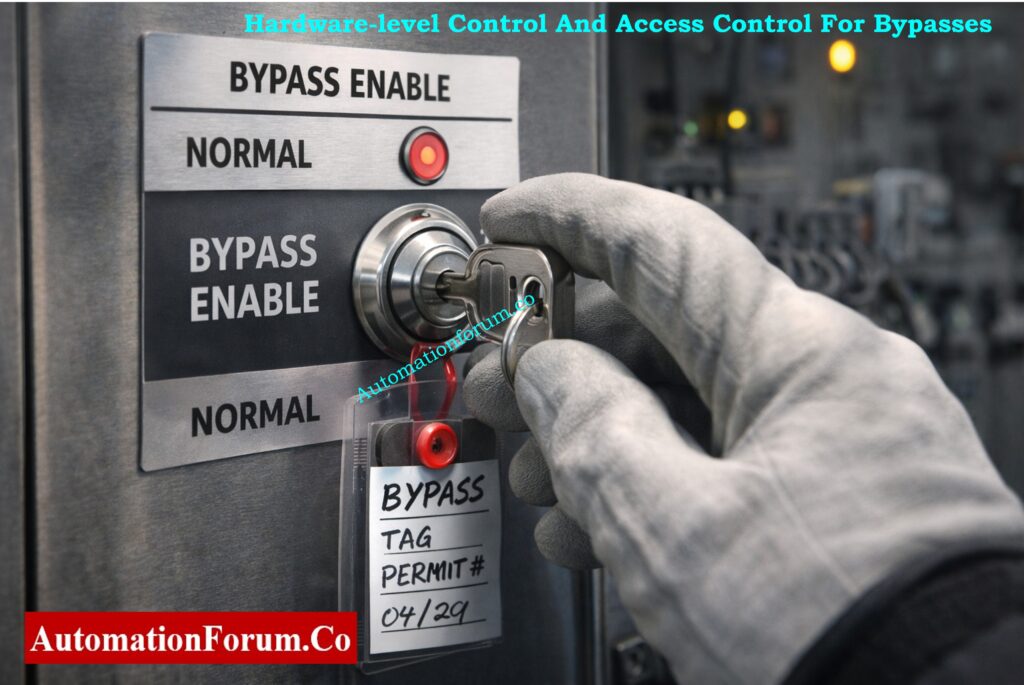
Logging, Traceability And Audit Records
It is important to automatically log bypass activities with the user ID, timestamp, cause, and predicted expiration. These logs help in audits and investigations of incidents.
Selective Bypass To Preserve Redundancy
If the architecture enables it, only bypass the least amount of elements needed. For example, bypass a single channel rather than the entire trip logic. Selective bypass reduces the reduction in safety integrity and preserves available redundancy.
Fail-Safe Design Of Bypass Mechanisms
Ensure that the control system design returns automatically to a safer state on loss of communication or if the bypass control fails. The bypass mechanism itself must be subject to the same engineering rigor as other SIS changes.
2oo2 SOV Explained – Understanding 2 out of 2 SOV: Working & Configuration
Time Limits And Bypass Expiry Management
Defining Maximum Bypass Duration
Every safety bypass needs to have a set time limit.
Shift Handover Review And Re-Authorization Rules
During shift handovers, maintenance crews should keep an eye on the status of bypasses and review any active bypasses.
If repair can’t be done in the period that was agreed upon, the bypass needs to be looked at again, not automatically extended.
Top SIS Interview Questions & Answers – Safety Instrumented System(SIS) Interview Questions and Answers
Returning The Safety Function To Service (Instrumentation Maintenance Safety)
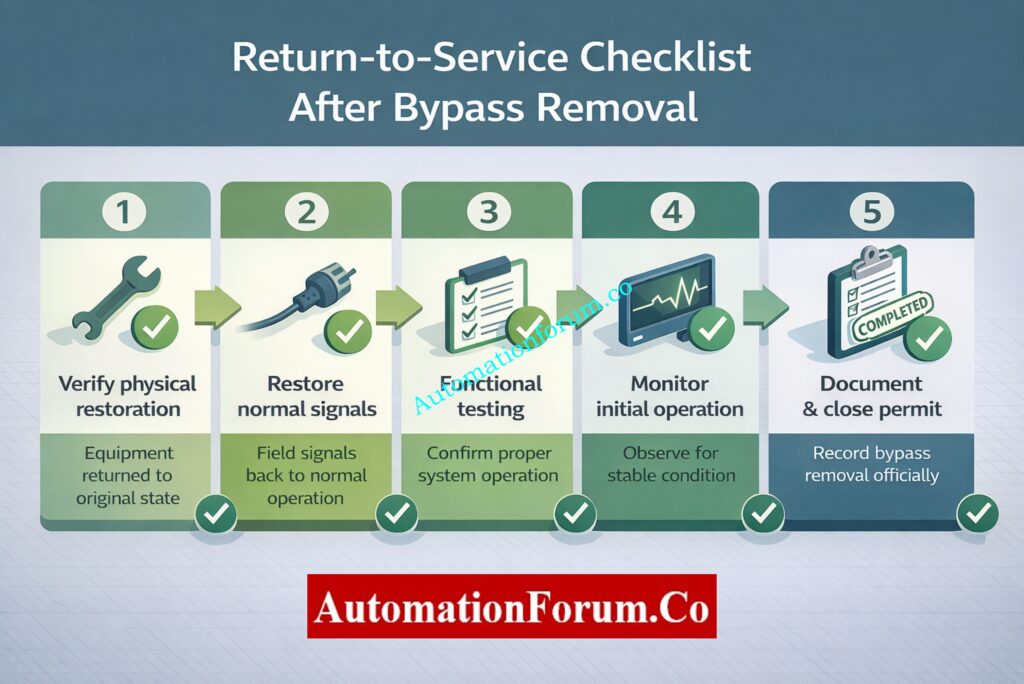
It should be a regulated, documented process to remove a bypass that checks the function before normal operation can start again.
Step 1: Verifying Physical Restoration Of Instruments And Valves
Check that the wiring, instruments, and final items are all properly reconnected and reinstalled.
Step 2: Restoring Normal Signals And Removing Test Connections
Re-enable inputs and take off any test wiring or connections required for maintenance.
Step 3: Functional Testing And Validation Of Safety Logic
Do a functional test to show that the safety logic and final items work as they should. Tests should be authentic and, if it’s safe to do so, they should be like a real demand.
Step 4: Monitoring Operation After Bypass Removal
Step 5: Documentation And Communication With Operations
Put the test results, the time, and the name of the person who took down the bypass in the permit record. Tell operations and plant management that the safety function is back in place.
These processes are necessary to meet the safety bypass and override requirements of IEC 61511 and to make sure that risk has not been left unmanaged by mistake.
You can’t finish the job unless the safety function is fully working and tested.
PLC Permissive Logic Troubleshooting –PLC Permissive Logic Troubleshooting Procedure for Instrumentation Engineers
Common Maintenance Mistakes Related to Safety Bypass
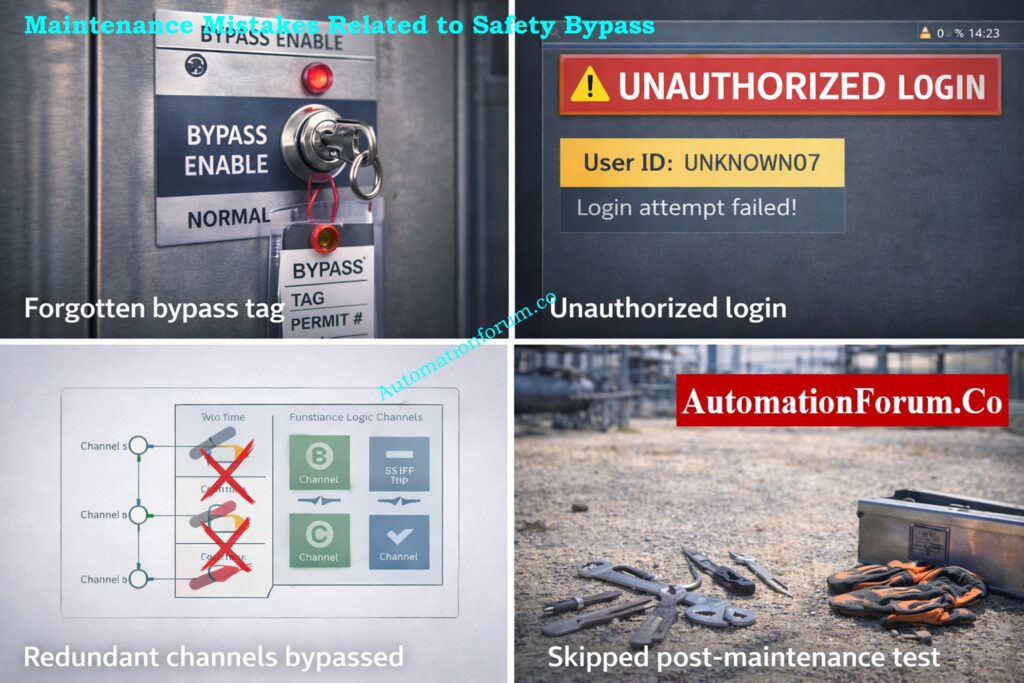
Frequent issues observed in plants include:
- Bypasses left active after maintenance due to poor handover.
- Operations unaware that a safety function is disabled.
- Multiple redundant channels bypassed simultaneously.
- Functional testing skipped after restoration.
- Bypass durations extended without reassessment.
These mistakes undermine both safety and maintenance credibility.
Refer the below link for the Top 10 Maintenance Metrics Every Reliability Engineer Must Track
Best Practices for Maintenance and Reliability Teams
- To improve safety and compliance:
- Standardize SIS bypass procedures and train personnel regularly.
- Integrate bypass control into permit-to-work systems.
- Design SIS to minimize the need for bypass where possible.
- Schedule maintenance during low-risk operating periods.
- Review bypass history to identify recurring issues.
Treat every bypass as a temporary degradation of plant safety.
Ultimate Maintenance Checklist – Prevent Failures Before They Happen- Maintenance Checklist
Disciplined Safety Bypass Management Under IEC 61511
Strong safety bypass management demonstrates technical competence, operational discipline, and commitment to protecting people, assets, and the environment.
Gas Turbine Control Loops Quiz – Gas Turbine Control Loops Quiz: Troubleshooting & Maintenance for Instrumentation Experts
FAQ on IEC 61511 Safety Bypass and Override
What is IEC 61511 process safety?
IEC 61511 is an international standard that defines how Safety Instrumented Systems are specified, designed, operated, and maintained to reduce process safety risks. It focuses on preventing hazardous events in industries such as oil and gas, chemicals, and power. The standard ensures risks are reduced to a tolerable level throughout the plant lifecycle.
What is the meaning of bypassing safety controls?
When must functional safety assessment be done according to IEC 61511?
Functional safety assessment must be performed at key stages of the Safety Instrumented System lifecycle. This includes after design, before commissioning, after modifications, and periodically during operation. The assessment verifies that the safety system meets its intended safety performance.
What is the difference between SIF and SIS?
A Safety Instrumented Function is a single protective function designed to reduce risk, such as a high-pressure shutdown. A Safety Instrumented System is the complete system that implements one or more SIFs, including sensors, logic solvers, and final control elements.
What are the 5 levels of safety?
The five common levels of safety include inherent process safety, basic process control systems, alarms and operator intervention, Safety Instrumented Systems, and physical protection or emergency response. Each layer works independently to reduce risk. If one layer fails, the next provides protection.
How Does an Emergency Block Valve (EBV) Work? –What is an Emergency Block valve and How does it work
What is a SIF in safety?
A Safety Instrumented Function is an automatic safety action designed to bring the process to a safe state when dangerous conditions occur. It uses sensors, logic, and final elements to prevent accidents. Each SIF is assigned a Safety Integrity Level based on risk reduction requirements.
Refer the below link for the Advanced Field Instrument Reliability & Cyber-Secure Maintenance Checklist
