
- Understanding Cable Requirements in Hazardous (Ex) Zones
- ATEX Cable Requirements for Hazardous Areas Under EN 60079-14
- Key Cable Selection Requirements in Ex Zones
- Why Cables Do Not Require ATEX Certification
- Global Standards for Hazardous Area Cables
- Cable Glands for Ex Zones (These Require ATEX Certification)
- Recommended Cable Types for Hazardous Area Installations
- Practical Engineering Scenarios for Ex Cable Selection
- How to Choose the Right Cables for Ex Zones
Understanding Cable Requirements in Hazardous (Ex) Zones
Choosing the correct cable for hazardous areas is a critical responsibility for instrumentation and control (I&C) engineers working in refineries, oil & gas facilities, chemical plants, LNG terminals, and offshore platforms. Ex zones require strict compliance with safety standards, and one of the areas that generates the most confusion is cable selection.
Contrary to common belief, cables used in Ex zones do not require ATEX certification. Instead, EN 60079-14, which tells how to design and put together electrical and instrumentation installations in dangerous regions, controls their choice.
This guide tells I&C engineers everything they need to know, such as:
- ATEX cable requirements
- Why cables don’t need to be ATEX certified
- Choosing the right cable glands for Ex zones
- Examples of good wires for circuits for lights and instruments
- Practical engineering situations in dangerous places
Essential ATEX IS Cable Checklist for EPC Engineers: Intrinsically Safe Cables for ATEX Zones – Complete Checklist for EPC Engineers
ATEX Cable Requirements for Hazardous Areas Under EN 60079-14
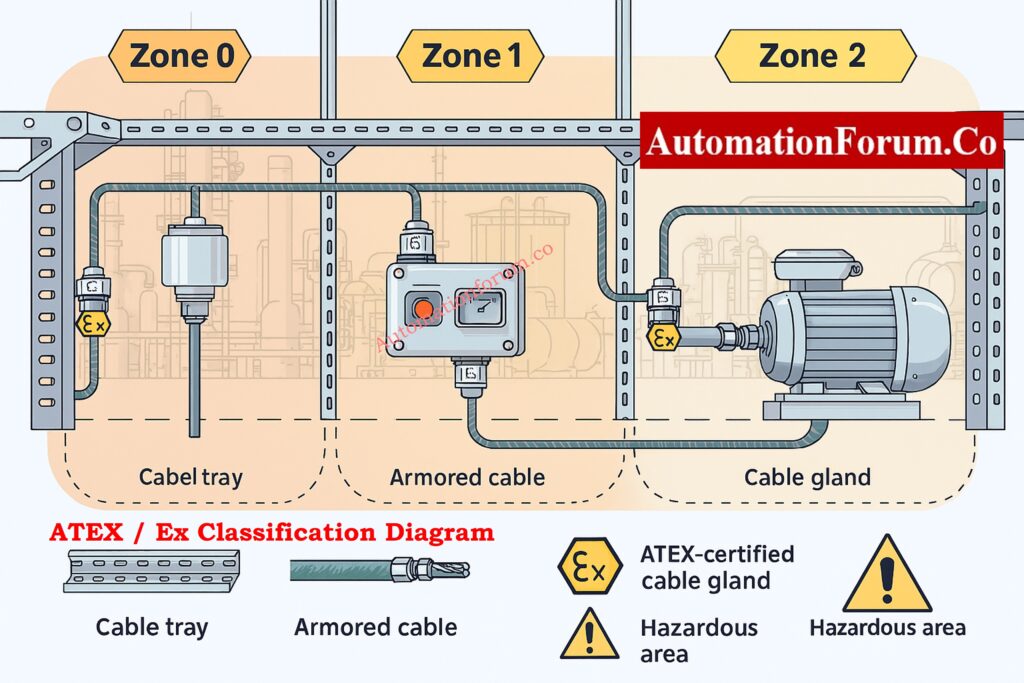
According to EN 60079-14, the cables used in areas with a risk of explosion must meet certain design and installation standards. These guidelines keep the system safe from electrical hazards, lower the chance of fire, and keep it working properly.
Cables Used in Hazardous Areas Are the Same as Industrial Cables
In Europe and elsewhere that follow ATEX rules, wires used in Ex zones:
- Are the same as those used in regular industrial electrical and instrumentation setups
- Do not need specific ATEX certificates or marks
- Must only meet the IEC standards for general safety, materials, and performance.
The only exception is for intrinsically safe (IS) circuits, which need extra care when it comes to shielding and separation.
Fix Cable Management Issues with the Right Tray Accessories: How to Fix Common Cable Management Issues using Cable Tray Accessories
Key Cable Selection Requirements in Ex Zones
Dedicated Cables for Each Field Device
To make circuits more reliable and stop faults from spreading:
- Every field device, whether a transmitter, positioner, analyzer, or solenoid, needs its own cable.
This keeps track of things and lowers the chance of cross-coupling mistakes.
Restrictions on Mixing Voltage Levels
You can’t put cables that transport various voltage levels, such 230 VAC lighting circuits and 24 VDC analog signals, in the same sheath. This prevents:
- Insulation breakdown
- Excessive heating
- Electric faults that could become ignition sources
Preventing Gas and Vapor Migration
To avoid flammable gases traveling along the conductor paths:
- Cables must be designed to block longitudinal gas migration
- Offshore and refinery-rated cables generally meet this requirement
This ensures that gas present in one area does not migrate into junction boxes or panels.
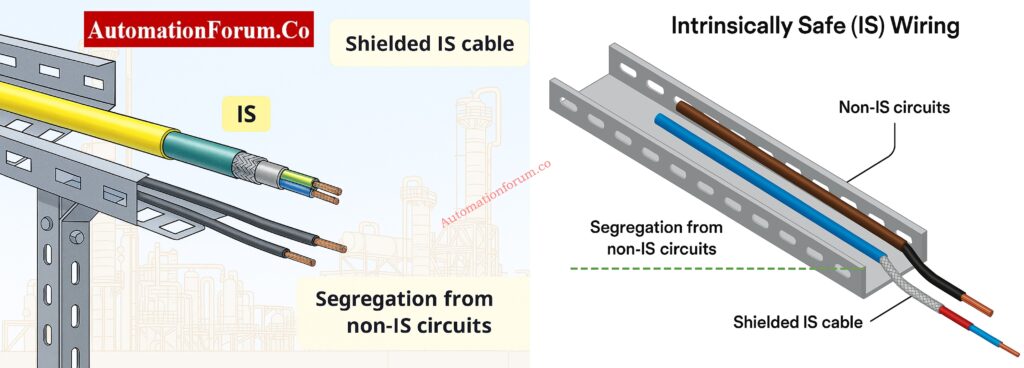
Shielding Rules for Intrinsically Safe (IS) Circuits
For IS circuits in Zone 0 and Zone 1:
- Shielding is mandatory
- Grounding and segregation rules must be followed
- Shield continuity must be maintained to ensure signal integrity and noise immunity
Environmental Resistance Requirements
Ex zones often have very tough working conditions. Because of this, cables must be able to resist:
- Mechanical damage
- UV radiation
- Chemical vapors
- Extreme temperatures
- Moisture and corrosion
This is especially relevant for installations outside of refineries or on offshore platforms.
Avoiding Excessive Cable Heating
Overloading, grouping, or bundling cables the wrong way can make the temperature go up. Excessive cable heating in a hazardous environment may create an ignition source. Engineers must apply:
- Proper current derating factors
- Correct installation spacing
- Cable tray loading limits
Importance of the Explosion Protection Document
Even when cables meet EN 60079-14 requirements, final approval must be documented according to the plant’s Explosion Protection Document (as per the ATEX User Directive). This makes sure that everyone on the site follows the rules.
Hazardous Area Cable Gland Selection – 2025 Guide: Cable Gland Selection for Hazardous Area Installations – Complete 2025 Guide
Why Cables Do Not Require ATEX Certification
People often think that all equipment put in Ex zones needs ATEX certificates. This is not true for cables.
Cables are Not Considered ATEX Equipment
ATEX certification applies only to equipment that can act as a potential ignition source. Cables:
- Don’t make sparks
- Do not have devices that switch
- Do not have parts that move or rub against each other.
So, they don’t have to go through an ATEX conformity evaluation.
Procurement teams commonly ask for ATEX certificates for cables. This article helps engineers give the right technical reasons to avoid delays.
Ex ia vs Ex ib vs Ex ic – Intrinsic Safety Explained: Intrinsic Safety Protection Systems: Understanding Ex ia, Ex ib, and Ex ic
Global Standards for Hazardous Area Cables
ATEX and IEC standards are the most common in Europe and many international EPC projects. However, other areas have tighter or different restrictions.
Europe (ATEX / IEC / EN Standards)
- Europe follows ATEX, IEC, and EN standards, with EN 60079-14 as the main installation standard.
- Cables do not require ATEX certification because they are not considered ignition-capable equipment.
- Cables must meet IEC/EN standards for flame resistance, mechanical strength, UV and chemical resistance, and stopping gas from moving through them.
- Shielded cables must be used for IS (Intrinsically Safe) circuits, and they must be kept separate from non-IS connections.
- Cable glands must be ATEX-certified, as they form part of the hazardous area protection method.
North America (NEC / CEC Class & Division Rules)
- NEC (USA) and CEC (Canada) have unique cable design requirements
- Class/Division systems may mandate armoring or special insulation
Offshore and Marine Requirements (API, RP14F, RP14FZ)
Additional standards apply, such as:
- API RP14 – offshore production platform safety systems
- RP14FZ – electrical design for fixed and floating offshore facilities
These documents may require enhanced environmental protection.
Instrumentation Cable Termination – Method Statement Guide: Method Statement for Instrumentation Cable Termination
Cable Glands for Ex Zones (These Require ATEX Certification)
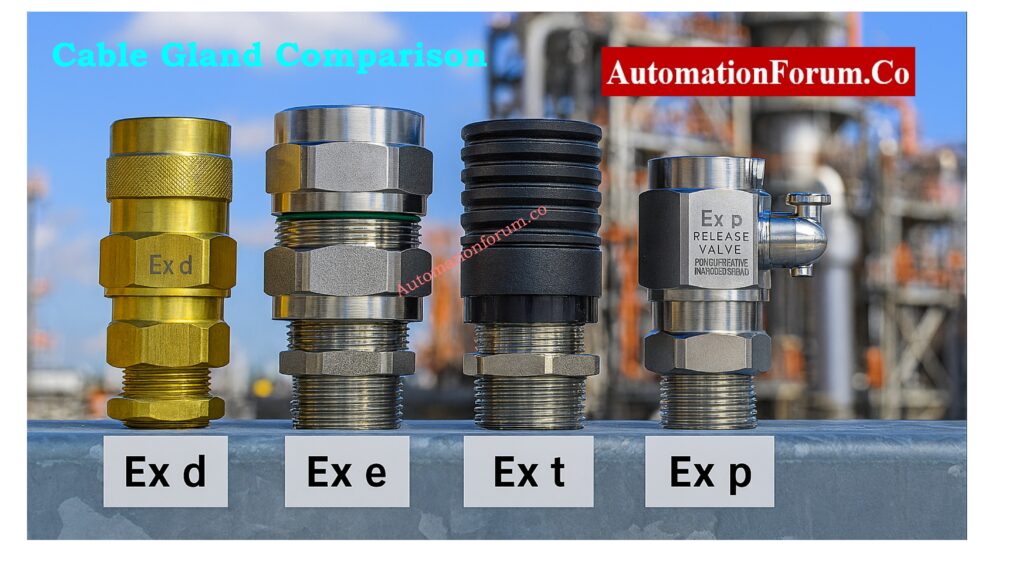
Unlike cables, cable glands must carry ATEX certification because they are part of the protection method of the equipment.
A cable gland directly influences the integrity of:
- Ex d flameproof enclosures
- Ex e increased safety enclosures
- Ex t dust-protected enclosures
- Ex p pressurized systems
The wrong gland type compromises the protection rating of the enclosure, making the installation unsafe and non-compliant.
Why Cable Glands Need ATEX Certification
Ex d (Flameproof)
- Only Ex d glands are allowed
- They have to be able to handle the pressure of an explosion inside.
Ex e (Increased Safety)
- Ex e glands or Ex d glands are okay as long as they keep IP and mechanical protection. Ex e glands or Ex d glands are permitted
- Must maintain IP and mechanical protection
Ex t (Dust Protection)
- Only glands that have been Ex t-certified are allowed.
Ex p (Pressurization)
- Must be the same sort of pressurization system (pxb, pyb, pzc)
Ex i (Intrinsic Safety)
- The type of gland depends on the enclosure, not the circuit.
- Make sure you follow the rules for separation.
Cable glands are one of the most typical things that fail during inspections of hazardous regions, so it’s important to choose the right ones.
Refer the below link for the Top Causes of Intrinsically Safe (IS) Loop Failure and How to Avoid Them
Recommended Cable Types for Hazardous Area Installations
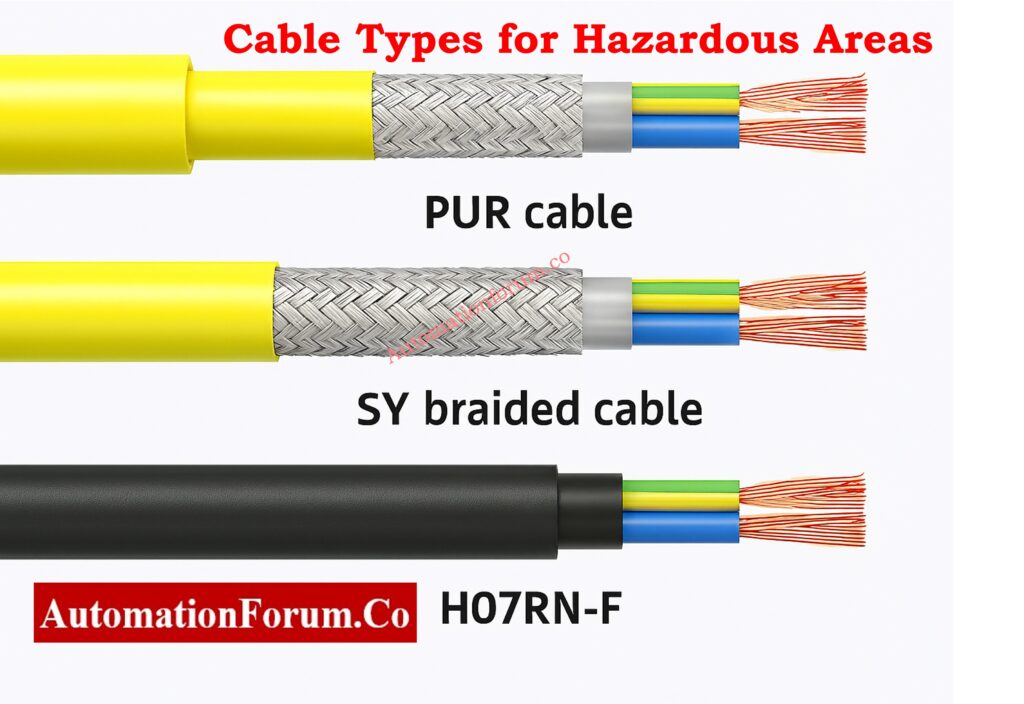
Instrumentation and power cables that are utilized in dangerous regions need to be strong, flexible, and able to withstand the elements. Ex lighting circuits and I&C wiring often employ the following sorts of cables.
PUR (Polyurethane-Sheathed) Cables
Common for portable and flexible applications in hazardous zones.
Characteristics:
- Halogen-free and flame-resistant
- Resistance to chemicals, UV rays, and mechanical stress
- Good for bending all the time
- About the temperature range –40°C to +125°C
Scenario Example:
During a refinery turnaround in a Zone 2 location, temporary floodlighting needs cable that can handle mechanical stress and chemical exposure. Because they are strong, PUR cables are ideal due to their robustness.
Instrumentation Cable Testing Standards You Must Know: Instrumentation Cables Testing Standards
SY Steel-Braided PVC Cables
Used when mechanical protection is needed.
Characteristics:
- Steel braid keeps things from getting crushed and hit.
- Good for short-term industrial settings
- The highest temperature in the room is usually +70°C.
- Not recommended below +5°C because PVC becomes rigid
Scenario Example:
A portable analyzer placed up in a dangerous area needs a strong cable that can handle foot traffic. SY cable offers strong protection against mechanical damage.
H07RN-F Rubber-Sheathed Industrial Cables
Used a lot in Europe for Ex lighting and temporary electricity.
Characteristics:
- Very flexible and resistant to the weather
- Great resilience to chemicals and wear and tear
- The range of temperatures:
- –30°C to +60°C (fixed)
- –15°C to +60°C (mobile)
- Up to +85°C (protected fixed installations)
Scenario Example:
H07RN-F cables are used to power temporary lighting units during tank cleaning in a Zone 1 area since they are flexible and long-lasting.
ATEX vs IECEx – Complete Hazardous Area Certification Guide: ATEX vs IECEx Certification: Complete Guide for Hazardous Area Instrumentation
Practical Engineering Scenarios for Ex Cable Selection
Instrumentation and control engineers typically have a hard time following the guidelines for choosing cables in dangerous areas in real life. The following enlarged scenarios show how to make decisions in real life when designing EPCs, making changes to brownfields, doing maintenance during a shutdown, and fixing problems. These examples show problems that are typical in refineries, petrochemical complexes, FPSOs, LNG terminals, and offshore drilling platforms.
Scenario 1: Installing a New Transmitter in Zone 1
A new differential pressure transmitter is going to be put in a conduit that feeds a reactor. Zone 1 is the categorization for the location, and a 24 VDC IS loop will power the instrument through a barrier in the control room.
An instrumentation design engineer must ensure:
- A special shielded instrumentation cable is employed to keep the quality of the analog and HART signals.
- Because the routing involves outside cable trays that are exposed to sunshine and corrosive vapors, the cable sheath is UV-stable and resistant to chemicals.
- The segregation standards in EN 60079-14 are respected, which means that IS and non-IS cables stay the right distance apart in the tray.
- The cable’s conductor size is selected based on voltage drop calculations to ensure accurate transmitter operation.
- Even though the cable will enter an Ex d junction box, the cable itself does not need ATEX certification. Only the gland must be Ex d certified.
Final commissioning notes:
During loop checking, the engineer verifies shield continuity, proper grounding at the marshaling panel end, and confirms that the cable routing has not introduced bends or damage that could compromise insulation integrity.
Refer the below link for the Why the Cable Shield is Grounded Only at the PLC or Control Panel Side
Scenario 2: Replacing a Cable Gland on an Ex d Motor Junction Box
A maintenance engineer discovers a damaged cable gland during a routine inspection of an Ex d-rated motor in a Zone 1 classified area. When the equipment was moved, the original gland had a dent, which made people worry about the integrity of the flame route.
Key steps include:
- Choosing just an Ex d-certified flameproof gland that fits the cable diameter and has the right thread engagement are two important measures.
- Checking that the gland’s temperature class matches the equipment’s T-rating (for example, T4 or T5).
- Making sure that the new gland seals properly so that no explosive gases can get into the enclosure.
- Checking the cable sheathing nearby for mechanical damage caused by vibration or stress.
- Checking the torque settings again according to the manufacturer’s instructions to keep the flameproof integrity.
Incorrect actions such as using an Ex e gland on an Ex d enclosure would create immediate safety non-compliance and could lead to shutdown or reinspection failures.
Top Cable Tray Installation Mistakes EPC Teams Must Avoid: Avoiding Mistakes in Instrumentation Cable Tray Installation: A Guide for EPC Projects
Scenario 3: Temporary Lighting Installations in Zone 2
During a turnaround, large process units are isolated for maintenance. Temporary floodlights, portable tools, and inspection lamps need to be installed across a large Zone 2 area.
The shutdown team must:
- Use H07RN-F, PUR, or SY cables depending on the environmental exposure, mechanical risks, and expected movement.
- Avoid PVC cables in colder climates, as they may become brittle and crack.
- Make sure that the insulation on the cables can handle hydrocarbons, moisture, and the stress of scaffolding and foot traffic..
- Select proper Ex n or Ex e-certified glands depending on equipment protection type.
- Route temporary cables on elevated trays or hangers to prevent trip hazards and mechanical damage.
Additional engineering considerations:
- Voltage drop must be assessed because temporary light strings often span large areas.
- Mechanical protection is critical; poorly placed cables can be crushed by scaffolding frames, forklifts, or cranes.
- During the shutdown, regular inspections are needed since temporary installations are more likely to get damaged by mistake.
Twisted Pair Cables for 4–20 mA & RS-485 – Essential Guide: Pair Cable in Industrial Signal Transmission: The Essential Guide for 4-20 mA and RS 485 Systems
Scenario 4: Solenoid Valve Wiring in a Zone 2 Pipe Rack
A team that runs an organization wants to add a new solenoid valve to an existing ESD system. The pipe rack is in Zone 2.
Important engineering decisions include:
- Choosing an armored instrumentation cable to make it more durable.
- Separating ESD and non-critical instrument cables is important.
- Using an Ex e or Ex n gland, depending on the certification of the solenoid valve junction box.
- Checking to see if the cable sheath can handle hydrocarbons and intense sunlight.
Then, commissioning experts examine the polarity, test the continuity, and make sure that the ESD system is sending feedback to the SCADA system.
Instrumentation Cable Types and Their Applications: Different Types of Cables in Instrumentation and its Applications
Scenario 5: Offshore Brownfield Modifications in Zone 1
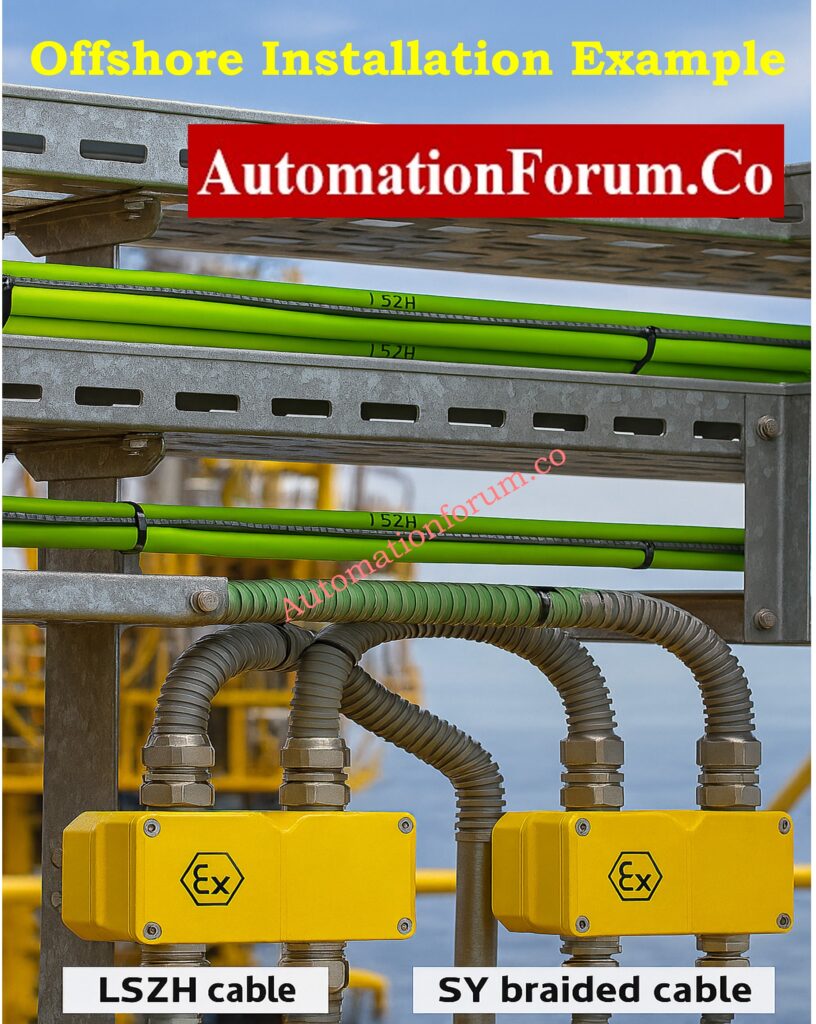
An offshore engineering crew is going to move an analyzer shelter that is already there and lengthen its power and signal connections.
Critical factors include:
- The marine environment needs LSZH (Low Smoke Zero Halogen) or offshore-grade sheathing to protect it from salt spray.
- You need to check the gas migration characteristics of long cable routes because offshore modules generally have limited cable penetrations.
- Analyzed gas sample lines may let out corrosive substances, hence cable jackets that can resist chemicals are needed.
- Ex d analyzer enclosures need flameproof glands that have been certified by ATEX. Ex e terminal boxes can use either Ex e or Ex d glands.
- Cables that can handle vibration and wave motion need to be very flexible and strong against fatigue.
IS vs Non-IS Cables: Key Differences Explained: Difference Between Intrinsically Safe (IS) and Non-IS Cables
How to Choose the Right Cables for Ex Zones
For engineers that work with instrumentation and control, the most important things are:
- Cables in Ex zones do NOT need to be ATEX certified.
- EN 60079-14 lists the criteria for cables, including as shielding, separation, and mechanical protection.
- Cable glands MUST be ATEX approved and work with the way the enclosure protects itself.
- People often utilize PUR, SY, and H07RN-F cables because they last a long time.
- Choosing the right cables makes sure that people are safe and follow the rules in dangerous locations for a long time.
EPC engineers, maintenance teams, and I&C designers may make sure that their work is safe in explosive environments by knowing this.
Thermocouple Wire vs Extension Wire – Engineer’s Complete Guide: Thermocouple Wire vs. Thermocouple Extension Wire: The Complete Guide for Instrumentation Engineers
