
- What Is an Intrinsically Safe Cable?
- Characteristics of Intrinsically Safe Cables
- Understanding ATEX and Related Certifications
- Key Factors to Consider When Choosing Intrinsically Safe Cables
- Top Intrinsically Safe Cable Products
- Comparison Table: Intrinsically Safe Cables
- Best Practices for Installing Intrinsically Safe Cables
- Intrinsically Safe Cable Selection Checklist for EPC Engineers
- FAQs on Intrinsically Safe Cables
- Best Choice by Industry use Case
- Ensuring Compliance with ATEX and IECEx
It is particularly important to choose the right electrical parts in places where explosive atmospheres are always a problem, such oil refineries, gas plants, offshore platforms, chemical manufacturing plants, paint shops, and grain silos. The cable is an important part that people often forget about.
Using the wrong type of cable may seem like a small problem compared to other devices like transmitters, sensors, or controllers, but it may destroy an entire intrinsically safe (IS) system. Cables are the physical paths that bring electricity into hazardous areas, and if they aren’t designed and certified correctly, they might cause sparks, arcs, or too much heat.
This article goes into extensive detail about how to choose intrinsically safe cables for ATEX equipment. It covers certifications, technical characteristics, construction aspects, environmental factors, and best practices for following the rules.
What Is an Intrinsically Safe Cable?
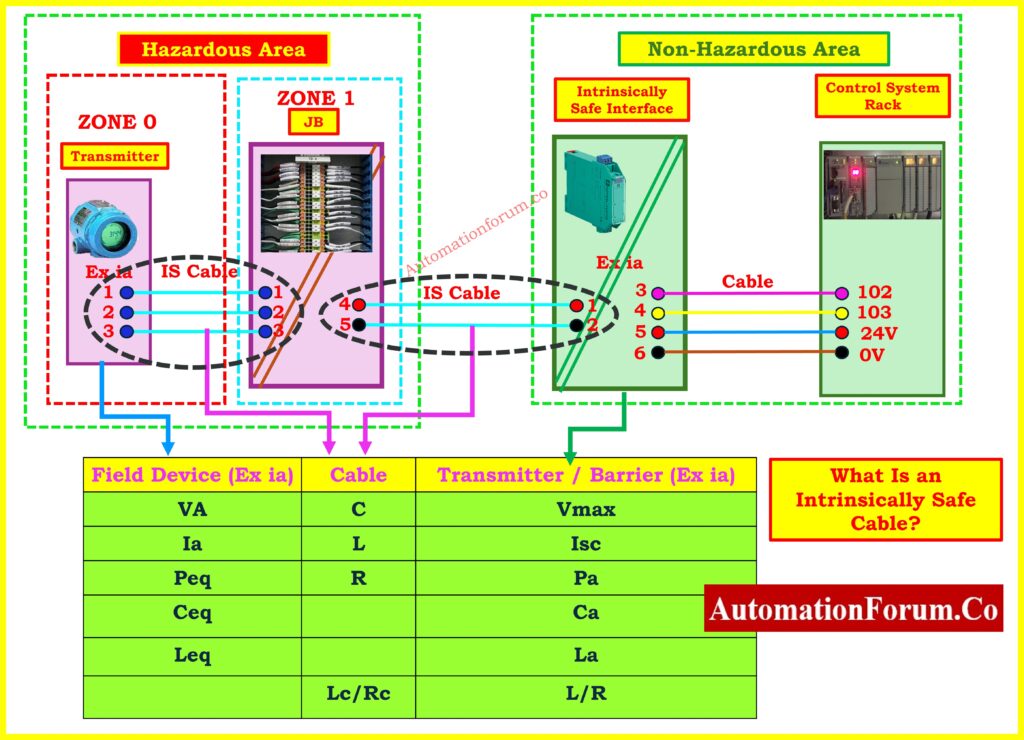
An intrinsically safe cable is a type of electrical cable that has been designed such that it can’t create a spark or heat level that is high enough to start an explosion, even when there are flammable gasses, vapors, or dust around.
These cables are part of a larger intrinsically safe loop, which normally has:
- IS field equipment, like sensors, transmitters, and detectors
- Barriers or galvanic isolators
- Wiring and terminations that have been certified
- A power source that is safe in and of itself
The overall system is not compliant if any portion of this loop, including the cable, does not meet inherent safety standards.
Characteristics of Intrinsically Safe Cables
It’s crucial to know what makes intrinsically safe cables distinct from other cables when you choose one:
Energy Limitation
- To keep the cable from storing or sending too much energy that could generate a spark, capacitance and inductance are strictly managed.
Distinctive Color Coding
- The blue outer sheath is the most popular standard for IS cables in the industry. This makes it easier for maintenance personnel to find inherently safe circuits during inspections.
High-Quality Insulation
- Usually, flame-retardant materials that don’t include halogens or polyurethane are employed. These meet ATEX flame spread regulations and are strong and resistant to chemicals.
Shielding
- Aluminum foil or braided copper is used to insulate many IS cables from electromagnetic interference (EMI), especially in sensitive instrumentation loops.
Low Capacitance and Inductance
- Makes ensuring that the cable meets the entity concept calculations set out in the ATEX and IECEx standards.
Mechanical Durability
- Resistant to grease, UV light, changes in temperature, and wear and tear, which is crucial for installations outside in dangerous areas.
Understanding ATEX and Related Certifications
What Is ATEX?
ATEX stands for Atmosphères Explosibles and refers to the European Union directives governing equipment used in explosive atmospheres.
There are two main directives:
ATEX 2014/34/EU (ATEX Equipment Directive)
- Sets rules for the design and certification of both electrical and non-electrical devices.
ATEX 1999/92/EC (ATEX Workplace Directive)
- Concentrates on the safety of workers and the proper installation and usage of certified equipment.
Other Relevant Certifications
- IECEx is an international certification scheme that is accepted in many places outside the EU.
- UL 60079-11 and UL 913 are the U.S. standards for systems that are safe by design.
- CSA is a Canadian certification that follows North American standards for explosion safety.
- FM Approvals are often needed in the U.S. for the petrochemical and refining industries.
One or more of these systems should test and certify a cable that is truly intrinsically safe.
Discover What an Intrinsically Safe System Is and Why It Matters:What is intrinsically safe system and what is its importance?
Key Factors to Consider When Choosing Intrinsically Safe Cables
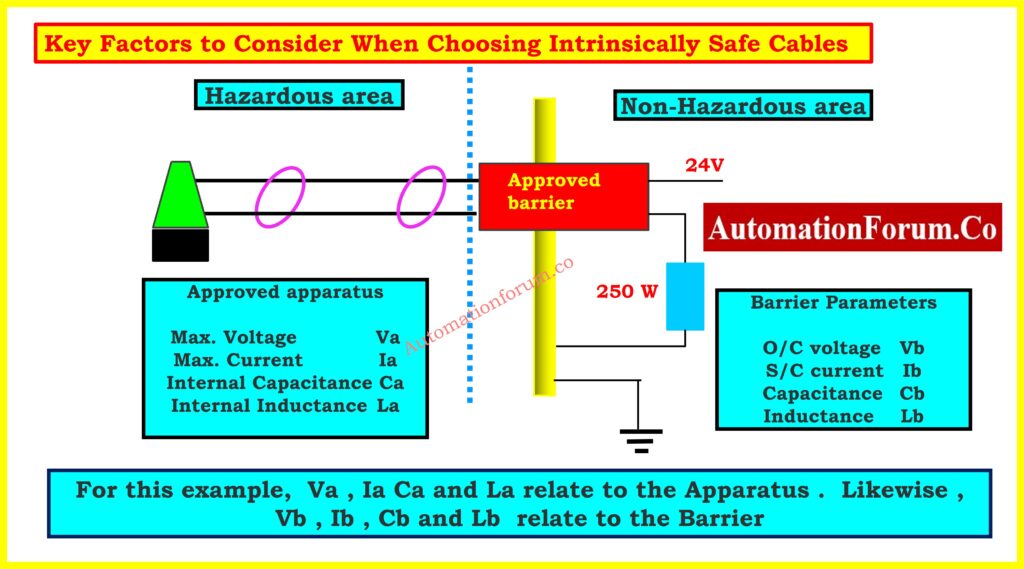
When choosing intrinsically safe (IS) cables for dangerous situations, you should never base your choice only on price or availability. There are a lot of technical, environmental, and regulatory issues that affect whether the cable will work safely in ATEX/IECEx designated areas. Here are the most important things to think about, with more information:
Factor 1. Zone Classification
Hazardous locations are split up into zones based on how often explosive atmospheres (gases, vapors, or dusts) are present. This classification is the basis for choosing all electrical equipment, such as cables.
Zone 0
- A place where explosive gasses or vapors are always there or are there for a long time. For example, inside storage tanks and close to the vapor space of chemical reactors.
- Cables in Zone 0 must be designed to be safe and have strict certification. There is no way to make a deal.
- Blue sheath IS cables are better since they are easier to see and follow the rules.
Zone 1
- A place where typical operations are likely to cause explosive atmospheres. For example, process units in refineries, around loading bays, or pump skids.
- The cables used here need strong mechanical protection, flame-retardant sheaths, and shielding to keep them from interfering with sensitive instruments.
- It is important to carefully evaluate the intrinsic safety characteristics against the devices and barriers that are being employed.
Zone 2
- A place where explosive atmospheres are not likely to happen, and if they do, they only last for a brief time. For example, control rooms next to dangerous process areas or outside locations with good air flow.
- Zone 2 applications provide you some freedom, but the cables still need to be certified.
- Armored or tray-rated cables are sometimes used to keep things from getting damaged by accident.
Key Insight: The more difficult the compliance standards are, the bigger the risk (Zone 0 or Zone 1). Always check the site’s hazardous area classification drawings (HAC drawings) before picking out cables.
Factor 2. System Capacitance and Inductance
The idea of intrinsic safety is to limit the amount of energy that can flow through a cable. Even if an instrument is certified, the improper cable can hold or release enough energy to make a spark. This is based on two main factors:
- Capacitance (C): Means that the cable can hold electrical energy like a capacitor. A higher capacitance suggests a higher chance that the stored energy will be released. To lower this risk, IS cables are made with low capacitance per meter.
- Inductance (L): When the current fluctuates quickly, the cable might cause voltage spikes, just like an inductor. Too much inductance might generate deadly arcs or sparks in places where they shouldn’t be.
When designing an IS loop, the engineer must calculate the:
- Total loop capacitance = C(cable) + C(device)
- Total loop inductance = L(cable) + L(device)
The IS barrier or isolator says that these totals must stay below the entity parameters. If this limit is reached, the installation will no longer be compatible, no matter what the device certification says.
Factor 3. Cable Construction
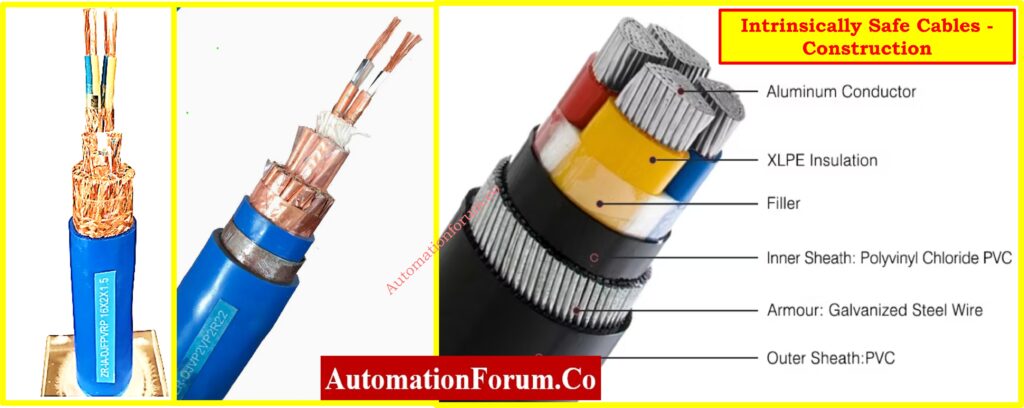
The way intrinsically safe cables are built affects how safe and long-lasting they are. The correct construction depends on both the technical needs and the site’s environmental characteristics.
Outer Sheath
- Polyurethane is a good choice because it doesn’t wear down, get damaged by oil, or react with chemicals.
- In some circumstances, halogen-free sheaths are needed to stop harmful gases from escaping during a fire.
Shielding
- Shielding (foil or braided copper) stops electromagnetic interference (EMI), which is very important in control and instrumentation lines.
- EMI shielding keeps delicate analog and digital signals, such 4–20 mA loops or Profibus connections, from being wrong.
Conductor Material
- Tinned copper is better at resisting corrosion, especially in humid or maritime settings.
- Fine-stranded copper is more flexible and easier to install in tight bends.
Color Coding
- The blue outer sheath is a common industry standard for circuits that are safe to use.
- It is not required by law, but it makes installation mistakes far less likely and inspections much easier.
Key Insight: A solid structure not only makes sure that the rules are followed, but it also cuts down on downtime caused by cables that break often.
Understand the Difference Between Intrinsically Safe (IS) and Non-IS Cables: Difference Between Intrinsically Safe (IS) and Non-IS Cables
Factor 4. Environmental Conditions
Not all hazardous installations are the same; the environment has a big impact on which cables are used. A cable that works well on an offshore oil platform would not work well in a chemical factory, and the other way around. Think about these environmental stresses:
Extreme Temperatures
- Cables can be exposed to very high temperatures on offshore rigs, in desert plants, or in furnace environments.
- Cryogenic or arctic facilities may need cables that can bend at temperatures below freezing.
Chemical Exposure
- Acids, oils, solvents, and fumes can get on cables at refineries and chemical facilities.
- To keep the sheath from breaking down, you need a jacket that is chemical-resistant and doesn’t contain halogens.
Mechanical Stress
- Armored or strengthened cables are needed for mining, drilling rigs, or conveyor systems to keep them from breaking or wearing out.
- You need flexible cables for moving equipment or robots.
Moisture and Ingress Protection
- Jackets that are resistant to UV rays and designs that keep water out are needed for outdoor and offshore conditions.
- Ships and offshore installations commonly employ marine-rated intrinsically safe cables.
Key Insight: When choosing a cable, be sure that its sheath and construction are right for the field environment, not simply the electrical needs.
See Why Intrinsic Safety (IS) Is the Best Choice for Hazardous Areas: Why Choose Intrinsic Safety (IS) for Hazardous Area Instrumentation?
Factor 5. Cable Type and Application
Diverse types of cables are needed for diverse uses in dangerous places. If you choose the wrong type, it could cause bad performance or even dangerous situations.
Control Cables
- Send low-voltage control signals, like sensor signals and 4–20 mA loops.
- Usually insulated to keep surrounding electrical lines from interfering with them.
Multiconductor Cables
- Make it possible for several devices to connect through a single run.
- Lower the cost of installation, but you need to carefully check the limitations of capacitance and inductance.
Power-Limited Tray Cable (PLTC)
- Commonly used for fixed installations in industrial plants.
- Can be armored for protection in mechanically demanding areas.
Fieldbus/Profibus/Modbus Cables
- There are specific IS versions for digital communication networks.
- Must meet both protocol-specific electrical parameters (impedance, shielding, resistance) and intrinsic safety norms.
Key Insight: When choosing a cable, don’t just look at its safety certification; also think about the sort of signal it will carry (analog, digital, communication, or power-limited).
Refer the below to Master Intrinsic Safety Calculations for Instrumentation Design Engineer
Top Intrinsically Safe Cable Products
Some examples of intrinsically safe cables that meet ATEX standards are:
ÖLFLEX® EB
- Blue polyurethane sheath
- Flame-retardant and oil-resistant
- Ideal for control and signal applications in ATEX zones
ÖLFLEX® EB CY
- Shielded version of ÖLFLEX EB
- Braided copper shield for EMI protection
- Suitable for sensitive instrumentation circuits
OZ-BL Blue Control Cable
- Flexible, halogen-free construction
- Flame-retardant, durable, and safe for ATEX environments
- Common in measuring and control loops
Refer the below link to Explore Cable Gland Selection for Hazardous Area Installations
Comparison Table: Intrinsically Safe Cables
| Product Name | Sheathing | Shielding | Ideal Application | Certification |
| ÖLFLEX® EB | Polyurethane | No | Control systems in hazardous areas | ATEX Certified |
| ÖLFLEX® EB CY | Polyurethane | Yes (Copper Braid) | Signal & instrumentation circuits | ATEX Certified |
| OZ-BL Blue Control Cable | Polyethylene | No | Data communication & control | ATEX Certified |
Access 30+ International Control System Standards – Complete Guide for Engineers: 30+ International Standards for Control Systems: The Complete Guide for Automation & Instrumentation Engineer
Best Practices for Installing Intrinsically Safe Cables
- Keep IS and Non-IS Circuits Separate: Keep them physically apart to stop interference.
- Use the Right Glands: To keep the flameproof integrity, you must use ATEX-certified cable glands.
- Avoid Long Cables: Extra loops make capacitance and inductance higher, which could cause non-compliance.
- Follow the rules for routing cables: put them in the right IS trays or conduits and mark them correctly.
- Regularly check for damage to sheaths or bad terminations, as they might make things less safe.
Intrinsically Safe Cable Selection Checklist for EPC Engineers
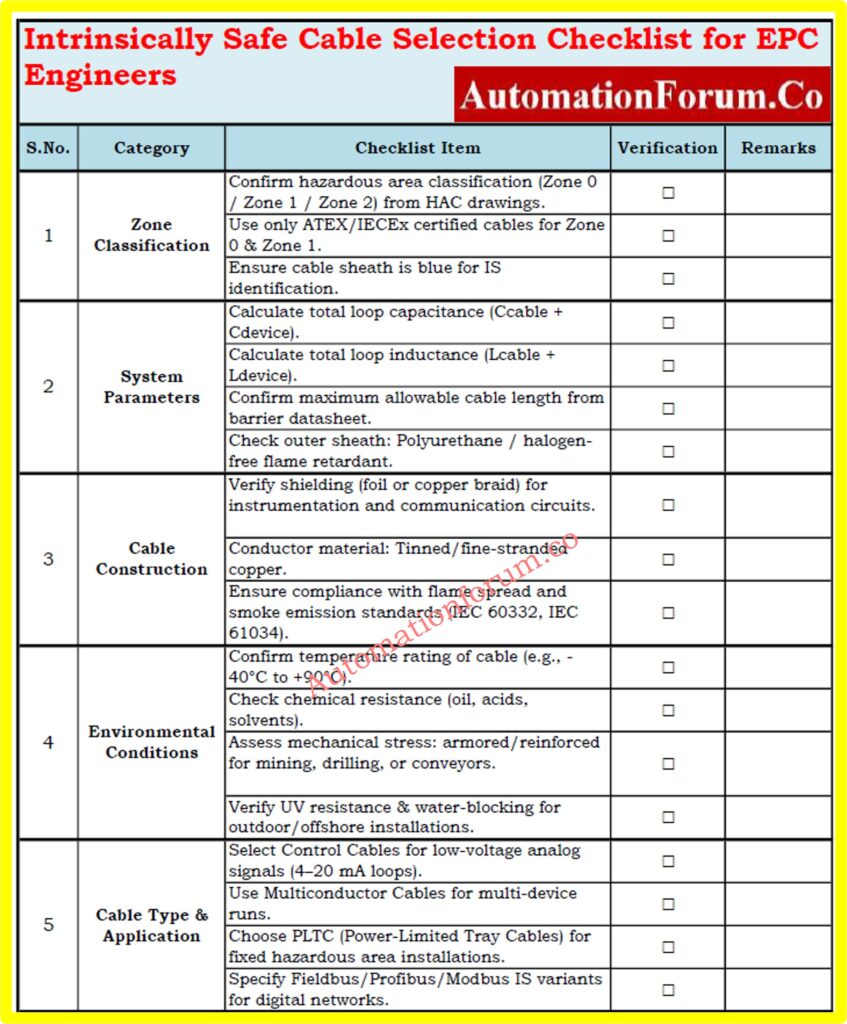
It is very important to follow all of the rules for zone classification, capacitance, construction, environment, and approved installation when choosing intrinsically safe cables.
To get the checklist in Excel format, click the link below.
Find Out Why NAMUR Sensors Are Essential in Explosive and Hazardous Areas: Why NAMUR Sensors are Essential in Explosive and Hazardous Areas ?
FAQs on Intrinsically Safe Cables
What makes a cable “intrinsically safe”?
A cable is IS if it has low capacitance/inductance, high-quality insulation, and has been tested to ATEX/IECEx requirements to make sure it won’t start a fire in an explosive atmosphere.
Can I use regular cables in ATEX Zones 0 or 1?
No. Regular cables are not approved and could cause a fire. Use only intrinsically safe cables that have been ATEX-certified.
Are intrinsically safe cables always blue?
Blue is the most common standard, however color doesn’t matter as much as certification. If the right paperwork is in place, some areas may accept additional hues.
Do intrinsically safe cables need to be part of a certified system?
How do I calculate the maximum safe cable length?
Use the settings for the device and the barrier entity. Make sure that the total capacitance (Ccable + Cdevice) and inductance (Lcable + Ldevice) stay below the limits set.
Best Choice by Industry use Case
| Industry | Recommended Cable | Justification |
| Oil & Gas | ÖLFLEX® EB CY | Hydrocarbon resistance + EMI protection |
| Chemical Manufacturing | OZ-BL | Strong chemical resistance & flame-retardant |
| Mining | Armored ÖLFLEX EB | Durable construction against abrasion |
| Food & Pharma | Halogen-Free Blue IS Cables | Easy to clean & hygienic compliance |
| Utilities & Power Plants | Shielded EB CY | Stable performance in high-temperature zones |
Ensuring Compliance with ATEX and IECEx
Choosing the correct intrinsically safe cable for ATEX equipment is not only a technical choice, but also a legal requirement and a way to keep people safe. Every little thing is important, from figuring out the zone and the system’s energy needs to building the cable and making it resistant to the elements.
Using approved cables like ÖLFLEX® EB, EB CY, or OZ-BL makes sure that they meet ATEX/IECEx standards and can last and work well in tough conditions.
When used correctly in a certified intrinsically safe loop, these cables assist keep operations safe, stop ignition sources, and keep process control going in hazardous industries.
Key Takeaway: To be sure you are following the rules and keeping everyone safe, always check the zone requirements, the capacitance and inductance restrictions, use ATEX-certified items, and follow best installation techniques.
Follow This Installation Checklist for Intrinsically Safe Instruments: Installation Checklist for Intrinsically Safe Instrument (Apparatus)
