
- Why PLC and I/O Module Maintenance is Crucial
- Risks of Poor I/O Module Maintenance
- Benefits of Proactive Maintenance in Automation
- Understanding the Role of I/O Modules in PLC Systems
- Proactive Maintenance Strategies for PLC I/O Modules
- Proactive Maintenance Free Checklist for PLC I/O Modules (Excel Download)
- Reactive vs. Proactive Maintenance: The Real Cost
- Why Proactive Maintenance is an Investment in PLC
- Frequently Asked Questions (FAQ) on Maintenance of PLC I/O Modules
- Test Your Knowledge on Instrumentation I/O Database
Programmable Logic Controllers (PLCs) and its Input/Output (I/O) modules are the most important parts of reliable plant operation in industrial automation. The I/O modules are like the nervous system for automation since they connect the logic to the real world. They turn sensor signals into useful information and send commands to valves, motors, and actuators.
Because they are so important, a failure in PLC I/O modules can stop whole production lines, cost a lot of money in lost production time, and put safety systems at risk. Some facilities still do reactive maintenance, which means fixing things only after they break. This method is unsafe and costly. Instead, plants that look to the future use proactive maintenance tactics that focus on finding problems early, stopping them from happening, and keeping an eye on things all the time.
This article discusses why proactive maintenance is important for PLC I/O modules, goes over several good ways to do it, and looks at more advanced methods like predictive analytics and redundancy planning.
Why PLC and I/O Module Maintenance is Crucial
For a manufacturing floor to work well, machines, sensors, and controls must all work together perfectly. The PLC is in charge of making decisions, and the I/O modules make sure that the system can interface to the real world. The PLC can’t “see” sensor inputs or “act” on actuators if the I/O modules don’t work well.
Risks of Poor I/O Module Maintenance
- Unexpected downtime: One broken I/O card could stop a vital production line, costing hours of lost output.
- Data about the process that is wrong: Bad inputs can send faulty signals, which can cause the improper control actions.
- Safety Issues: If I/O modules that are connected to interlocks or shutdown systems fail, they put people and equipment in danger.
- Costs Going Up: Scheduled maintenance might cost a lot less than emergency repairs, getting replacement parts, and reworking.
Avoid Downtime: Common Causes of Programmable Logic Controller(PLC) Failure and Mitigation Strategies
Benefits of Proactive Maintenance in Automation
- Prevented early failure, which lengthened the life of the equipment.
- Better process dependability by always talking to each other.
- Less money spent on repairs means a lower total cost of ownership (TCO).
- More safety because mistakes are found early.
- Made the most of downtime by doing work during planned shutdowns.
Understanding the Role of I/O Modules in PLC Systems
Before we go into tactics, we need to understand what I/O modules perform and why they are so crucial.
What is an I/O Module?
An Input/Output module is a piece of hardware in a PLC system that controls the flow of data between the PLC CPU and field devices.
- Input Modules: Get signals from sensors, transmitters, switches, or measurement tools.
- Output Modules: Send control signals to motors, actuators, relays, or solenoids.
Core Functions of I/O Modules
- Finding Errors: Using CRC or parity bits to find bad data transfer.
- Processor Communication: This includes decoding commands, sending and receiving data, and managing addresses.
- Data Buffering: Changing the speed at which data is sent to match the time it takes for a device to respond.
- Timing and Control: Managing synchronization to ensure correct process control.
If any of these functions break down, it might have a big effect on production and safety. That’s why proactive care is so important.
Implement: Implementation of Control Algorithms in PLC Programming
Proactive Maintenance Strategies for PLC I/O Modules
Reactive maintenance fixes things when they break, but proactive maintenance focuses on stopping problems before they happen, predicting them, and making things better all the time. Here are some complete plans that facilities should put into action.
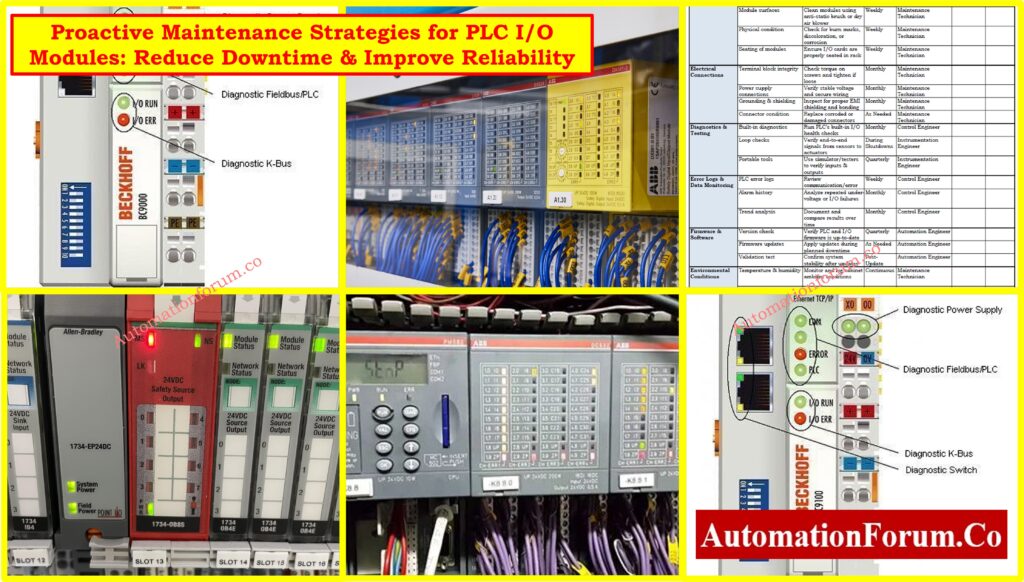
1. Regular Visual Inspections and Cleaning
Routine cleaning and inspection is one of the easiest and most effective ways to keep things clean. Control cabinets that are open to dust, heat, and vibration are where I/O modules are most typically kept. Over time, impurities might build up and cause overheating or distortion of the signal.
Best Practices:
- Set up weekly walkthroughs to check the surfaces and racks of the modules.
- Use anti-static brushes or dry air blowers to get rid of dust. Don’t use high-pressure air, though, because it can push particles deeper.
- Look for burn marks, discoloration, or corrosion on the terminals.
- Make sure that modules are securely fastened to racks so that connections don’t drop out.
For example, in a cement mill, cleaning the PLC cabinets of dust once a week cut down on unexpected I/O failures caused by cement particles in the air.
Discover: Which PLC is Mostly used in the Automation Industry?
2. Tightening Electrical Connections
Maintenance Tips:
- Every month, check the torque on terminal blocks and connectors.
- Check the connections to the power source to make sure there is no undervoltage, which might generate erroneous warnings.
- Check the grounding and shielding to cut down on electromagnetic interference (EMI).
- Change out the connectors that are rusted right away.
Find Out: Why is 24 Volts Mostly used in Industrial PLC Systems?
3. Diagnostic Testing and Loop Checks
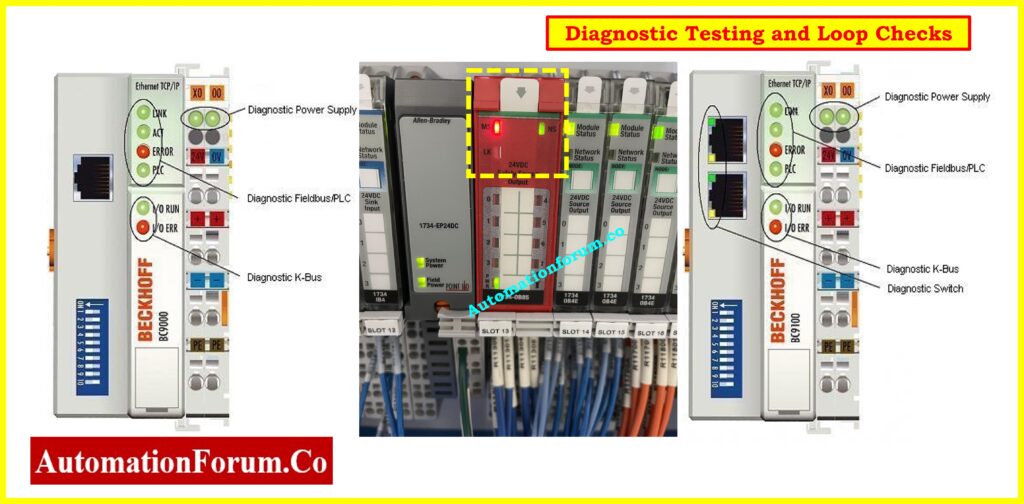
Most current PLC platforms have built-in tools for checking I/O modules. These exams can find problems that are hiding before they get worse.
Diagnostic Activities:
- Use the built-in I/O diagnostics to see how quickly inputs respond and how well outputs work.
- Check the loop during scheduled shutdowns to make sure the signals from the sensors to the actuators are working.
- Use portable diagnostic tools to test inputs and outputs and make sure the module is correct.
Pro Tip: Keep track of diagnostic results so you can look for patterns. This helps you spot early signs of degeneration.
4. Monitoring Error Logs and Data
PLCs keep event histories and error logs that can help you understand things better. Sadly, a lot of plants don’t look at these logs until something goes wrong.
Why Error Logs Matter:
- If you keep making mistakes when you talk to someone, it could be because of problems with the cable shielding.
- If you get a lot of under-voltage alarms, it could mean that your power supply is about to break.
- If you have input issues every now and again, it could be a problem with the connector.
Teams can plan interventions before failures happen by regularly analyzing logs, such as once a week or once a month.
Use This: Programmable Logic Controller (PLC) Program Backup Checklist
5. Updating Firmware and Software
To repair issues, make diagnostics better, or make things more stable, manufacturers often offer firmware upgrades for I/O modules. Outdated firmware can make systems more vulnerable.
Firmware Maintenance Process:
- Make copies of your PLC programs and settings.
- During designated downtime windows, install firmware updates.
- Run tests after an update to make sure the system stays stable.
- Keep a history of versions so you can find them again.
Follow This: Step-by-Step PLC Battery Replacement and Maintenance Procedure
6. Maintain Optimal Environmental Conditions
Environmental conditions have a big effect on I/O modules. Dust, humidity, vibration, and heat are some of the main causes of early failure.
Environmental Controls:
- Put in filters and ventilation for the control cabinet.
- In places that are damp, use cabinet heaters or dehumidifiers.
- Use shock absorbers or vibration isolators in places where heavy machinery is used.
- Use sensors and alerts to keep an eye on the environment.
Case Study: After putting humidity controls in the electrical rooms, a food processing plant lowered I/O failures by 40%.
Understand: Understanding NO vs NC Contacts is key for Logic Writing in PLC Programming
7. Spare Parts and Redundancy Planning
Even with proactive care, things will sometimes go wrong. Having extra I/O modules on hand cuts down on downtime.
Best Practices:
- Keep a list of important spare I/O parts.
- Set up redundant I/O modules for processes that are very important to the objective. The backup should take over right away if the primary fails.
- Some PLC systems support hot-swappable modules, which let you change I/O cards without stopping work.
Refer the below link to Explore: Hot Standby in PLC Systems: Architecture, Working, and Benefits
8. Backup and Documentation Management
Losing configuration is a regular problem when replacing I/O. Backups make it easy to get back up quickly.
Backup Strategy:
- Set up monthly backups of your PLC programs and I/O settings.
- Backups should be kept on both onsite servers and secure offsite/cloud storage.
- Keep your wiring diagrams, terminal layouts, and other paperwork up to date.
When a module goes down, engineers may easily restore settings instead of having to start over with code.
Refer the below link for Master the PLC System Documentation Guide: Essential Records for Industrial Automation Success
9. Predictive Maintenance with Analytics
Many sectors now use predictive maintenance, which is based on data analytics and condition monitoring, in addition to traditional preventative approaches.
Techniques Include:
- Vibration Monitoring: Finds problems with modules that are exposed to mechanical vibration.
- Thermal imaging finds hot areas in connections or I/O cards.
- AI/ML Analytics looks at error records, current draw, and environmental factors to find patterns in failures.
- Remote Monitoring: IoT-enabled PLCs communicate health data about I/O to centralized dashboards so that decisions can be made ahead of time.
Learn How to: Replacing a Faulty Analog Input Card in a PLC Rack in Continuous Process Industries: Step by Step Procedure
10. Training Maintenance Teams
Without skilled workers, the best tools and techniques won’t work. Training makes ensuring that technicians know how to find, look into, and fix I/O problems.
Key Training Areas:
- Taking care of I/O cards the right way while being careful about electrostatic discharge (ESD).
- How to use built-in diagnostics well.
- Reading and understanding error logs.
- Recognizing early warning indications like input failures that happen from time to time.
Apply: Best Practices for PLC Tag and Address Naming Conventions
Proactive Maintenance Free Checklist for PLC I/O Modules (Excel Download)
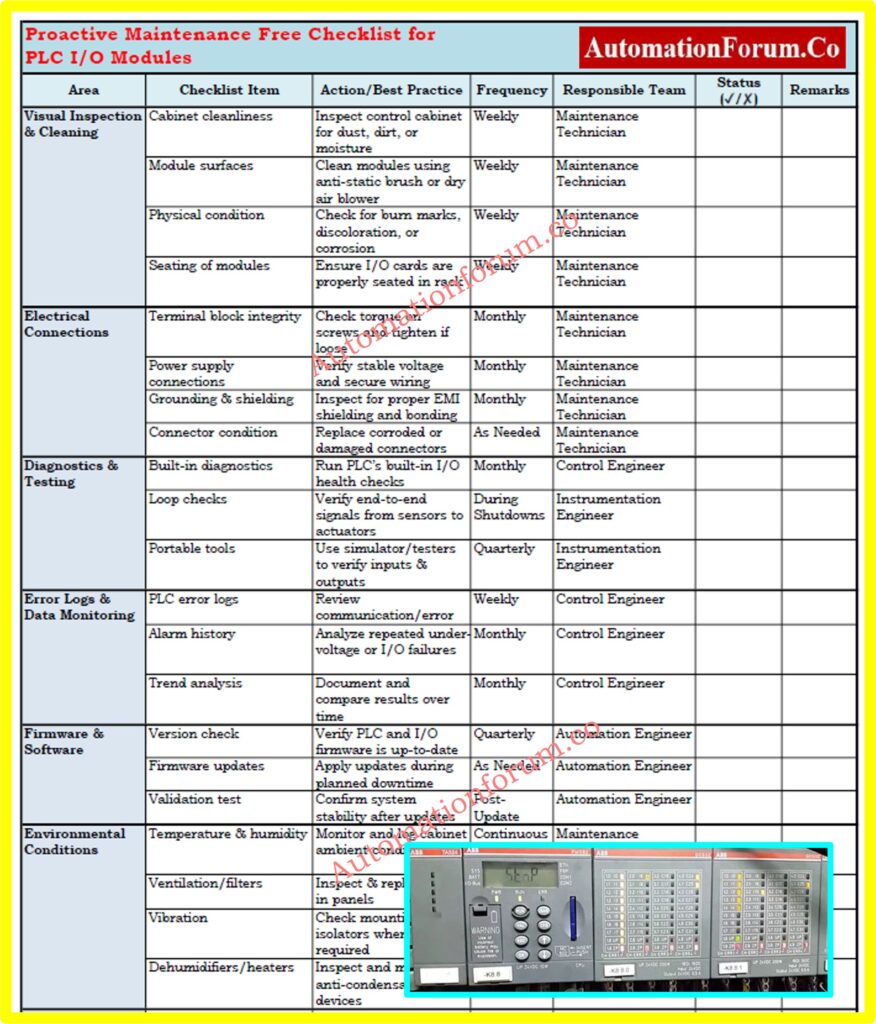
A well-organized checklist lets maintenance personnel keep an eye on, check on, and take care of PLC I/O modules in a systematic way. Engineers may cut down on downtime, make equipment last longer, and make the plant more reliable overall by taking these proactive efforts. The table below shows in detail the preventive acts, how often they should be done, and who is responsible for each one.
Reactive vs. Proactive Maintenance: The Real Cost
Many plant managers are hesitant to spend money on preventive maintenance because they think it would raise costs. In actuality, the cost difference makes prevention the better option.
| Category | Reactive Maintenance | Proactive Maintenance |
| Downtime | Long, unplanned, costly | Short, scheduled, controlled |
| Repair Costs | High (emergency + overtime) | Predictable and budgeted |
| Safety | Higher risk due to sudden failures | Lower risk with early detection |
| Equipment Life | Shortened by neglect | Extended through care |
| Profitability | Reduced due to disruptions | Enhanced with reliable uptime |
Troubleshoot with This: Step-by-Step Procedure for Troubleshooting PLC Digital Outputs
Why Proactive Maintenance is an Investment in PLC
Today, downtime costs more than ever in the industrial world. It is important to keep the PLC and its I/O modules in good shape because they are the backbone of automation.
Companies may make sure that they are doing the right things by using proactive maintenance tactics including:
- Fewer unexpected breakdowns
- Improved process reliability
- Longer equipment lifespan
- Enhanced worker safety
- Lower overall costs
In the end, reactive maintenance is a risk, but proactive maintenance is a smart move. Facilities that follow this attitude will avoid failures, keep their production schedules, and gain a big edge over their competitors.
Frequently Asked Questions (FAQ) on Maintenance of PLC I/O Modules
What are common causes of PLC I/O module failures?
The most typical reasons for PLC I/O failures include loose wiring, dust buildup, overheating, and problems with the power supply.
How often should PLC I/O modules be checked?
Monthly basic checks are a good idea, and quarterly or semi-annual full testing and cleaning are optimal.
What is the difference between reactive and proactive PLC maintenance?
Reactive maintenance addresses problems after they happen, but proactive maintenance stops problems from happening in the first place, which cuts down on downtime.
Test Your Knowledge on Instrumentation I/O Database
Refer the below link for the test your knowledge on Instrumentation I/O Database with Quiz
