
- Why PLCs Still Dominate the Automation World
- Most Popular PLCs in the Automation Industry 2025
- Leading PLC Brands in Industrial Automation
- Recent Technological Advancements in PLCs
- Role of PLCs in Industry 4.0 and Smart Factories
- Industry-Specific PLC Usage
- PLC Market Size, Growth & Future Outlook
- Choosing the Right PLC for Your Automation Needs
- Frequently Asked Questions – PLC in Automation Industry
Why PLCs Still Dominate the Automation World
Key Advantages Over PACs and IPCs
Programmable Logic Controllers (PLCs) have been the main part of industrial automation for almost 50 years. PLCs (Programmable Logic Controllers) are still the most trusted and commonly used control solution in many industries, including oil and gas, power generation, automotive production, pharmaceuticals, and food processing. This is despite the rise of PACs (Programmable Automation Controllers) and IPCs (Industrial PCs).
PLCs are frequently the primary choice for engineers who develop automation systems because they are tough, reliable, and can work in very harsh industrial environments. But the question is still: Which PLC is most often utilized in the automation field these days?
Because PLC usage patterns change by area, sector, and application complexity, the answer is to understand global market trends, industry-specific needs, and brand competencies.
Common PLC Communication Protocols
PLCs are still favored over alternative controllers because they:
- PLCs are still preferred over other types of controllers because they work well in challenging environments including high temperatures, dust, vibration, and electrical noise.
- Some models can be used for more than 20 years, thus they offer long-term support.
- Support a number of IEC 61131-3 programming languages, such as Ladder Logic, Structured Text, Function Block Diagram, and SFC.
- It’s easy to connect to sensors, actuators, SCADA/DCS, and MES systems.
- Use communication technologies that are open, such PROFINET, EtherNet/IP, Modbus, OPC UA, and PROFIBUS.
Understand PLC Redundancy Types: Understanding PLC Redundancy: Cold, Warm & Hot Redundancy
Most Popular PLCs in the Automation Industry 2025
Siemens Simatic PLCs and Allen-Bradley PLCs by Rockwell Automation are the most popular types of automation around the world. But Mitsubishi Electric, Schneider Electric, and Omron are also strong competitors.
Regional PLC Usage Trends
- Europe & Middle East: Siemens is the leader in Europe and the Middle East with its Simatic S7 PLCs, which are widely used in both discrete and process automation.
- North America: Allen-Bradley is the best choice in North America, especially in factories and car plants.
- Asia-Pacific: Mitsubishi Electric is a major competitor in the Asia-Pacific region, especially in electronics assembly and high-speed manufacturing.
- Latin America & Africa: Siemens and Allen-Bradley are still important players because they have well-established service networks.
PLC Market Share Leaders
- In the US, Allen-Bradley is the best in automating machines and packaging.
- Mitsubishi Electric is always among the top three in Asia’s industrial automation sector.
Simplify Analog Signal Scaling: Scaling Analog Values in Industrial Automation (PLC)
Why Siemens and Allen-Bradley Lead
- Siemens: The S7-1200 is small and can be used for little machines, whereas the S7-400 is big and can be used for complicated facilities. It is perfect for international businesses because it has training and spare parts available all around the world.
- Allen-Bradley: Allen-Bradley is known for being easy to use with RSLogix and Studio 5000 software, working well with FactoryTalk SCADA, and having better motion control for machines.
Use This PLC Backup Checklist: Programmable Logic Controller (PLC) Program Backup Checklist
Leading PLC Brands in Industrial Automation
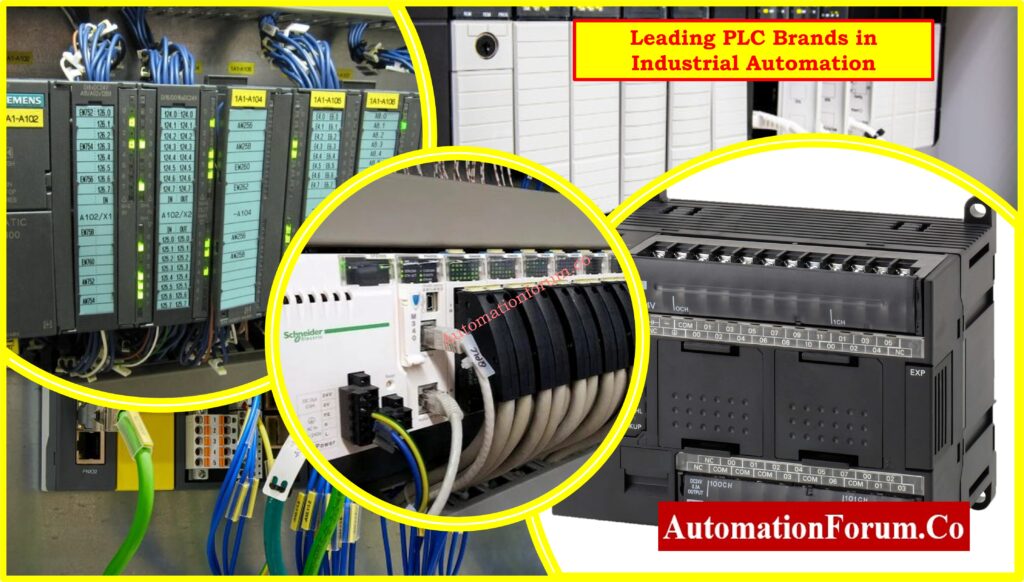
Siemens and Allen-Bradley are the best brands, although other brands fill important gaps in the market.
1. Siemens – Simatic Series
- Reach: Global leader, strong in Europe, Asia, and Middle East.
- Models: S7-1200, S7-1500, S7-300/400, ET 200SP.
- Strengths: TIA Portal makes programming easy, the design is adaptable, and there is built-in cybersecurity.
- Industries: Automotive, oil & gas, pharmaceuticals, infrastructure projects.
2. Allen-Bradley – Rockwell Automation
- Reach: Dominant in North America, strong OEM presence worldwide.
- Models: MicroLogix, CompactLogix, ControlLogix.
- Strengths: easy to understand programming, fast motion control, and good interface with Rockwell drives.
- Industries: Automotive, packaging, food and drink, and logistics are some of the industries.
3. Mitsubishi Electric – Melsec Series
- Reach: Leading in Japan and Southeast Asia.
- Models: FX5U, L Series, Q Series, iQ-R Series.
- Strengths: Fast logic execution, integration with robots, and low cost.
- Industries: Industries include making electronics, conveyor systems, and automating machines.
4. Schneider Electric – Modicon Series
- Reach: Strong in process and utility sectors.
- Models: M221, M241, M340, M580.
- Strengths: It saves energy, can be used in small to large facilities, and has built-in safety features.
- Industries: oil and gas, chemical facilities, water treatment, and renewable energy.
5. Omron – Sysmac Series
- Reach: Widely used in Asia, Europe, and food industries worldwide.
- Models: NX1, NJ Series, CP1H.
- Strengths: It has machine vision, robotics, and motion control all in one platform.
- Industries: Food processing, pharmaceutical packaging, and robotics automation are some of the industries.
6. ABB – AC500 Series
- Reach: Strong in utilities and heavy industries.
- Models: AC500-eCo, AC500-XC.
- Strengths: Can work in harsh environments, lasts a long time, and follows IEC programming standards.
- Industries: Mining, power generating, and water utilities.
Legacy Brands:
Brands like GE Fanuc, Telemecanique, and Cutler-Hammer used to be well-known PLCs, but they have either been bought out or phased out, making place for newer, more connected PLC technologies.
Refer the below link for the Understanding PLC Racks and Chassis: Types, Differences, and Purposes
Recent Technological Advancements in PLCs
To keep up with Industry 4.0, IIoT, and smart manufacturing, PLCs have made a lot of progress. These changes make them stronger, more connected, and safer.
1. Enhanced Connectivity
To keep up with Industry 4.0, IIoT, and smart manufacturing, PLCs have made a lot of progress. These changes make them stronger, more connected, and safer.
2. Smaller and Smarter
Miniaturized PLCs are great for installations with limited space since they take up less room in cabinets while yet providing higher processing power and built-in functionality.
3. Improved Speed
Faster scan times and multi-core computers make it possible to control motion at fast speeds, get input in real time, and run complicated algorithms without delays.
4. User-Friendly Interfaces
Engineers and operators can program and fix PLCs more easily with advanced HMI integration and web-based setup tools.
5. Remote Monitoring and Control
With secure VPN connectivity, you can monitor, program, and debug PLCs from anywhere, which cuts down on trip time for maintenance crews.
6. Energy Efficiency
Energy-efficient PLC designs use less power, which helps with sustainability goals and saves money on operating costs.
7. Advanced Diagnostics
Built-in diagnostic tools and self-health monitoring assist find and fix problems before they create downtime.
8. Cybersecurity Measures
PLCs now have firewalls, encrypted communications, and user authentication to keep industrial systems safe from cyber threats.
9. Cloud Integration
Direct cloud connectivity lets you store past data, analyze it, and make predictions without needing extra gear.
10. Predictive Maintenance
AI-powered algorithms in PLCs may look at operating trends to predict when equipment might fail, which cuts down on unplanned downtime.
Cut Voltage Drop in PLC Wiring: How to Calculate and Minimize Voltage Drop in PLC Wiring?
Role of PLCs in Industry 4.0 and Smart Factories
Crack the NO vs NC Logic Code: Understanding NO vs NC Contacts is key for Logic Writing in PLC Programming
IoT Integration and Cloud Connectivity
IoT Integration:
Advanced PLCs can link directly to industrial IoT sensors via Ethernet/IP, PROFINET, and MQTT protocols. This makes it easy to send data to supervisory control systems and cloud platforms.
Real-Time Analytics:
Modern PLCs can evaluate production data on-site, filter out the information that isn’t useful, and transfer only useful insights to higher-level systems. This is possible because they have quicker processors and edge computing capabilities. This makes the network less busy and speeds up the process of making decisions.
Learn the Rungs & Rails Basics: Understanding Rungs and Rails: The Foundation of PLC Ladder Logic
Digital Twin and Predictive Maintenance
Digital Twin Support:
PLCs can now work with digital twin models, which are virtual copies of equipment or production lines. This lets engineers simulate, optimize, and fix problems with operations without stopping real-world processes.
AI & Predictive Maintenance:
PLCs can use AI algorithms to forecast faults before they happen, organize maintenance during planned downtime, and make equipment last longer by feeding them operational data.
Cybersecurity for PLC-Controlled Systems
In the linked world of Industry 4.0, PLCs include built-in firewalls, encryption, and authentication mechanisms to keep industrial networks safe from cyber threats.
Example in Action:
A modern car assembly plant might use Siemens S7-1500 PLCs to talk to robotic arms, vision inspection systems, and RFID-based material tracking systems. A cloud analytics platform gets real-time performance data. AI then uses this data to improve the order in which things are made and guess when robots will need to be fixed. This not only cuts down on downtime, but it also increases production yield by more than 8%.
Refer the below link for Master Your PLC Documentation: Essential Records for Industrial Automation Success
Industry-Specific PLC Usage
Different industries have different process needs, safety norms, and environmental problems that affect the choice of PLC brand.
| Industry | Preferred PLC Brands | Reasons for Dominance |
| Oil & Gas | Siemens, Allen-Bradley, Schneider | Redundancy, explosion-proof designs, IEC 61511 safety compliance |
| Automotive | Siemens, Allen-Bradley | Robotics integration, high-speed motion control, safety PLC options |
| Electronics Manufacturing | Mitsubishi, Omron, Siemens | Precision control, high-speed cycle times, compact footprint |
| Power & Utilities | ABB, Siemens, Schneider | Harsh environment tolerance, SCADA integration |
| Water & Wastewater | Schneider, Siemens, Allen-Bradley | Remote monitoring, corrosion resistance, energy optimization |
| Food & Beverage | Omron, Allen-Bradley, Schneider | Washdown-resistant designs, recipe management, HACCP compliance |
| Pharmaceuticals | Siemens, Allen-Bradley | GMP compliance, data integrity, environmental monitoring |
| Mining & Metals | Siemens, ABB, Allen-Bradley | Ruggedness, dust and vibration resistance, heavy load handling |
| Marine & Shipbuilding | Mitsubishi, Siemens | Marine-certified hardware, vibration resistance, compact modules |
| Renewable Energy | Siemens, Schneider, ABB | Smart grid integration, remote diagnostics, energy analytics |
Why this is Important
For instance, in the oil and gas industry, the risk of dangerous conditions calls for ATEX-certified PLC enclosures and backup fail-safe systems, which are two areas where Siemens and Schneider are quite good. In the automobile industry, where downtime costs a lot of money, Allen-Bradley’s motion control and Siemens’ integrated safety solutions keep production running smoothly.
Discover Why 24V Rules PLC Systems: Why is 24 Volts Mostly used in Industrial PLC Systems?
PLC Market Size, Growth & Future Outlook
The global PLC market was worth $12.83 billion in 2024 and is expected to increase to $15.07 billion by 2029, with a CAGR of 4.23%.
Growth Drivers:
- Industry 4.0 is making smart manufacturing grow.
- Connecting to Industrial Internet of Things (IIoT) systems.
- Need for predictive maintenance tools.
- Updating aging PLC gear in older plants.
Follow These 6 Ladder Logic Rules: Top 6 Important Rules for PLC Ladder Diagram Programming
Choosing the Right PLC for Your Automation Needs
The most used PLCs in the automation industry are:
- Siemens (Simatic Series) is the most used PLC in the automation business. It is the best at scalability and process integration.
- Allen-Bradley (Rockwell Automation) is a leader in motion control in North America.
- Mitsubishi Electric makes small, fast solutions for manufacturing.
- Schneider Electric (Modicon) has great process automation features.
- Omron (Sysmac) combined robotics and machine vision.
The ideal PLC for you will rely on the needs of your application, the conditions in which it will be used, the communication needs, and the assistance you can get from the manufacturer. PLCs are not only surviving, but they are also changing to stay the backbone of industrial automation for many years to come. For example, they are integrating with the cloud, using AI to diagnose problems, and improving cybersecurity.
Refer the below link to explore Hot Standby in PLC Systems: Architecture, Working, and Benefits
Frequently Asked Questions – PLC in Automation Industry
What is the role of a PLC in automation?
In industrial automation, the Programmable Logic Controller (PLC) is the main control unit. It is the “brain” of the system since it collects data from sensors, processes it according to programmed logic, and transmits commands to machines and actuators. This makes sure that automated operations work correctly, quickly, and dependably.
What does automation mean in the context of PLCs?
PLC automation is the use of PLCs to control and manage industrial operations with as little help from people as possible. The PLC gives real-time instructions to run machines, production lines, and other equipment, which makes work more productive, consistent, and safe.
Know the Core Ladder Diagram Parts: Understanding Basic Parts of Ladder Diagram (LD) in PLC Programming
How are PLCs used in the automotive industry?
PLCs control assembly lines, robotic arms, conveyor systems, painting processes, and quality inspection tools in the automotive industry. They make it possible to sequence things exactly, cut down on downtime, and make sure that production requirements are always met.
What are the four main types of automation?
There are four kinds of automation:
- Fixed Automation: Made for making a lot of things with special tools.
- Programmable Automation lets you change the programming for different items or processes.
- Flexible Automation: It can quickly modify to fit new designs or processes.
- Integrated Automation brings together several automated systems so that everything works together.
Which PLC is most commonly used in the automation industry?
The Siemens S7 series and the Allen-Bradley ControlLogix are two of the most popular PLCs because they are reliable, can be expanded, and have technical assistance all around the world.
Which industries rely heavily on PLCs?
PLCs are very important in the packaging, pharmaceuticals, food and drink, power generating, and water and wastewater treatment industries.
What factors should be considered when selecting a PLC for industrial automation?
A few important things to think about are the number of I/O points, whether the communication protocol works with the device, how fast it processes data, how well it can handle different environments (temperature, humidity, vibration), and how well the manufacturer supports customers after the sale.
Are PLCs being replaced by newer technologies?
No. Even if industrial PCs, edge controllers, and IoT-based devices are becoming more popular, PLCs are still the best choice since they are strong, can control things in real time, and last a long time in hard industrial settings.
