
- Why Instrumentation Maintenance Has Transformed
- Evolution of Instrumentation Maintenance in Modern Plants
- Rise of Smart Sensors and Digital Communication Protocols
- Integration with IIoT, Edge, and Cloud Ecosystems
- Key Drivers Behind Modern Instrumentation Maintenance Strategy
- Practical Engineering Considerations for Smart Device Maintenance
- Common Failure Modes in Modern Instrumentation
- Advanced Maintenance Framework for Smart Process Plants
- Case Scenario: Maintenance Strategy in an Ex-Rated Chemical Plant
- Importance of a Unified Maintenance Checklist
- Advanced Integrated Field Instrument Maintenance Checklist
- Future of Instrument Maintenance
- Download: Advanced Integrated Instrument Reliability & Cyber-Secure Maintenance Checklist (Excel)
Why Instrumentation Maintenance Has Transformed
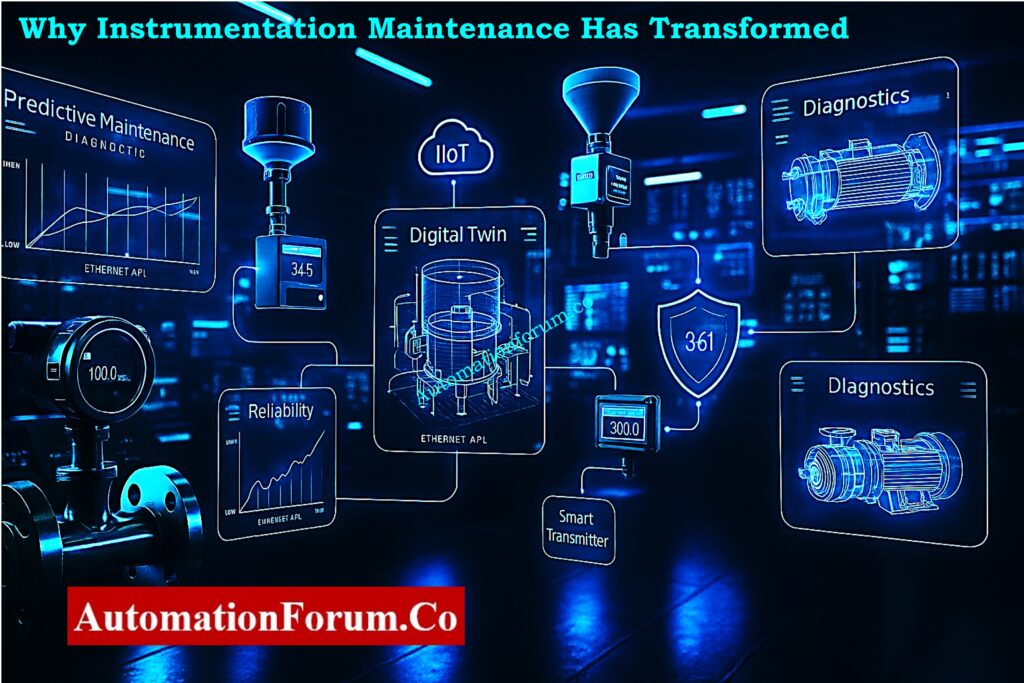
The fast digital revolution of process industries has made a big difference in how instrumentation maintenance is done. Calibration, loop checks, and troubleshooting were the only things that traditional maintenance techniques focused on. Today’s smart plants need a single approach that includes predictive diagnostics, compliance with cybersecurity standards, digital twins, IIoT-enabled sensors, cloud analytics, remote monitoring, and SIL lifecycle management.
Is Your DCS Truly Secure? Here’s What Every Engineer Must Check Today: DCS Cybersecurity: Mitigating Risks in Industrial Automation
Need for Unified Reliability + Cybersecurity Maintenance
Instrumentation maintenance teams are now responsible for smart transmitters, digital positioners, radar level devices, Coriolis mass flowmeters, wireless instruments, devices that work with HART-IP/PROFINET/Modbus TCP, and new technologies like AI-powered anomaly detection, condition-based maintenance (CBM), and built-in self-diagnostics (NE107). As machines get smarter, the ways we keep them running must change as well.
This article has a full deep-dive guide called “Advanced Integrated Field Instrument Reliability & Cyber-Secure Maintenance Checklist for Smart Process Plants (2025 Edition).” A modern framework that helps professionals who work on instrumentation improve dependability, avoid unplanned downtime, keep cybersecurity intact, and make sure they follow standards for a long time.
Evolution of Instrumentation Maintenance in Modern Plants
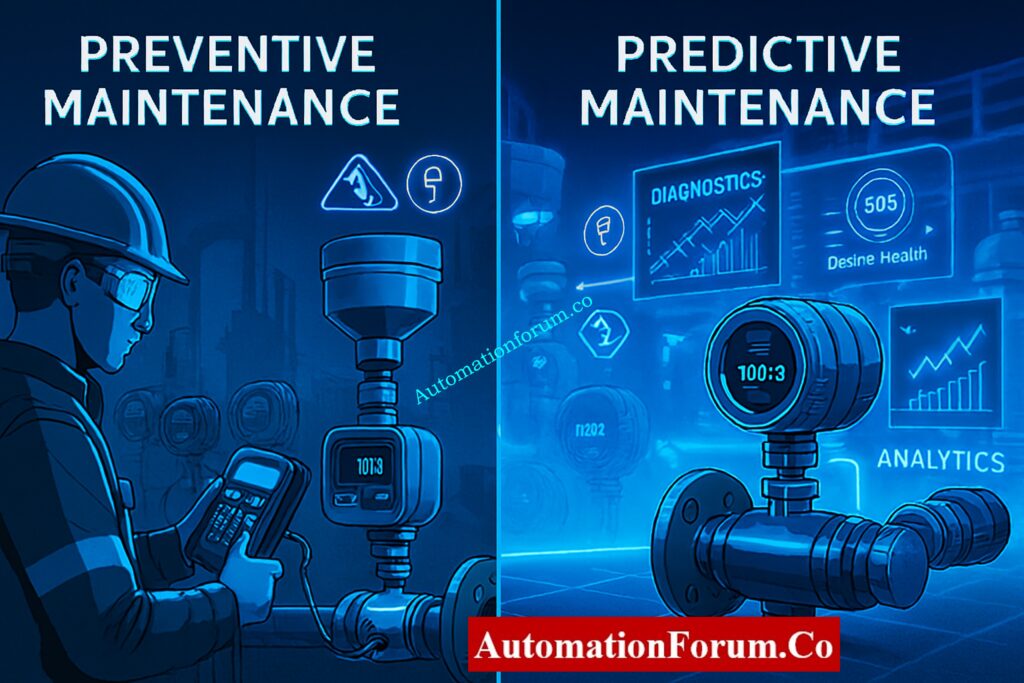
From Preventive to Predictive Maintenance
In the past, maintenance was mostly done with specified calibration intervals and regular overhauls. This made sure that the system was generally reliable, but it also meant that maintenance was often needed when it wasn’t needed or breakdowns were ignored between intervals.
Diagnostics, Analytics, and Digital Signatures
Modern smart instruments now offer:
- Advanced diagnostics that can find drift, process influence, sensor blockage, and changes in internal health.
- Onboard analytics that can look at how stable measurements are, how quickly they respond to changes, and how changes in the environment affect them.
- Digital signatures that check the integrity of the device and make sure that the configuration parameters have not been changed.
- Performance indications based on firmware that show possible memory problems, aging components, and signal-processing errors.
Because of these improvements, facilities can move toward predictive and condition-based maintenance, where real-time health data guides decisions. This will cut down on downtime and wasteful calibration tasks.
PLCs Are the New Target – Protect Them Before Hackers Find You: How to Safeguard PLCs Against Cyber Attacks in Industrial Networks ?
Rise of Smart Sensors and Digital Communication Protocols
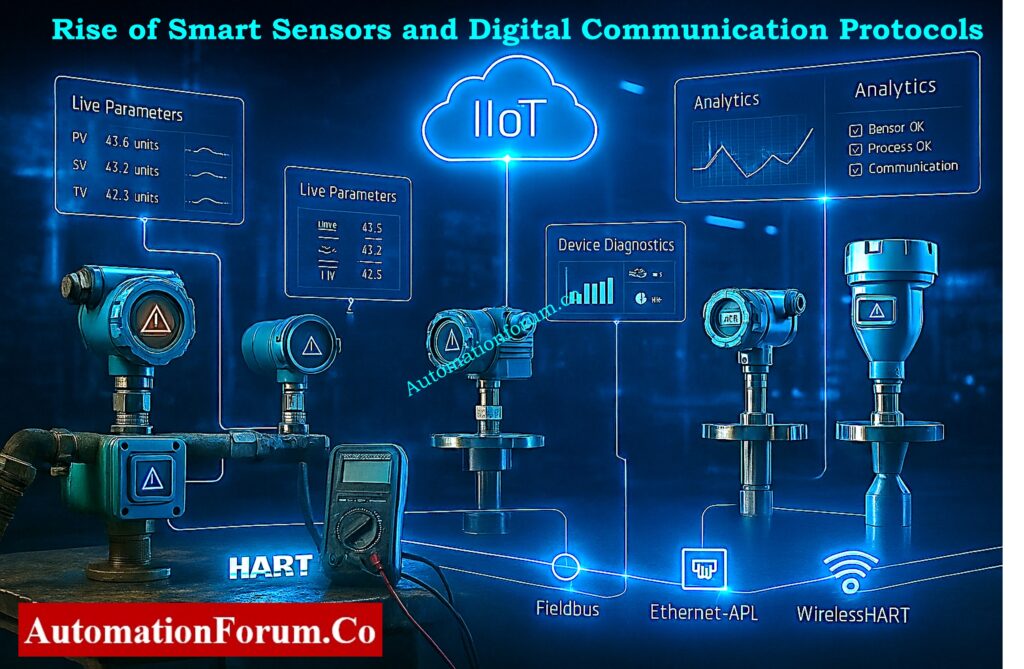
Modern instruments use advanced digital communication technologies including HART 7, WirelessHART, Fieldbus, PROFINET, Ethernet-APL, Modbus TCP, OPC-UA, IO-Link, and HART-IP. These protocols enable:
- Remote configuration and diagnostics, reducing field exposure and enabling centralized troubleshooting.
- High-resolution data lets you keep a close eye on how processes work and how well devices work.
- Better asset analytics that give reliability teams useful information about failures and energy use.
Now, maintenance engineers need to know more than just how sensors work. They also need to know about digital communication problems, parameter mapping, power distribution, and network diagnostics.
SCADA Attack Surface Is Growing – Secure It With This 30-Point Checklist: SCADA Security Checklist: 30+ Essential Tips for Securing Critical Infrastructure
Integration with IIoT, Edge, and Cloud Ecosystems
More and more, modern factories are using IIoT ecosystems that include edge gateways, cloud analytics, data historians, and digital twins.
These technologies depend on:
- Accurate, validated device data to make sure that analytics and predictions are reliable.
- Cyber-secure device communication protects plant networks against illegal access.
As IIoT grows, keeping instruments in good shape is very important for making sure that data is reliable, devices work well, and field equipment can connect to digital platforms without any problems.
Your I/O Modules Are Failing Silently – Prevent It With These Tips: Proactive Maintenance Strategies for PLC I/O Modules: Reduce Downtime & Improve Reliability
Key Drivers Behind Modern Instrumentation Maintenance Strategy
Asset Reliability & Uptime
Unplanned downtime caused by broken or inaccurate tools can have a big effect on the safety, quality, and continuity of production. Because of this, modern maintenance plans put more emphasis on:
- Stable signal quality, which means that measurements are not affected by noise, grounding problems, or electrical interference.
- Getting rid of drift by employing internal diagnostics and verification features to find deviations before they harm the process.
- Early failure detection is possible thanks to smart transmitters and asset management systems that constantly check for problems.
- Digital records, electronic signatures, and traceable calibration certifications help keep calibration integrity.
- Keeping track of configuration history so that engineers can find recent changes, restore settings, and avoid errors that are caused by configuration.
Cybersecurity as a Maintenance Responsibility
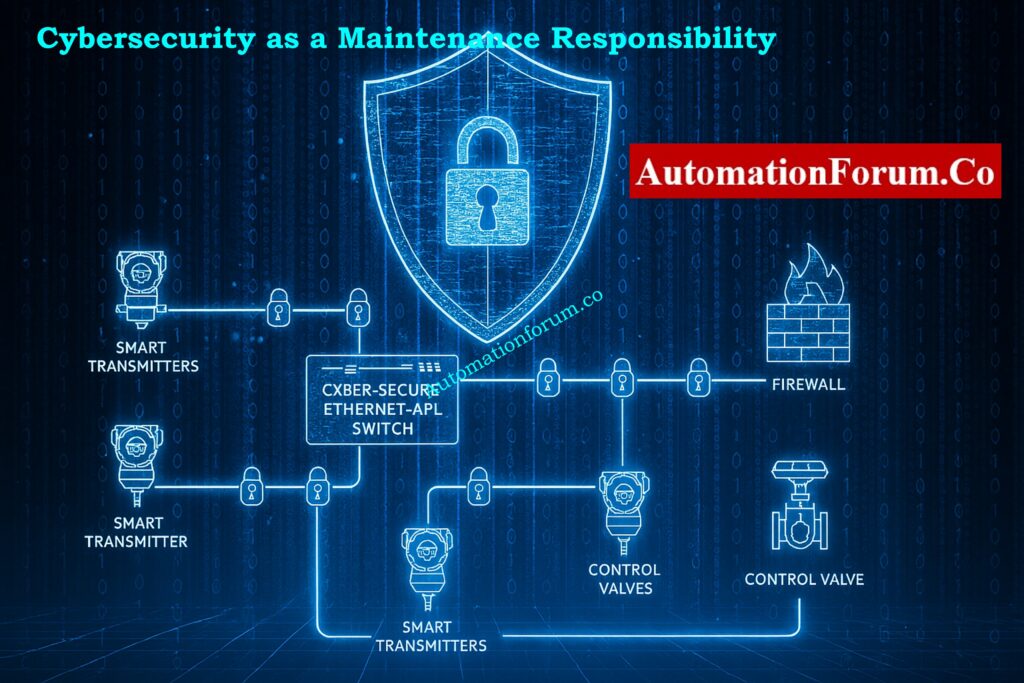
Cybersecurity is becoming increasingly important as more field equipment start talking to each other using Ethernet-APL, Wi-Fi, and wireless mesh networks. Proper cyber-secure maintenance makes sure that:
- Firmware that you can trust, is not corrupted, and is updated through secure OEM channels.
- Controlled access, which means utilizing robust authentication, role-based access, and limited rights to change settings.
- Removing default credentials lowers the likelihood of basic intrusion attempts.
- Monitoring device traffic can assist find scans that aren’t allowed or communication patterns that are out of the ordinary.
Compliance with Global Standards (IEC 61511, IEC 62443, NE107)
Instrumentation teams must make sure they follow modern rules, such as:
- IEC 61511, which covers the whole life cycle of safety instrumented systems and proof-testing activities.
- API/ASME best practices that affect how accurate flow, level, and pressure measurements are.
- ISA/IEC 62443 sets the rules for cybersecurity controls for industrial automation systems.
- NAMUR NE107 diagnostics, which give devices the same status categories to make them easy to understand.
- OEM advisories and service bulletins, which give important information about safety and dependability.
Stop PLC Failures – Use This Preventive Maintenance Checklist: Checklist to Carry out PLC Preventive Maintenance Activity
Practical Engineering Considerations for Smart Device Maintenance
Calibration Strategy in Smart Plants
Smart transmitters come with self-diagnostics and verification tools that make it less necessary to calibrate them by hand all the time. Maintenance should:
- Use digital as-found/as-left logs to keep track of how accurate the measurements are over time.
- Use heartbeat or built-in verification mechanisms to cut down on the requirement to physically remove something or stop the process.
- Combine calibration schedules with CMMS/EAM to make planning and tracking easier.
- Follow the OEM’s dry-calibration steps, especially for radar and ultrasonic equipment that don’t need to be exposed to the process.
Control Valve + Digital Positioner Diagnostics
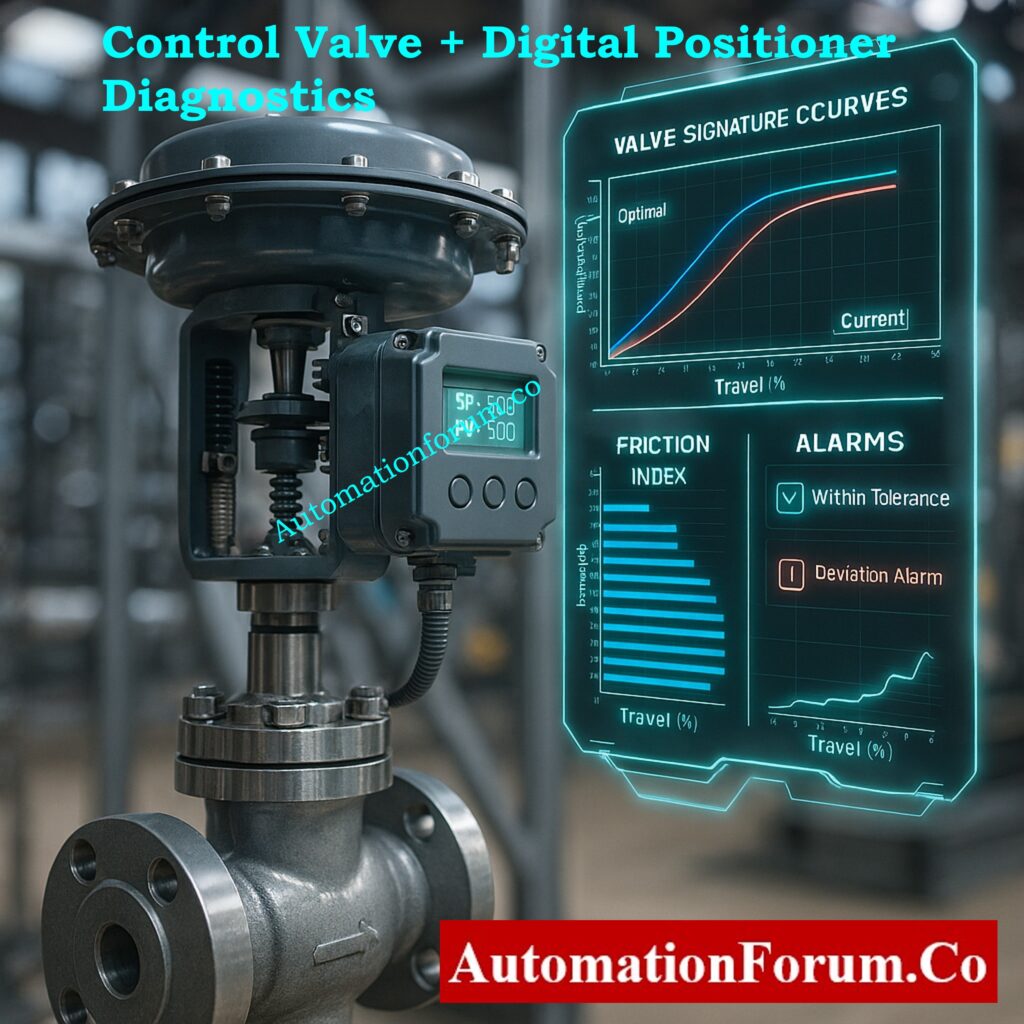
Modern positioners provide us more information about how valves work. Maintenance staff should check on a regular basis:
- Auto-tuning results that make sure the system responds best in all situations.
- Friction and stiction analysis, which helps find early packing or mechanical problems.
- Valve characteristic curves that show wear and tear or strange movement patterns.
- Travel deviation alarms, which show that the performance is drifting or the actuator isn’t working right.
These diagnostics cut down on unanticipated valve failures by a lot.
Wireless Instrument Maintenance Requirements
Wireless equipment need specific care, such as:
- Regularly checking the health of the battery and figuring out when it will need to be replaced.
- Signal quality checks to make sure the antenna is pointing in the right direction and the mesh is routing correctly.
- Interference analysis, which finds RF congestion or physical barriers.
- Secure firmware updates stop weaknesses in the wireless network.
Ethernet-APL Network Health Requirements
High-speed APL networks need special attention to:
- Link stability, which means making sure that communication speeds and connections are always the same.
- Power availability is making sure that devices get the right amount of loop power across the APL network.
- Network loading, which stops delays or communication problems.
- Diagnosing switches by looking at CRC errors, retries, and throughput.
- To control EMI in tough industrial settings, you need to use the right shielding and grounding.
Don’t Start a Shift Without This PLC Panel Inspection Checklist: Running Inspection Checklist of PLC Components in Control Panels
Common Failure Modes in Modern Instrumentation
Firmware Corruption & Software Integrity Issues
Firmware is very important for modern equipment. When they are old or broken, they may show:
- Calculations for measurements that are wrong
- Drift that keeps getting worse even after calibrating
- Communication that isn’t stable
- Bad diagnostics or false alerts
Managing firmware is now a big element of preparing for maintenance.
Loss of Digital Communication (HART/APL/FB)
Typical digital communication failures include:
- HART burst mode interrupts caused by loops that are too loud
- Ethernet-APL link is unstable since the terminations are not done right
- Fieldbus segment noise, which is commonly produced by bad shielding
- Problems with grounding that cause signals to change or resets to happen randomly
To fix current devices, you need to know how the digital layer works.
Sensor Element Degradation Over Time
Even with built-in diagnostics, field sensors naturally break down over time due to:
- RTD lead wear and tear
- Coriolis tube coating that changes resonance
- Contamination of the radar horn, which makes the signal less reflective
- Corrosion or too much pressure can destroy the DP cell diaphragm.
Diagnostics are helpful, but you still have to look at the physical object.
Cyber Intrusions & Unauthorized Access
Some examples of cyber threats are:
- Engineering laptops that have been infected with malware are transferring it to field networks.
- Switches that aren’t set up correctly leave open ports open to attack.
- Default passwords that don’t change, making it easy to get in
Cyber hygiene is increasingly a prerequisite for technical maintenance.
Confused About PV, SV, TV & QV? This Guide Makes It Crystal Clear: Explained: The Four Main Process Variables (PV, SV, TV, QV) in HART Transmitters
Advanced Maintenance Framework for Smart Process Plants
Predictive & Condition-Based Maintenance
Modern plants require:
- Advanced DTM/EDD systems for real-time health monitoring
- Dashboards that display early warning signs and predictions
- Modeling failures by comparing past failures to current patterns
- AI-based anomaly detection for better, earlier failure prediction
Digital Twins for Instrument Diagnostics
Digital twins allow maintenance teams to simulate:
- Progression of measurement drift
- Effect of fouling or coating
- Trends in mechanical wear on valves, actuators, and flow sensors
This makes planning much more accurate.
Remote Maintenance with Secure Access Controls
Remote maintenance offers major benefits when supported by:
- Zero-trust networks or VPN tunnels
- Encrypted communication tools
- Digital certificates for device authentication
This keeps strong cybersecurity protections in place while lowering field exposure.
Lifecycle Management of Smart Instruments
Good lifecycle management includes:
- Full records of commissioning
- Regular checks of calibration
- Regular audits of configurations
- Planned replacement of old smart devices in a structured way
This makes sure that the measurements are stable and reliable throughout time.
How Secure Is Your OT? Run This Simple NIST-Based Check: ICS/SCADA OT Cybersecurity Self-Assessment: NIST-Based Procedure for Critical Infrastructure
Case Scenario: Maintenance Strategy in an Ex-Rated Chemical Plant
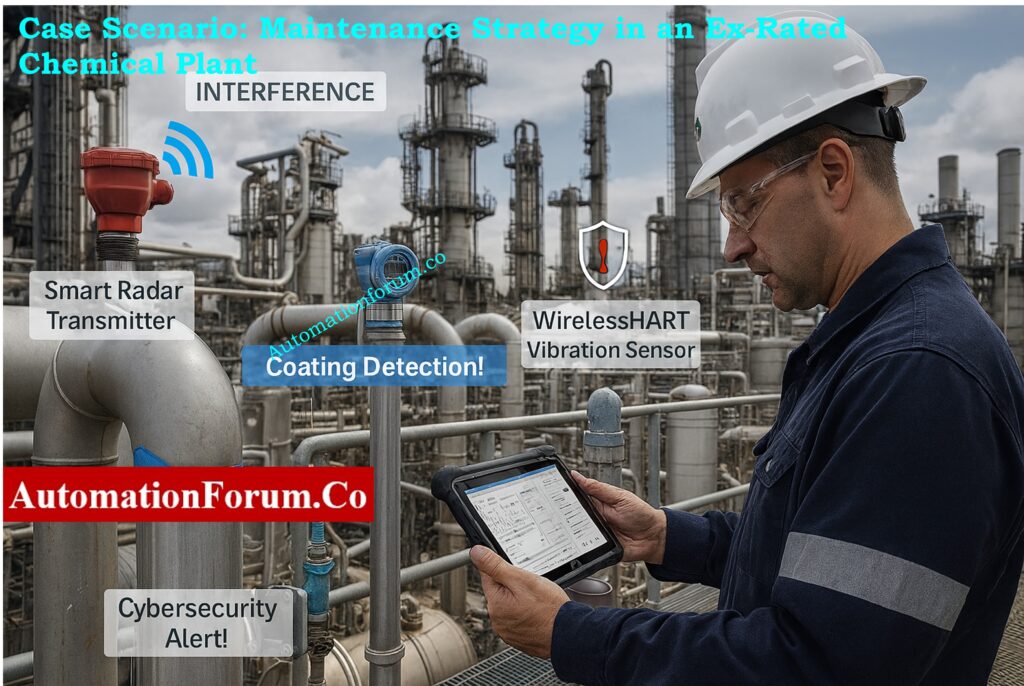
Smart radar level transmitters, SIL-rated pressure transmitters, HART digital positioners, and WirelessHART vibration sensors are all used in a chemical plant. Sensor fouling, gas compatibility problems, cybersecurity constraints, and temporary communication failures are some of the problems that come up during maintenance.
Key Maintenance Actions
- Radar level transmitter:
Maintenance engineers check the built-in verification (Heartbeat/Device Verification) and find accumulation on the antenna. Plant automatically sets up tank cleaning and sends out signals for recalibration. - Coriolis mass flowmeter:
AI predictive diagnostics show a modest attenuation of tube oscillation, which means there is coating. Maintenance checks the cleaning schedule and makes plans for when to stop cleaning. - SIL pressure transmitters:
Engineers view partial-stroke test logs for SIS actuators. They detect a small increase in travel deviation and schedule valve maintenance. - Wireless vibration sensor:
The gateway logs high interference. Maintenance repositions the sensor and adjusts mesh routing. - Cybersecurity event:
Device audit logs show failed SSH login attempts. Maintenance locks access, updates the firmware, and reviews firewall settings.
Your OT Network Isn’t Safe Without These Protocol Protections: Protocols and Standards in Industrial Automation: A Guide to OT Cybersecurity
Importance of a Unified Maintenance Checklist
A well-designed maintenance checklist ensures that field teams systematically check every critical aspect mechanical, electrical, diagnostic, communication, cybersecurity, and documentation. The checklist provided below is specifically designed for the latest generation of smart, SIL-rated, IIoT-enabled instrumentation used in today’s process industries.
Are Your PLCs Compliant? Benchmark Them Against Global Cyber Standards: Cybersecurity Standards for PLCs
Advanced Integrated Field Instrument Maintenance Checklist
Instrument Health, Diagnostics & Calibration
- Check the NE107 status, alert logs, and fault history for the device.
- Use the built-in verification tools (Heartbeat, FieldCheck, and DVC signature) to check if the calibration is correct.
- Check “as-found” vs “as-left” calibration drift records.
- Examine sensor element condition (DP diaphragm, radar antenna, RTD leads).
- Check the parameters for temperature and pressure in the environment.
- Check that the range, scaling, linearization, and units are all accurate.
- Validate sensor redundancy logic (2oo3, 1oo2).
- Inspect local indicators and backlit LCDs for pixel issues.
Communication, Protocols & Network Integrity
- Validate HART/Fieldbus/Ethernet-APL communication parameters.
- Check physical layer: shielding, grounding, terminations, segment load.
- Review device communication error logs.
- Verify APL switch diagnostics, packet drops, and link quality.
- Confirm update rate, burst mode, and polling accuracy.
- Test wireless link: RSSI, gateway routing, battery status.
Control Valve & Final Element Integrity
- Look over the digital positioner’s diagnostics, such as the friction index and valve signature.
- Check the logs for trip deviation alarms and partial-stroke tests.
- Check the quality of the air supply to the actuator (filter, regulator, tubing).
- Check the feedback link and see if there is any mechanical wear.
- Check that fail-safe mode is active (fail-open/close).
Power, Environment & Physical Condition
- Check the stability of the power supply, the state of the UPS, and the load sharing.
- Check the health of the cables, the resistance of the insulation, and the condition of the trays.
- Check the IP rating, sunshields, and condensation traps to make sure they protect against the weather.
- Check that the glands, seals, and earthing continuity are all in line with the Ex-zone.
- Check the integrity of the enclosure and the protection against water and dust.
Cybersecurity & Firmware Assurance
- Check the legitimacy of the firmware and its revision history.
- Check the rules for access control: passwords, RBAC, and audit logs.
- Make sure that remote access is safe (VPN/zero trust).
- Turn off services and protocols that you don’t utilize.
- Check with the OEM to be sure the security patches are real.
Documentation, Records & Compliance
- Update CMMS/EAM records for every maintenance task.
- Review SIL proof-test intervals and completion logs.
- Confirm device configuration backups and checksum verification.
- Record failure reports, incident logs, and FMEAs.
- Make sure that you follow the rules set out in IEC 61511 and 62443.
IIoT, Digital Twins & Predictive Analytics
- Connect device data to cloud and edge analytics platforms.
- Check the alarms for predictive maintenance.
- Make that the digital twin model matches up with the field data.
- Check the thresholds for finding anomalies.
Shutdown & Startup Instrumentation Checks
- Check that SIL loops work in a safe condition.
- Confirm interlocks, permissives, and override integrity.
- Verify hot-cutover procedures for smart network devices.
- Inspect bypass logs and override duration.
- Make sure that all maintenance operations are logged and approved.
New to Cybersecurity? Start With These Must-Know Threats: Cybersecurity Basics: Types, Threats, and Protection Tips
Future of Instrument Maintenance
In modern process facilities, instrument maintenance goes much beyond just checking devices. It now includes keeping track of digital diagnostics, making sure that cybersecurity rules are followed, checking the health of networks, using smart analytics, and using predictive technologies. The Advanced Integrated Field Instrument Reliability & Cyber-Secure Maintenance Checklist (2025 Edition) gives maintenance workers a complete framework that is in line with the newest equipment and international requirements.
This complex checklist makes sure that maintenance is always done safely, consistently, and reliably, which helps keep uptime high, meet regulations, and improve process performance. It is an essential tool for every instrumentation maintenance engineer working in today’s changing industrial world.
Download: Advanced Integrated Instrument Reliability & Cyber-Secure Maintenance Checklist (Excel)
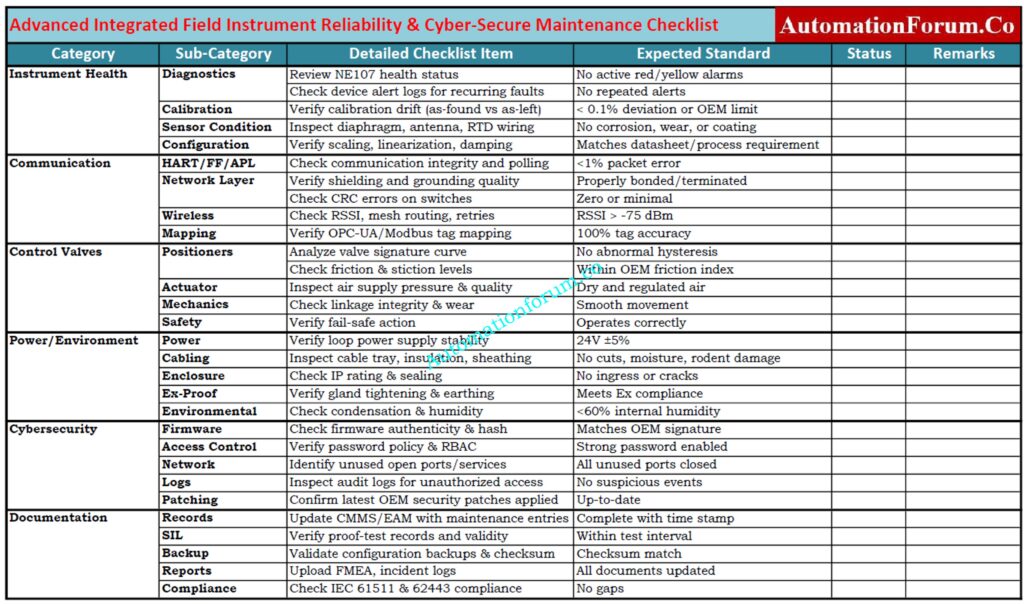
To keep current smart instruments working, you need more than just calibrating and fixing them. You need an organized, predictive, and cyber-secure method. This is a completely structured Excel checklist for dependability and uptime that will enable instrumentation maintenance teams keep track of IIoT devices, Ethernet-APL systems, SIL equipment, and digital diagnostics.
Advanced Integrated Field Instrument Reliability & Cyber-Secure Maintenance Checklist – 2025 Edition
