
- What are Process Variables in HART Devices?
- 1. Primary Variable (PV)
- 2. Secondary Variable (SV) – The Supporting Measurement
- 3. Tertiary Variable (TV) – The Calculated Companion
- 4. Quaternary Variable (QV) – The Intelligent Output
- Only PV Is Transmitted via Analog Signal
- How the Four Variables Enhance Plant Operations
- Practical Example – HART Multivariable Flow Transmitter in a Steam Line
- Applications of Multi-Variable HART Devices
- Test Your Knowledge on HART Protocol
- FAQs on HART Protocol and Process Variables
In the fields of industrial automation and process control, it’s important to be able to measure things accurately and talk to each other reliably. Modern field instruments, especially those that use the HART (Highway Addressable Remote Transducer) protocol, are much more advanced than traditional 4–20 mA transmitters.
HART devices are “smart instruments” that can send digital status information, diagnostics, and various process variables all over the same two-wire loop used for analog signaling.
This guide will show you one of HART devices’ most useful features: the four process variables (PV, SV, TV, and QV). You’ll discover what each variable means, examine examples of instruments in the real world, and see how digital data makes diagnostics and control better in modern plants.
Master the Art of HART Configuration: Best Practices for Configuring HART Parameters in DCS Software
What are Process Variables in HART Devices?
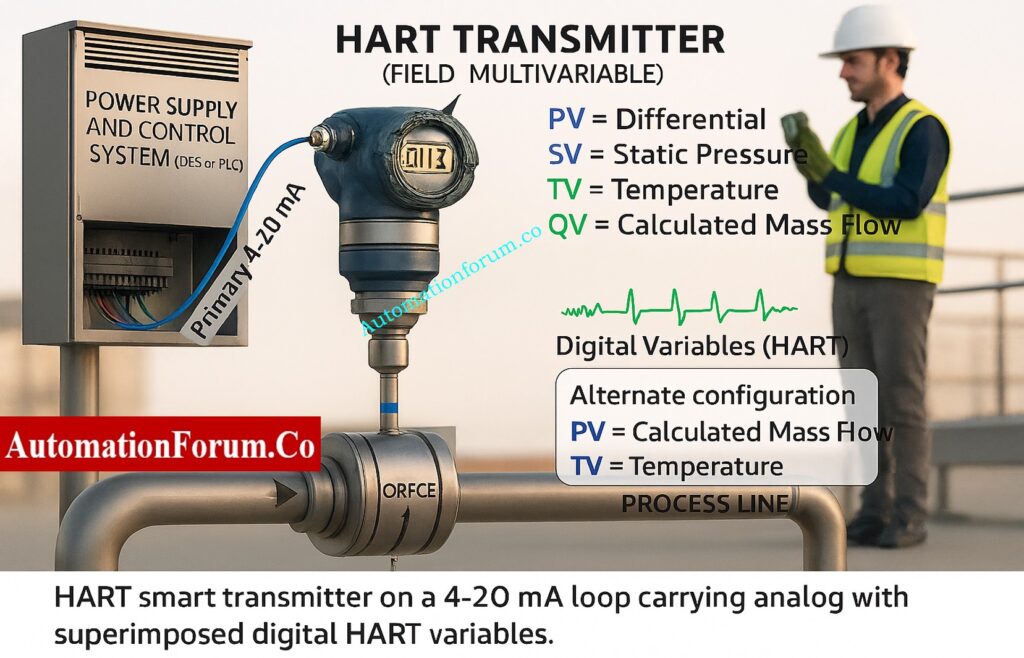
Conventional analog transmitters were limited to transmitting a singular data point, specifically the principal measured variable, by transforming it into a 4-20 mA signal. For instance, a pressure transmitter sends out 4–20 mA for a pressure range of 0–10 bar.
Hands-On Field Guide: Step-by-Step Guide for Installing and Commissioning HART and WirelessHART Devices for Engineers and Technicians
List of Four HART Process Variables
HART communication, on the other hand, adds a digital layer to the analog signal. This means that one transmitter can send up to four process variables (PVs) at the same time:
- PV – Primary Variable
- SV – Secondary Variable
- TV – Tertiary Variable
- QV – Quaternary Variable
Depending on the type of transmitter, these four variables can be measured, derived, or calculated. They let operators and control systems get to rich, multidimensional data without needing extra wiring or transmitters.
Understand the Secret Behind Reliable Signals: Why is a 250-Ohm Resistor Important for HART Communication?
1. Primary Variable (PV)
Definition of PV
Depending on the type of transmitter, these four variables can be measured, derived, or calculated. They let operators and control systems get to rich, multidimensional data without needing extra wiring or transmitters.
Key Characteristics of PV
- Represents the core measurement function of the device.
- Mapped directly to the analog output (4-20 mA).
- Also sent in the HART digital communication frame.
- Always there in every device that works with HART.
Example – Pressure Transmitter (Rosemount 3051)
For example, the Rosemount 3051 Pressure Transmitter.
- Type of instrument: Differential Pressure Transmitter
- Parameter that was measured: Pressure Difference
- PV (Primary Variable): Units of pressure: bar, psi, or kPa
- Output in analog form (4-20 mA): Shows a pressure range of 0 to 10 bar
If the process pressure is 5 bar, the analog signal will be 12 mA, which is in the middle of the range. Simultaneously, the digital HART signal also carries “PV = 5.00 bar” for diagnostic or display purposes.
Other PV Examples in Field Instruments
- For a Temperature Transmitter, PV = Process Temperature (°C).
- For a Flow Transmitter, PV = Flow Rate (m³/h).
- When it comes to a Level Transmitter, PV = Level (in meters or %).
Why PV Matters in Process Control
The PV is the principal way for the control system (DCS or PLC) to get input on the process. This variable is necessary for accurate regulation of process conditions in control loops like PID control.
Refer the link for How to Safely Check the mA Current of an Instrument Loop Using a Multimeter
2. Secondary Variable (SV) – The Supporting Measurement
Definition of SV
The Secondary Variable (SV) is a second variable that can be monitored or derived from the transmitter. PV is the main measurement, but SV gives you more information that helps you understand how the process is going.
Characteristics of Secondary Variables
- Can be a parameter that can be measured directly, like static pressure.
- It can also be a derived value, such pressure that has been adjusted for temperature.
- Only accessible through the digital HART signal (not 4-20 mA).
- Increases overall diagnostic and process knowledge.
Example – Multivariable Transmitter (Yokogawa EJX910A)
Think about the Yokogawa EJX910A Multivariable Transmitter, which is used to measure flow.
- Instrument Type: Multivariable Differential Pressure Transmitter
- Measured Parameters: Differential Pressure (DP), Static Pressure, and Temperature
In this device:
- PV (Primary Variable): Differential Pressure (used to figure out flow)
- SV (Secondary Variable): Static Pressure
Static pressure is a very important variable to have with you. It helps the transmitter adjust for variations in gas density or find line pressure loss, which makes flow estimates more precise.
Other SV Examples
- In a temperature transmitter with two RTDs:
- PV = Sensor 1 Temperature
- SV = Sensor 2 Temperature
- In a flow transmitter:
- PV = Flow Rate
- SV = Fluid Temperature (used for density correction)
Why SV Matters for Diagnostics and Compensation
Technicians can keep an eye on more process parameters without adding another transmitter by making the secondary variable available digitally. This lowers the cost of hardware, makes installation easier, and makes it easier to see what’s going on throughout operation.
Test Your Troubleshooting Skills: Closed-Loop Control Valve Troubleshooting: HART, Fieldbus and Diagnostics Skills Quiz
3. Tertiary Variable (TV) – The Calculated Companion
Definition of TV
The Tertiary Variable (TV) is the third variable that can be measured or calculated by the HART transmitter. Depending on the type of equipment, this could be a temperature, density, or even a diagnostic parameter.
Characteristics of Tertiary Variables
- Usually a parameter that has been derived or measured in an indirect way.
- Only accessible via the digital HART interface.
- Not utilized for analog control, but very important for diagnostics and sophisticated monitoring.
Stay Aligned with Global Standards: IEC Standards Chart for Instrumentation and Control
Example – Emerson Rosemount 3051S Multivariable Transmitter
For example, the Emerson Rosemount 3051S Multivariable Transmitter
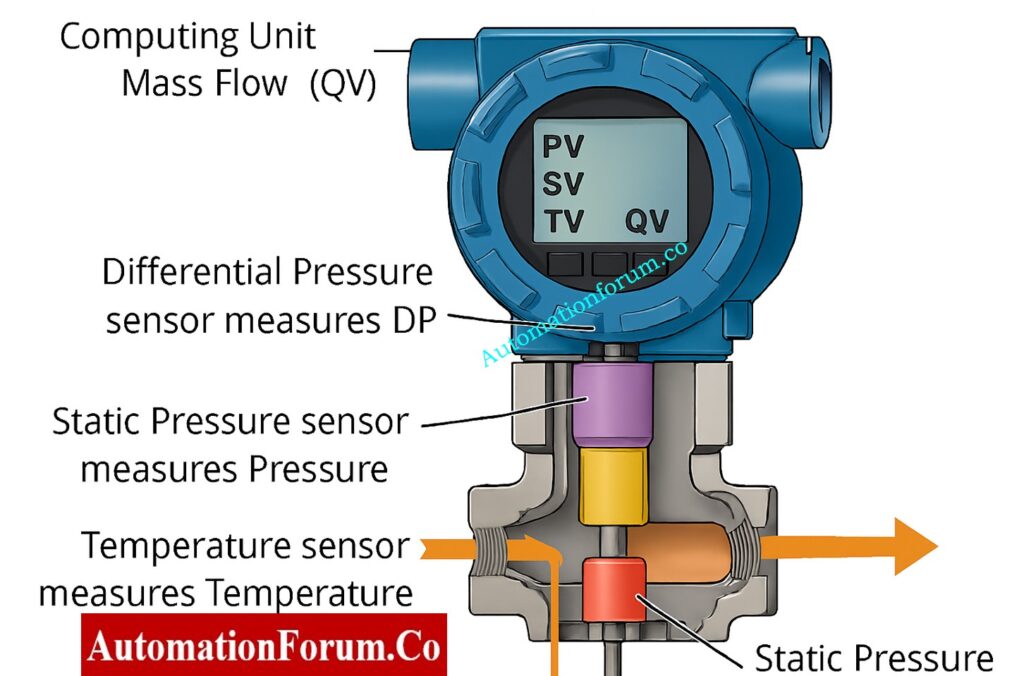
We should go back to the Emerson Rosemount 3051S MultiVariable Transmitter, which can measure static pressure, differential pressure, and temperature all at the same time.
- PV: Differential Pressure
- SV: Static Pressure
- TV: Process Temperature
Here, the transmitter uses TV (temperature) along with DP and static pressure to compute mass flow or corrected volumetric flow based on fluid properties.
This makes the device an intelligent flow measurement solution combining three sensors into one digital instrument.
Other TV Examples
- In a density transmitter, TV could stand for temperature, which is used to make up for changes in density due to temperature.
- In a level transmitter, TV could stand for vapor pressure, which can affect how accurate the level is in pressurized vessels.
Why TV Matters for Accuracy and Compensation
TV gives process control more accurate information by putting it in context. For instance, changes in temperature can have a big effect on the viscosity or density of a fluid. The transmitter allows operators do real-time correction and makes sure accurate measurements by adding temperature as a third variable.
Refer the below link for Understanding the Working Principle of Multivariable DP Mass Flow Transmitters
4. Quaternary Variable (QV) – The Intelligent Output
Definition of QV
The Quaternary Variable (QV) is the fourth process variable that can be used in HART communication. It is usually a computed, diagnostic, or supplementary parameter that gives further information about the operation or the health of the transmitter.
Characteristics of Quaternary Variables
- Usually shows calculated numbers like mass flow, density, or total flow.
- Can also have diagnostic signs, including sensor drift or process variability.
- Exclusively available through the digital HART signal.
- Enables predictive maintenance and advanced analytics.
Example – ABB 266MST Smart Multivariable Transmitter
Think about a Multivariable Transmitter, like the ABB 266MST Smart Transmitter, once more.
It measures differential pressure, static pressure, and temperature. From these inputs, the transmitter computes mass flow, which becomes the Quaternary Variable (QV).
| Variable | Description | Unit |
| PV | Differential Pressure | mbar |
| SV | Static Pressure | bar |
| TV | Process Temperature | °C |
| QV | Mass Flow (Calculated) | kg/h |
In this setup:
- The QV = mass flow is derived using DP, static pressure, and temperature, following the compensated flow equation.
- This single HART device thus replaces three separate transmitters making it a compact and efficient solution for process industries.
Other QV Examples in Advanced Instruments
- In a Coriolis Mass Flowmeter (e.g., Micro Motion CMF200):
- PV = Mass Flow
- SV = Density
- TV = Temperature
- QV = Totalized Flow
- In a smart density meter:
- QV could be compensated density at reference temperature.
Why QV Matters for Predictive Maintenance and Insight
The QV is the “bonus variable” that makes smart transmitters truly intelligent. It’s what turns raw data into actionable insight helping operators:
- Detect abnormal conditions early
- Perform advanced diagnostics
- Optimize control strategies
- Reduce the need for additional sensors
Simplify Your Calibration Setup: Wiring Diagram for Pressure Transmitter Calibration in Workbench using HART
Only PV Is Transmitted via Analog Signal
How HART Combines Analog and Digital Signals
One key principle of HART communication is that only the PV is sent via the traditional 4-20 mA analog output.
However, SV, TV, and QV are transmitted digitally over the same pair of wires using frequency-shift keying (FSK) modulation.
Benefits of Hybrid (4–20 mA + Digital) Communication
This combination allows:
- Backward compatibility with analog control systems
- Enhanced digital communication for smart diagnostics
The analog loop keeps legacy systems running, while digital HART data provides real-time access to additional process and device information.
Diagnose Like a Pro: 4-20 mA Loop Troubleshooting with Loop Calibrators : A Practical Guide
How the Four Variables Enhance Plant Operations
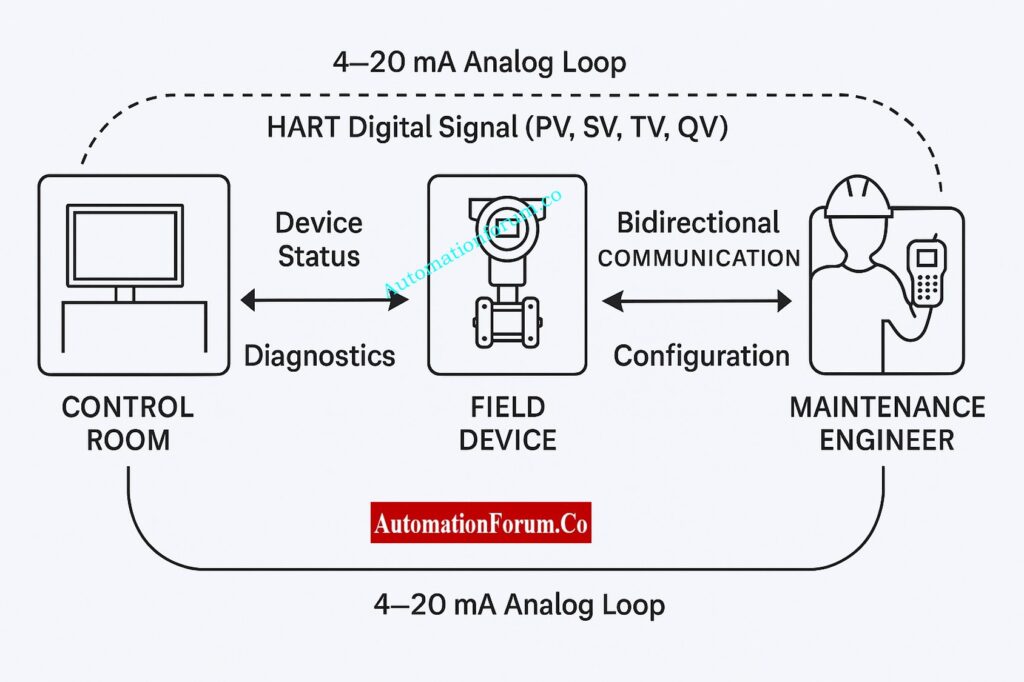
HART connectivity lets modern DCS and asset management systems read all four process variables. Here’s how that helps the plant work better:
| Benefit | Description |
| Improved Accuracy | Compensation using secondary and tertiary variables ensures more precise flow, level, and density calculations. |
| Reduced Hardware | One multivariable transmitter replaces multiple single-variable transmitters, saving installation cost and panel space. |
| Predictive Maintenance | Digital diagnostics (QV or status variables) alert technicians before failures occur. |
| Data Integration | HART variables integrate easily into asset management software like AMS, PRM, or FieldCare. |
| Operational Insight | Engineers can view temperature, pressure, and flow data from one device, enabling better decision-making. |
Field Engineer’s Complete Calibration Manual: HART transmitter calibration procedure – For pressure transmitter
Practical Example – HART Multivariable Flow Transmitter in a Steam Line
Let’s look at how PV, SV, TV, and QV work together in a real-life system for measuring steam flow.
Instrument Setup and Measurement Parameters
How it works: Steam Flow Measurement in Power Plant Variable
| Variable | Description | Function in Measurement |
| PV | Differential Pressure | Used to calculate flow rate |
| SV | Static Pressure | Compensates for steam density |
| TV | Temperature | Provides temperature compensation |
| QV | Mass Flow (Calculated) | Final compensated mass flow output |
How PV, SV, TV, and QV Work Together
- The DP sensor monitors how much the pressure drops over an aperture plate.
- The sensors for static pressure and temperature fix the density of steam.
- The computer inside the transmitter figures out the mass flow (QV).
- The DCS gets the 4-20 mA signal for control (PV) and can check digital variables (SV, TV, QV) to keep an eye on things or report on them.
This method makes steam systems more accurate, cheaper to install, and better at managing energy.
See the Real Difference in Communication Protocols: Comparison between Conventional (4-20ma) connection, Foundation-Fieldbus, and HART?
Applications of Multi-Variable HART Devices
| Application Area | Example Measurement | Typical PV/SV/TV/QV Setup |
| Oil & Gas Pipelines | Pressure and Temperature Monitoring | PV = Pressure, SV = Temperature, TV = Density, QV = Mass Flow |
| Chemical Plants | Reactor Pressure and Level | PV = Pressure, SV = Temperature, QV = Level |
| Power Plants | Steam Flow Measurement | PV = DP, SV = Static Pressure, TV = Temperature, QV = Mass Flow |
| Water Treatment | Differential Pressure Across Filters | PV = DP, SV = Temperature |
| Pharmaceutical Industry | Flow and Density of Liquids | PV = Mass Flow, SV = Density, TV = Temperature |
- HART transmitters can send out four process variables: PV, SV, TV, and QV.
- 4-20 mA analog output only sends PV.
- You can get SV, TV, and QV digitally through HART communication.
- Each variable can stand for a measured, deduced, or computed value.
- Accessing all four variables improves accuracy, diagnostics, and maintenance that can be predicted.
- In modern process industries, multivariable transmitters make installation easier and cheaper.
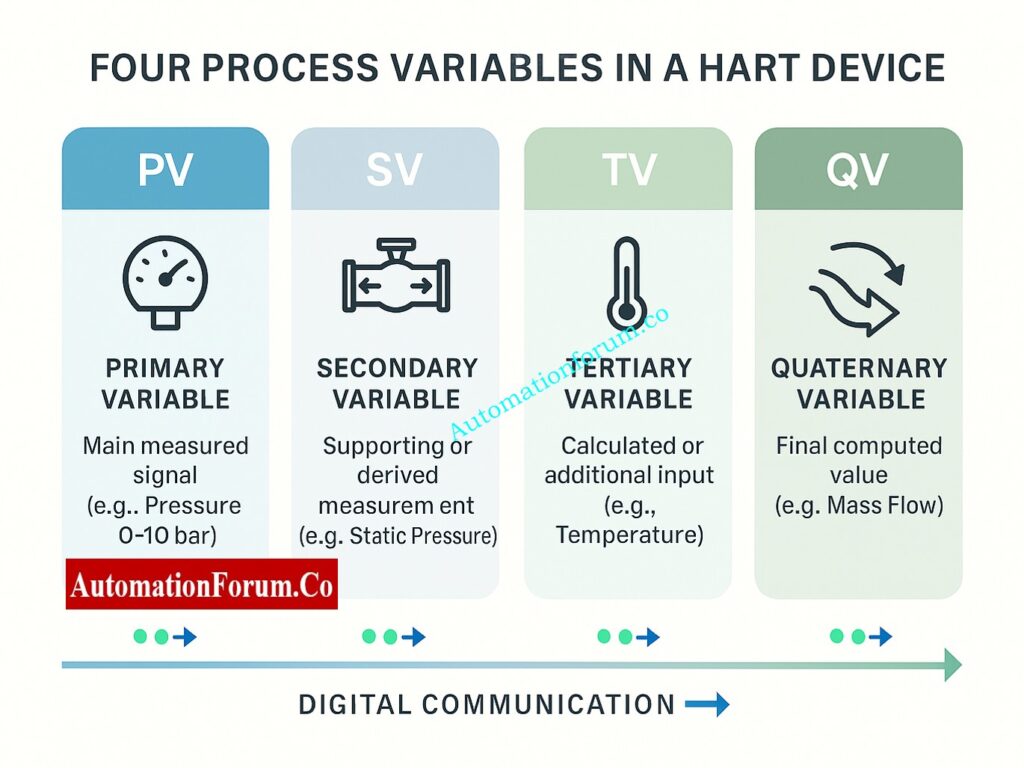
The idea of PV, SV, TV, and QV in HART devices shows how digital communication has changed process instrumentation.
From a single smart transmitter, engineers can now access multiple data points, perform advanced diagnostics, and integrate intelligent insights into plant control systems all using the same two-wire loop.
Whether it’s pressure, temperature, flow, or density, these four process variables enable a new level of efficiency, reliability, and intelligence in industrial automation.
Test Your Knowledge on HART Protocol
Refer the below link to Challenge Your HART Knowledge: with our Advanced HART Protocol Quiz
FAQs on HART Protocol and Process Variables
What is the function of HART?
HART (Highway Addressable Remote Transducer) lets digital signals travel across the 4–20 mA analog signal that is already present in field devices. It lets devices send various process variables, configuration data, and diagnostics without needing more wiring. This makes process control, monitoring, and maintenance more efficient.
What is the SV in HART?
The SV (Secondary Variable) in a HART device is the second digital parameter that can be monitored or derived. For instance, in a multivariable transmitter, the PV may be the difference in pressure, and the SV could be the static pressure. You can’t get to SV data through the analog 4–20 mA signal; you have to use HART communication.
What is SV and PV?
The 4–20 mA output of HART transmitters shows the main process measurement, or PV (Primary Variable), which could be pressure, temperature, or flow.
SV (Secondary Variable) is another value that is sent digitally, like static pressure or temperature in the same instrument.
What are HART variables?
HART variables are the four process variables that a smart transmitter can send digitally:
- PV – Primary Variable
- SV – Secondary Variable
- TV – Tertiary Variable
- QV – Quaternary Variable
These variables provide you more than one reading (such pressure, temperature, and flow) from one HART instrument, which makes diagnostics and accuracy better.
What is HART in process control?
HART (Highway Addressable Remote Transducer) is a hybrid communication system used in process control. It combines analog (4–20 mA) and digital communication. It lets control systems and handheld communicators read process data, set up instruments, and keep an eye on health diagnostics over the same two-wire loop.
What is HART 7 protocol?
The HART communication standard has a new version called HART 7. It adds support for WirelessHART, better device diagnostics, more reliable connectivity, and more data capabilities for managing assets and doing predictive maintenance in smart plants.
Why use a 250 ohm resistor in HART?
To make digital communication possible, a HART loop needs a 250-ohm resistor to establish the minimum load resistance. The resistor creates a tiny voltage across the current loop. This lets the communicator or control system pick up the HART FSK (Frequency Shift Keying) signal.
What is HART 5 and HART 7?
HART 5 is an older version of the protocol that lets digital devices talk to each other and set up devices.
HART 7 builds on this by adding WirelessHART support, better diagnostics, event notifications, and better handling of multi-variable data. This makes it better for today’s smart field networks.
Put Your Process Knowledge to the Test: Advanced Multivariable Transmitter Challenge: Flow, Pressure & Temperature Integration
