
- What is a Temperature Transmitter?
- Advantages of Using Temperature Transmitters
- Types of Temperature Transmitters and How to Choose
- Temperature Transmitter Mounting Options
- Temperature Transmitter Selection Table for Practical Applications
- Selection Process for Temperature Transmitters
- Latest Innovations in Temperature Transmitters
- Choosing the Right Temperature Transmitter for Industrial Reliability
- FAQ – Temperature Transmitters & Sensors
For industrial process control in fields like chemical processing, oil and gas, energy, and food production, it is very important to be able to measure temperature accurately. Picking the proper temperature transmitter makes sure that the product is safe, of good quality, and uses less energy.
The following article tells you how to choose temperature transmitters depending on their type, how they are mounted, how well they work with other sensors, the environment they will be used in, and any extra characteristics they may have.
What is a Temperature Transmitter?
A temperature transmitter takes a signal from a sensor, generally a thermocouple or Resistance Temperature Detector (RTD), that changes with temperature and turns it into a standard output signal that control systems like PLCs, DCS, or SCADA can read.
Key Functions of a Temperature Transmitter
- Signal Conditioning: It removes noise, makes sensor signals more linear, and scales readings.
- Transmission: Changes the conditioned signal into digital protocols like HART or Modbus, 4-20 mA, or 0-10 V.
- Remote Monitoring: Sends correct readings to local displays or control systems.
Why Temperature Transmitters Are Important in Process Control
For effective process control, using a transmitter is important because it enhances precision, long-distance signal integrity, and wiring.
→ Calibrate Temp Instruments Step-by-Step: Temperature Measuring Instrument Calibration Procedure
Advantages of Using Temperature Transmitters
- Improved accuracy: Less noise and signal loss over long wiring lines.
- Standardized Output Signals: Works perfectly with PLCs, DCS, SCADA, or data loggers.
- Remote Monitoring: A way to see all the processes in a big plant from one place.
- Local Calibration and Adjustment: It’s often possible to change the span and zero on-site.
- Safety and Protection: Options that are safe from explosions or the weather for dangerous or outdoor settings.
Types of Temperature Transmitters and How to Choose
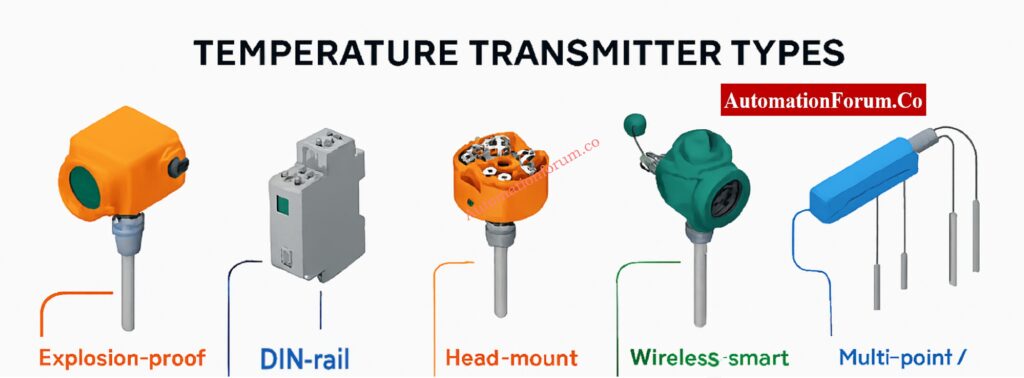
You can group temperature transmitters by how well they protect the environment, how they are mounted, and how they are designed. The ideal type for you will depend on how you use it and where you use it.
1. Weather-Proof and Explosion-Proof Transmitters – For Harsh and Hazardous Environments
Best Selection When: You work in chemical facilities, oil and gas refineries, or outdoor sites where dust, wetness, or explosive atmospheres are present.
Key Features:
- Stainless steel or explosion-proof alloy housing that is tough.
- Two chambers that keep electronics and sensors apart.
- Very accurate even under tough situations.
- Changes to the local span and calibration.
Applications:
- Dangerous areas in petrochemical plants
- Monitoring HVAC systems in outdoor factories
- Food and drink factories that need protection against washdown
Advantages: Strong, dependable, and long-lasting with little downtime.
Considerations: The cost is more, and the installation is a little more difficult.
2. DIN Rail / Panel Mount Transmitters – For Indoor Control Panels
Best Selection When: You need to put modular parts in interior control panels or distributed control systems.
Key Features:
- Spring clips make it easy to mount on a DIN rail or panel quickly.
- Works with thermistors, thermocouples, and RTDs.
- A cheap way to solve common problems.
Applications:
- Factory automation and control panels
- Monitoring of indoor processes that are not dangerous
- Power stations that use distributed control systems
Advantages: It’s easy to install, maintain, and replace, and it works with many sensors.
Considerations: It’s not as precise over lengthy wiring, and it could need an extra housing to keep dust and moisture out.
3. Head-Mount Transmitters for Point-of-Measurement Accuracy
Best Selection When: It’s very important for the temperature at the measuring site to be accurate, like in pipes, furnaces, or chemical reactors.
Key Features:
- Built into the sensor’s connecting head, so it doesn’t need much wire.
- A lot of accuracy at the point of measurement
- The sensor head also acts as the transmitter.
Applications:
- pipelines, ovens, and high-temperature furnaces
- High-temperature containers and chemical reactors
- Industrial activities that need to know the exact temperature in a certain area
Advantages: small, light, very accurate, and cheap to wire.
Considerations: Not very adjustable; how well it protects the environment depends on the design of the sensor head.
→ Decode Temp Transmitter Datasheets: How to Read a Datasheet of a Temperature Transmitter ?
4. Wireless and Smart Transmitters for Remote Monitoring
Best Selection When: You need to be able to access something from far away, do predictive maintenance, or make the wiring less complicated.
Key Features:
- Installation on the field or head
- Works with thermocouples and RTDs
- Digital communication (HART, Modbus)
- Advanced diagnostics and remote calibration
Applications: Large industrial plants, predictive maintenance programs, and hard-to-reach measurement points.
Advantages: It lets you monitor things from afar and do extensive diagnostics.
Things to think about: it costs more and needs a network to work.
5. Multi-Sensor or Multi-Point Transmitters
Best Selection When: You need to monitor more than one point with one transmitter, like in HVAC systems or big process vessels.
Key Features:
- Can work with RTD or thermocouple arrays
- Compatible with field or panel mounts
- Accuracy from medium to high
Advantages: It cuts down on the number of transmitters needed.
Considerations: More complicated calibration and maybe specific software.
Refer the below link for How to Troubleshoot Industrial Temperature Transmitters ?
Temperature Transmitter Mounting Options
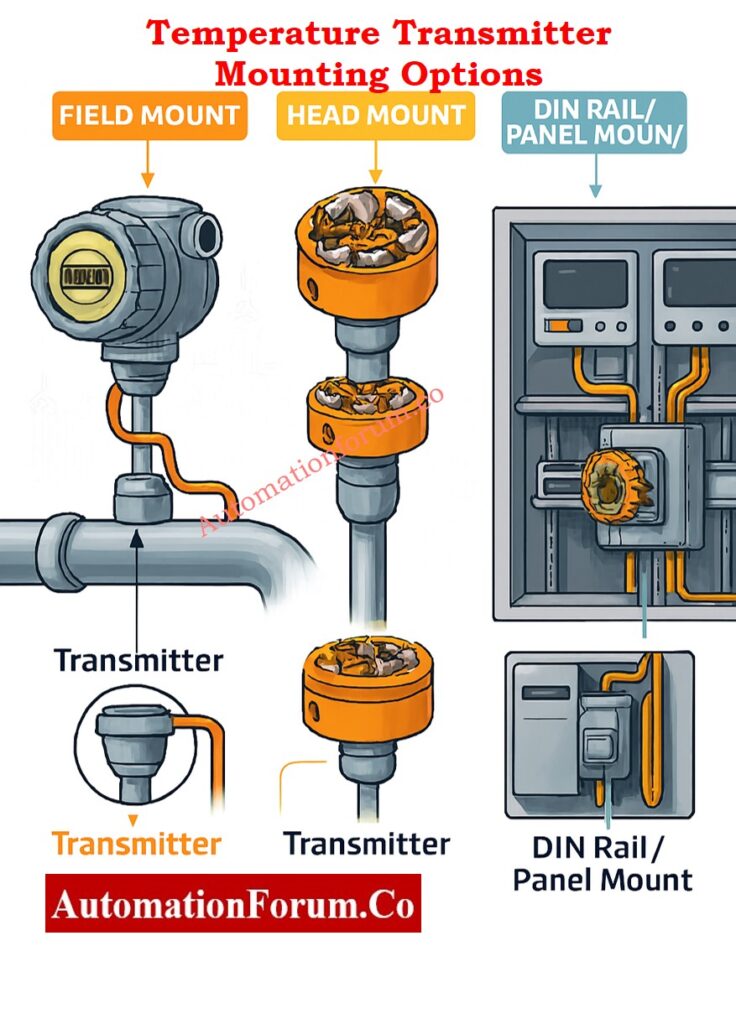
- Rail Mounting: DIN rail within control panels
- Field Mounting: Outside on process equipment directly
- Head Mounting: Built within the sensor head for easy installation in a small space
Tip: Choose the mounting depending on the environment, how easy it is to get to, and the needs of the process.
→ 4-20mA Temp Calculation Guide: How to Calculate Temperature Transmitter 4-20mA Output Using Linear Equation and Percentage Method ?
Temperature Transmitter Selection Table for Practical Applications
| Transmitter Type | Ideal Applications | Mounting | Sensor Compatibility | Accuracy | Environmental Protection | Advantages | Considerations |
| Explosion-Proof | Oil & gas, chemical plants | Field | RTD, TC | High | IP66/IP67, certified | Robust, reliable | High cost, complex wiring |
| DIN Rail / Panel | Factory automation, control panels | Rail | RTD, TC, thermistor | Medium | Limited | Easy install, modular | Less accurate over long wiring |
| Head Mount | Pipelines, furnaces | Head | RTD, TC | High | Depends on sensor head | Compact, high accuracy | Limited adjustability |
| Wireless / Smart | Remote monitoring, predictive maintenance | Field/Head | RTD, TC | High | IP66/IP67 optional | Remote monitoring, diagnostics | Costly, network setup |
| Multi-Point | HVAC, large vessels | Field/Panel | RTD/TC arrays | Medium-High | IP65/IP66 | Multi-point monitoring | Complex calibration |
→ Temperature Transmitter Burnout Explained: Burnout Function of a Temperature Transmitter with an example
Selection Process for Temperature Transmitters
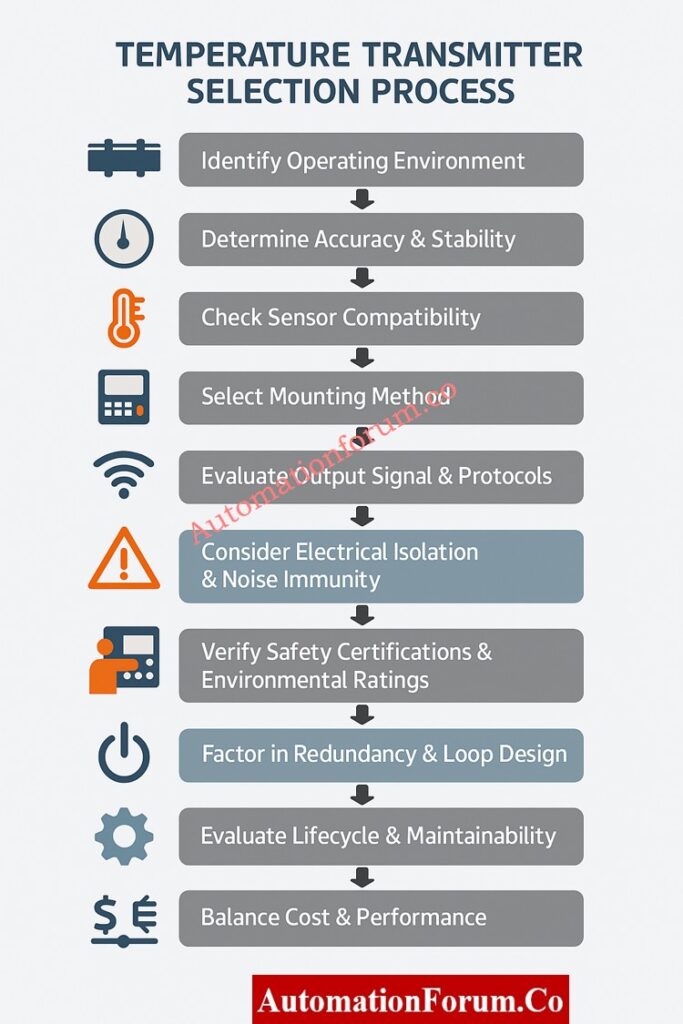
You need to follow an organized, step-by-step process to choose the proper temperature transmitter. The purpose is to make sure that the transmitter’s features are compatible with the process circumstances, accuracy needs, safety standards, and lifetime factors. The following important steps will help you choose the best option for your business.
Step 1. Identify the Operating Environment
First, figure out where the transmitter will go. The design of the transmitter, the type of enclosure, and the protection rating all depend on the environmental conditions.
- Hazardous or explosive atmospheres: se transmitters that have ATEX, IECEx, or FM approvals and are explosion-proof or fundamentally safe.
- Outdoor or washdown environments: Choose weather-proof or IP67-rated transmitters.
- Indoor control panels: choose DIN rail or panel-mounted transmitters for indoor control panels.
- High ambient temperature zones (e.g., furnaces or kilns): should use transmitters with a wide operational range (-40°C to +85°C) and strong thermal correction.
Choosing the right atmosphere keeps things from breaking down too soon and makes sure that precision stays the same over time.
Step 2. Determine Accuracy and Stability Requirements
Accuracy is the first level of precision, while stability is the transmitter’s ability to keep that level of accuracy for months or years of use.
- For critical process control (such a reactor, turbine, or high-temperature furnace), choose transmitters that are accurate to within ±0.1°C and that drift less than 0.1°C per year.
- For general process monitoring or utility loops, an accuracy of ±0.3-0.5°C is usually enough.
- Long-term stability means less frequent recalibration and greater performance over the life of the product.
Keep in mind that the accuracy of the system is the sum of the sensor and the transmitter. Always choose a transmitter that is stable and accurate enough for your process.
Step 3. Check Sensor Compatibility
Make sure that the transmitter works with the kind and wiring of your temperature sensor:
- RTD inputs: works with 2-wire, 3-wire, or 4-wire (4-wire is better for accuracy).
- Thermocouple inputs work with standard kinds (J, K, T, E, N, R, S, B) and have built-in cold-junction compensation.
- Thermistor inputs are available on some HVAC or low-temperature models.
If your system has more than one sensor or array, use multi-input or multi-channel transmitters to make installation and data collection easier.
Step 4. Select the Appropriate Mounting Method
The choice of mount influences how accurate, easy to maintain, and complicated the wiring is.
- Field mount: Attached directly to process equipment; great for outdoor or hazardous conditions.
- Head mount: This fits within the sensor connection head and is the best way to reduce noise and the length of the cable.
- DIN rail/panel mount: Used in centralized cabinets and control rooms to connect modules.
When making a decision, think about how easy it is to calibrate, how much exposure it will have to the environment, and how much room is available for the container.
Step 5. Evaluate Output Signal and Protocol Compatibility
select the transmitter output that works with your control system or monitoring network.
- 4-20 mA analog output is the most popular type and works with all PLCs, DCS, and indicators.
- 0-10 V output works well in quiet places that are close by.
- Digital communication (HART, Modbus, PROFIBUS, Foundation Fieldbus) lets you calibrate, configure, and diagnose things from a distance.
Digital protocols let you do predictive maintenance and remote diagnostics on modern plants that include asset management systems. Check to see if the input module works with your DCS or PLC every time.
Step 6. Consider Electrical Isolation and Noise Immunity
Electrical interference can make signals worse in plants that have motors, drives, or switching circuits.
Choose transmitters that have galvanic isolation (at least 1500 V) between the input, output, and power circuits.
This helps:
- Stop ground loops
- Guard against voltage spikes
- Keep measurements stable when there is a lot of electrical noise.
Step 7. Verify Safety Certifications and Environmental Ratings
Following global standards makes ensuring that anything is reliable and legal:
- IEC 60751 / 60584 – The rules for RTDs and thermocouples.
- IEC 60079: Protection against dangerous areas (Ex d, Ex ia, Ex e).
- IEC 61326: EMC compatibility.
- NAMUR NE43 sets the limitations for signal failure at 3.6 mA and 21 mA.
Transmitters that are SIL-certified (IEC 61508) are needed for safety instrumented systems (SIS).
It is very important to choose transmitters that satisfy the right criteria for safe and legal plant operations.
Step 8. Assess Power Supply and Loop Design
Check the power needs of the transmitter in relation to the loop voltage and the overall length of the wiring:
- Loop-powered (2-wire) transmitters make wiring easier and use less energy.
- Externally powered (4-wire) transmitters can send signals to more than one place, although they need more wiring.
- To keep the signal clear over extended distances, examine the voltage drop and cable resistance.
If you have a redundant or high-availability system, think about using dual-loop or dual-output transmitters to keep things running smoothly.
Step 9. Factor in Redundancy and Diagnostics
Redundancy makes crucial loops more reliable:
- If the main sensor fails, dual-input transmitters can automatically switch to a backup sensor.
- Advanced diagnostics find open circuits, drift, or sensor burnout early on.
- Some smart transmitters can track trends and send out alerts when a failure is likely to happen, which cuts down on downtime.
If your facilities have predictive maintenance programs, make sure to prioritize transmitters that enable diagnostic protocols like HART or Modbus.
Step 10. Evaluate Lifecycle and Maintainability
Long-term maintainability affects operational cost in more ways than just the original selection:
- choose transmitters that can have their firmware updated and that work with conventional configuration tools.
- Make sure that spare parts and vendor support are available for at least ten years.
- Check the Mean Time Between Failures (MTBF) to make sure it fulfills the plant’s dependability standards.
- Choose models that are the same across the plant to make it easier to calibrate and maintain spare parts.
Step 11. Balance Cost and Performance
Don’t give too much details. Smart transmitters with diagnostics are best for important loops, but simpler transmitters are better for less important areas because they cost less.
Use a tiered selection strategy:
- Tier 1: Smart transmitters for loops that are dangerous or need to be very accurate.
- Tier 2: Standard analog transmitters for keeping an eye on processes in general.
- Tier 3: Basic transmitters for utilities and temperature points that aren’t very important.
This method keeps reliability high while lowering the total cost of ownership.
→ Test Your Temp Troubleshooting Skills: Temperature Transmitter Troubleshooting Quiz – Advanced Diagnostics for Industrial Applications
Latest Innovations in Temperature Transmitters
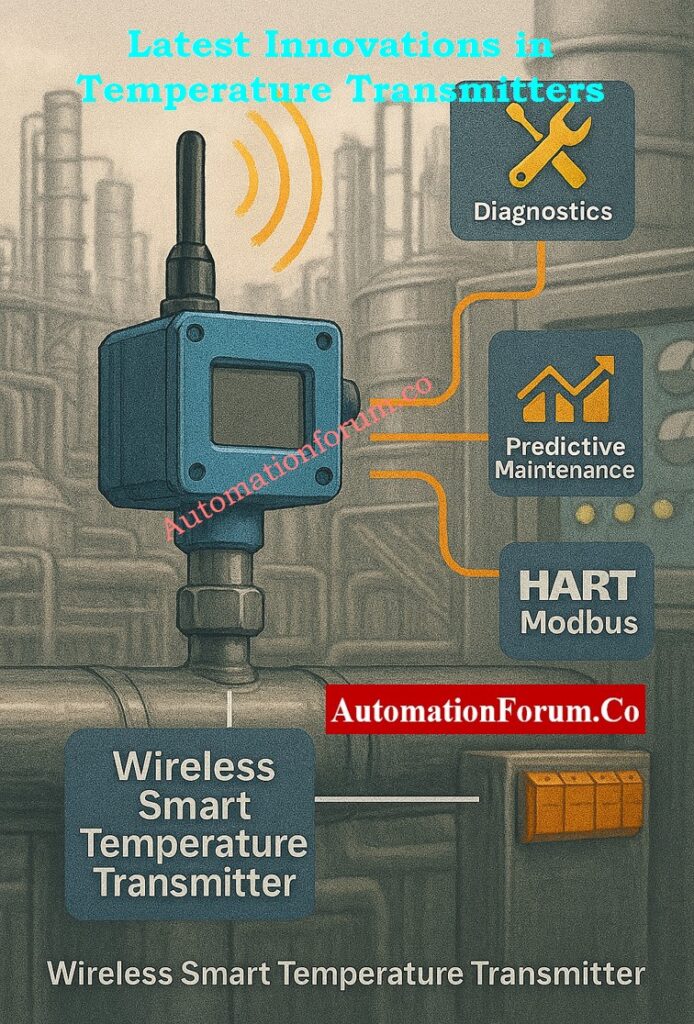
- Digital Protocols: HART, Modbus, and PROFIBUS digital protocols enabling remote calibration and diagnostics.
- Self-Diagnostics: Find problems with sensors, wiring, and the surroundings.
- Wireless Transmission: Less expensive wiring and more options for where to put it.
- Multi-Sensor Capability: For complicated systems, keep an eye on more than one point at once.
Choosing the Right Temperature Transmitter for Industrial Reliability
Choosing the correct temperature transmitter is very important for making sure that industrial processes are accurate, safe, and efficient. There are several types of transmitters for different applications, such as explosion-proof ones for dangerous areas, DIN rail ones for inside panels, head mount ones for point accuracy, and wireless and multi-point smart transmitters. New transmitters with comprehensive diagnostics and remote monitoring make operations even more reliable.
→ All-in-One Temp Calculators: Collection of Temperature Measurement Calculators
FAQ – Temperature Transmitters & Sensors
What are the types of temperature transmitters?
Some examples of temperature transmitters are:
- Explosion-Proof and Weather-Proof for hazardous or outdoor situations.
- DIN Rail and Panel Mount are for interior control panels.
- Head-Mount: Very accurate at high points of measurement.
- Smart and wireless: digital protocols for remote monitoring.
- Multi-Sensor / Multi-Point: Use one transmitter to keep an eye on several points.
What’s the best temperature transmitter brand?
Some well-known and trustworthy brands are:
- Yokogawa: Very accurate and well-built.
- Emerson (Rosemount) makes smart and wireless transmitters that can do diagnostics.
- Endress+Hauser makes things for the food and chemical industries.
- Siemens has choices for DIN rail and panel mounting.
- ABB makes transmitters that are both explosion-proof and very accurate.
How to select a temperature sensor?
Steps to choose a sensor:
- Find out what the temperature range is.
- Choose the type of sensor: thermocouple, RTD, or thermistor.
- Check to see if the chemicals are compatible.
- Choose how to mount the probe, head, or surface.
- Think about how accurate and how quickly it responds.
What is the most accurate temperature sensor?
For industrial use, RTDs (Resistance Temperature Detectors) are usually the most accurate and stable, with an accuracy of about ±0.1°C.
What is the most accurate type of temperature?
For accurate measurement:
- The most accurate and stable over time are platinum RTDs (Pt100, Pt1000).
How many types of temperature sensors are there?
The most common types are:
- RTDs (Resistance Temperature Detectors)
- Thermocouples
- Thermistors
- Infrared / Non-contact sensors
- Semiconductor-based sensors
