Advanced Flowmeter Selection Quiz for EPC Engineers in Process Industries

One of the hardest things for EPC instrumentation engineers in the process industries to do is choose a flowmeter. To choose the suitable flowmeter, you need to know about the process circumstances, the fluid properties, the accuracy requirements, the installation limitations, the cost implications, and the international standards. If you make the wrong option, you could have problems with efficiency, operations, and expensive rework during commissioning. This advanced quiz is meant to see how well you know how to compare different flow measuring technologies, like differential pressure, Coriolis, magnetic, ultrasonic, vortex, and turbine meters. This quiz can help you get better at choosing things if you are a design engineer, project consultant, or instrumentation expert.

Advanced Flowmeter Selection Quiz for EPC Engineers in Process Industries

Advanced Flowmeter Selection Quiz for EPC Engineers in Process Industries

Advanced Flowmeter MCQs with Answers & Explanations
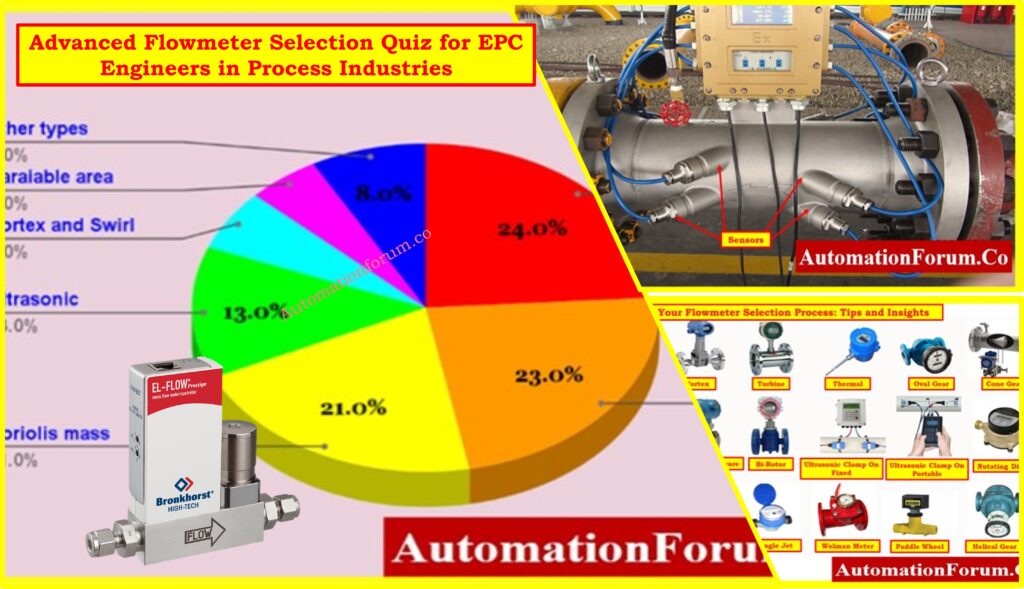
In process industries, choosing a flowmeter isn’t only about measuring flow; it’s also about making sure the technology fits the needs of the process. EPC instrumentation engineers need to look at process fluids, accuracy, pressure drop, piping, and safety requirements for dangerous areas. This quiz gives you real-life advanced situations to see how well you can choose the best flowmeter for each job.

1 / 25

The gasoline loading rack needs to be accurate to within ±0.15%, be able to transfer custody, and be easy to maintain. Pick the best one.

2 / 25

For a pulp stock that has a lot of air in it (fiber + air), which technology is least affected by gas and solids that get trapped in it?

3 / 25

Measuring corrosive HCl acid (37%), DN100, which needs to be installed without interfering with the existing spool. What is the best choice?

4 / 25

For energy balance, you need a lot of saturated steam flowing; there is only a little straight-run available, DN50. Best choice?

5 / 25

What parameter has the biggest effect on the vortex lower measurable limit?

6 / 25

If you want bi-directional flow in a pipeline and don’t want to have to do a lot of maintenance, choose:

7 / 25

The SIL2 loop needs to be proof tested every two years. Which meter usually has built-in partial proof testing and diagnostics to help SIL?

8 / 25

A mag meter keeps going to zero because the electrodes are coated. Fix that works?

9 / 25

Which DP primary is more resistant to erosion in abrasive slurry tailings?

10 / 25

What kind of technology is usually used for flare flow (big turndown, low pressure)?

11 / 25

What installation mistake makes transit-time ultrasonic accuracy the worst?

12 / 25

When the temperature changes, a Coriolis meter in heated heavy oil displays no drift. What is your preferred setup?

13 / 25

Choosing a mag meter liner for strong caustic (80°C, 50% NaOH). What is the best choice?

14 / 25

To transfer custody of natural gas, you must follow established norms and pay. What is the right combination?

15 / 25

A vortex meter gives the wrong reading on a pump discharge that moves back and forth. What is the best way to reduce risk?

16 / 25

You need to keep permanent pressure loss to a minimum for a large-bore gas pipeline. Which DP primary has the least loss while the beta ratio is the same?

17 / 25

Which statement is true about demineralized water (conductivity < 2 µS/cm)?

18 / 25

A crude feed line has gas in it (0.5–2%). Which technology keeps precision the best without extra degassing?

19 / 25

There are times when the condensate return line is in a vacuum. What kind of meter is most likely to break or get damaged because of cavitation?

20 / 25

To measure oxygen in a pharmaceutical CIP line, the design must be clean and the pressure drop must be low. What is the best choice?

21 / 25

For wet gas (gas with 2% liquid carryover) on an offshore platform, which DP main element is stronger than an orifice?

22 / 25

A mag meter indicates strange low flow when it starts up in brine (conductivity 1000 µS/cm). Most likely a mistake during installation?

23 / 25

For saturated steam (8 barg) with a short straight run (3D upstream, 2D downstream), which solution is best without additional spool space?

24 / 25

For custody transfer, a hydrocarbon liquid with a viscosity that can change (2–40 cP) and no conductivity must be measured with an accuracy of ±0.1%. Pick the best one.

25 / 25

Which method is the most accurate for a conductive slurry (5% solids) in a 10″ carbon steel line with a changing speed, with the least amount of pressure loss and risk of abrasion?

Your score is

The average score is 62%

0%

Refer the below link for Streamlining Your Flowmeter Selection Process: Tips and Insights

Access 1000+ MCQs tailored for instrumentation engineers: Instrumentation and Process Control Quiz Hub – 1000+ MCQs for Engineers

Read More

Recent