
- Understanding pH Sensor Temperature Compensation
- What Is pH Sensor Temperature Compensation?
- Why Does Temperature Affect pH Measurement?
- What Does This pH Temperature Compensation Calculator Calculate?
- Inputs Required for the pH Temperature Compensation Calculator
- Understanding the Nernst Slope in pH Sensors
- What Is the Isopotential Point of a pH Sensor?
- What Is the Solution Temperature Coefficient in pH Measurement?
- How the Calculator Performs the pH Temperature Compensation
- pH Temperature Compensation Calculation Example
- How to Interpret pH Temperature Compensation Calculator Results
- Theoretical Nernst Slope vs Actual Measured Slope
- Does Temperature Compensation Replace pH Sensor Calibration?
- Practical Applications of pH Temperature Compensation
- Common Mistakes When Using pH Temperature Compensation
- Frequently Asked Questions About pH Temperature Compensation
- Important Engineering Note for pH Temperature Compensation
- pH Temperature Compensation Calculator Summary
pH Sensor Temperature Compensation Calculator
Nernst Slope · Isopotential Point · Solution Temperature Coefficient
pH Temperature Compensation Schematic
Measurement Parameters
pH Sensor Specific Parameters
Temperature Compensation Results
| Parameter | Value |
|---|
Understanding pH Sensor Temperature Compensation
Temperature has a significant effect on pH measurement in process industries. A pH value displayed by a transmitter can change when process temperature changes, even when the operating condition appears unchanged.
There are two different temperature effects that instrumentation engineers need to consider. The first is the change in electrical sensitivity of the pH electrode caused by temperature. The second is the actual change in the chemistry of the process solution with temperature.
This makes the calculation useful when engineers need to compare a measured pH with a common reference temperature such as 25 °C.
Can You Solve These Tough pH Analyzer Problems?: Advanced pH Analyzer Troubleshooting Quiz | Test Your Industrial Engineering Skills
What Is pH Sensor Temperature Compensation?
How pH Sensor Temperature Compensation Works
pH sensor temperature compensation is the process of accounting for the change in electrode response caused by temperature.
A glass pH electrode develops an electrical potential proportional to the hydrogen ion activity. The electrode response is dependent on temperature. Therefore, the millivolt response corresponding to one pH unit is not constant at every temperature.
The theoretical Nernst slope at 25 °C is approximately 59.16 mV per pH. As absolute temperature increases, the theoretical slope also increases.
This is why a pH transmitter with automatic temperature compensation normally receives temperature information from a temperature element installed with the pH sensor.
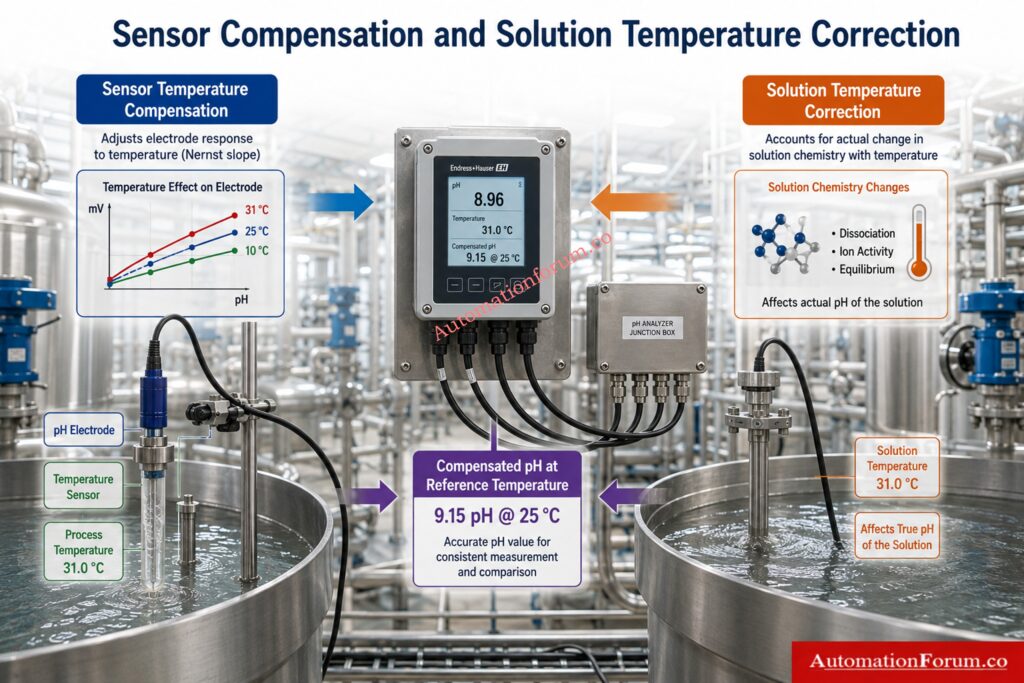
However, sensor temperature compensation and solution temperature compensation are not the same thing.
Sensor Temperature Compensation vs Solution Temperature Compensation
Sensor compensation corrects the temperature dependence of the electrode response.
Solution compensation considers the actual change in process liquid pH caused by temperature.
The calculator treats these effects separately, which is important when evaluating pH measurement temperature compensation in a real process.
Refer the below link for the Find the Real Cause Behind Incorrect pH Readings: How to troubleshoot pH transmitter issues?
Why Does Temperature Affect pH Measurement?
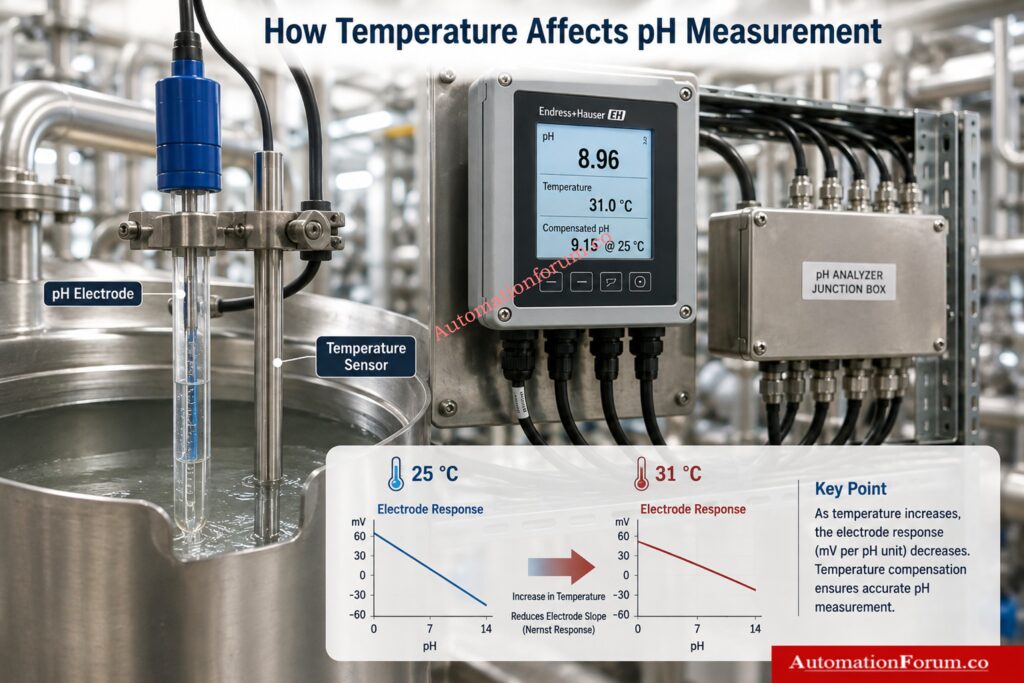
A pH electrode generates an electrical potential according to the Nernst relationship. In practical terms, the electrode produces a different millivolt response for the same pH as its temperature changes.
At 25 °C, the theoretical Nernst slope is approximately 59.16 mV per pH.
For an instrumentation engineer, this explains why a pH transmitter needs reliable temperature information when automatic temperature compensation is required.
The temperature element is particularly important because the transmitter must know the actual sensor temperature rather than relying on an assumed process temperature.
A wrong temperature input can therefore result in an incorrect compensated pH value.
Choose the Right pH Analyzer Before Installation Starts: Selection Guide for pH Analyzers in Process Applications
What Does This pH Temperature Compensation Calculator Calculate?
The calculator begins with the measured pH and measured process temperature.
It then calculates the Nernst slope at the measurement temperature and at the selected reference temperature. The sensor response is adjusted around the isopotential pH value.
After that, the calculator applies the solution temperature coefficient separately.
The final result is the estimated compensated pH at the selected reference temperature.
The calculation therefore follows this sequence:
Measured pH
Measured temperature
Nernst slope at measured temperature
Nernst slope at reference temperature
Sensor temperature compensation
Solution temperature correction
Compensated pH at reference temperature
This separation is useful because the sensor effect and the process solution effect can have very different magnitudes.
Prevent Costly pH Failures Before They Affect Production: How to do Preventive maintenance of pH transmitter?
Inputs Required for the pH Temperature Compensation Calculator
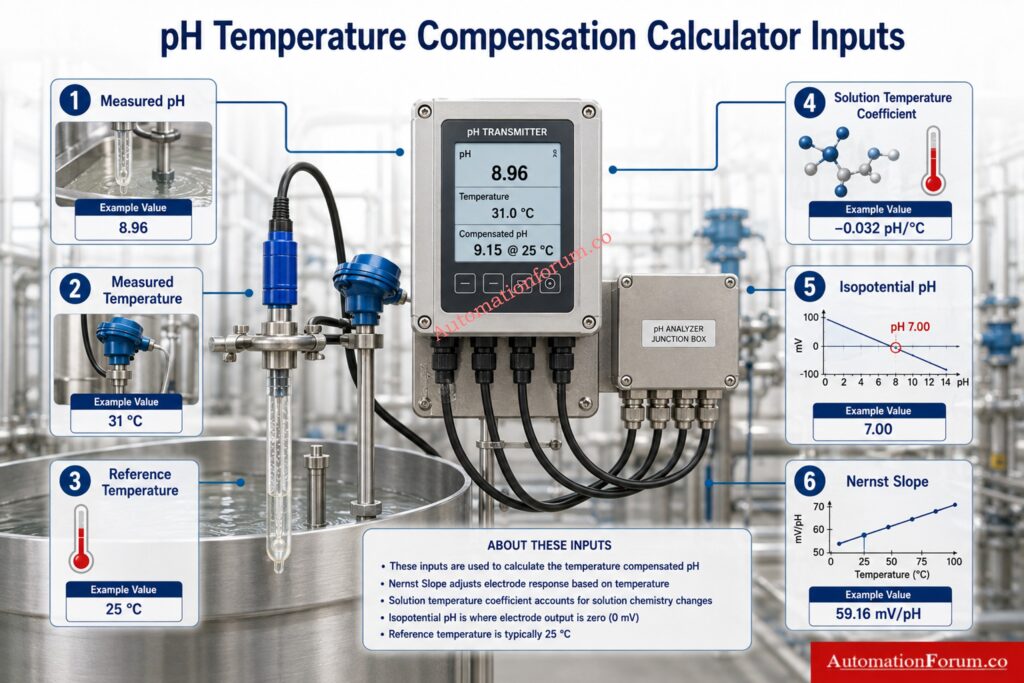
| Parameter | What it means | Engineering consideration |
| Measured pH | pH indicated at the actual measurement temperature | Use the pH value associated with the measured temperature |
| Measured Temperature | Actual temperature of the pH measurement | Use the temperature measured by the sensor assembly where possible |
| Reference Temperature | Temperature to which the pH result is compared | 25 °C is a common reference, but another value can be selected |
| Solution Temperature Coefficient | Change in actual solution pH per °C | Use reliable process or laboratory information |
| Isopotential Point | pH at which sensor output is theoretically independent of temperature | Use the sensor manufacturer’s appropriate value when available |
| Nernst Slope at 25 °C | Base electrode sensitivity used by the calculation | The theoretical value is approximately 59.16 mV per pH |
| Actual Measured Nernst Slope | Electrode slope obtained from calibration | Use only when reliable two point calibration information is available |
The calculator allows either the theoretical slope or an actual measured slope to be selected.
Fix Unstable pH Measurements With Correct Electrode Calibration: How to do pH electrode calibration?
Understanding the Nernst Slope in pH Sensors
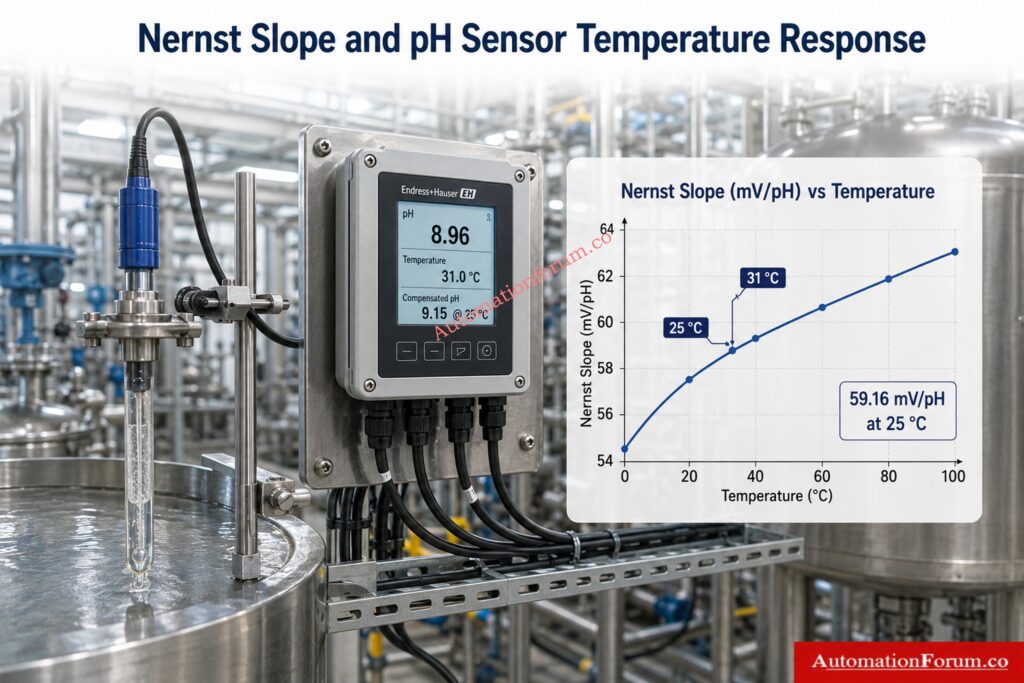
The Nernst slope represents the electrical sensitivity of the pH electrode.
At 25 °C, the theoretical value used by the calculator is 59.16 mV per pH. The actual slope of an electrode can differ from the theoretical value because of sensor condition, calibration condition and individual sensor characteristics.
The calculator provides two choices.
Theoretical slope uses the entered Nernst slope at 25 °C.
Actual measured slope uses a slope obtained from a two point calibration.
An actual measured slope can be useful when reliable calibration data represents the condition of the electrode. However, it should not automatically be considered better than the theoretical value. Poor calibration data, unsuitable buffers or an unstable electrode can produce an unreliable slope.
The important point is to use a slope value that represents the sensor and calibration conditions being evaluated.
Calculate Probe Resistance Before Conductivity Measurement Problems Escalate: Conductivity Liquid Analyzer Probe Resistance Calculator – Complete Guide for Instrumentation Engineers
What Is the Isopotential Point of a pH Sensor?
The isopotential point is the pH at which the theoretical sensor output is independent of temperature.
The actual isopotential behavior depends on the electrode design and characteristics, so an appropriate sensor value should be used when available.
Refer the below link for the pH Transmitter Calibration Procedure Using Standard Buffer Solutions
What Is the Solution Temperature Coefficient in pH Measurement?
How to Calculate pH Temperature Compensation
Temperature can affect the actual chemistry of the process solution. This is different from the electrical temperature response of the pH electrode.
The solution temperature coefficient represents the change in solution pH for each degree Celsius of temperature change. It is entered in pH per °C.
For example, a negative coefficient means that the calculated solution pH correction changes in the negative direction as the temperature relationship changes according to the selected reference temperature.
This value should not be guessed.
For a process application, the coefficient should ideally come from process data, laboratory measurements, application knowledge or reliable instrument configuration information.
If the solution temperature coefficient is entered as zero, the calculator does not apply a solution correction. In that situation, the result represents sensor Nernst compensation only.
How the Calculator Performs the pH Temperature Compensation
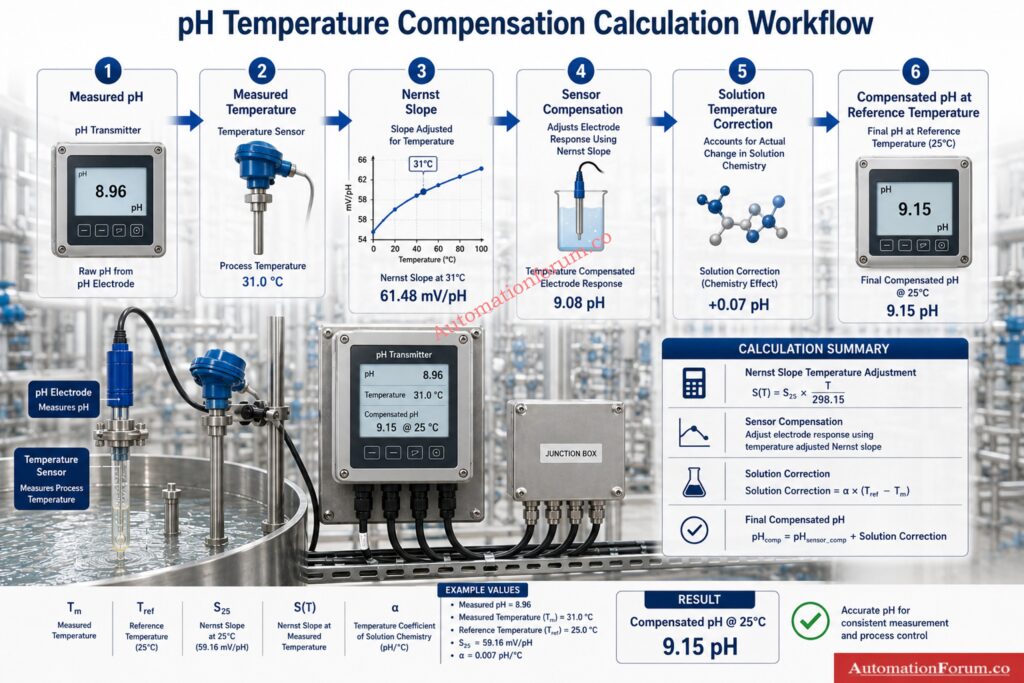
The calculator uses absolute temperature when calculating the Nernst slope.
Nernst slope at measurement temperature
S(Tm) = S25 × Tm / 298.15
Nernst slope at reference temperature
S(Tref) = S25 × Tref / 298.15
Temperatures used in these equations are absolute temperatures in Kelvin.
Sensor Compensated pH Calculation
pHref,sensor = pHiso + [S(Tm) / S(Tref)] × [pHm − pHiso]
This calculation adjusts the measured pH according to the change in electrode sensitivity between the measured temperature and reference temperature.
Solution temperature correction
Correction = α × (Tref − Tm)
Here, α represents the solution temperature coefficient.
Final Compensated pH Calculation
pHref = pHref,sensor + Correction
Understand Why Cell Constant Controls Measurement Accuracy: Understanding Cell Constant in Conductivity Analyzers and its Significance
pH Temperature Compensation Calculation Example
Consider the default values provided in the calculator.
Measured pH is 8.96.
Measured temperature is 31 °C.
Reference temperature is 25 °C.
Solution temperature coefficient is −0.032 pH per °C.
Isopotential pH is 7.00.
Nernst slope at 25 °C is 59.16 mV per pH.
The calculator first determines the Nernst slope at 31 °C and at 25 °C. It then uses the ratio of these slopes to calculate the sensor compensated pH around the isopotential point.
The solution correction is calculated separately using the temperature difference between 25 °C and 31 °C.
For these values, the solution correction is:
−0.032 × (25 − 31) = +0.192 pH
This demonstrates why the solution coefficient can have a substantial influence on the final result. The process solution effect should therefore not be confused with the sensor response correction.
The calculator combines both contributions to produce the compensated pH at 25 °C.
Verify Conductivity Transmitter Accuracy Using Resistance Simulation: Conductivity transmitter resistance calibration – With decade resistance box
How to Interpret pH Temperature Compensation Calculator Results
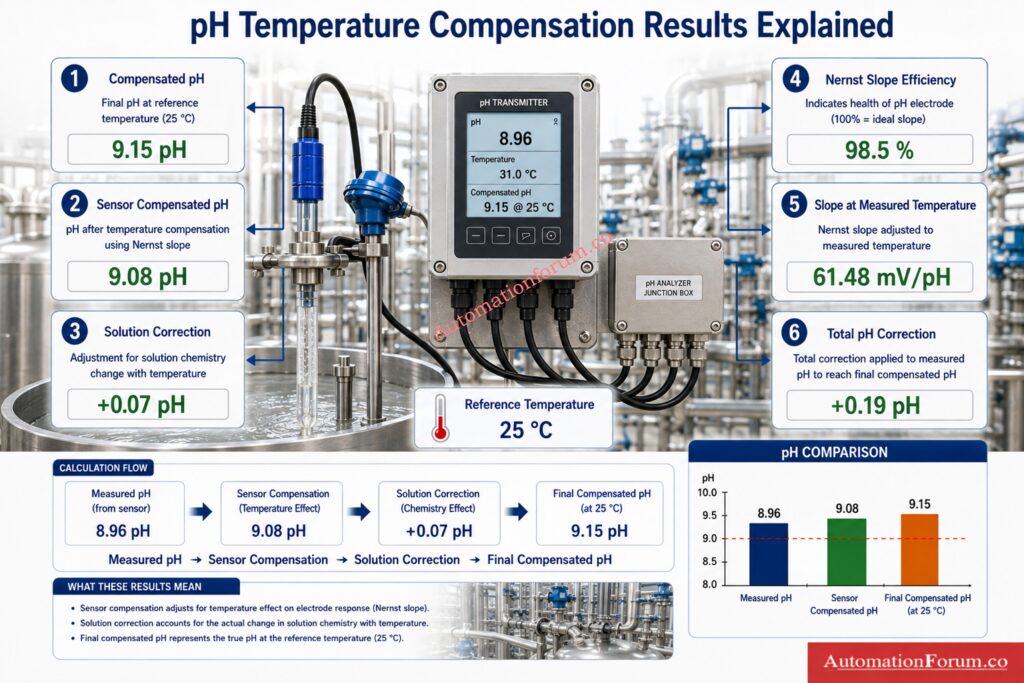
The calculator provides several useful result fields.
Compensated pH at Reference Temperature
This is the final calculated pH after applying both sensor compensation and solution temperature correction.
Compensated pH at Reference Temperature
This value represents the result after correcting the electrode response using the Nernst slope and isopotential point.
Sensor Compensated pH
This shows the separate pH correction calculated from the solution temperature coefficient.
Nernst Slope Efficiency
Slope efficiency compares the selected base slope with the theoretical 59.16 mV per pH value.
Solution Temperature Correction
This shows the calculated Nernst slope at the actual measurement temperature.
Total pH Correction
This represents the difference between the final compensated pH and the originally measured pH.
The calculator classifies the result as Minimal Temperature Effect, Moderate Compensation or Significant Compensation depending on the magnitude of the total correction. These labels are useful for interpretation, but they should not be treated as process safety limits or calibration acceptance criteria.
Theoretical Nernst Slope vs Actual Measured Slope
The theoretical slope is useful when a standard theoretical electrode response is required for the calculation.
The actual measured slope can be selected when a reliable two point calibration has produced a representative slope value.
An instrumentation engineer should consider the quality of the calibration before using an actual slope. Calibration buffers, sensor condition, stabilization time and measurement conditions can all influence the calculated slope.
Therefore, actual measured slope data is useful when it is trustworthy and relevant to the application.
Refer the below link for the Conductivity Transmitter Calibration Procedure
Does Temperature Compensation Replace pH Sensor Calibration?
No.
Temperature compensation and calibration are different things.
Calibration determines or confirms the relationship between the sensor response and known reference conditions.
Temperature compensation accounts for the temperature dependence of the sensor response and, when configured, the temperature effect of the solution.
A properly functioning pH electrode, reliable temperature measurement and appropriate calibration remain important.
For critical process measurements, the compensated result should also be evaluated against suitable process data.
Understand How Industrial Conductivity Measurement Really Works: Conductivity Measurement Principle
Practical Applications of pH Temperature Compensation
Accurate pH temperature compensation can be useful across many process applications.
Water Treatment
pH measurement is commonly used for chemical dosing, neutralization and water quality monitoring. Temperature compensation helps engineers interpret measurements obtained under changing operating conditions.
Chemical Processing
Chemical reactions and solution properties can be temperature dependent. Separating electrode response from solution temperature behavior can improve engineering analysis.
Pharmaceutical Processes
Controlled process conditions can require careful pH measurement and documentation. Reliable temperature information is an important part of the measurement system.
Food and Beverage Processing
Cleaning processes, product monitoring and water treatment applications can involve changing temperatures. Temperature compensation can help engineers compare pH measurements at a selected reference condition.
Boiler and Utility Water Systems
pH is an important parameter in utility water monitoring. Temperature changes can influence both measurement response and actual solution chemistry.
Effluent Treatment
Prevent Oxygen Analyzer Failures With Proven Maintenance Practices: Step by Step Preventive Maintenance Procedure for Zirconia Type Oxygen Analyzer with Checklist
Common Mistakes When Using pH Temperature Compensation
One common mistake is entering an incorrect solution temperature coefficient. Different process solutions can have different temperature behavior.
Another mistake is assuming that sensor temperature compensation automatically corrects the actual chemistry of the solution.
Using an inappropriate reference temperature can also produce a result that does not match the intended comparison.
Engineers should also avoid entering an unreliable electrode slope simply because an actual measured value is available.
Ignoring the temperature element is another important problem. If the temperature measurement is incorrect, the compensation calculation can also be incorrect.
Finally, laboratory data should not automatically be applied to the plant process without considering whether the process conditions are comparable.
Master ORP Measurement Before Troubleshooting Your Process Analyzer: Understanding ORP Analyzer: Principles, Measurement, and Applications in Industry
Frequently Asked Questions About pH Temperature Compensation
What is a temperature compensating pH probe?
A temperature compensating pH probe measures pH along with temperature so the transmitter can account for changes in electrode sensitivity.
This helps provide a more meaningful pH reading when process temperature changes.
How do you calculate pH temperature compensation?
The calculation uses the measured pH, measured temperature, reference temperature, Nernst slope and isopotential point.
A solution temperature coefficient can then be applied to account for the actual temperature effect of the process liquid.
Improve Zirconia Analyzer Accuracy With Correct Calibration: Zirconia Oxygen Analyzer Calibration Procedure
How much is pH affected by temperature?
The amount of change depends on the pH electrode, process solution and temperature range involved.
The electrode response and the actual solution chemistry can both contribute to the observed pH change.
Does temperature raise or lower pH?
Temperature can either raise or lower the actual pH because different solutions respond differently to temperature.
The direction and magnitude should therefore be determined from suitable process or laboratory data.
What is pH temperature compensation?
pH temperature compensation accounts for the change in electrode response caused by temperature during pH measurement.
It can also include the actual temperature effect of the process solution when reliable data is available.
Why does pH change with temperature?
Temperature affects the sensitivity of the pH electrode, and can also affect the chemical equilibrium of the process fluid.
This means that a change in temperature can influence both the measured response and the actual solution pH.
What is the Nernst slope of a pH sensor at 25 °C?
The theoretical Nernst slope of a pH sensor at 25 °C is approximately 59.16 mV/pH.
The actual electrode slopes can be changed based on sensor condition and calibration results.
Get Stable Oxygen Readings With Proper Analyzer Calibration: Oxygen Analyzer Calibration Procedure: Paramagnetic Type
What is the isopotential point of a pH electrode?
What is a solution temperature coefficient in pH measurement?
The solution temperature coefficient describes how the actual process solution pH changes with temperature.
It is generally quoted in pH / °C and should be derived from sound process or laboratory data.
Does a pH sensor need temperature compensation?
Temperature compensation is important when the process temperature could significantly affect the pH measurement.
The temperature element is suited for the sensor temperature to be determined by the transmitter for compensating purposes.
See How TDLS Technology Transforms Industrial Gas Measurement: Exploring Tunable Diode Laser Spectrometer (TDLS): Components, Principles, and Industrial Applications for Gas Measurement
Does temperature compensation replace pH sensor calibration?
No, temperature compensation and calibration are different things in a pH measurement system.
The sensor still needs proper calibration, suitable process data and a reliable temperature measurement.
How do you calculate compensated pH at 25 °C?
First, the calculator converts the sensor response by the Nernst slope and isopotential point.
Then the calculated pH at 25 °C is obtained by applying the solution temperature correction.
Can the actual Nernst slope be used instead of the theoretical slope?
Yes, the calculator can use an actual Nernst slope obtained from a suitable two point calibration.
The calibration result should be reliable and representative of the electrode condition being evaluated.
Avoid Sampling Problems That Distort Critical Gas Measurements: Gas Analyzer Sampling System
Important Engineering Note for pH Temperature Compensation
The pH Sensor Temperature Compensation Calculator is a calculation aid. It should not be treated as a replacement for proper pH sensor calibration, transmitter configuration or process validation.
For an actual plant application, verify the sensor temperature, electrode condition, calibration data, isopotential information and solution temperature coefficient. The reliability of the compensated result depends strongly on the quality of these inputs.
Master Process Analyzer Installation Calibration And Troubleshooting Skills: Exploring Process Analyzers: Principles, Installation, Calibration & Troubleshooting
pH Temperature Compensation Calculator Summary
Temperature can influence pH measurement in two different ways. It changes the electrical sensitivity of the pH electrode and can also change the actual chemistry of the process solution.
The pH Sensor Temperature Compensation Calculator provides a practical method for separating these effects. It calculates the Nernst slope at the measured and reference temperatures, applies sensor compensation around the isopotential point and then applies the solution temperature coefficient.
The calculated result should always be considered together with proper pH sensor calibration, reliable temperature measurement and suitable process data.
Refer the below link for the Discover Exactly How pH Converts Into Sensor Voltage: pH to Voltage Conversion Calculator
