
- Hazardous Area Zone Classification Calculator: Gas Release and Ventilation Screening
- What Is a Hazardous Area Zone Classification Calculator?
- Key Inputs Required for Hazardous Area Classification
- How the Hazardous Area Zone Classification Calculator Works
- How to Use the Hazardous Area Classification Tool
- Understanding Hazardous Area Zone Classification Results
- Practical Hazardous Area Classification Example for a Natural Gas Flange Leak
- Hazardous Area Classification Limitations and Engineering Considerations
- Hazardous Area Classification Standards and Best Practices
- Frequently Asked Questions About Hazardous Area Classification
- Conclusion: Use the Hazardous Area Zone Classification Calculator for Preliminary Screening
Hazardous Area Zone Classification Tool
1. Fluid Properties and Process Data
2. Leak Source and Release Type
3. Ventilation and Environment Parameters
Quick Scenarios
Hazardous Area Classification Screening Results
Additional Screening Outcome
Indicative Zone Categories
Dilution Screening Indicator
Step by Step Calculation
| Parameter | Calculated Value |
|---|
Governing Equations and Assumptions
Engineering Interpretation
Common Reference Standards
| Standard | General scope |
|---|---|
| IEC 60079-10-1 | Classification of areas where explosive gas atmospheres may occur |
| IS/IEC 60079-10-1 | Indian adoption of gas hazardous area classification methodology |
| API RP 505 | Zone classification for petroleum facilities |
| NFPA 497 | Classification practices for flammable liquids, gases and vapours in chemical process areas |
Hazardous Area Zone Classification Calculator: Gas Release and Ventilation Screening
Flammable gas leaks are a major hazard in oil and gas plants, refineries, chemical processing facilities, and other industrial infrastructure. A minor leak from a flange, compressor seal, valve connection or instrument fitting can form an explosive environment if the gas collects faster than ventilation can disperse it.
A proper hazardous area categorization analysis indicates where flammable gas or vapor may be present and what precautions need to be taken for electrical and instrumentation equipment.
Hazardous Area Zone Classification Calculator from AutomationForum.co helps engineers review gas release rates, ventilation conditions, and preliminary zone categorization possibilities. It provides a convenient starting point for engineering screening, but its results must be verified before they are used in safety critical decisions.
What Is a Hazardous Area Zone Classification Calculator?
How Hazardous Area Classification Supports Industrial Safety
A Hazardous Area Zone Classification Calculator is an engineering tool that helps evaluate the potential formation of explosive gas atmospheres around release sources. It brings together gas properties, operating conditions, release characteristics, and ventilation information.
The AutomationForum.co hazardous area classification tool supports hydrogen, methane or natural gas, propane, ethylene, hydrogen sulphide, and custom gas properties. Engineers can evaluate pressurised gas leaks or perform simplified screening of vapour released from an evaporating liquid pool.
Understanding Zone 0, Zone 1, and Zone 2 Hazardous Areas
The three principal zones for explosive gas atmospheres are:
- Zone 0: An explosive gas atmosphere is present continuously, frequently, or for long periods.
- Zone 1: An explosive gas atmosphere is likely to occur occasionally during normal operation.
- Zone 2: An explosive gas atmosphere is not likely during normal operation and, if it occurs, exists for a short period.
These definitions describe the likelihood and duration of an explosive atmosphere. They are not determined by gas pressure or leak size alone.
The calculator generates a preliminary zone class candidate using simplified programmed logic. It does not independently establish a compliant hazardous area classification.
Refer the below link for the Complete Guide for Hazardous Area Instrumentation
Key Inputs Required for Hazardous Area Classification
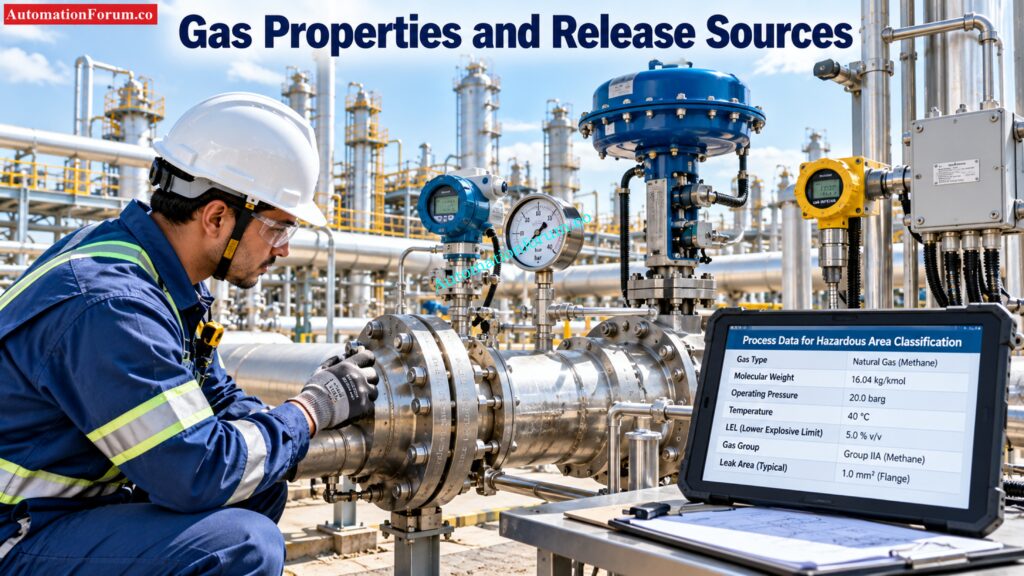
Accurate results depend on the quality of the input data. Engineers should obtain verified information from process datasheets, safety data sheets, approved design documents, and site records.
| Input parameter | Engineering purpose |
| Gas or vapour | Identifies the flammable substance being assessed |
| Molecular weight | Supports gas release and density calculations |
| Lower explosive limit | Establishes the lower concentration limit used in screening |
| Specific heat ratio | Supports the pressurised gas flow calculation |
| Operating pressure and temperature | Define the process conditions |
| Auto ignition temperature | Helps assess ignition temperature requirements |
| Gas group | Supports selection of appropriately certified equipment |
| Release mechanism | Selects pressurised gas leakage or liquid pool screening |
| Release grade | Represents the expected frequency and duration of release |
| Leak area and discharge coefficient | Support the pressurised gas release estimate |
| Environment and ventilation availability | Describe the surroundings and ventilation conditions |
| Ventilation velocity | Provides an input for environmental screening |
| Room volume and air changes per hour | Support the indoor ventilation flow calculation |
| Safety factor on the lower explosive limit | Sets the selected concentration threshold for screening |
Preset gas properties are illustrative and must be verified for the actual substance. Gas group and auto ignition temperature must also be confirmed against appropriate technical data and project requirements.
Discover Critical Differences That Could Prevent Dangerous Instrumentation Failures: Difference Between Ex ia, Ex ib and Ex ic in Hazardous Area Instrumentation
How the Hazardous Area Zone Classification Calculator Works
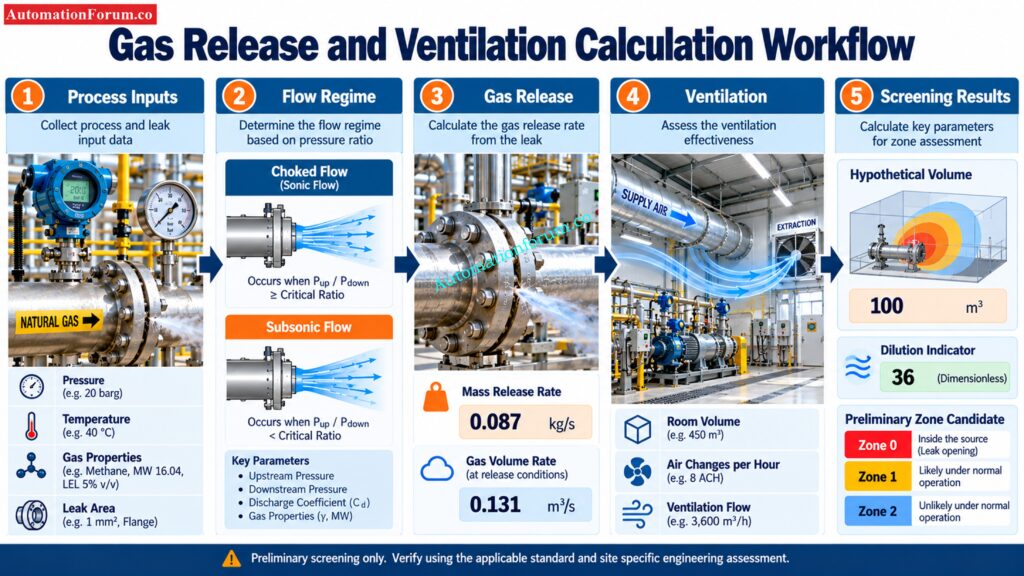
The calculator performs several simplified engineering calculations before presenting the screening results.
Absolute Pressure Conversion for Gas Release Calculations
Gas flow calculations require absolute pressure rather than gauge pressure.
Absolute pressure = Gauge pressure + Atmospheric pressure
The calculator first converts the pressure in bar gage to absolute pressure in bar absolute and then evaluates the discharge circumstances.
See Why Smart Engineers Trust This Proven Protection Method: Why Choose Intrinsic Safety (IS) for Hazardous Area Instrumentation?
Choked and Subsonic Flammable Gas Leak Calculations
The calculator calculates the critical pressure ratio to determine if the gas discharge is choked or subsonic.
The projected mass release rate for constricted flow is a function of discharge coefficient, effective leak area, upstream absolute pressure, molecular weight, specific heat ratio, gas constant, and absolute temperature.
For subsonic flow the calculation additionally includes the absolute pressure ratio downstream to upstream.
This means that the rate of mass release is represented in kilos per second . This is an estimate based on the flow model selected and the input assumptions. It is not an observed leak rate.
Avoid Costly Installation Mistakes With These Essential Compliance Rules: IEC 60079-14 Explained: Complete Guide to Hazardous Area Installation for Instrumentation and Control Systems
Gas Mass Release Rate and Volume Flow Calculation
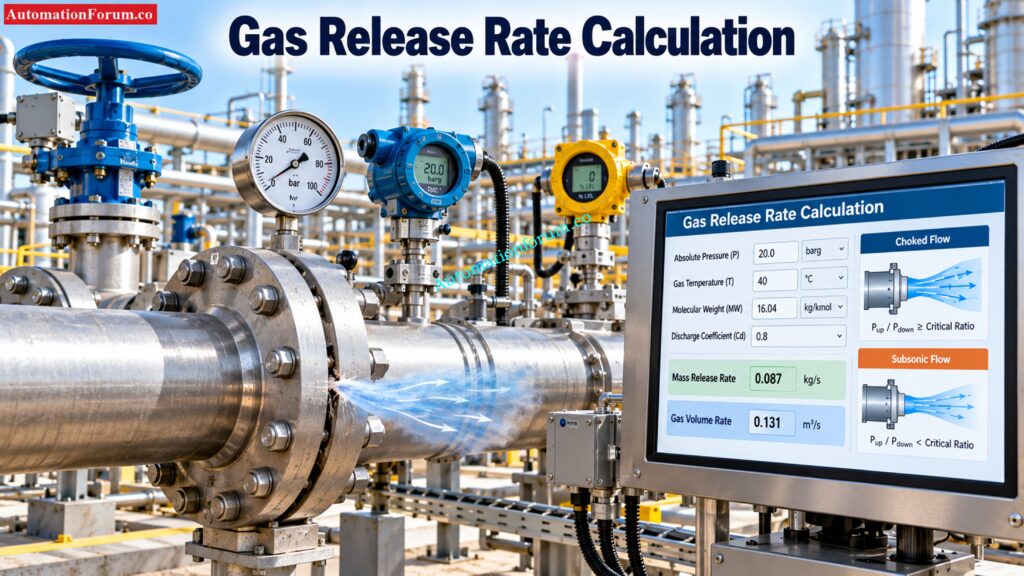
The calculator estimates gas volume flow using the calculated mass release rate and an estimated ambient gas density.
Gas volume rate = Mass release rate / Estimated ambient density
The result is expressed in cubic metres per second. It provides an additional measure of the potential gas release for ventilation screening.
Stop Making Dangerous Cable Gland Selection Mistakes Today: Cable Gland Selection for Hazardous Area Installations – Complete 2025 Guide
Ventilation Flow Rate Calculation for Indoor Enclosures
For an indoor enclosure, the calculator estimates ventilation flow from room volume and air changes per hour.
Ventilation flow rate = Room volume × Air changes per hour / 3600
For example, a room volume of 80 cubic metres and an air change rate of 8 per hour gives an estimated ventilation flow of 0.1778 cubic metres per second.
This calculation estimates the overall air replacement rate. It does not establish how effectively fresh air reaches the leak source or removes accumulated gas.
Reveal the Essential Protection Secrets Every Plant Engineer Needs: Exploring Explosion-Proof: Safety in Hazardous Environment
Hypothetical Volume Calculation and Gas Dilution Assessment
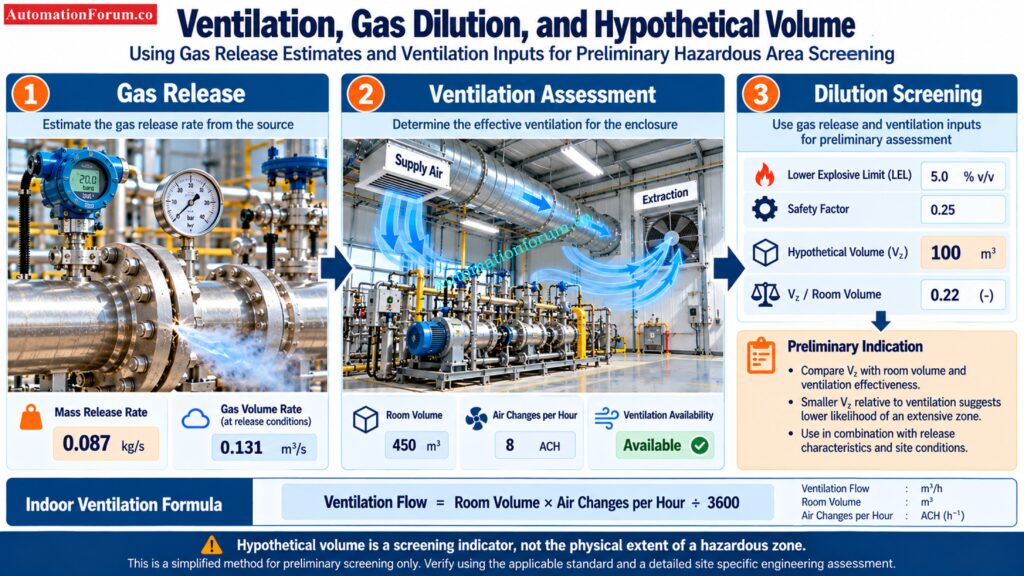
The calculator estimates a hypothetical dilution volume indicator using the gas volume rate, lower explosive limit, selected safety factor, air change rate, and a factor associated with ventilation availability.
The result is compared with room volume to generate a dilution indicator. The tool then presents a preliminary zone class candidate and an additional screening outcome.
This hypothetical volume is a simplified screening indicator. It is not automatically the physical extent of a hazardous zone, and the calculation is not a complete implementation of the IEC hazardous area classification methodology.
Refer the below link for Why NAMUR Sensors are Essential in Explosive and Hazardous Areas ?
How to Use the Hazardous Area Classification Tool
Follow these steps to perform a preliminary assessment.
- Select the gas or vapour and verify its molecular weight, lower explosive limit, specific heat ratio, gas group, and auto ignition temperature.
- Enter the operating pressure and temperature in the shown units.
- According to the real process situation, choose the release mechanism and award the appropriate release grade.
- Pressurized gas release calculations – Effective leak area and discharge coefficient
- Choose outdoor, indoor or partially enclosed location and evaluate the ventilation available.
- Enter the ventilation velocity, the enclosure volume, the air change rate and the safety factor on the lower explosive limit specified.
- Compute the screening results.
- Review mass release rate, gas volume rate, ventilation flow, hypothetical volume, potential preliminary zone and engineering evaluation notes.
- Download the screening report to retain the calculated parameters and assumptions for further engineering review.
The tool also includes quick scenarios for a hydrogen seal leak, a natural gas flange leak, and poor ventilation. These scenarios help engineers explore the calculator’s response to different inputs.
Always select the release grade from the expected release frequency and duration. Do not change it simply to obtain a preferred zone result.
Understanding Hazardous Area Zone Classification Results
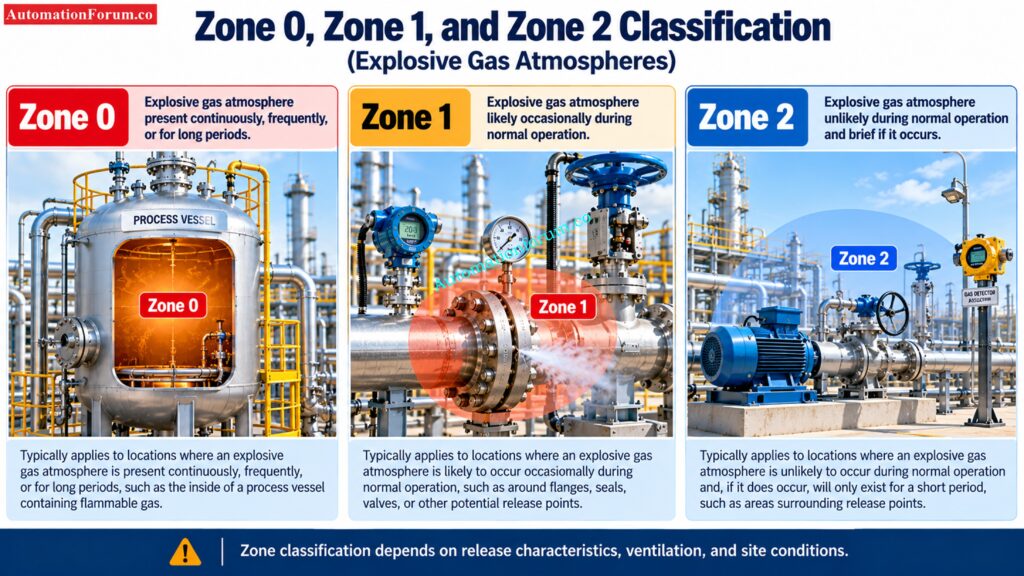
Zone Classification and Gas Release
The calculator uses simplified programmed logic to assign a candidate based on the selected release grade and ventilation availability.
A continuous release produces a Zone 0 candidate. A primary release produces a Zone 1 candidate. A secondary release generally produces a Zone 2 candidate, while a secondary release with poor ventilation triggers a Zone 1 review candidate.
These are preliminary outputs, not final engineering decisions. The additional screening outcome is separate from the zone class candidate and may indicate that detailed assessment is required.
Know Which Protection Method Your Hazardous Plant Really Needs: Difference Between Intrinsically Safe and Explosion-Proof
Understanding Ventilation and Dilution Screening Results
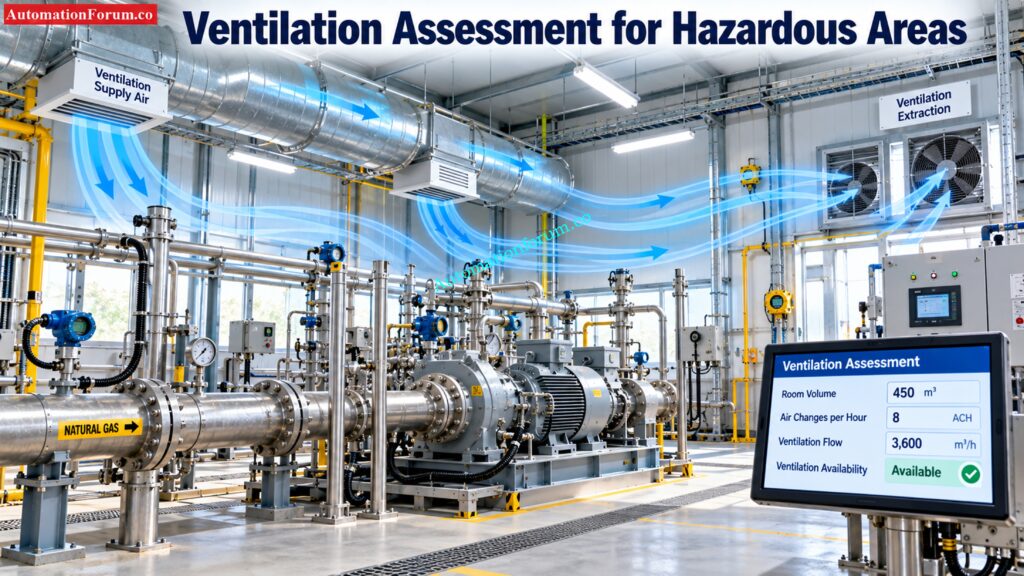
Actual hazardous area classification also depends on the release rate, release characteristics, dilution, ventilation effectiveness and availability, gas properties, and surrounding geometry.
A low hypothetical dilution volume does not prove that a hazardous zone is physically small. Similarly, good ventilation does not automatically establish Zone 2, and poor ventilation does not automatically establish Zone 1.
Prevent Dangerous Safety System Bypasses With Proper Override Control: Maintenance Override Switch in ESD and SIS Systems
Practical Hazardous Area Classification Example for a Natural Gas Flange Leak
Natural Gas Leak Inputs and Process Conditions
Consider a natural gas flange connection inside a process building. The operating pressure is 8 bar gauge, the operating temperature is 25°C, the assumed effective leak area is 1 mm², the room volume is 80 cubic metres, and the air change rate is 8 per hour.
Gas Release Rate and Ventilation Assessment
Assume the release is classified as secondary following a separate engineering assessment of the expected release conditions.
Enter these values into the calculator, verify the natural gas properties, and select the indoor environment. Set the ventilation availability according to the actual installation.
Unlock Reliable Fieldbus Communication Without Compromising Intrinsic Safety: Fieldbus Intrinsically Safe Concept (FISCO) Model for Foundation Fieldbus H1 and Profibus PA
Interpreting the Preliminary Hazardous Area Classification Results
The calculator estimates the gas mass release rate and volume flow, calculates the room ventilation flow, and evaluates its hypothetical dilution volume indicator. It then displays the programmed preliminary zone class candidate and associated screening notes.
No specific zone extent or final classification should be inferred from these inputs alone. The engineer must verify the actual leak scenario, ventilation effectiveness, potential gas accumulation, nearby obstructions, and applicable classification methodology.
This example illustrates how the tool organises preliminary calculations. It does not replace a site specific hazardous area classification study.
Calculate Barrier Earth Fault Risks Before They Threaten Safety: IS Barrier Earth Fault Current Calculator | Intrinsic Safety Loop Design Tool
Hazardous Area Classification Limitations and Engineering Considerations
Limitations of Pressurised Gas Release Calculations
The pressurised gas calculation depends on the assumed discharge model and the accuracy of the process data. Real releases may involve complex geometry, changing pressure, temperature effects, or other conditions not fully represented by the simplified calculation.
Limitations of Liquid Pool Evaporation Screening
The liquid pool mode uses a rough, user entered vapour release estimate. It does not implement a validated evaporation correlation accounting for all relevant liquid properties and heat transfer effects.
Expose Common Explosion Protection Mistakes Before They Become Disasters: Exploring Explosion-Proof: Safety in Hazardous Environment
Ventilation Effectiveness, Wind Conditions, and Gas Accumulation
Outdoor wind conditions, congestion, obstructions, enclosure geometry, ventilation effectiveness, and ventilation failure scenarios are not fully represented.
The preliminary zone candidate is generated using simplified programmed logic. It must not be treated as a certified or compliant engineering conclusion.
Gas Group, Equipment Temperature Class, and Explosion Protecton
Gas group and equipment temperature class are separate considerations. Gas group relates to the ignition protection requirements of equipment, while temperature class concerns the maximum permitted equipment surface temperature. Auto ignition temperature alone does not establish the complete equipment marking.
Why a Preliminary Zone Candidate Cannot Replace an Engineering Study
Before approving hazardous area drawings or selecting certified equipment, a qualified engineer must verify the release sources, release grades, gas properties, ventilation conditions, zone extent, gas group, temperature class, equipment protection requirements, and applicable standards.
Understand Which Protection Levels Your Instrumentation Actually Requires: Intrinsic Safety Protection Systems: Understanding Ex ia, Ex ib, and Ex ic
Hazardous Area Classification Standards and Best Practices
IEC 60079 10 1 Hazardous Area Classification Requirements
IEC 60079 10 1 addresses the classification of areas where explosive gas atmospheres may occur. After the applicable edition and project requirements are validated, a formal assessment is required.
API RP 505 and NFPA 497 for Industrial Hazardous Locations
Relevant references may include the Indian adoption of IEC 60079 10 1, API RP 505 for applicable petroleum facilities, and NFPA 497 for relevant chemical process installations. The governing standard depends on the facility, jurisdiction, and project specification.
Hazardous Area Equipment Selection and Engineering Documentation
A complete engineering assessment should document the source of release, process conditions, release grade, ventilation study, zone drawings, equipment certification requirements, assumptions, and engineering approvals.
Use the calculator as a preliminary screening aid, then validate the conclusions using the complete applicable standard and site specific information.
Discover the Safety Principle Behind Reliable Industrial Instrumentation: What is Intrinsic Safety? Definition, Working Principle, Standards and Applications
Frequently Asked Questions About Hazardous Area Classification
What Is Zone 0, Zone 1, and Zone 2 Hazardous Area Classification?
Zone 0 means an explosive gas atmosphere occurs continuously or for long periods. Zone 1 means it is likely during normal operation, while Zone 2 means it is unlikely during normal operation and persists briefly if it occurs.
What Is Class I, Division 2, Groups C and D?
Class I, Division 2 refers to locations where flammable gases or vapours are normally contained and become hazardous mainly under abnormal conditions. Groups C and D identify specific gas or vapour groups under the North American classification system.
Avoid Critical Cable Mistakes in ATEX Installation Projects: Intrinsically Safe Cables for ATEX Zones – Complete Checklist for EPC Engineers
What Are Gas Groups IIA, IIB, and IIC?
Gas groups classify gases according to their ignition characteristics and the protection requirements of equipment. IIA covers gases such as propane, IIB includes ethylene, and IIC includes hydrogen, representing increasingly stringent equipment requirements.
What Is a Class I, Zone 2 Hazardous Area?
Class I, Zone 2 is a North American hazardous location classification for areas where flammable gases or vapours are not likely to occur during normal operation. If an explosive atmosphere occurs, it is expected to exist only briefly.
Catch Installation Errors Before They Compromise Intrinsic Safety: Installation Checklist for Intrinsically Safe Instrument (Apparatus)
What Are Class I, II, and III Hazardous Locations?
Class I covers flammable gases or vapours, Class II covers combustible dust, and Class III covers ignitable fibres or flying materials. These classes help determine the appropriate electrical equipment protection for each hazardous environment.
What Is the Difference Between Zone 1 and Zone 2?
Zone 1 is an area where an explosive gas atmosphere is likely to occur occasionally during normal operation. Zone 2 is an area where it is not likely during normal operation and, if it occurs, lasts only briefly.
What Is Zone 2 Classification?
Zone 2 classification identifies an area where an explosive gas atmosphere is unlikely during normal operation but may occur under abnormal conditions. Any resulting atmosphere is expected to persist for only a short period.
What Is Zone 1 Used For?
Zone 1 classification identifies locations where flammable gas or vapour may occur occasionally during normal operation. It helps engineers specify suitable certified electrical and instrumentation equipment for the hazardous environment.
What Is a Hazardous Area Zone Classification Calculator?
A Hazardous Area Zone Classification Calculator estimates gas release rates, ventilation flow, and dilution indicators to support preliminary hazardous area assessment. Its results require verification by a qualified engineer before safety critical use.
Which Inputs Are Required for Hazardous Area Classification Screening?
Typical inputs are the gas characteristics, operational pressure and temperature, leak area, release grade and ventilation conditions. The screening calculations are additionally supported by the room volume, air change rate and the chosen lower explosive limit safety factor.
Can a Hazardous Area Classification Calculator Determine the Final Zone?
No. A calculator gives preliminary screening results and is not a substitute for a comprehensive engineering study. Final classification is based on validated process data, ventilation evaluation, release analysis, site conditions and applicable standards.
Why Do Gas Group, Auto Ignition Temperature, and Ventilation Matter?
The gas group defines the equipment protection standards that are necessary. Auto ignition temperature is used to set appropriate limits for equipment surface temperature. Ventilation influences the rate of dispersion of released gas and the potential for development of an explosive atmosphere.
Verify Safety Integrity Before Dangerous System Failures Occur: SIL Verification Report (Safety Integrity Level Verification Report)
Conclusion: Use the Hazardous Area Zone Classification Calculator for Preliminary Screening
AutomationForum.co’s Hazardous Area Zone Classification Calculator is a practical tool that combines gas release estimations, ventilation calculations, hypothetical dilution volume and preliminary zone class candidates.
It is a great starting point for instrumentation engineers, electrical engineers, EPC teams and process safety professionals to evaluate probable gas release situations and to identify incidents that require additional investigations.
Use verified process data, review every assumption, and obtain qualified engineering approval before finalising hazardous area drawings or equipment selection.
Use the AutomationForum.co calculator for preliminary learning and screening, and confirm every safety critical conclusion through a complete site specific engineering assessment.
Refer the below link for the Intrinsic Safety Calculation for Instrumentation Engineers: Complete Guide
