
- Introduction to Compressor Surge and Its Risks
- Effects of Surge on Compressor Systems
- What is an Anti-Surge Control Valve?
- Why Anti-Surge Valve Selection is Critical
- Anti-Surge Valve Sizing Methodology
- Key Criteria for Anti-Surge Valve Selection
- Engineering Design Considerations: Anti-Surge Valve Performance Requirements
- Common Mistakes in Anti-Surge Valve Selection
- Practical Example of Anti-Surge Valve Sizing
- Anti-Surge Valve Selection Checklist (Detailed Table)
- Key Takeaways for Engineers
- Anti-Surge Control Valve Checklist (Download)
- FAQs on Anti-Surge Valves
Introduction to Compressor Surge and Its Risks
What is Compressor Surge?
Compressor surge is one of the most critical and damaging phenomena in process industries. It occurs when the compressor operates below its minimum stable flow limit, resulting in flow reversal, pressure fluctuations, and severe mechanical stress. Within a very short duration, this instability can lead to vibration, overheating, seal damage, and even catastrophic compressor failure.
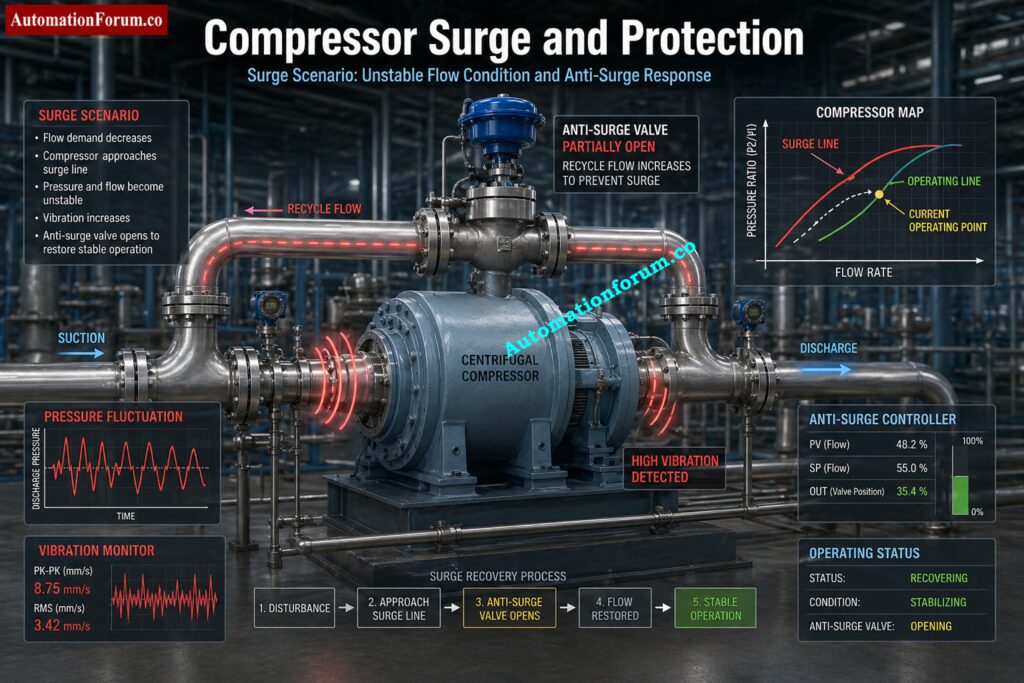
Effects of Surge on Compressor Systems
The anti surge control system is designed to prevent this condition, and at the center of this system lies the anti surge control valve. This valve is responsible for maintaining minimum flow through the compressor by recycling gas from discharge back to suction. While the control logic detects surge conditions, it is the valve that physically executes the protection action.
Why Surge Prevention is Critical in Process Industries
Because surge develops extremely fast, the valve must respond with high speed and precision. In many industrial applications, the valve is expected to move from closed to fully open within one to two seconds. This makes the selection of the anti surge valve a highly critical engineering task rather than a routine valve sizing exercise.
A properly selected anti surge valve ensures compressor safety, operational stability, and long equipment life. A poorly selected valve, however, can result in repeated surge events, energy losses, and increased maintenance costs.
Crush Surge Failures Before They Damage Equipment: What is an anti-surge valve and what are their functions?
What is an Anti-Surge Control Valve?
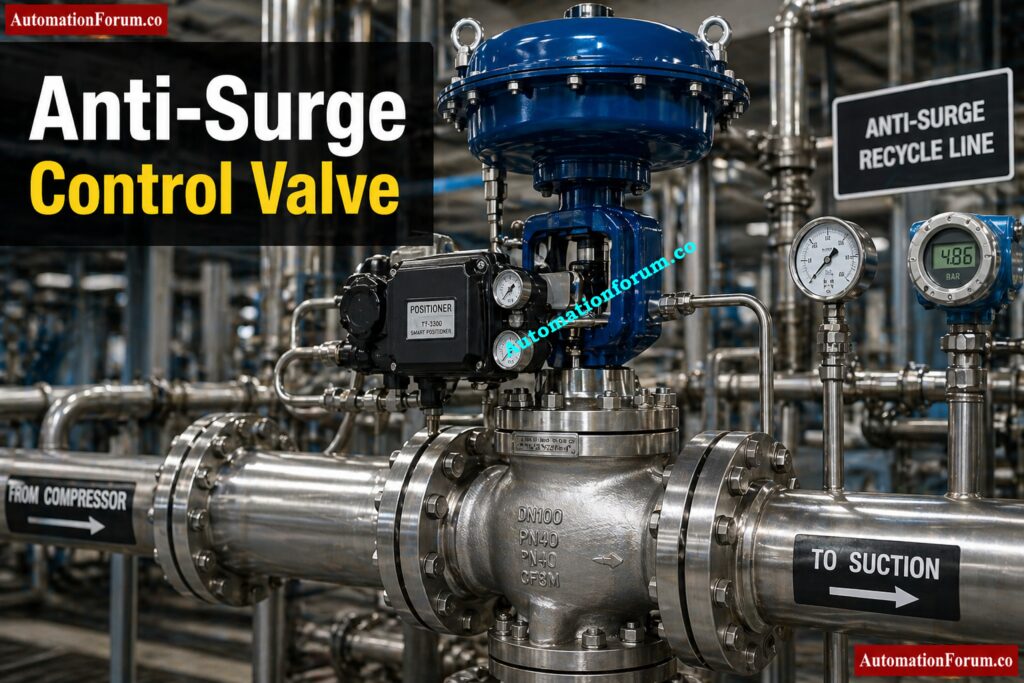
Definition and Basic Function
An anti surge control valve is installed in the compressor recycle line between discharge and suction.
Role in Compressor Protection System
Its function is to
- Maintain minimum flow through the compressor
- Prevent operation near the surge line
- Stabilize compressor operation
How Anti-Surge Valves Work in Recycle Lines
When flow drops toward the surge region, the valve opens and recycles gas back to suction, ensuring continuous forward flow.
Surge itself is a complete breakdown of stable flow, often accompanied by pressure pulsations, vibration, and even reverse flow.
Start Pumps Cleanly Without Dangerous Pressure Shock: Anti-Surge Pump Start Control Valve
Why Anti-Surge Valve Selection is Critical
Impact on Compressor Safety
Anti surge valve selection is not a normal control valve sizing exercise. It is a safety critical design decision.
Effect on Process Stability and Efficiency
- Compressor protection from mechanical failure
- Prevention of flow reversal and vibration
- Maintaining process continuity
- Reducing energy losses due to excessive recycle
- Avoiding frequent shutdowns and maintenance
Consequences of Improper Valve Selection
If the valve is undersized, it cannot pass sufficient flow.
If oversized, it becomes unstable and difficult to control.
Both cases can lead to compressor surge.
Pick the Correct Valve Action Every Time: When to Choose Forward and Reverse Acting Control Valves for Design Engineer
Anti-Surge Valve Sizing Methodology
Below is the practical explanation of each checklist parameter used in real EPC and commissioning projects.
Process Data Requirements for Sizing
The foundation of anti surge valve selection begins with accurate process data. The engineer must establish a complete understanding of operating conditions, including maximum and minimum flow rates, suction and discharge pressures, temperature ranges, and gas composition.
Cv Calculation for Recycle Flow
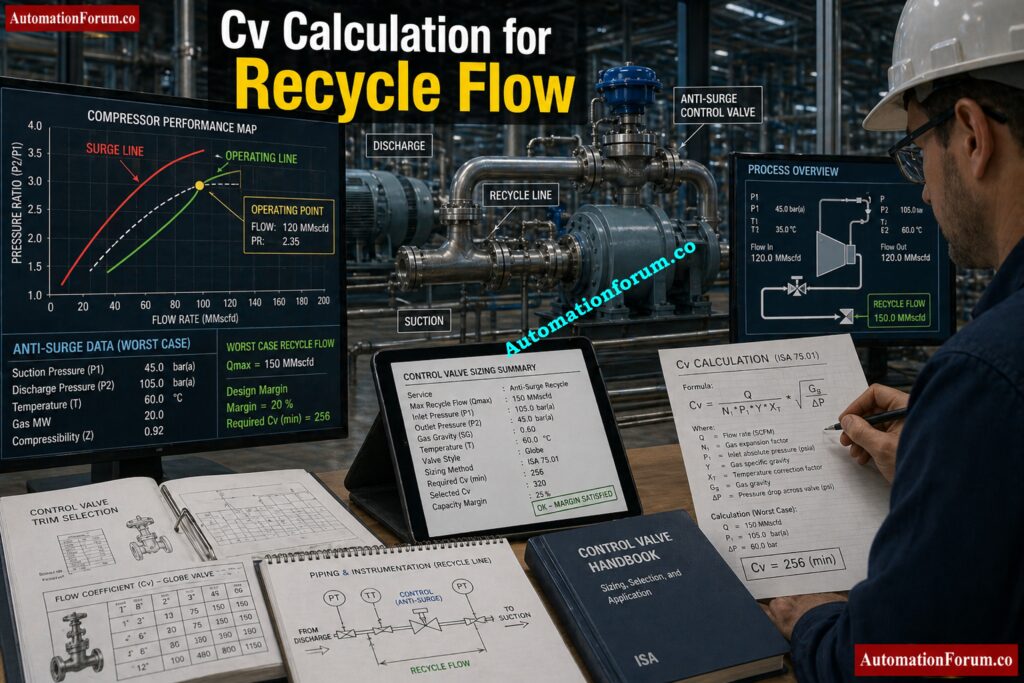
Gas properties play a significant role in valve sizing and performance. Parameters such as molecular weight, compressibility, and density directly influence flow behavior and Cv calculations. Any inaccuracies in process data will propagate through the design and lead to incorrect valve selection.
It is also essential to consider all operating scenarios, including startup, shutdown, normal operation, and emergency conditions. The valve must be capable of performing effectively under each of these situations.
Choose Wet Part Materials That Won’t Fail: How to Select the Right Wet Part Materials of Sensors in Process Industries
Compressor Characteristics and Surge Limits
Understanding compressor performance is essential for selecting the correct anti surge valve. The compressor performance curve provides critical information such as the surge line and operating envelope.
The surge line represents the boundary beyond which the compressor becomes unstable. Operating near this line is risky, and therefore a control line is established with a safety margin above the surge line. This margin typically ranges from ten to twenty percent, depending on system design and vendor recommendations.
The anti surge valve must be sized and configured to ensure that the compressor operating point never crosses into the surge region. This requires coordination between the control system and the valve response.
Pick Control Valves Built for Harsh Service: Control Valve Selection and Recommended Practices for Harsh Process Conditions
Cv Calculation for Recycle Flow
The Cv value of the anti surge valve determines its ability to pass the required recycle flow. Cv calculation must be based on the worst case operating condition, typically when maximum recycle flow is required at the lowest pressure differential.
A key engineering principle in anti surge valve sizing is maintaining a capacity margin. The valve capacity should be approximately 1.8 to 2.2 times the minimum required surge protection flow. This margin ensures that the valve can respond effectively during sudden disturbances without being undersized.
Sizing for Worst-Case Operating Conditions
At the same time, excessive oversizing must be avoided. An oversized valve may lead to poor controllability at low openings, resulting in instability and oscillations during normal operation. Therefore, the objective is to achieve a balance between sufficient capacity and stable control.
The selected valve capacity should also be checked against the compressor maximum flow limit to ensure that the recycle valve does not exceed the compressor stonewall flow region, which can create additional instability.
Understand Rangeability Before Making Bad Selections: Rangeability vs. Turndown Ratio and their Implications for Pressure Transmitter Selection
Multi-Scenario Sizing (Startup, Shutdown, Normal)
Anti surge valve sizing should not be based only on the maximum emergency recycle case. In real plant operation, the valve operates under multiple conditions such as startup, normal recycle, shutdown, and upset conditions. Each of these operating modes imposes different requirements on valve performance.
During emergency conditions, the valve must pass maximum recycle flow to protect the compressor. However, during normal operation, the valve may remain partially open for extended periods to maintain minimum flow. If the valve is sized only for the maximum flow case, it may operate at extremely low openings during normal conditions.
This creates poor controllability, instability, and internal damage risk. Therefore, the valve must be sized by evaluating all operating modes together rather than a single worst case.
Refer the below link for the ESD vs SIS Difference When to Use Each and Practical Engineering Guide
Key Criteria for Anti-Surge Valve Selection
Valve Type Selection (Globe, Angle, Axial)
The choice of valve type has a direct impact on performance, reliability, and response characteristics. Globe valves are commonly used in anti surge applications due to their excellent control accuracy and ability to handle a wide range of operating conditions.
In applications involving very high flow rates or significant pressure drops, angle valves may be preferred. These valves provide better flow handling and reduce stress on internal components. For high performance or specialized applications, axial flow valves may be selected due to their fast response and streamlined flow path.
The selection of valve type should consider not only flow capacity but also dynamic behavior, maintenance requirements, and compatibility with the process conditions.
Low Flow Operation and Valve Damage Risk
In many compressor systems, the anti surge valve operates at very low opening during normal recycle conditions. If the valve is oversized, it may operate at less than five percent opening for long durations.
At such low openings, flow becomes unstable and can create high velocity jets inside the valve. This leads to trim vibration, erosion, noise, and eventual mechanical damage. The valve may also lose controllability, causing oscillations in the anti surge loop.
A well engineered valve should operate in a stable range even during low flow conditions. In practical design, maintaining a minimum opening of around eight to ten percent during normal recycle operation improves valve life and control stability.
Challenge Your Flowmeter Knowledge With Advanced MCQs: Advanced Flowmeter Selection Quiz for EPC Engineers in Process Industries
Flow Characteristics (Linear vs Equal %)
Flow characteristic determines how the flow rate changes with valve position. In anti surge applications, the flow characteristic must support stable and predictable control under dynamic conditions.
Linear flow characteristic is often preferred because it provides a direct relationship between valve opening and flow. This simplifies control tuning and improves stability during rapid response situations.
In certain cases, equal percentage characteristic may be used when the operating range is wide and nonlinear behavior is required. However, the final selection should be based on system dynamics and control requirements rather than general preference.
Test Your RTD and Thermocouple Selection Skills: Quiz on RTD and Thermocouple Selection for Instrumentation Design Engineers
Actuator Type and Speed Requirements
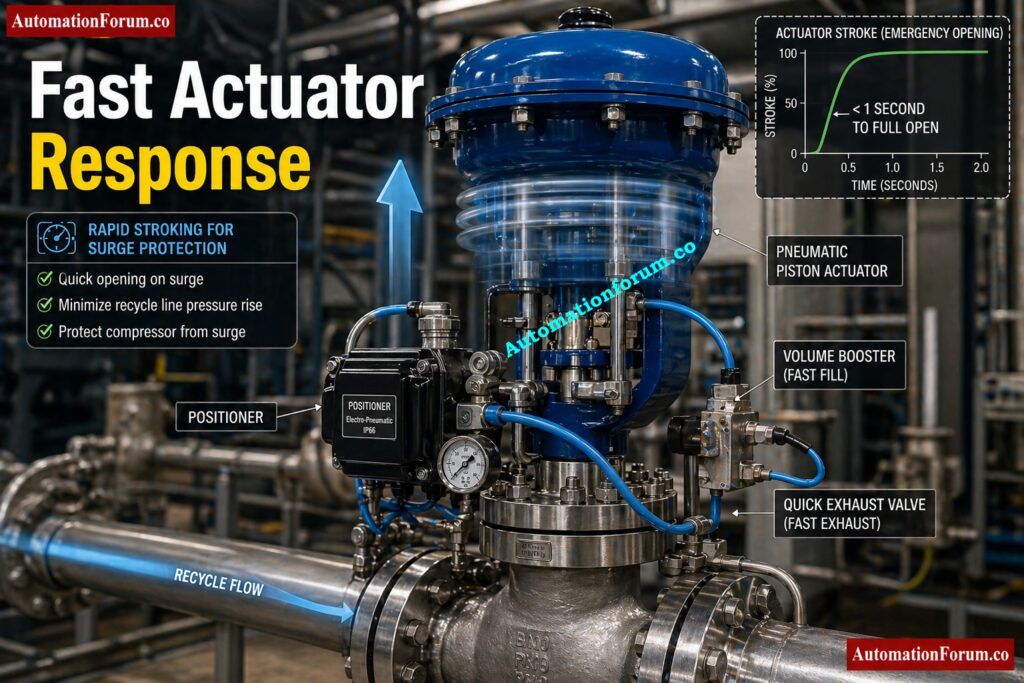
The actuator plays a crucial role in determining how quickly and accurately the valve responds to control signals. In anti surge service, pneumatic piston actuators are widely used due to their ability to deliver high force and rapid movement.
Double acting actuators are typically preferred because they provide faster response in both opening and closing directions. This is particularly important in systems where rapid correction is required to prevent surge.
The actuator must also be supported by appropriate accessories such as volume boosters and quick exhaust valves. These components enhance the speed of air movement, allowing the valve to achieve the required stroking time.
For high performance applications, actuator sizing should consider not only thrust but also air delivery capacity. Oversized actuators combined with volume boosters and high capacity positioners significantly improve dynamic response. The objective is to ensure that the valve follows the control signal without lag under all operating conditions.
Response Time and Stroking Speed
Response time is one of the most critical parameters in anti surge valve selection. The valve must react quickly enough to prevent the compressor from entering the surge region.
In most applications, the valve is required to achieve full or near full opening within one to two seconds. This requirement is based on the dynamic behavior of the compressor and the time available to prevent surge.
Achieving this response time requires careful selection of actuator, accessories, and control system tuning. Any delay in signal transmission, actuator movement, or valve travel can compromise the effectiveness of the protection system.
Measure Interface Level the Right Way, First Time: Interface Level Measurement Selection Procedure – Complete 2025 Guide for Process Engineers
Fail-Safe Action (Fail Open Requirement)
Fail safe action defines the position the valve takes in the event of power or instrument air failure. In anti surge applications, the valve must be configured to fail open.
This ensures that even if the control system fails, the valve will open and allow recycle flow, protecting the compressor from surge. Fail open configuration is considered mandatory for compressor protection systems.
The reliability of this function depends on proper actuator design, air supply integrity, and periodic testing to ensure correct operation under failure conditions.
Valve Accessories and Enhancements
Accessories play a vital role in achieving the required performance of the anti surge valve. Components such as volume boosters increase the speed of actuator response by providing additional air capacity.
Quick exhaust valves allow rapid release of air, improving the speed of valve movement. High performance positioners ensure accurate tracking of control signals and stable valve positioning.
Solenoid valves are often included to enable fast shutdown or emergency action. These accessories must be selected and integrated carefully to ensure that the valve meets its dynamic performance requirements.
Advanced anti surge applications may require diagnostic positioners and characterized trims to improve performance. Smart positioners provide feedback on valve travel, response time, and health condition, which helps in predictive maintenance and reliability improvement.
Stop Misjudging Flow Meter Turndown Ratios: Why Turndown Ratio is Important when Selecting a Flow Meter ?
Noise, Vibration, and Trim Design
Anti surge valves often operate under high pressure drop conditions, which can lead to noise and vibration issues. These effects can cause damage to valve internals and surrounding equipment if not properly managed.
To address these challenges, special trim designs such as multi stage or anti cavitation trim may be used. These designs help distribute pressure drop and reduce flow velocity, minimizing noise and vibration.
Proper design and selection of trim not only improve performance but also extend the service life of the valve.
Use a Better Level Transmitter Selection Method: Level Transmitter Selection Checklist for EPC Engineers – Step-by-Step Guide
Installation Location and Piping Considerations
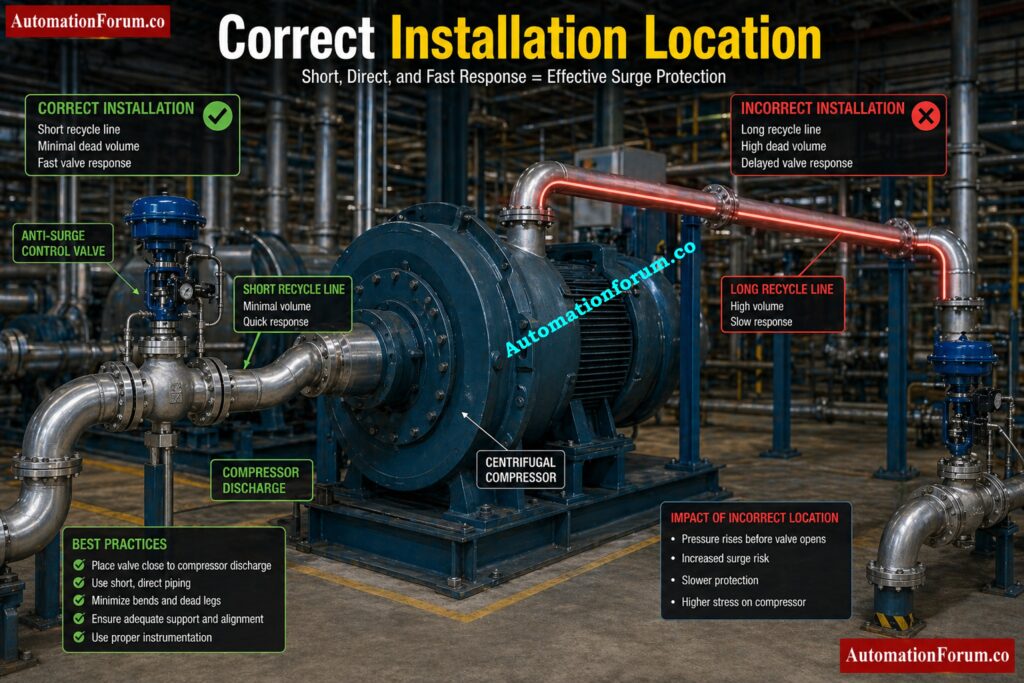
The location of the anti surge valve within the system has a significant impact on its effectiveness. The valve should be installed as close as possible to the compressor discharge to minimize dead volume and response delay.
Long piping runs and large volumes of gas between the valve and compressor can introduce lag in the system, reducing the effectiveness of the protection mechanism. Therefore, careful attention must be given to piping layout and valve placement.
The design should aim to reduce system delays and ensure that valve action translates quickly into changes in compressor flow.
Master Honeywell Turbomachinery Redundancy Like a Pro: Virtual Redundant Transmitter (VRT) in Honeywell Turbomachinery Control Systems
Engineering Design Considerations: Anti-Surge Valve Performance Requirements
Stability at Low Flow Conditions
Anti surge valve design must account for both high flow emergency conditions and low flow normal operation. The valve must remain stable at low openings while being capable of passing large volumes of gas during surge conditions.
This dual requirement presents a challenge in design and selection. The valve must be robust enough to handle high flow without damage, yet precise enough to control small flow changes during normal operation.
Balancing these requirements requires careful evaluation of valve size, actuator performance, and control strategy.
High Capacity for Emergency Recycle
In some complex compressor systems, a single valve may not be sufficient to handle both high flow emergency conditions and low flow stable control. In such cases, a dual valve arrangement may be considered, where one valve is designed for high capacity emergency recycle and another smaller valve is used for precise low flow control. This approach improves stability, reduces valve wear, and enhances overall system reliability.
Get the Process Industry Valve Reference Fast: Valves: Resource for Professionals in the Process Industry
Common Mistakes in Anti-Surge Valve Selection
- Several common mistakes can compromise the performance of anti surge valves. Oversizing the valve is a frequent issue that leads to poor controllability. Selecting a slow actuator can result in delayed response and inadequate protection.
- Incorrect flow characteristic can cause instability, while improper installation location can introduce delays in system response. Ignoring low flow conditions can also lead to valve instability during normal operation.
- Avoiding these mistakes requires a comprehensive approach that considers both steady state and dynamic performance.
Select the Right Valve Body Without Guesswork: Control Valve Body Material Selection Guide for EPC Design Instrumentation Engineers
Practical Example of Anti-Surge Valve Sizing
Real Industry Case Study
Consider a compressor system with a flow range of 5000 to 15000 Nm3 per hour. Based on process data, the required Cv is calculated as 1200. To ensure sufficient margin, a valve with Cv of 2200 is selected.
Step-by-Step Calculation Approach
The valve is equipped with a pneumatic piston actuator and volume booster, achieving a response time of approximately one second. The installation is carried out close to the compressor discharge to minimize lag.
Performance Verification During Commissioning
During commissioning, the system demonstrates stable operation even near the surge control line. The valve responds quickly to disturbances, and no surge events are observed. This example highlights the importance of proper sizing, actuator selection, and installation.
Test Your Flow Measurement Skills Under Pressure: Advanced Flow Measurement Selection MCQs for EPC Instrumentation Design Engineers
Anti-Surge Valve Selection Checklist (Detailed Table)
| Parameter | Detailed Requirement | Engineering Reason | Typical Range or Value | Verification Method | Remarks |
| Compressor service | Define whether the valve is for centrifugal compressor recycle duty, axial compressor protection, or a special high performance compression system. | The compressor type directly affects surge behavior, response demand, and valve sizing philosophy. | Centrifugal service is most common. | Review compressor datasheet and vendor performance curve. | This is the first selection point. |
| Process flow range | Identify minimum normal flow, maximum normal flow, startup flow, shutdown flow, and recycle flow requirement. | The valve must handle both normal control and emergency recycle duty. | Full operating envelope must be available. | Study process data sheet and operating cases. | Do not size only for one operating case. |
| Surge line | Obtain the compressor surge line from the OEM curve. | The valve must keep the operating point safely away from surge. | Vendor specific. | Review compressor curve and OEM technical documents. | This is mandatory for selection. |
| Control line | Define the control line with proper safety margin above the surge line. | The anti surge system must open before the compressor enters unstable operation. | Usually 10 to 20 percent above surge line, depending on project philosophy. | Compare with compressor vendor recommendation. | Margin should be based on dynamic study. |
| Gas composition | Record full gas analysis including molecular weight, density, compressibility, and contaminants. | Gas properties affect Cv, trim selection, erosion risk, and dynamic response. | Project specific. | Review process simulation and gas analysis report. | Accuracy is very important. |
| Operating pressure | Define suction pressure, discharge pressure, and maximum differential pressure across the valve. | Differential pressure controls valve sizing, noise, and actuator force requirement. | Wide variation possible. | Use worst case operating condition. | High differential pressure service needs careful review. |
| Operating temperature | Identify minimum, normal, and maximum gas temperature. | Temperature affects material selection, sealing, and gas density. | Project specific. | Check process conditions and upset scenarios. | High temperature may require special materials. |
| Valve capacity margin | Select a valve capacity that provides enough recycle flow with safety margin. | Undersized valves cannot protect the compressor during surge events. | Typically 1.8 to 2.2 times the surge flow requirement. | Compare calculated Cv with required recycle flow. | Do not oversize without analysis. |
| Cv calculation basis | Perform Cv calculation using the worst credible recycling condition, not just normal operation. | Anti surge duty is dynamic and worst case based sizing prevents failure in upset conditions. | Based on maximum recycle demand and pressure drop. | Use valve sizing software or engineering calculation. | This is a core design step. |
| Valve type | Choose the valve body style based on capacity, speed, and pressure drop. | Different valve types provide different controllability and flow capacity. | Globe valve, angle valve, or axial flow valve. | Review project conditions and OEM recommendation. | Globe is common for general use. |
| Globe valve suitability | Use globe valve where good throttling and stable control are required. | Globe valves provide reliable modulation and good controllability. | Standard choice in many compressor systems. | Evaluate required flow range and response. | Common in many anti surge applications. |
| Angle valve suitability | Use angle valve where high flow and severe pressure drop are expected. | Angle valves can handle flow more efficiently and reduce some stress conditions. | Large flow and severe service cases. | Review pressure drop and velocity. | Useful in demanding recycle services. |
| Axial flow valve suitability | Use axial flow design for high performance applications requiring very fast response and high capacity. | Axial designs can provide excellent aerodynamic performance and fast stroking. | Specialized compressor systems. | Check OEM or specialist valve vendor data. | Often used in advanced compressor trains. |
| Flow characteristic | Select the valve characteristic that matches the compressor control strategy. | Characteristic affects controllability, loop stability, and response quality. | Linear often preferred, equal percentage in some cases. | Review control philosophy and tuning study. | Characteristic should suit dynamic response. |
| Linear characteristic | Prefer linear characteristic when predictable valve travel to flow response is needed. | It provides stable behavior and simplifies control tuning. | Frequently used in anti surge service. | Compare against loop dynamics. | Very common in compressor recycle duty. |
| Equal percentage characteristic | Use equal percentage only when system dynamics justify it. | It can provide better control over a wide operating range in some services. | Case dependent. | Check with control engineer and OEM. | Not always the first choice. |
| Actuator type | Select actuator based on required thrust and response speed. | Anti surge valves need powerful and fast actuators. | Pneumatic piston actuator is common. | Check sizing calculations and travel requirement. | Actuator selection is critical. |
| Actuator action | Determine whether single acting or double acting design is needed. | Double acting designs often provide better speed and stronger movement control. | Double acting preferred in many systems. | Review opening and closing speed requirements. | High performance service often needs double acting. |
| Response time | Define the total valve response time from signal to full useful opening. | Surge can develop within seconds, so delay can destroy protection. | Often 1 to 2 seconds or faster, depending on project. | Dynamic testing and stroke timing. | This is one of the most important criteria. |
| Stroking speed | Check how fast the valve moves through the full travel range. | Fast stroking improves ability to arrest surge quickly. | About 0.5 to 2 seconds in many applications. | Perform stroke time test. | Must match compressor dynamics. |
| Fail safe action | Ensure the valve fails open on air or power loss. | Compressor protection must remain active during failure conditions. | Fail open is standard practice. | Verify spring or air failure action. | Mandatory for protection duty. |
| Volume booster | Provide a volume booster where rapid air delivery is needed. | Boosters improve opening and closing speed. | Common accessory in fast acting valves. | Check actuator air demand and flow rate. | Strongly recommended for fast loop response. |
| Quick exhaust valve | Include quick exhaust capability where fast air release is required. | It helps the valve move faster during sudden action. | Used in high speed service. | Review actuator pneumatic circuit. | Helps reduce delay in motion. |
| Positioner type | Use a high performance positioner suitable for fast dynamic control. | Accurate signal tracking is essential for surge protection. | Smart or digital high response positioner. | Test step response and positioning accuracy. | Basic slow positioners may not be suitable. |
| Solenoid valve | Provide solenoid valve for trip and shutdown functions. | Required for safety logic and emergency operation. | Project dependent, but usually required. | Check shutdown philosophy and cause and effect. | Important for trip integration. |
| Noise control | Evaluate noise generation caused by high pressure drop and high velocity gas. | Excessive noise indicates severe energy loss and possible trim damage. | Severe service may need special trim. | Perform acoustic or velocity review. | Noise is often high in recycle duty. |
| Vibration control | Check vibration risk in trim, piping, and supports. | Vibration can damage valve internals and surrounding equipment. | Depends on flow and pressure drop. | Review piping stress and dynamic analysis if needed. | Ignore only at high risk. |
| Anti cavitation trim | Use special trim when service conditions demand energy dissipation and damage control. | It reduces erosion and protects internal parts. | Needed in severe pressure drop service. | Review vendor trim recommendation. | More common in difficult services. |
| Multi stage trim | Consider multi stage trim for high differential pressure and noisy service. | It distributes pressure drop and reduces velocity. | Severe service application. | Check pressure recovery and vendor data. | Improves reliability in harsh conditions. |
| Installation location | Install the valve as close as possible to compressor discharge. | Shorter distance reduces dead time and improves system response. | Close coupled installation preferred. | Review plot plan and piping layout. | Long recycle lines reduce protection speed. |
| Recycle line volume | Minimize trapped volume between valve and compressor. | Excess volume delays the effect of valve movement. | As low as practical. | Review line size, length, and routing. | Important for response performance. |
| Piping arrangement | Avoid unnecessary elbows, restrictions, and dead legs in the recycle line. | Bad piping increases pressure loss and response lag. | Smooth, direct routing preferred. | Check piping isometric and layout. | Often ignored during construction. |
| Leakage class | Select proper leakage class for shutoff performance and operating stability. | Excess leakage can reduce efficiency and affect control. | Class IV or better in many cases. | Verify seat leakage specification. | Depends on project requirement.Installation Location and Piping Consideration |
| Body material | Choose body material based on gas chemistry, pressure, and temperature. | Wrong material causes corrosion, cracking, and early failure. | Carbon steel, stainless steel, or alloy material. | Review metallurgy specification. | Material choice must match service. |
| Trim material | Select trim material for erosion, corrosion, and wear resistance. | The trim sees the most severe fluid velocity and pressure drop. | Special alloy if needed. | Review process severity and vendor recommendation. | Very important for long life. |
| Maintenance accessibility | Ensure the valve can be inspected, removed, and repaired easily. | Anti surge valves are critical equipment and must be maintainable. | Project dependent. | Check access space and maintenance plan. | Good access reduces downtime. |
| Dynamic testing | Verify valve performance by stroking test and response test during commissioning. | Selection is not complete unless the real response meets the design target. | Test required before startup. | Commissioning test and loop validation. | Final proof of performance. |
| Control loop tuning | Tune the anti surge controller to match valve response and compressor dynamics. | Even a good valve will not protect properly if the loop is poorly tuned. | Project specific. | Perform loop tuning and disturbance test. | Valve and controller must work as one system. |
| Vendor coordination | Confirm all final selections with compressor vendor and control valve vendor. | Compressor protection requires coordination between equipment suppliers. | Always required. | Review datasheets and dynamic studies. | Never rely on one document alone. |
Compare Valve Types and Choose the Best One: Globe vs Ball vs Butterfly Control Valves Complete Comparison Guide for Flow Control Selection and Applications in Process Industries
Key Takeaways for Engineers
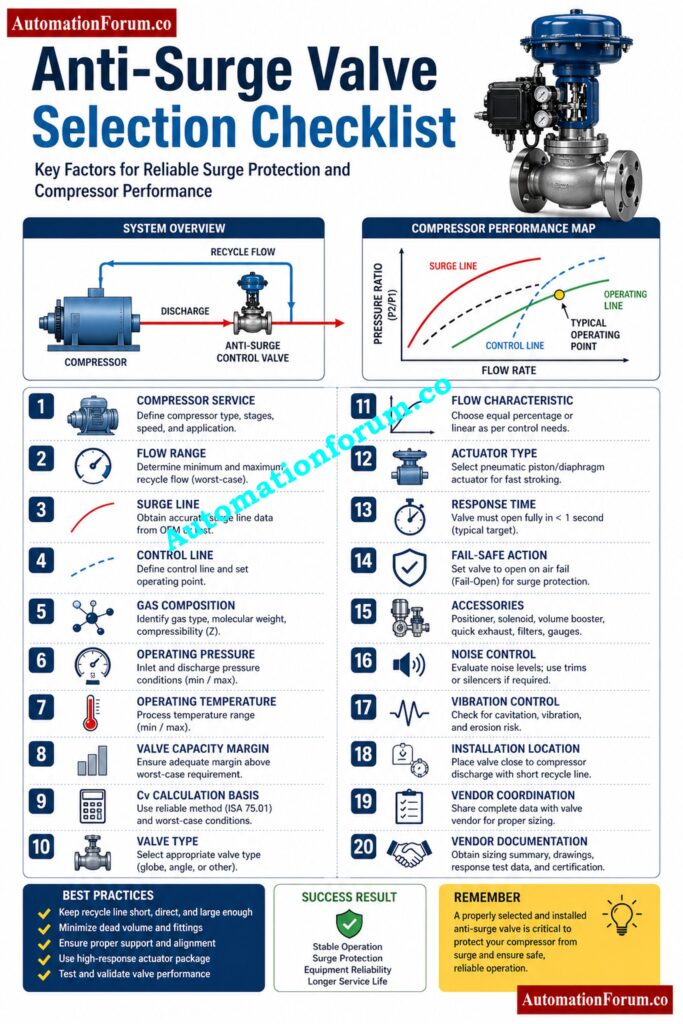
- The anti surge control valve is one of the most critical components in compressor protection systems. Its selection requires a detailed understanding of process conditions, compressor behavior, and control system dynamics.
- Each parameter, from Cv sizing to actuator response, plays a vital role in ensuring reliable performance. The valve must be capable of fast response, stable control, and safe operation under all conditions.
- A structured and well engineered selection approach ensures that the compressor remains protected, the process remains stable, and the plant operates efficiently.
Lock In the Correct Level Measurement Strategy: Hybrid Level Measurement Selection Procedure for EPC Instrumentation Engineers
Anti-Surge Control Valve Checklist (Download)
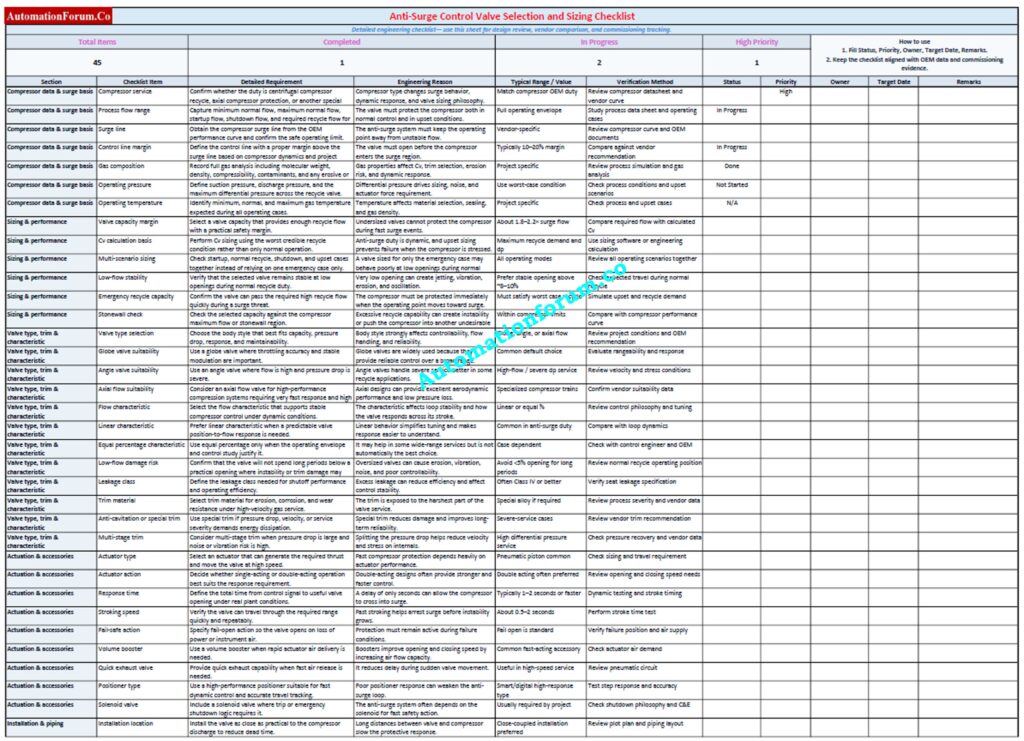
Get a professionally structured, engineering-grade Excel checklist designed from real project requirements, covering sizing, selection, actuator performance, installation, and commissioning validation in one place.
Choose Solenoid Valves That Actually Perform: Essential Checklist for Selecting the Right Solenoid Valve for Your Application
FAQs on Anti-Surge Valves
How to size an anti-surge valve?
Anti-surge valves are sized based on maximum recycle flow at worst-case conditions with a capacity margin of about 1.8–2.2 times required flow.
What is an anti-surge control valve?
An anti-surge control valve is a fast-acting recycle valve that prevents compressor surge by maintaining minimum flow through the compressor.
What are the criteria for control valve selection?
Control valve selection depends on flow capacity (Cv), pressure drop, response time, valve type, actuator performance, and process conditions.
Select Temperature Transmitters That Survive Real Plants: How to Select the Right Temperature Transmitter: A Practical Guide for Industrial Applications
What does an anti-surge valve do?
It opens rapidly to recycle gas from discharge to suction, preventing flow reversal and protecting the compressor from damage.
What is the difference between ATO and ATC valves?
ATO (Air-To-Open) valves open with air pressure, while ATC (Air-To-Close) valves close with air pressure; anti-surge valves are typically fail-open.
What is a surge control valve?
A surge control valve is another name for an anti-surge valve used to maintain stable compressor operation and avoid surge conditions.
What does anti-surge mean?
Anti-surge refers to preventing unstable flow conditions in compressors that can cause vibration, pressure oscillations, and equipment damage.
Refer the below link for the Codes and Standards for Control Valve Selection in Industrial Applications
