
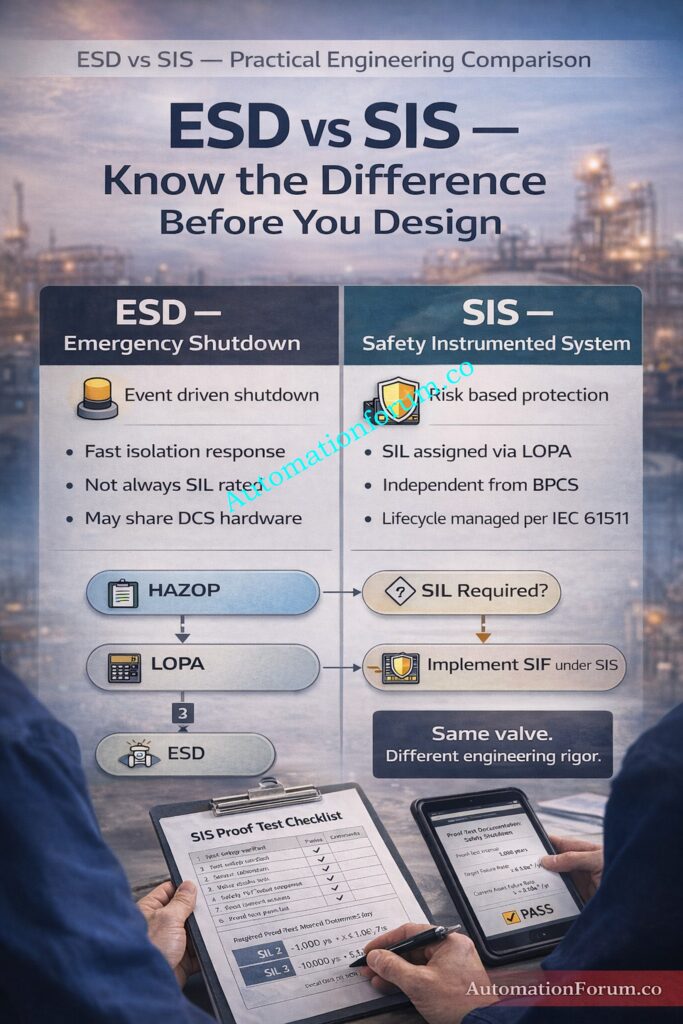
- ESD vs SIS Quick Summary and Core Difference
- Why Understanding ESD vs SIS Matters in Process Industries
- What is Emergency Shutdown ESD
- What is Safety Instrumented System SIS
- Core Difference Between ESD and SIS
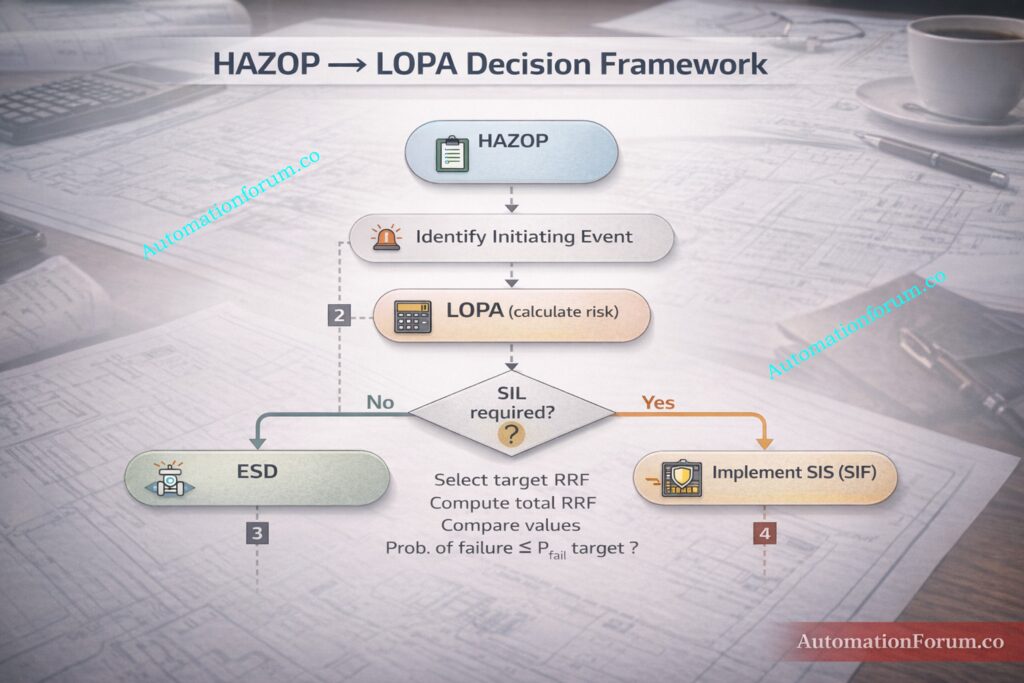
- HAZOP and LOPA Decision Framework for ESD vs SIS
- Real Industry Examples of ESD vs SIS
- When Is ESD Required?
- When Is SIS Required?
- Brownfield Upgrade Challenges and Compliance
- Independence Requirement in SIS Design
- Testing and maintenance: ESD vs SIS
- Lifecycle Comparison Between ESD and SIS
- Cost and Risk Implications
- Practical Engineering Decision Framework
- Practical engineering takeaway – do this on every project
- Final Professional Insights for Process Safety Engineers
- FAQ on ESD vs SIS
ESD vs SIS Quick Summary and Core Difference
In process industries such as oil & gas, petrochemical, refining, LNG, pharmaceuticals, power generation, and specialty chemicals, the confusion between Emergency Shutdown (ESD) and Safety Instrumented Systems (SIS) continues to create design inconsistencies, audit findings, and unnecessary capital expenditure.
Field-Proven 4–20 mA Loop Signal Testing Method: Live Signal Verification 4 to 20 mA Loop Standard Operating Procedure (SOP)
Why Understanding ESD vs SIS Matters in Process Industries
Both systems perform shutdown actions. Both may close valves and trip equipment. Both appear to “protect the plant.”
However, the difference between ESD vs SIS is not in the physical action it is in the risk justification, performance requirement, independence criteria, and lifecycle management behind that action.
This comprehensive technical guide explains in depth:
- What ESD really is
- What SIS really is
- How SIL applies
- When to require ESD
- When to require SIS
- Real refinery, LNG, compressor, and pipeline examples
- Brownfield upgrade challenges
- Independence requirements
- Testing philosophy differences
- Practical engineering decision framework
This guide is structured specifically for instrumentation engineers, process safety engineers, EPC engineers, QA/QC professionals, and maintenance teams working in high-hazard industries.
Ultimate Calibration Standards Quiz for Engineers: Process Instrument Calibration MCQ Challenge – NIST, ISO 17025, ISA Standards & Calculations
What is Emergency Shutdown ESD
Definition and Objective of ESD
Emergency Shutdown (ESD) is a system or logic arrangement designed to bring equipment or an entire plant to a safe state during abnormal or emergency conditions.
The objective of ESD is:
- Immediate hazard isolation
- Energy removal
- Escalation prevention
- Equipment damage limitation
- Protection of personnel
ESD is primarily event-driven and action-focused.
Typical ESD Triggers in Process Plants
- High-high pressure in vessel
- High temperature excursion
- Low-low level causing pump cavitation
- Fire detection
- Gas detection
- Compressor surge
- Turbine overspeed
- Loss of instrument air
- Utility power failure
Typical ESD Actions in Oil Gas LNG and Refining
- Closing Emergency Shutdown Valves (ESDV)
- Tripping pumps and compressors
- Depressurization through blowdown valves
- Cutting fuel gas supply
- Isolating feed streams
- Shutting down loading operations
The emphasis of ESD is fast response and immediate energy isolation.
How ESD is Implemented in PLC DCS and Integrated Systems
ESD logic can be implemented in:
- Dedicated ESD PLC
- DCS-based shutdown logic
- Hardwired relay systems
- Integrated safety systems
However, ESD by itself does not automatically mean SIL-rated or formally engineered under functional safety lifecycle.
What is Safety Instrumented System SIS
SIS Definition and Engineering Principles
A Safety Instrumented System (SIS) is a formally engineered, risk-reduction system designed to achieve a defined Safety Integrity Level (SIL) through implementation of one or more Safety Instrumented Functions (SIFs).
Unlike ESD, SIS is:
- Performance-based
- Quantified
- Lifecycle-managed
- Auditable
- Risk-justified
SIS follows standards such as IEC 61511 for the process industry.
What is a Safety Instrumented Function (SIF)?
A SIF is a specific safety function designed to:
- Detect a hazardous condition
- Decide using a logic solver
- Execute a final element action
- Achieve defined risk reduction target
Each SIF has:
- Defined process safety time
- Defined probability of failure on demand
- Defined SIL target
- Proof test interval
- Hardware architecture requirements
SIS is the overall system.
SIF is the individual safety function inside it.
SIS Lifecycle in Process Industry
Unlike simple ESD logic, SIS must follow the full functional safety lifecycle:
- Hazard identification (HAZOP)
- Risk analysis (LOPA)
- SIL assignment
- Detailed engineering design
- Verification and validation
- Installation and commissioning
- Proof testing and maintenance
- Periodic review and MOC control
SIS is governed by standards such as IEC 61511 (process industry).
The most critical difference:
SIS is performance-based.
ESD is event-based.
On-Site Valve Acceptance Made Simple: Control Valve Site Acceptance Test (SAT) Procedure – Step-by-Step Field Guide
Core Difference Between ESD and SIS
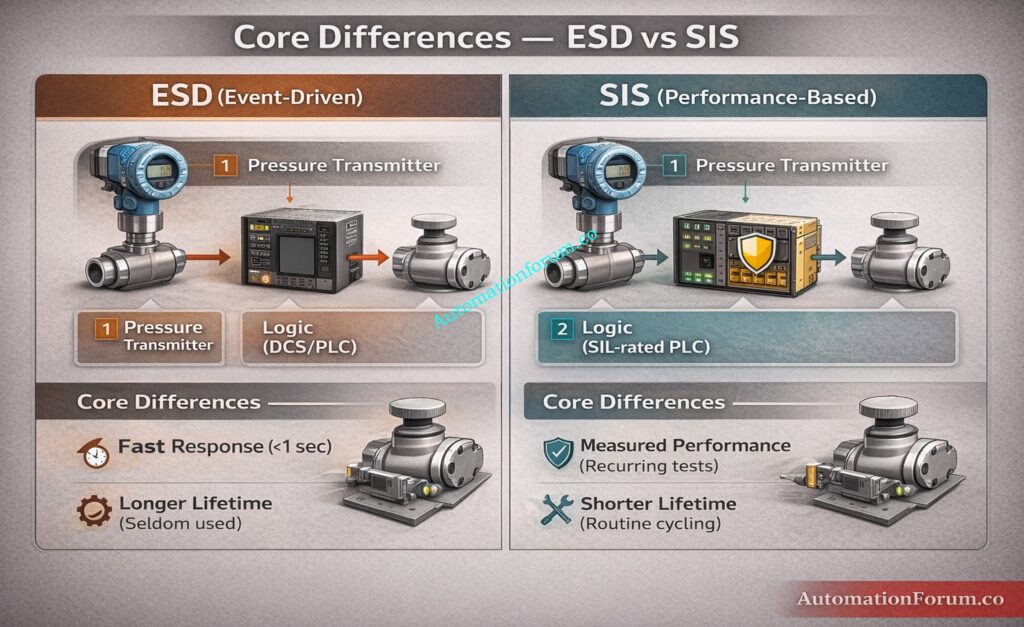
The confusion arises because both systems may close valves or trip equipment.
The difference lies in:
| Aspect | ESD | SIS |
| Primary Objective | Emergency response | Quantified risk reduction |
| SIL Assignment | Not mandatory | Mandatory when required |
| Lifecycle Documentation | Limited | Full functional safety lifecycle |
| Proof Testing | Functional check | Reliability-based proof testing |
| Independence Requirement | May or may not be independent | Must be independent from BPCS |
| Risk Credit in LOPA | Not automatically credited | Credited as IPL if SIL justified |
The shutdown valve may be identical in both cases.
What changes is the engineering rigor behind it.
Decode Control Valve Installation Drawings Easily: How to Read Control Valve Hookup Drawings?
HAZOP and LOPA Decision Framework for ESD vs SIS
Using LOPA to Determine SIL Requirement
When a HAZOP identifies an initiating scenario, LOPA is used to determine whether existing protection is adequate:
- Identify initiating event and consequences.
- List existing layers of protection alarms, operator response, ESD, relief devices, SIS, physical barriers.
- Assign risk and required risk reduction.
- If existing protective layers do not achieve required risk reduction, design or upgrade SIFs, assign SIL targets, or modify operating procedures.
Refer the below link for the SIF PFDavg / SIL Verification – Complete Guide + Online Calculator (IEC 61508 / 61511)
When to Formalize ESD as SIS
Practical example: A pressure excursion is currently handled by ESD isolation via DCS. LOPA shows the ESD alone doesn’t achieve the needed risk reduction. The project team then determines whether to:
- Formalize the ESD as a SIF and apply SIL requirements (hardware architecture, diagnostics, proof testing), or
- Add additional independent protective layers (e.g., pressure relief, physical interlocks, operator procedural changes) until risk target met.
Common Brownfield Misclassification Issues
Brownfield traps: Many plants operate for years with ESD trips not justified as SIFs. During later HAZOP/LOPA reviews these may be retrofitted into the SIS lifecycle a process that requires
scope, budget and careful implementation planning.
Master Industrial P&ID Interpretation Fast: Step-by-Step Guide: Reading and Interpreting Piping and Instrumentation Diagrams (P&ID)
Real Industry Examples of ESD vs SIS
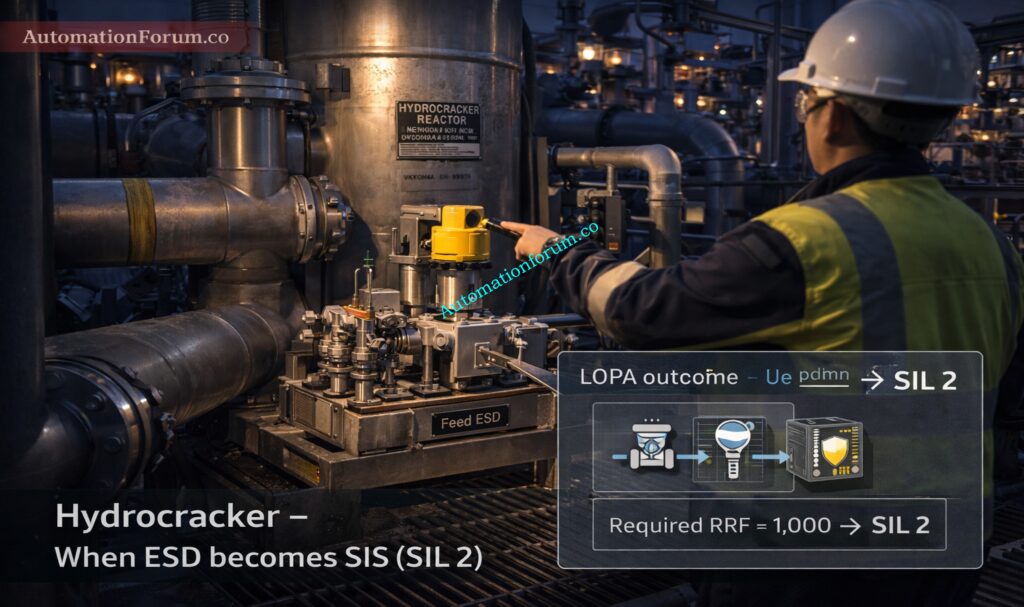
Refinery Hydrocracker Reactor High Pressure Scenario
Process Context
A hydrocracking reactor operates at 150 bar and high temperature. Feed composition variation can trigger runaway reaction.
Hazard Scenario
If pressure exceeds vessel design rating, catastrophic rupture and explosion may occur.
Existing Safeguards
- Pressure control loop
- High pressure alarm
- Operator intervention
- Pressure relief valve
HAZOP Outcome
Control loop failure and delayed operator response can lead to pressure escalation.
LOPA Result
Required Risk Reduction Factor = 1,000
Equivalent to SIL 2
Engineering Decision
Implement High-High Pressure SIF:
- Independent pressure transmitter
- Certified safety PLC
- Close feed ESD valve
- Trip heater
Now the shutdown action is not just ESD.
It is a SIL 2 SIF under SIS lifecycle.
This includes:
- Failure rate calculation
- Proof test interval determination
- Architectural redundancy check
- Functional safety management plan
- MOC control
This example shows how an ESD-style action becomes SIS when SIL is required.
Complete Functional Safety Systems Explained Clearly: What is SIS, SIF and SIL? An In-Depth Guide to Functional Safety in Process Industries
LNG Storage Fire and Gas Detection Scenario
Process Context
LNG storage tanks with transfer pumps and loading arms.
Hazard Scenario
Gas leak detected in pump skid area.
Required Actions
- Stop pumps
- Close tank outlet ESD valves
- Activate deluge system
- Isolate loading arms
Case A: No SIL Requirement
If risk analysis shows passive fire protection and relief systems provide adequate risk reduction, the fire shutdown remains ESD only.
Case B: SIL 1 Required
If LOPA identifies gas detection as required independent protection layer with SIL 1 target, then:
- Fire & gas detectors must meet reliability targets
- Logic solver must be certified
- Final elements must be proof tested
- Lifecycle documentation mandatory
The same shutdown action becomes part of SIS.
The physical act does not change.
The risk justification does.
Expert-Level SIL Practice Questions: Top 25 MCQs on Safety Integrity Level (SIL) for Instrumentation and Control Engineers
Compressor Surge Protection SIL 3 Case
Process Context
Gas compressor operating near surge line.
Hazard Scenario
Surge event causes severe mechanical damage and possible casing rupture.
Safeguards
- Anti-surge control (BPCS)
- Surge alarm
- Surge trip
If LOPA shows required risk reduction factor = 10,000
Equivalent to SIL 3
Then surge trip logic becomes SIL 3 SIF.
Requirements include:
- 2oo3 transmitters
- Redundant logic solver
- High diagnostic coverage
- Tight proof test interval
If SIL not assigned, it remains ESD only.
Pipeline Pump Station Manual Emergency Shutdown
Pump trips. Valves close.
No SIL assigned.
No PFD calculation.
No proof test planning.
This is pure ESD.
Valuable, but not a quantified safety layer.
Download 60+ Practical Calibration Workflows: Free Instruments Calibration Procedures: 60+ Step-by-Step Methods for Pressure, Temperature, Flow & Level
When Is ESD Required?
ESD is required whenever rapid shutdown is necessary to:
- Protect equipment
- Isolate flammable inventory
- Prevent escalation
- Respond to fire or gas
- Handle emergency utility failure
- Enable manual emergency intervention
ESD is essential in:
- Offshore platforms
- Refineries
- LNG terminals
- Gas compression stations
- Chemical reactors
- Power turbines
ESD is operationally critical.
Complete Industrial Calibration Blueprint: Instrument Calibration in Process Industries – Complete Guide
When Is SIS Required?
SIS is required when:
- HAZOP identifies intolerable risk
- LOPA determines required risk reduction
- SIL assigned
- Independent protection layer needed
- Regulatory requirement mandates SIL compliance
- Corporate standards demand functional safety
SIS is mathematically justified protection.
Refer the below link for the Checklist for Installation of Local Instruments – Complete Guide for EPC, QA/QC and Commissioning Engineers
Brownfield Upgrade Challenges and Compliance
Many older plants have ESD systems installed without SIL documentation.
Common issues:
- Shutdown logic inside DCS
- No failure rate data
- No proof test interval defined
- No safety requirement specification
When plant undergoes revalidation:
- ESD trips may need to be formalized into SIFs
- Independent transmitters installed
- Certified safety PLC required
- Proof testing program introduced
- Documentation generated
This upgrade can be costly but necessary for compliance.
Eliminate Valve Oscillation Like a Pro: Control Valve Hunting due to Valve Positioner: Troubleshooting
Independence Requirement in SIS Design
Common cause failure examples:
- PLC CPU crash
- Software bug
SIS independence requires:
- Separate transmitters
- Separate logic solver
- Separate power supply
- Separate I/O modules
- Physical segregation where practical
Without independence, risk reduction claim is invalid.
Why Your Control Valve Keeps Oscillating: What are the main causes of control valve hunting?
Testing and maintenance: ESD vs SIS
ESD Functional Testing Approach
ESD testing:
- Typically functional checks: does the trip action occur when triggered?
- Frequency often tied to operations or shift checks.
- Records may be informal or held in maintenance logs.
Challenge Your SIS Engineering Knowledge: Test Your Expertise in Safety Instrumented Systems (SIS): Knowledge Quiz
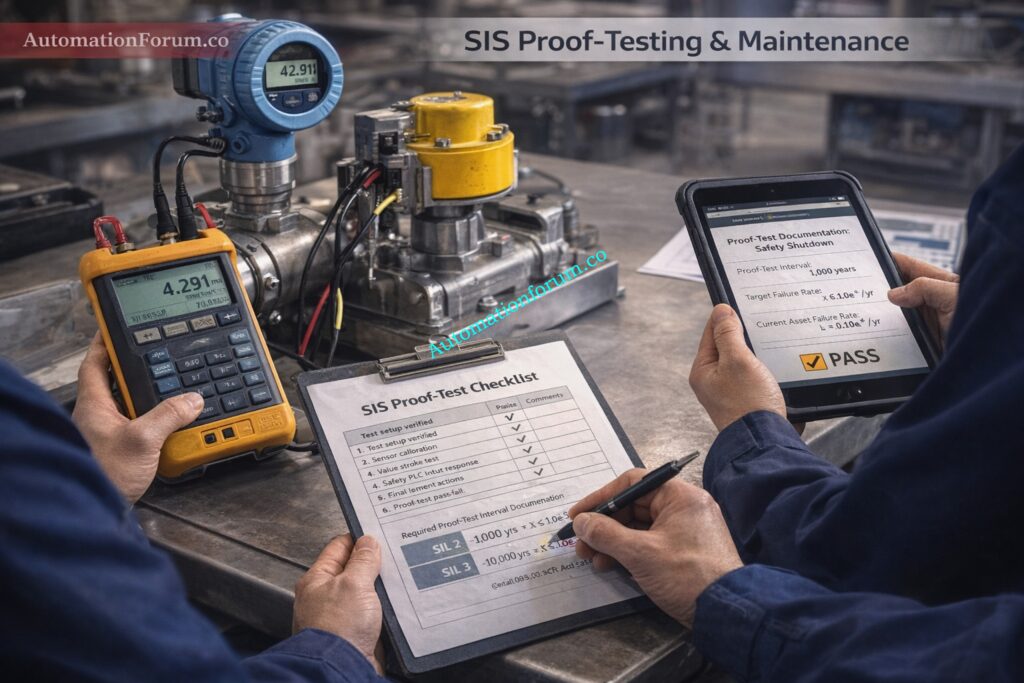
SIS Proof Testing and Audit Requirements
SIS testing (proof testing):
- Formalized and periodic, based on failure rates and SIL.
- Documented test procedures and records are mandatory for audits.
- Management of Change (MOC) and spares policy must be documented.
Failing to apply proof-testing regimes when a function is effectively performing a safety role leads to silent reliability decay the SIS requirement prevents that.
Practical Guide to Cause–Effect Logic Diagrams: Cause and Effect Drawings
Lifecycle Comparison Between ESD and SIS
ESD Lifecycle Overview
ESD lifecycle typically:
Design → Install → Operate → Maintain
SIS Functional Safety Lifecycle Depth
SIS lifecycle includes:
- Hazard analysis
- Risk assessment
- SIL determination
- Safety requirement specification
- Detailed design
- Verification
- Validation
- Installation
- Commissioning
- Proof testing
- Operation
- Periodic review
- Management of change
SIS is structured, traceable, and auditable.
Avoid Sizing Errors: Rangeability vs Turndown: Understanding Rangeability vs Turndown Ratio in Control Valve Sizing
Cost and Risk Implications
Over-classifying ESD as SIS:
- Increases hardware cost
- Increases redundancy requirement
- Requires certified PLC
- Requires lifecycle documentation
- Increases proof testing cost
Under-classifying SIS as ESD:
- Increases catastrophic risk
- Creates regulatory exposure
- Invalidates LOPA claims
- Leads to audit failure
- Risks loss of life
Proper classification balances cost and safety.
Build Reliable Triple-Redundant Voting Logic: Designing 2 out of 3 Voting Logic in Control Systems
Practical Engineering Decision Framework
Step 1: Conduct HAZOP
Step 2: Identify hazard scenarios
Step 3: Perform LOPA
Step 4: Determine required risk reduction
Step 5: Assign SIL if required
Step 6: Determine independence needs
Step 7: Define proof test interval
Step 8: Document lifecycle requirements
If no SIL required → ESD sufficient
If SIL required → Implement SIS
Understand Cascade Loops in DCS with Real Example: How to Read a DCS Cascade Control Loop Diagram: A Complete Guide with Example
Practical engineering takeaway – do this on every project
- Define function first, hardware later. Start with what the safety function must do (detect, respond, isolate), then determine whether it must be an SIS SIF with SIL or can be an ESD action.
- Run HAZOP then LOPA early. Use LOPA outputs to determine whether existing ESDs need SIL justification.
- Ensure independence. If the intention is to credit a function, design separation between BPCS and SIS from day one.
- Document testing requirements. If you decide a function is a SIF, add proof testing, inspection plans, spare lists and MOC processes.
- Treat operator actions as support, not the sole credited layer.
- Plan brownfield upgrades carefully. Account for budget/time to meet SIL requirements if converting ESD → SIS.
- Communicate clearly in design documents. Label which trips are ESD-only vs. SIF-with-SIL so commissioning, operations and auditors are aligned.
Advanced Cascade Control Knowledge Test: DCS Cascade Control Loop Instrumentation Quiz – 25 Expert-Level Questions
Final Professional Insights for Process Safety Engineers
In modern high-hazard industries, layered protection is essential.
Basic Process Control System prevents deviation.
ESD limits escalation.
SIS reduces risk to tolerable level.
Confusion between ESD and SIS usually arises during:
- Brownfield modernization
- SIL verification projects
- Audit preparation
- EPC design reviews
Clear separation ensures:
- Correct risk reduction
- Proper SIL allocation
- Compliance with IEC 61511
- Optimized capital cost
- Reduced common cause failures
- Safer plant operations
For process safety professionals, mastering ESD vs SIS distinction is not theoretical it is fundamental to defensible engineering.
If needed, I can next provide:
- Detailed LOPA numeric calculation example
- SIL verification calculation walkthrough
- Architectural comparison diagrams explanation
- EPC project specification template for ESD vs SIS
- Advanced troubleshooting guide for mixed ESD/SIS systems
Let me know which technical direction you want to go deeper into.
Accurate Cable Voltage Drop Calculation Explained: How to do the voltage drop calculation of instrument cable?
FAQ on ESD vs SIS
Is an ESD always part of the SIS?
No ESD is not automatically part of an SIS.
It becomes part of an SIS only if risk assessment or LOPA assigns it as a SIF and it is implemented under the functional safety lifecycle.
Can an ESD be SIL rated?
Yes an ESD can be SIL rated when LOPA requires quantified reliability.
In that case it is engineered as a SIF with a SIL target safety rated hardware diagnostics and proof testing.
What is the difference between ESD and DCS?
ESD is an event driven protective shutdown system while DCS is a distributed control system for continuous process control and operation.
ESD focuses on rapid isolation during emergencies whereas DCS manages normal control loops sequencing and optimization.
Crack Your SIS Job Interview with Confidence: Safety Instrumented System(SIS) Interview Questions and Answers
What is the difference between DCS and SIS?
DCS controls and optimizes the production process while SIS is an independent safety system designed to reduce risk to a tolerable level.
SIS implements SIL assigned safety functions under a formal lifecycle whereas DCS focuses on operational control.
What is the difference between PLC and SIS?
A PLC is a general purpose industrial controller used for automation and control tasks.
SIS is a certified safety system that may use safety rated PLCs to implement SIL based safety instrumented functions.
What does ESD stand for?
ESD stands for Emergency Shutdown.
It refers to a system designed to quickly bring equipment or a plant to a safe state during abnormal or emergency conditions.
What is ESD used for?
ESD is used to rapidly isolate energy sources stop material flow and prevent escalation during emergencies.
Typical actions include closing ESD valves tripping pumps or compressors and shutting down hazardous operations.
Refer the below link for the Selecting the Right Emergency Shutdown Valve Strategy
