
- Introduction to Safety Instrumented System (SIS)
- Why SIS Running Inspection Is Important
- Why SIS Running Inspection Is Important
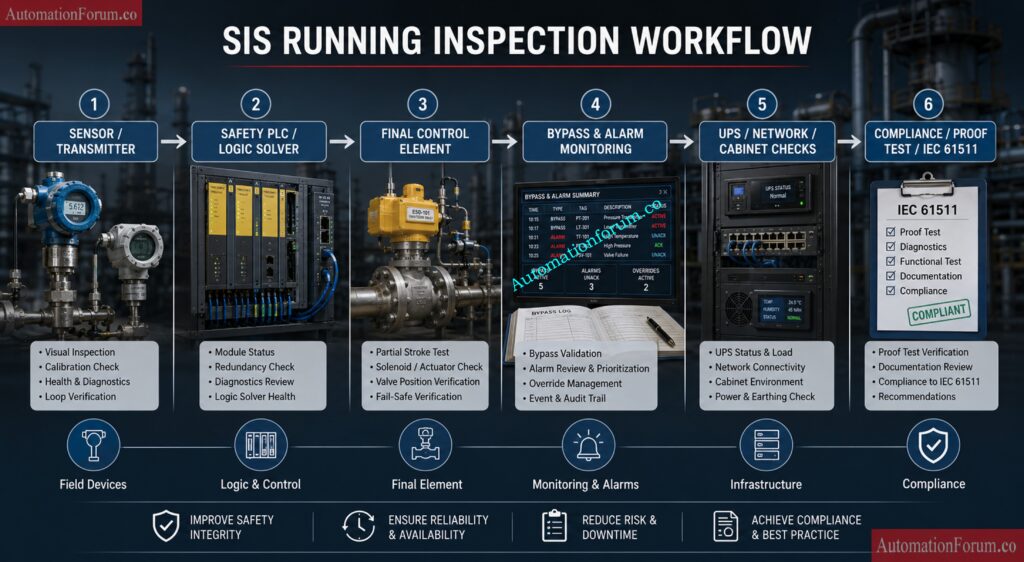
- Purpose of SIS Running Inspection
- Why SIS Running Inspection Is Important
- Advanced SIS Running Inspection Checklist
- Section A – SIS General Health Monitoring Checklist
- Section B – Safety PLC and Logic Solver Inspection Checklist
- Section C – SIS Field Instrument Inspection Checklist
- Section D – Final Element Inspection Checklist
- Section E – SIS Alarm and Bypass Management Checklist
- Section F – SIS UPS and Power Supply Inspection Checklist
- Section G – SIS Communication and Network Inspection Checklist
- Section H – SIS Panel and Environmental Inspection Checklist
- Section I – Functional Safety Compliance Inspection Checklist
- Section J – Operator and Maintenance Practice Inspection Checklist
- Common SIS Failures and Troubleshooting Guide
- SIS Troubleshooting and Corrective Actions
- Recommended SIS Inspection Frequencies
- Advanced SIS Inspection Checklist Excel Workbook
- IEC 61511 SIS Best Practices
- SIS Shutdown and Startup Inspection Best Practices
- Conclusion: Why Regular SIS Inspection Is Essential for Industrial Safety
Introduction to Safety Instrumented System (SIS)
What Is a Safety Instrumented System?
A Safety Instrumented System (SIS) is one of the most critical protection layers in any process plant. Its job is simple in principle but extremely important in practice: detect unsafe process conditions and move the plant to a safe state before those conditions turn into an accident.
How SIS Protects People, Assets, and the Environment
In real industrial environments, that safe state may mean shutting down equipment, isolating a process line, stopping a compressor, closing a valve, or triggering an emergency action that protects people, assets, and the environment.
You will find SIS applications across oil and gas, refineries, petrochemical plants, LNG facilities, power plants, chemical industries, pharmaceutical units, and water treatment plants. In all these industries, the SIS works as an independent layer of protection, designed to act when the normal control system is no longer enough.
Unlock the complete IEC 61511 SIS engineering guide today: S84 / IEC 61511 Standard for Safety Instrumented Systems – Complete Guide
Why SIS Running Inspection Is Important
Main Components of a SIF
A Safety Instrumented Function (SIF) is the specific safety action inside the SIS. In most cases, a SIF is built from three main parts:
- Sensor(s)
- Logic solver
- Final control element
SIS Health Monitoring During Plant Operation
- For example, in a high-pressure shutdown loop, a pressure transmitter detects the unsafe condition, a safety PLC processes the logic, and an ESD valve isolates the process.
- That is why SIS health cannot be checked only during shutdown or turnaround. It must be watched continuously while the plant is running.
Test your practical SIS expertise with this advanced safety quiz: Test Your Expertise in Safety Instrumented Systems (SIS): Knowledge Quiz
Why SIS Running Inspection Is Important
- It also supports SIL integrity, proof testing, lifecycle documentation, audit readiness, and compliance with IEC 61511 and ISA 84.
- In many plants, the real danger is not a complete SIS failure that is obvious and easy to spot.
Avoid these dangerous SIS design mistakes before project commissioning: Top Critical Mistakes in Safety Instrumented System Design as per ISA 84 Standard and How to Avoid Them
Purpose of SIS Running Inspection
The main purpose of SIS running inspection is to ensure that every safety instrumented function remains healthy, available, and ready to respond when required.
Prepare confidently for SIS interviews with these expert questions:Safety Instrumented System(SIS) Interview Questions and Answers
Why SIS Running Inspection Is Important
Detect Hidden Dangerous Failures
Running inspection helps identify failures that may not be visible during normal operation, including:
- Sensor drift
- Solenoid coil degradation
- Stuck shutdown valves
- Faulty relay contacts
- Communication failure in the logic solver
Prevent Fire, Explosion and Gas Release
A healthy SIS helps prevent:
- Fire
- Explosion
- Toxic gas release
- Environmental contamination
- Major equipment damage
Reduce Spurious Trips and False Shutdowns
False trips create production loss, upset plant operation, and can even damage equipment. Inspection helps identify causes such as:
- Signal noise
- Ground loops
- Intermittent wiring faults
- Poor power quality
- Weak bypass control
Improve Shutdown Reliability
Inspection confirms that critical elements can still perform their duty, such as:
- ESD valves moving freely
- Solenoids energizing and de-energizing correctly
- Safety PLC redundancy staying healthy
- Field instruments remaining within calibration limits
Learn how SIS voting logic works in industrial applications: Voting Logic in Safety Instrumented System
Support IEC 61511 and SIL Compliance
Running inspection supports:
- IEC 61511 compliance
- Functional safety audits
- SIL verification
- Proof test planning
- Maintenance record keeping
Improve Plant Safety and Availability
A disciplined SIS inspection program reduces nuisance shutdowns while keeping the safety layer effective.
Understand SIS basics every instrumentation engineer must clearly know: SIS (safety instrumented system) basics
Advanced SIS Running Inspection Checklist
Section A – SIS General Health Monitoring Checklist
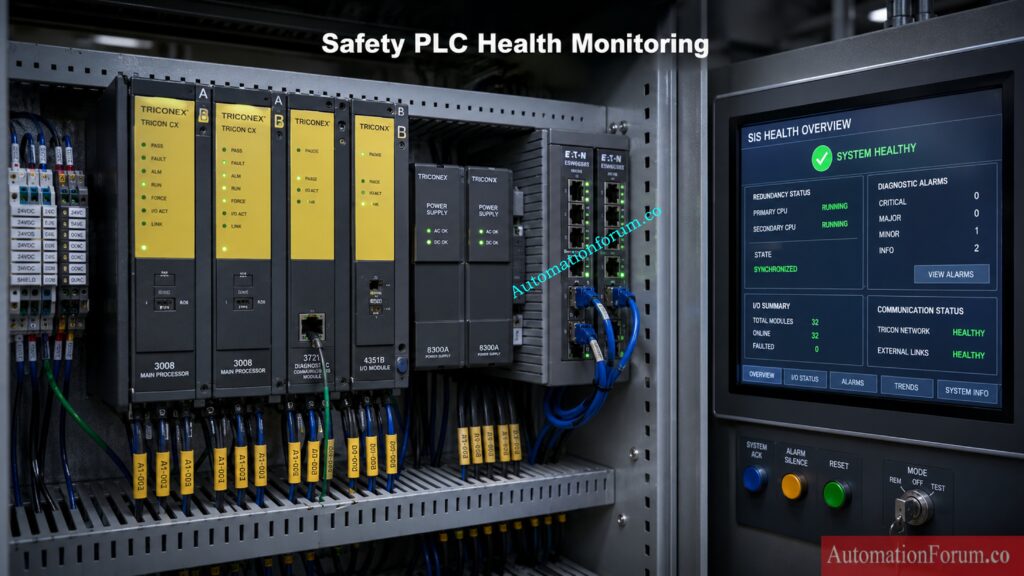
Safety PLC Controller Health Inspection
| Sl No | Inspection Area | Equipment / Tag | Inspection Requirement | Expected Condition | Inspection Method | Frequency |
| 1 | SIS Controller | Safety PLC | Controller healthy status | Healthy without fault | HMI diagnostics | Daily |
| 2 | CPU Redundancy | Redundant CPU | Redundant synchronization | Both CPUs synchronized | PLC diagnostics | Daily |
| 3 | Power Supply | SIS Power Module | Voltage monitoring | Stable DC voltage | Multimeter / HMI | Daily |
| 4 | Communication | Safety Network | Communication integrity | No communication loss | Diagnostic screen | Daily |
| 5 | SOE System | Event Recorder | Time synchronization | Accurate timestamp | SOE check | Weekly |
| 6 | Diagnostics | SIS Alarms | Diagnostic alarm review | No critical alarms | Alarm review | Daily |
| 7 | Memory Utilization | PLC Memory | Memory load verification | Within safe limit | Engineering station | Monthly |
| 8 | Redundancy | CPU Switchover | Switchover readiness | Successful redundancy | Diagnostic review | Monthly |
| 9 | Application Integrity | Safety Logic | Checksum verification | Matching checksum | Engineering software | Monthly |
| 10 | Cybersecurity | SIS Access | Unauthorized access check | No unauthorized login | Audit logs | Weekly |
Discover how safety light curtains protect industrial working environments: Safety Light Curtain Working Principle: How Does a Safety Light Curtain Work?
Section B – Safety PLC and Logic Solver Inspection Checklist
Safety PLC Hardware and Software Inspection
| Sl No | Inspection Area | Equipment / Tag | Inspection Requirement | Expected Condition | Inspection Method | Frequency |
| 11 | CPU Diagnostics | Safety PLC CPU | CPU fault monitoring | No active fault | HMI diagnostics | Daily |
| 12 | Scan Time | Logic Solver | Scan time verification | Within design limit | Diagnostic tools | Weekly |
| 13 | Communication | Redundant Ethernet | Communication redundancy | Healthy redundancy | Switch diagnostics | Weekly |
| 14 | Logic Validation | Safety Program | Logic mismatch verification | No mismatch | Compare tool | Monthly |
| 15 | Fault LEDs | PLC Rack | LED fault inspection | No red LEDs | Visual inspection | Daily |
| 16 | Bypass Monitoring | Safety Logic | Active bypass check | No unauthorized bypass | Bypass report | Daily |
| 17 | Forced I/O | Safety PLC | Forced signal verification | No active force | Engineering station | Daily |
| 18 | Firmware | PLC Firmware | Firmware verification | Approved version | Software check | Quarterly |
| 19 | Online Edits | SIS Logic | Unauthorized online edit check | No unauthorized changes | Audit review | Weekly |
| 20 | Battery Health | CPU Battery | Battery voltage check | Healthy battery | Diagnostics | Monthly |
Simplify intrinsic safety loop calculations using this engineering calculator: IS Barrier Earth Fault Current Calculator | Intrinsic Safety Loop Design Tool
Section C – SIS Field Instrument Inspection Checklist
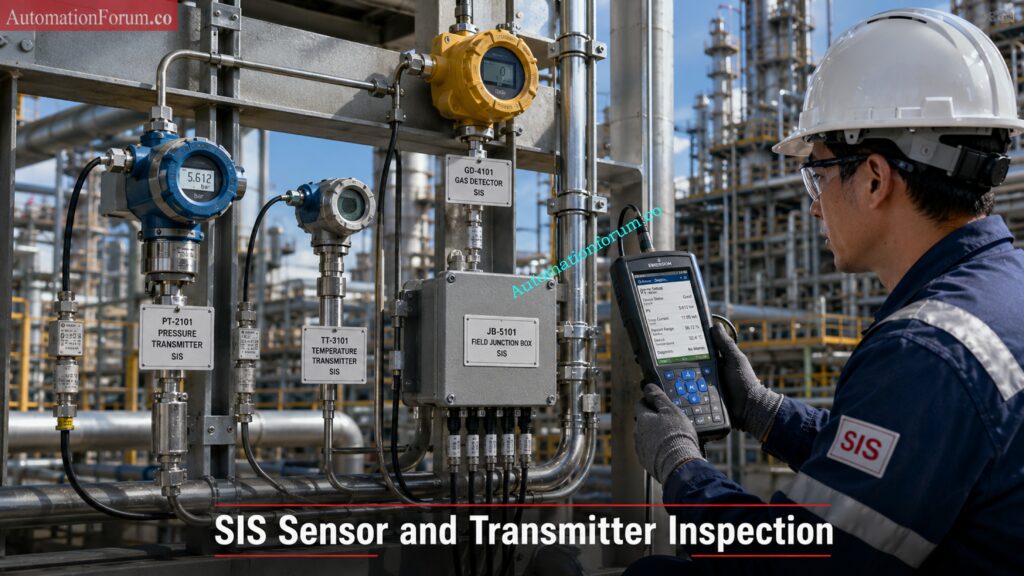
SIS Sensor and Transmitter Inspection Procedure
| Sl No | Inspection Area | Equipment / Tag | Inspection Requirement | Expected Condition | Inspection Method | Frequency |
| 21 | Pressure Transmitter | PT-101 | Calibration status | Within calibration validity | Calibration record | Monthly |
| 22 | Temperature Transmitter | TT-101 | Sensor drift check | Stable reading | Trend analysis | Monthly |
| 23 | Flow Transmitter | FT-201 | Impulse line leakage | No leakage | Visual inspection | Weekly |
| 24 | Level Transmitter | LT-301 | Diagnostic health | Healthy diagnostics | HART communicator | Weekly |
| 25 | Gas Detector | GD-101 | Sensor poisoning check | Normal sensor response | Gas bump test | Monthly |
| 26 | Flame Detector | FD-201 | Optical cleanliness | Lens clean | Visual inspection | Weekly |
| 27 | Vibration Switch | VS-101 | Mechanical integrity | Secure mounting | Physical check | Monthly |
| 28 | ESD Push Button | PB-ESD-01 | Functional verification | Operable condition | Functional test | Monthly |
| 29 | Limit Switch | LSH-101 | Switching integrity | Proper operation | Simulation test | Quarterly |
| 30 | Junction Box | JB-SIS-01 | Water ingress check | Dry and sealed | Visual inspection | Monthly |
Challenge your ESD system knowledge with this practical industry quiz: ESD Control System Basics Quiz for Process Industries
Section D – Final Element Inspection Checklist
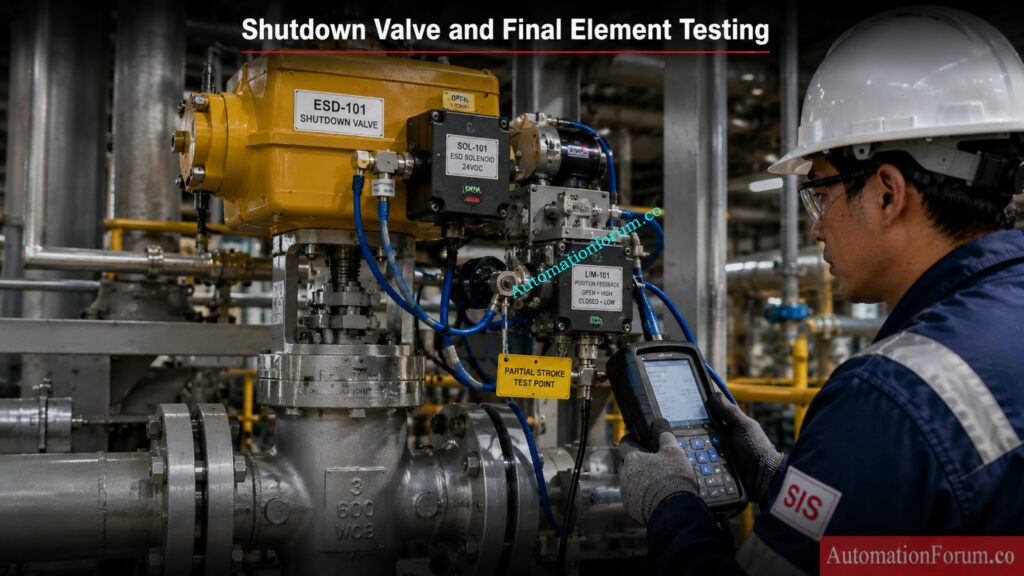
Shutdown Valve and Final Control Element Inspection
| Sl No | Inspection Area | Equipment / Tag | Inspection Requirement | Expected Condition | Inspection Method | Frequency |
| 31 | Shutdown Valve | XV-101 | Partial stroke testing | Smooth movement | PST system | Monthly |
| 32 | ESD Valve | SDV-201 | Leakage verification | No passing leakage | Leak test | Quarterly |
| 33 | Solenoid Valve | SOV-101 | Coil resistance check | Normal resistance | Multimeter | Monthly |
| 34 | MOV | MOV-401 | Position feedback | Accurate indication | Functional test | Monthly |
| 35 | Pneumatic Supply | Air Header | Air pressure monitoring | Stable pressure | Pressure gauge | Daily |
| 36 | Valve Stroke | SDV-202 | Stroke timing | Within design limit | Stroke timer | Quarterly |
| 37 | Fail Safe Action | Shutdown Valve | Fail-safe verification | Correct fail position | Functional test | Shutdown |
| 38 | Mechanical Integrity | Valve Assembly | Obstruction check | No obstruction | Visual inspection | Monthly |
| 39 | Positioner Feedback | Valve Positioner | Signal response | Stable response | Loop test | Quarterly |
| 40 | Bypass Valve | Manual Bypass | Position verification | Closed and locked | Visual inspection | Daily |
Master hazardous area installation rules using IEC 60079-14 guide: IEC 60079-14 Explained: Complete Guide to Hazardous Area Installation for Instrumentation and Control Systems
Section E – SIS Alarm and Bypass Management Checklist
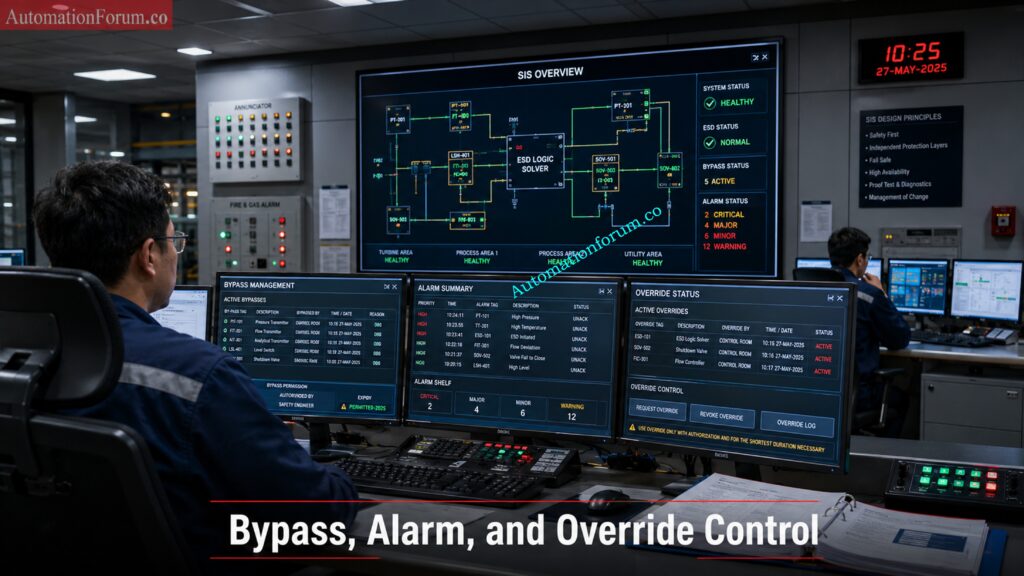
SIS Bypass and Override Monitoring
| Sl No | Inspection Area | Equipment / Tag | Inspection Requirement | Expected Condition | Inspection Method | Frequency |
| 41 | Bypass Monitoring | SIS Bypass | Active bypass review | Authorized only | Bypass log review | Daily |
| 42 | Override Management | Temporary Override | Timeout verification | Within approved limit | Override report | Daily |
| 43 | Alarm Management | Alarm System | Alarm shelving review | No stale shelving | Alarm review | Daily |
| 44 | Alarm Flood | Operator Station | Alarm flood analysis | Controlled alarm rate | Alarm analytics | Weekly |
| 45 | Key Control | Bypass Key | Key management verification | Controlled access | Audit check | Weekly |
Learn redundant transmitter logic and SIL concepts with examples: Redundant Transmitters Explained: Reliability, Voting Logic and SIL for Instrumentation Engineers
Section F – SIS UPS and Power Supply Inspection Checklist
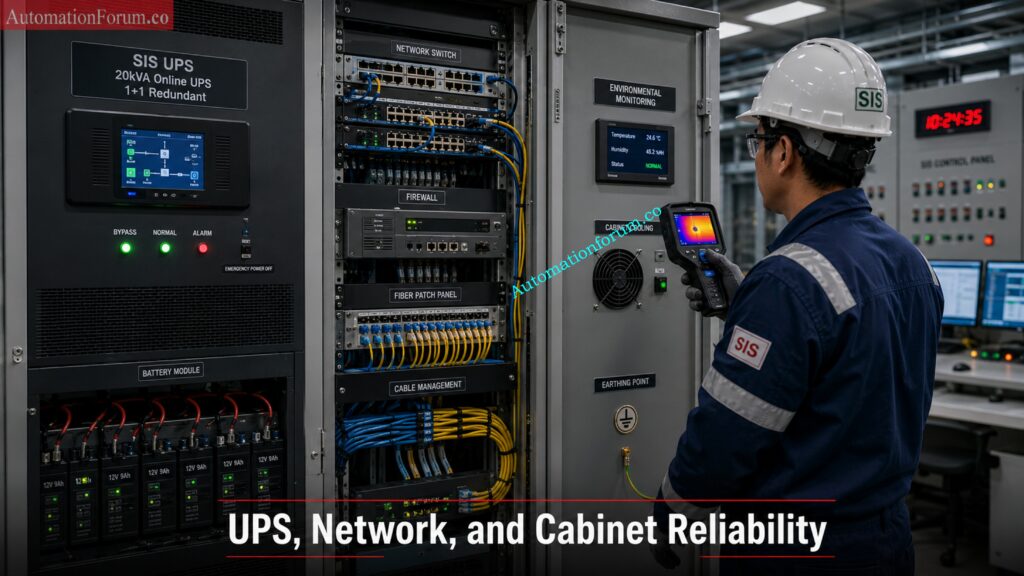
SIS Power Reliability Inspection
| Sl No | Inspection Area | Equipment / Tag | Inspection Requirement | Expected Condition | Inspection Method | Frequency |
| 46 | UPS Health | UPS Panel | UPS status monitoring | Healthy operation | HMI / UPS panel | Daily |
| 47 | Battery Voltage | UPS Battery | Battery condition | Stable voltage | Battery tester | Monthly |
| 48 | Charger Health | Charger Unit | Charger verification | Normal charging | Indicator check | Weekly |
| 49 | Earthing | SIS Panel | Earthing continuity | Low resistance | Earth tester | Quarterly |
| 50 | Panel Temperature | SIS Cabinet | Temperature monitoring | Normal temperature | Thermal scanner | Weekly |
Understand practical differences between ESD and SIS safety systems: ESD vs SIS Difference When to Use Each and Practical Engineering Guide
Section G – SIS Communication and Network Inspection Checklist
SIS Network and Cybersecurity Inspection
| Sl No | Inspection Area | Equipment / Tag | Inspection Requirement | Expected Condition | Inspection Method | Frequency |
| 51 | Safety Network | SIS Ethernet | Communication stability | No packet loss | Diagnostics | Weekly |
| 52 | Fiber Link | Fiber Network | Fiber health verification | Healthy link | OTDR / diagnostics | Quarterly |
| 53 | Switch Health | Network Switch | Port diagnostics | No failed ports | Switch monitoring | Weekly |
| 54 | Firewall | SIS Firewall | Security monitoring | No unauthorized event | Security logs | Weekly |
| 55 | Network Latency | SIS Communication | Latency monitoring | Within limit | Monitoring software | Monthly |
Confused about SIS, SIF and SIL? Start learning here: What is SIS, SIF and SIL? An In-Depth Guide to Functional Safety in Process Industries
Section H – SIS Panel and Environmental Inspection Checklist
SIS Cabinet and Instrument Room Inspection
| Sl No | Inspection Area | Equipment / Tag | Inspection Requirement | Expected Condition | Inspection Method | Frequency |
| 56 | Panel Cleanliness | SIS Cabinet | Dust inspection | Clean condition | Visual inspection | Weekly |
| 57 | Cooling Fan | Panel Fan | Fan operation | Proper airflow | Physical inspection | Monthly |
| 58 | HVAC | Instrument Room | HVAC condition | Stable temperature | HVAC check | Weekly |
| 59 | Water Ingress | Panel Door | Seal inspection | No ingress | Visual inspection | Monthly |
| 60 | Corrosion | Terminal Blocks | Corrosion inspection | No corrosion | Visual inspection | Quarterly |
Simplify SIL verification and PFDavg calculations with practical methods: SIF PFDavg / SIL Verification – Complete Guide + Online Calculator (IEC 61508 / 61511)
Section I – Functional Safety Compliance Inspection Checklist
IEC 61511 Functional Safety Compliance Verification
| Sl No | Inspection Area | Equipment / Tag | Inspection Requirement | Expected Condition | Inspection Method | Frequency |
| 61 | SIL Records | SIS Documentation | SIL verification review | Updated records | Document audit | Quarterly |
| 62 | Proof Test | SIF Loop | Proof test due review | No overdue tests | Maintenance records | Monthly |
| 63 | Cause and Effect | Shutdown Matrix | Logic validation | Accurate sequence | Review / test | Quarterly |
| 64 | SRS | Safety Requirement Spec | SRS availability | Approved copy available | Document review | Quarterly |
| 65 | Lifecycle Documents | SIS System | Documentation completeness | Updated lifecycle records | Audit | Annual |
Learn IEC testing and repair deferral best practices for safety: Testing and Repair Deferral – IEC Guidelines, Procedure, and Best Practices
Section J – Operator and Maintenance Practice Inspection Checklist
SIS Operational Discipline and Safety Culture Inspection
| Sl No | Inspection Area | Equipment / Tag | Inspection Requirement | Expected Condition | Inspection Method | Frequency |
| 66 | Bypass Logbook | Shift Records | Logbook review | Updated entries | Document review | Daily |
| 67 | Shift Handover | Operations | Safety communication | Complete communication | Interview / review | Daily |
| 68 | Operator Awareness | Operations Team | SIS awareness check | Adequate knowledge | Interview | Monthly |
| 69 | PTW Compliance | Maintenance Work | Permit verification | Proper permit usage | Audit | Weekly |
| 70 | Emergency Preparedness | Operations Team | Emergency readiness | Prepared personnel | Drill review | Quarterly |
Download important functional safety terms used in industrial automation: Functional Safety Terminology – Excel Download for Industrial Automation
Common SIS Failures and Troubleshooting Guide
Common Safety Instrumented System Problems in Industrial Plants
| Abnormality | Probable Cause | Recommended Action |
| Frequent false trips | Ground loop or signal noise | Verify shielding and grounding |
| Valve sluggish movement | Corrosion or air leakage | Perform maintenance and PST |
| Sensor drift | Aging transmitter sensor | Recalibrate or replace sensor |
| CPU redundancy mismatch | Firmware inconsistency | Synchronize firmware |
| Water ingress in JB | Failed gland sealing | Replace cable gland |
| Gas detector unstable | Sensor poisoning | Replace sensing element |
| High panel temperature | HVAC failure | Restore cooling immediately |
| Communication alarm | Fiber issue | Inspect switch and fiber link |
Discover how emergency block valves protect critical process industries: What is an Emergency Block valve and How does it work
SIS Troubleshooting and Corrective Actions
| Issue | Symptom | Root Cause | Impact | Corrective Action |
| Spurious Trips | Unexpected shutdown | Noise or grounding issue | Production loss | Improve grounding |
| Solenoid Failure | Valve not actuating | Coil burnout | Failed shutdown | Replace solenoid |
| Valve Sticking | Delayed response | Corrosion | Unsafe shutdown delay | Lubrication / maintenance |
| Sensor Drift | Incorrect reading | Aging sensor | Unsafe process operation | Calibration |
| Communication Failure | Loss of signal | Network issue | SIS unavailable | Restore communication |
| CPU Mismatch | Redundancy alarm | Sync failure | Reduced availability | CPU synchronization |
| Power Fluctuation | System reboot | UPS instability | SIS interruption | UPS maintenance |
| Ground Loop | Signal fluctuation | Poor grounding | False trip | Improve earthing |
| Water Ingress | Corrosion | Failed sealing | Equipment damage | Replace seals |
| Gas Detector Poisoning | Slow response | Sensor contamination | Gas leak undetected | Sensor replacement |
Recommended SIS Inspection Frequencies
| Inspection Activity | Recommended Frequency |
| Critical alarm review | Daily |
| Bypass verification | Daily |
| CPU diagnostics review | Daily |
| UPS inspection | Weekly |
| Sensor diagnostics review | Weekly |
| Valve partial stroke test | Monthly |
| Proof test review | Monthly |
| Network diagnostics | Monthly |
| SIL verification review | Quarterly |
| Full functional test | Annual |
| Shutdown inspection | During turnaround |
Learn how HIPPS systems prevent dangerous process overpressure conditions: How does the HIPPS system work in the Oil and gas Industry?
Advanced SIS Inspection Checklist Excel Workbook
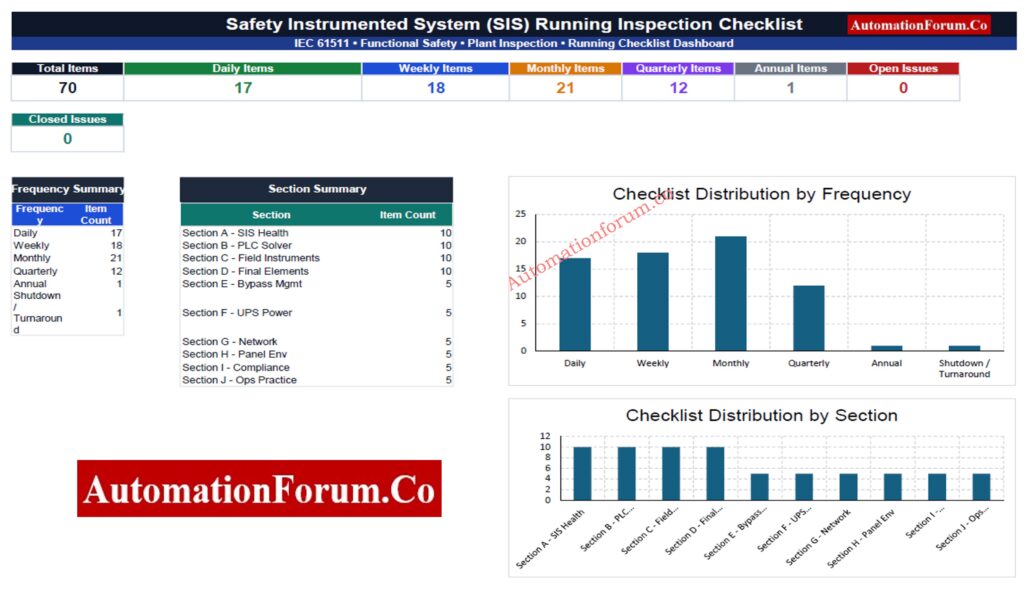
Professional and fully editable Safety Instrumented System (SIS) running inspection checklist workbook designed for IEC 61511 compliance, plant audits, shutdown reliability, safety PLC monitoring, field instrument inspection, and functional safety management. Includes dashboard, master checklist, section-wise inspection tabs, corrective action tracking, filters, dropdowns, conditional formatting, and due-date monitoring.
IEC 61511 SIS Best Practices
Functional Safety Best Practices for SIS Reliability
- Maintain complete functional safety lifecycle documentation.
- Ensure all proof tests are traceable.
- Implement strict Management of Change (MOC).
- Review cause and effect matrices regularly.
- Maintain spare solenoids, relays, and transmitters.
- Conduct regular functional safety audits.
- Use cybersecurity monitoring for SIS networks.
- Train operators on alarm response procedures.
- Minimize nuisance shutdowns through proper maintenance.
SIS Shutdown and Startup Inspection Best Practices
- Verify all bypasses before startup.
- Perform stroke testing after maintenance.
- Confirm transmitter impulse lines are free from blockage.
- Validate fail-safe action after shutdown work.
- Review all temporary modifications before startup.
Refer the below link for the Understanding 2 out of 2 SOV: Working & Configuration
Conclusion: Why Regular SIS Inspection Is Essential for Industrial Safety
Role of Inspection in Preventing Catastrophic Accidents
A reliable Safety Instrumented System is one of the most important protective barriers in any modern industrial facility. Its performance depends not only on good engineering design but also on disciplined inspection, proof testing, maintenance, and lifecycle management.
Building a Strong Functional Safety Culture
A strong functional safety culture requires close coordination between operations, maintenance, instrumentation, engineering, and management. The SIS long-term reliability depends on proper bypass management, correct documentation, alert management, cybersecurity awareness and disciplined MOC practices.
IEC 61511, for example, is quite explicit that functional safety is a lifecycle duty rather than a project that you do once.
That means inspection routines, audits, proof testing, and competency development must remain active throughout the plant’s operating life.
Long-Term Benefits of a Structured SIS Inspection Program
Learn essential shutdown signals used for emergency valve protection: Signals for Emergency Valve Shutdown in Critical Processes
 inspection checklist for IEC 61511 compliance, SIL verification, shutdown valve testing, safety PLC monitoring, and functional safety audits.)