
- Why Control Valve Sizing Software Is Important in Modern Industries
- Top 10 Control Valve Sizing Software Used By Engineers
- Emerson Fisher Specification Manager and ValveLink
- Valmet Nelprof Control Valve Sizing Software
- Samson Valve Sizing Software for Steam and Thermal Systems
- Flowserve Valtek STARPAC Tools for Severe Service Applications
- Siemens COMOS Valve Engineering for EPC Projects
- Honeywell Control Valve Sizing Tool for Automation Projects
- Bray BII Sizing Software for Butterfly and Quarter Turn Valves
- ARI myValve for Steam and Utility Service
- Habonim HVS for Hygienic and Specialty Systems
- Kent Introl Valve Sizing Software for High Pressure Severe Service
- Comparison Table Of The Best Control Valve Sizing Software
- How To Select The Right Control Valve Sizing Software
- Choosing Software for EPC Projects
- Choosing Software for Oil and Gas Applications
- Choosing Software for Chemical Plants
- Choosing Software for Water Treatment and Utility Service
- Choosing Software for Steam Applications
- Choosing Software for Severe Service Valves
- Budget, Team Experience, and Integration Requirements
- Common Mistakes Engineers Make While Using Valve Sizing Software
- Future Trends In Control Valve Sizing Software
- Frequently Asked Questions About Control Valve Sizing Software
- What Is Control Valve Sizing Software?
- Which Is The Best Control Valve Sizing Software?
- What Is Cv In Control Valves?
- Why Is Valve Sizing Important?
- Can Valve Sizing Software Predict Cavitation?
- Can Valve Sizing Software Calculate Noise?
- Is Valve Sizing Software Free?
- What Standards Are Used In Valve Sizing?
- What is rated Cv and calculated Cv
- What is the Bray sizing program
- What is the rule of thumb for control valve sizing
- What Happens If A Control Valve Is Oversized?
- Can Software Replace Engineering Judgment?
- Why Proper Valve Sizing Matters for Plant Reliability
- The Role of Advanced Control Valve Sizing Software in Modern Industry
Control valve sizing looks simple on paper, but in the plant it decides whether a process runs smoothly or becomes a maintenance problem. A valve that is too small can starve the system and limit production. A valve that is too large can create unstable control, poor rangeability, excessive wear, and wasted energy. In severe services, poor sizing can also lead to cavitation, flashing, vibration, and unacceptable noise. That is why Control Valve Sizing Software has become a practical engineering tool for instrumentation teams, EPC consultants, process engineers, and valve specialists who need accurate Cv calculation and dependable valve selection.
Can You Solve These Cavitation Failure Problems: Control Valve Cavitation Troubleshooting Quiz for Instrumentation and Control Engineers
Why Control Valve Sizing Software Is Important in Modern Industries
A control valve is not just a final element. It is part of the process control loop, and its performance affects product quality, operating cost, equipment life, and plant stability. In many plants, the valve is the point where process energy is intentionally removed. If that energy is not managed correctly, the valve becomes the source of trouble instead of the solution.
Accurate Cv Calculation for Reliable Valve Selection
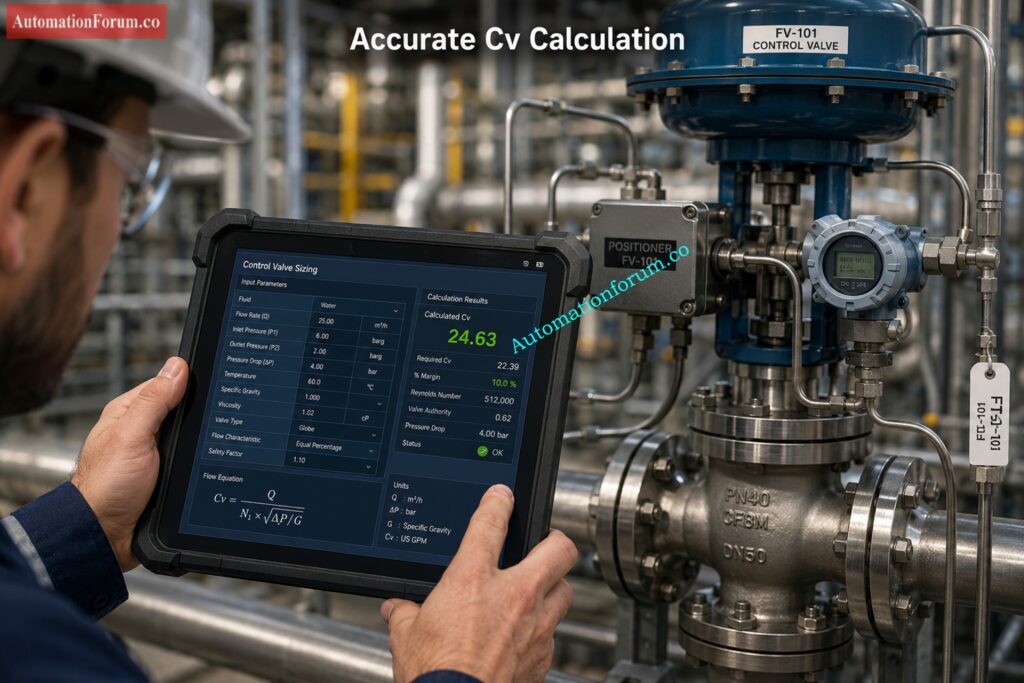
Cv is the flow coefficient that tells engineers how much fluid a valve can pass at a given pressure drop. Accurate Cv calculation is the foundation of proper valve sizing because it connects process demand with valve capacity. If the Cv is too low, the valve becomes a bottleneck. If it is too high, the valve may operate in a narrow travel range and lose control quality.
In real plant work, this shows up in applications such as chemical dosing, steam pressure reduction, fuel gas control, and cooling water regulation. A valve that never opens far enough will create chronic restriction. A valve that spends all day nearly closed will respond poorly and often become unstable.
ISA and IEC Based Control Valve Sizing Standards
Professional valve sizing is not based on guesswork. It follows recognized engineering methods such as ISA and IEC sizing standards. These standards help ensure that calculations are repeatable, defensible, and usable across project teams, vendor packages, and site operations.
For EPC engineers, this matters because the same valve may be reviewed by process, instrumentation, mechanical, and operations teams. A software tool that follows standard methods reduces confusion and improves consistency. It also helps create clean datasheets and engineering records that can be used during procurement and commissioning.
Cavitation and Flashing Prediction in Control Valves

In liquid service, one of the most important tasks of sizing software is to identify cavitation risk. Cavitation occurs when local pressure falls below vapor pressure and vapor bubbles form inside the valve. When those bubbles collapse, they create shock waves that can damage the trim, produce severe noise, and shorten service life.
Flashing is different. In flashing, the pressure drop is severe enough that the fluid remains partially vaporized after passing through the valve. That can lead to erosion, vibration, and rapid deterioration of the flow passage.
These risks are especially important in hydrocarbon systems, condensate service, boiler blowdown, and any liquid line with a high pressure drop. Good software helps the engineer detect these problems early and select a more suitable trim or pressure reduction arrangement.
Noise Prediction in Gas and Steam Service
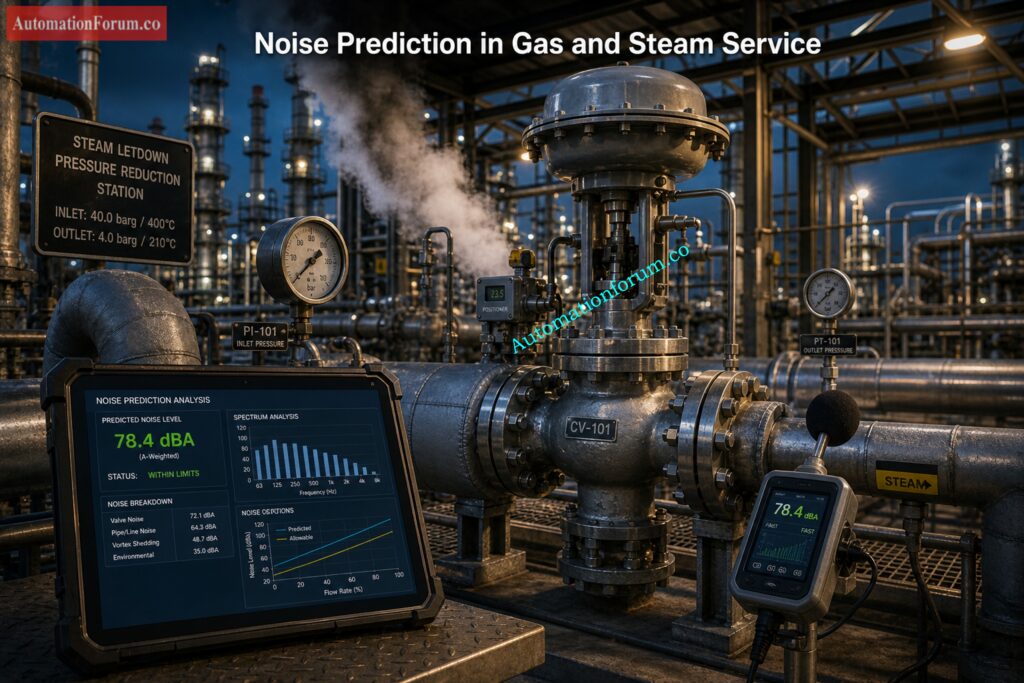
Gas and steam valves can create very high noise levels if the pressure reduction is not managed properly. High velocity flow through a valve generates turbulence, and that turbulence becomes acoustic energy. In power plants and process units, this is not only an equipment issue. It is also a personnel safety and compliance issue.
Modern Control Valve Sizing Software helps estimate noise so that engineers can choose low noise trims, multistage designs, diffusers, or special valve bodies before the system goes into service. This is especially useful in steam letdown stations, compressor recycle loops, gas pressure reduction systems, and refinery utility networks.
Best Valve Body Materials for Harsh Process Conditions: Control Valve Body Material Selection Guide for EPC Design Instrumentation Engineers
Actuator Sizing and Valve Authority in Process Control
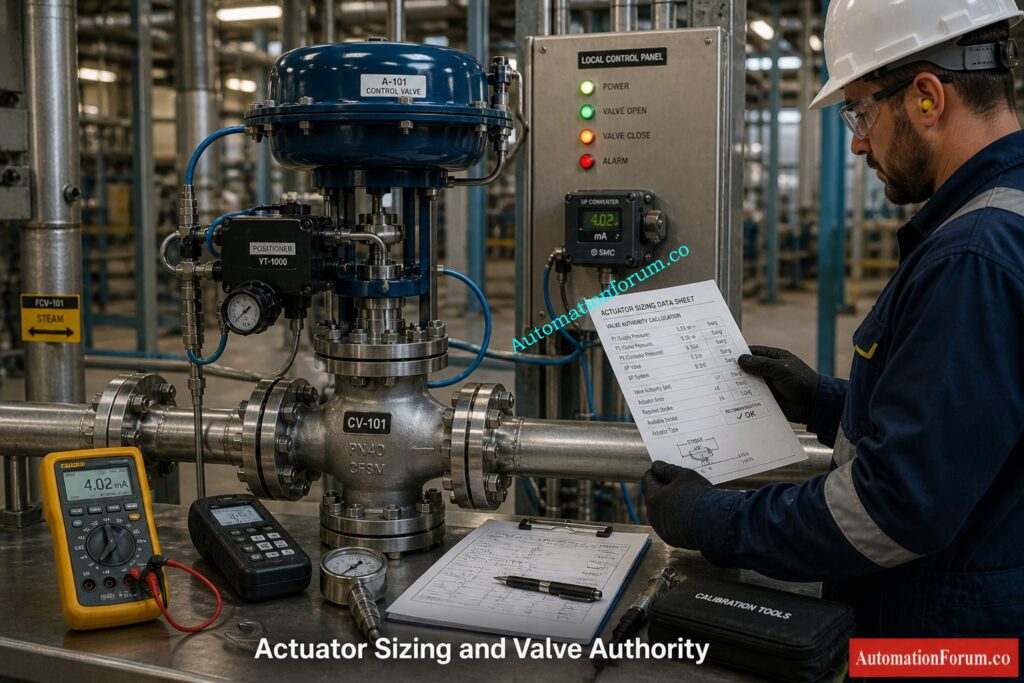
Valve sizing is not complete without actuator sizing. Even if the valve body is correct, the actuator must be able to move it reliably under all operating conditions. That includes normal control, emergency shutoff, and high differential pressure conditions.
Energy Efficiency and Process Stability Benefits
Correctly sized valves waste less energy because they avoid excessive throttling. That matters in pumping systems, compressed gas systems, and steam networks where every extra pressure loss raises the cost of running the system. A valve that is the right size also helps keep process control stable, which means less work for the operator and no changes in the product.
This means that in practice, there will be fewer maintenance problems, better batch uniformity, better temperature management, and smoother pressure regulation. That is why good sizing software is not just a design tool. It is part of plant reliability and operational efficiency.
Download the Ultimate Liquid Valve Sizing Spreadsheet: Control Valve Sizing Excel tool Without Iteration: Liquid Application
Top 10 Control Valve Sizing Software Used By Engineers
The best software depends on the service, the industry, the project scale, and the type of engineering workflow. Some tools are built for severe service and critical applications. Others are better for EPC documentation, steam systems, hygienic plants, or quarter turn valve work. The following platforms are among the best known in process industries.
Emerson Fisher Specification Manager and ValveLink
Engineering Profile
Emerson Fisher Specification Manager is one of the most respected tools in the field of Control Valve Sizing Software. It is widely used in refining, oil and gas, petrochemicals, LNG, and power generation because it supports detailed engineering decisions rather than just basic flow calculations. ValveLink complements it by adding diagnostics, performance checks, and smart valve insight when FIELDVUE devices are used.
Why Engineers Use It
Calculate Actuator Torque and Sizing with Confidence: Valve Actuator Sizing Calculator – Complete Engineering Guide
Strengths And Limitations
Its biggest strength is depth. The technology lets engineers test how a valve will work in real life, not only in perfect settings. The downside is that it is more complicated than a basic calculator, thus new users usually need some training. It is also a paid platform, which is expected for this level of engineering capability.
Best Fit
It is a strong choice for critical hydrocarbon service, high pressure applications, and severe service loops where reliability matters more than simplicity.
Test Your Skills in Eliminating Valve Oscillation Issues: Control Valve Hunting Troubleshooting – Advanced MCQ Quiz
Valmet Nelprof Control Valve Sizing Software
Engineering Profile
Valmet Nelprof is a practical and well known valve sizing platform used in process industries that need reliable selection and strong control performance. It is especially useful in pulp and paper, chemical processing, and utility systems.
Why Engineers Use It
Nelprof supports liquid, gas, and steam sizing and helps engineers evaluate cavitation, noise, and actuator requirements. It is often appreciated for its clear workflow, which makes it easier to move from process data to valve recommendation without unnecessary complexity.
Strengths And Limitations
The software is user friendly and technically solid. It works well for teams that want dependable engineering support without dealing with an overly complicated interface. Its limitation is not technical weakness, but lower familiarity in some EPC environments compared to larger global vendor packages.
Best Fit
It is a strong choice for engineers who want practical sizing support, stable control behavior, and a straightforward design workflow.
Essential QA Checklist for Control Valve Inspection: Inspection and Test Plan (ITP) for Control Valves
Samson Valve Sizing Software for Steam and Thermal Systems
Engineering Profile
Samson is strongly associated with steam service and European process applications. Its sizing software is widely used for flow coefficient calculations, valve selection, and pressure drop analysis in thermal and utility systems.
Why Engineers Use It
Steam systems require careful attention because pressure, temperature, density, and acoustic energy can change rapidly through the valve. Samson software is useful because it helps engineers handle steam letdown, thermal utilities, and pressure reduction duties with more confidence.
Strengths And Limitations
Its strength is its strong steam engineering focus. It also supports cavitation and noise evaluation, which is valuable in high energy systems. The main limitation is that beginners may need time to become comfortable with the workflow, especially if they are used to simpler calculators.
Best Fit
It is a strong option for power plants, steam distribution systems, and process utilities where thermal behavior must be handled carefully.
Engineer Accurate Cv Values Using ISA Standards: Control Valve Sizing Calculator: Complete ISA S75.01 Cv Calculation Guide for Instrumentation Engineers
Flowserve Valtek STARPAC Tools for Severe Service Applications
Engineering Profile
Flowserve is a serious name in severe service valve technology, and its engineering tools reflect that focus. The platform is used for difficult applications where pressure drop, erosion, cavitation, or gas noise must be managed carefully.
Why Engineers Use It
The tools are particularly useful for trim selection, severe service analysis, noise prediction, and diagnostics. In compressor recycle service, refining, and LNG work, the ability to evaluate the valve beyond simple Cv becomes very important.
Strengths And Limitations
Flowserve tools are valuable because they help engineers think about how the valve will survive in difficult service. The limitation is that the platform is more specialized than a general purpose sizing tool. It is best used by engineers who understand the process context and need strong technical depth.
Best Fit
It is ideal for high pressure, high velocity, and severe service applications where long term reliability is critical.
The Real Difference Between Turndown and Rangeability: Understanding Rangeability vs Turndown Ratio in Control Valve Sizing
Siemens COMOS Valve Engineering for EPC Projects
Engineering Profile
Siemens COMOS Valve Engineering is part of a larger enterprise engineering environment. It is not only about valve sizing. It is about integrating valve data into a broader plant information system.
Why Engineers Use It
This tool is especially attractive for EPC projects because it helps maintain consistency across documentation, process data, and engineering deliverables. Valve selection, datasheet management, and multidisciplinary coordination become easier when the same engineering environment is used across the project.
Strengths And Limitations
Its major strength is integration. It helps prevent mismatched data across departments and supports structured engineering workflows. The downside is that it can be harder to put into place and a small team may not need it for infrequent size work.
Best Fit
It’s a great solution for big projects, engineering teams at big companies, and plants that value digital continuity across all areas of work.
Excel Sheet for Critical Flow Valve Engineering Calculations: Control Valve Sizing Calculation Worksheet for Critical and Sub-Critical Flow: Excel Tool
Honeywell Control Valve Sizing Tool for Automation Projects
Engineering Profile
Honeywell is a well-known name in process automation, and its valve sizing tool fits right in with that. It supports engineers who work within control system centric projects and want sizing to align with the broader automation strategy.
Why Engineers Use It
The tool supports valve selection, Cv calculation, and sizing for liquid, gas, and steam service. It is useful when the valve must be designed as part of an integrated automation architecture rather than as a standalone component.
Field Proven SAT Procedure for Control Valve Commissioning: Control Valve Site Acceptance Test (SAT) Procedure – Step-by-Step Field Guide
Strengths And Limitations
Its strength is workflow consistency. Engineers already working with Honeywell systems may find it easier to stay within a familiar ecosystem. The limitation is that it is less widely used outside Honeywell centered environments, so some teams may have less exposure to it.
Best Fit
It works well in integrated automation projects where control system alignment is a priority.
Instant Gas Valve Capacity Conversion Made Simple: Cv to Cg for Gases Conversion Calculator: Control Valve Sizing
Bray BII Sizing Software for Butterfly and Quarter Turn Valves
Engineering Profile
Why Engineers Use It
The platform supports flow calculations, actuator sizing, and torque analysis for quarter turn valves. That makes it useful for large diameter lines and simpler flow control duties where fast engineering support is needed.
Strengths And Limitations
Its main strength is simplicity. It is easy to use and practical for everyday engineering tasks. Its limitation is that it is not intended for advanced severe service analysis, so applications involving cavitation, flashing, or complex noise prediction may require a more specialized tool.
Best Fit
It is well suited to water, utilities, and general industrial service where quarter turn valve selection is the main requirement.
Fast Track Liquid Valve Calculations Without Iteration: Control Valve Sizing Excel tool Without Iteration: Liquid Application
ARI myValve for Steam and Utility Service
Engineering Profile
ARI myValve is closely associated with steam systems, condensate service, and thermal utilities. It is especially useful in plants where energy management and pressure reduction behavior must be understood clearly.
Why Engineers Use It
The software is strong in steam sizing and utility calculations. It supports thermal engineering decisions in power plants, food processing facilities, pharmaceutical utilities, and process plants that rely heavily on steam.
Strengths And Limitations
Its strength is focus. Instead of trying to do everything, it concentrates on steam and utility service, where accuracy matters most. The limitation is that it is more specialized than broad multi industry platforms.
Best Fit
It is a strong choice for steam pressure reduction, condensate recovery, and utility systems engineering.
Improve Plant Stability Through Smarter Valve Sizing: Control Valve Sizing For The Process Performance
Habonim HVS for Hygienic and Specialty Systems
Engineering Profile
Habonim HVS serves hygienic, high purity, and specialty process systems. It is most relevant for pharmaceutical, biotech, and food processing applications where cleanliness and product integrity matter.
Why Engineers Use It
The software helps with sizing in sanitary and specialty systems, especially where ball valve based solutions are involved. It supports a clean engineering workflow for process lines that must meet hygiene and quality requirements.
Strengths And Limitations
Its strength is practicality in specialized hygienic applications. The limitation is that it is not aimed at aggressive severe service or high pressure hydrocarbon work. It is more focused on purity, reliability, and process cleanliness.
Best Fit
It is well suited to sanitary process industries and high purity applications where careful valve selection matters.
Complete Severe Service Anti Surge Valve Engineering Guide: Anti-Surge Control Valve Selection and Sizing – Complete Engineering Guide
Kent Introl Valve Sizing Software for High Pressure Severe Service
Engineering Profile
Kent Introl is associated with severe service and high performance control valve work. Its sizing software is designed for difficult process conditions where erosion, cavitation, and noise can become serious concerns.
Why Engineers Use It
The tool is useful in oil and gas, offshore systems, power generation, and other heavy industrial services. It helps the engineer think about pressure drop, trim durability, and real world operating stress instead of only basic flow demand.
Strengths And Limitations
Its strength lies in severe service thinking and practical reliability. It helps engineers select a valve that can survive the duty, not just pass the required flow. The limitation is that it is specialized, so it is most useful to teams that already understand difficult valve service.
Best Fit
It is a strong choice for erosive, noisy, or high differential pressure service where valve life and stability are both important.
Comparison Table Of The Best Control Valve Sizing Software
| Software | Best For | Cavitation Prediction | Noise Analysis | ISA Compliance | Ease Of Use | Free Or Paid | Key Strengths | Main Limitation |
| Emerson Fisher Specification Manager and ValveLink | Severe service, critical control loops, refining, LNG, oil and gas | Advanced | Advanced | Yes | Moderate | Paid | Strong severe service capability, detailed sizing logic, smart valve diagnostics, strong datasheet output, good for anti cavitation trim selection | Can feel complex for beginners and needs some training |
| Valmet Nelprof | General process industries, pulp and paper, chemical plants, utility systems | Yes | Yes | Yes | High | Paid | Easy workflow, reliable sizing, good process oriented analysis, practical for engineering and maintenance teams | Less common in some EPC environments compared with larger global vendor platforms |
| Samson Valve Sizing Software | Steam systems, thermal utilities, pressure reducing stations | Yes | Yes | Yes | Moderate | Paid | Very strong steam service support, good pressure drop analysis, useful for thermal and utility applications | May need time for users who are new to steam engineering tools |
| Flowserve Valtek STARPAC Tools | High severity service, recycle loops, severe gas and liquid service | Advanced | Advanced | Yes | Moderate | Paid | Excellent for severe service thinking, trim evaluation, noise control, and diagnostic oriented valve engineering | More specialized than general purpose sizing tools |
| Siemens COMOS Valve Engineering | EPC projects, enterprise engineering, plant wide documentation control | Moderate | Moderate | Yes | Moderate | Paid | Strong integration with engineering workflows, good for document control, data consistency, and large multidisciplinary projects | Heavier to implement and may be more than a small team needs |
| Honeywell Control Valve Sizing Tool | Automation integrated projects, process plants using Honeywell systems | Yes | Yes | Yes | High | Paid | Works well inside integrated control and automation environments, good for practical valve selection and process alignment | Less widely used outside Honeywell centered environments |
| Bray BII Sizing Software | Butterfly valves, quarter turn valves, water and utility service | Basic | Basic | Yes | High | Paid | Simple to use, practical for torque and actuator selection, good for large diameter utility and water applications | Not built for advanced severe service analysis |
| ARI myValve | Steam and utility service, condensate systems, thermal engineering | Moderate | Moderate | Yes | High | Paid | Strong focus on steam and energy applications, useful for pressure reduction and condensate recovery work | More specialized for utilities than for aggressive process service |
| Habonim HVS | Hygienic systems, pharmaceutical, biotech, food processing | Basic | Basic | Yes | High | Paid | Suitable for sanitary and high purity applications, simple and practical for specialty valve selection | Not intended for deep severe service or high pressure hydrocarbon duties |
| Kent Introl Valve Sizing Software | Severe service, high pressure, erosive service, oil and gas | Advanced | Advanced | Yes | Moderate | Paid | Strong severe service orientation, good for trim durability thinking, useful in difficult operating conditions | More specialized and best for engineers familiar with severe service applications |
How EPC Engineers Select On Off Valves Correctly: ON OFF Control Valve Type Selection Procedure for EPC Engineering
How To Select The Right Control Valve Sizing Software
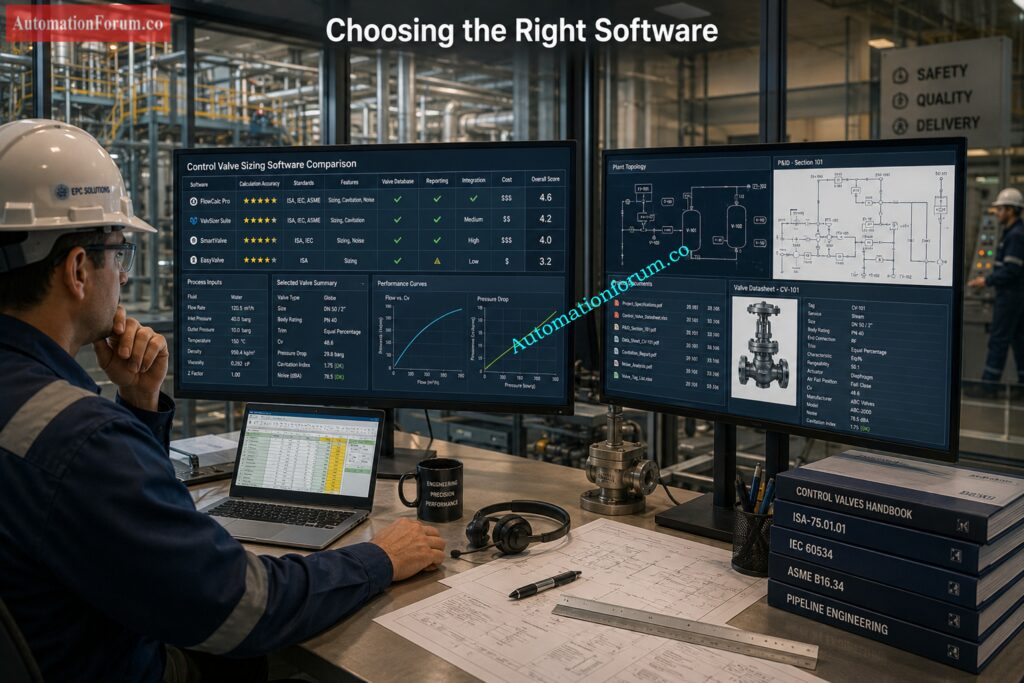
Selecting the right software starts with understanding the application, not just the brand name.
Choosing Software for EPC Projects
For EPC projects, data consistency and document control matter a lot. The software should support standard datasheets, engineering collaboration, and traceable calculations. In this environment, integrated platforms are often more useful than simple calculators because many teams must work from the same technical basis.
Choosing Software for Oil and Gas Applications
Oil and gas projects usually involve severe service, high pressure differentials, hydrocarbon fluids, and demanding operating conditions. The software should support cavitation prediction, flashing checks, acoustic analysis, and actuator sizing. In this area, advanced engineering depth is more important than ease of use alone.
Choosing Software for Chemical Plants
Chemical plants often need stable control, repeatable performance, and strong process awareness. The software should help the engineer avoid oversizing while still protecting against flow instability and trim wear. Accuracy and practical control behavior matter as much as theoretical flow capacity.
Choosing Software for Water Treatment and Utility Service
Water and utility systems often have simpler service conditions, but they still require correct sizing. A valve that is too large can create poor response, while a valve that is too small can limit system performance. In these plants, ease of use and dependable flow calculation may be the deciding factors.
Choosing Software for Steam Applications
Steam service requires careful attention to pressure, temperature, noise, and energy loss. The ideal software should evaluate the full thermal picture rather than just flow capacity. Steam letdown stations are especially sensitive to incorrect assumptions.
Choosing Software for Severe Service Valves
Severe service work is where specialized software really proves its value. The right tool should help with cavitation, flashing, trim selection, and acoustic performance. In many cases, long term reliability depends on how well the software reflects real process stress.
Budget, Team Experience, and Integration Requirements
Cost always matters, but it should not be the only deciding factor. A cheaper tool that produces poor decisions can become far more expensive later. At the same time, the software must fit the team’s skill level. A powerful package is only useful when engineers can interpret the results correctly.
Common Mistakes Engineers Make While Using Valve Sizing Software
Even the best Control Valve Sizing Software can lead to a poor outcome if the inputs are wrong or the results are misunderstood.
Wrong Process Data and Incorrect Pressure Units
Incorrect flow rate, pressure, temperature, or fluid properties can distort the entire calculation. The software will only be as reliable as the data given to it.
One of the simplest mistakes is also one of the most damaging. Confusing gauge pressure with absolute pressure, or mixing units during data entry, can give the wrong answer very quickly.
Ignoring Vapor Pressure and Cavitation Risk
In liquid service, vapor pressure must be considered carefully. If it is ignored, cavitation risk can be missed and the selected valve may fail early.
Oversizing the Control Valve
Oversizing is extremely common in practice. Engineers often add too much margin, but an oversized valve is usually harder to control than a correctly sized one. It leads to poor rangeability and unstable loop behavior.
Ignoring Valve Authority and Installed Characteristics
Using the Wrong Fluid Properties
Incorrect density, viscosity, or compressibility values can change the calculation significantly. This matters in gas, steam, and mixed phase service.
Not Validating the Final Sizing Result
Software is a tool, not a substitute for engineering review. Good practice means checking the output against operating conditions, process goals, and field experience.
Prevent Power Supply Undersizing in Instrument Systems: Instrument Power Supply Load Calculator: 7 Critical Steps for Accurate 24VDC Power Supply Sizing
Future Trends In Control Valve Sizing Software
The future of valve engineering is moving toward smarter, more connected, and more predictive tools.
AI Based Valve Sizing
Artificial intelligence may soon help engineers refine valve selection by learning from historical plant behavior. That could reduce oversizing and improve real world valve performance.
Digital Twins in Control Valve Engineering
Digital twins can simulate valve behavior within the full process environment. This gives engineers a much better picture of how the valve will actually perform after installation.
Cloud Based Engineering Collaboration
Cloud based tools make it easier for project teams in different locations to work on the same engineering data at the same time. That supports collaboration and reduces version conflicts.
Predictive Maintenance and Smart Diagnostics
Future systems will link valve sizing data with real operating diagnostics. That means maintenance teams will be able to identify wear, instability, or degradation before the valve fails.
IoT Integration and Machine Learning Analytics
Smart valves are already sending more operating data back into plant systems. That data will increasingly support better sizing, diagnostics, and lifecycle decisions.
Machine Learning Diagnostics
Machine learning may help identify sticking, leakage, erosion, and actuator issues faster than traditional manual review. That will make valve performance analysis more proactive.
Remote Collaboration
Smart Valve Analytics
The long term direction is clear. Software will not only size the valve, it will also explain how to maintain it, improve it, and monitor it throughout its service life.
How Three Way Valves Improve Process Temperature Control: Application of 3 – Way Control Valve in Process Control Systems
Frequently Asked Questions About Control Valve Sizing Software
What Is Control Valve Sizing Software?
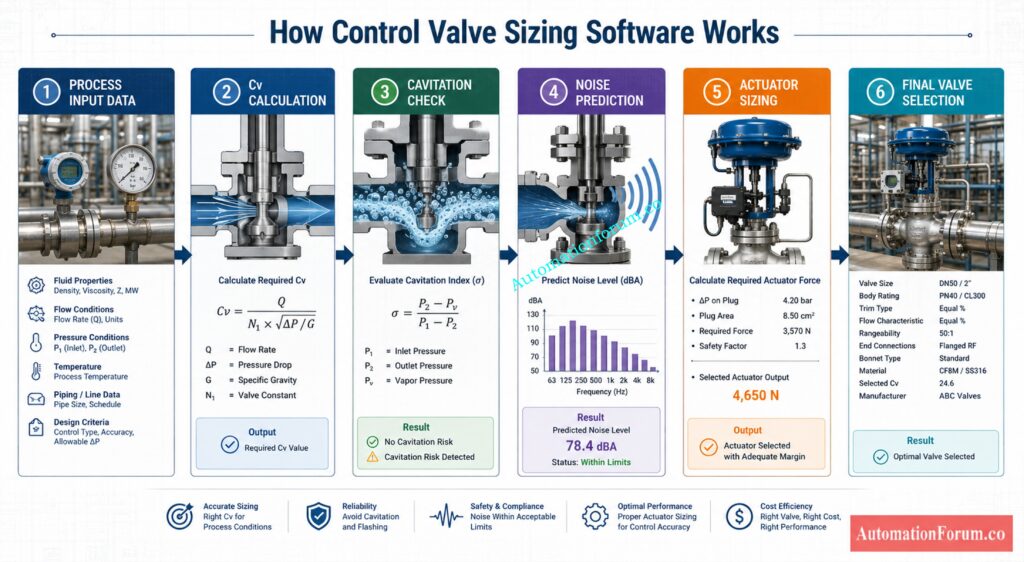
It is an engineering tool used to calculate valve flow capacity, select the right valve size, and evaluate risks such as cavitation, flashing, and noise.
Which Is The Best Control Valve Sizing Software?
The best option depends on the application. Emerson is highly respected for severe service, while Valmet, Samson, Flowserve, Siemens, Honeywell, and others are strong in their own areas.
What Is Cv In Control Valves?
Cv is the valve flow coefficient. It indicates how much flow a valve can pass at a given pressure drop under defined conditions.
Why Is Valve Sizing Important?
Proper sizing improves control, protects equipment, reduces maintenance, and supports stable and efficient plant operation.
Can Valve Sizing Software Predict Cavitation?
Yes, advanced tools can estimate cavitation risk and help the engineer select the correct trim or pressure reduction arrangement.
Can Valve Sizing Software Calculate Noise?
Yes, many professional tools estimate aerodynamic or hydrodynamic noise so that engineers can reduce acoustic risk.
Is Valve Sizing Software Free?
Some basic tools may be available, but most professional platforms are commercial products.
What Standards Are Used In Valve Sizing?
ISA and IEC standards are commonly used to provide consistent and defensible sizing methods.
What is rated Cv and calculated Cv
Rated Cv is the manufacturer’s published maximum flow capacity of a valve at full open under standard test conditions.
Calculated Cv is the required flow coefficient derived from actual process conditions such as flow rate, pressure drop, and fluid properties.
What is the Bray sizing program
The Bray sizing program is a valve sizing software used to select and size butterfly and ball valves based on flow, pressure, and torque requirements.
It helps engineers determine Cv, actuator sizing, and valve performance for water, utility, and general industrial applications.
What is the rule of thumb for control valve sizing
A control valve should ideally operate between about 20 percent and 80 percent travel during normal conditions for stable control.
Avoid oversizing, because a valve that runs too close to closed position will cause poor control, instability, and faster wear.
What Happens If A Control Valve Is Oversized?
An oversized valve usually produces poor control, low rangeability, unstable operation, and faster wear.
Can Software Replace Engineering Judgment?
No. Software supports the engineer, but it does not replace field knowledge, process understanding, or design review.
Choosing Between Reverse and Direct Acting Valves: When to Choose Forward and Reverse Acting Control Valves for Design Engineer
Why Proper Valve Sizing Matters for Plant Reliability
Control valve sizing is one of the most important steps in process engineering because it affects control quality, safety, reliability, and cost. A well sized valve helps the plant run smoothly, protects equipment, and reduces energy losses. A poorly sized valve can create instability, cavitation, flashing, noise, and repeated maintenance problems.
The Role of Advanced Control Valve Sizing Software in Modern Industry
That is why Control Valve Sizing Software has become essential in modern process industries. It gives engineers a practical way to calculate Cv, assess severe service risk, select the right trim, and verify actuator performance. It also helps EPC teams and plant engineers work with more confidence and less guesswork.
Manual calculations still matter, but they should not be the only method used in a modern plant. The future belongs to smarter sizing tools that combine process knowledge, diagnostics, digital collaboration, and lifecycle insight. For engineers who want better reliability and better control, that is the direction worth following.
Refer the below link for the Control Valve Hunting Due to PID Controller: Causes, Effects, Root Analysis and Complete Troubleshooting
