
- What is a PLC (Programmable Logic Controller)?
- What is a DCS (Distributed Control System)?
- PLC vs. DCS – Detailed Comparison Table
- When to Choose a PLC System
- When to Choose a DCS System
- Key Technical Differences Explained
- Cost Comparison – PLC vs DCS
- Integration Possibilities – PLC and DCS Working Together
- Real-World Example: Hybrid PLC – DCS Architecture
- Programming and Engineering Differences
- Maintenance and Lifecycle Management
- Safety and Cybersecurity Considerations
- Role of PLC and DCS in Industry 4.0 and IIoT
- Summary – Which One Should You Choose?
- FAQ – PLC vs DCS
Programmable Logic Controllers (PLCs) and Distributed Control Systems (DCSs) are the two most important control systems in modern industrial automation. They are both used to automate jobs, make things safer, and enhance productivity, but they are fundamentally different in terms of how they are designed, what they are used for, and how effectively they function.
You can choose between a PLC and a DCS based on the type of business you work in, the needs of your process, and your control philosophy. This article talks about the fundamental differences between each system, as well as its advantages and downsides and real-world examples, to help engineers, EPC experts, and automation managers pick the best one.
Understand the key differences between standard and safety PLCs with real-world examples: Difference Between Standard and Safety PLCs: Features, Applications & Future Trends
What is a PLC (Programmable Logic Controller)?
A PLC is a digital computer that industries use to run machines or specific types of equipment. It works in real time, using programmed instructions like logic, sequencing, and timing to control machines at the machine level.
Originally, PLCs were supposed to replace hardwired relay logic devices. Over the years, they have turned into strong, flexible, and modular systems that can handle intricate automation jobs.
Key Characteristics of PLCs:
- Main use: making machines work on their own
- Common Uses: packing lines, high-speed machinery, robotics, and motion control
- Response Time: Microseconds (fast and sure)
- Very high accuracy and precision, suitable for robotics and motion
- Programming: the IEC 61131-3 standard, which includes Ladder Logic, Function Block, and Structured Text
- Operating System: An RTOS (real-time operating system)
PLCs are built for discrete industrial processes, where things happen in independent steps, like sorting, welding, or labeling on a packaging line.
Calculate your PLC power requirements with precision using this complete PLC power sizing guide: PLC Power Supply Calculator – Complete Guide for Accurate PLC Power Sizing
What is a DCS (Distributed Control System)?
A DCS is a system that keeps an eye on and regulates continuous processes all across the facility. These things can happen in oil refineries, electricity plants, or the making of chemicals. A DCS controls the full plant or process area, however a PLC only controls a few units.
It has a lot of dispersed controllers that are all linked to a fast network for communication. The system makes sure everything works well, gathers data, deals with alarms, and makes things better.
Key Characteristics of DCS:
- Main Use: Making things run automatically at the factory or plant level
- Controlling operations, acquiring data, interpreting data, and keeping an eye on things from one spot are all common uses.
- Response Time: From a few milliseconds to a few seconds (slower and not always the same)
- Moderate accuracy and precision, with safety and dependability coming first
- Programming: Tools for setting up suppliers (with a focus on process logic)
- Operating System: Linux and Windows are two examples of operating systems that are used a lot.
DCS is the best choice for processes that run all the time or in batches where dependability, redundancy, and centralized control are very critical.
Discover proven techniques to boost PLC scan speed and optimize your automation performance: How to Increase PLC Speed: 7 Optimization Tips + Advanced Programming Guide
PLC vs. DCS – Detailed Comparison Table
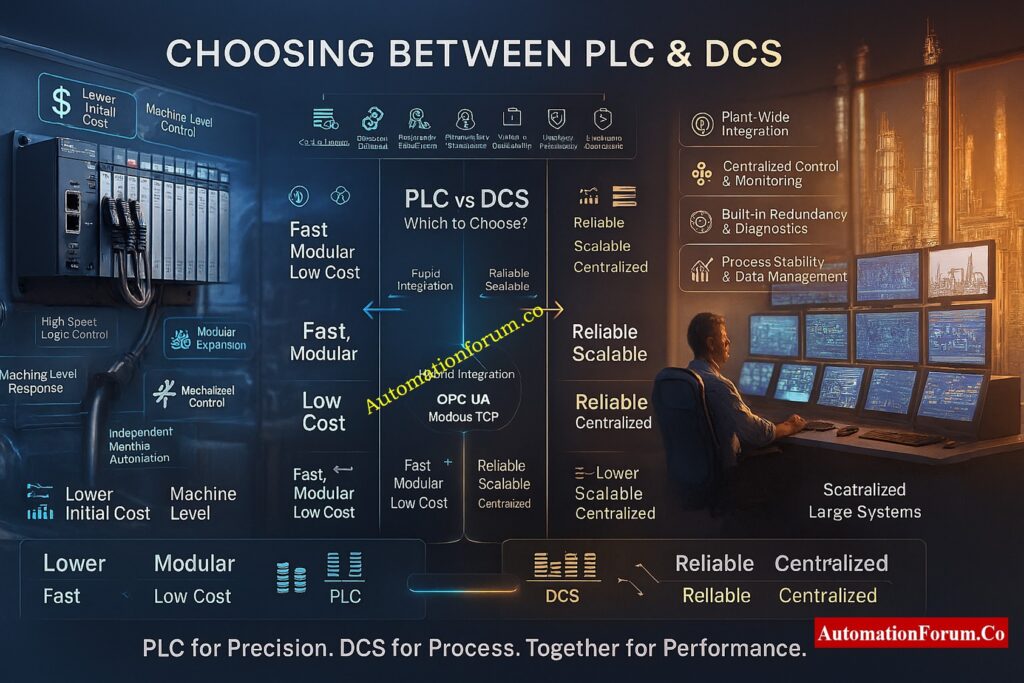
| Feature / Aspect | PLC (Programmable Logic Controller) | DCS (Distributed Control System) |
| Primary Use | Machine automation | Plant or process automation |
| Applications | Robotics, packaging, motion control, high-speed machinery | Power plants, oil & gas, water treatment, process industries |
| Response Time | Microseconds (very fast) | Milliseconds to seconds |
| Accuracy & Precision | Very high | Moderate (focus on reliability) |
| Hardware | FPGA, ARM, microcontrollers, Industrial PC | Industrial PC with redundancy options |
| Operating System | Real-Time OS (RTOS) | General-purpose OS (Linux/Windows) |
| Programming Languages | Ladder, Function Block, Structured Text | Vendor-specific configuration |
| System Role | Controls individual machines or processes | Centralized plant-level monitoring and control |
| Scalability | Easy to scale for each machine | Scales across entire plants and subsystems |
| Redundancy | Rarely required (used only in critical machines) | Often includes redundancy for 24×7 uptime |
| Safety & Security | Focused on equipment safety | Focused on plant safety, reliability, and cybersecurity |
| Data & IT Connectivity | Limited to machine-level data | Acts as gateway to enterprise-level systems and analytics |
| Best Fit Industries | Discrete manufacturing, automotive, robotics | Oil & gas, power, chemical, water treatment |
| Strengths | High speed, precise real-time control | Centralized data, reliability, integrated control |
| Limitations | Not ideal for large-scale process automation | Not suitable for ultra-fast motion control |
| Examples | Machine controllers, conveyors, robotic arms | Plant monitoring, power plants, critical infrastructure |
Refer the below link to learn smart PLC I/O maintenance methods to minimize downtime and improve plant reliability
When to Choose a PLC System
PLCs operate best when tasks are broken down into smaller, repeated processes, like in discrete automation. They are perfect for situations where equipment run quickly and control is definite since they are fast, versatile, and durable.
Ideal Scenarios for PLC:
1. High-Speed Manufacturing Lines
High-speed manufacturing lines, such as bottling facilities where each machine does a distinct step, such filling or capping.
PLCs make sure that machines function together with very minimum delay.
2. Robotic Automation
Robotic arms, for instance, weld or paint cars on production lines.
PLCs manage motion and respond in less than a microsecond.
3. Material Handling Systems
For example, conveyor control systems in the packaging or logistics industries.
PLCs are good for controlling sensors, actuators, and motors.
4. Machine Interlocks and Safety
For instance, press machines or injection molding machines with guards that are locked together and emergency stops.
Safety PLCs are often used to add safety logic to PLCs.
Refer the below link to Discover why 24VDC is the standard for PLC systems and how it ensures safety and stability
When to Choose a DCS System
DCS systems are the most important part of continuous or batch process automation, where stability, dependability, and centralized monitoring are very important. They combine many control loops and make sure that everything works together in the plant.
Ideal Scenarios for DCS:
1. Power Generation Plants
Thermal or nuclear power facilities, for example, have hundreds of loops that control things like boilers, turbines, and other equipment.
DCS has a backup, an alarm, and ongoing monitoring.
2. Chemical and Petrochemical Plants
For instance, polymer manufacturers or refineries that always keep an eye on things like temperature, flow, and pressure.
DCS makes sure that processes are effectively managed and that safety
3. Water and Wastewater Treatment
For instance, municipal treatment plants control pumps, valves, and the amount of chemicals that are added.
DCS makes it easier to keep track of things and write down and send in data.
4. Pharmaceutical Manufacturing
For instance, automating the batch process for manufacturers that make APIs or formulations.
You can keep track of recipes, check them, and produce batch reports using DCS.
Master PLC documentation best practices to ensure compliance, reliability, and easy troubleshooting: PLC System Documentation Guide: Essential Records for Industrial Automation Success
Key Technical Differences Explained
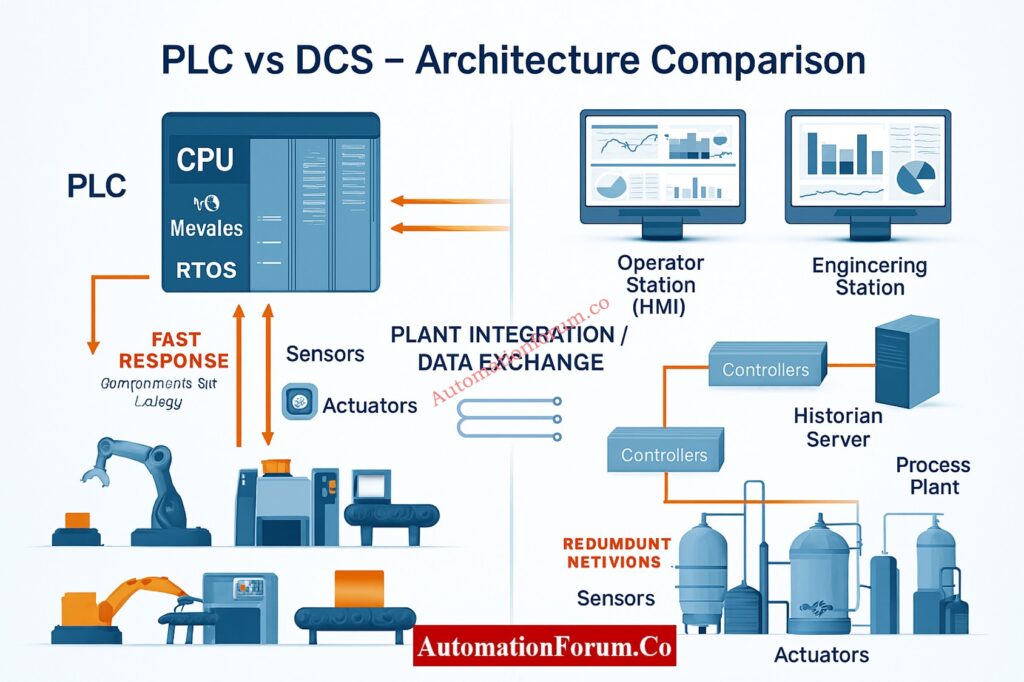
1. Architecture
- PLC: It has input/output modules and a CPU that links to field devices. It is modular and machine-specific.
- DCS: DCS is both hierarchical and spread out. It has a lot of operator stations, controllers, engineering stations, and historical servers.
2. Communication
- PLC: Uses fast and reliable industrial protocols like EtherNet/IP, Profibus, or Modbus RTU.
- DCS: Uses networks that are redundant and cover the complete plant for communication, like Foundation Fieldbus, OPC UA, or Modbus TCP.
3. Redundancy and Reliability
- PLC: These are usually single-CPU systems, although you can add redundancy for key tasks.
- DCS: It has backup mechanisms at every level, such as controllers, networks, and servers, to make sure it is always available.
4. Data Management
- PLC: Can only handle a modest quantity of data; it usually controls devices in the area.
- DCS: Links process control systems to IT and business systems so that analytics and performance dashboards can be used.
5. Scalability
- PLC: It grows by adding more controllers to control more machines.
- DCS: It works on big plants by combining many PLCs and subsystems into one platform.
See the top DCS manufacturers shaping the future of industrial automation: Top 10 DCS manufacturing companies
Cost Comparison – PLC vs DCS
When designing automation initiatives, the cost is a crucial thing to think about. Over the life of a PLC or DCS system, the expenses of hardware, software, and maintenance are all varied.
PLC Cost Characteristics:
- Less expensive hardware costs for each controller at first.
- Each system is modular, so you only pay for the I/O modules you need.
- The costs of integration and engineering go up as the system gets bigger.
- Good for equipment that can work on their own or small production units.
DCS Cost Characteristics:
- Less expensive hardware costs for each controller at first.
- Each system is modular, so you only pay for the I/O modules you need.
- The costs of integration and engineering go up as the system gets bigger.
- Good for equipment that can work on their own or small production units.
Summary: PLCs are a terrific deal for small or medium-sized automation. DCSs offer a better value for the overall system when it comes to plant-wide control systems.
Find out which PLC brands dominate today’s automation industry and why engineers prefer them: Which PLC is Mostly used in the Automation Industry?
Integration Possibilities – PLC and DCS Working Together
Many modern factories have both PLCs and DCSs. For example,
- PLCs quickly control machines.
- DCS is in charge of coordinating activities at the plant level, gathering data, and giving operators a way to interact with the system.
Real-World Example: Hybrid PLC – DCS Architecture
In many modern buildings, PLC and DCS systems work together in a hybrid structure to speed things up and keep an eye on everything from one place.
Example – Power Plant Integration:
- PLCs operate the turbine auxiliaries, boiler feed pumps, and soot blowers in the area.
- DCS is in charge of coordinating the whole plant, collecting data, setting off alerts, and showing operators what they need to see.
- Both systems can talk to one other over OPC UA or Modbus TCP, which makes sure that data is exchanged in real time.
With this hybrid setup, PLCs may control machines quickly while the DCS keeps an eye on the whole plant, provides backup, and handles alarms.
Result: All layers of automation are more reliable, visible, and easy to maintain.
Programming and Engineering Differences
| Aspect | PLC | DCS |
| Programming Environment | Complies with IEC 61131-3 (Ladder, FBD, ST, IL, SFC) | Vendor-specific (typically process blocks that you can drag and drop) |
| Configuration Effort | Needs someone who knows how to program | Templates make configuration easier. |
| Engineering Focus | Logic and sequencing | Process control and tuning |
| Maintenance | Less work for small systems | It’s easier for big systems with central diagnostics. |
In general, PLC programming is based on how things work, while DCS setup is based on how things are done.
Maintenance and Lifecycle Management
PLC Maintenance:
- It’s easy to change out individual modules or CPUs.
- Less time spent down and less reliance on vendors.
- Needs a manual backup and documentation for each machine program.
DCS Maintenance:
- Operator stations can undertake diagnostics and monitoring from a central location.
- Backups that happen on their own, alerts that keep track of things, and managing firmware.
- Long-term support contracts from suppliers make sure that updates are constantly available and that the system is always working.
Note: Keep in mind that PLCs are easier to keep up with on-site, while DCSs make it easier to manage the lifecycle of intricate facilities that have extended working lifespans.
Understand PLC hot standby architecture and its benefits for uninterrupted process control: Hot Standby in PLC Systems: Architecture, Working, and Benefits
Safety and Cybersecurity Considerations
For PLCs:
- For emergency stop features, use Safety PLCs with a SIL rating.
- A lot of the time, these are employed in systems that keep machines safe and lock them together.
- To keep networks safe, they need to be distinct and firewalls need to be set up right.
For DCS:
- DCS has Safety Instrumented Systems (SIS) and backup control networks.
- Includes built-in security structures including managing patches, user roles, and segregating networks.
- Great for keeping important infrastructure (CIP) safe.
Explore how permissive logic and trip interlocks protect equipment and enhance safety in process plants: Understanding Permissive Logic and Trip Interlocks in Industrial Systems
Role of PLC and DCS in Industry 4.0 and IIoT
Smart, networked architectures that meet the rules of Industry 4.0 are quickly replacing old industrial systems.
PLCs in IIoT:
- It can connect to the cloud using Ethernet/IP, Modbus TCP, or MQTT.
- Allow edge computing for predictive maintenance and analytics that happen in real time.
DCS in IIoT:
- It is a central hub for data that links sensors, controllers, and historians.
- Helps with apps for digital twins and analytics at the enterprise level.
By improving performance, reducing energy, and enabling for remote monitoring, the combination of PLC, DCS, and IIoT platforms makes factories smarter.
Learn how to secure your DCS against cyber threats with proven industrial cybersecurity measures: DCS Cybersecurity: Mitigating Risks in Industrial Automation
Summary – Which One Should You Choose?
| Criterion | Choose PLC When… | Choose DCS When… |
| Application Type | Discrete, machine-level automation | Continuous or batch process control |
| Response Time | Microseconds matter | Seconds-level control is fine |
| System Size | Small to medium | Medium to large, plant-wide |
| Focus | Speed, precision, and motion | Safety, redundancy, and data integration |
| Scalability | Multiple independent machines | Entire plant integration |
| Budget | Lower cost per controller | Higher initial cost, but scalable |
| Maintenance | Localized | Centralized |
The debate between PLC and DCS isn’t about which one is better; it’s about which one works best for your automation needs.
- If you need rapid, accurate, and predictable control, like in robotics, packaging, or motion systems, choose a PLC.
- If you need safe, reliable, and centralized process control, like in refineries, power generating, or chemical plants, use a DCS.
In many contemporary construction projects, both technologies work together to create a hybrid design that improves performance, safety, and data management at all levels of operation.
Use this integration checklist to connect third-party systems seamlessly with your DCS: Integrating Third-Party Systems with a Distributed Control System (DCS): Checklist
FAQ – PLC vs DCS
What is the main difference between PLC and DCS?
A PLC is used to control machines at the machine level, while a DCS is used to control processes across the whole plant.
Which is better – PLC or DCS?
There is no one better than the other; PLCs are best for fast automation, and DCSs are best for managing processes from a central location.
Can PLCs replace DCS?
PLCs can work with small process systems, but DCSs are ideal for big plants since they can manage more processes, add more redundancy, and work with more systems.
Which industries use PLCs and which use DCSs?
PLCs are utilized in robotics, packaging, and manufacturing, while DCSs are employed in oil and gas, power generation, and chemical facilities.
Can PLC and DCS work together?
Yes. In a hybrid system, PLCs control the equipment and the DCS keeps track of data, alerts, and plant monitoring.
What are the main selection factors?
Before deciding between PLC and DCS, think about the scale of the system, the type of process, the reaction time, the requirement for redundancy, and the need for integration.
