
- What Is AI Based PLC Programming and How Does It Work?
- How AI Is Changing Industrial PLC Programming
- Types of AI Tools Available for PLC Programming
- Best AI Tools for PLC Programming
- AI Tools for PLC Programming Comparison: Features and Compatibility
- AI Ladder Logic vs Structured Text Generation: Which Is Better?
- Real World Industrial PLC Programming Applications Using AI
- Limitations and Risks of AI Generated PLC Code
- How to Choose the Best AI Tool for PLC Programming
- Best Practices for Using AI in Industrial PLC Programming
- Frequently Asked Questions About AI Tools for PLC Programming
- Conclusion: Which AI Tool Is Best for PLC Programming?
The most important consideration when selecting an AI tool for PLC programming is not simply how well it generates code. It is whether the tool understands the PLC platform, programming language, existing project structure, I/O configuration, interlocks, and industrial operating conditions.
ChatGPT and Claude can generate Structured Text, explain Ladder Logic, troubleshoot programming errors, and help engineers develop control sequences. However, dedicated PLC programming assistants offer additional capabilities, including engineering software integration, project context, code modification, and testing.
For instrumentation, control and automation engineers, the best choice depends on the PLC manufacturer, engineering environment, programming requirements, and cybersecurity restrictions.
This article compares the best AI tools for PLC programming, including ChatGPT, Claude, Siemens Eigen Engineering Agent, AnyAutomation Studio, PLC Copilot, Rockwell FactoryTalk Design Studio Copilot, Beckhoff TwinCAT CoAgent, and CODESYS Development System MCP Server.
What Is AI Based PLC Programming and How Does It Work?
How AI Generates PLC Code and Control Logic
AI based PLC programming uses artificial intelligence and large language models to assist engineers in developing, understanding, modifying, and troubleshooting programmable logic controller programs.
Instead of writing every instruction manually, an engineer can describe a control requirement in natural language and ask an AI assistant to generate the corresponding PLC logic.
PLC Programming Languages Supported by AI Tools
For example, an engineer can request a motor control program with start and stop commands, overload protection, running feedback, emergency stop conditions, and fault indication.
Depending on the tool, the AI can generate:
- Ladder Diagram logic.
- Structured Text programs.
- Function Block Diagram logic.
- Timer and counter instructions.
- Motor and pump control sequences.
- Analog signal scaling calculations.
- Alarm and interlock descriptions.
- PLC troubleshooting documentation.
However, generating code is different from producing a verified PLC application. The engineer must still check manufacturer specific instructions, hardware compatibility, and operating conditions.
Secure Your Remote PLC Access Before Cyber Threats Strike Hard: What is Two Factor Authentication for Remote PLC Programming in Process Automation?
How AI Is Changing Industrial PLC Programming
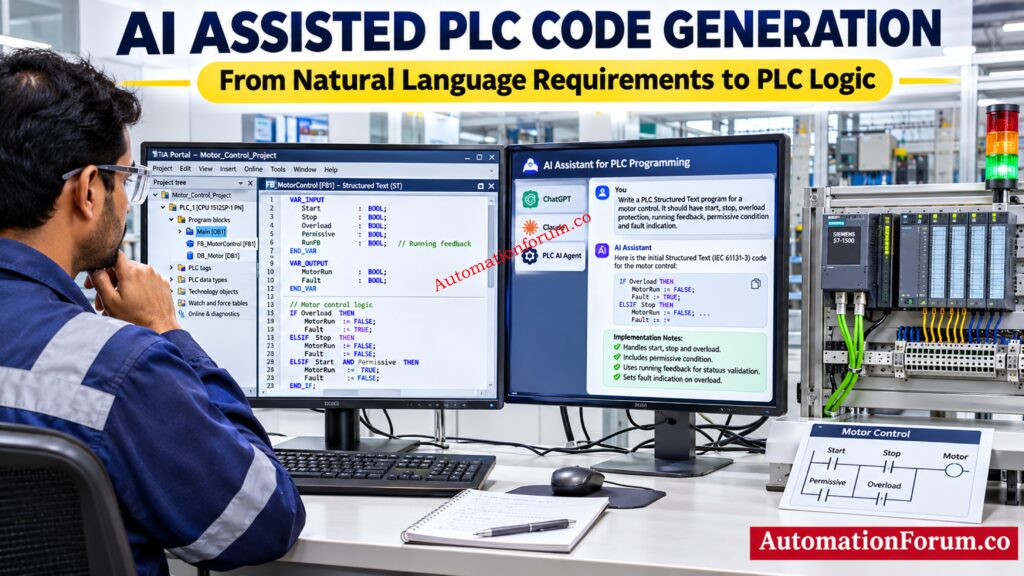
AI Assisted PLC Code Generation and Troubleshooting
AI is changing PLC engineering from manual code development towards requirement based programming and assisted engineering.
The biggest improvement is in repetitive programming activities. Engineers can generate standard function blocks, explain complicated sequences, prepare comments, convert programming languages, and identify possible logic errors more quickly.
AI Agents for PLC Engineering Software Integration
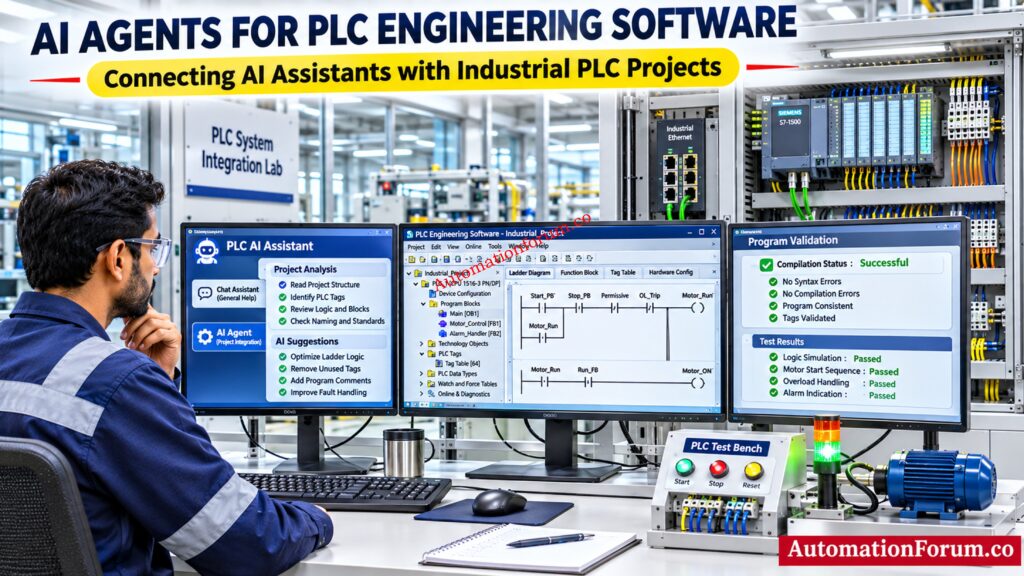
Another important development is the introduction of AI agents that interact with engineering software instead of simply providing code in a chat window.
This distinction is important when selecting an AI solution for industrial applications.
Types of AI Tools Available for PLC Programming
There are four major categories.
General Purpose AI Assistants for PLC Coding
General purpose AI assistants: ChatGPT, Claude, and Google Gemini. These tools are useful for code generation, explanations, calculations, and troubleshooting.
AI Coding Assistants and Programming Agents
GitHub Copilot, Cursor, and Claude Code. They assist with programming workflows and can interact with engineering environments when suitable integrations are available.
Dedicated PLC Programming AI Tools
PLC Copilot, AnyAutomation Studio, and other specialist engineering assistants. Their main advantage is their focus on PLC programming environments and project structures.
Manufacturer Specific AI Assistants for Industrial Automation
Siemens, Rockwell Automation, Beckhoff, CODESYS, and Schneider Electric are developing or providing AI capabilities for their respective engineering platforms.
Refer the below link for Understanding NO vs NC Contacts is key for Logic Writing in PLC Programming
Best AI Tools for PLC Programming
The following tools are worth evaluating based on their programming capabilities, engineering environment integration, and suitability for industrial automation.
ChatGPT for PLC Programming and Structured Text Generation
Best general purpose starting point
General AI assistant
ChatGPT is useful for generating PLC Structured Text, explaining Ladder Logic, preparing control sequences, and troubleshooting programming problems.
Engineers can provide an I/O list, control philosophy, tag descriptions, and programming requirements to generate an initial PLC program.
Its main capabilities include:
- Generating IEC 61131 3 Structured Text.
- Explaining Siemens SCL and common PLC instructions.
- Developing motor, pump, and compressor control logic.
- Calculating analog input and output scaling.
- Preparing PLC troubleshooting procedures.
- Reviewing uploaded code and project documentation.
Limitation: Standard ChatGPT conversations do not automatically understand the complete TIA Portal or Studio 5000 project. Generated code requires adaptation and compilation in the target engineering software.
Never Confuse These Critical Plant Protection Functions Again: Inhibit vs Bypass in Process Plants: DCS, PLC and ESD/SIS Differences
Claude AI for PLC Programming and Code Analysis
Best for lengthy code analysis
General AI assistant and coding agent
Claude is another strong option for PLC programming, particularly when engineers need to understand lengthy Structured Text programs, review control sequences, or analyse technical documentation.
Claude Code extends this approach by allowing an AI coding agent to work with files and supported development tools.
Its practical applications include:
- Reviewing large Structured Text programs.
- Explaining complicated function blocks.
- Identifying possible interlock and sequence problems.
- Converting control requirements into PLC code.
- Preparing technical comments and documentation.
Limitation: Claude does not automatically understand proprietary PLC project structures simply because it can read programming text. Direct integration requires an appropriate engineering interface or connector.
Prepare For Tough PLC Interviews With These Essential Answers: PLC (Programmable Logic Controllers) Interview Questions and Answers
Siemens Eigen Engineering Agent for TIA Portal
Best AI engineering assistant for supported Siemens TIA Portal projects
Siemens Eigen Engineering Agent is an AI powered engineering assistant designed to support PLC programming and automation engineering directly within the TIA Portal environment.
Its documented capabilities include generating and adapting Structured Control Language (SCL) and Ladder Diagram (LAD) logic, analysing existing PLC programs, supporting code testing, correcting errors, and preparing engineering documentation.
The agent can understand project elements such as function blocks, user defined data types, and HMI screens. However, its supported software versions must be considered before implementation.
The documented TIA Portal requirements are V19 Update 5 or later, V20 Update 4 or later, and V21. Eigen Engineering Agent is provided as a cloud based Software as a Service solution through Siemens Digital Exchange. It is not an offline AI deployment.
Siemens offers a one month free trial, subject to the applicable account and subscription requirements. Engineers should also remember that generated code requires technical review and validation in the target engineering environment.
Choose The Right PLC Language For Every Automation Task: PLC learning series 2: PLC programming languages
PLC Copilot for Industrial PLC Programming
Best specialist AI assistant for multiple PLC platforms
PLC Copilot is a specialised AI assistant developed for industrial automation and PLC programming. It helps engineers generate and review Ladder Logic, Function Block Diagram, and Structured Text programs.
Its documented platform support includes Rockwell Studio 5000 L5X exports, Siemens TIA Portal AP17 to AP21 exports, and AutomationDirect Productivity Suite project files.
PLC Copilot can assist with existing program analysis, tag understanding, troubleshooting, logic generation, and engineering documentation. It is designed to help engineers work with PLC project information rather than relying only on manually entered programming instructions.
The platform uses a local first architecture. Its subscription service uses the vendor’s AI processing service, while its Perpetual License provides options for organisations to connect their own AI providers for on premises deployment.
However, local first architecture should not be interpreted as a guarantee that every feature works completely offline. Deployment depends on the selected licence, AI provider, and configuration.
Direct PLC simulation integration was not confirmed in the reviewed official documentation. Therefore, generated logic should still be compiled and tested using the appropriate manufacturer engineering software.
AnyAutomation Studio for AI Assisted PLC Engineering
Best option to evaluate for TIA Portal simulation and local AI workflows
AnyAutomation Studio combines an engineering environment with an AI assistant for industrial PLC programming. Its documented platform coverage includes Siemens TIA Portal V15 to V21 and CODESYS 3.5.
The software assists engineers with SCL code generation, project analysis, code modification, and engineering workflows. It also supports different AI model providers, including Claude, GPT, and Gemini.
An important feature is its support for local AI models through Ollama and LM Studio. This allows organisations to evaluate local model deployment for projects with specific data security requirements. However, local model support should not be interpreted as confirmation that every Studio function operates completely offline.
For Siemens applications, AnyAutomation Studio provides integration with PLCSIM Advanced for supported simulation and SCL unit testing workflows. Engineers should check the required TIA Portal version, PLCSIM Advanced installation, and licensing before using these capabilities.
It is particularly relevant to engineering teams that need AI assistance combined with PLC project interaction, rather than a standalone conversational AI assistant.
Speed Up PLC Execution And Eliminate Performance Bottlenecks: How to Increase PLC Speed: 7 Optimization Tips + Advanced Programming Guide
Other AI Tools for PLC Programming and Industrial Automation
CODESYS Development System MCP Server
The CODESYS Development System MCP Server connects compatible AI assistants to the CODESYS engineering environment through the Model Context Protocol.
It allows AI tools to read project information, create or modify Structured Text program organisation units and data types, access engineering documentation, and use the compiler to retrieve programming errors.
The MCP Server is available through the CODESYS Installer and requires CODESYS V3.5 SP22 or later with a Professional Developer Edition licence.
It supports connections to cloud based and local AI models. The Professional Developer Edition also provides separate engineering tools, including Test Manager and Simulation Interface. These additional tools should not be confused with the core MCP Server functionality.
Rockwell FactoryTalk Design Studio Copilot
Rockwell FactoryTalk Design Studio Copilot is an AI assistant integrated into the cloud based FactoryTalk Design Studio environment.
It assists engineers with project understanding, project searches, routine creation, Add On Instruction explanations, tag updates, and PLC programming activities.
Its documented code generation capabilities include Ladder Diagram and Structured Text routines. However, project search and code generation require Core entitlement and enabled Project Access.
Engineers should not assume that FactoryTalk Design Studio Copilot provides identical functionality within every locally installed Studio 5000 Logix Designer project. The documented integration is specifically associated with FactoryTalk Design Studio.
Beckhoff TwinCAT CoAgent
Beckhoff TwinCAT CoAgent for Engineering is an AI assistant announced for the TwinCAT 3 XAE engineering environment.
It is designed to support PLC code suggestions, I/O configuration, HMI layout assistance, and access to Beckhoff engineering documentation.
The product is identified as TE1700, and the TE1000 licence is listed as a requirement. However, Beckhoff currently identifies the product as an announcement with market release available on request.
Therefore, engineers should confirm the current availability, licensing, and deployment requirements with Beckhoff before planning to use it in an active automation project.
Google Gemini and GitHub Copilot
However, these general AI and coding assistants should not automatically be considered replacements for manufacturer specific PLC engineering software. Their usefulness depends on available integrations, project access, programming requirements, and engineering validation.
Stop Using Timers Incorrectly In Critical PLC Applications: Why is RTO Used in Place of TON Timer in PLC Program?
AI Tools for PLC Programming Comparison: Features and Compatibility
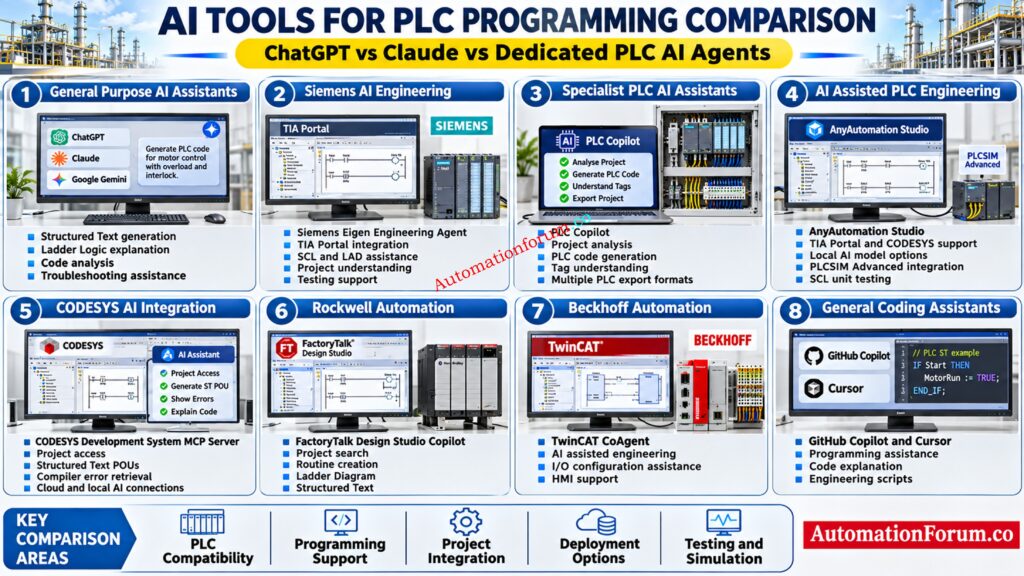
The following table compares the engineering environments, programming capabilities, deployment options, and testing features of different AI tools. Actual functionality depends on the software version, licence, and configuration.
| AI tool | Supported environment | Programming support | AI deployment | Testing and simulation |
| ChatGPT | General AI assistant | Structured Text generation and Ladder Logic explanation | Cloud service | No direct PLC simulation |
| Claude | General AI assistant | Structured Text generation and Ladder Logic explanation | Cloud service | No direct PLC simulation |
| Siemens Eigen Engineering Agent | TIA Portal V19 Update 5+, V20 Update 4+, V21 | SCL and LAD | Cloud based SaaS | Test logic generation and testing support; direct PLCSIM integration not confirmed |
| AnyAutomation Studio | TIA Portal V15 to V21 and CODESYS 3.5 | SCL generation and project assistance | Cloud and local AI model options | PLCSIM Advanced integration and SCL unit testing |
| PLC Copilot | Studio 5000, TIA Portal exports, AutomationDirect Productivity Suite | LAD, FBD and ST capabilities | Vendor AI service or configured on premises AI provider | Direct PLC simulation integration not confirmed |
| FactoryTalk Design Studio Copilot | FactoryTalk Design Studio | Ladder Diagram and Structured Text | Cloud based environment | Direct Copilot simulation capability not confirmed |
| Beckhoff TwinCAT CoAgent | TwinCAT 3 XAE | AI assisted engineering capabilities announced | Deployment details to be confirmed | Not confirmed |
| CODESYS Development System MCP Server | CODESYS V3.5 SP22 or later | Structured Text POUs and data types | Cloud or local AI model connection | Compiler access; separate PDE simulation tools |
No single AI tool has been demonstrated here to support every PLC manufacturer, programming language, project format, and simulation environment.
Master These Ladder Diagram Elements Before Writing Programs: Understanding Basic Parts of Ladder Diagram (LD) in PLC Programming
AI Ladder Logic vs Structured Text Generation: Which Is Better?
AI for PLC Ladder Diagram Programming
AI tools generally perform more consistently with text based programming languages because their input and output are naturally represented as text.
AI Structured Text Generator for IEC 61131 3 Programming
Structured Text: This is usually the easiest PLC language for general AI assistants to generate and review. It supports readable expressions, conditional statements, loops, and function block implementations.
AI Support for Function Block Diagram and Sequential Function Chart
Ladder Diagram: AI can explain contacts, coils, timers, counters, and interlocks. However, generating importable Ladder Logic requires the correct manufacturer specific representation.
Function Block Diagram: AI can help design signal relationships and function block arrangements, but graphical implementation depends on the engineering software.
Sequential Function Chart: AI can develop sequence descriptions, transitions, and operating states. The engineer must verify the implementation against the target platform.
Siemens SCL, Rockwell Logix and CODESYS Compatibility
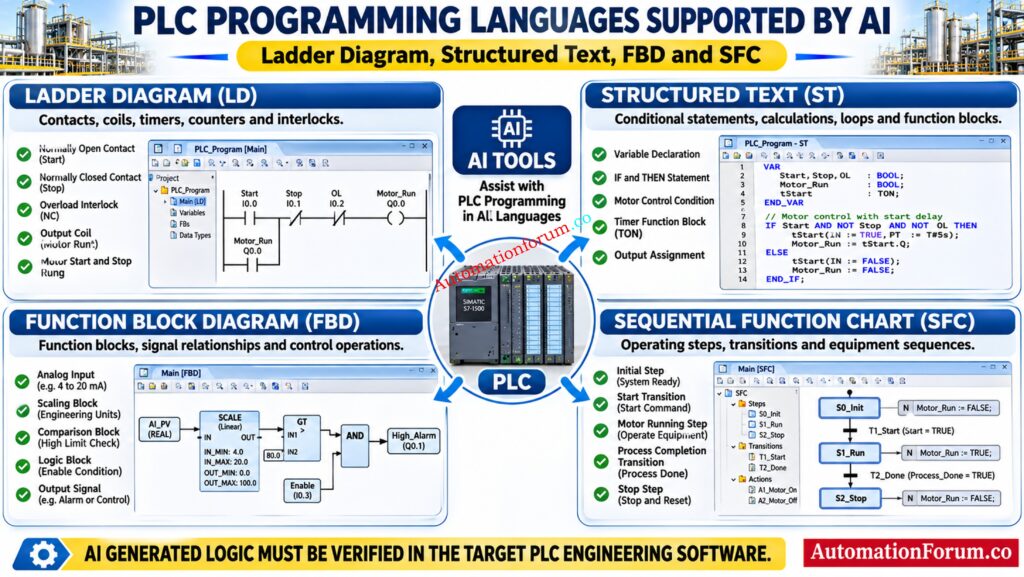
Siemens SCL is a manufacturer specific implementation of Structured Text. Rockwell Logix Structured Text and CODESYS ST also have their own platform specific instructions and restrictions.
IEC 61131 3 provides the programming language framework, but compliance with the standard does not automatically guarantee compatibility with every PLC manufacturer, CPU, firmware, or library.
Refer the below link for the PLC Program for Motor Starter with Low-Level Switch Interlock
Real World Industrial PLC Programming Applications Using AI
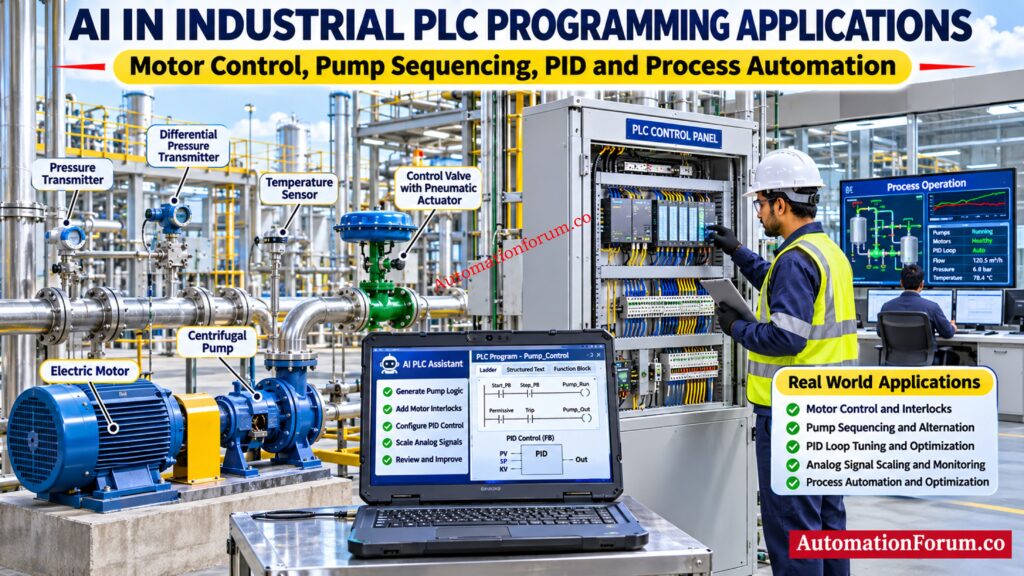
AI can assist engineers with several practical PLC programming activities, including motor control, pump sequencing, analog signal processing, PID control, alarm management, and communication troubleshooting
Avoid These Critical Ladder Programming Mistakes Before Commissioning: Top 6 Important Rules for PLC Ladder Diagram Programming
AI for Motor Control and Interlock Programming
AI can assist PLC programmers in developing motor start and stop sequences, operating modes, running status, overload protection, and equipment interlocks. It can also help engineers understand existing motor control logic and identify missing operating conditions.
AI for Pump and Compressor Control Logic
In process industries, pumps and compressors require multiple permissives and protective interlocks. AI can help engineers organise these conditions, develop operating sequences, document trip logic, and review automatic standby equipment changeover logic.
AI for PLC Analog Input and Output Programming
AI can assist with PLC analog input scaling, transmitter signal conversion, engineering unit configuration, and analog output generation. This is particularly useful when working with 4 to 20 mA pressure, flow, level, and temperature instruments.
AI for PID Control Programming
AI can help engineers understand PID controller configuration, explain proportional, integral, and derivative parameters, and prepare initial controller implementation structures. Actual tuning and process performance verification must be completed by qualified engineers.
AI for PLC Alarm and Trip Logic Development
AI can help prepare alarm conditions, trip descriptions, permissive matrices, and cause and effect documentation. Engineers can also use it to review existing alarm logic and identify possible inconsistencies.
AI for PLC Communication Troubleshooting
AI can assist with analysing PLC communication problems involving industrial protocols such as Modbus TCP, PROFINET, EtherNet/IP, and OPC UA. It can explain communication errors, identify possible configuration issues, and suggest troubleshooting procedures.
AI for Existing PLC Program Analysis
When engineers work with existing automation systems, understanding undocumented PLC programs can be time consuming. AI tools can help explain programming routines, identify signal relationships, interpret interlocks, and prepare technical documentation.
AI for Automatic and Manual Operating Mode Programming
AI can help develop operating mode selection logic, command priorities, permissive conditions, and equipment status handling. Engineers must ensure that manual operation does not bypass essential equipment protection or safety requirements.
Unlock Accurate Counting Functions For Better PLC Control: UP Counter in PLC Programming
Limitations and Risks of AI Generated PLC Code
AI generated PLC code must never be assumed correct simply because it looks technically reasonable.
The most important risks include:
- Incorrect instructions: AI may generate instructions that do not exist in the selected PLC platform.
- Scan cycle errors: PLCs operate using cyclic execution, and incorrectly designed state transitions can create unexpected behaviour.
- Incorrect latching: Improper use of set and reset instructions can cause motors or equipment to remain energised unexpectedly.
- Interlock failures: Missing permissives or incorrect trip priorities can affect equipment protection.
- Timer errors: Incorrect timer presets, reset conditions, and timer execution assumptions can produce unexpected sequences.
- Hardware incompatibility: Generated code may not support the selected CPU, firmware, libraries, or I/O modules.
- Cybersecurity: Uploading confidential PLC programs, plant drawings, network details, and control philosophies to external AI services may violate company security requirements.
- Graphical programming limitations: A generated textual description is not necessarily an importable Ladder Logic routine.
Choose The Right Timer And Prevent Costly Sequence Errors: Understanding ON Delay and OFF Delay Timers in PLC Programming
Why AI Generated PLC Code Requires Engineering Validation
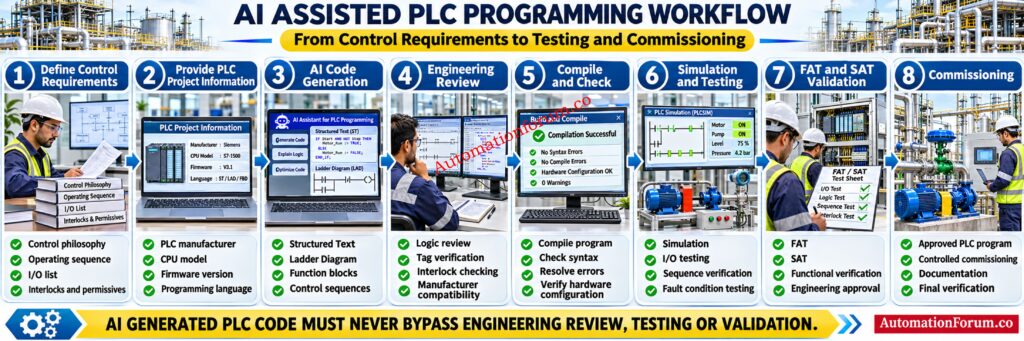
Most importantly, safety PLC logic, SIL functions, and emergency shutdown systems must follow the applicable functional safety lifecycle, including independent engineering review and validation. Unverified AI generated code must not be used as the basis of safety functions.
A proper engineering workflow should include:
- Review the generated logic.
- Compile in the target engineering software.
- Perform static checks and code review.
- Simulate operating conditions.
- Conduct FAT and SAT verification.
- Obtain engineering approval before commissioning.
Discover Powerful Logic Combinations Behind Smarter PLC Programming: Logic Gates in PLC Programming: A Guide with Truth Tables and Ladder Logic Diagrams
How to Choose the Best AI Tool for PLC Programming
The following selection guide can help automation professionals identify the most appropriate solution.
| Engineer or application | Suitable AI tool to evaluate |
| Beginner learning PLC programming | ChatGPT or Claude |
| Structured Text development | ChatGPT or Claude |
| Siemens TIA Portal project integration | Eigen Engineering Agent |
| TIA Portal with local AI models | AnyAutomation Studio |
| Allen Bradley PLC project assistance | PLC Copilot or FactoryTalk Design Studio Copilot |
| CODESYS development | CODESYS MCP Server |
| Beckhoff TwinCAT engineering | TwinCAT CoAgent, subject to availability |
| Existing PLC program analysis | PLC Copilot or a suitable AI assistant |
| Secure local AI model deployment | AnyAutomation Studio or a properly configured local AI solution |
For industrial facilities, cybersecurity and engineering software compatibility should be evaluated before subscription cost.
Prevent Programming Failures By Understanding PLC Data Types: PLC Data Types Every Automation Engineer Must Know to Avoid Costly Programming Errors
Best Practices for Using AI in Industrial PLC Programming
To obtain useful results from AI, engineers should provide complete technical requirements rather than short instructions.
For example, instead of requesting a motor control program, provide the following information:
- PLC manufacturer and CPU model.
- Engineering software and firmware versions.
- Complete I/O list with tag descriptions.
- Control philosophy and operating sequence.
- Motor ratings and feedback signals.
- Interlocks, alarms, and trip conditions.
- Manual and automatic operating requirements.
- Fail safe output conditions.
- Required programming language.
- Applicable company programming standards.
Ask the AI to generate comments, identify assumptions, explain each interlock, and provide a list of test conditions.
Never allow generated code to bypass engineering review, change control, backups, simulation, FAT, SAT, or OT cybersecurity procedures.
For confidential engineering projects, obtain company approval before using cloud AI. OpenAI’s business offerings and API have different data handling commitments from personal ChatGPT accounts.
Turn Electrical Control Drawings Into Working PLC Programs Faster: Step-by-Step Guide: Converting Electrical Diagrams into PLC Programs for Industrial Automation
Frequently Asked Questions About AI Tools for PLC Programming
Which AI tool is best for PLC programming?
Siemens Eigen Engineering Agent is a strong choice for supported TIA Portal projects, while ChatGPT, Claude, and PLC Copilot are useful for PLC code generation, troubleshooting, and engineering assistance.
Can ChatGPT write PLC code?
Yes, ChatGPT can generate PLC Structured Text, explain Ladder Logic, develop motor control sequences, and assist with troubleshooting. Always verify and compile the generated code in the target PLC engineering software.
Is Claude better than ChatGPT for PLC programming?
Claude and ChatGPT are both capable of generating PLC code and analysing programming logic. The better choice depends on project complexity, programming requirements, and the quality of engineering integration.
Can AI generate PLC Ladder Logic?
Yes, AI tools can generate Ladder Logic structures, explain programming rungs, and develop control sequences. Dedicated PLC programming assistants generally offer better support for graphical PLC engineering workflows.
Solve Industrial Communication Problems With The Correct Converter: PLC Interface Converter vs Protocol Converter: Key Differences and Industrial Applications
Which AI is best for Siemens TIA Portal?
Siemens Eigen Engineering Agent is a strong option for supported TIA Portal versions, including V19 Update 5 or later, V20 Update 4 or later, and V21. AnyAutomation Studio is another option for engineers who need TIA Portal integration with local AI model support.
Can AI program Allen Bradley PLCs?
Yes, AI tools can assist with Allen Bradley PLC programming, including Ladder Logic and Structured Text generation. PLC Copilot supports specified Studio 5000 project exports, while FactoryTalk Design Studio Copilot provides AI assistance within the FactoryTalk Design Studio environment.
Can AI debug existing PLC programs?
Yes, AI can analyse existing PLC code, explain interlocks, identify possible programming errors, and suggest troubleshooting methods. Project aware AI tools can provide deeper assistance when they have access to the engineering project.
Implement Better Control Strategies With Proven PLC Techniques: Implementation of Control Algorithms in PLC Programming
Can AI generate IEC 61131 3 Structured Text?
Yes, ChatGPT, Claude, and dedicated PLC AI tools can generate Structured Text based on IEC 61131 3 programming concepts. Engineers must verify manufacturer specific instructions, data types, and PLC compatibility.
Is AI generated PLC code reliable?
AI generated PLC code can reduce programming effort, but it is not automatically reliable or suitable for industrial implementation. Code review, compilation, simulation, FAT, and engineering validation are essential.
Will AI replace PLC programmers?
No, AI is more likely to assist PLC programmers by reducing repetitive coding, documentation, and troubleshooting work. Industrial experience, control philosophy, safety assessment, and commissioning expertise will remain essential.
Conclusion: Which AI Tool Is Best for PLC Programming?
The best AI tool for PLC programming depends on the PLC manufacturer, engineering software, programming language, and project requirements.
ChatGPT and Claude are useful for Structured Text generation, Ladder Logic explanations, and troubleshooting. Siemens Eigen Engineering Agent, PLC Copilot, AnyAutomation Studio, and CODESYS MCP offer more specialised engineering capabilities for their supported platforms.
For industrial automation engineers, AI should be treated as a programming assistant rather than an independent PLC programmer. All generated logic must undergo engineering review, compilation, testing, and validation before commissioning.
Refer the below link for the Programmable Logic Controller (PLC) Program Backup Checklist
