
- What Is a 3-Way Control Valve in Process Control Systems and How It Works
- Types of 3-Way Control Valve Based on Function: Mixing and Diverting Valves Explained
- Construction and Components of 3-Way Control Valve in Process Industries
- How a valve positioner helps a 3-way control valve work better
- Working Principle of 3-Way Control Valve in Process Control Systems
- Mixing Operation of 3-Way Control Valve in Heat Exchanger and HVAC Systems
- Diverting Operation of 3-Way Control Valve in Bypass and Flow Distribution Systems
- Types of 3-Way Control Valves Used in Industry: Globe, Ball and Plug Valves
- Types of 3-Way Control Valves Based on Actuation Systems
- When to Use a 3-Way Control Valve in Process Control Systems
- Industrial Applications of 3-Way Control Valve in Process Industries
- 3-Way Control Valve in Heat Exchanger Temperature Control System: Detailed Example
- Advantages of 3-Way Control Valve in Process Control Systems
- Disadvantages of 3-Way Control Valve in Industrial Applications
- 3-Way Control Valve vs 2-Way Control Valve: Key Differences and Comparison
- Selection Criteria for 3-Way Control Valve in Process Industries
- Installation and Commissioning of 3-Way Control Valve: Best Practices
- FAQ On 3 Way Control Valve
- Conclusion: Why 3-Way Control Valve Is Important in Process Control Systems
- Engineering Recommendation for Selecting 3-Way Control Valve
What Is a 3-Way Control Valve in Process Control Systems and How It Works
Definition of 3-Way Control Valve in Industrial Process Control
A 3-way control valve is a modulating final control element that is used in process industries to control the flow of fluids between three ports. This keeps process variables like temperature, flow, or pressure stable. A control valve is part of a closed loop control system. It gets a signal from a controller and changes its internal position to get the process condition that is wanted.
Key Functional Characteristics of a 3-Way Control Valve for Flow, Pressure and Temperature Control
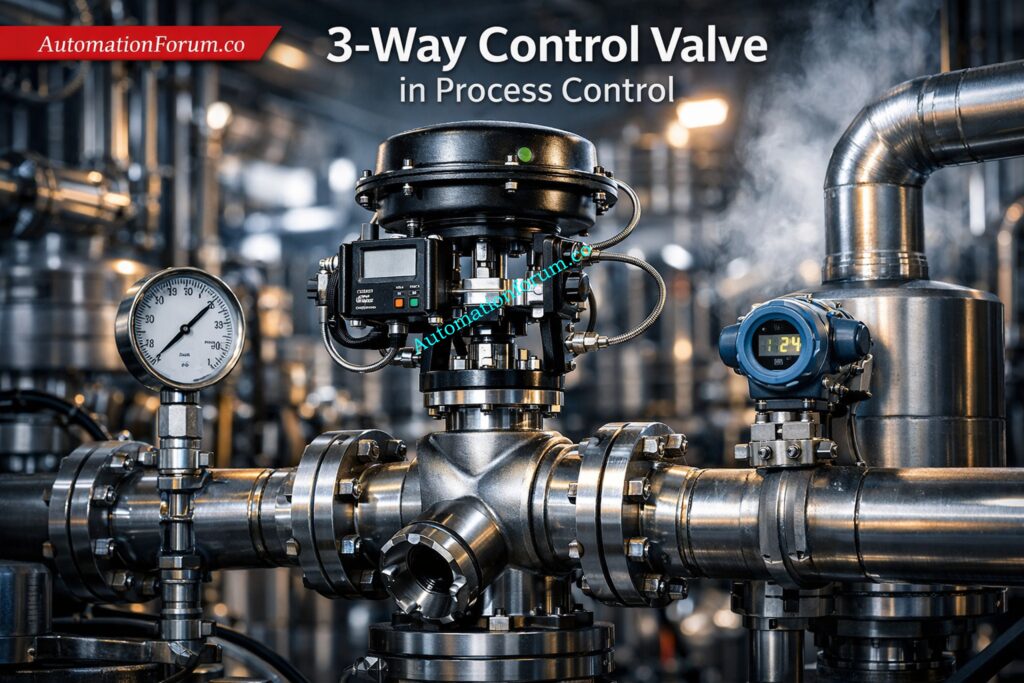
A 3-way control valve has three ports: A, B, and AB. This lets you regulate more than one flow stream at the same time, unlike a 2-way valve, which only isolates one flow direction. It can change the flow dynamically, which means it can partially open several ports at once to provide you fine control. It is commonly utilized when process fluids need to be mixed or redirected without stopping the flow of the system.
Refer the below link for the Control Valve Body Material Selection Guide for EPC Design Instrumentation Engineers
Types of 3-Way Control Valve Based on Function: Mixing and Diverting Valves Explained
Mixing Type 3-Way Control Valve Working Principle for Temperature Control Applications
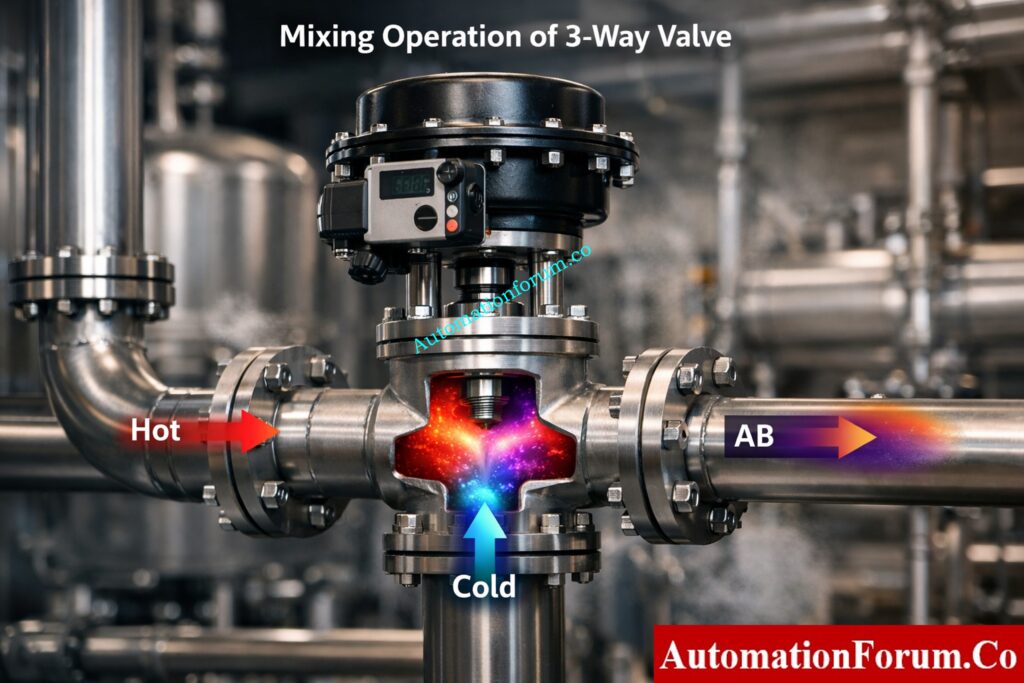
A mixing type 3 way control valve is made to merge two independent inlet streams into one controlled outlet stream. The internal plug movement controls the amount of each incoming flow, which makes sure that the mixing is correct. This kind is often used to manage temperature when hot and cold fluids need to be mixed.
Understanding of engineering. It keeps the output temperature stable by constantly changing the mixing ratio of two fluids.
Diverting Type 3-Way Control Valve Operation for Flow Routing and Bypass Systems
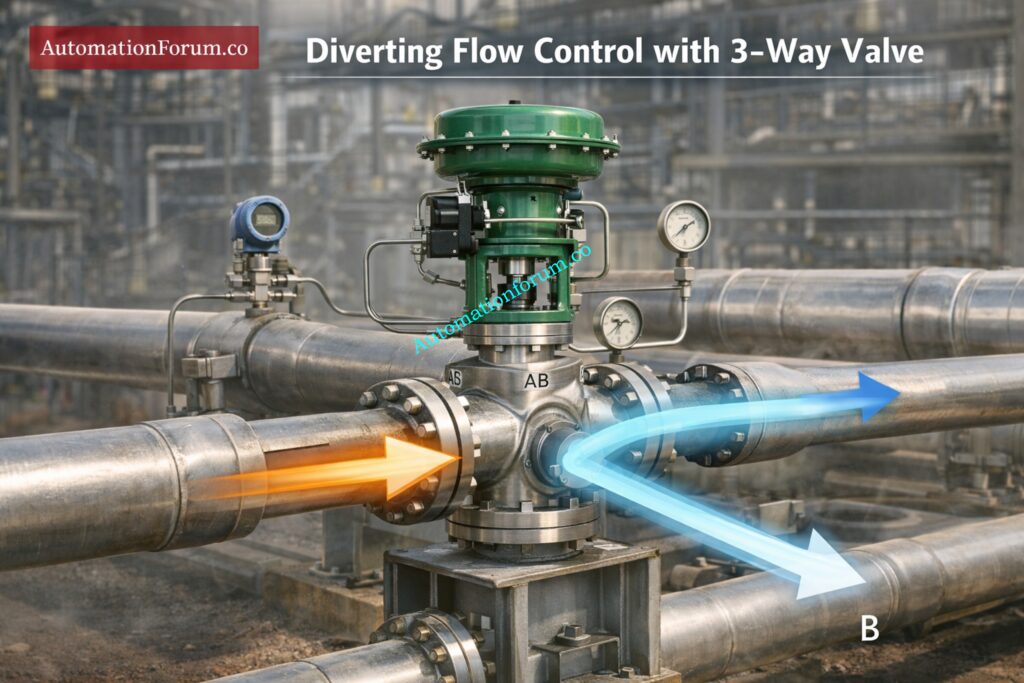
A diverting type 3-way control valve is made to break one flow coming in into two independent flows going out. You can send all of the flow to one exit or split it up in a certain way. People utilize it in load distribution systems, bypass systems, and switching applications.
Engineering knowledge. By sending flow to different pathways without pausing the system, it gives the process more freedom.
Stop PID Hunting Fast Today: Control Valve Hunting Due to PID Controller: Causes, Effects, Root Analysis and Complete Troubleshooting Guide for Industrial Process Control Systems
Construction and Components of 3-Way Control Valve in Process Industries
3-Way Control Valve Body Design and Material Selection for Industrial Applications
The valve body is a strong part that can hold a lot of pressure. It has three ports and internal flow tunnels. Depending on the parameters of the process, it can be made from carbon steel, stainless steel, or alloy steel. It is made to deal with fluids that are very hot, very cold, or very corrosive.
Internal Trim Design in 3-Way Control Valve for Flow Control Accuracy
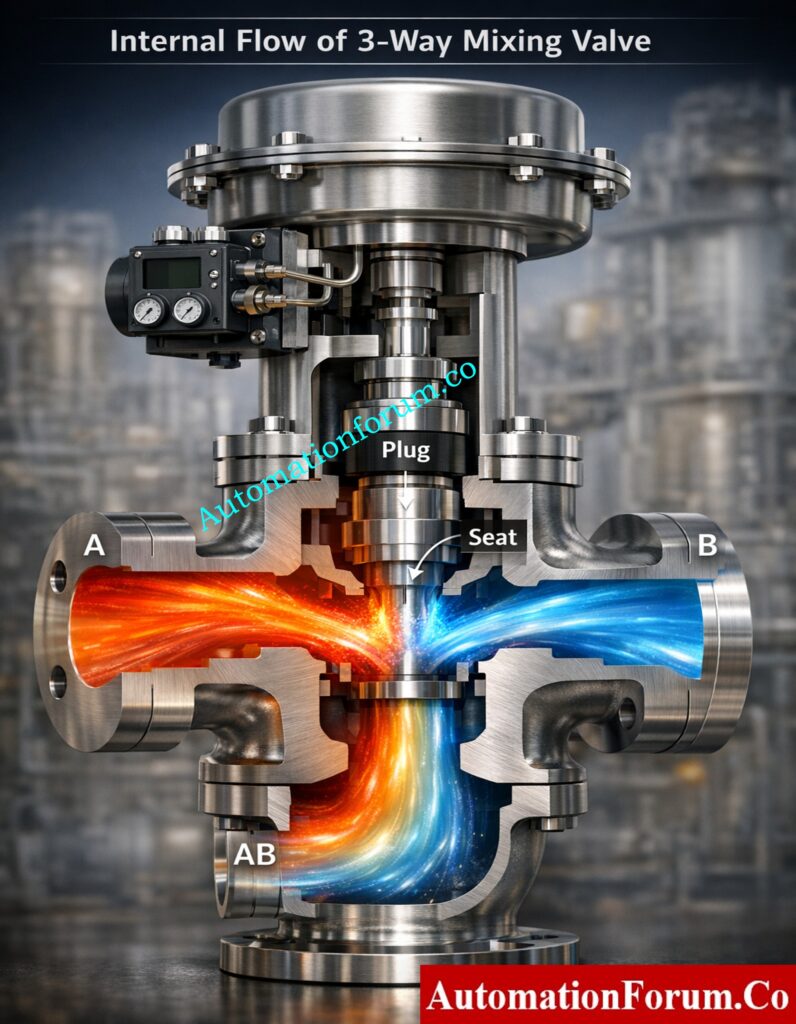
The internal trim is the main part that controls the flow and changes its direction. It travels in relation to the seat to control the flow area and figure out the flow features, like linear and equal proportion.
More advanced understanding. Trim design of mixing valves makes sure that the mixing goes smoothly without any turbulence or pressure shock.
Actuator Types in 3-Way Control Valve: Pneumatic vs Electric vs Hydraulic
The actuator turns a control signal into movement. Pneumatic actuators are the most frequent type in industries because they respond quickly and are reliable. Electric actuators are common in HVAC and automation systems.
How a valve positioner helps a 3-way control valve work better
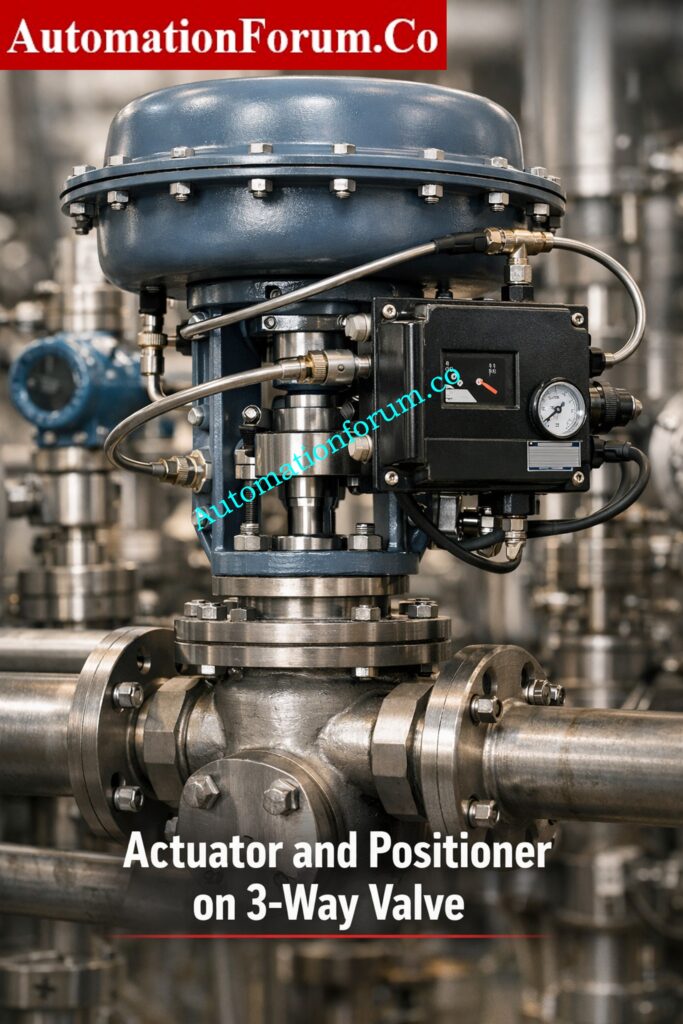
Role of Valve Positioner in 3-Way Control Valve Performance Optimization
The valve positioner makes sure that the valve stem is in the right place based on the control signal. It makes up for changes in load, hysteresis, and friction. It makes things more accurate, repeatable, and quick to respond.
Flow Path Configuration: T Port vs L Port in 3-Way Control Valves
The way the inside is made determines how it works. The design of the T port lets you mix and divert. The L port design is mostly utilized for applications that need to redirect.
ESDV vs EBDV: Know Difference: ESDV vs EBDV – Fail Close vs Fail Open | Emergency Shutdown Valve vs Emergency Blowdown Valve
Working Principle of 3-Way Control Valve in Process Control Systems
Basic Working Principle of 3-Way Control Valve with Control Signal Response
A 3-way control valve works by changing the flow path inside the valve by moving the plug, ball, or disc in response to a signal from the controller. This lets the valve either mix two incoming streams or send one stream in two different ways, depending on what the process needs.
Step-by-Step Control Loop Operation of 3-Way Control Valve in PLC and DCS Systems
- A field sensor constantly checks the process variable, like flow, pressure, or temperature, and sends an electrical signal to the control system.
- The PID controller gets this signal and compares it to the setpoint that was set in advance to find any mistakes or differences.
- The controller takes care of this inaccuracy and sends out a signal (usually 4–20 mA or a pneumatic signal) that is proportional to the amount of correction needed.
- The actuator gets this signal and turns it into mechanical movement of the valve stem or rotary shaft, which moves the internal trim into the right position.
- The flow path inside the valve body changes when the valve position changes, which affects the flow between the three ports.
- This change in how the flow is distributed has a direct effect on the process variable.
Globe Ball Butterfly: Choose Smart: Globe vs Ball vs Butterfly Control Valves Complete Comparison Guide for Flow Control Selection and Applications in Process Industries
Mixing Operation of 3-Way Control Valve in Heat Exchanger and HVAC Systems
Detailed Mixing Operation of 3-Way Control Valve for Temperature Control
- Two separate fluid streams enter the valve through ports A and B. These streams usually have different temperatures or other qualities.
- The valve plug controls the opening of each input port, which lets you manage both incoming flows at the same time.
- The mixed fluid leaves through port AB, where the final output property (such temperature) is regulated very accurately.
- The valve enables some flow from both inlets in intermediate positions, which makes blending easier instead of switching suddenly.
Practical Example of 3-Way Control Valve in Temperature Control Systems
The controller tells the valve to slowly close the hot fluid input if the process temperature goes above the setpoint. At the same time, it opens the cold fluid inflow more to keep the temperature steady. If the temperature goes below the setpoint, the opposite happens: the hot flow goes up and the cold flow goes down.
Advantages of Mixing Type 3-Way Control Valve in Maintaining Constant Flow
The valve keeps the total flow rate in the system almost constant while only changing the mixing ratio. This is very important in systems like HVAC and heat exchangers. This keeps the pumps running smoothly and stops the pressure in the pipeline from changing.
Fix Non-Responding Control Valve Fast: Field Troubleshooting Guide: Control Valve Not Responding in Process Area
Diverting Operation of 3-Way Control Valve in Bypass and Flow Distribution Systems
Detailed Diverting Operation of 3-Way Control Valve in Process Industries
The common port AB lets in a single stream of fluid. The valve changes the position of its inside parts to send the flow to either outlet port A or port B, or to split it evenly between the two. The amount of flow that goes to each outlet is based on how wide the opening is. This lets you manage how the process fluid flows.
Example of 3-Way Control Valve in Bypass Flow Control System
When there isn’t much work to do, the valve sends more flow to the bypass line, which takes some of the load off the main machinery. The valve slowly moves flow toward the main process line when there is a lot of demand for the process. This makes sure that there is enough supply to meet operational needs.
Practical Insight for Proper Installation of Diverting Type 3-Way Control Valve
When the valve is in the middle position, flow can go via both outlets. This is helpful for keeping the flow at a minimum or for slowly changing the load. Proper installation and precise port identification are very important since wrong piping might change the way the system is supposed to work and make it unstable.
Master Partial Stroke Testing Now: What is Partial Stroke Test (PST)? A Complete Guide for Shutdown and Control Valves
Types of 3-Way Control Valves Used in Industry: Globe, Ball and Plug Valves
Globe Type 3-Way Control Valve for Precise Flow and Temperature Control
- A globe type 3 way control valve has a plug or disk that moves in a straight line. This lets you control the flow rate very precisely and throttle it very finely, making it perfect for modulating service.
- It has a high level of control accuracy and consistent modulation, which is especially important in situations where slight changes in valve position have a big effect on process variables like temperature or pressure.
- It is best for important control loops like steam management, heat exchangers, and reactor temperature control, where stability and repeatability are very important.
- It can endure big dips in pressure without losing much control performance, therefore it’s good for tough industrial conditions.
Ball Type 3-Way Control Valve for Fast Switching and Compact Design
- A ball type 3 way control valve has a spherical ball that spins and has a hole in it that lines up with the flow route to control or stop flow.
- It has a small design and responds quickly, making it good for situations when the flow direction needs to change quickly or lines need to be switched.
- It is often utilized in mild control systems and diverting applications where very fine throttling is not needed.
- It can shut off tightly and last a long time, especially in systems that cycle or turn on and off often.
Plug Type 3-Way Control Valve for Abrasive and Corrosive Fluid Handling
- A plug type 3 way control valve has a rotating cylindrical or tapered plug with an internal passage. This lets the flow go between several ports in a flexible way.
- It works well with fluids that are abrasive, thick, or corrosive, which can wear out or clog other types of valves.
- It has a strong build with fewer interior cavities, which lowers the chance of material buildup or blockage.
- It works well in settings that are tough on equipment and need to switch between multiple ports, including in chemical plants and systems that handle slurry.
Find Why Your Valve Passing: How to Troubleshoot a Control Valve Passing Problem after Overhauling: Complete Root Cause Analysis
Types of 3-Way Control Valves Based on Actuation Systems
Pneumatic 3-Way Control Valve for Industrial Process Control Applications
- A pneumatic actuated 3 way valve uses compressed air to move things around, usually with diaphragm or piston actuators.
- It responds very quickly and produces a lot of force, which makes it great for dynamic process control and emergency shutdown situations.
- It is commonly utilized in dangerous places like oil and gas or chemical industries because it doesn’t make sparks and is safe by nature.
- It is very reliable and easy to use, especially in big industrial plants where compressed air is easy to get.
Electric 3-Way Control Valve for Automation and HVAC Systems
- An electric actuated 3 way valve uses an electric motor to move the valve stem or rotary element, which lets it be positioned exactly according to the control signal.
- It works well for tasks that need a lot of accuracy and can be used with automation systems like PLC and DCS.
- People often utilize it in HVAC systems, water treatment facilities, and building automation, where electrical infrastructure is the most important part.
- It gives greater feedback and diagnostics, especially when used with smart positioners or digital communication systems.
Hydraulic 3-Way Control Valve for High Pressure Industrial Applications
- A hydraulic actuated 3-way valve uses pressurized hydraulic fluid to create a lot of force, which lets it work with big valves under high pressure.
- It can be used in heavy-duty situations like high-pressure pipelines, power plants, and systems that are out at sea.
- It gives smooth, strong actuation, especially in places where pneumatic systems might not be able to supply enough force.
- It needs an extra hydraulic power unit and regular maintenance, which makes it less common than pneumatic and electric systems.
Best Actuator Selection for 3-Way Control Valve in Process Industries
When accuracy and stable control are very important, globe-type valves are the best choice. When you need to switch quickly, are tough on fluids, or need to handle them, ball and plug types are best. Pneumatic actuation is the most common type of actuation in process industries because it is fast, safe, and reliable. Electric actuation is better in conditions where automation is important.
Refer the below link for the Control Valve Selection and Recommended Practices for Harsh Process Conditions
When to Use a 3-Way Control Valve in Process Control Systems
Selection Criteria for Using 3-Way Control Valve in Industrial Applications
When two streams of fluid need to be mixed constantly to get the required process state, a 3-way control valve is employed. It is used to change the direction of flow between two process lines without turning off the system. It is also utilized when bypass control is needed to keep pumps or heat exchangers from getting too low of a flow. It is better when temperature control is really important and needs to be changed all the time instead of just turning it on and off.
Key Control Valve Performance Metrics: Essential Control Valve Performance Parameters
Industrial Applications of 3-Way Control Valve in Process Industries
3-Way Control Valve in HVAC Systems for Temperature Control
In air handling units, 3-way control valves are used to adjust the temperature of chilled water circuits. They keep the flow steady while changing the temperature. They assist cooling systems run more efficiently when it comes to energy.
3-Way Control Valve in Heat Exchanger and Steam Systems
Three-way control valves manage the flow of steam to keep the process temperature stable. They are used to stabilize temperature and bypass condensation. They make sure that heat exchangers work smoothly.
3-Way Control Valve in Oil and Gas Industry for Flow Diversion
In pipeline systems, three-way control valves are used to change the direction of flow and mix fluids. They make sure that fluids are safely routed during maintenance or an emergency.
3-Way Control Valve in Chemical Process Plants for Mixing Applications
3-way control valves are used in reactors to mix chemicals in a regulated fashion. They keep the reaction conditions, like the temperature and concentration.
3-Way Control Valve in Power Plants for Boiler and Feedwater Control
In boiler systems, three-way control valves are used to adjust the temperature of the feedwater. They keep equipment from getting too hot.
Must-Have Control Valve Accessories: Essential Control Valve Accessories for Reliable Process Control
3-Way Control Valve in Heat Exchanger Temperature Control System: Detailed Example
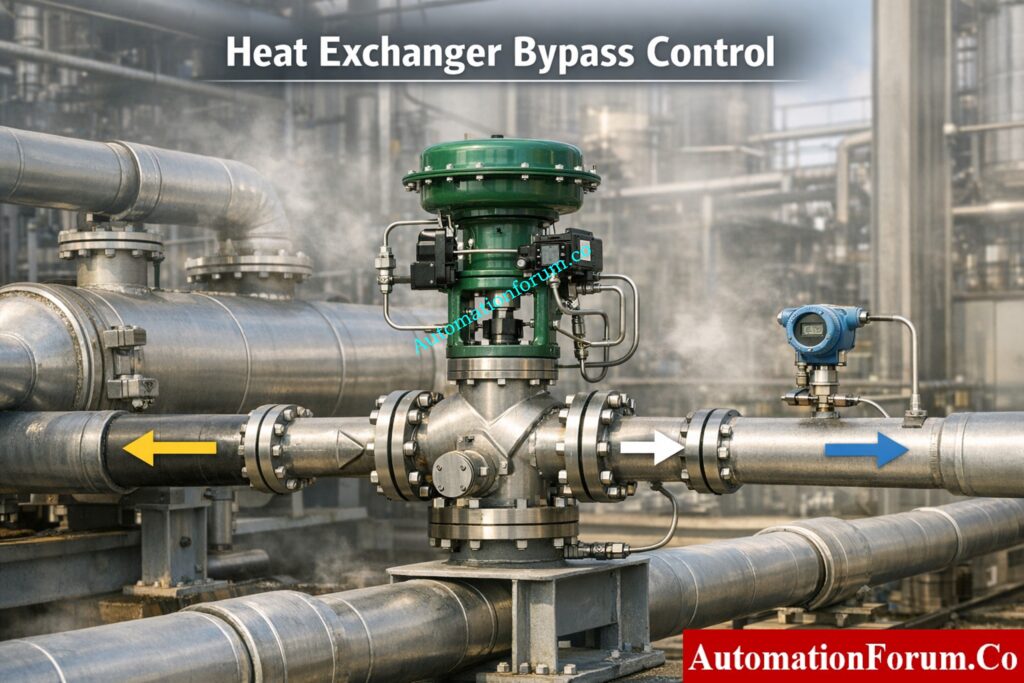
Process Description of Heat Exchanger Temperature Control Using 3-Way Valve
A shell and tube heat exchanger moves heat from one fluid to another without mixing them. This is often done to heat or cool process streams in sectors including oil and gas, power plants, and chemical processing. The fundamental goal is to keep the output temperature steady, even when the flow rate, inlet temperature, or process demand changes.
Changes in upstream process conditions, changes in the production rate, and changes in the temperature of the environment or the season can all cause load variations. If you don’t keep an eye on these changes, they can cause temperature swings, lower efficiency, or damage to equipment because of thermal stress.
Control Philosophy Using PID Controller and 3-Way Control Valve
A temperature transmitter is put near the heat exchanger’s outlet to keep an eye on the actual process temperature and send the control system real-time feedback. Using proportional, integral, and derivative logic, the PID controller compares the recorded temperature to the setpoint and figures out what needs to be done to fix the problem. The 3-way control valve receives the controller output signal and changes its position to control the flow between the process and bypass lines. The 3-way valve mixes or diverts the flow to keep the exit temperature steady while keeping the flow going in the system.
Operation of 3-Way Control Valve at Low Load Condition
When demand is low, the system doesn’t need as much heat transfer, and if full flow goes through the exchanger, the system tends to overheat. Instead of going through the heat exchanger, the 3-way valve sends more of the fluid through the bypass line. This lowers the effective heat transmission and helps keep the process fluid from getting too hot, keeps the outlet temperature consistent without rapid changes, and keeps the exchanger tubes from being too hot.
Size Control Valves Like Expert: How to Properly Size Control Valves for Maximum Efficiency?
Operation of 3-Way Control Valve at High Load Condition
When the demand for a process goes up, more heat transfer is needed to keep the outlet temperature where it should be. Instead of going through the bypass line, the valve slowly lets additional flow through the heat exchanger channel. This makes sure that the heat exchanger is used to its fullest, that the process fluid is heated or cooled enough, and that the process runs smoothly even when the load varies quickly.
Failure Scenario of 3-Way Control Valve During Air Supply Loss
If the pneumatic air supply to the actuator fails, the valve will move to its predetermined fail-safe position, which could be open or closed, depending on how it was designed. Engineers choose the fail position depending on safety criteria for the process.
If the valve is in the improper position, it could cause too much flow through the exchanger, which could cause overheating or thermal damage, or too much bypass, which could lead to not enough heating or cooling and compromise the quality of the product. When you suddenly lose control, the process can become unstable, the equipment can trip or shut down, and safety interlocks can turn on.
Engineering Best Practices for 3-Way Control Valve in Heat Exchanger Systems
In heat exchanger systems, three-way valves are typically used as bypass control valves to control the temperature of the outlet by changing the bypass flow proportion. They assist keep the total flow in the system steady, which is important for protecting the pump and keeping the system running smoothly. To stop temperature swings, valve hunting, and uneven heat transmission, you need to tune the PID correctly and size the valves correctly.
Measure Cv Before Valve Sizing: Why Measuring Control Valve Cv is Essential for Proper Valve Sizing ?
Advantages of 3-Way Control Valve in Process Control Systems
- Replacing two valves with one unit makes the pipework less complicated.
- Takes up less space when installing in small plant layouts
- Fewer places for leaks to happen, which makes the system safer.
- Offers multiple functions, such as mixing and diverting
- Keeps a steady flow in a lot of systems
- Increases the flexibility of process control.
Leak Test Control Valves Correctly: Control Valve Leakage Testing, Types, and Calculation Standards
Disadvantages of 3-Way Control Valve in Industrial Applications
- Not as good at changing ranges as dedicated 2-way control valves
- Needs to be installed carefully to avoid the wrong flow direction.
- More expensive at first than a single 2-way valve
- If the pressure conditions aren’t set up right, flow imbalance can happen.
- Internal design can make maintenance hard.
Understand Cv vs Kv Clearly: Relationship Between Cv and Kv in Control Valves
3-Way Control Valve vs 2-Way Control Valve: Key Differences and Comparison
| Parameter | 3-Way Control Valve | 2-Way Control Valve |
| Function | Mixes two inlet streams into one outlet or diverts one inlet stream into two outlets. It supports multi-directional flow control in a single valve body. | Controls flow between one inlet and one outlet only. It is mainly used for throttling or on/off control. |
| Application | Used in heat exchangers, HVAC systems, bypass loops, blending systems, and temperature control applications. | Used in basic flow control applications such as water, steam, and utility lines where simple flow regulation is needed. |
| Cost | Higher initial cost because of a more complex design and extra ports. It can reduce overall system cost in some applications by replacing multiple valves. | Lower cost because of its simple construction and fewer parts. It is more economical for straightforward applications. |
| Complexity | More complex due to multiple internal flow paths such as L-port or T-port arrangements. Needs proper installation and correct port selection. | Simple design with a single flow path. Easy to install, operate, and understand. |
| Maintenance | Requires moderate maintenance because of more sealing surfaces and moving parts. Internal leakage or wear may occur over time. | Easier to maintain because of fewer internal parts. Lower chance of leakage and simpler servicing. |
Choose Right Control Valve Bonnet: How to Choose Right control Valve Bonnet for your Application?
Selection Criteria for 3-Way Control Valve in Process Industries
- Choosing the right flow characteristic
- Making ensuring that pressure is even across all ports
- Choosing the right form of mixing or diverting
- Choosing the right fail-safe action
- Material that works well with the process fluid
Troubleshoot Shutdown Valves Like Pro: How to Troubleshoot On-Off / Shutdown Valve
Installation and Commissioning of 3-Way Control Valve: Best Practices
- Make sure you know which port is which (A, B, AB).
- Follow the flow direction marking exactly
- Set the positioner correctly
- Do loop tweaking to make control stable.
- Check the fail-safe condition
End Control Valve Hunting Issues: What are the main causes of control valve hunting?
FAQ On 3 Way Control Valve
What is the difference between a 2 way and 3 way control valve?
A 2-way control valve only controls flow in one line because it has one intake and one outlet. A 3-way control valve can either combine two streams into one or split one stream into two pathways.
Which actuator is best for 3-way control valves?
Pneumatic actuators are often employed because they are fast and dependable, however the optimum actuator depends on the job. You can also choose electric or electro-pneumatic actuators for precise control.
What is the main limitation of a 3-way valve?
The fundamental problem is that it doesn’t work as well for basic high-accuracy throttling as a 2-way valve does. It can also be harder to develop, put together, and balance the flow.
What is the difference between PCV and LCV?
A pressure control valve (PCV) is a part of a system that controls the pressure. Level Control Valve (LCV) is a device that controls the level of liquid in tanks or containers.
What is the application of 3-way valve?
You can use a 3-way valve to mix, divert, control a bypass, or control the temperature. It is common in heat exchangers, HVAC systems, and blending operations.
What causes instability in 3-way valves?
Improper sizing, choosing the wrong actuator, bad tuning, or unequal pressure conditions can all cause instability. Wear and tear on parts, leaks, and improper port connections can also make things run poorly.
Fix Stuck Control Valves Quickly: How to do maintenance on struck control valve?
Conclusion: Why 3-Way Control Valve Is Important in Process Control Systems
In process control systems where mixing, diverting, or bypassing are needed, the 3-way control valve is a very useful tool.
Refer the below link for the Control Valve Calibration Procedures
Engineering Recommendation for Selecting 3-Way Control Valve
Use when you need to alter the temperature, mix things together, or change the flow. Don’t use it if you merely need to control the flow in a simple way. A well-chosen and correctly tuned 3-way control valve makes a big difference in the stability, efficiency, and reliability of a process.
Top Control Valve Tools You Need: Top Essential Control Valve Calculators and Excel Tools for Instrumentation Engineers
