
- Introduction to Next-Generation PLCs
- What is ControlLogix 5590 PLC?
- Key Features of ControlLogix 5590 PLC
- ControlLogix 5590 Architecture
- ControlLogix 5590 vs Previous Generations (5570 / 5580)
- Role of ControlLogix 5590 in Smart Manufacturing
- Applications in Process and Discrete Industries
- Engineering and Programming Environment
- Advantages of ControlLogix 5590 for Engineers
- Limitations and Key Considerations
- When to Use ControlLogix 5590 PLC
- Future of PLCs and Where ControlLogix 5590 Fits
- FAQ on ControlLogix 5590 PLC
Introduction to Next-Generation PLCs
Why Traditional PLCs Are No Longer Enough
Traditional PLCs were built to execute deterministic control. Modern plants, however, need much more than basic logic: they need real-time motion, connected diagnostics, cybersecurity, safety integration, and data exchange with MES, SCADA, historians, and cloud layers. Rockwell Automation positions ControlLogix 5590 as a controller family designed for exactly this kind of connected, data-driven, performance-intensive environment.
How ControlLogix 5590 Fits Industry 4.0
That shift is what makes the term next generation PLC meaningful today. In Industry 4.0, the controller is no longer just a logic engine; it is also a data node, a security boundary, and a production-intelligence source. Rockwell’s documentation frames ControlLogix 5590 as a platform that brings together high-speed processing, integrated safety, and built-in security in a scalable architecture for modern industrial systems.
For engineering teams, that matters because many plants are now asking one control platform to handle motion, process, batch, safety, diagnostics, and connectivity without multiplying hardware and software silos. The ControlLogix 5590 family is presented as Rockwell’s answer to that requirement.
Master PLC Alarms & Trips: PLC Alarm and Trip Documentation Procedure – EPC PLC Automation Engineer Guide
What is ControlLogix 5590 PLC?
Standard, Safety, Redundant, and Logix SIS Variants
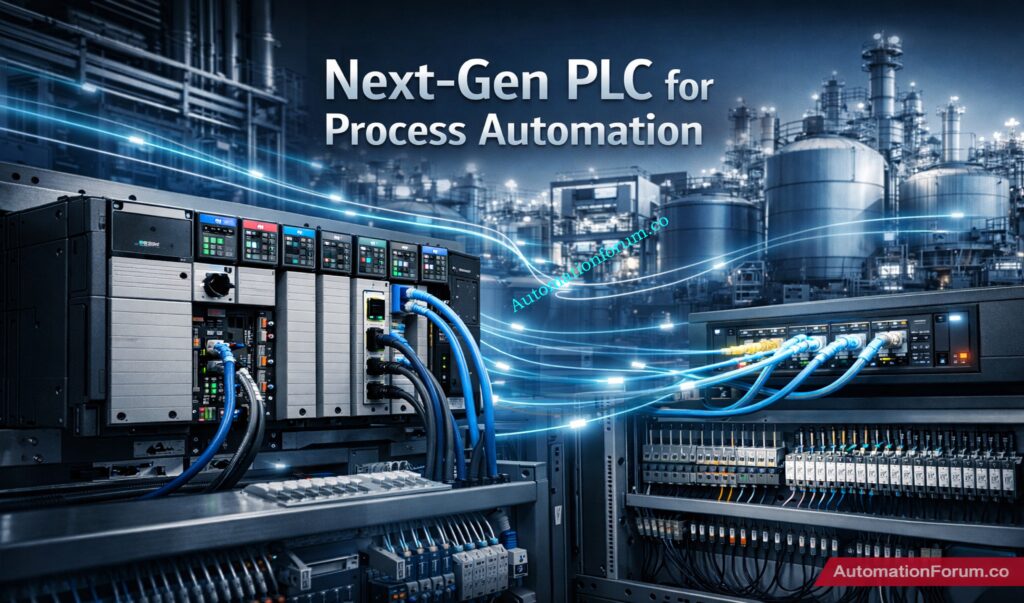
The ControlLogix 5590 PLC is the latest controller family in the Allen-Bradley Logix portfolio, designed for standard, safety, redundancy, and Logix SIS applications. It is a chassis-based controller that supports multiple communications and I/O options, and it is built to handle sequential, process, motion, and drive control within the same platform.
Where ControlLogix 5590 Is Used
Rockwell describes it as part of the broader Integrated Architecture offering, where the controller works with ControlLogix I/O modules, network communication modules, and the Studio 5000 environment. That modularity is important in real plants because it lets engineers build systems that scale from standalone machines to plant-wide automation architectures.
In practical terms, the 5590 is not a “single-purpose PLC.” It is positioned as a modern automation controller for high-performance manufacturing environments where safety, connectivity, and expansion are all part of the design brief. Rockwell also identifies variants for standard, XT (harsh/corrosive environments), and process use cases.
Fix PLC Resolution Issues Fast: Resolution in PLCs – The Complete Guide for Automation & Instrumentation Engineers
Key Features of ControlLogix 5590 PLC
High-Performance Processing and Memory Options
This matters in plants where one controller may need to coordinate process loops, discrete sequencing, motion, and condition-based logic at the same time. Rockwell explicitly describes the 5590 as suitable for multidiscipline applications and a forward-engineered control system that supports more devices with secure data flow.
Advanced Motion Control and Scalability
The platform supports up to 512 real and virtual motion axes, which is a major step for packaging lines, robotics cells, handling systems, and synchronized manufacturing equipment. Rockwell positions this capability for robotics, packaging, and high-speed systems where a controller must keep up with coordinated movement across many servo-driven elements.
The important engineering point is not just the axis count. It is the scalability of motion inside the same control family. Instead of introducing a separate motion controller layer, ControlLogix 5590 lets teams consolidate high-speed motion with standard plant control, which simplifies troubleshooting, spare strategy, and lifecycle management. That is a practical advantage in large automation systems.
Refer the below link for Which PLC is Mostly used in the Automation Industry?
Integrated Safety Architecture
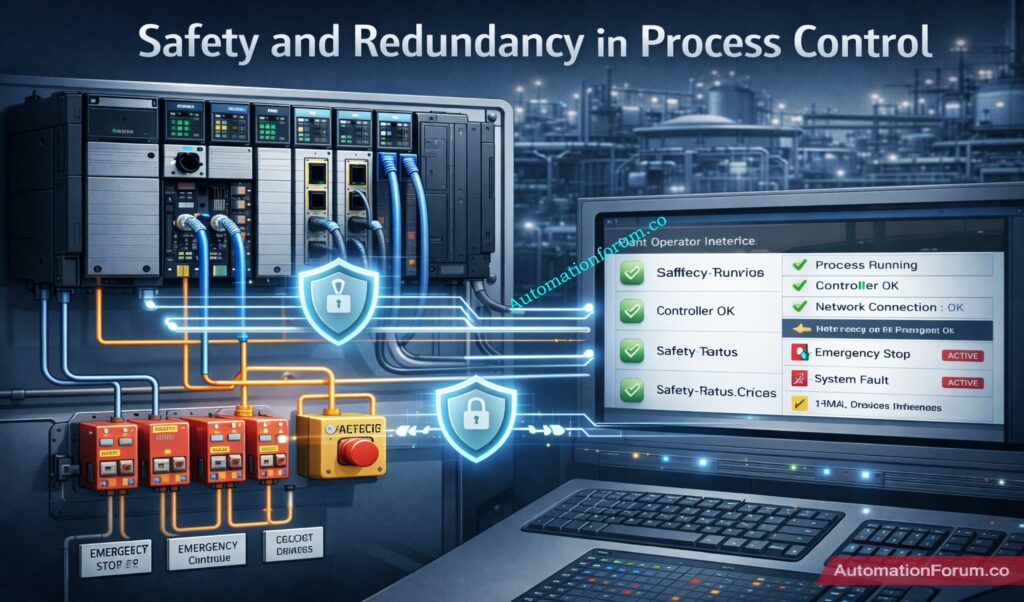
ControlLogix 5590 includes SIL 2 / PLd safety built into every controller variant. When paired with the 1756-L9SP safety partner, the controller can achieve SIL 3 / PLe capability. Rockwell also states that Logix SIS can achieve up to SIL 3 / PLe in redundant configurations, which is especially relevant for safety-critical process applications.
For engineers, this means safety does not have to be bolted on as a separate platform. The controller is designed so that standard and safety can coexist in one project and one engineering workflow. That unified approach reduces hardware complexity and can shorten validation time, especially when the process requires a mix of BPCS and SIS functions.
Industrial Cybersecurity and IEC 62443-4-2 Compliance
This is especially relevant for smart manufacturing PLC deployments where the controller is expected to exchange operational data with enterprise systems, remote support tools, and analytics layers. A controller that is security-aware from the start is easier to align with plant cybersecurity frameworks and defense-in-depth architectures.
Dual EtherNet/IP Connectivity and OPC UA Support

ControlLogix 5590 provides dual, 1 Gb embedded EtherNet/IP ports and can be configured for dual IP addresses or DLR. Rockwell also states that the platform handles 600+ Ethernet nodes per controller, giving it the network scale needed for large plants with broad device counts.
OPC UA support is another major feature. Rockwell’s product information shows the 5590 is positioned for modern communication and secure data flow, while the product release notes describe support for modern protocols such as OPC UA to enable vendor-neutral data exchange between OT and IT systems. That makes the 5590 a better fit for IIoT and analytics-heavy architectures than older, more isolated PLC generations.
Avoid PLC Data Type Mistakes: PLC Data Types Every Automation Engineer Must Know to Avoid Costly Programming Errors
ControlLogix 5590 Architecture
Chassis-Based Modular Design
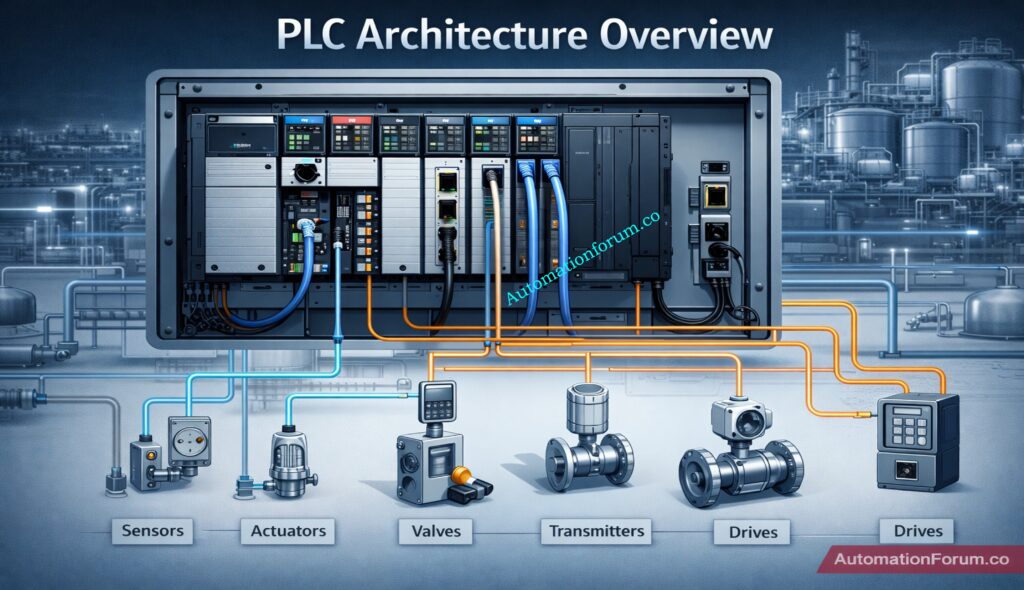
The 5590 is a chassis-based modular architecture, which means the controller works together with I/O modules and network modules rather than as a fixed, monolithic device. Rockwell’s system guide says the ControlLogix 5590 system consists of the controller, the Studio 5000 environment, ControlLogix I/O modules, and network communication modules.
Fix PLC Voltage Drop Issues: How to Calculate and Minimize Voltage Drop in PLC Wiring?
Support for Standard, Safety, Redundancy and SIS Architectures
That modularity is valuable because it lets engineers tailor the system to the application. A process plant may need a different combination of communications, safety, and I/O than a packaging line or a robotics cell. The 5590 family also supports standard, safety, redundancy, and Logix SIS architectures, so the same controller platform can fit multiple design philosophies.
Embedded EtherNet/IP Ports and Network Topologies
On the networking side, the controller’s embedded EtherNet/IP ports support linear and DLR topologies. In practical plant terms, that reduces the need for extra network modules in many designs and helps simplify the cabinet layout. Rockwell also indicates that the front Ethernet ports can be configured for DLR or dual-IP operation, which gives engineers more flexibility in segmentation and network resilience.
For high-availability applications, Rockwell provides dedicated redundancy documentation and reference architectures. The 5590 technical resources include standard architecture, security architecture, redundancy architecture, Logix SIS architecture, and safety architecture, which shows that the family is designed to support different plant risk profiles and availability targets.
Don’t Miss PLC Inspection Checks: Running Inspection Checklist of PLC Components in Control Panels
ControlLogix 5590 vs Previous Generations (5570 / 5580)
The clearest way to understand the value of the 5590 is to compare it with the 5580 family. Rockwell’s 5580 documentation shows a platform with an embedded 1 Gb Ethernet port, up to 256 axes, and enhanced security features; the 5590 moves beyond that with dual 1 Gb embedded Ethernet ports, up to 512 axes, 600+ Ethernet nodes, and up to 80 MB memory.
ControlLogix 5590 vs ControlLogix 5580
| Area | ControlLogix 5590 | ControlLogix 5580 | Engineering takeaway |
| Memory | Up to 80 MB. | 3 MB, 5 MB, or 10 MB depending on model. | 5590 is better for larger programs, richer diagnostics, and more complex multidiscipline control. |
| Motion | Up to 512 real and virtual axes. | Up to 256 axes. | 5590 is more suitable for large motion and robotics systems. |
| Ethernet architecture | Dual embedded 1 Gb ports, DLR or dual-IP. | One embedded 1 Gb port, with chassis communication options. | 5590 simplifies network design and improves resilience. |
| Node scale | 600+ Ethernet nodes per controller. | 5580 network capacity is lower, with the technical data showing 528 EtherNet/IP and 512 TCP for certain modules. | 5590 is better for larger connected plants. |
| Safety/security | SIL 2/PLd in every variant, SIL 3/PLe with safety partner, IEC 62443-4-2, CIP Security, secure boot. | 5580 also supports strong safety and security, but with lower capacity and older architecture. | 5590 is a stronger fit when safety and cybersecurity must scale together. |
Why the 5590 Is a Major Upgrade
The practical migration message is simple: the 5590 is not just an incremental refresh. It is a capacity and connectivity jump that targets plants needing more axes, more nodes, stronger security, and a more unified engineering model.
Refer the the below link for the Difference Between Triconex PLC and Other PLCs: A Complete Guide
Role of ControlLogix 5590 in Smart Manufacturing
Connected Control for IIoT and Data-Driven Plants
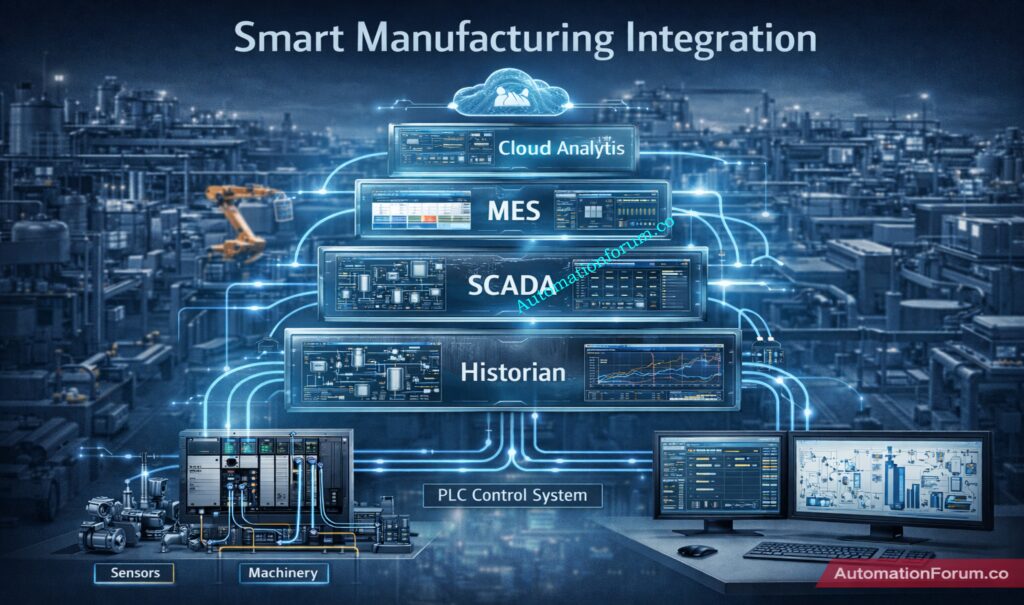
Smart manufacturing depends on connected data, not just connected devices. ControlLogix 5590 is positioned for that reality because it combines deterministic real-time control with industrial networking, built-in safety, and secure communication paths. Rockwell’s product positioning explicitly connects the 5590 to modern industrial environments that are more connected, data-driven, and performance-intensive.
Refer the below link for the Sinking and Sourcing: Which Connection is Best for Your PLC?
Integration with MES, SCADA, Historians and Cloud Layers
Safety vs Standard PLC Battle: Difference Between Standard and Safety PLCs: Features, Applications & Future Trends
PlantPAx and Digital Transformation Readiness
It also fits well with PlantPAx-style architectures. Rockwell explicitly notes integrated safety and redundancy support for scalable PlantPAx systems, which is important for process plants that want a consistent control platform across unit operations, utilities, and batch/process areas.
Stop PLC I/O Failures Now: Proactive Maintenance Strategies for PLC I/O Modules: Reduce Downtime & Improve Reliability
Applications in Process and Discrete Industries
ControlLogix 5590 for Process Industries
For process industries such as oil & gas, chemical, power, and batch operations, the 5590 is attractive because it unifies process control, safety, and redundancy in one modular platform. Rockwell’s documentation lists process and batch control, Logix SIS architecture, and redundancy support as the main application cases.
A chemical unit is a good example. The controller has to handle pumps, valves, analyzers, and interlocks while also enabling safe shutdown logic and secure connections with the plant network. In that kind of environment, the 5590’s safety partner option and Logix SIS pathway are especially useful.
ControlLogix 5590 for Discrete Manufacturing
For discrete manufacturing, the strongest fit is in robotics, packaging, material handling, and high-speed assembly. Rockwell specifically cites robotics, packaging, and high-speed systems as motion-heavy application areas, and the 512-axis ceiling shows the platform is built for scale.
Best Use Cases in Robotics, Packaging and Batch Systems
A packaging line, for example, may need coordinated servo axes, safety doors, recipe management, and line diagnostics. Instead of splitting those tasks across multiple control systems, the 5590 lets engineers consolidate them into a single high-performance architecture.
Essential PLC Docs You Need: PLC System Documentation Guide: Essential Records for Industrial Automation
Engineering and Programming Environment
FactoryTalk Design Studio Compatibility
ControlLogix 5590 is designed for the Studio 5000 Logix Designer ecosystem, and Rockwell states that it can also be designed efficiently using FactoryTalk Design Studio. That matters because engineering teams are increasingly expected to work with modern tools that support collaboration, reuse, and faster commissioning.
FactoryTalk Logix Echo for Simulation and Testing
Rockwell also highlights FactoryTalk Logix Echo for accelerating deployment through simulation and validation before field commissioning. That is valuable when controls teams want to catch logic, sequence, and integration issues before hardware is energized.
For engineers, the benefit is threefold: faster development, safer testing, and easier lifecycle maintenance. The controller family is explicitly intended to reduce engineering overhead and simplify complex automation challenges, which is a strong fit for plants that need repeatable standards across multiple lines or units.
Never Lose PLC Control Again: Hot Standby in PLC Systems: Architecture, Working, and Benefits
Advantages of ControlLogix 5590 for Engineers
System Consolidation and Simplified Architecture
The biggest advantage is system consolidation. Because the platform combines safety, motion, process control, and communications, engineers can reduce the number of separate controllers and network islands in a plant. That generally simplifies drawings, FAT/SAT, spare parts, and troubleshooting.
Faster Commissioning and Better Diagnostics
Another advantage is diagnostics and commissioning speed. Rockwell emphasizes faster scan times, secure data flow, enhanced troubleshooting, and design tools that reduce time to commission. In plant maintenance terms, that often translates into faster fault isolation and better visibility across the system.
Scalability for Future Expansion
Finally, the platform’s scalability is a long-term benefit. The same controller family can address standard, safety, redundancy, and Logix SIS needs, so engineering standards do not have to be reinvented every time the application changes.
Fix PLC Scaling Errors Fast: Scaling Analog Values in Industrial Automation (PLC)
Limitations and Key Considerations
Cost and Project Budget Planning
Learning Curve for Existing Logix Users
There is also a learning curve. Teams moving from older Logix platforms should plan for Studio 5000 version alignment, safety architecture decisions, network design, and controller migration validation. Rockwell’s documentation set for the 5590 includes separate resources for standard, security, redundancy, Logix SIS, and safety architectures, which is a good indicator that proper engineering discipline is required.
Compatibility and Migration Planning
Compatibility planning is another key consideration. Because the controller is modular and chassis-based, the migration path should be reviewed against existing I/O, communication modules, network topology, and plant standards before a cutover is scheduled.
Why 24V Rules PLC Systems: Why is 24 Volts Mostly used in Industrial PLC Systems?
When to Use ControlLogix 5590 PLC
Use ControlLogix 5590 when the project has one or more of these characteristics:
- Large-scale control systems with many devices and wide-area Ethernet needs.
- Safety-critical applications that need SIL 2 / PLd by default and SIL 3 / PLe with a safety partner.
- Applications that need a lot of axes for high-speed motion or robotics.
- Systems that are redundant or have high availability and where uptime is a design requirement.
- Smart manufacturing projects that need safe connections, OPC UA, and integration based on EtherNet/IP.
Stop Confusing NO vs NC: Understanding NO vs NC Contacts is key for Logic Writing in PLC Programming
Future of PLCs and Where ControlLogix 5590 Fits
PLC Evolution Toward OT/IT Convergence
The future of PLCs is moving toward tighter integration with digital engineering, secure connectivity, and real-time data exchange. Rockwell’s ecosystem already points in that direction through cloud-based design, controller emulation, and software-defined industrial automation tools.
Digital Twin and Edge-Connected Manufacturing
That is where ControlLogix 5590 fits: as a controller that bridges classic deterministic control with modern OT/IT expectations. Its support for OPC UA, EtherNet/IP, secure boot, and safety integration positions it well for edge-connected plants, digital twin workflows, and cybersecurity-conscious architecture.
Why the 5590 Is Built for the Future
In practical terms, the plants that win with this platform will be the ones that want fewer isolated controllers, more connected diagnostics, and a stronger path toward smart manufacturing without sacrificing control reliability. That is the strategic value of the 5590.
ControlLogix 5590 is Rockwell Automation’s next-generation Logix controller for demanding industrial environments. It combines high-performance processing, up to 80 MB memory, up to 512 motion axes, dual 1 Gb EtherNet/IP ports, embedded safety, redundancy options, OPC UA support, and IEC 62443-4-2-aligned cybersecurity. For engineers designing smart manufacturing systems, that is a powerful combination of performance, safety, and connectivity.
If your plant needs a smart manufacturing PLC that can handle motion, process, safety, and secure networking in one platform, the ControlLogix 5590 belongs near the top of the shortlist. Its biggest advantage is not just speed; it is the way it reduces architecture complexity while increasing capability.
Refer the below link for the Critical Flaw in Rockwell ControlLogix CVE-2024-6242 – Trusted Slot Bypass Vulnerability
FAQ on ControlLogix 5590 PLC
What makes ControlLogix 5590 different from older ControlLogix controllers?
The 5590 adds more memory, more motion capacity, dual embedded 1 Gb Ethernet ports, stronger built-in safety, and broader communication support than the earlier 5580 generation.
Does ControlLogix 5590 support functional safety?
Yes. Rockwell states that every controller variant includes SIL 2 / PLd safety, and SIL 3 / PLe is achievable with a safety partner.
Can ControlLogix 5590 be used in redundant systems?
Yes. Rockwell provides redundancy architecture resources for the family and states that the controller is configurable for redundancy and Logix SIS applications.
Avoid Ladder Logic Mistakes: Top 6 Important Rules for PLC Ladder Diagram Programming
What is the difference between ControlLogix 5590 and 5580?
ControlLogix 5590 has more memory (up to 80 MB), two 1 Gb Ethernet ports, and support for 512 axes. ControlLogix 5580 has less memory (up to 256 axes), one Ethernet port, and support for 256 axes.
Is ControlLogix a PLC or PAC?
ControlLogix is considered a Programmable Automation Controller (PAC) because it combines PLC reliability with advanced features like motion, safety, and data integration.
What is ControlLogix?
ControlLogix is a modular industrial controller platform from Rockwell Automation used for process, discrete, and safety control in modern automation systems.
PLC Redundancy Explained Simply: Understanding PLC Redundancy: Cold, Warm & Hot Redundancy
What software does ControlLogix use?
ControlLogix controllers are programmed using Studio 5000 Logix Designer, part of the Studio 5000 engineering environment.
Does ControlLogix 5590 support OPC UA?
Yes. Rockwell’s technical and product material identifies OPC UA support as part of the platform’s modern communication capability.
Which software is used to program ControlLogix 5590?
Rockwell states that it is designed for the Studio 5000 Logix Designer environment and can also be developed using FactoryTalk Design Studio.
Is ControlLogix 5590 suitable for process plants?
Yes. Rockwell positions it for process and batch control, PlantPAx-aligned systems, and Logix SIS architectures.
PLC Hardware You Must Know: PLC Hardware: Modules,Types, Functions, and Applications
