
- What is a Triconex PLC?
- What are Conventional PLCs?
- Key Differences Between Triconex PLC and Other PLCs
- Fault Tolerance and Triple Modular Redundancy (TMR)
- Safety Certification and Standards Compliance
- Diagnostics, Maintenance, and System Reliability of Triconex PLC Systems
- Comparison with Conventional PLC Diagnostics
- Applications of Triconex PLC Systems
- Applications of Conventional PLCs
- Advantages and Disadvantages of Triconex PLC
- Why Choose Triconex PLC Over Other PLCs?
- When to Choose Triconex vs Other PLCs
- Which PLC Is Right for Your Application?
- FAQ on Difference Between Triconex PLC and Other PLC
- Test Your PLC Troubleshooting Skills: Quiz for Process Engineers
Programmable Logic Controllers (PLCs) are very important for controlling equipment, processes, and safety systems in industrial automation. Most PLCs are made for common automation activities like sequencing, process control, and interlocking. However, some applications need very high levels of safety and reliability. This is what makes Triconex PLCs different.
Schneider Electric makes the Triconex brand of safety and fault-tolerant PLCs. These PLCs are made specifically for safety instrumented systems (SIS) for protecting key processes. Triconex PLCs are different from regular PLCs because they use triple modular redundancy (TMR) and are certified for Safety Integrity Level (SIL) 3. This makes them perfect for places where failure is not an option.
This article will go into great detail on the differences between Triconex PLC and other PLCs. It will cover things like architecture, fault tolerance, diagnostics, certification, cost, and real-world uses.
What is a Triconex PLC?
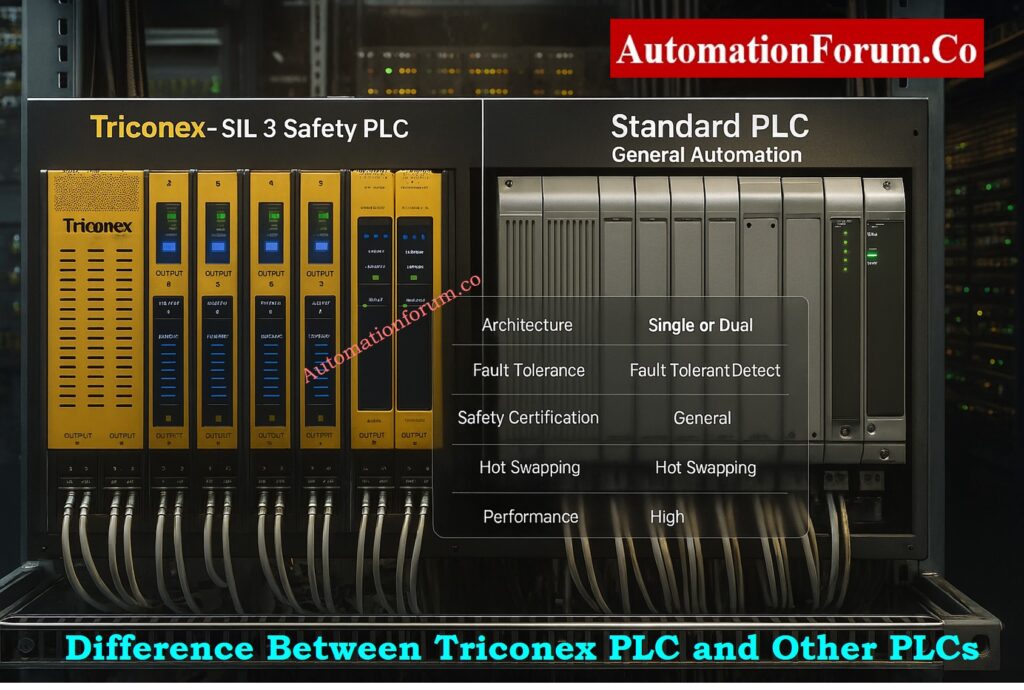
Triconex PLCs are high-integrity safety and critical control systems made for industries including oil and gas, power generation, petrochemicals, and manufacturing where failure is not an option.
Triconex systems are different from regular PLCs since they are made to keep process safety and availability even when hardware problems happen. They are the main parts of Safety Instrumented Systems (SIS), which protect people, equipment, and the environment all the time.
Standard vs Safety PLCs: Key Differences, Applications & Emerging Trends Explained: Difference Between Standard and Safety PLCs: Features, Applications & Future Trends
Triple Modular Redundancy (TMR) Explained
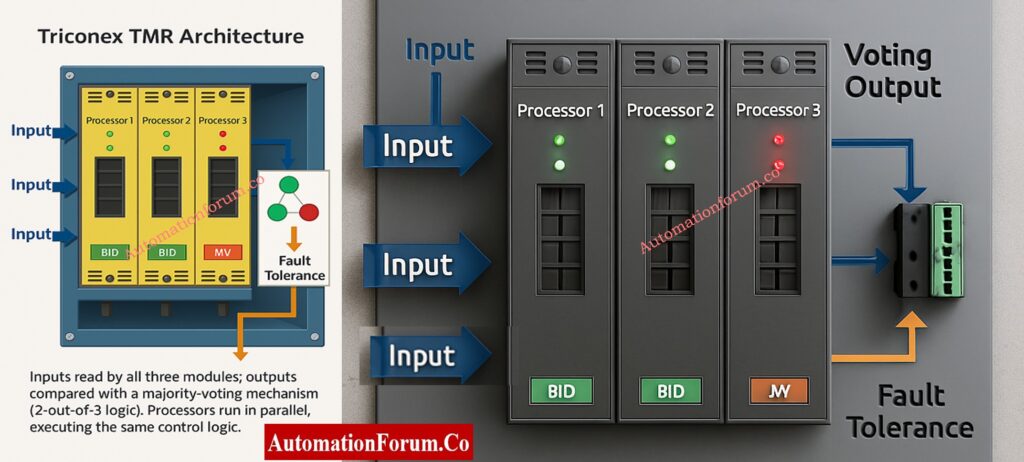
The Triple Modular Redundancy (TMR) architecture is what makes every Triconex PLC fault-tolerant.
Here’s how it works:
- All three processors read the input data at the same time.
- A majority-voting technique (2-out-of-3 logic) is used to compare output signals.
- If one processor gives an incorrect answer, the other two automatically vote against it, so the system keeps working without any problems.
This method removes single points of failure, resulting in uninterrupted process operation, zero downtime, and maximum safety integrity.
Industries Using Triconex Systems
Triconex PLCs are used a lot in applications that need the highest level of safety and dependability since they have SIL 3 certification and a design that can handle faults. These include:
- Emergency Shutdown Systems (ESD)
- Fire and Gas Detection Systems (FGS)
- High-Integrity Pressure Protection Systems (HIPPS)
- Turbine and Compressor Protection Systems
These systems are often used in chemical plants, refineries, power plants, and offshore platforms, where it is very important that they work all the time and meet safety standards.
Step-by-Step PLC Program for Motor Starter with Low-Level Switch Safety Interlock: PLC Program for Motor Starter with Low-Level Switch Interlock
What are Conventional PLCs?
Common PLCs are automation controllers that can be utilized in many different fields. Siemens, Allen-Bradley (Rockwell Automation), Schneider Modicon, Mitsubishi, ABB, and Omron are some well-known brands.
These PLCs are made for controlling processes, automating machines, controlling motion, and sequencing logic. They usually have:
- A single or dual processor
- Modular I/O cards for communication, analog, and digital signals
- Programming languages like structured text, ladder logic, or function blocks
- Protocols for communication like Modbus, Ethernet/IP, or Profinet
These PLCs are dependable and strong, but they aren’t made to be used in safety-critical situations unless they are used with extra safety modules.
PLC Racks & Chassis Explained: Types, Functions, and Selection Guide: Understanding PLC Racks and Chassis: Types, Differences, and Purposes
Key Differences Between Triconex PLC and Other PLCs
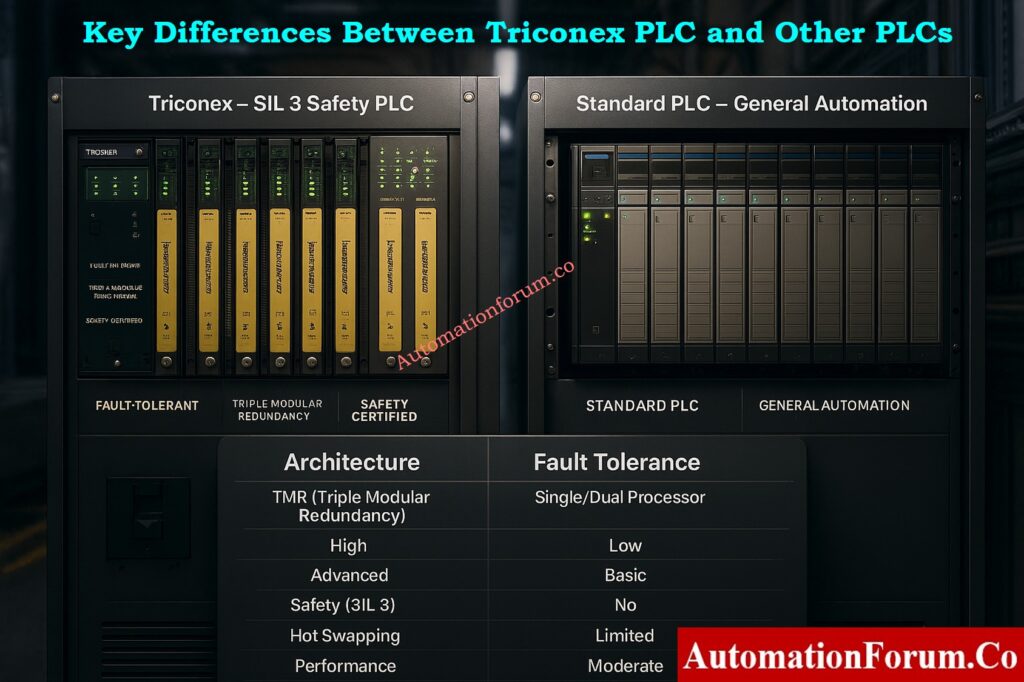
You may see a side-by-side comparison of Triconex PLCs and regular PLCs below.
| Feature | Triconex PLC | Other PLCs |
| Architecture | Triple Modular Redundancy (three processors with voting logic). | Single or dual processor, basic redundancy if available. |
| Fault Tolerance | Faults in one leg are masked, system continues without interruption. | A processor or module failure can cause downtime. |
| Diagnostics | Advanced diagnostics at CPU, I/O, and voting levels. Fault isolation and detailed logging. | Basic diagnostics (module failure, bus errors). |
| Safety Certification | Certified up to SIL 3 for safety instrumented systems. | Standard PLCs are not SIL-rated; safety modules may be added. |
| Hot Swapping | Modules can be replaced online without stopping the system. | Some PLCs allow hot swapping, but with limitations. |
| Performance | Slightly slower due to triple computation and voting, but optimized for safety. | Faster scan times in general control applications. |
| Cost | High, due to triple hardware, certification, and complexity. | Lower cost, widely available. |
| Use Case | Emergency shutdown, HIPPS, fire & gas, turbine protection, SIS. | General automation, process control, machine logic. |
| Programming Tool | Uses TriStation software with safety-focused programming. | Uses vendor-specific software like Siemens STEP 7, Rockwell Studio 5000, etc. |
| Integration | Typically integrated with DCS as a safety logic solver. | Can be a standalone controller or part of a control network. |
Hot Standby PLC Systems Explained: Architecture, Operation & Advantages: Hot Standby in PLC Systems: Architecture, Working, and Benefits
Fault Tolerance and Triple Modular Redundancy (TMR)
You may see a side-by-side comparison of Triconex PLCs and regular PLCs below.
Fault Tolerance in Triconex
Fault tolerance is the ability of a PLC system to keep working correctly even when one aspect of it breaks.
Triconex achieves this by:
- Running three control paths at the same time
- Always comparing the outputs from all three channels
- Automatically finding and fixing broken modules without stopping the process
This makes sure that there is no downtime and that the system is always available, which is very important in places like refineries and nuclear plants where safety is very important.
TMR Voting Mechanism
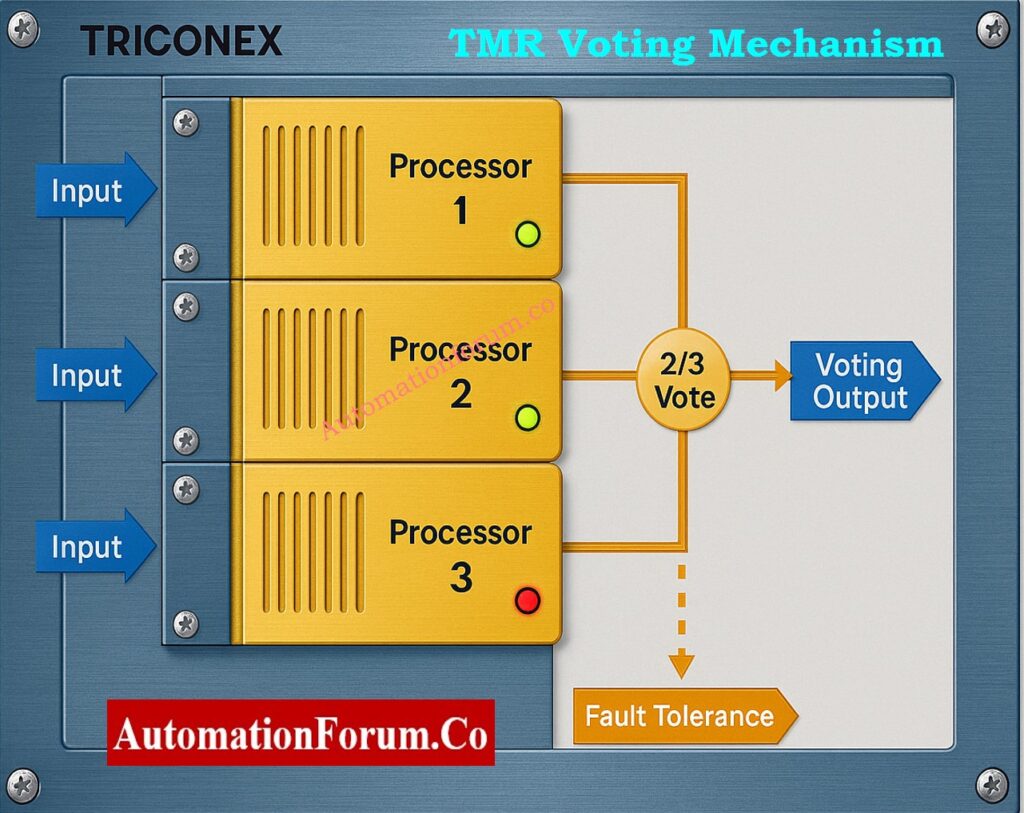
The TMR system has three separate processor modules that do the same logic activity at the same time. A voting system (2-out-of-3 logic) choose the right answer.
If one processor fails or gives the wrong output, the other two “outvote” it, which keeps the system safe and lets the process keep going.
Benefits of TMR in Industrial Safety Systems
- Makes sure that it keeps working even with a lot of problems
- Finds and fixes problems on its own
- Increases the safety and availability of the process
- Gets rid of single-point failures
The Triple Modular Redundancy architecture is what makes Triconex PLC stand out from other PLCs. Most typical PLCs only use dual redundancy or simple backup systems, which may not be able to reach SIL 3 reliability.
Supercharge Your PLC: 7 Expert Tips to Optimize Speed & Performance: How to Increase PLC Speed: 7 Optimization Tips + Advanced Programming Guide
Safety Certification and Standards Compliance
Triconex systems are made to meet safety standards around the world:
- IEC 61508: A standard for functional safety for electrical and electronic systems.
- SIL 3 certification: The highest level of safety that is usually applied in process industries.
- TUV certified: Verification by a third party for reliability.
Most standard PLCs don’t have SIL 3 certification. Some suppliers sell safety PLCs with extra safety modules, however they still don’t have the same level of full fault tolerance as a Triconex system.
Diagnostics, Maintenance, and System Reliability of Triconex PLC Systems
Self-Testing and Fault Logging
Triconex systems can do a lot of different kinds of diagnostics, such as:
- Continuous self-testing of CPUs, I/O, and internal buses
- Fault logging and reporting
- Predictive maintenance alerts
- Online replacement of faulty modules without halting the process.
Standard PLCs can show basic faults, as when a module fails, there is a communication mistake, or there is a short circuit. But in most circumstances, you have to stop using the system to replace broken parts.
Triconex does triple processing and voting, which means that its raw scan speeds may be slower than those of typical PLCs. But the system is set up to work best for deterministic safety response, which means it guarantees that safety events will always happen at the same time.
Standard PLCs can work faster for controlling machines, moving things, and real-time applications, but they don’t have built-in safety features.
Boost PLC Reliability: Proven Maintenance Strategies for I/O Modules to Cut Downtime: Proactive Maintenance Strategies for PLC I/O Modules: Reduce Downtime & Improve Reliability
Comparison with Conventional PLC Diagnostics
Because of its redundant architecture, certified parts, and safety lifecycle management, setting up a Triconex Safety PLC costs more in terms of both money and engineering. But the total cost of ownership (TCO) is often worth it because of:
- Reduced plant downtime
- Lower risk of accidents or environmental damage
- Extended equipment life
- Compliance with international safety standards
In comparison, some PLCs are cheaper to start with, but they might not be as fault-tolerant or safe, thus they aren’t good for SIL 3 or emergency shutdown applications.
Top PLCs in Automation: Which Controllers Lead the Industry?: Which PLC is Mostly used in the Automation Industry?
Applications of Triconex PLC Systems
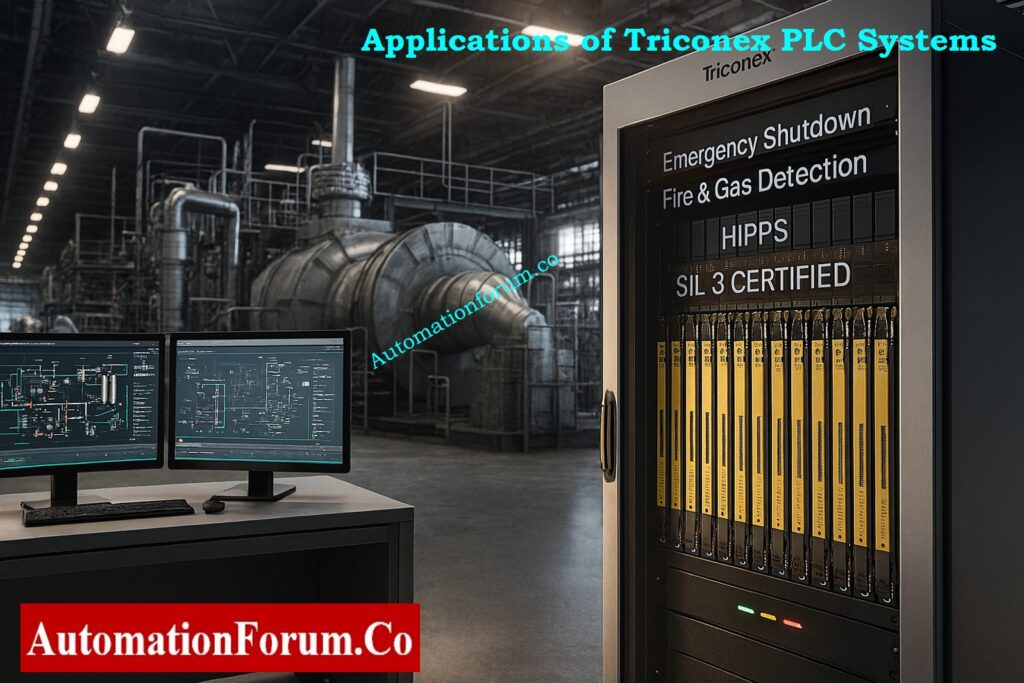
Triconex safety systems are employed in places where process safety, fault tolerance, and activities that don’t stop are very important. Some of the most common industries are:
- Oil and gas refineries need emergency shutdown systems (ESD) and fire and gas (F&G) protection.
- Power Generation: Used in safety systems for turbines, boilers, and the whole facility.
- Petrochemical and chemical plants use burner management systems, process safeguarding, and reactor protection.
- Nuclear Industry: To make sure that reactors work safely and that radiation protective controls are in place.
- Pharmaceutical and food industries need process automation that is clean and safe.
Example Application
The Triconex PLC could be in charge of an Emergency Shutdown (ESD) System at a refinery. If a process variable like temperature or pressure goes above safe levels, the system starts a safe shutdown sequence right away. This includes closing valves and isolating process units to stop explosions or harmful leaks.
The TMR architecture makes sure that the shutdown signal still works perfectly, even if one controller module fails during this procedure. This protects people, property, and the environment.
Applications of Conventional PLCs
Standard PLCs are good for:
- General manufacturing automation
- Packaging and material handling
- Conveyor systems
- Motion control applications
- Non-critical process control
- Utility and facility automation
Advantages and Disadvantages of Triconex PLC
Advantages – Safety, Reliability, and Uptime
High Reliability and Availability
- The system can keep running even if there are problems thanks to Triple Modular Redundancy.
- Perfect for plants that need to be up and running all the time and have no process breaks.
Safety Compliance (SIL 3 Certified)
- Triconex systems fulfill the strict IEC 61508/61511 criteria for SIL 3 Safety Instrumented Systems.
Comprehensive Diagnostics
- Built-in self-diagnostic tools keep an eye on the status of hardware, I/O, and logic all the time, which cuts down on maintenance downtime.
Modular and Scalable
- Triconex PLCs may be easily scaled up to fit a growing system while keeping safety standards.
Redundant I/O and Communication
- Supports many redundant I/O modules and communication networks to make things more reliable.
Seamless Integration
- Works with Tristation software, DCS, and SCADA systems to allow for centralized monitoring and configuration.
Reduced Downtime and Maintenance Costs
- Predictive defect identification cuts down on unplanned shutdowns and maintenance times.
High Availability PLC for Critical Operations
- Ensures that the process keeps going even when hardware is replaced or upgraded.
Disadvantages – Cost, Complexity, and Maintenance
High Initial Cost
- Triconex systems cost more than regular PLCs since they have more complex architecture and are SIL 3 certified.
Complexity in Design and Configuration
- Needs engineers who know a lot about TMR architecture and Tristation programming tools.
Limited Flexibility for Non-Safety Tasks
- Triconex systems are best for safety purposes, not for general automation.
Maintenance Expertise Requirement
- People that are trained and certified in Triconex safety systems are needed for troubleshooting and maintenance.
Hardware Footprint
- Redundant modules and multiple racks increase space requirements in control cabinets.
Despite these challenges, industries dealing with hazardous processes prefer Triconex PLCs because the cost of safety failure far outweighs the investment in reliability.
Why Choose Triconex PLC Over Other PLCs?
The proper PLC for your industrial process relies on how important it is, how safe it needs to be, and what the operational hazards are. Both Triconex and regular PLCs are made for control and automation, yet they do very different things.
Safety and Fault Tolerance as Top Priority
The Triconex PLC is the best choice for your plant operations if they include dangerous or high-risk activities, such those in oil and gas refineries, petrochemical facilities, or power generation units.
It was made specifically for Safety Instrumented Systems (SIS) and Emergency Shutdown (ESD) applications that need SIL 3 certification, fault tolerance, and high availability.
The Triple Modular Redundancy (TMR) design lets the system keep working even if one or more parts stop working. This makes sure that no one mistake can cause a process to stop or put safety at risk. On the other hand, a traditional PLC may need to be restarted or manually fixed after a failure, which increases downtime and operational risk.
High Availability for Continuous Production
For industries that have production lines that run 24 hours a day, 7 days a week, like chemical plants, fertilizer units, and offshore platforms, downtime is expensive and risky.
The Triconex Safety PLC has a self-healing fault-tolerant system, redundant I/O modules, and real-time diagnostics that make sure it is almost always up.
Triconex systems can stay up even when they are being serviced or modules are being replaced. This is a big plus in contexts where high availability is important.
Compliance with SIL and IEC Standards
Using a typical PLC in these situations could mean not following the rules, being more exposed to risks, and possibly facing legal action if something goes wrong.
Integration with DCS and BPCS
Triconex PLCs are made to work with both Distributed Control Systems (DCS) and basic process control systems (BPCS). They can easily talk to each other via industrial protocols and provide safe shutdown logic that is independent from conventional control functions. This makes sure that both process optimization and safety protection are in place.
When safety is not the main concern, regular PLCs are superior for controlling machines, automating batches, moving materials, and automating factories.
SIS vs PLC vs BPCS: Clear Differences Every Automation Engineer Should Know: Understanding Differences of SIS, PLC, and BPCS in Industrial Automation
Long-Term Cost Efficiency and ROI
Triconex PLCs cost more up front because they are designed with redundancy and are certified, but they usually cost less during their lifetime. Over time, the lower chance of plant shutdowns, accidents, and equipment damage gives a big return on investment (ROI).
Other PLCs, on the other hand, are more cost-effective up front and work well for non-critical tasks like building automation, packaging lines, or conveyors, where downtime doesn’t pose a big safety or environmental hazard.
When to Choose Triconex vs Other PLCs
When to Choose Triconex
- The application is safety-critical.
- SIL 3 compliance is mandatory.
- High availability and zero downtime are required.
- Failure could lead to catastrophic consequences.
When to Choose Standard PLCs
- The application is general process or machine control.
- Safety integrity requirements are low or moderate.
- Cost and simplicity are priorities.
- Speed and flexibility matter more than fault tolerance.
Which PLC Is Right for Your Application?
The biggest distinction between Triconex PLC and other PLCs is what they are used for. Triple modular redundancy and SIL certification make Triconex safe, fault-tolerant, and always available. This makes it essential for industries where failure is not an option.
On the other hand, regular PLCs are cheaper, more flexible, and good enough for most automation applications.
Ultimately, you should decide between Triconex and a regular PLC based on safety considerations, cost limits, application needs, and risk assessment.
FAQ on Difference Between Triconex PLC and Other PLC
Is Triconex a PLC?
Yes. Triconex devices are PLCs, however they are unusual kinds. They are safety-PLC and safety logic solvers made for critical and safety-instrumented control. Schneider Electric owns the Triconex brand.
What is a Triconex system?
The Triple Modular Redundancy (TMR) design is the basis for the Triconex system. It has three parallel processors, or “legs,” that all run the same control program. All of them read inputs, and the majority votes on outputs. It was made to be very safe and dependable, and it is certified up to SIL 3 for safety-critical tasks including shutting down in an emergency, protecting turbines from fire and gas, and more.
Can Triconex PLCs be used for general automation?
Triconex PLCs are not meant for general-purpose automation since they are too complicated and expensive. They are only meant for safety applications.
Which industries commonly use Triconex PLC systems?
Triconex systems are utilized in the nuclear, petrochemical, oil and gas, and power generation industries.
Are all PLCs SIL 3 certified?
No. Only specialized safety PLCs like Triconex can get SIL 3 certification; conventional PLCs need extra safety modules.
Test Your PLC Troubleshooting Skills: Quiz for Process Engineers
Refer the below link to Test Your PLC Skills with our Advanced Digital Output Troubleshooting Quiz for Process Engineers
