
- What is an IS Barrier Earth Fault Current Calculator?
- Why IS Barrier Earth Fault Current Calculation Is Important
- How the IS Barrier Calculator Works
- Technical Explanation of Results
- Relevant Standards in Practical Use
- Key Benefits of Using an IS Barrier Earth Fault Current Calculator
- Who Should Use This Calculator
- When to Use This Calculator
- Frequently Asked Questions on IS Barrier Earth Fault Current
IS Barrier Earth Fault
Current Calculator
Intrinsic Safety · Zener Barrier & Galvanic Isolator
An IS barrier earth fault current calculator is a tool used to evaluate intrinsic safety loops by calculating fault current, verifying grounding, checking gas group compatibility, and ensuring hazardous area compliance.
What is an IS Barrier Earth Fault Current Calculator?
An IS barrier earth fault current calculator is a useful engineering tool used to evaluate the safety of an intrinsic safety loop in a hazardous area. It helps instrumentation engineers, electrical engineers, and maintenance teams check whether the selected zener barrier or galvanic isolator is suitable for the application, whether the earth conductor size is adequate, and whether the fuse rating is properly selected for safe operation.
In process industries, intrinsic safety is one of the most important protection methods for equipment installed in explosive atmospheres. A small error in barrier selection, grounding, gas group matching, or conductor sizing can create a serious safety risk. That is why using an IS barrier calculator is valuable during loop design, commissioning, troubleshooting, and maintenance.
This calculator is especially helpful for engineers who need a quick but practical check of earth fault current, zone compliance, gas group compatibility, and fault protection in hazardous area instrumentation loops.
Master Intrinsic Safety Protection (Ex ia, ib, ic): Intrinsic Safety Protection Systems: Understanding Ex ia, Ex ib, and Ex ic
Why IS Barrier Earth Fault Current Calculation Is Important
The calculation of earth fault current in intrinsic safety circuits is important because the earth conductor and protective devices must be able to handle abnormal fault conditions safely. In a zener barrier system, the earth path is a critical part of the protection concept. If the earth conductor is undersized, incorrectly installed, or poorly connected, the safety barrier may not perform as intended.
For this reason, an intrinsic safety earth fault current calculator supports safer design decisions by helping to identify:
- Whether the loop current is within a safe range
- Whether the selected barrier type matches the hazardous area requirement
- Whether the earth conductor can withstand the calculated fault current
- Whether the fuse rating is appropriate for the loop
- Whether the barrier gas group is suitable for the area gas group
- Whether the selected setup meets the required hazardous area classification
This makes the calculator a practical tool for both design verification and field maintenance.
FISCO Model Explained for Fieldbus Safety: Fieldbus Intrinsically Safe Concept (FISCO) Model for Foundation Fieldbus H1 and Profibus PA
How the IS Barrier Calculator Works
The attached calculator is straightforward, but every input represents an engineering decision. The idea is to enter the real loop data, not just default values.
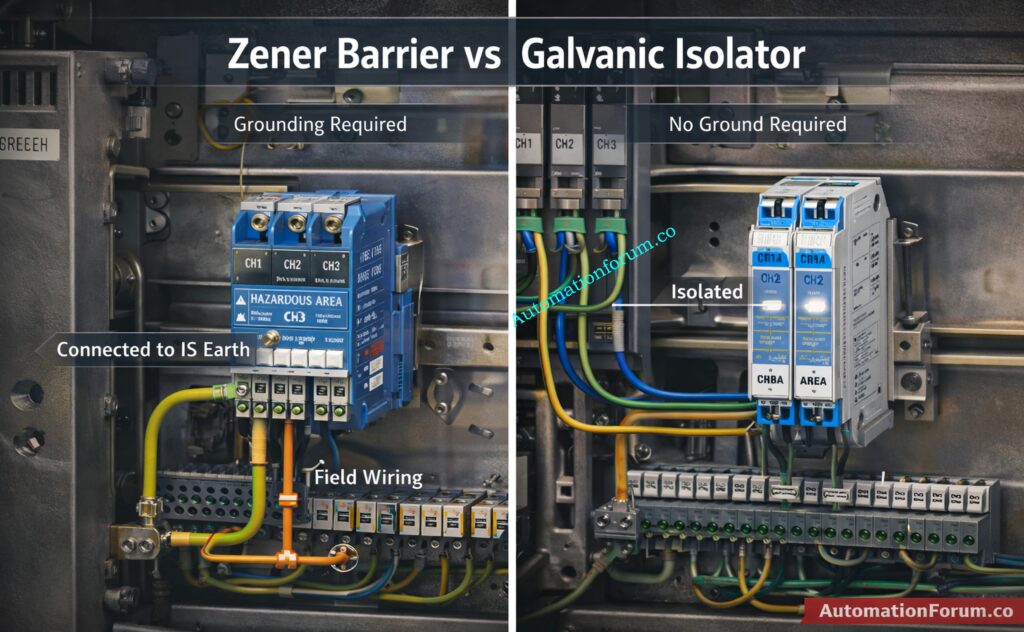
Barrier type
Select Zener Barrier or Galvanic Isolator.
A zener barrier depends on a sound earth reference to divert fault energy safely. A galvanic isolator provides isolation through electronics and transformer-based or similar methods, which changes the grounding requirement. This selection affects the current calculation method in the attached logic.
Hazard zone
Choose the area classification: Zone 0, Zone 1, or Zone 2.
This matters because not every barrier arrangement is acceptable in every zone. In the attached logic, the zone check flags galvanic isolator use as not permitted in Zone 0. That makes the calculator useful as an advisory screening tool before final design review.
Gas group of area
Select the site gas group: IIA, IIB, or IIC.
This represents the severity of the flammable atmosphere. A gas group mismatch can invalidate the protection concept even if the loop current looks acceptable.
Gas group of barrier
Enter the barrier gas group.
The calculator checks whether the barrier gas group is equal to or more robust than the area gas group. In practice, that is one of the first things to confirm during intrinsic safety review.
Panel Door Earth Bonding Procedure (Step-by-Step): Panel Door Earth Bonding Procedure: Ensuring Safety and Reliability
Voltage
Enter the loop voltage.
For a zener-style calculation, voltage contributes to the available current. In the attached logic, voltage and resistance are used to estimate current when galvanic isolation is selected.
Resistance
Enter the loop resistance.
This helps determine the single-channel current when the calculator uses the voltage/resistance method.
Isc
Enter the short-circuit current value, usually in mA.
For the zener barrier path in the attached calculator, Isc is used directly as the single-channel current. That reflects a practical fault-current-oriented approach.
Loop current
Enter the normal operating loop current.
This is important for fuse recommendation and for checking whether the field loop operates within expected current demand.
Number of channels
Enter the number of channels in the barrier or isolator arrangement.
The calculator multiplies channel current by the number of channels and fault factor to estimate total fault current. That is useful when a multi-channel unit is feeding several loops.
What Is an Earth Pit? (Full Guide): What is an Earth Pit?
Fault factor
Enter the fault factor.
This gives a margin for practical fault conditions. In plant work, that margin is important because real installations are never perfectly ideal.
Clearing time
Enter the clearing time in seconds.
This is used in the earth conductor sizing calculation. A longer clearing time generally increases the conductor size requirement.
Conductor material
Choose Copper or Aluminium.
The attached logic uses different k-values for the adiabatic sizing equation depending on the conductor material. That means conductor material directly affects the earth conductor size result.
Selected fuse
Enter the fuse rating in mA.
The calculator compares the selected fuse to a recommended value based on loop current. This helps flag under-rated protection before field installation.
Top IS Loop Failures You Must Avoid: Top Causes of Intrinsically Safe (IS) Loop Failure and How to Avoid Them
Technical Explanation of Results
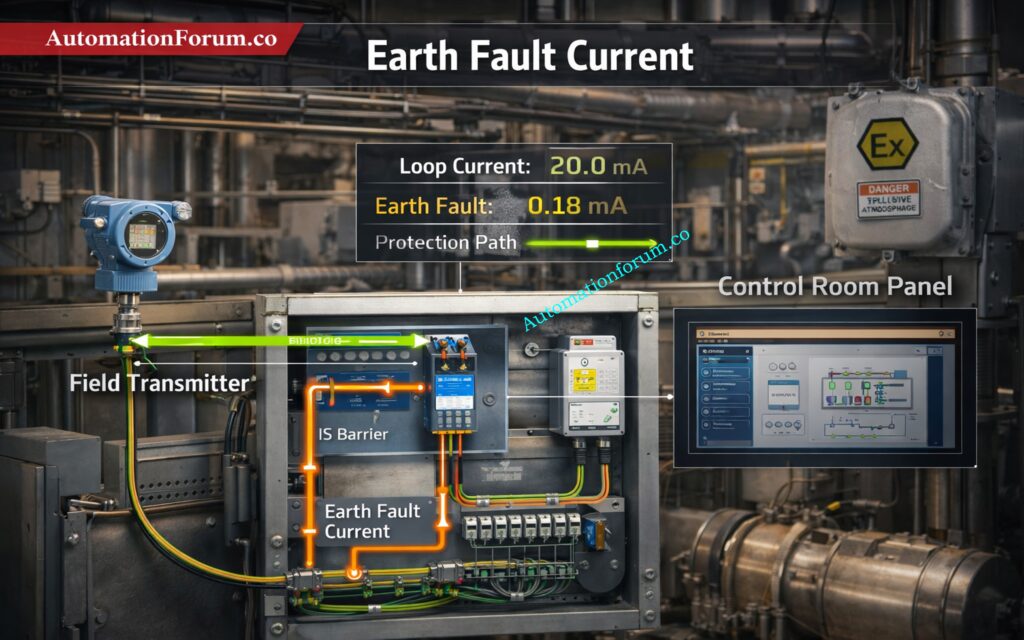
The output is where the calculator becomes especially useful for engineering review.
Single channel current
This is the current for one channel based on the selected barrier type and input values. For zener barriers, the calculator uses Isc. It uses voltage split by resistance, which is then turned into mA, for galvanic isolators.
Intrinsic Safety Explained (Complete Guide): What is Intrinsic Safety? Definition, Working Principle, Standards and Applications
Total fault current
This is the expected fault current after considering number of channels and fault factor. In plant terms, it helps you think about worst-case stress on earthing and protection components.
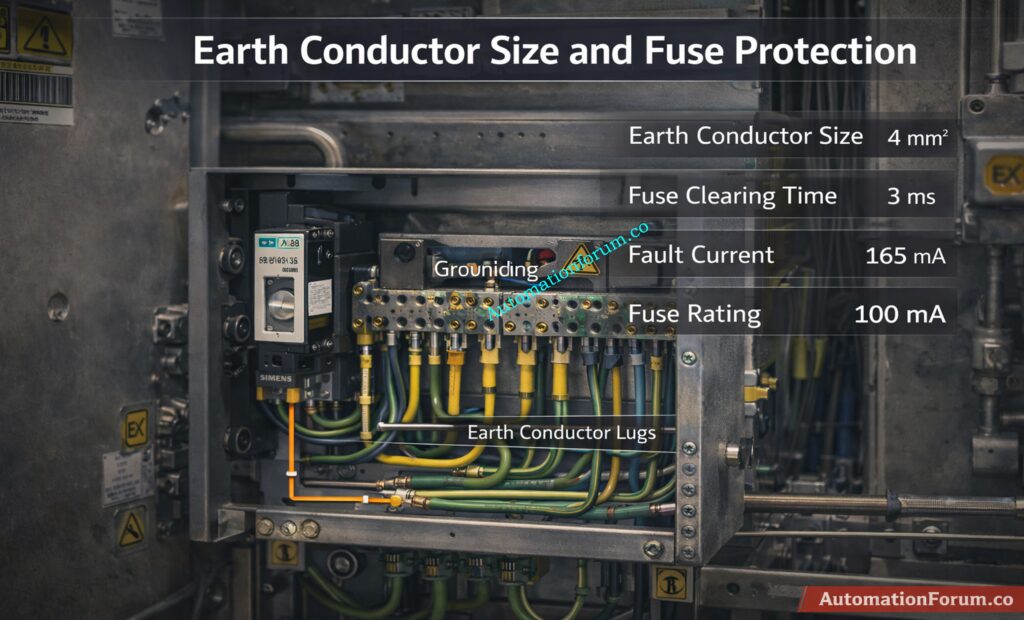
Earth conductor size
This is one of the most important results. The calculator uses an IEC adiabatic-style equation and applies a minimum size rule. That helps ensure the earth conductor can survive fault energy long enough for protection to operate.
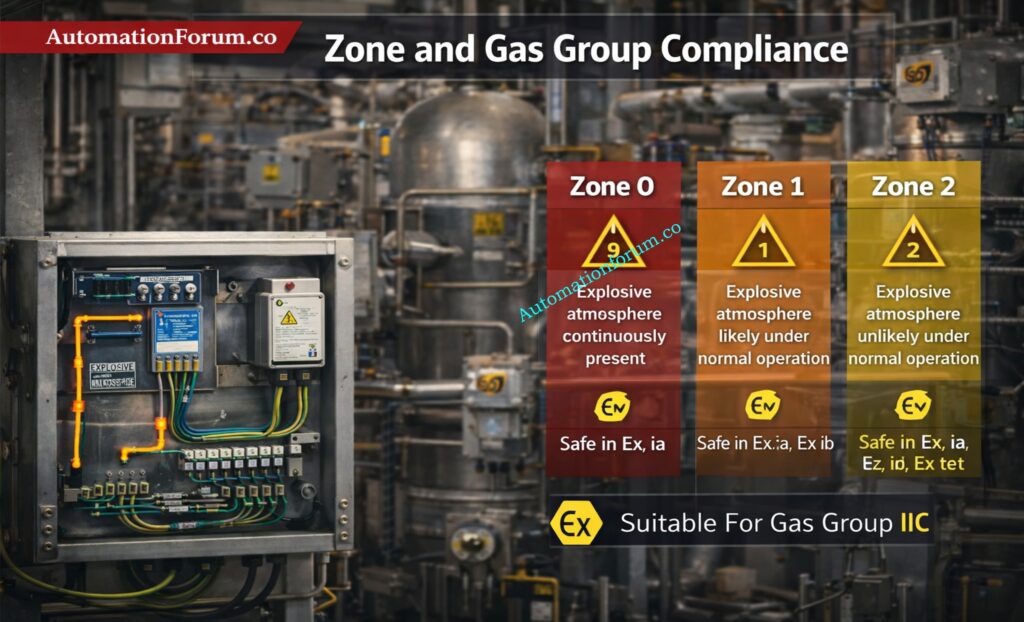
Gas group check
This result tells you whether the selected barrier gas group is suitable for the area gas group. In intrinsic safety, gas group compatibility is not optional; it is central to the protection concept.
Zone compliance
This result checks whether the chosen barrier arrangement is acceptable for the selected hazardous zone. In the attached logic, galvanic isolators are flagged as not suitable for Zone 0.
Earthing Drawing Explained for Engineers: Earthing Drawing
Fuse recommendation
The calculator recommends a fuse rating based on loop current, then compares it with the selected fuse. In maintenance terms, this is useful when verifying that a replacement fuse has not altered the protection margin.
Overall status
The overall status is shown as either SAFE (Advisory) or CHECK REQUIRED. Engineers should treat this as a screening result, not a final certification. Final design still has to follow the applicable project specification, local code, and approved hazardous area documentation. That is especially important when applying IEC 60079 series requirements in real plant work.
ATEX Intrinsically Safe Cable Checklist (Must Read): Intrinsically Safe Cables for ATEX Zones – Complete Checklist for EPC Engineers
Relevant Standards in Practical Use
The calculator is aligned with engineering practices that support the following standards and concepts:
- IEC 60079 series: The main family for explosive atmospheres.
- IEC 60079-11: Intrinsic safety equipment requirements.
- IEC 60079-14: Installation practices in hazardous areas.
- IEC 60079-17: Inspection and maintenance of electrical installations in hazardous areas.
- IEC 60529: Enclosure protection, when panel or field enclosure protection is part of the review.
- IEC 61508 / IEC 61511: Functional safety context, where loop protection interacts with safety instrumented systems.
- NEC / NFPA 70 Articles 500 and 504: Useful when comparing North American hazardous area practice.
- ATEX concepts: Important for Europe-based hazardous area compliance.
These standards matter because they shape barrier selection, grounding practices, installation quality, and inspection expectations. They don’t take the role of project-specific technical judgment; instead, they set the rules for how the loop should be established and kept up.
Test Your Intrinsic Safety Knowledge (Quiz): Advanced Quiz on Intrinsic Safety Instrumentation Circuits in Oil & Gas Process Industries
Key Benefits of Using an IS Barrier Earth Fault Current Calculator
Using an IS barrier earth fault current calculator provides several practical benefits for engineers working in process industries, oil and gas plants, chemical plants, and other hazardous environments.
Faster Loop Design Review
The calculator gives a rapid engineering view of the loop instead of having to check each value by hand. This saves time during the design process and helps find problems early.
Better Hazardous Area Compliance
The calculator may check for zone compliance, gas group compatibility, and the right way to safeguard people, all of which are critical for compliance in hazardous areas.
Improved Maintenance Verification
Maintenance teams can use the calculator to recheck the loop after a barrier replacement, cable change, fuse replacement, or grounding modification.
Instrument Earthing Systems Explained: Instrument Earthing Systems
Safer Earth Fault Protection
Sizing earth conductors and evaluating fault current assist lower the risk of protection parts that are too small.
More Reliable Instrumentation Systems
A well-designed intrinsic safety loop makes things more reliable, cuts down on false alarms, and helps field devices work steadily.
IS vs Non-IS Cables – Critical Differences: Difference Between Intrinsically Safe (IS) and Non-IS Cables
Who Should Use This Calculator
This calculator is practical for teams involved in both design and ongoing plant support.
Design engineers
Use it while preparing IS loop design packages, selecting barriers, sizing earth conductors, and checking whether the proposed loop is compatible with the hazardous area classification.
Instrumentation engineers
Use it when choosing a barrier for transmitters, switches, solenoids, or other low-energy field devices and when confirming the loop against project standards.
Maintenance engineers
Use it during repair, replacement, periodic checks, and troubleshooting of existing intrinsic safety loops, especially if a barrier, fuse, or cable has been changed.
IEC 60079-14 Explained (Installation Guide): IEC 60079-14 Explained: Complete Guide to Hazardous Area Installation for Instrumentation and Control Systems
Electrical and automation engineers
Use it when coordinating loop protection, grounding philosophy, fuse selection, and panel-side installation requirements.
Commissioning engineers
Use it before energizing a loop in a hazardous area to verify that the intended installation matches the approved documentation.
Hazardous area specialists
Use it as a quick advisory check during reviews against IEC 60079-based documentation and site standards.
Refer the below link for the Intrinsic Safe Calculation for Instrumentation Design Engineers
When to Use This Calculator
The most useful time to use an IS barrier earth fault current calculator is before installation and again during maintenance verification.
During loop design
This is the best time to confirm whether the selected barrier type, gas group, and zone are aligned with the field device and area classification.
During hazardous area review
Use it when checking whether the proposed loop meets the intended intrinsic safety arrangement and plant documentation.
Earth Fault vs Ground Fault – Key Differences: Difference between Earth Fault and Ground Fault
Before selecting a zener barrier or galvanic isolator
A zener barrier usually depends heavily on proper earthing. A galvanic isolator changes the grounding philosophy, so this check helps avoid mismatches early.
Before finalizing earth conductor size
The calculator’s conductor sizing result is useful when deciding whether the earth conductor is adequate for the expected fault current and clearing time.
During maintenance checks and troubleshooting
When verifying fuse and protection settings
Fuse selection should be checked whenever loop current, barrier protection, or wiring changes are made.
Complete IS Installation Checklist for Engineers: Installation Checklist for Intrinsically Safe Instrument (Apparatus)
Frequently Asked Questions on IS Barrier Earth Fault Current
What is the difference between a zener barrier and a galvanic isolator?
A zener barrier relies on earthing to divert excess energy, while a galvanic isolator provides electrical isolation. The calculator helps compare both options in a practical IS loop context.
Why does earth fault current matter?
Because the earth path must be able to carry fault energy safely until protection operates. If the conductor is undersized, the protection concept becomes weak.
Why Intrinsic Safety Is Critical in Hazardous Areas: Why Choose Intrinsic Safety (IS) for Hazardous Area Instrumentation?
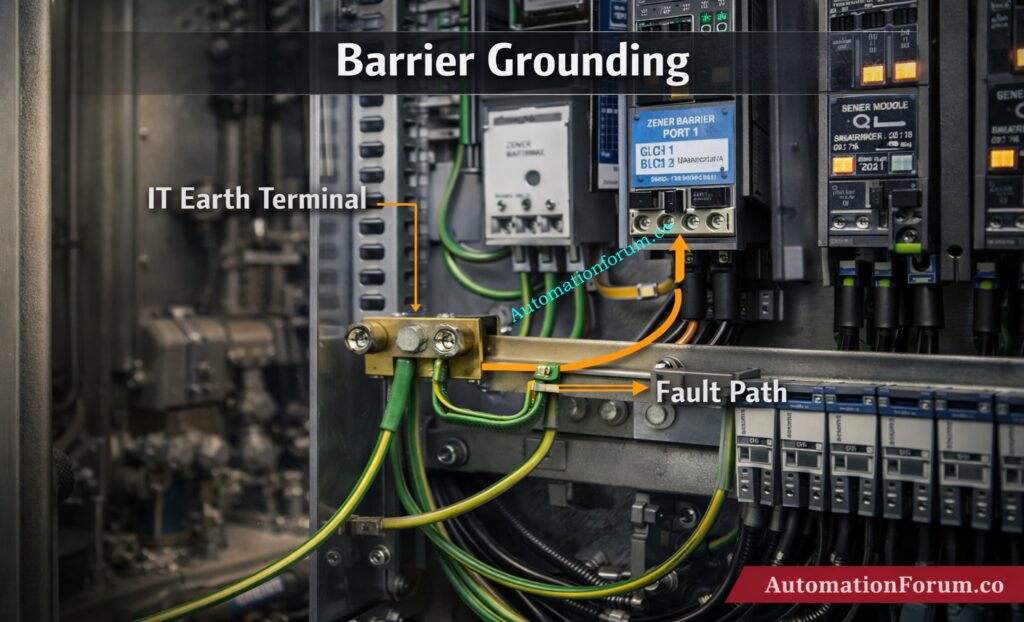
Is barrier grounding?
Yes. A zener barrier must be properly grounded to a dedicated intrinsic safety (IS) earth.
Grounding safely diverts fault energy and prevents sparks.
Without proper grounding, the intrinsic safety protection can fail.
What is the earth fault current?
Earth fault current is the current that flows to ground during a fault condition.
It occurs when a live conductor contacts earth or grounded parts.
This current is critical for protection system design and safety.
Is the earth an effective ground fault current path?
Yes, but only if the earth path is low resistance and properly designed.
In intrinsic safety systems, a dedicated IS earth is required.
Poor grounding can lead to unsafe conditions and protection failure.
Which is better: Zener barrier or galvanic isolator?
It all relies on the application and how it is set up.
Zener barriers are cheap, but they need robust grounding.
Galvanic isolators are safer where proper grounding is difficult.
Signal Noise & Stability in Instrumentation Systems: Noise and Signal Stability Observation for Running Inspection in instrumentation and Control Systems
Is galvanic AC or DC?
Galvanic isolation is a method, not a type of supply (AC/DC).
It can be used in both AC and DC systems depending on design.
Most industrial isolators work with DC signal loops.
Intrinsic Safety vs Explosion-Proof (Full Comparison): Difference Between Intrinsically Safe and Explosion-Proof
What is the difference between barrier and isolator?
A barrier limits energy entering a hazardous area and needs grounding.
An isolator provides electrical separation without relying on earth.
Isolators offer better noise immunity and flexible installation.
Is this calculator suitable for Zone 0, Zone 1, and Zone 2?
It is useful as an advisory tool for all three zones, but the attached logic flags galvanic isolator use as not permitted in Zone 0. Final suitability still depends on project and code requirements.
Why is fuse sizing important?
The size of the fuse influences how well it protects the loop and how well it can remove errors. The calculator looks at the chosen fuse and compares it to a suggested value depending on the loop current.
How do international standards influence IS loop design?
Standards such as IEC 60079-11, IEC 60079-14, and IEC 60079-17 define the framework for safe equipment selection, installation, and inspection in hazardous areas.
Instrument Earth (IE) – Complete Engineering Guide: Understanding Instrument Earth (IE) in Industrial Automation – Complete Guide for Engineers
The IS barrier earth fault current calculator is a practical tool for engineers who work with intrinsic safety, hazardous area instrumentation, and process automation systems. It brings together the core checks that matter in real plant work: barrier type, zone suitability, gas group compliance, earth fault current, conductor sizing, and fuse selection. The attached calculator also reflects the way engineers actually work in the field, where design review and maintenance troubleshooting often overlap.
For design engineers, it helps reduce loop-design errors before installation. For maintenance teams, it provides a quick way to verify whether a modified loop still makes sense from an intrinsic safety point of view. Used correctly, it supports safer decisions, cleaner documentation, and better alignment with IEC 60079-based hazardous area practice.
Engineering takeaway: treat the calculator as a disciplined first check for IS loop protection, then complete the final review against project specifications, local code, and approved hazardous area documentation.
Refer the below link for What is HAZOP Study in Instrumentation Engineering for EPC Engineers in Process Industries
