
- Introduction to Process Safety vs Functional Safety
- Why Many Engineers Confuse Process Safety and Functional Safety
- What is Process Safety?
- What is Functional Safety?
- Relationship Between Process Safety and Functional Safety
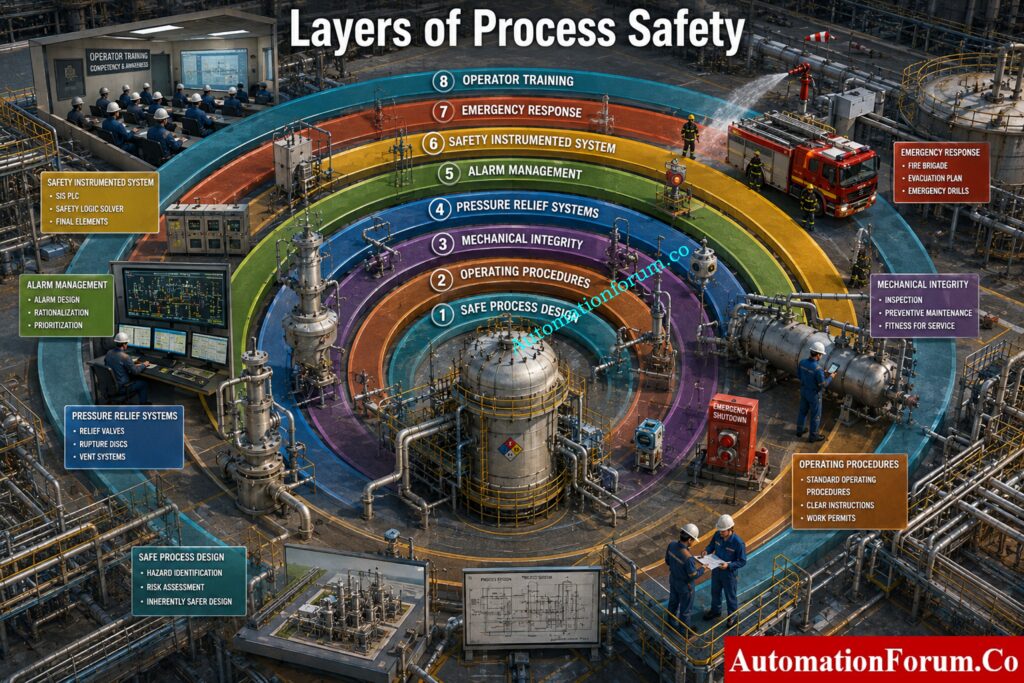
- Process Safety Framework Explained
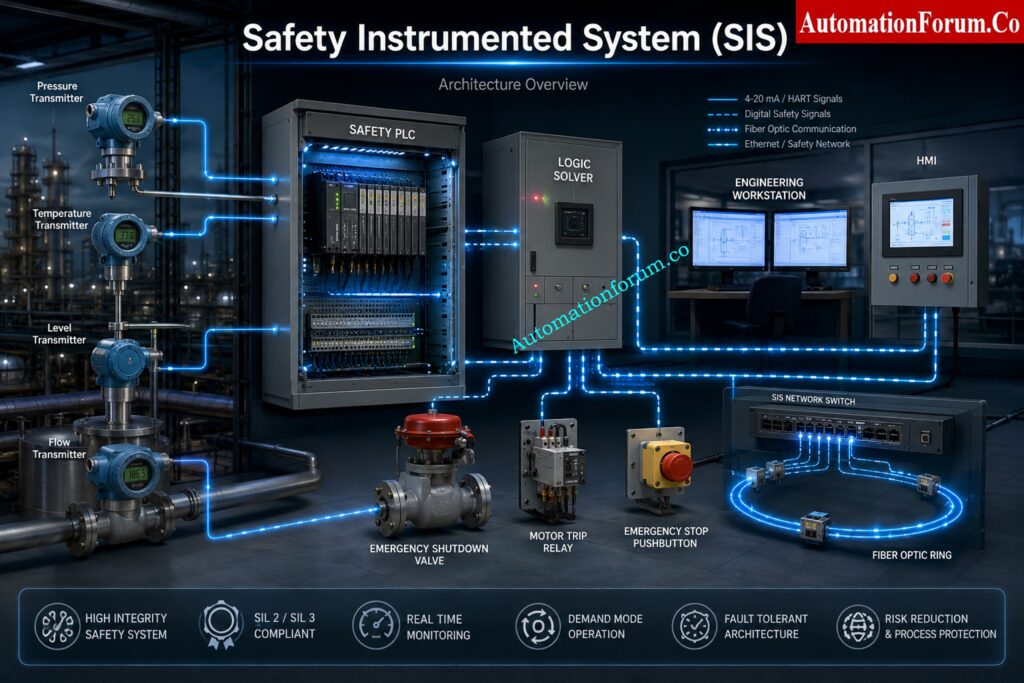
- Functional Safety Framework Explained
- Functional Safety Lifecycle Explained
- Components of a Safety Instrumented Function (SIF)
- Understanding Safety Integrity Level (SIL)
- Difference Between SIS and SIF
- Real Industrial Examples of Functional Safety
- Common Misconceptions About Process Safety and Functional Safety
- Best Practices for Process Safety and Functional Safety
- Latest Trends in Process Safety and Functional Safety
- International Standards for Functional Safety
- Benefits of Process Safety
- Benefits of Functional Safety
- Frequently Asked Questions (FAQs) on Process Safety vs Functional Safety
- Key Takeaways and Final Thoughts for Instrumentation Engineers
Introduction to Process Safety vs Functional Safety
If you have worked in a refinery, chemical plant, power station, or any process industry, you have probably heard the terms Process Safety and Functional Safety used in meetings, HAZOP reviews, or project discussions. Many engineers even use these terms as if they mean the same thing. In reality, they are closely connected but they are not identical.
This misconception typically leads to false assumptions in plant design, commissioning, maintenance, and risk assessment. For example, some engineers believe that installing a Safety Instrumented System automatically makes a plant safe. Others think Functional Safety covers every aspect of Process Safety. Both ideas are incorrect.
Why Understanding the Difference Matters
Understanding the difference is important because every industrial facility handles risks. These risks include fire, explosion, toxic gas release, equipment damage, environmental pollution, and injury to personnel. Managing these hazards requires many layers of protection, not just automation.
Process Safety vs Functional Safety at a Glance
Think of Process Safety as the complete safety strategy for an industrial plant. One significant part of that concept is Functional Safety, which uses instrumentation and control systems to mitigate risk when hazardous situations occur.
Knowing this relationship enables engineers to build safer factories, troubleshoot systems better and adhere to international safety regulations with more assurance.
Why Many Engineers Confuse Process Safety and Functional Safety
The confusion usually begins because both disciplines aim to reduce industrial risk. Both involve hazard studies, engineering reviews, documentation, and safety standards. They also work together throughout the life of a plant.
Another reason is that modern plants rely heavily on automation. Since many safety functions are performed by instruments, PLCs, and Safety Instrumented Systems, engineers naturally associate Functional Safety with overall Process Safety.
However, Process Safety is much broader.
A simple way to remember the difference is this:
Every Functional Safety activity supports Process Safety, but Process Safety includes much more than Functional Safety.
Avoid Costly Design Errors That Compromise Plant Safety Today: Top Critical Mistakes in Safety Instrumented System Design as per ISA 84 Standard and How to Avoid Them
What is Process Safety?
Definition of Process Safety
Process Safety is the discipline of preventing major industrial accidents involving hazardous materials or dangerous forms of energy.
Occupational safety is about protecting individual workers from common threats such as falls or electrical shock. Process Safety is about preventing catastrophic events that impact people, equipment, the environment and adjacent communities.
Its main aim is to prevent incidents before they occur, rather than react after an accident has already occurred.
Main Objectives of Process Safety
- Prevent fires and explosions
- Prevent toxic chemical releases
- Protect people and the environment
- Minimize equipment damage
- Maintain safe and reliable plant operation
- Ensure compliance with safety regulations
Major Process Safety Hazards
Process Safety manages hazards such as:
- Flammable gas leaks
- Chemical reactions that become unstable
- High pressure equipment failure
- Boiler explosions
- Tank overfilling
- Pipeline ruptures
- Toxic gas releases
- Steam system failures
These hazards require a mix of engineering controls, operating practices, inspections, maintenance programs and emergency readiness.
Why Process Safety is Critical in Process Industries
Modern industry runs on huge amounts of stored energy and dangerous substances. A small error might lead to a domino effect with catastrophic results.
For example , a blocked outlet on a reactor may cause pressure to rise rapidly . If the relief mechanisms fail, the reactor could explode, unleashing dangerous chemicals. Designing such situations out, appropriate maintenance, skilled people and good safety management throughout the plant are all required to avoid such events.
Master Proven Redundancy Strategies That Maximize Instrument Reliability: Redundant Transmitters Explained: Reliability, Voting Logic and SIL for Instrumentation Engineers
What is Functional Safety?
Definition of Functional Safety
In simple words, Functional Safety ensures that safety systems perform the correct action at the right time whenever a dangerous situation develops.
Instead of preventing every abnormal condition, Functional Safety minimizes the consequences when hazardous events cannot be avoided through normal process control.
Purpose of Functional Safety
The main purpose is to place the process in a safe condition whenever predefined hazardous conditions are detected.
For example:
- High reactor pressure automatically shuts down feed pumps.
- High furnace temperature closes fuel gas valves.
- Low boiler water level trips the burner.
- High tank level stops incoming transfer pumps.
- Gas detection initiates emergency shutdown actions.
These automatic procedures lower the probability of accidents, which could otherwise be disastrous.
Role of Instrumentation and Control Systems
Functional safety is achieved by dependable instrumentation that operates as an integrated system.
Typical equipment consists of:
- Pressure transmitters
- Temperature transmitters
- Level transmitters
- Gas detectors
- Safety PLCs
- Logic solvers
- Emergency shutdown systems
- Final control elements such as shutdown valves and motor trips
The devices continually monitor process parameters and immediately respond when harmful limits of operation are exceeded.
Stop Choosing the Wrong Shutdown System for Critical Applications: ESD vs SIS Difference When to Use Each and Practical Engineering Guide
Relationship Between Process Safety and Functional Safety
Process Safety Framework
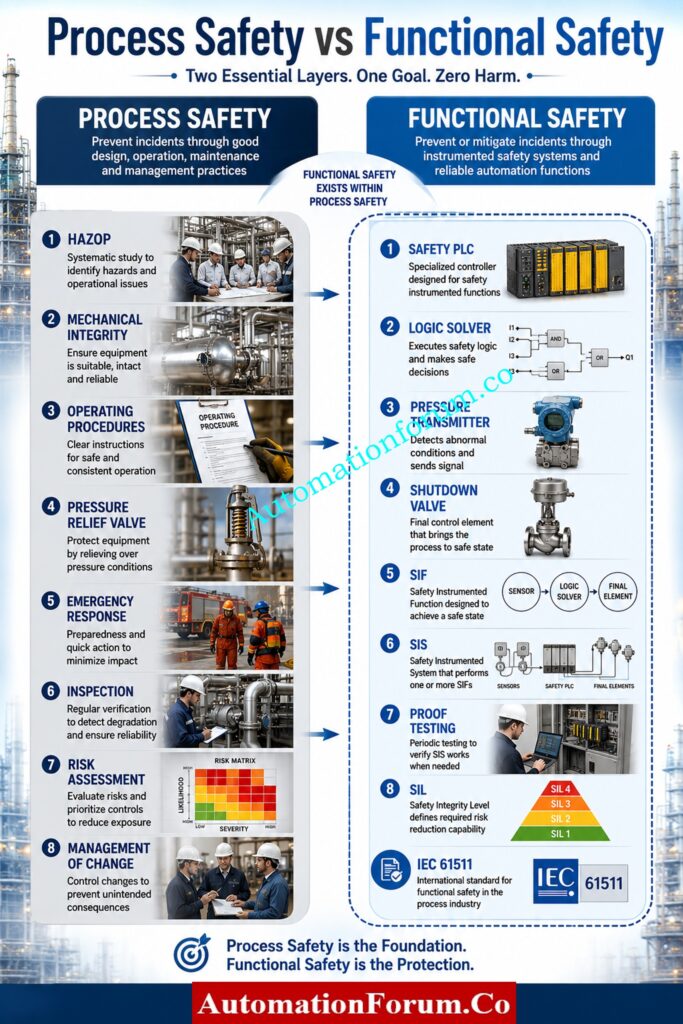
The easiest way to understand their relationship is to imagine a large umbrella.
Process Safety is the umbrella. Functional Safety is one important section underneath it.
Process Safety manages every activity required to prevent major accidents throughout the entire plant.
Functional Safety as a Layer of Protection
Functional Safety specifically focuses on automatic risk reduction using instrumentation and control systems.
Industrial Refinery Example
For example, consider a crude oil refinery.
To prevent a reactor accident, the plant may use:
| Process Safety Activity | Purpose |
| HAZOP study | Identify hazards before operation |
| Operating procedures | Guide operators during normal and abnormal conditions |
| Mechanical inspections | Detect equipment deterioration |
| Pressure relief valves | Protect against excessive pressure |
| Emergency response plans | Manage incidents effectively |
| Safety Instrumented System | Automatically shut down dangerous processes |
Why SIS Alone Cannot Ensure Process Safety
Notice that the Safety Instrumented System is only one element among many Process Safety measures.
Even the greatest Safety Instrumented System cannot be guaranteed to operate safely without proper maintenance, operating discipline, inspection programs and managerial monitoring.
This knowledge enables the engineer to make better design decisions and to understand why both disciplines are required for reliable industrial operations.
Refer the below link for the What is SIS, SIF and SIL? An In-Depth Guide to Functional Safety in Process Industries
Process Safety Framework Explained
Process Safety is founded on a number of integrated operations that combine to manage industrial risk across the life of a facility.
| Process Safety Activity | Purpose |
| HAZOP | Identifies process hazards before operation |
| Risk Assessment | Evaluates likelihood and consequences of hazards |
| LOPA | Determines whether existing protection layers are adequate |
| Mechanical Integrity | Keeps equipment in safe operating condition |
| Management of Change | Controls modifications to equipment and procedures |
| Operating Procedures | Guides safe plant operation |
| Emergency Response | Prepares personnel for abnormal situations |
| Incident Investigation | Identifies root causes and prevents recurrence |
| Independent Protection Layers | Provide multiple barriers against hazardous events |
Each activity contributes to reducing overall plant risk. Together they create a comprehensive Process Safety program that protects people, assets, production, and the environment.
Calculate SIL Performance Accurately Before Your Safety Audit Begins: SIF PFDavg / SIL Verification – Complete Guide + Online Calculator (IEC 61508 / 61511)
Functional Safety Framework Explained
Its framework includes the following key elements.
| Functional Safety Activity | Purpose |
| IEC 61508 | General Functional Safety standard for electrical and electronic systems |
| IEC 61511 | Functional Safety standard for the process industries |
| Safety Instrumented Systems | Automatically reduce process risk |
| Safety Instrumented Functions | Perform specific protective actions |
| Safety Lifecycle | Guides activities from concept to retirement |
| Safety Integrity Level | Defines required reliability of safety functions |
| Verification | Confirms engineering meets design requirements |
| Validation | Confirms the complete system performs correctly in the plant |
| Proof Testing | Demonstrates continued performance during operation |
| Functional Safety Assessment | Reviews compliance throughout the lifecycle |
| Functional Safety Management | Ensures safety activities are planned, documented, and controlled |
These activities ensure that safety systems remain dependable throughout their operational life and continue to provide the required level of risk reduction.
Prevent Dangerous Testing Delays Using Proven IEC Best Practices: Testing and Repair Deferral – IEC Guidelines, Procedure, and Best Practices
Functional Safety Lifecycle Explained
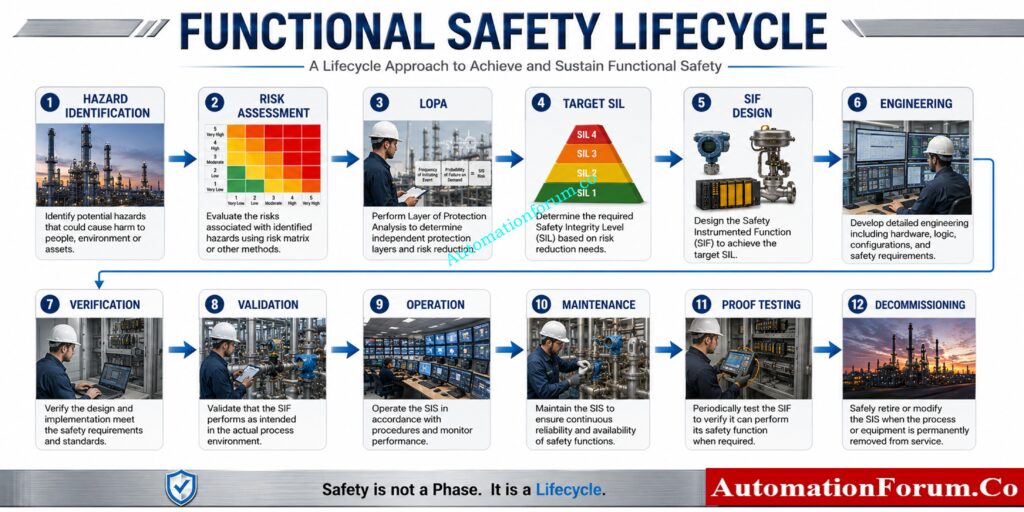
Functional Safety is not something that begins after the Safety Instrumented System is installed. It starts during the earliest stages of a project and continues until the system is finally removed from service. Every stage of the lifecycle is important because a weakness at any point can reduce the effectiveness of the safety function.
The table below summarizes the complete Functional Safety lifecycle.
| Lifecycle Stage | Purpose |
| Hazard Identification | Identify potential hazardous events |
| Risk Assessment | Evaluate the severity and likelihood of each hazard |
| LOPA | Determine whether additional protection is required |
| Target SIL Selection | Define the required Safety Integrity Level |
| SIF Design | Develop the required Safety Instrumented Functions |
| Engineering | Select and configure safety equipment |
| Verification | Confirm the design meets requirements |
| Validation | Confirm the installed system performs correctly |
| Operation | Operate the safety system correctly |
| Maintenance | Maintain system reliability |
| Proof Testing | Periodically verify safety function performance |
| Modification | Control changes using formal procedures |
| Decommissioning | Safely remove the system from service |
Hazard Identification
Every Functional Safety project begins by identifying hazardous operating conditions.
Engineers look at the process to see what could go wrong. They analyze equipment failures, operator errors, utility breakdowns and anomalous operating conditions that could lead to hazardous situations.
The idea is to find dangers before they turn into events.
Risk Assessment
Once hazards are identified, engineers estimate the probability of each incident and its potential repercussions.
A little equipment failure may not have much consequence. Loss of cooling in a reactor could lead to a big accident. Knowing the level of risk helps determine if more protection is needed.
Layer of Protection Analysis
A Layer of Protection Analysis or LOPA looks at whether the layers of protection in place have reduced the risk to an acceptable level .
If residual risk is still too great, possibly another Safety Instrumented Function is needed.
LOPA provides a standardized and consistent means of determining how much risk reduction is required.
Target Safety Integrity Level
Once the LOPA is finished, the engineers decide the Safety Integrity Level (SIL) required.
The higher the SIL the more reliable the safety function needs to be because the potential repercussions are more severe.
The chosen SIL is the design target for the Safety Instrumented Function.
SIF Design and Engineering
Engineers now design the Safety Instrumented Function.
This comprises the selection of the proper sensors, logic solver, shutdown valves, communication interfaces, power supplies, and diagnostic capability.
Each component has to function together to be able to achieve the required SIL but also be practical for operation and maintenance.
Verification and Validation
Although these terms are often confused, they have different purposes.
Verification confirms that the engineering design satisfies all specified requirements.
Validation confirms that the installed Safety Instrumented System performs correctly under actual plant operating conditions.
Both activities are essential before the system is placed into service.
Operation, Maintenance and Proof Testing
After commissioning, the Safety Instrumented System enters normal operation.
Without regular maintenance, even a well designed Safety Instrumented Function can gradually lose its ability to protect the process.
Modification and Decommissioning
Industrial plants continue to evolve throughout their operating life.
Whenever equipment, process conditions or operating procedures are changed, engineers need to assess the influence on Functional Safety.
When a plant reaches the end of its service life, the Safety Instrumented System must also be removed in a controlled manner to avoid introducing new hazards.
Download Essential Functional Safety Terms Every Engineer Must Master: Functional Safety Terminology – Excel Download for Industrial Automation
Components of a Safety Instrumented Function (SIF)
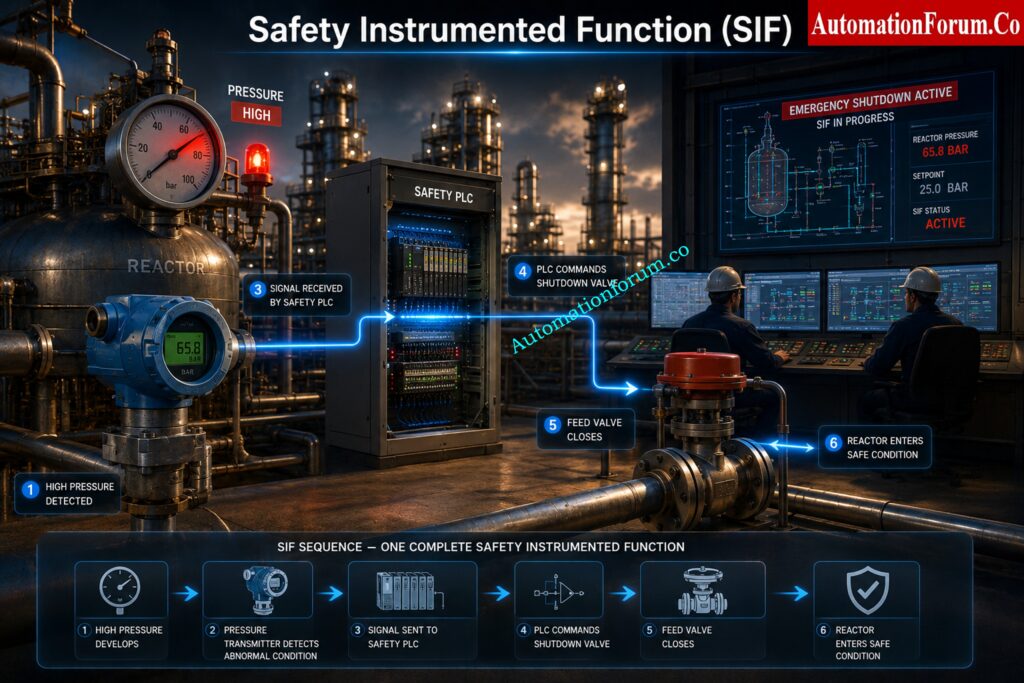
A Safety Instrumented Function, commonly called a SIF, performs one specific protective action whenever a dangerous process condition is detected.
Every SIF contains three basic components.
| Component | Function |
| Sensors | Detect hazardous process conditions |
| Logic Solver | Makes the shutdown decision |
| Final Element | Places the process in a safe condition |
Sensors
Sensors continuously monitor important process variables such as pressure, temperature, flow, and level.
If the process variable goes beyond the safe operating limit the sensor sends a signal to the logic solver.
For example, a pressure transmitter detects dangerously high reactor pressure.
Logic Solver
The logic solver acts as the decision making unit.
It receives signals from one or more sensors, evaluates the programmed safety logic, and determines whether a shutdown action is required.
Most modern plants use dedicated Safety PLCs because they are specifically designed for safety applications.
Final Element
The final element performs the physical action that places the process into a safe condition.
Typical final elements include shutdown valves, motor contactors, circuit breakers, dampers, and trip relays.
For example, a shutdown valve immediately closes the fuel gas supply to a fired heater when excessive temperature is detected.
Together, these three components perform a complete Safety Instrumented Function that automatically reduces process risk.
Discover Critical Shutdown Signals That Protect High-Risk Industrial Processes: Signals for Emergency Valve Shutdown in Critical Processes
Understanding Safety Integrity Level (SIL)
What is Safety Integrity Level?
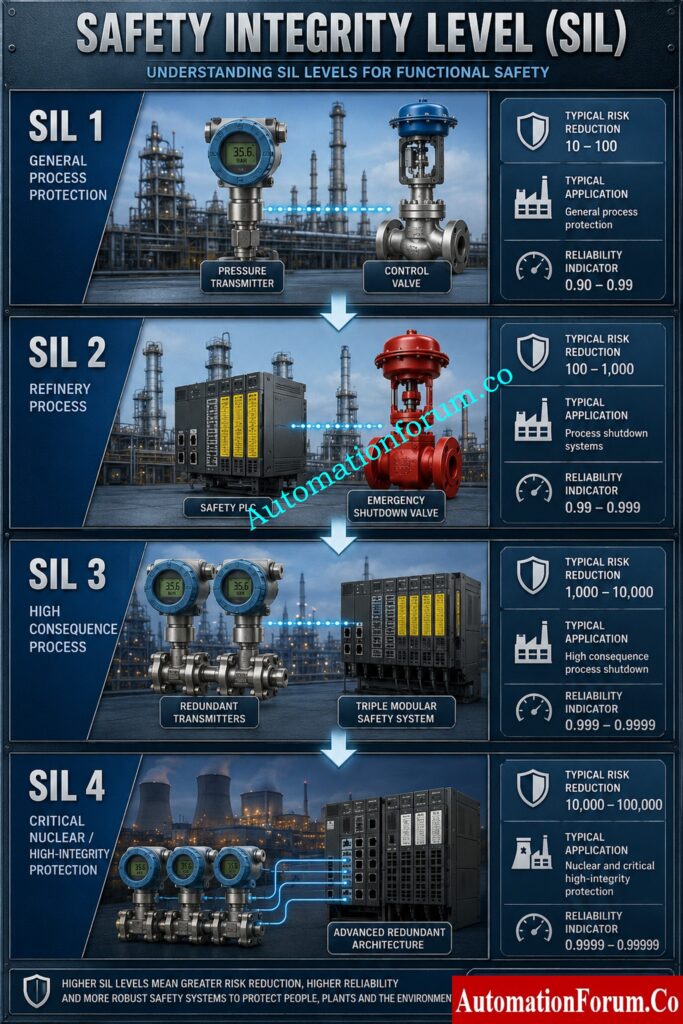
Safety Integrity Level defines the reliability required for a Safety Instrumented Function.
It does not indicate how safe a plant is. Instead, it specifies how reliably a particular safety function must perform when demanded.
SIL 1 vs SIL 2 vs SIL 3 vs SIL 4
| SIL | Typical Risk Reduction | Typical Application |
| SIL 1 | Lowest level | General process protection |
| SIL 2 | Moderate risk reduction | Refinery and chemical process protection |
| SIL 3 | High risk reduction | High consequence hazardous processes |
| SIL 4 | Very high risk reduction | Extremely rare in process industries |
Higher SIL requirements demand better equipment reliability, more rigorous engineering, increased testing, and stronger documentation.
How SIL is Determined
SIL is never selected by personal preference or equipment capability.
It is calculated by Layer of Protection Analysis considering process hazards, existing safeguards and acceptable risk levels.
This structured approach ensures that the required risk reduction matches the actual process hazard.
Challenge Your Functional Safety Skills Before the Next Project: Test Your Expertise in Safety Instrumented Systems (SIS): Knowledge Quiz
Difference Between SIS and SIF
What is a Safety Instrumented System (SIS)?
A Safety Instrumented System is the complete safety system installed within a plant.
What is a Safety Instrumented Function (SIF)?
A Safety Instrumented Function is one individual protective function performed by that system.
SIS vs SIF Comparison Table
The comparison below makes the distinction clear.
| Feature | Safety Instrumented System | Safety Instrumented Function |
| Definition | Complete safety system | One specific protective function |
| Scope | Includes multiple safety functions | Performs one defined action |
| Components | Sensors, logic solver, final elements, engineering and support systems | Sensors, logic solver and final element for one function |
| Quantity | One system may contain many functions | Each function protects one hazard |
| Example | Entire Emergency Shutdown System | High reactor pressure shutdown |
Practical Example of SIS and SIF
A refinery Emergency Shutdown System may contain dozens of Safety Instrumented Functions. One function protects against high reactor pressure, another protects against high furnace temperature, while another trips pumps during low suction pressure.
Each SIF addresses a single hazardous scenario, while the SIS manages all of them together.
Master Proven Solenoid Voting Configuration for Reliable Shutdown Performance: Understanding 2 out of 2 SOV: Working & Configuration
Real Industrial Examples of Functional Safety
The concepts become much easier to understand when viewed in real operating plants.
Refinery Reactor High Pressure Shutdown
A refinery reactor may experience excessive pressure because of a blocked outlet. The pressure transmitter detects the abnormal condition, the Safety PLC evaluates the signal, and shutdown valves isolate the feed to prevent equipment failure.
Chemical Reactor Temperature Protection
In a chemical plant, loss of cooling water may cause reactor temperature to increase rapidly. Temperature transmitters detect the anomalous rise, and Safety Instrumented Function cuts off reactant flow before the reaction gets out of hand.
Boiler Low Water Level Protection
In a boiler, dangerously low drum water level can damage boiler tubes. The Safety Instrumented Function immediately trips the burners to prevent overheating and possible tube failure.
Tank High Level Shutdown
An independent high level switch on a storage tank can shut down the incoming transfer pumps before the tank overflows, lowering the danger of product discharge and environmental damage.
Emergency Shutdown During Gas Leak
During a severe gas leak, the Emergency Shutdown System can isolate fuel supply, shut down spinning equipment and execute Emergency Shutdown steps that protect personnel and facility assets.
Crack Tough Functional Safety Interviews with Confidence and Ease: Safety Instrumented System(SIS) Interview Questions and Answers
Common Misconceptions About Process Safety and Functional Safety
These examples show how Functional Safety provides automatic protection, while Process Safety includes many additional layers that work together to prevent major industrial accidents
Several misunderstandings continue to exist in the industry. Correcting these misconceptions helps engineers make better safety decisions.
Is Functional Safety the Same as Process Safety?
This is incorrect. Functional Safety is only one part of the overall Process Safety program. Process Safety also encompasses hazard studies, mechanical integrity, operating procedures, emergency preparedness, management of change and incident investigation.
Does SIS Guarantee Complete Plant Safety?
A Safety Instrumented System is intended to reduce risk but it is not able to remove all hazards. Even where other Process Safety standards are observed, mishaps can be caused by poor maintenance, wrong operating practices, equipment failure or human mistake.
Are SIL Certified Devices Enough?
SIL approved transmitters, logic solvers and shutdown valves are only components. The right design, engineering, installation, testing, documentation and maintenance throughout the lifecycle is fundamental to a compliant Safety Instrumented Function.
Is Every SIF an Independent Protection Layer?
Not every Safety Instrumented Function qualifies as an Independent Protection Layer. It must satisfy the independence, reliability, and performance requirements identified during Layer of Protection Analysis.
Discover Why Emergency Block Valves Save Critical Industrial Assets: What is an Emergency Block valve and How does it work
Best Practices for Process Safety and Functional Safety
Successful Functional Safety requires more than selecting quality equipment. It’s about focused engineering and ongoing progress.
- Perform periodic proof testing in accordance with the approved maintenance plan.
- Maintain cause and effect diagrams and engineering documentation.
- Any safety function change must first be through a Management of Change.
- Provide frequent Functional Safety training to staff.
- Maintain full records of testing and maintenance.
- Review Safety Instrumented Functions following process changes.
- Use Functional Safety Management methods throughout the plant lifetime.
Learn How Automated Block Valves Improve Plant Safety Instantly: What is an Automated Block Valve and how does it work
Latest Trends in Process Safety and Functional Safety
Modern digital technologies continue to improve Functional Safety and Process Safety.
- Digital proof test saves manual testing work and improves test accuracy.
- Smart field devices allow continuous diagnostics to expose growing flaws before they impact plant safety.
- Engineers can monitor the health of equipment remotely from central control centers.
- Predictive maintenance analyzes past operational data to schedule maintenance before to failure.
- Digital twins let engineers to assess proposed process modifications without impacting what’s occurring in the plant.
- Artificial Intelligence is starting to help with danger assessments, alarm management and maintenance planning by spotting patterns that the engineer may not see.
Explore High-Integrity Pressure Protection Systems Every Engineer Should Understand: How does the HIPPS system work in the Oil and gas Industry?
International Standards for Functional Safety
| Standard | Purpose |
| IEC 61508 | General Functional Safety standard for electrical, electronic, and programmable systems |
| IEC 61511 | Functional Safety standard for the process industries |
| IEC 61513 | Functional Safety guidance for nuclear power applications |
| ISA 84 | Practical implementation guidance aligned with IEC 61511 |
| API RP 556 | Recommended practice for instrumentation and protective systems in fired heaters |
Following these standards helps organizations develop consistent, reliable, and compliant safety systems.
Improve Emergency Shutdown Performance with Smarter Solenoid Valve Design: Implementing a Solenoid Operated Valve for Emergency Shtdown
Benefits of Process Safety
| Benefit | Value to Industry |
| Protects people | Reduces injuries and fatalities |
| Protects assets | Minimizes equipment damage |
| Protects environment | Prevents hazardous releases |
| Improves reliability | Reduces unplanned shutdowns |
| Supports compliance | Meets regulatory requirements |
Understand Proven Voting Logic That Enhances Functional Safety Reliability: Voting Logic in Safety Instrumented System
Benefits of Functional Safety
| Benefit | Value to Industry |
| Automatic protection | Responds rapidly to hazardous conditions |
| Risk reduction | Lowers the probability of major incidents |
| Reliable shutdown | Places the process in a safe state |
| Improved availability | Detects hidden failures through diagnostics |
| Better lifecycle management | Supports safe operation throughout plant life |
Discover Critical Shutdown System Differences Every Engineer Must Understand: ESD vs PSD: Difference Between Emergency Shutdown System and Process Shutdown System
Frequently Asked Questions (FAQs) on Process Safety vs Functional Safety
What is the difference between Process Safety and Functional Safety?
Process Safety is the prevention of catastrophic industrial mishaps by engineering, procedures and risk management. Functional Safety is a part of Process Safety that uses safety systems to automatically decrease process hazards.
What is a Safety Instrumented System?
A Safety Instrumented System (SIS) is an autonomous safety system that identifies dangerous conditions and automatically brings the process to a safe state. It is composed of sensors, a logic solver and final pieces.
What is a Safety Instrumented Function?
A Safety Instrumented Function is a particular protective activity provided by a Safety Instrumented System. It detects a hazardous condition and performs one predefined safety action.
What is Safety Integrity Level?
The level of reliability necessary for a Safety Instrumented Function to mitigate risk is called the Safety Integrity Level or SIL. The required SIL is determined by risk assessment and Layer of Protection Analysis.
Why is proof testing important?
What is the purpose of Layer of Protection Analysis?
Layer of Protection Analysis (LOPA) assesses whether existing controls sufficiently mitigate risk. It also helps in making a decision as to whether a further Safety Instrumented Function and SIL are needed.
Can a Basic Process Control System replace a Safety Instrumented System?
No. A Basic Process Control System manages regular operations. A Safety Instrumented System provides autonomous protection of the plant under hazardous situations.
Why is Management of Change important?
Management of Change (MOC) is the process of evaluating plant changes prior to implementation. It prevents new threats and preserves the integrity of existing safety systems.
What is PHA and HAZOP?
A Process Hazard Analysis (PHA) is a systematic method for detecting and analyzing process hazards. HAZOP is one of the most common techniques of PHA used to study process abnormalities.
What are the four pillars of Process Safety?
The four pillars of Process Safety are commitment to safety, understanding hazards and risks, managing risk, and learning from experience. Together they help organizations prevent major industrial accidents.
What is a Level 7 Process Safety?
There is no internationally recognized “Level 7 Process Safety” classification in standards such as IEC 61511 or CCPS. The term may refer to an organization specific safety maturity model rather than a global standard.
Build Reliable 2oo4 Voting Logic Using Practical PLC Techniques: Designing 2 out of 4 Voting Logic in Control Systems: A Step-by-Step PLC Ladder Diagram Tutorial with Video
Key Takeaways and Final Thoughts for Instrumentation Engineers
The best industrial plants think of Functional Safety as one critical layer in an overall Process Safety program, not a stand-alone solution. Engineers should use accepted worldwide standards, proof test often, keep proper documentation, manage plant changes cautiously, and continuously improve system performance throughout the equipment lifecycle.
A good understanding of both disciplines results in safer designs, more reliable operation of plant, better regulatory compliance, and greater protection of people, assets and the environment.
Refer the below link for the Designing 2 out of 3 Voting Logic in Control Systems: A Step-by-Step PLC Ladder Diagram Tutorial with Video
