
A Resistance Temperature Detector (RTD) is a precision sensor that changes electrical resistance with temperature. The PT2000 is a member of the RTD family with a nominal resistance of 2000 Ω at 0°C. It has a greater signal level (less noise and lead-resistance effects) than the PT100 or PT500, but it still has the same excellent accuracy and stability as platinum sensing elements.
What is a PT2000 RTD?
A PT2000 RTD is a platinum resistance temperature detector with a nominal resistance of 2000 Ω at 0°C. Like PT100, PT500, or PT1000 sensors, it works on the idea that the electrical resistance of platinum increases in a predictable way with temperature.
Some of the best things about PT2000 sensors are:
- Higher nominal resistance for a better signal-to-noise ratio.
- More sensitivity for accurate measurement.
- Reduced effect of lead wire resistance in long cable runs.
PT2000 RTD Resistance Temperature Calculator – Free Online Tool
This PT2000 calculator converts a measured resistance into the corresponding process temperature using the common linear approximation (IEC 60751 style, α = 0.00385). It’s handy for commissioning, field checks, calibration, and quick troubleshooting.
How the PT2000 RTD Calculator Works
The calculator uses IEC 60751 temperature-resistance characteristics but scales them for PT2000 sensors. You can:
- Enter a resistance value to get the temperature.
- Enter a temperature value to find the corresponding resistance.
- Work in °C
PT2000 RTD Wiring
PT2000 sensors can be wired in 2-wire, 3-wire, or 4-wire configurations:
- 2-wire: Simple but affected by lead resistance.
- 3-wire: Compensates for lead resistance in most industrial cases.
- 4-wire: Best for laboratory-grade accuracy.
Learn: Converting 2-Wire and 3-Wire RTDs into 4-Wire RTDs
How to use the PT2000 Resistance-to-Temperature Calculator
The calculator gives you the approximate temperature (°C) when you enter the measured RTD resistance (ohms). Use it for:
- Calibration in the field and loop checks
- Quick check of the wiring and health of the RTD and sensor
- Scaling analog input channels in PLC/DCS when they are being set up
- Training and showing how RTD behaves in a straight line
Who uses this tool:
- Instrumentation and control engineers for checking loops and scaling DCS/PLC
- Calibration technicians for bench tests and spot checks
- Maintenance teams fixing temperature loops
- System integrators and students who are studying the basics of RTD
PT2000 RTD Temperature Calculation Formula
Formula (linear approximation, IEC-style):
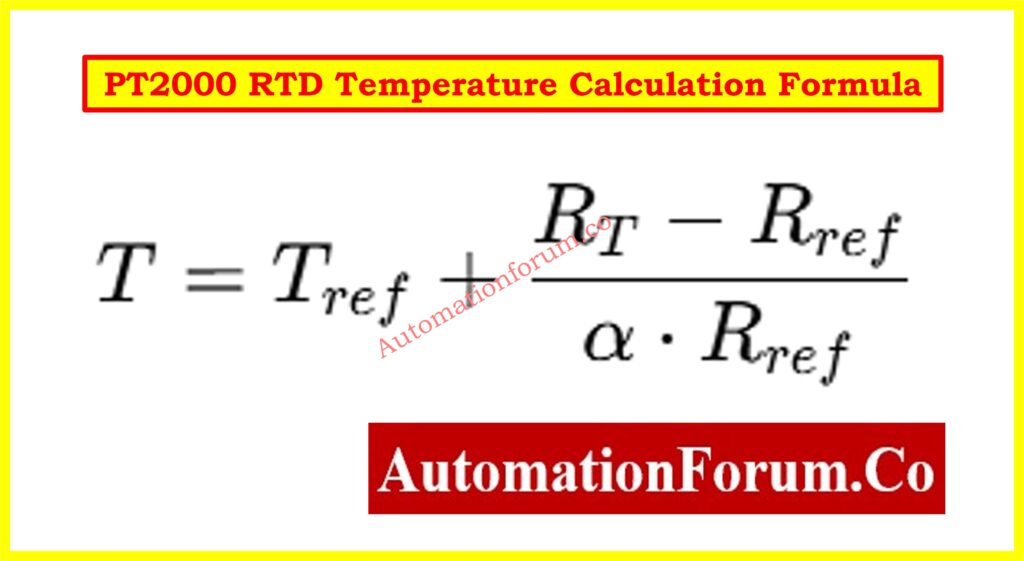
Where:
- T = temperature in degrees Celsius
- RT= measured resistance (Ω)
- Rref= reference resistance at Tref (for PT2000, Rref =2000 Ω at Tref =0∘C)
- α = temperature coefficient (for typical platinum RTDs, use 0.00385 /°C)
This treats the RTD as a straight line throughout a range of moderate temperatures, and it is correct for the linearized approximation.
Example Calculation for PT2000 RTD
Measured RTD resistance: 2307.7 Ω
Parameters:
Rref=2000 Ω
α=0.00385
Tref=0∘C
α x Rref=0.00385×2000=7.7
Resistance difference: RT−Rref=2307.7−2000=307.7
Temperature: T=0+(307.7÷7.7)=40.0∘C
So a PT2000 reading of 2307.7 Ω corresponds to 40.0 °C (linear approx).
Considerations & limitations
- Lead-wire resistance: The simple formula does not remove lead resistance. In 2-wire RTD installations, wire resistance adds to RT and will raise the apparent temperature. Use 3-wire or 4-wire measurements or subtract known lead resistance for accurate results.
- Linearity limits: The linear formula is a good, fast approximation over moderate temperature ranges. At temperature extremes, the RTD response deviates from linear use the Callendar Van Dusen equation or manufacturer calibration curves for high accuracy.
- Accuracy class and tolerances: Real sensors have tolerance classes, like IEC 60751 Class A, B, etc. Expect small deviations vs the ideal values.
- Self-heating and wiring errors: Long loops, improper excitation current, or poor connections can bias readings follow calibration best practices.
PT2000 RTD Resistance vs Temperature Table (α = 0.00385)
| Temperature (°C) | Resistance (Ω) |
| -50 | 1615.00 |
| -40 | 1692.00 |
| -30 | 1769.00 |
| -20 | 1846.00 |
| -10 | 1913.00 |
| 0 | 2000.00 |
| 10 | 2077.00 |
| 20 | 2154.00 |
| 30 | 2231.00 |
| 40 | 2308.00 |
| 50 | 2385.00 |
| 60 | 2462.00 |
| 70 | 2539.00 |
| 80 | 2616.00 |
| 90 | 2693.00 |
| 100 | 2770.00 |
| 150 | 3155.00 |
| 200 | 3540.00 |
| 250 | 3925.00 |
| 300 | 4310.00 |
| 350 | 4695.00 |
| 400 | 5080.00 |
(Calculated with R = 2000 × [1 + 0.00385 × T]. Values rounded to two decimal places where needed.)
Applications of PT2000 RTDs
- Monitoring the temperature in high-precision industrial processes.
- HVAC systems where precision is very important.
- Laboratory experiments needing minimal measurement error.
- Process automation for better control feedback
Practical Field Tips for PT2000 RTDs
- Use 3-wire RTD wiring for most industrial installations to cancel lead resistance. Use 4-wire for laboratory precision.
- When doing a quick loop check with a handheld ohmmeter, note and subtract measured lead resistance if using 2-wire.
- For transmitter scaling, set the analog input span using the expected resistance at the span endpoints (use the table or calculator).
- If high accuracy is required, record and apply the manufacturer’s calibration curve or use the Callendar-Van Dusen coefficients.
Refer the below link for the Collection of temperature measurement calculators and other instrumentation tools:
FAQs on PT2000 Temperature Calculations
What does PT2000 mean?
“PT” indicates a platinum sensing element; “2000” is the nominal resistance (2000 Ω) at 0°C.
How does PT2000 compare to PT100/PT1000?
PT2000 gives higher resistance (signal) than PT100 but lower than PT1000 it can offer better noise immunity than PT100 while keeping manageable resistance for input circuits.
What α should I use?
Use α = 0.00385 /°C for standard IEC 60751 platinum RTDs unless the manufacturer specifies different Callendar-Van Dusen coefficients.
When must I use Callendar-Van Dusen instead of linear formula?
For precision work (tight uncertainty budgets) or when temperatures are near sensor limits (very low or very high), use Callendar-Van Dusen or a certified calibration table.
Related Tools and Resources
- Online PT1000 RTD Calculator – Convert Resistance (Ω) to Temperature (°C) Instantly
- Free Online PT500 RTD Calculator: Resistance to Temperature Conversion for Instrumentation Professionals
- RTD Calculator: Converting Measured Resistance to Process Temperature
- RTD Calculator: Converting Process Temperature to measured Output Resistance
- RTD Temperature Coefficient Calculation
RTD (Resistance Temperature Detector) Advanced Quiz
Refer the below link to test your knowledge on RTD (Resistance Temperature Detector)
Check out the whole collection of instrumentation calculators for other tools for scaling signals, calculating transmitter spans, compensating for temperature, and more: More than 200+ online instrumentation calculators for instruments
 to temperature (°C) using the IEC 60751 linear formula. Ideal for calibration, loop checks, PLC/DCS scaling, and instrumentation troubleshooting.)