
- Calibration vs Verification: a Commonly Confused Concept
- Why Understanding the Difference Between Calibration and Verification Matters In Process Industries
- What Is Calibration in Instrumentation?
- What is Instrument Verification?
- Key Differences Between Calibration and Verification
- Calibration Vs Verification Comparison Table
- Practical Industrial Examples of Calibration Vs Verification
- Step-By-Step Industrial Calibration Procedure
- Step-by-Step Instrument Verification Procedure
- Regulatory Standards Governing Calibration Activities
- Common Mistakes When Performing Calibration and Verification
- Industrial Case Study: Consequences Of Relying Only on Verification
- When Should Calibration be Performed?
- When Should Verification be Performed?
- How Calibration Frequency is Determined in Industrial Plants
- Technician Checklist for Calibration and Verification
- Key Takeaways: Calibration Vs Verification
- Why Calibration and Verification are Both Critical for Process Industry Measurement Systems
- Frequently Asked Questions (FAQ) on Calibration vs Verification
Calibration vs Verification: a Commonly Confused Concept
In fields like oil and gas, petrochemical plants, electricity generation facilities, fertilizer production units, and chemical processing plants, safety, product quality, and following the rules all depend on how accurate measurements are. Because of this, businesses need to make sure they know the difference between calibration and verification and employ each one correctly in their instrumentation management programs.
This article explains the concept of calibration and verification in clear and practical terms. It provides definitions, comparisons, real industrial examples, procedures, common mistakes, and best practices so instrumentation professionals can confidently apply the correct approach in their daily work.
Stop Guessing About Instrument Calibration: Instrument Calibration in Process Industries – Complete Guide
Why Understanding the Difference Between Calibration and Verification Matters In Process Industries
Impact Of Measurement Accuracy On Industrial Process Control
Accurate measurements are the foundation of process control systems. Instruments such as pressure transmitters, flow meters, temperature sensors, and weighing systems provide the critical data used by control systems to regulate industrial processes.
Risks Of Incorrect Instrument Measurements
When these instruments drift or provide incorrect readings, several problems can occur. Conditions in the process may go outside of the range they were meant to work in. Safety interlocks might not work right. The quality of the product may not meet the standards. In businesses that are regulated, wrong measurements can potentially cause compliance problems during audits.
Both calibration and verification are used to make sure that measurements are accurate, although they are employed for different things.
Role Of Calibration And Verification In Regulatory Compliance
- Using traceable standards, calibration finds out how accurate an instrument really is.
- Verification just makes sure that the instrument is still working within a range of allowable tolerances.
Knowing when to use each method helps plants keep accurate readings without having to do extra calibration work, while still making sure they follow the rules and are reliable.
The Right Way to Calibrate Control Valves in the Field: Control valve Calibration Procedure
What Is Calibration in Instrumentation?
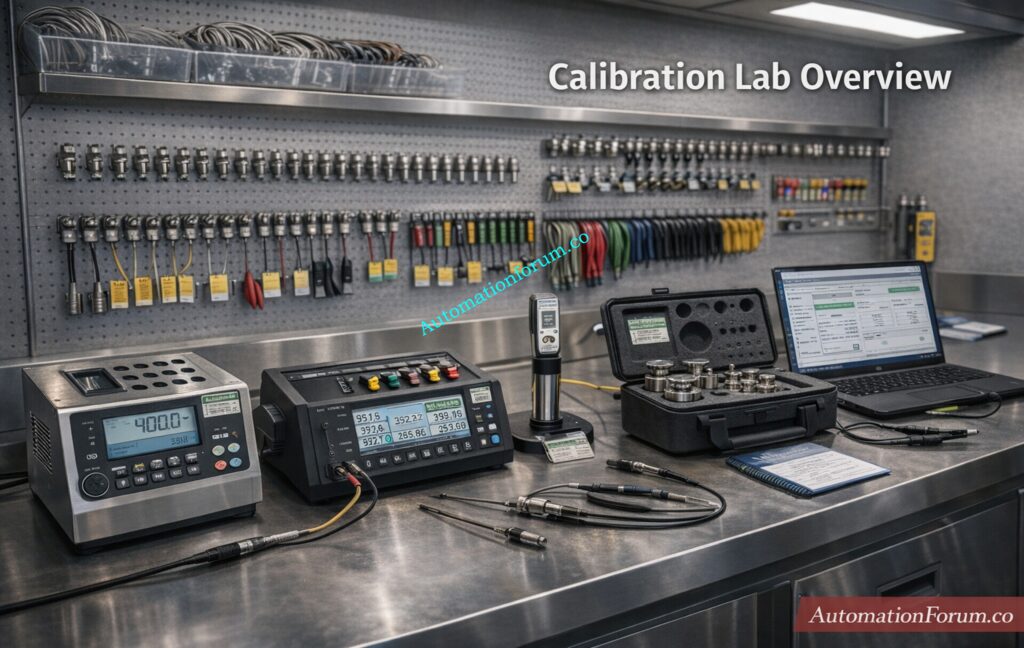
Definition of Calibration
Calibration is a controlled way to compare the output of an instrument’s measurement to a recognized reference standard whose value is known and can be traced back to national or international standards.
Purpose of Calibration in Industrial Measurement Systems
Key Elements of A Proper Calibration Process
Calibration normally means taking measurements at several points across the instrument’s entire operational range. This makes sure that the instrument works appropriately at all three levels of measurement: low, mid, and high.
A proper calibration process typically includes the following elements.
- Comparison with a traceable reference standard
- Multiple test points across the instrument range
- Measurement of deviation or error
- Adjustment if necessary
- Calculation of measurement uncertainty
- Documentation in the form of a calibration certificate
- Calibration records are usually stored in calibration management systems or maintenance databases and are often required during quality audits.
Calibration establishes measurement traceability and provides documented proof that the instrument is capable of producing accurate readings.
Don’t Choose the Wrong Master Instrument: 6 Steps Guide to Selecting a Master Instrument for Calibration
What is Instrument Verification?
Definition of Verification
Verification is a simpler activity performed to confirm that an instrument is functioning correctly within a specified tolerance.
Verification usually only verifies one or two measurement points with a reference device instead than doing a full multi-point calibration.
Purpose of Verification in Maintenance Programs
- The purpose is not to find out how accurate the measurements are, but to make sure that the instrument hasn’t gone outside of permitted limitations.
- People usually do verification between specified calibration times or after maintenance work.
Typical Characteristics of Instrument Verification
Typical characteristics of verification include the following.
- Limited measurement points such as zero and mid range
- Pass or fail assessment
- Minimal documentation compared to calibration
- Faster procedure requiring less downtime
- Often performed by plant technicians or operators
If the instrument passes verification, it continues to remain in service until the next scheduled calibration. If the instrument fails verification, a full calibration or repair is usually required.
Verification therefore acts as an early warning check that helps detect potential measurement drift before it becomes a serious problem.
Access 60+ Free Industrial Calibration Procedures Now: Methods for Pressure, Temperature, Flow & Level https://automationforum.co/instrument-calibration-procedures/
Key Differences Between Calibration and Verification
Calibration and verification both have to do with making sure that instruments are accurate, but they are used for distinct things in industrial measuring systems.
Purpose and Objective Differences
Calibration is a thorough process that compares an instrument’s findings to traceable reference standards to find out how accurate its measurements really are. It requires testing the instrument at several places along its working range and writing down the results in a calibration certificate.
Verification, on the other hand, is a simpler way to check that an instrument is still working within an acceptable range. It usually involves checking one or two measurement points and determining whether the instrument passes or fails the test.
Measurement Method Differences
Calibration establishes measurement traceability and provides documented evidence of accuracy. Verification provides a quick confirmation that the instrument has not drifted significantly since the last calibration.
Understanding these differences helps engineers maintain reliable instrumentation systems while avoiding unnecessary calibration work.
Stop Confusing These Critical Engineering Terms: Differences Between Validation and Calibration
Calibration Vs Verification Comparison Table
| Attribute | Calibration | Verification |
| Objective | Determine measurement accuracy and establish traceability | Confirm instrument is operating within tolerance |
| Measurement points | Multiple points across full range | One or two points |
| Traceability | Requires traceable reference standards | May use portable master instruments |
| Result | Calibration certificate and adjustment record | Pass or fail confirmation |
| Documentation | Detailed calibration report | Simple log or verification record |
| Time required | Longer process | Quick check |
| Personnel | Qualified calibration technician or laboratory | Technician or trained operator |
| Frequency | Periodic schedule based on risk and standards | Performed between calibrations or during routine checks |
Why Every Engineer Needs a Master Pressure Calibrator: Master Pressure Calibrators: Precision Tools for Accurate Pressure Instrument Calibration
Practical Industrial Examples of Calibration Vs Verification
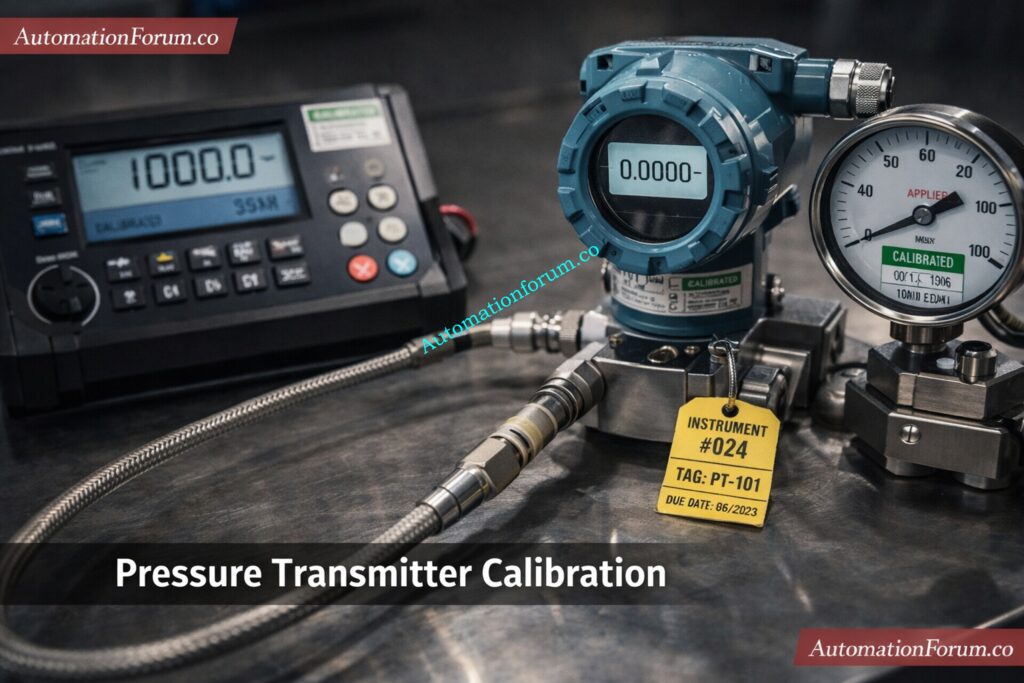
Pressure Transmitter Calibration And Verification Example
Calibration of a pressure transmitter normally involves isolating the transmitter from the process and connecting it to a precision pressure calibrator or dead weight tester. Pressure values are applied at several points such as zero percent, twenty five percent, fifty percent, seventy five percent, and one hundred percent of the transmitter range.
The technician records both the applied pressure and the transmitter output signal. If the transmitter output deviates from the expected value, adjustments are performed to correct the zero and span settings.
Verification of a pressure transmitter may involve applying a single pressure value using a portable pressure calibrator. The technician checks whether the transmitter output signal matches the expected value within the acceptable tolerance. If the measurement is within limits, the transmitter passes verification.
The Tools Every Calibration Engineer Should Be Using: Best Calibration Management Software
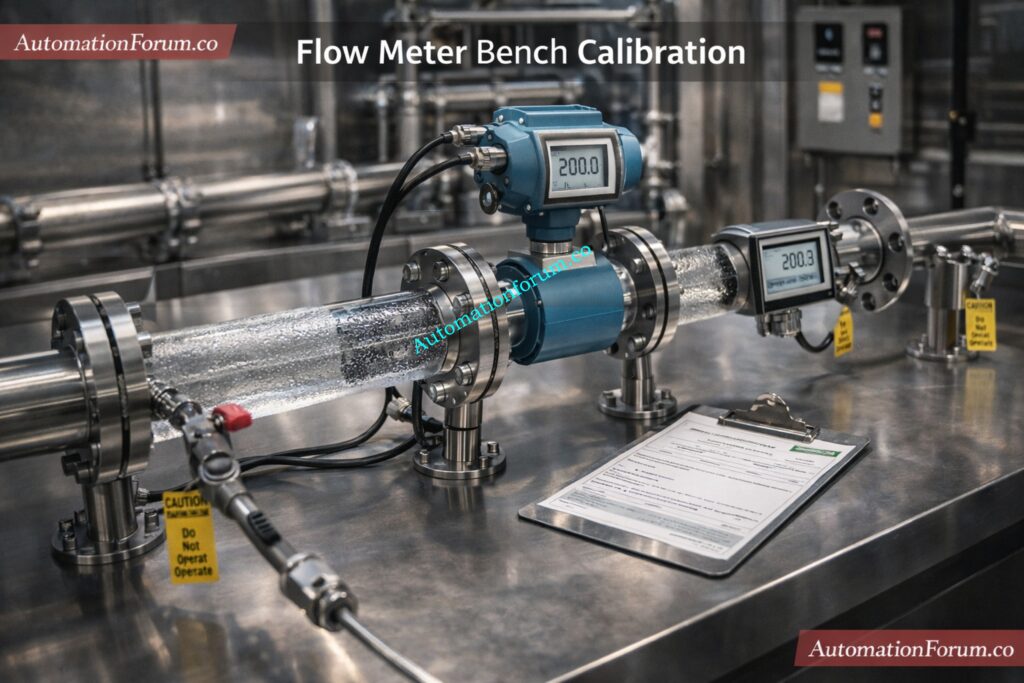
Flow Meter Calibration Vs Verification Example
Calibration of flow meters such as turbine or magnetic flow meters typically requires specialized calibration facilities or flow laboratories. Water or another calibration fluid is passed through the meter at several controlled flow rates, and the measured output is compared with the reference flow measurement.
Verification of a flow meter may involve comparing its reading with a portable clamp on ultrasonic flow meter or comparing process readings with another trusted reference meter.
Avoid Costly Errors in Absolute Pressure Calibration: Step-by-Step Procedure to Calibrate an Absolute Pressure Transmitter
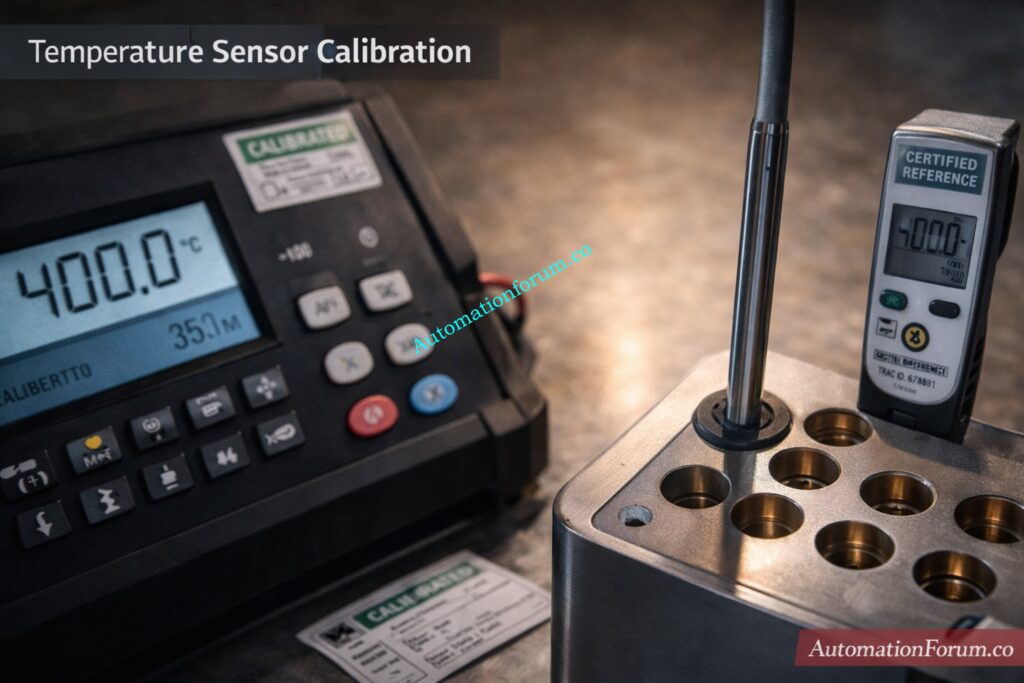
Temperature Sensor Calibration and Verification Example
Calibration of temperature sensors such as RTDs or thermocouples is usually performed using a dry block calibrator or liquid bath. The sensor is tested at multiple temperature points and compared with a certified reference thermometer.
Verification may involve comparing the sensor reading with a portable temperature indicator at one process temperature point to confirm the sensor has not drifted significantly.
Industry-Approved Methods for Flow Meter Calibration: ISO Standard Calibration Procedures for Flow Measuring Instruments
Weighing Balance Calibration Vs Verification Example
Calibration of a weighing balance uses certified standard weights traceable to national measurement standards. The balance is tested at multiple weight levels to evaluate linearity and repeatability.
Verification may involve placing a routine check weight on the balance to confirm that the displayed value remains within the allowable tolerance.
Pressure Calibration Done the Right Way: Calibration Procedures for Various Pressure Measuring Instruments
Step-By-Step Industrial Calibration Procedure
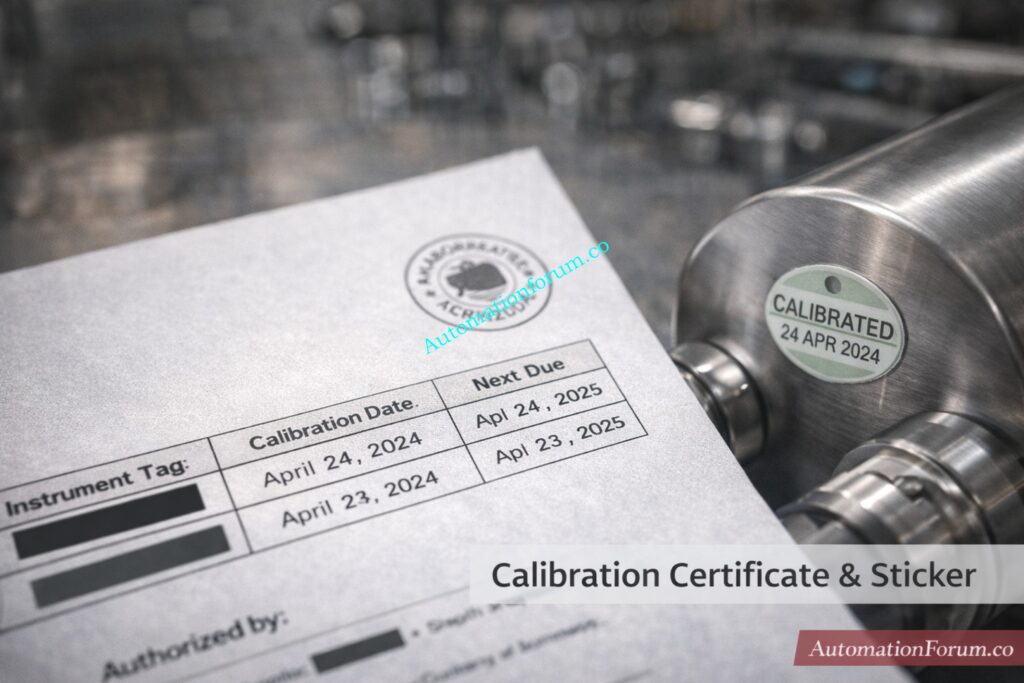
A typical industrial calibration procedure includes several important steps that ensure measurement reliability.
- Preparation begins with identifying the instrument tag number, serial number, and calibration history. The technician selects appropriate reference standards and verifies that their calibration certificates are valid.
- The instrument is then isolated from the process and connected to the calibration reference device. Safety precautions such as lockout procedures and work permits are followed when necessary.
- Reference values are applied across the measurement range. At each point the instrument output is recorded and compared with the reference value.
- Measurement errors are calculated and analyzed. If the instrument exceeds the acceptable tolerance, adjustments are performed.
- Once the instrument performs within specification, the calibration results are documented. A calibration certificate is generated containing information such as instrument identification, calibration date, reference standards used, measurement results, technician name, and next calibration due date.
- Finally the instrument is labeled with a calibration sticker and the calibration record is updated in the maintenance or calibration management system.
Complete Calibration Guide for Level Measurement Devices:
Step-by-Step Instrument Verification Procedure
Verification checks are usually simpler and faster than calibration procedures.
- The technician first confirms the instrument identification and obtains a portable reference device that has a valid calibration status.
- The reference value is applied to the instrument at one or two predetermined points. The instrument reading is compared with the reference measurement.
- If the instrument reading falls within the acceptable tolerance range, the instrument passes verification and continues operating.
- If the instrument fails the verification check, the instrument is scheduled for full calibration or removed from service depending on its criticality.
- Verification results are recorded in a logbook or maintenance system along with the date, technician name, reference device used, and pass or fail result.
How Professionals Calibrate Temperature Instruments: Temperature Calibration Procedure
Regulatory Standards Governing Calibration Activities
Role of ISO/IEC 17025 in Calibration Laboratories
Many industries operate under strict quality and measurement control requirements. Calibration activities are often governed by quality management standards and industry regulations.
International laboratory competence requirements are defined by the standard ISO/IEC 17025. This framework ensures that laboratories performing calibration services maintain traceability to national measurement standards and follow documented quality systems.
Quality Management and Measurement Traceability
Process industries also follow internal calibration procedures aligned with regulatory frameworks, manufacturer recommendations, and plant risk management practices. Maintaining proper calibration documentation helps organizations demonstrate measurement reliability during audits and inspections.
The Correct Method to Calibrate Signal Converters: Signal Convertors Calibration Procedures
Common Mistakes When Performing Calibration and Verification
Using Uncalibrated Reference Instruments
One common mistake is assuming that a quick verification check is equivalent to calibration. Verification only confirms that the instrument appears to be functioning correctly at a specific point. It does not establish complete measurement accuracy across the entire range.
Ignoring Historical Calibration Drift Data
Another frequent issue is using reference instruments that are themselves out of calibration. If the reference device is inaccurate, the verification or calibration result becomes unreliable.
Some organizations also fail to review calibration trends. Over time, instruments may show gradual drift. Without analyzing historical calibration data, this drift may remain unnoticed until it causes process problems.
Poor Calibration Documentation Practices
Poor documentation is another problem. Missing calibration certificates, incomplete records, or inconsistent documentation formats can create serious difficulties during audits.
Clear procedures, proper training, and consistent documentation help eliminate these problems.
Don’t Skip These Control Valve Calibration Steps: Control Valve Calibration Procedures
Industrial Case Study: Consequences Of Relying Only on Verification
Problem in Reactor Temperature Measurement
A petrochemical plant relied heavily on verification checks for its temperature transmitters in a reactor control system. Operators regularly compared transmitter readings with local indicators and recorded them as acceptable.
However, during a scheduled calibration shutdown, technicians discovered that several transmitters had gradually drifted by more than two degrees Celsius. Because verification checks were performed only at a single operating temperature, the drift at other temperature levels went unnoticed.
Impact on Process Performance
The incorrect temperature readings caused the reactor control system to operate outside its intended range, affecting product yield and increasing energy consumption.
Corrective Actions Implemented by the Plant
Following the incident, the plant revised its instrumentation maintenance procedures. Full multi point calibration intervals were maintained, and verification checks were expanded to include multiple operating points. Calibration trend analysis was also introduced to detect measurement drift earlier.
This case demonstrates that verification alone cannot replace proper calibration.
Proper Calibration Techniques for Analytical Instruments: Analytical Instruments Calibration Procedures
When Should Calibration be Performed?
Calibration should be performed under several conditions to ensure measurement reliability and compliance with industrial standards.
- Calibration is typically required when an instrument is newly installed in the plant. New instruments must be calibrated before being placed into service to confirm their measurement accuracy.
- Calibration should also be performed after instrument repair or major maintenance activities. Any adjustment or component replacement may affect measurement accuracy.
- Scheduled calibration intervals are another important factor. Many plants perform calibration annually or semi annually depending on instrument criticality and process requirements.
- Calibration is also required when a verification check fails. If an instrument does not meet the acceptable tolerance during verification, a full calibration must be performed to determine the actual measurement error.
In regulated industries, calibration may also be required to meet quality standards and audit requirements.
How Industrial Weighing Systems Are Properly Calibrated: Weighing System Calibration Procedure
When Should Verification be Performed?
Verification is usually performed between calibration intervals to confirm that instruments are still functioning correctly.
- Routine verification checks can be performed during maintenance inspections or process shutdowns. These checks help detect measurement drift early without performing a full calibration.
- Verification may also be performed after minor maintenance activities such as replacing cables, reconnecting transmitters, or cleaning sensors.
- Another common use of verification is during troubleshooting. Engineers may verify an instrument reading using a portable reference device to determine whether a process issue is caused by instrumentation or by actual process conditions.
Because verification procedures are faster and simpler, they allow technicians to monitor instrument health without interrupting plant operations for long periods.
Not All Calibrators Are the Same: Different types of Calibrators and their Calibration Procedures
How Calibration Frequency is Determined in Industrial Plants
Determining the correct calibration interval is an important part of an instrumentation maintenance program.
Several factors influence calibration frequency in industrial plants.
- Instrument criticality is one of the most important considerations. Instruments involved in safety systems, custody transfer measurement, or regulatory reporting usually require more frequent calibration.
- Manufacturer recommendations also provide guidance on typical calibration intervals for different types of instruments.
- Historical calibration data is another valuable factor. If an instrument continuously exhibits minimal drift, the calibration interval may be prolonged. On the other hand, instruments that drift a lot may need to be calibrated more often.
- Environmental factors like vibration, temperature changes, humidity, and corrosive surroundings can also make instruments less stable and need to be calibrated more often.
Plants can create risk-based calibration schedules that keep measurements accurate while making the best use of maintenance resources by looking at these aspects.
Read This Before Performing Any Instrument Calibration: Calibration Guidelines
Technician Checklist for Calibration and Verification
Before doing any maintenance on a measurement, technicians can utilize the following checklist to make sure they are doing it right.
- Check to see if the task is calibration or verification.
- Check to see if the reference instrument is properly calibrated.
- Check the tag number and identity of the instrument.
- Look at the results of past calibrations and the drift history.
- Make sure that all safety procedures and permits are in order.
- Follow the prescribed technique for doing measurement checks.
- Write down reference values and instrument readings correctly.
- Check that the findings are within the allowed range of values
- Change the calibration or verification records in the maintenance system.
- If you need to, put a calibration label or verification status tag on it.
- If verification fails, send it up for thorough calibration or repair.
Are These Calibration Mistakes Happening in Your Plant?: Top 15 Common Calibration Mistakes in Industrial Instruments
Key Takeaways: Calibration Vs Verification
- For industrial facilities to have reliable instrumentation systems, calibration and verification are both very important.
- Calibration uses traceable reference standards to find out how accurate an instrument really is and creates a written calibration certificate.
- Verification is a simple pass-or-fail test that makes sure an instrument stays within permissible parameters between calibration periods.
- Calibration usually means taking measurements at several sites along the instrument’s range, while verification usually simply checks one or two points.
- Both of these things work together to make sure that measurements are accurate, products are of high quality, and process industries follow the rules.
The Dangerous Mistake of Not Calibrating Your Calibrators: Why Calibrating your Calibrators is Critically Important: Accuracy, Compliance and ISO 17025 and NIST Traceability
Why Calibration and Verification are Both Critical for Process Industry Measurement Systems
An successful instrumentation maintenance program must include both calibration and verification. Even though they have diverse jobs, they all work together to make sure that measurement systems stay precise, dependable, and in line with industry standards.
Calibration gives you proof that your measurements are accurate by doing extensive multi-point tests and keeping records. Verification is a quicker way to make sure that instruments stay within acceptable operating parameters between calibration intervals.
Organizations can avoid expensive measurement mistakes and keep trust in their instrumentation systems by explicitly outlining these tasks in plant procedures, teaching staff on the right way to execute them, and keeping good records.
Knowing the difference between calibration and verification will help you regulate your processes better, make your products better, and follow industrial standards more closely.
One Calibration Myth That Misleads Many Engineers: Why Calibration Isn’t the Same as Re-ranging in Process Instrumentation
Frequently Asked Questions (FAQ) on Calibration vs Verification
What is the difference between calibration and performance verification?
Calibration compares an instrument with a traceable reference standard to determine measurement error and establish accuracy.
Performance verification simply checks whether the instrument still meets specified performance limits without full calibration.
Can I do a verification instead of calibration to save time?
Not if traceability, uncertainty, or regulatory compliance is required. Verification is a quicker interim check; calibration is required at scheduled intervals or after repair, or when legal/quality traceability is needed.
How often should calibration be done?
Frequency depends on instrument criticality, manufacturer guidance, process risk, stability history, and regulatory requirements. Use data (trend analysis) to set intervals rather than arbitrary dates.
Who can perform calibration vs verification?
Calibration should be performed by qualified calibration personnel or accredited labs. Verification can be performed by trained operators or technicians following a documented procedure.
Does calibration always require adjustment?
Calibration documents the error. If the error is within acceptable uncertainty, no adjustment may be necessary. If it exceeds limits, adjustment or repair is required.
What is measurement uncertainty and why is it important?
Uncertainty quantifies the doubt in a measurement result. It’s essential in calibration to determine whether an instrument truly meets required specifications when uncertainty is considered.
What is the difference between control and calibration?
Calibration makes assurance that measurements are correct by comparing an instrument to a known reference standard.
Control is the regular monitoring that makes sure readings stay steady and consistent over time.
What is the difference between equipment calibration and validation?
Calibration of equipment makes ensuring that an instrument measures correctly against known standards.
Validation demonstrates that a system or equipment consistently performs its intended function within the required process conditions.
What is the difference between calibration and verification?
Calibration determines measurement accuracy using traceable standards and produces documented calibration results.
Verification checks whether the instrument output falls within a defined tolerance without performing full calibration.
What are the four types of calibration?
Common calibration categories include electrical calibration, mechanical or dimensional calibration, temperature calibration, and pressure or flow calibration.
These categories are based on the measurement parameter and the type of industrial instrument being tested.
The ISO Rules Every Instrument Engineer Should Know: ISO Standards For Instrumentation Calibration Complete Guide for Industrial Engineers
#Calibration
#Instrumentation
#ProcessControl
#IndustrialAutomation
#CalibrationEngineering
#ProcessInstrumentation
#MeasurementAccuracy
#CalibrationProcedure
#InstrumentationEngineering
#IndustrialMaintenance
