
- What Is a Differential Pressure Switch and How Does It Work?
- Why Differential Pressure Switch Calibration is Required
- Tools Required for Differential Pressure Switch Calibration
- Safety Precautions Before DP Switch Calibration
- Isolation of the Differential Pressure Switch from Process
- Ensuring Zero Pressure Condition
- Differential Pressure Switch Calibration Setup
- Final Pre Calibration Checklist
- Step by Step Differential Pressure Switch Calibration Procedure
- Increasing and Decreasing Differential Pressure Calibration Method
- Final Calibration Checklist
- Completion of Differential Pressure Switch Calibration
- Common Mistakes in Differential Pressure Switch Calibration
- When Low Pressure Side Atmospheric Method is Not Suitable
- Sample Differential Pressure Switch Calibration Report
- Key points to remember for DP switch calibration
- Frequently Asked Questions About Differential Pressure Switch Calibration
What Is a Differential Pressure Switch and How Does It Work?
Differential pressure switch working principle
A differential pressure (DP) switch is a tool that tells you how different two pressure points are. The high-pressure (HP) side and the low-pressure (LP) side are the two pressure points that are usually measured. The switch turns on or off an electrical contact based on this differential in pressure. This can set off alarms, trips, or control activities.
How A Dp Switch Measures High Pressure And Low Pressure
The DP switch operates using a diaphragm or piston mechanism. The difference in pressure between HP and LP makes a force that moves the detecting element, which then turns on an electrical switch. A spring mechanism is used to change the setpoint.
DP switch applications in process industries
- Filter Monitoring: Measures the pressure drop across filters to find out if they are clogged.
- Flow Detection: Used with orifice plates to make sure there is flow
- Level Measurement: Using pressure differential in closed tanks
- HVAC Systems: keep an eye on airflow and duct pressure.
- Safety Interlocks & Alarms These systems go off when pressure changes.
In industrial operations, differential pressure measurement is often used to keep an eye on flow, level, and system health.
Stop mixing calibration and verification: Calibration Vs Verification: Key Differences, Procedures, Examples and Best Practices In Process Industries
Why Differential Pressure Switch Calibration is Required
Accuracy, Safety and Operational Reliability
Calibration makes ensuring that the DP switch works correctly, consistently, and safely, which is especially important for safety-critical systems like SIS (Safety Instrumented Systems).
Verifying Set Point, Reset Point and Deadband
- Check the precision of the setpoint
- Check the reset point
- Find the deadband (hysteresis)
- Make sure the switching works right
IEC 61511 and Calibration Practice Considerations
- IEC 61511: Making sure things work safely in process industries
- ISA Calibration Practices: Standard methods for the industry
- ISO/IEC 17025: Quality and traceability of calibration
Calibration makes sure that the device works within safe limits and keeps the process safe.
Set calibration intervals the smart way: Calibration Interval Schedule Procedure for Process Instrumentation Using Risk-Based Method
Tools Required for Differential Pressure Switch Calibration
Required Equipment
- Pressure calibrator (hand pump – pneumatic/hydraulic)
- Digital multimeter / continuity tester
- Differential pressure test gauge
- Manifold (block, bleed, equalizing valve)
- Tubing and fittings
- Basic hand tools
- Cleaning cloth
To compare how instruments respond, calibration needs a reference pressure source and tools that can measure things accurately.
Master ISO calibration standards now: ISO Standards For Instrumentation Calibration Complete Guide for Industrial Engineers
Safety Precautions Before DP Switch Calibration
Isolate The DP Switch From The Process Line
- Isolate DP switch from process line
- Depressurize both HP and LP sides completely
- Electrically isolate switch contacts
- Use PPE:Gloves,Safety goggles,Face shield
Your complete calibration guide starts here: Instrument Calibration in Process Industries – Complete Guide
Mandatory Steps Before DP Switch Calibration
- Put interlocks in manual / bypass mode (MOS)
- Close isolation valves
- Drain impulse lines
- Ensure no trapped pressure
- Handle hazardous fluids carefully
Improper isolation can cause false trips or unsafe conditions during calibration.
Fix smart transmitter trim errors: Smart Pressure Transmitter Sensor Trim Guide with Diagrams & Calibration Steps
Isolation of the Differential Pressure Switch from Process
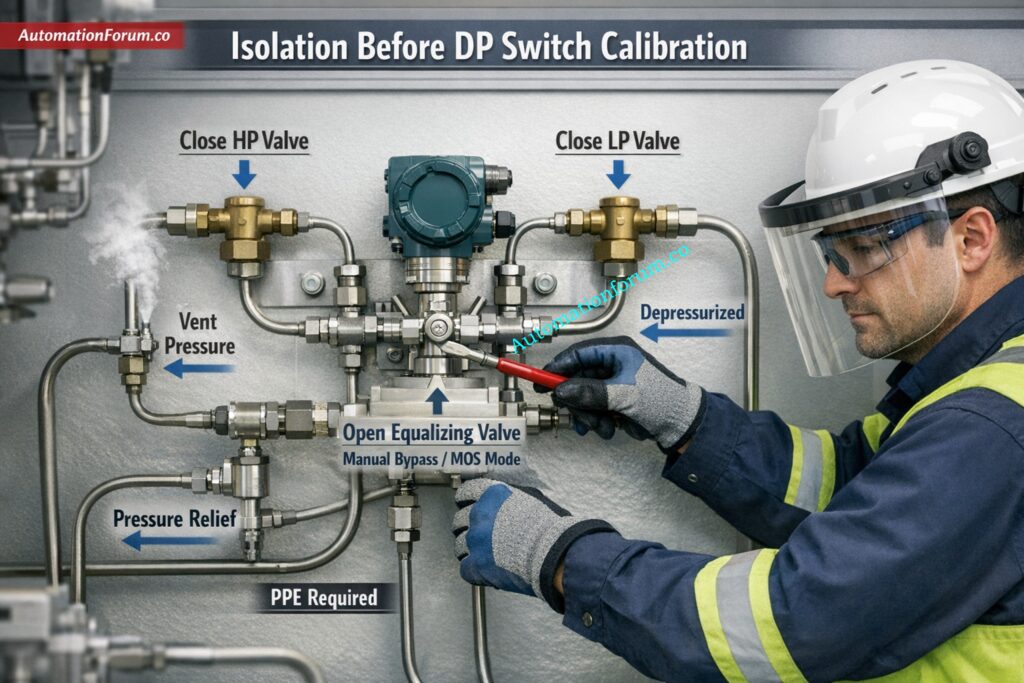
Step by step isolation procedure
- Inform control room and take loop in manual mode
- Disable interlocks and alarms if applicable
- Close high pressure isolation valve
- Close low pressure isolation valve
- Open equalizing valve to balance pressure
- Open vent or drain valves
- Ensure complete depressurization
Trapped pressure inside impulse lines can cause serious calibration errors. Even a small residual pressure can shift the set point significantly.
Don’t skip calibrator calibration: Why Calibrating your Calibrators is Critically Important: Accuracy, Compliance and ISO 17025 and NIST Traceability
Ensuring Zero Pressure Condition
After isolation, it is necessary to establish a true zero differential condition.
Steps to ensure zero condition
- Keep equalizing valve open
- Ensure both sides are exposed to same pressure
- Confirm no fluid discharge from vent
- Verify pressure is equal on both sides
At this stage, differential pressure should be zero.
Stop confusing calibration with re-ranging: Why Calibration Isn’t the Same as Re-ranging in Process Instrumentation
Differential Pressure Switch Calibration Setup
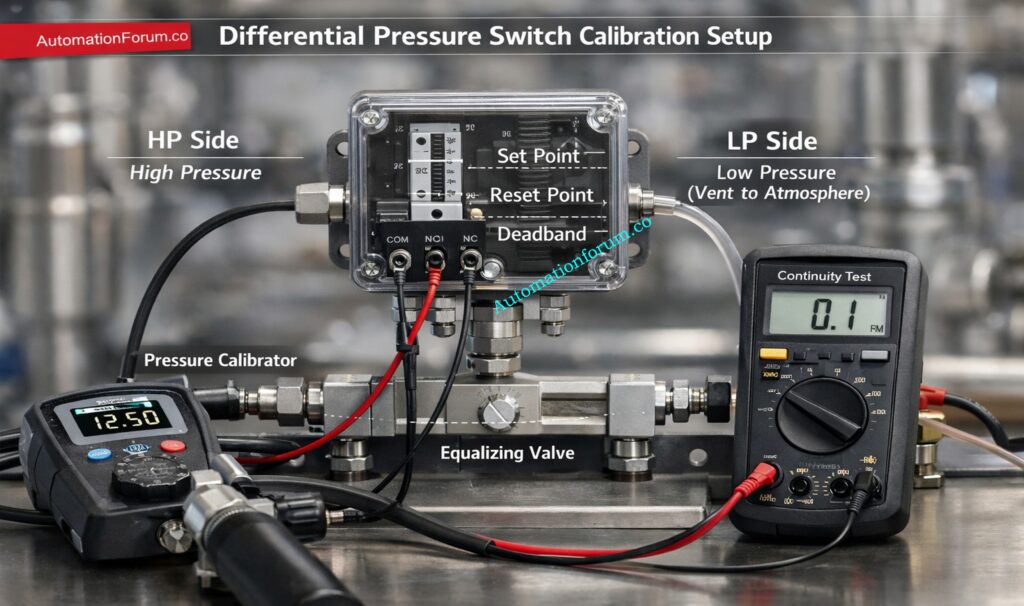
The calibration setup is the foundation of accurate differential pressure switch calibration. If the setup is incorrect, even a perfectly executed procedure will produce wrong results. In real plant conditions, most calibration errors are not due to the instrument itself but due to improper setup, trapped pressure, or incorrect connections.
A differential pressure switch works based on the pressure difference between two points. Therefore, the calibration setup must simulate this pressure difference correctly.
In most field activities, the low-pressure side is left open to the air. This procedure makes it easier to calibrate and is often used for regular maintenance and checks.
Avoid these costly calibration mistakes: Top 15 Common Calibration Mistakes in Industrial Instruments
Identifying The High Pressure and Low Pressure Ports
Before you can start calibrating, you need to be sure you know where the pressure ports are.
Key identification points
- HI or H is frequently used to denote the high pressure port.
- LO or L marks the low pressure port.
- If the connection is wrong, it will switch in the opposite direction.
- Always check with the datasheet or tag marking.
One of the most typical problems made during field calibration is not correctly identifying ports.
Connecting The Pressure Calibrator to The High Pressure Side
Pressure connection method
The most popular and useful way to do field calibration is:
- Connect the pressure calibrator to the high-pressure side.
- Keep the low-pressure side open to the air.
This indicates that the only way to create the differential pressure is to put pressure on the high side.
Select the right master instrument: 6 Steps Guide to Selecting a Master Instrument for Calibration
Why The Low Pressure Side Is Kept Open to Atmosphere
- Makes setup easier
- No need for a second source of pressure
- Less time needed to set up
- Good for most uses in the field
But this method is affected by changes in the weather, thus it might not be good for calibrating with great accuracy.
Follow the right calibration rules: Calibration Guidelines
Connecting The Multimeter Across Com, NO and NC Contacts
Electrical monitoring is needed to find switching action.
Electrical connection steps
- Set the multimeter to continuity mode.
- Connect across the common and normally open contacts.
- Alternatively connect across common and normally closed
- Check the status of the first contact
This configuration makes it easy to find the exact changeover point during calibration.
Refer the below link for the Step by Step Calibration Procedure for Differential Pressure Transmitter
Equalizing Valve Position Before Calibration
Before using differential pressure, you need to do a functional check.
Steps for equalization check
- Leave the equalizing valve open.
- Put a little pressure on the calibrator.
- Make sure that no switching happens
- Check to see that the condition is steady.
If switching happens during equalization, it means the configuration is wrong.
Choose the right calibrator fast: Different types of Calibrators and their Calibration Procedures
Leak Check And Tubing Cleanliness Before Testing
Leakage is a big reason why DP calibration goes wrong.
Leak test procedure
- Put some pressure on the area, around 10% of the range.
- Keep an eye on pressure stability
- Look over all of the tubing and fittings.
- If necessary, tighten the connections.
A stable pressure reading means that the setup is leak-free.
Cleanliness and Contamination Control
The accuracy of calibration depends on how clean it is.
Important practices
- Make sure the tubing is clean.
- Don’t let oil or moisture get in.
- Use the right fittings
- Don’t use hoses that are broken.
Contamination can change how pressure is transmitted and cause measurements to be unstable.
Calibrate weighing systems correctly: Weighing System Calibration Procedure
Final Pre Calibration Checklist
Check the following before you start calibration:
- Instrument cut off from process
- No trapped air
- The low-pressure side is open to the air.
- Calibrator for pressure is connected correctly
- Multimeter is connected and operating.
- No leaks in the system
Calibration can start once all the inspections are done.
Get analytical calibration right: Analytical Instruments Calibration Procedures
Step by Step Differential Pressure Switch Calibration Procedure
Understanding the Core Calibration Principle
Differential pressure is defined as the difference between high pressure and low pressure.
High pressure minus low pressure equals DP.
The low pressure side is accessible to the outside world, so the differential pressure is the same as the pressure on the high side.
This makes the process of calibrating much easier.
Stabilize The Calibration Equipment Before Applying Pressure
Set the equipment up before putting pressure on it.
Steps
- Turn on the pressure calibrator.
- Give it time to settle down
- Make sure there is no drift in reading
- Look at the conditions around you.
For proper calibration, it is important to have stable pressure generation.
Establish Zero Differential Pressure Condition
Procedure
- Make sure that no pressure is put on the high side.
- The low-pressure side stays open to the outside.
- The difference in pressure is zero.
- Check the state of the switch
This is where the reference starts.
Increase Differential Pressure Gradually From The High Side
Important instruction
Always apply pressure slowly.
Procedure steps
- Start putting more pressure on the high side.
- Keep the steady rise
- Don’t change the pressure too quickly.
- Always keep an eye on the pressure gauge.
Applying pressure too quickly can lead to overshoot and wrong readings.
Observe The Contact Change and Record The Set Point
What to observe
- Changes in multimeter readings
- The contact changes state.
Recording
- Note the pressure value when you switch
- This is where the set point is.
The most important part of calibration is the set point.
Verify Switching Stability After Actuation
Procedure
- Put a little more pressure on the set point.
- Keep the pressure steady
- Watch for steadiness in contact
This makes sure that the switch works mechanically.
Reduce Pressure Slowly and Record The Reset Point
Procedure
- Gradually lower the pressure
- Look at the return of contact
- At reset, record the pressure.
This is where the switch resets.
Eliminate control valve errors: Control Valve Calibration Procedures
Calculate Deadband and Compare With Datasheet Values
The deadband is the space between the set point and the reset point.
Importance of deadband
- Stops switching too often
- Gives stability
- Shows the health of the machine
A correct deadband is necessary for reliable operation.
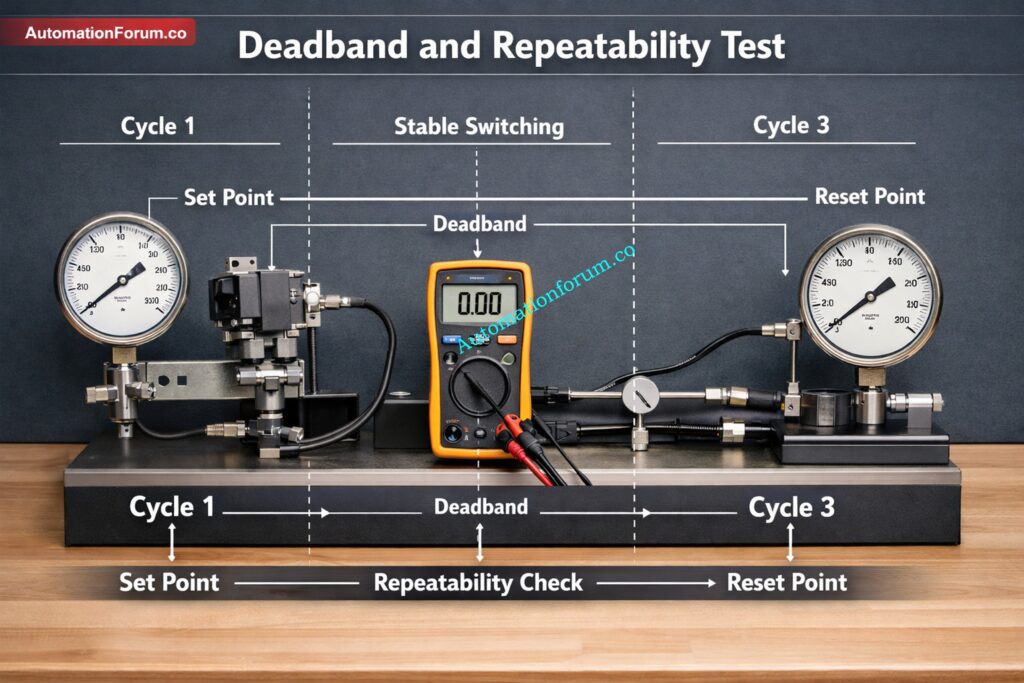
Repeat The Calibration Cycle For Repeatability
There should never be just one cycle for calibration.
Repeat procedure
- Do at least three cycles
- Each time, write down the set point and reset it.
- Look at the values side by side
Consistent readings show that the instrument is in good shape.
Adjust The Set Point Screw If Deviation Is Found
Adjustment is needed if there is a deviation.
Adjustment steps
- Find the screw for adjusting the set point
- Make tiny changes progressively.
- Repeat the calibration cycle.
- Check the new set point
After making an adjustment, you should always check it.
Nail displacement calibration steps: Displacement Measurement Instrument Calibration Procedures
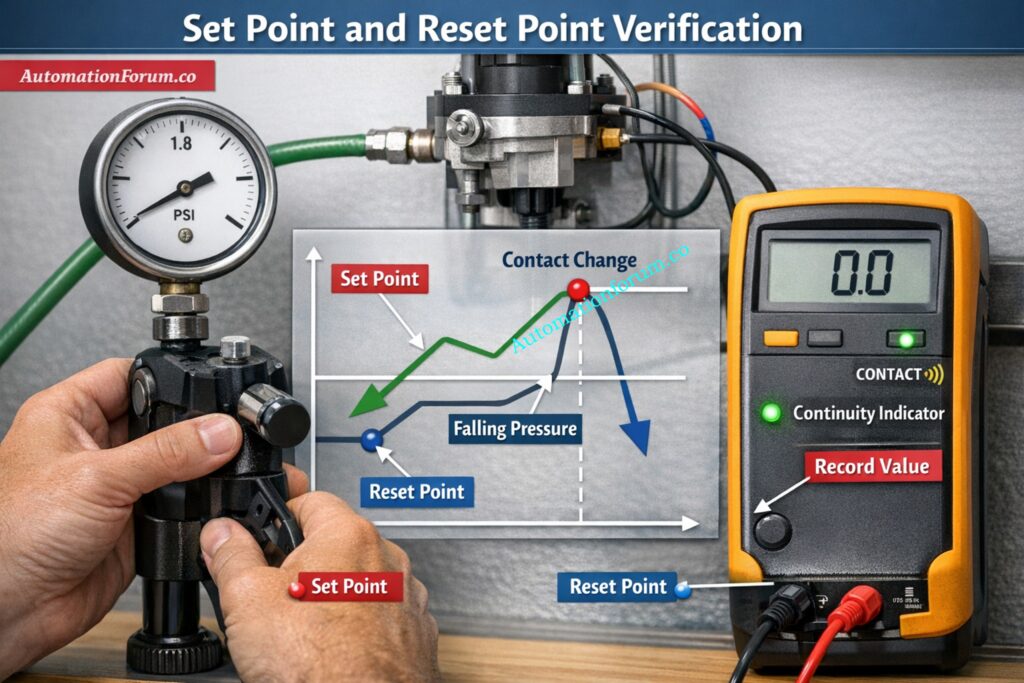
Increasing and Decreasing Differential Pressure Calibration Method
Increasing Differential Pressure Calibration For Trip Point Verification
This method is used to check switching while the pressure is rising.
Steps
- Slowly raise the pressure
- Look at the switching point
- Set point record
- Check for correctness
This is the most usual way to calibrate.
Decreasing Differential Pressure Calibration For Reset Point Verification
This method checks how the reset works.
Steps
- Slowly lower the pressure
- Look at the reset point
- Value of record
- Look at the specifications and compare.
This makes sure that hysteresis works right.
Correct signal converter drift: Signal Convertors Calibration Procedures
Perform Final Verification After Adjustment
Do a final check after making changes.
Steps
- Do the whole calibration cycle again.
- Check the accuracy of the set point
- Check the reset point
- Confirm the deadband
Calibration is only complete after successful verification.
Best Practice For Slow And Controlled Pressure Changes
Always do these things
- Slowly apply pressure near the set point.
- Come at the set spot from the same direction
- Don’t let the pressure change.
- Use a consistent source of pressure
These methods make things more accurate and repeatable.
Lock in accurate temperature readings: Temperature Calibration Procedure
Final Calibration Checklist
Check the following before finishing the job:
- Set point within limits
- Reset point is within the permitted range
- Deadband matches the specifications.
- No leaks in the system
- Electrical contacts are working right
Stop level measurement inaccuracies: Calibration Procedures for Level Measurement Devices
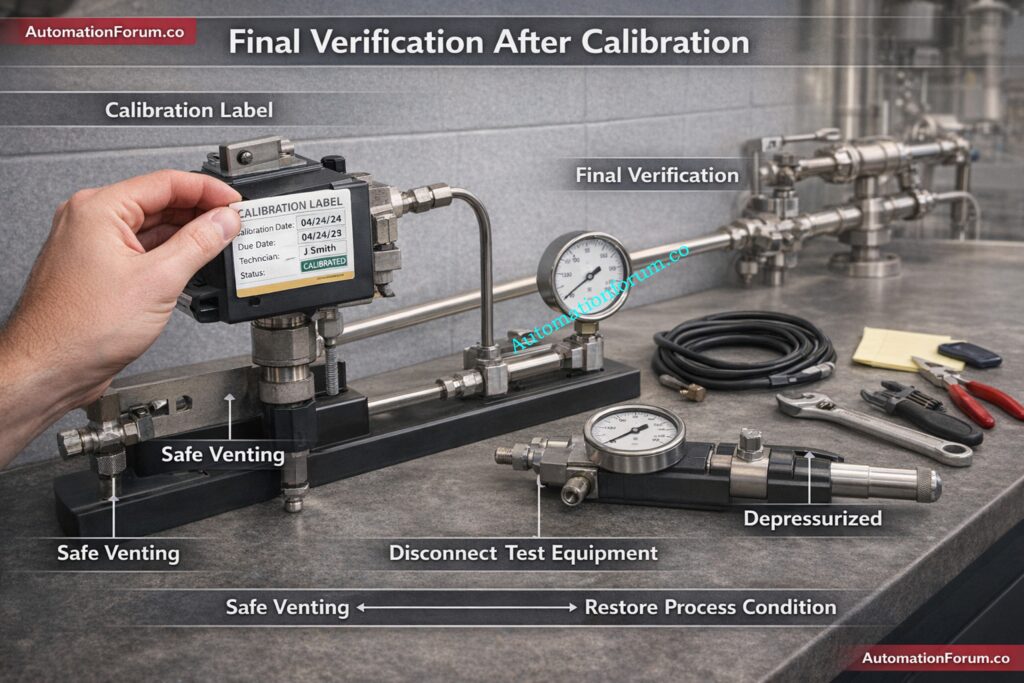
Completion of Differential Pressure Switch Calibration
- After the differential pressure switch has been successfully calibrated, put a label on it that shows the date of calibration, the due date, and the name of the technician.
- After that, the calibration setup needs to be carefully ventilated and let go of its pressure. This is crucial so that there isn’t any leftover pressure in the high-pressure side lines.
- Carefully unplug all testing equipment from the high pressure port and make sure that the low pressure side, which was open to the air during calibration, is correctly locked.
- Make sure that the area where you work is clean and doesn’t have any tools, tubing, or fittings that were used during calibration.
- De isolate the differential pressure switch from the test condition and restore it back to process condition.
- Bring back any signals that were bypassed or inhibited during calibration to their normal operating state.
- Slowly open isolation valves and restore the impulse lines.
- Bring the differential pressure switch back online and return it to normal operation.
Fix pressure measurement deviations: Calibration Procedures for Various Pressure Measuring Instruments
Common Mistakes in Differential Pressure Switch Calibration
Frequent problems
- Wrong set point due to trapped pressure
- Delayed switching due to mechanical wear
- Unstable readings due to leakage
- Incorrect results due to improper venting
When Low Pressure Side Atmospheric Method is Not Suitable
Although widely used, this method has limitations.
Do not use when
- High accuracy calibration required
- Process involves static pressure influence
- Closed system simulation required
- Laboratory calibration needed
In such cases, both sides must be controlled using pressure sources.
Meet ISO flow calibration standards:ISO Standard Calibration Procedures for Flow Measuring Instruments
Sample Differential Pressure Switch Calibration Report
The image that follows represents a typical differential pressure switch calibration report, which includes set point and reset point recorded during calibration.
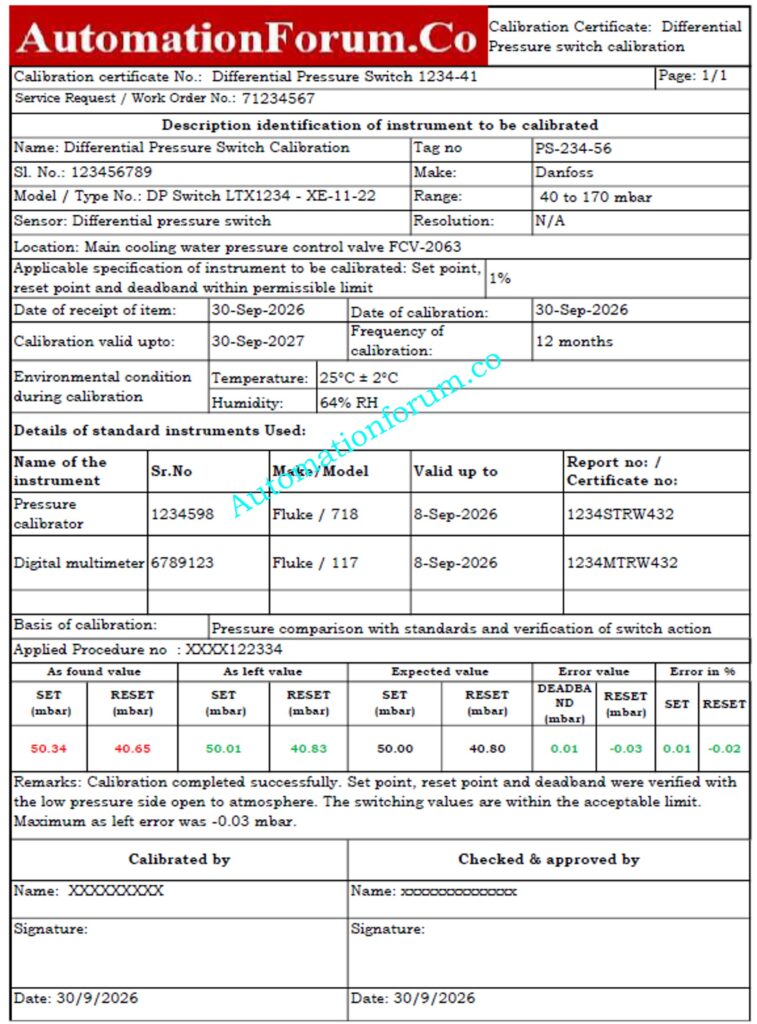
Instrument Details And Calibration Data Fields
The calibration report generally includes
- Instrument tag number
- Range of the DP switch
- Set point value
- Reset point value
- Deadband calculation
- Tolerance limits
- As found and as left readings
Calibration results must be documented properly to ensure traceability and compliance with standards.
The link below provides a downloadable Excel template that can be used to prepare a differential pressure switch calibration report
Expose ISO gaps fast: Internal Audit Checklist for ISO Process Instrument Calibration in Process Industries
Differential pressure switch calibration template download
Key points to remember for DP switch calibration
The calibration of a differential pressure switch in field conditions is typically performed by keeping the low pressure side open to atmosphere and applying pressure on the high pressure side.
The method includes
- Proper isolation
- Correct setup
- Controlled pressure application
- Accurate recording of set and reset points
- Verification and adjustment
A organized and disciplined methodology makes sure that the calibration is correct and the plant runs safely.
Calibrate absolute pressure transmitters properly: Step-by-Step Procedure to Calibrate an Absolute Pressure Transmitter
Frequently Asked Questions About Differential Pressure Switch Calibration
How often should a DP switch be calibrated?
You should calibrate a differential pressure switch once a year or according to the plant’s maintenance schedule. Depending on the risk of the process and the conditions in which it is running, critical safety applications may need to be calibrated more often.
Why is the low pressure side kept open to atmosphere?
The low pressure side is maintained open to the outside world to make a reference pressure of zero. This makes it easy to make differential pressure with just the high side. This makes it easier to calibrate in the field and makes setups more accurate.
Upgrade to better calibration software: Best Calibration Management Software
What is deadband in a differential pressure switch?
The difference between the switch’s set point and reset point is called the deadband. It prevents frequent switching and ensures stable operation by introducing a small gap between ON and OFF actions.
Can a DP switch be calibrated in situ?
Yes, you can calibrate a DP switch in place if it is appropriately isolated, depressurized, and safe to get to. However, it is important to eliminate process interruptions and make sure that the test circumstances are correct.
Do differential pressure sensors need calibration?
Yes, differential pressure sensors need to be calibrated on a regular basis to keep their accuracy, dependability, and safety performance. Over time, drift and the parameters of the operation can change how measurements and switches work.
Refer the below link for the Free Instruments Calibration Procedures: 60+ Step-by-Step Methods for Pressure, Temperature, Flow & Level
