
- Calibration Interval Scheduling in Process Industries
- Purpose of the Calibration Interval Scheduling Procedure
- Scope of the Calibration Interval Procedure for Process Instrumentation
- Applicability of the Calibration Interval Planning Procedure
- Roles and Responsibilities in Calibration Interval Management
- Escalation Procedures for Calibration Issues
- Reference Standards for Calibration Scheduling
- Required Inputs for Developing Calibration Interval Schedules
- Risk-Based Method for Determining Calibration Intervals
- Instrument Criticality Scoring Method for Calibration Planning
- Calibration Interval Decision Table Based on Criticality Score
- Statistical Analysis of Instrument Drift for Calibration Planning
- Control Chart Monitoring for Instrument Calibration Performance
- Calibration Schedule Template for Process Instruments
- Calibration Interval Decision Log Template
- Implementation Plan for Risk-Based Calibration Scheduling
- Key Performance Indicators for Calibration Programs
- Calibration Execution Procedure for Field Instruments
- Handling Out-of-Tolerance Instruments
- Vendor and External Calibration Laboratory Requirements
- Calibration Records and Documentation Requirements
- Training and Competency Requirements for Calibration Personnel
- Calibration Planning Checklist Before Publishing the Schedule
- Final Verification Checklist Before Uploading Calibration Schedule to CMMS
- FAQ on Calibration interval schedule
Calibration Interval Scheduling in Process Industries
In industries that process things like oil and gas, petrochemicals, chemicals, fertilizers, and power generation, it is very important to accurately measure and regulate process variables so that operations can run safely and efficiently.
To make sure that measurements are accurate, process instrumentation like pressure transmitters, temperature sensors, flow meters, level instruments, analyzers, and control valves must be calibrated from time to time. However, calibrating at set times without taking into account how important the instrument is or how well it has worked in the past might lead to higher maintenance costs or more operational risk.
This method gives you an organized way to build a timetable for calibration intervals based on risk assessment, instrument importance, and past performance data. Plants may get the most out of their calibration frequencies while still making sure their measurements are accurate and follow the rules by using this strategy.
Purpose of the Calibration Interval Scheduling Procedure
This procedure’s goal is to set up a systematic way to develop and keep calibration interval schedules for process instrumentation.
This makes sure that:
- Safe plant operation
- Accurate process measurements
- Compliance with regulatory standards
- Reduced maintenance costs
- Improved reliability of measurement systems
Instead of just following the manufacturer’s advice, you can find the best calibration frequency by looking at instrument drift, operational conditions, and criticality.
Scope of the Calibration Interval Procedure for Process Instrumentation
This protocol applies to all tools used in industrial process facilities for monitoring, control, and safety.
The following kinds of instruments are included:
- Pressure switches and pressure transmitters
- RTDs, thermocouples, and temperature transmitters
- Differential pressure, vortex, magnetic, and Coriolis meters are all types of flow meters.
- Level instruments such as capacitance, radar, and DP level transmitters
- Analyzers for processes, like gas chromatographs and oxygen analyzers
- Valves and valve positioners for control
- Sensors for safety instrumented systems
- Flow meters for custody transfer
- Laboratory analyzers used to control processes
Everything You Need to Know About Instrument Calibration: Instrument Calibration in Process Industries – Complete Guide
Applicability of the Calibration Interval Planning Procedure
This process can be used by the following people in a plant:
- Instrumentation Engineers
- Calibration Technicians
- Reliability Engineers
- Maintenance Planners
- Quality Assurance / Quality Control Engineers
- Process Engineers
- Plant Management
- CMMS Administrators
Roles and Responsibilities in Calibration Interval Management
- Instrumentation Engineer: In charge of setting the calibration procedure, approving intervals, and making sure everything is technically correct.
- Calibration Planner: Makes calibration schedules and puts them into the system for managing maintenance.
- Calibration Technician: Does field calibration work and keeps track of measurement data.
- Reliability Engineer: Looks at the history of calibration and the patterns in how well the equipment works.
- Quality Assurance/Quality Control: Makes sure that calibrating processes follow the right rules and standards.
- Process Owner: Makes sure that the intervals between calibrations suit the needs of the process and the quality of the production.
Field Method for Accurate Control Valve Calibration: Control valve Calibration Procedure
Escalation Procedures for Calibration Issues
- Instrument that is out of tolerance: Notify the instrumentation engineer and process owner right away.
- If the calibration schedule is missed, the maintenance planner must be told within 24 hours.
- When a critical instrument fails, an immediate engineering evaluation and temporary process safeguards may be needed.
Key Definitions Used in Calibration Interval Planning
- Calibration is when you compare the measurement of an instrument with a verified reference standard.
- Verification means checking the accuracy of a measurement without changing it.
- Adjustment: Changing the output of an instrument so that it matches the reference standard.
- Drift: Over time, the precision of an instrument slowly changes.
- Link between calibration results and national or international measuring standards is called traceability.
- Mean Time Between Failures (MTBF): The average amount of time that equipment can run before it breaks down.
- Mean Time To Repair (MTTR): The average time it takes to get equipment back up and running.
- Criticality Score: A number that shows how important an instrument is.
- Tolerance: the most measurement inaccuracy that is tolerated.
How to Choose the Right Master Instrument: 6 Steps Guide to Selecting a Master Instrument for Calibration
Reference Standards for Calibration Scheduling
Calibration schedule should follow well-known industry norms, such as:
- Best practices from ISA
- Standards for calibration laboratories set by ISO 17025
- Calibration recommendations from the manufacturer
- Quality management methods for internal plants
Refer the elbow link to Access 60+ Instrument Calibration Procedures for Free: Methods for Pressure, Temperature, Flow & Level
Required Inputs for Developing Calibration Interval Schedules
Before setting calibration intervals, you need to gather the following information:
- Piping and Instrumentation Diagrams (P&ID)
- Instrument loop diagrams
- Instrument datasheets
- Manufacturer recommended calibration intervals
- Historical calibration records
- Instrument repair history
- Process criticality matrix
- Environmental operating conditions such as temperature, humidity, and vibration
Operational duty cycles - Redundancy or backup instrumentation availability
- Regulatory compliance requirements
- CMMS calibration history reports
Many Engineers Confuse These Two Concepts: Differences Between Validation and Calibration
Risk-Based Method for Determining Calibration Intervals
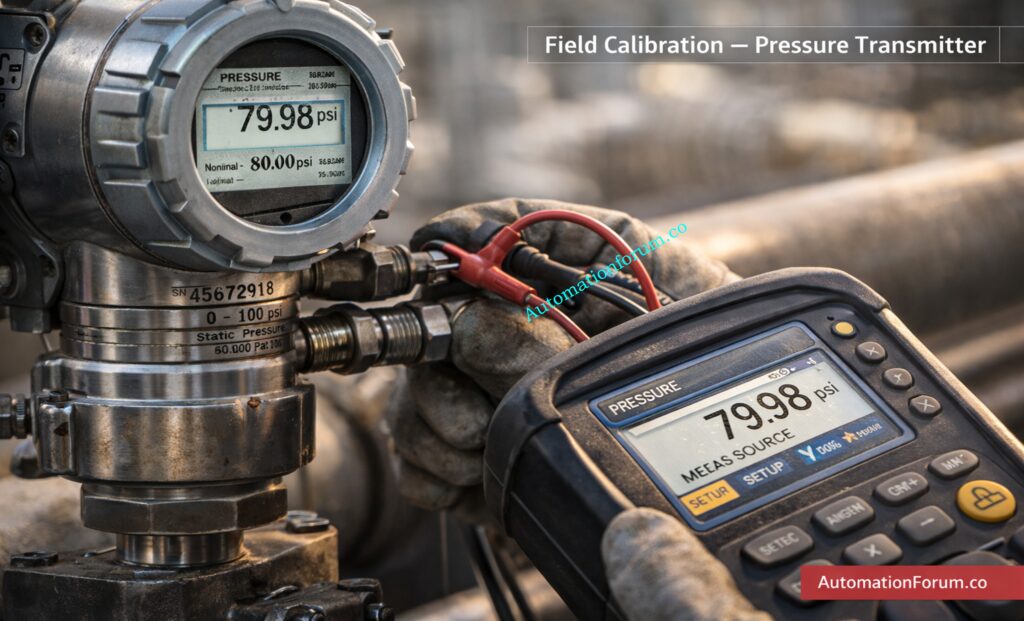
Step 1 – Create a Complete Instrument Inventory
Make a full and correct list of all the plant instruments. This list provides the basis for arranging calibration activities and keeping track of how well the instruments work over time. To make sure that the instrument list is consistent with plant documentation, it should come from the CMMS, instrument index, or engineering database.
There should be the following information in each record:
- Tag number
- Location
- Instrument description
- Instrument type
- Manufacturer
- Measurement accuracy
- Last calibration date
Instrument range, service conditions, loop number, and installation area are some more useful fields that might be included. Keeping a well-organized inventory of instruments makes it easier for engineers to find important devices, check their calibration history, and decide what maintenance tasks are most important. You should check the inventory every so often to make sure that new instruments are added and old ones are taken off the calibration schedule.
Step 2 – Categorize Instruments Based on Process Importance
After making the instrument inventory, each device should be put into groups depending on how important it is to the process and how it affects how it works. Correctly classifying an instrument helps figure out how important it is for the safety of the plant, the quality of the product, and the reliability of the operations.
- Safety Critical Instruments: These are the tools that are utilized in safety systems like emergency shutdown (ESD) systems or safety interlocks. If these tools don’t work right or break, it could cause dangerous circumstances or shut down the factory.
- Process Control Instruments: These tools are used to automatically control things like pressure, temperature, flow, and level in a process. Accurate calibration keeps the process running smoothly and stops it from going off course.
- Tools for Monitoring: Monitoring tools give you information about trends or indications, but they don’t immediately affect control actions. They don’t need to be checked as often as control instruments, but they still need to be checked from time to time to make sure the data is accurate.
- Instruments for transferring custody: These tools are used for business measurements, such billing or moving products between locations. Because of the costs and rules that come with them, these devices generally need stronger calibration controls and certified calibration methods.
Step 3 – Review Manufacturer Calibration Interval Recommendations
Instrument makers usually give recommended calibration intervals based on tests done in labs and real-world performance. When developing a calibration program, these suggestions should be seen as the starting point.
Some common suggestions from manufacturers are:
- Pressure transmitters – 12 months
- Flow meters – 12 to 24 months
- Gas analyzers – 3 to 6 months
- Control valve positioners – 6 to 12 months
But the actual calibration interval may change based on how the plant is running. The frequency with which an instrument has to be calibrated can be affected by things like the temperature of the process, vibration, exposure to the environment, operating duty cycles, and past drift data. So, even while the manufacturer’s suggestions are a good place to start, the ultimate interval should be based on a risk-based review that uses operational data and reliability analysis.
Why Master Pressure Calibrators Are Essential: Master Pressure Calibrators: Precision Tools for Accurate Pressure Instrument Calibration
Instrument Criticality Scoring Method for Calibration Planning
A risk-based weighted scoring technique should be used to figure out how often to calibrate. We look at each instrument based on several factors that show how measurement errors could affect the safety of the plant, the quality of the production, and the reliability of the operations.
On a scale from 0 to 10, each criterion gets a score.
- 0–2 = Very Low Impact
- 3–4 = Low Impact
- 5–6 = Moderate Impact
- 7–8 = High Impact
- 9–10 = Very High Impact
To get the final criticality score, you multiply the score of each criterion by its weight and add the results. Instruments that score higher need to be calibrated more often.
Example Calculation of Instrument Criticality Score
| No | Evaluation Criteria | Weight (%) | Score Range | Evaluation Description | Typical Examples |
| 1 | Safety Impact | 25% | 0–10 | Measures how much the instrument affects plant safety or protection systems. Instruments connected to shutdown or safety systems receive the highest scores. | Pressure transmitters in SIS, flame detectors, ESD sensors |
| 2 | Process / Product Quality Impact | 25% | 0–10 | Evaluates how measurement errors could affect product quality, process stability, or production output. | Reactor temperature transmitters, flow meters controlling product ratios |
| 3 | Historical Measurement Drift | 20% | 0–10 | Based on calibration history. Instruments with frequent drift or adjustments receive higher scores. | Gas analyzers, low-range pressure transmitters |
| 4 | Environmental Conditions | 10% | 0–10 | Considers harsh environmental factors such as vibration, humidity, corrosive atmosphere, and temperature fluctuations that can affect instrument accuracy. | Field instruments installed near pumps or outdoor installations |
| 5 | System Redundancy | 10% | 0–10 | Evaluates whether backup or redundant instruments exist. Instruments without redundancy receive higher scores. | Single transmitter in critical process measurement |
| 6 | Calibration Complexity | 5% | 0–10 | Determines the difficulty of performing calibration including special equipment, laboratory requirements, or system shutdown requirements. | Custody transfer meters, gas chromatographs |
Example Calculation of Instrument Criticality Score
If an instrument receives the following scores:
- Safety Impact = 8
- Process Impact = 7
- Drift History = 6
- Environmental Conditions = 5
- Redundancy = 4
- Calibration Complexity = 3
The weighted score can be calculated as:
Criticality Score =
(8 × 0.25) + (7 × 0.25) + (6 × 0.20) + (5 × 0.10) + (4 × 0.10) + (3 × 0.05)
Criticality Score = 6.85 (or 68.5 out of 100)
This value is then used to determine the recommended calibration interval.
Top Tools Used to Manage Calibration Programs: Best Calibration Management Software
Calibration Interval Decision Table Based on Criticality Score
You can use the following decision table to choose the right calibration interval after figuring out the instrument criticality score.
| Criticality Score Range | Risk Level | Recommended Calibration Interval | Typical Instrument Examples | Remarks |
| 85 – 100 | Very High Criticality | Monthly Calibration | Safety shutdown transmitters, critical analyzers | Frequent verification required due to high safety risk |
| 65 – 84 | High Criticality | Every 3 Months | Reactor temperature sensors, flow meters controlling product quality | Regular monitoring required to maintain process stability |
| 45 – 64 | Medium Criticality | Every 6 Months | General process transmitters such as pressure and level instruments | Standard calibration interval used in many plants |
| 20 – 44 | Low Criticality | Annual Calibration | Monitoring instruments and secondary measurement devices | Minimal process impact if small drift occurs |
| Below 20 | Very Low Criticality | Every 24 Months | Non-critical indicators, backup instruments | Extended interval acceptable if historical stability is proven |
Notes for Practical Application
- Before increasing the frequency of calibration, always check the manufacturer’s recommended intervals.
- If an instrument drifts a lot during calibration, the interval should be shorter, no matter what the estimated score is.
- Legal or contractual obligations may set the calibration intervals for custody transfer instruments and regulatory devices.
- This scoring approach makes sure that calibration resources are only utilized on important tools that have a direct impact on the safety of the plant, the quality of the products, and the reliability of the operations.
Learn the Correct Way to Calibrate Absolute Pressure Transmitters: Step-by-Step Procedure to Calibrate an Absolute Pressure Transmitter
Statistical Analysis of Instrument Drift for Calibration Planning
You can use historical calibration data to guess how much an instrument will drift.
Mean Drift per Month Calculation
Mean Drift per Month is calculated using the formula:
Mean Drift per Month =
(Last Calibration Reading − Baseline Reading) ÷ Months Between Calibrations
Formula for Recommended Calibration Interval
The recommended calibration interval can be estimated using:
Recommended Interval (months) =
Allowable Measurement Error ÷ Mean Drift per Month
Example Calculation for Pressure Transmitters
Instrument Type: Pressure Transmitter
Tolerance: ±0.5 bar
Observed drift: 0.02 bar per month
Recommended Interval = 0.5 ÷ 0.02
Recommended Interval = 25 months
However, the manufacturer recommended maximum interval is 12 months.
Final Calibration Interval = 12 months
Example Calculation for Oxygen Analyzers
Instrument Type: Oxygen Analyzer
Tolerance: ±0.1 percent oxygen
Observed drift: 0.04 percent per month
Recommended Interval = 0.1 ÷ 0.04
Recommended Interval = 2.5 months
Rounded interval = 3 months
Standard Methods Used to Calibrate Flow Meters: ISO Standard Calibration Procedures for Flow Measuring Instruments
Control Chart Monitoring for Instrument Calibration Performance
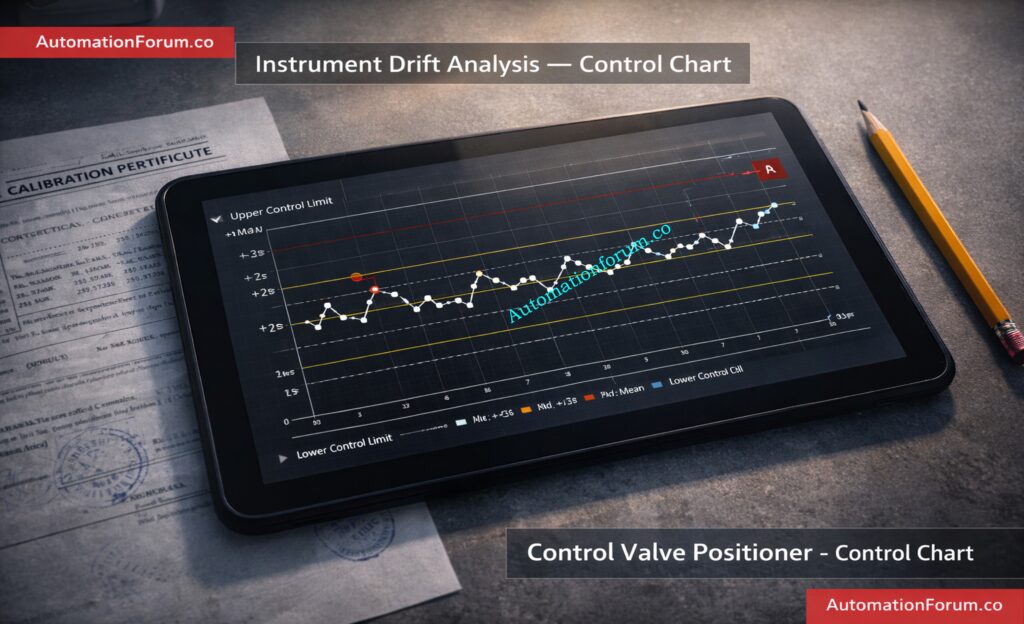
Control charts show how the accuracy of an instrument changes over time. Engineers use statistical limits to figure out when to change the frequency of calibration.
| Parameter | Statistical Limit | Description | Recommended Action |
| Normal Operating Range | Within ±1σ | Instrument readings remain stable and within expected variation. | Continue monitoring; no change in calibration interval. |
| Warning Level | ±2σ (Two Sigma) | Indicates potential drift or abnormal measurement trend. Instrument performance should be closely monitored. | Review historical calibration data and schedule verification if trend continues. |
| Action Level | ±3σ (Three Sigma) | Measurement deviation exceeds acceptable statistical limits and indicates significant drift or potential instrument failure. | Immediate investigation required. Calibration should be performed and interval may need to be reduced. |
| Out-of-Control Condition | Beyond ±3σ repeatedly | Indicates unstable instrument performance or process disturbance affecting measurements. | Immediate recalibration and root cause analysis. |
Note:
Control charts help maintenance teams identify instrument drift trends early and prevent process measurement errors before they affect plant operation.
Best Practices for Pressure Instrument Calibration: Calibration Procedures for Various Pressure Measuring Instruments
Calibration Schedule Template for Process Instruments
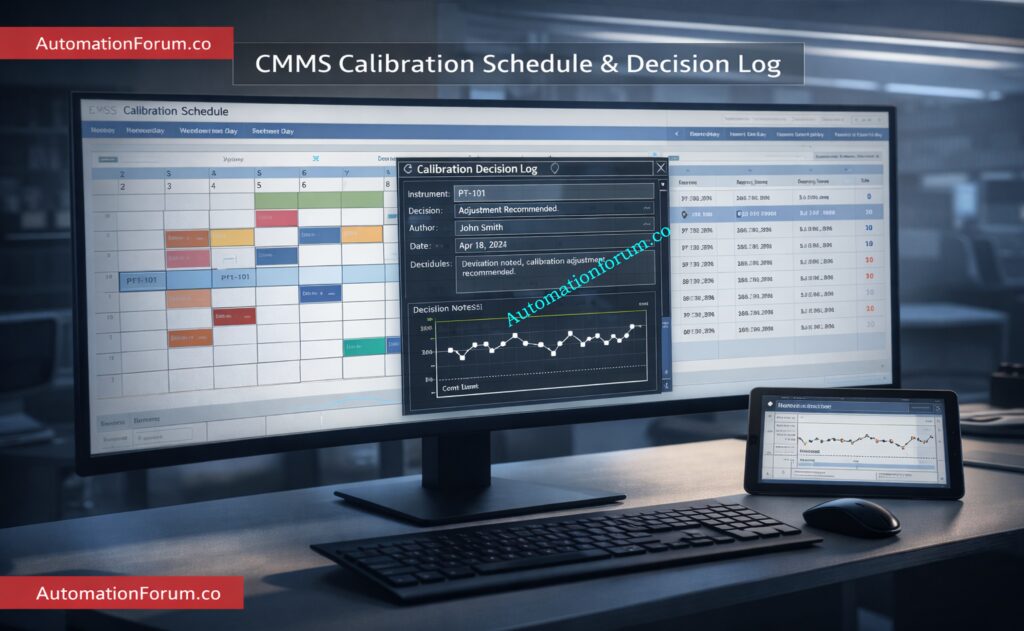
A organized calibration schedule helps maintenance personnel keep track of calibration tasks and make sure that devices are calibrated within the set time frame.
Refer the below link for the Calibration Procedures for Level Measurement Devices
Calibration Schedule Template
| Field Name | Description | Example |
| Tag Number | Unique identification number assigned to the instrument | PT-101 |
| Location | Physical installation location of the instrument | Reactor Area |
| Instrument Description | Short description of the instrument and its function | Reactor Pressure Transmitter |
| Instrument Type | Category of instrument | Pressure Transmitter |
| Manufacturer Recommended Interval | Recommended calibration interval provided by manufacturer | 12 Months |
| Average Historical Drift | Average drift observed from past calibrations | 0.02 bar/month |
| Calibration Tolerance | Maximum allowable error | ±0.5 bar |
| Criticality Score | Risk-based score determined from criticality matrix | 40 |
| Final Calibration Interval | Approved calibration interval based on scoring | 12 Months |
| Last Calibration Date | Date when the instrument was last calibrated | 2025-01-10 |
| Next Calibration Date | Planned next calibration date | 2026-01-10 |
| Assigned Team | Responsible maintenance or instrumentation team | Instrumentation Team |
| External Calibration Required | Indicates if calibration requires an external lab | No |
| Notes / Justification | Reason for selected calibration interval | Stable drift history |
Accurate Temperature Instrument Calibration Methods: Temperature Calibration Procedure
Example Calibration Schedule Entries
| Parameter | PT-101 | FT-205 | O2-301 |
| Tag Number | PT-101 | FT-205 | O2-301 |
| Location | Reactor Area | Feed Line | Boiler Area |
| Instrument Description | Reactor Pressure Transmitter | Coriolis Flow Meter | Oxygen Analyzer |
| Instrument Type | Pressure | Flow | Analyzer |
| Manufacturer Interval | 12 Months | 12 Months | 6 Months |
| Drift | 0.02 bar/month | 0.01%/month | 0.04%/month |
| Tolerance | ±0.5 bar | ±0.2% | ±0.1% |
| Criticality Score | 40 | 75 | 90 |
| Final Interval | 12 Months | 6 Months | 3 Months |
| Last Calibration | 2025-01-10 | 2025-02-01 | 2025-03-01 |
| Next Calibration | 2026-01-10 | 2025-08-01 | 2025-06-01 |
| Assigned Team | Instrument Team | Instrument Team | Analyzer Team |
| External Lab | No | Yes | Yes |
| Notes | Stable drift history | Critical process measurement | High drift rate |
These examples show that calibration intervals can change based on how important an instrument is, how much measurement drift there is, and how important the process is. To keep measurements accurate and make sure the plant runs safely, instruments that drift more or have a bigger effect on operations need to be calibrated more often.
Step-by-Step Method to Calibrate Signal Converters: Signal Convertors Calibration Procedures
Calibration Interval Decision Log Template
When you vary the calibration intervals from what the manufacturer recommends, you need to keep a decision journal for audit and traceability reasons.
| Instrument Tag | Original Interval | New Interval | Reason for Change | Approved By | Approval Date |
| O2-301 | 6 Months | 3 Months | High drift observed during previous calibration cycles | Instrumentation Engineer | 2025-03-10 |
| FT-205 | 12 Months | 6 Months | Critical process measurement affecting product quality | Reliability Engineer | 2025-02-05 |
| PT-101 | 12 Months | 12 Months | Stable performance and acceptable drift | Maintenance Manager | 2025-01-15 |
Keeping a decision record makes sure that all modifications to the calibration interval are approved, documented, and backed up for audits.
How Linear Displacement Instruments Are Calibrated: Displacement Measurement Instrument Calibration Procedures
Implementation Plan for Risk-Based Calibration Scheduling
It is important to gradually implement calibration interval optimization to make sure that the process is reliable and stable.
Calibration Interval Implementation Plan
| Phase | Activity | Description | Duration |
| Phase 1 | Pilot Study | Select representative instruments such as pressure transmitters, analyzers, and control valves to test the risk-based calibration approach. | 6 Months |
| Phase 2 | Performance Evaluation | Review pilot results including drift data, out-of-tolerance events, and maintenance workload. Evaluate KPIs to validate the effectiveness of new intervals. | 1–2 Months |
| Phase 3 | Full Deployment | Implement optimized calibration intervals across the plant. Update schedules in the CMMS system and assign technicians for execution. | Ongoing |
| Phase 4 | Continuous Monitoring | Track calibration performance metrics and adjust intervals when necessary. | Continuous |
This step-by-step method makes sure that calibration optimization makes things more efficient without putting safety or measurement accuracy at risk.
The Correct Way to Test and Calibrate Control Valves: Control Valve Calibration Procedures
Key Performance Indicators for Calibration Programs
You should use the following KPIs to see how well the calibration interval schedule works.
- Rate of completion of calibration on time
- Percentage of out-of-tolerance calibration
- Average time to respond to corrective action
- Number of instrument failures
- Calibration cost per instrument
Practical Methods for Calibrating Analytical Instruments: Analytical Instruments Calibration Procedures
Calibration Execution Procedure for Field Instruments
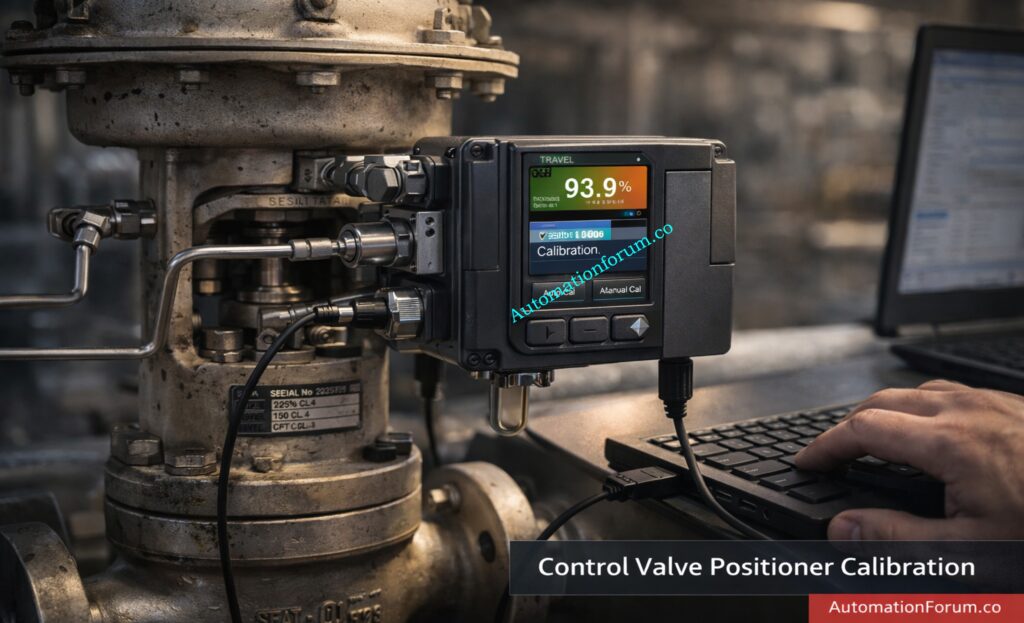
When calibrating, you should do the following things.
- Isolate the instrument safely.
- Connect certified calibration equipment.
- Apply test points across the instrument range.
- Record instrument output values.
- Adjust instrument if required.
- Document calibration results in CMMS.
How Industrial Weighing Systems Are Calibrated: Weighing System Calibration Procedure
Handling Out-of-Tolerance Instruments
If an instrument is discovered to be outside the acceptable limits:
- Put a tag on the tool that says it is out of tolerance.
- Tell the engineer who works with instruments.
- Look at how the process might be affected.
- Make adjustments and recalibrate.
- Write down what you did to fix the problem.
Which Calibrator Should You Use?: Different types of Calibrators and their Calibration Procedures
Vendor and External Calibration Laboratory Requirements
External calibration labs must:
- Keep your ISO 17025 certification up to date
- Give calibration certificates that may be traced
- Use requirements that have been certified
- Custody transfer instruments must be calibrated by accredited laboratories.
Start Here Before Performing Any Instrument Calibration: Calibration Guidelines
Calibration Records and Documentation Requirements
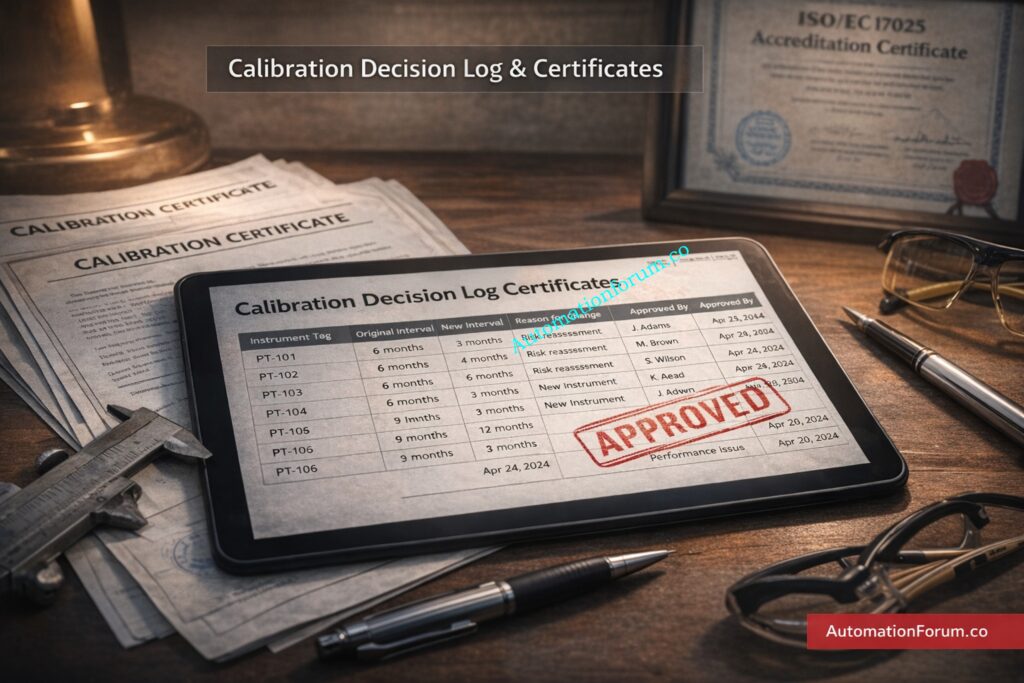
You need to keep the following records.
- Calibration certificates
- Calibration data sheets
- Adjustment records
- Criticality scoring documentation
- Calibration interval decision logs
Depending on what the law says, the recommended retention term is between 3 and 7 years.
Are You Making These Calibration Errors?: Top 15 Common Calibration Mistakes in Industrial Instruments
Training and Competency Requirements for Calibration Personnel
- People who work in calibration management need to get the right training.
- Calibration Technicians: yearly training on how to calibrate instruments
- Instrumentation Engineers: Reliability methods and statistical data analysis (every two years)
- Maintenance Planners: CMMS scheduling processes (training once a year)
Calibration Planning Checklist Before Publishing the Schedule
Check the following before putting out a calibration schedule.
- Instrument inventory is complete
- Criticality scores are assigned
- Drift calculations are verified
- Manufacturer recommendations are respected
- Calibration intervals are approved
- Next calibration dates are defined
A Mistake Many Engineers Make with Calibration and Re-Ranging: Why Calibration Isn’t the Same as Re-ranging in Process Instrumentation
Final Verification Checklist Before Uploading Calibration Schedule to CMMS
Ensure the following conditions are satisfied.
- All instruments have assigned responsible teams
- Calibration intervals are documented
- Next calibration dates are calculated
- Decision log is completed
- Engineering approvals are obtained
Understand the ISO Rules Behind Accurate Instrument Calibration: ISO Standards For Instrumentation Calibration Complete Guide for Industrial Engineers
FAQ on Calibration interval schedule
What is a calibration interval schedule?
A calibration interval schedule tells you how often to calibrate process equipment like pressure transmitters, temperature sensors, flow meters, and analyzers to keep them accurate.
How are calibration intervals determined?
Using manufacturer recommendations, instrument criticality score, historical drift analysis, and regulatory requirements, we decide how often to calibrate.
What is risk-based calibration?
Risk-based calibration is a way to figure out how often to calibrate an instrument depending on how important it is, how safe it is, and how much its measurements vary.
Why is instrument drift important in calibration planning?
Instrument drift shows how the precision of measurements decreases over time. Engineers can use drift analysis to find the best times to calibrate.
What standards apply to calibration programs?
ISO 17025, ISA suggested practices, and plant quality management procedures are all examples of common standards.
What is the recommended calibration interval?
The type of instrument, the manufacturer’s instructions, and how important the process are all factors in determining the best calibration interval. In a lot of fields, the most common intervals are between three and twelve months, however risk-based calibration methods might change this.
How do you calculate calibration interval?
The instrument drift rate and the permissible measurement tolerance are used to figure out how often to calibrate. A popular way to figure out the best calibration frequency is to divide the permitted error by the measured drift per month.
How often should you calibrate instruments?
Most industrial tools need to be calibrated every six to twelve months, depending on the rules and the state of the process. Some important tools used in safety systems may need to be calibrated more often, such every three or six months.
How to decide calibration frequency of instruments?
To figure out how often to calibrate an instrument, you need to look at how important it is, how much it has drifted in the past, the conditions in the environment, and what the manufacturer says. Risk-based calibration methods are commonly utilized to find the best intervals while still getting accurate measurements.
What is the ISO standard for calibration frequency?
ISO standards like ISO/IEC 17025 say that you should use past data, instrument stability, and risk assessment to figure out how often to calibrate. The standard does not need specific intervals, but it does require documented justification.
