
- Online Mass Flow Rate Converter for Industrial and HVAC Applications
- Use the Free Online Mass Flow Rate Converter Tool Now
- What is Mass Flow Rate and Why Is Unit Conversion Important
- International Standards Supporting Mass Flow Measurement and Conversion
- Meet the Mass Flow Converter AutomationForum.co – Features
- Supported Mass and Volumetric Flow Units Conversion Table
- How to Convert Mass Flow Rate – Step by Step Engineering Method
- Practical Engineering Applications of Mass Flow Unit Conversion
- Bulk Mass Flow Conversion Tool with CSV Export and Comparison Table
- Accuracy Considerations in Volumetric to Mass Flow Conversion
- How to Use the Mass Flow Rate Converter in Real Project Work
- Frequently Asked Questions About Mass Flow Rate Conversion
Online Mass Flow Rate Converter for Industrial and HVAC Applications
A mass flow rate converter is an essential engineering tool for converting between different mass and volumetric flow units quickly and accurately. The Mass Flow Converter on AutomationForum.co is designed specifically for instrumentation engineers, HVAC designers, process engineers, and maintenance professionals who need reliable mass flow units conversion in daily project work. It supports more than 50 units and uses a consistent base unit method to ensure transparent and traceable calculations.
Venturi Flow Made Easy: Advanced Venturi Tube Flow Calculator – Formula, Working & Applications
Use the Free Online Mass Flow Rate Converter Tool Now
Mass Flow Rate Converter
Convert between 50+ mass flow rate and volumetric flow units with scientific precision
Mass Flow Rate: Measures the mass of a substance passing through a given point per unit time. Common applications include HVAC systems, chemical processing, industrial manufacturing, and fluid dynamics.
Volumetric Flow (Water): Assumes water density of 1000 kg/m³ (at 4°C). Units include L/h (liters per hour), m³/h, gal/min.
Volumetric Flow (Air/Gas): Assumes standard air density of 1.225 kg/m³ at STP (0°C, 1 atm). SCFM (Standard Cubic Feet per Minute) and Nm³/h are commonly used in compressed air systems and gas flow measurement.
Coriolis Mass Flow Simplified: Coriolis Mass Flow Calculator – Complete Guide for Instrumentation & Process Engineers
What is Mass Flow Rate and Why Is Unit Conversion Important
Definition of Mass Flow Rate in Process Engineering
Mass flow rate measures the mass of a substance passing a point per unit time. Volumetric flow measures the volume per unit time. Converting between the two is essential because instruments plant documentation and control systems may use different units. Conversions let you compare instrument ranges specify set points and reconcile mass balances in process audits.
Turn DP Readings into Flow Values: Differential Pressure to Flow Calculator – Complete Interactive Tool for Process Engineers
Difference Between Mass Flow Rate and Volumetric Flow Rate
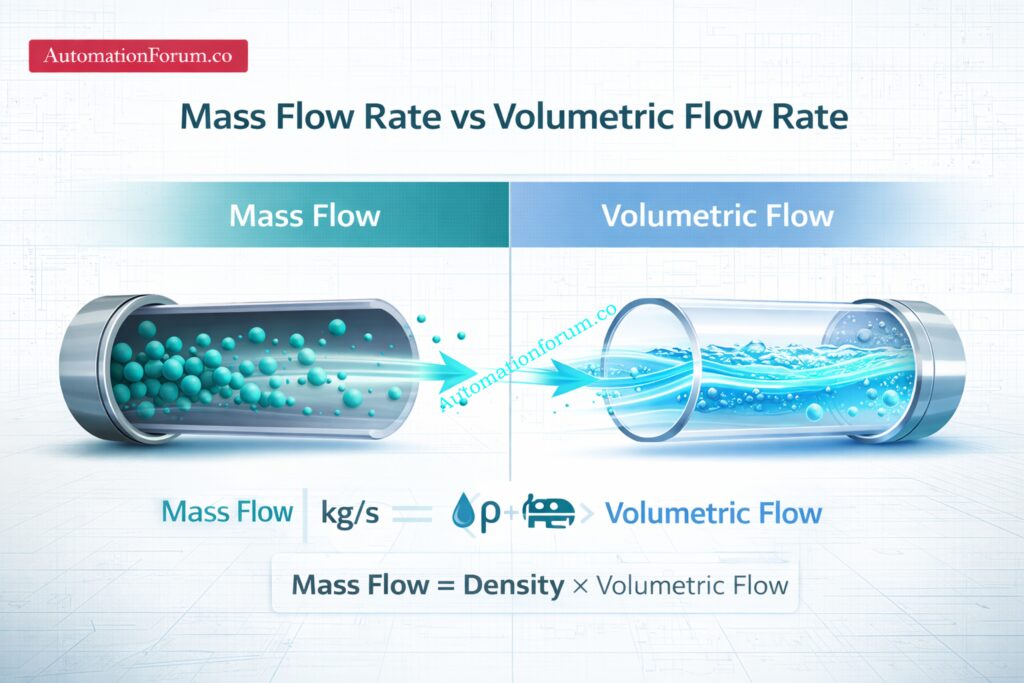
Mass flow rate measures how much mass flows per unit time. For example, kilogram per second or pound per minute.
Volumetric flow rate measures how much volume flows per unit time. For example, cubic meter per hour, liter per hour, or standard cubic feet per minute.
Fix Thermal MFC Problems Fast: Mastering Thermal Mass Flow Controller Troubleshooting: A Comprehensive Guide
Mass Flow Formula – Mass Flow Equals Density Multiplied by Volumetric Flow
The relationship between mass flow and volumetric flow is governed by density:
Mass flow equals density multiplied by volumetric flow.
This is why volumetric to mass conversion always requires a density assumption. When changing between volumetric and mass units, the Mass Flow Converter AutomationForum employs standard density values.
Inside Thermal Flow Control Technology: Precision Control: The Science Behind Thermal Mass Flow Controllers
Typical Use Cases HVAC Compressors Chemical Dosing Custody Transfer
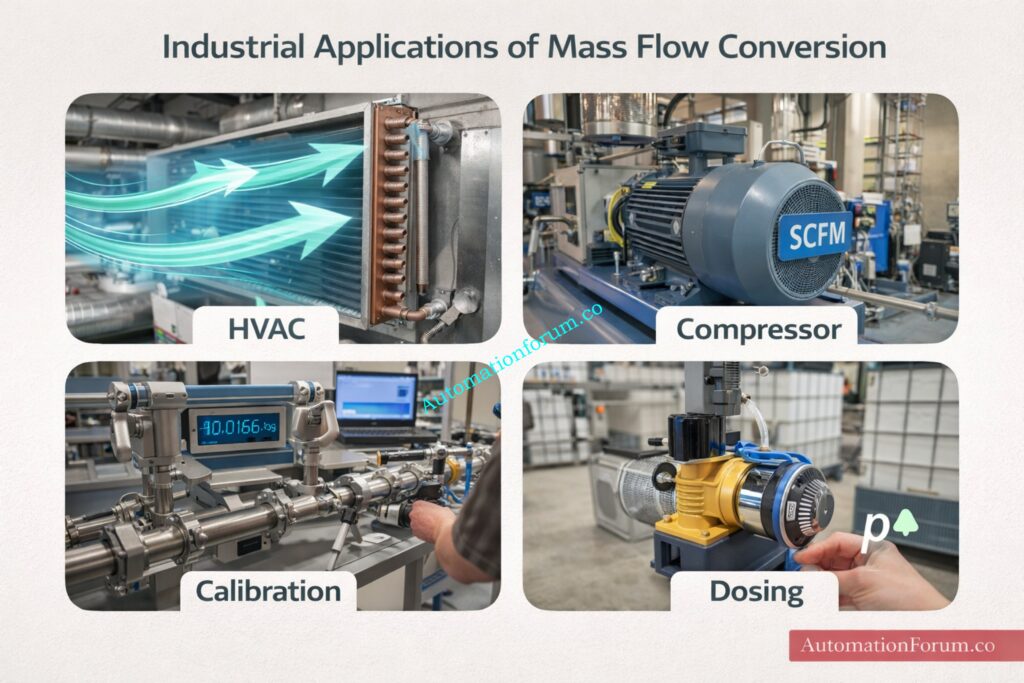
- HVAC designers change the flow of air and chilled water to size coils and choose pumps.
- Instrumentation engineers are mapping the output of field sensors to control system units and alert levels.
- Process engineers checking the mass balance in reactors, separators, and pipelines
- Maintenance workers checking the results on flow meters against calibrated benchmarks
- Specifiers for compressors and blowers changing SCFM and Nm cubed per hour to mass flow for thermodynamic calculations
- Chemical dosing devices that use fluid density to change the volume of a pump’s output into a mass dose.
Smart Plant Reliability Playbook: Advanced Integrated Field Instrument Reliability & Cyber-Secure Maintenance Checklist for Smart Process Plants
International Standards Supporting Mass Flow Measurement and Conversion
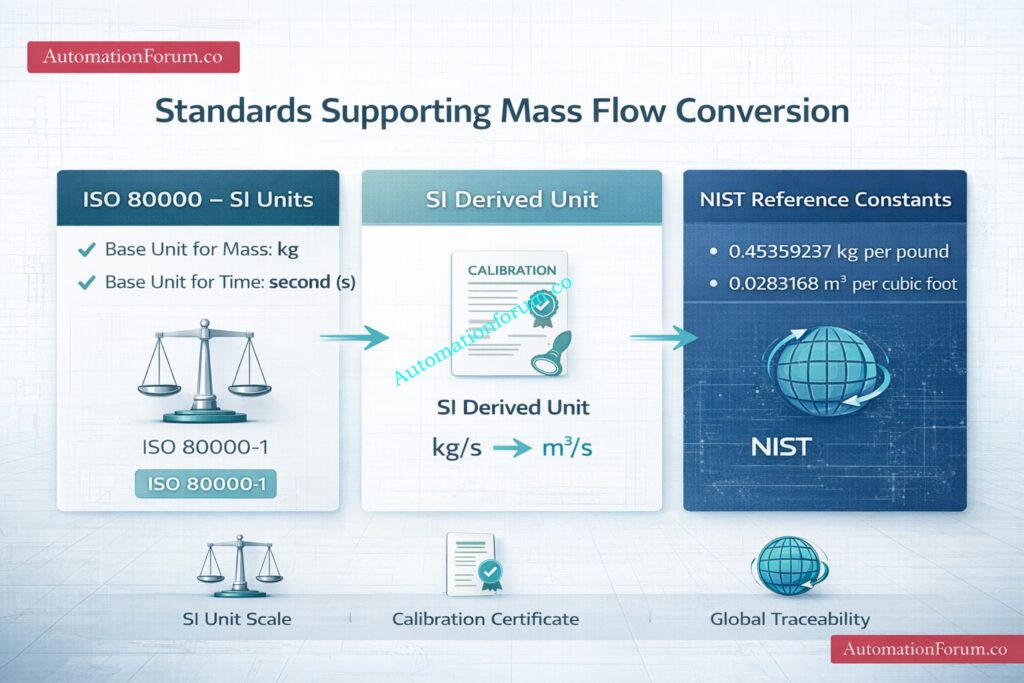
Internationally accepted standards are used to measure mass flow rate and change units so that the results are technically correct, can be traced, and are the same around the world. The main standards and references for converting mass flow units are:
ISO 80000 – SI Units for Mass and Time
- ISO 80000 – Defines the International System of Units including kilogram as the base unit of mass and second as the base unit of time. Kilogram per second is therefore the derived SI unit for mass flow rate.
Smarter PID Tuning Starts Here: Best PID Controller Tuning Simulation Tool for Engineers
SI Derived Unit for Mass Flow Rate – Kilogram Per Second
- SI System of Units – Establishes coherent derived units such as kilogram per second for mass flow and cubic meter per second for volumetric flow.
NIST Physical Constants Used in Flow Conversions
- NIST Reference Constants – Provides internationally accepted physical constants such as:
1 pound equals 0.45359237 kilogram
1 cubic foot equals 0.0283168 cubic meter - Standard Reference Conditions for Gas Flow-Sets the temperature and pressure levels for units like SCFM and Nm³ per hour. 0 degrees Celsius and 1 atmosphere of pressure are two common reference conditions.
Instant Gas Flow Converter: Gas Flow Conversion Calculator
Traceability Requirements in Industrial Metrology
- Traceability Principles in Metrology – principles say that the unit conversions used in calibration, custody transfer, and reporting must be based on standard constants and known reference circumstances.
- Using kilogram per second as the internal base unit in a mass flow rate converter aligns with ISO SI unit structure and supports globally consistent engineering documentation.
Unlock Multivariable Measurement Power: Advanced Multivariable Transmitter Challenge: Flow, Pressure & Temperature Integration
Meet the Mass Flow Converter AutomationForum.co – Features
Mass Flow Converter AutomationForum.co provides an engineer oriented interface and features drawn from the tool build. Key elements include the following
- Presets for common conversions such as kg per hour to lb per minute SCFM to kg per hour and L per hour to gal per minute
- Single value mode for one off checks and quick calculations
- Bulk convert mode that accepts newline or comma separated lists for batch processing
- Comparison table mode that shows one input value across a set of common units side by side
- CSV export and copy to clipboard for sharing conversion results and for inclusion in reports
- History of recent conversions stored locally for quick recall of past values
- Precision control that lets you select number of decimal places typically 2 4 6 8 or 10 depending on task
- Show formulas option that reveals the numeric factors and the step by step calculation so results are auditable
Refer to the tool build for the full unit list UI behavior and the default density assumptions.
Flow Calibration the Right Way: ISO Standard Calibration Procedures for Flow Measuring Instruments
Supported Mass and Volumetric Flow Units Conversion Table
The converter supports 50 plus units including:
Kilogram per second
Kilogram per hour
Gram per second
Ton per hour
Pound per minute
Pound per hour
Ounce per minute
SCFM
SCFH
Nm cubic meter per hour
Liter per hour
Cubic meter per hour
Gallon per minute
Ton US per hour
Ton UK per hour
Slug per second
This wide coverage makes it suitable as a complete mass flow conversion table for HVAC engineers and industrial users.
Coriolis Signal Conversion Tool: Coriolis Flow Meter Output Frequency Calculator
How to Convert Mass Flow Rate – Step by Step Engineering Method
Two Step Base Unit Method Using Kg Per Second
The converter uses a two step base unit approach to keep conversions consistent and simple.
1 Convert the input value to the base unit kg per second using the input unit factor
2 Convert from kg per second to the target unit using the target unit factor
The core formula used across the tool is
result = input × fromFactor ÷ toFactor
where fromFactor and toFactor are the numeric multipliers that convert a unit to kilograms per second.
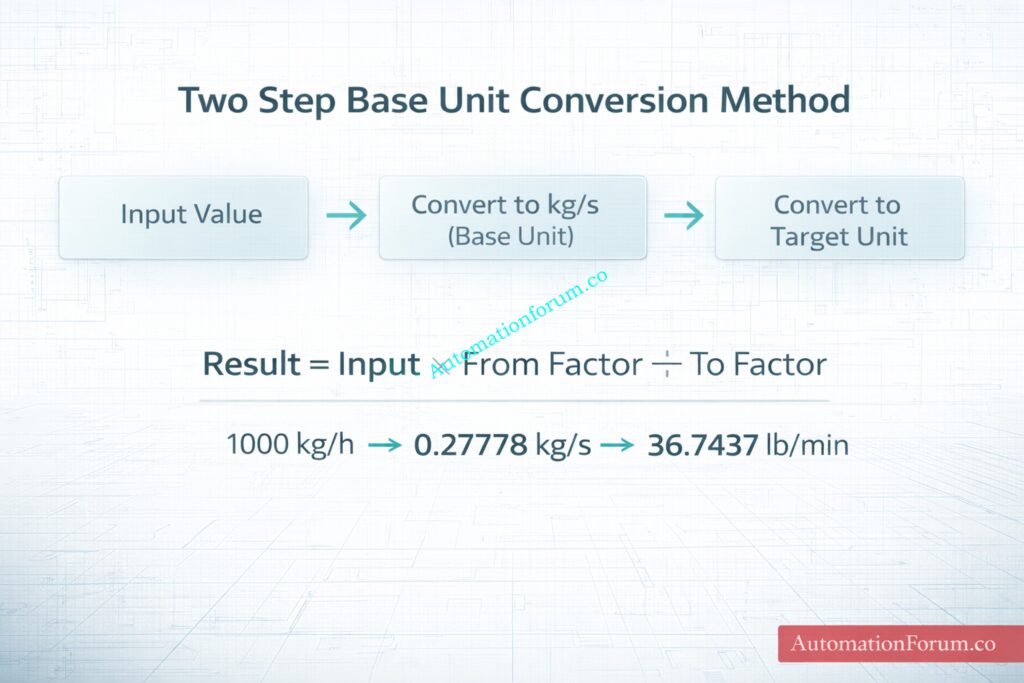
Example 1 – Convert 1000 Kg/H to Lb/Min
Step 1 convert 1000 kg per hour to kg per second
fromFactor for kg per hour = 1 ÷ 3600
kgPerSec = 1000 × 1 ÷ 3600 = 0.2777777777777778 kg per second
Step 2 convert kg per second to lb per minute
toFactor for lb per minute = 0.45359237 ÷ 60 = 0.007559872833333333
result lb per minute = kgPerSec ÷ toFactor
result = 0.2777777777777778 ÷ 0.007559872833333333 = 36.74371036414626 lb per minute
So 1000 kg per hour is approximately 36.7437 lb per minute using the tool default factors.
Refer the below link for the Free Instruments Calibration Procedures: 60+ Step-by-Step Methods for Pressure, Temperature, Flow & Level
Example 2 – Convert 500 SCFM to Kg/H Using Standard Air Density
The tool uses standard air density 1.225 kilograms per cubic meter and one cubic foot equals 0.0283168 cubic meters. Use those constants in the SCFM to kg per second factor.
Step 1 compute SCFM to kg per second factor
scfmFactor = 0.0283168 × 1.225 ÷ 60 = 0.0005781346666666667 kg per second per SCFM
kgPerSec = 500 × 0.0005781346666666667 = 0.28906733333333336 kg per second
Step 2 convert kg per second to kg per hour
kg per hour factor inverse = 3600
result kg per hour = 0.28906733333333336 × 3600 = 1040.6423999999999 kg per hour
So 500 SCFM is approximately 1040.6424 kg per hour with the standard air density assumption used by the tool.
Keep Your Coriolis Meter Accurate: How to Maintain Coriolis Mass Flowmeters ?
Practical Engineering Applications of Mass Flow Unit Conversion
- Water density assumption in the tool is 1000 kilograms per cubic meter which corresponds to water near four degrees Celsius. Use a temperature corrected density for hot water or process liquids whose density changes significantly with temperature or composition.
- Air and gas assumption in the tool is 1.225 kilograms per cubic meter representing standard conditions zero degrees Celsius and one atmosphere. For compressed air at elevated temperature or pressure or for other gases compute gas specific density using ideal gas or real gas methods before converting volumetric to mass flow.
- For custody transfer custody or billing level accuracy do not rely solely on standard assumptions use measured density and traceable calibration.
- When converting process gas volumetric numbers to mass flow consider molar mass temperature and pressure corrections and use corrected standard conditions if required.
Perfect Magmeter Installation Guide: Electromagnetic Flow Meter Installation – Step-by-Step Guide and Checklist for Accurate Measurements
Bulk Mass Flow Conversion Tool with CSV Export and Comparison Table
Bulk processing removes repetitive work when you have many flow values to convert. Paste comma separated or newline separated numbers in bulk mode select the from unit and the to unit then convert and export CSV. Engineers value this for datasheet review and for preparing spreadsheets used in simulation and reporting.
Comparison table mode creates a quick side by side view showing an input value across common engineering units. This is useful when you need a quick spec sheet for an instrument or to show different stakeholders values in their preferred units.
Precision control allows you to select decimal places depending on the task. Two decimal places may be sufficient for a quick field check while six or more digits are used for simulation and calibration planning.
CSV export is available for single bulk and comparison outputs so you can import results into documentation software spreadsheets and test reports.
Choosing the Right Turndown Ratio: Why Turndown Ratio is Important when Selecting a Flow Meter ?
Accuracy Considerations in Volumetric to Mass Flow Conversion
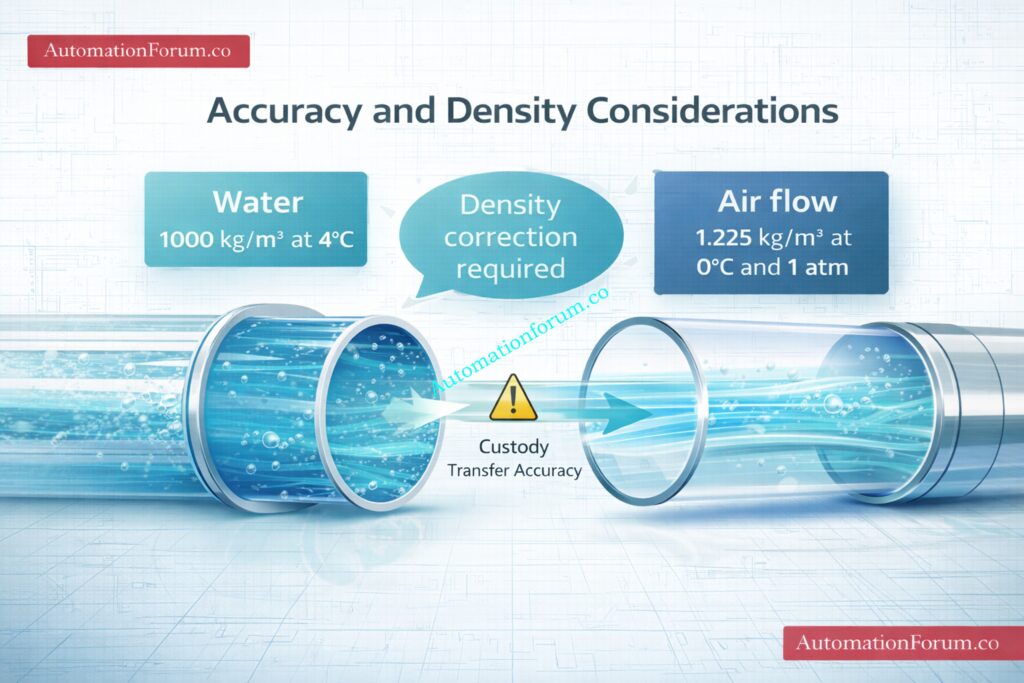
- For volumetric to mass conversion density is the key variable. If the fluid or gas temperature pressure or composition differs from the assumption you must supply corrected density.
- Compressible flow effects do not change the mathematical conversion between volume and mass but they change density. For high pressure gas systems calculate actual gas density at operating conditions before converting.
- Rounding and precision choices matter for reporting. Record the precision used and include units on all reports and datasheets so readers can reproduce calculations.
- The tool exposes formulas and numeric factors so you can audit results. For regulatory custody transfer or billing use site specific procedures and traceable calibration data.
Quick Orifice Flow Estimator: Orifice Plate Flow Rate Calculator
How to Use the Mass Flow Rate Converter in Real Project Work
Suggested workflows
- Datasheet checks use comparison table mode to present one test flow across the units that appear on instrument datasheets and in control system displays.
- Instrument calibration use single value mode to verify zero and span set points then record results and export CSV to include in calibration reports.
- Compressor specification convert required mass flow to volumetric inlet conditions using corrected density so compressor curves and power calculations use consistent mass flow input.
- Control valve sizing cross check convert meter station readings from SCFM or Nm cubed per hour to kg per second then to the mass flow units used by the sizing software.
Include the conversion formula and the density assumptions in project documentation so results remain reproducible.
MFC Accuracy Setup Guide: Mass Flow Controller Calibration Procedure
Frequently Asked Questions About Mass Flow Rate Conversion
How to Convert Mass Flow Rate
Convert mass flow rate by multiplying the input value by the appropriate unit conversion factor.
In engineering tools, this is typically done using a base unit such as kilogram per second for consistent results.
How to Calculate Mass Flow Rate from Volumetric Flow
Mass flow rate is calculated by multiplying density by volumetric flow rate.
Mass flow equals density multiplied by volumetric flow when fluid density is known.
Engineering Pressure Conversion Tool: Pressure Unit Converter – ISO and NIST Compliant Professional Calculator for Engineers
How to Convert M Per Second to M3 Per Hour
Multiply velocity in meter per second by the pipe cross sectional area to get cubic meter per second.
Then multiply the result by 3600 to convert cubic meter per second to cubic meter per hour.
How to Convert CFM to Kg Per Second
First convert cubic feet per minute to cubic meter per minute using 1 cubic foot equals 0.0283168 cubic meter.
Then multiply by air density and divide by 60 to obtain kilogram per second.
What Is 1 CFM Equal To in Kg Per Second
One CFM equals 0.0283168 cubic meter per minute.
At standard air density, it equals approximately 0.000578 kilogram per second.
How Many Kilograms are in One Cubic Foot
One cubic foot equals 0.0283168 cubic meter.
For water at 1000 kilogram per cubic meter density, 1 cubic foot equals about 28.3168 kilogram.
Refer the below link for the 100+ Online Instrumentation Calculators and Engineering Tools
