
🔧 Pressure Unit Converter
Professional-grade converter with precise conversion factors • 50+ units supported
Input
Result
Conversion Methodology
All conversions use Pascal (Pa) as the canonical intermediate unit. The conversion path is:
Input Value × (From Unit → Pa Factor) → Pa Value → Pa Value × (Pa → To Unit Factor) → Result
All conversion factors comply with ISO 80000-4 (Quantities and units – Part 4: Mechanics) and NIST SP 811 standards.
Standards & References
- SI Units: International System of Units (SI) – BIPM standards
- PSI/Imperial: ASME Y14.38 & ISO 1000 conversion factors
- Standard Atmosphere: 101,325 Pa (ISO 2533, ICAO standard)
- Technical Units: Based on standard gravity (9.80665 m/s²)
Temperature-Dependent Units
Some units have temperature specifications:
- Mercury columns: inHg (32°F / 0°C) vs inHg (60°F / 15.6°C), cmHg & mmHg at 0°C
- Water columns: inAq & ftAq at both 4°C (max density) and 60°F (15.6°C)
These use standardized density values from NIST and ISO fluid property tables.
Usage Tips
- Scientific notation is supported (e.g., 1.5e6 or 1.5E6)
- Use the search box to quickly find units (type “psi”, “bar”, etc.)
- Enable “Show conversion steps” to see the intermediate Pascal value
- Bulk mode supports newline or comma-separated values
- Results are automatically saved to history (stored locally)
Keyboard Shortcuts
- Enter in any input field triggers conversion
- Tab to navigate between fields
- Type in unit dropdowns to filter results instantly
International Standards Compliance
This converter adheres to internationally recognized standards and metrology guidelines:
🌍 SI Base Standards
- ISO 80000-4:2019 – Quantities and units — Part 4: Mechanics
- BIPM SI Brochure (9th Ed.) – The International System of Units
- Pascal (Pa): SI derived unit = 1 N/m² = 1 kg/(m·s²)
🇺🇸 US Standards (NIST)
- NIST SP 811 – Guide for the Use of the International System of Units
- NIST SP 330 – The International System of Units (SI)
- Standard PSI: 1 psi = 6,894.757293168 Pa (exact)
- Standard Atmosphere: 1 atm = 101,325 Pa (exact, ISO 2533)
🔧 Engineering Standards
- ISO 1000:1992 – SI units and recommendations
- ASME Y14.38 – Abbreviations and Acronyms for Use on Drawings
- ICAO Standard Atmosphere – Aviation pressure reference (101,325 Pa at MSL)
- Bar: 1 bar = 100,000 Pa = 10⁵ Pa (metric system)
- Torr: 1 Torr = 133.322368421… Pa (1/760 of standard atm)
🌡️ Temperature-Specific Conversions
- Mercury Density (0°C): 13,595.1 kg/m³ (NIST fluid tables)
- Water Density (4°C): 999.972 kg/m³ (maximum density point)
- Water Density (60°F): 999.001 kg/m³ (15.556°C)
- Standard Gravity: gₙ = 9.80665 m/s² (exact, ISO 80000-3)
✅ Key Exact Conversions (Standards-Based)
| Unit | Pascal Equivalent | Standard |
|---|---|---|
| 1 atm | 101,325 Pa | ISO 2533 |
| 1 bar | 100,000 Pa | ISO 1000 |
| 1 psi | 6,894.757293168 Pa | NIST SP 811 |
| 1 Torr | 133.3223684211 Pa | ISO 80000-4 |
| 1 kgf/cm² | 98,066.5 Pa | Technical atm |
| 1 inHg (32°F) | 3,386.38 Pa | NIST tables |
All conversions maintain up to 15 significant figures of precision. For critical applications requiring traceable measurements, consult your national metrology institute (e.g., NIST, NPL, PTB) for calibration standards.
- What is a Pressure Unit Converter and Why it is Critical for Engineers
- Why a Professional Pressure Unit Converter is Necessary
- How the Pressure Unit Converter Works Using Pascal as the Base Unit
- Complete List of Supported Pressure Units
- International Standards Compliance and Traceability
- High Precision Pressure Calculation Features
- Single and Bulk Pressure Conversion Modes
- Step by Step Pressure Conversion Display for Audit and Training
- Practical Engineering Examples of Pressure Unit Conversion
- Industrial Applications of a Professional Pressure Unit Converter
- User Experience and Engineering Focused Design
- Safety and Accuracy in Critical Process Industries
- Future Expansion and Scalability
- Professional Pressure Unit Conversion for Engineers
The Pressure Unit Converter is a high-quality engineering calculator that can accurately convert pressure between different units in industrial, laboratory, and calibration settings. It can handle more than 50 different pressure units and follows well-known worldwide standards as ISO 80000 4, NIST SP 811, ISO 2533 Standard Atmosphere, and BIPM’s SI unit definitions. This isn’t a simple internet converter. It was made just for instrumentation engineers, calibration technicians, process engineers, mechanical engineers, HVAC professionals, and automation specialists that need results that can be traced and are accurate.
What is a Pressure Unit Converter and Why it is Critical for Engineers
One of the most important process factors in industrial automation is pressure. It’s important to convert pressure units correctly whether you establish alarm limits in a DCS, configure a transmitter, scale a PLC analogue input, or make a calibration certificate. Even slight rounding mistakes can cause systems to be incorrectly scaled, documents to be deceptive, or safety issues in important systems. This professional pressure calculator gets rid of these hazards by utilising Pascal as the standard unit of measurement and conversion factors that follow standards.
Converting Raw Counts in PLC Applications: PLC Raw Count Calculator: Comparison with PLC Internal Scaling Blocks, Real-World Use Cases and Practical Benefits
Why a Professional Pressure Unit Converter is Necessary
In real-world engineering, pressure levels are given in different units depending on where you are, what the industry norms are, and what the manufacturer says. For instance:
- Bar and kilopascal are two units of measurement that are used a lot throughout Europe.
- A lot of people in the US use psi
- Pascal and Torr are typically used in scientific labs, and inches of water column are often used in HVAC systems.
- Aviation uses the normal environment as a guide.
- Calibration labs employ mmHg and kgf/cm².
Engineers might have to use rounded estimates if they don’t have a dependable pressure conversion calculator that is based on standards. These approximations can cause inaccuracies to build up in calculations about:
- Flow measurement
- Density compensation
- Differential pressure transmitters
- Control valve sizing
- Boiler pressure calculations
- Hydraulic system design
A competent pressure unit converter makes sure that the results are always the same and can be traced back, which is important for documentation, audits, and compliance.
Understanding PLC Input and Output Resolution: Resolution in PLCs – The Complete Guide for Automation & Instrumentation Engineers
How the Pressure Unit Converter Works Using Pascal as the Base Unit
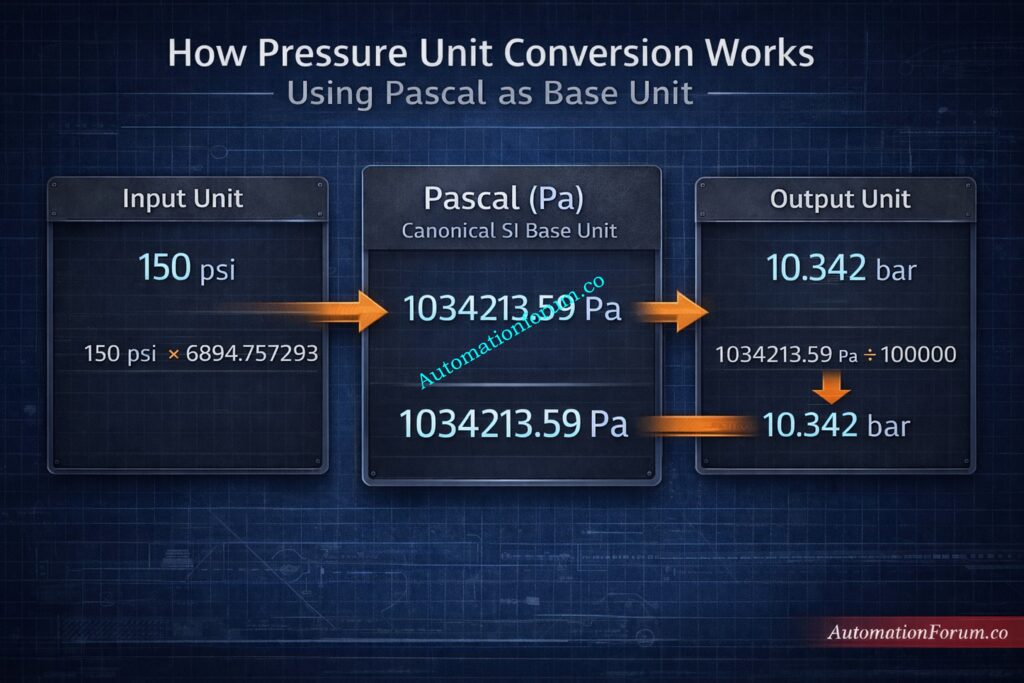
This calculator utilises an approach that is both technically sound and mathematically stable. The SI derived unit of pressure, Pascal, is used as a reference for all pressure units.
One Pascal is the same as one Newton per square metre.
There are two steps to the conversion process:
Step 1
The value in Pascal is equal to the input value times the From Unit conversion factor.
Step 2
The final answer is the value in Pascal divided by the To Unit conversion factor.
The calculator doesn’t make chained conversion mistakes because it uses Pascal as the standard base unit. This method makes sure that everything is correct, consistent, and easy to add more units in the future.
Analog Signal Scaling in PLC Systems: Scaling Analog Values in Industrial Automation (PLC)
Complete List of Supported Pressure Units
The calculator can handle more than 50 different pressure units from different groups.
SI Pressure Units
Pascal, kilopascal, megapascal, gigapascal, hectopascal, millipascal, micropascal, nanopascal, picopascal, femtopascal, and attopascal are all units of pressure.
These units are commonly employed in scientific research, laboratory settings, and contemporary industrial instrumentation.
Metric Pressure Units
Bar, millibar, microbar.
In European technical documents, industrial process facilities, and hydraulic systems, the word “bar” is often employed.
Imperial Pressure Units
Psi, ksi, pound force per square inch, pound force per square foot, and kip force per square inch are all examples of this.
People in the US and in mechanical design calculations use these a lot.
Atmosphere Pressure Units
The standard atmosphere and the technical atmosphere.
The standard atmosphere is 101325 Pascal, and it is often used in aviation, meteorology, and laboratory reference systems.
Mercury Based Pressure Units
Torr, millimetre mercury at 0 degrees Celsius, centimetre mercury at 0 degrees Celsius, inch mercury at 32 degrees Fahrenheit, and 60 degrees Fahrenheit.
In vacuum systems, laboratory manometers, and pressure calibration setups, these units are very significant.
Water Column Pressure Units
Millimetre water at 4 degrees Celsius, centimetre water at 4 degrees Celsius, inch water at 4 degrees Celsius, foot water at 4 degrees Celsius, inch water at 60 degrees Fahrenheit, and foot water at 60 degrees Fahrenheit.
HVAC systems, duct pressure measurement, and differential pressure applications all use water column units a lot.
Technical Force Based Pressure Units
Force in kilograms per square centimetre, grams per square centimetre, and kilograms per square metre.
People typically utilise these in older engineering drawings and some parts of the industrial sector.
CGS Pressure Units
Dyne per square centimetre.
This unit is sometimes used in scientific study and calculations.
Correct Method for Pressure Gauge Testing: Pressure gauge Calibration procedure
International Standards Compliance and Traceability
This pressure unit converter is in line with accepted standards, so the results are accurate and can be traced.
ISO 80000 4 talks about mechanical quantities and units, such as pressure.
NIST SP 811 tells you how to utilise the International System of Units.
The standard atmospheric value of 101325 Pascal is set by ISO 2533.
For conversions based on force, the standard gravity of 9.80665 meters per second squared is utilised.
Using conversion factors based on standards makes sure that the results may be utilised with confidence in calibration reports, engineering documents, and places that are controlled.
Fieldbus Transmitter Calibration Explained: Fieldbus pressure Transmitters Calibration Procedure
High Precision Pressure Calculation Features
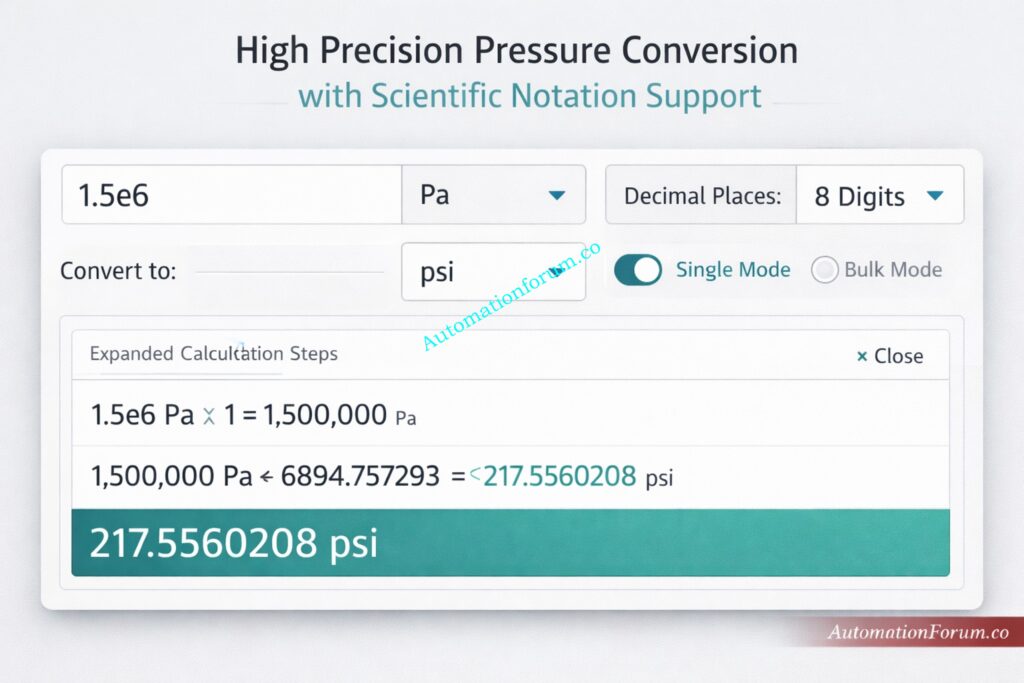
A lot of the time, engineering needs very high precision. You can choose how many decimal places the calculator shows, from zero to twelve. It can also read scientific notation, like 1.5e6 or 3.2E 4.
The calculator automatically converts to exponential style for very small or very large numbers to keep them easy to read and accurate.
This functionality is especially helpful in:
- Vacuum measurement systems
- High pressure hydraulic systems
- Laboratory research
- Gas flow calculations
Refer the below link for the Differential Pressure Transmitter Calibration procedure
Single and Bulk Pressure Conversion Modes
Single Conversion Mode
Single mode is meant for quick engineering maths. The user types in a number, picks the source unit, picks the target unit, changes the precision if necessary, and then clicks convert.
The unit and the outcome are both clearly shown. When this option is turned on, the steps for converting are shown, along with the intermediate Pascal value.
This is great for commissioning teams, field engineers, and maintenance workers.
Simplified Valve Sizing for Liquid Service: Control Valve Sizing Excel tool Without Iteration: Liquid Application
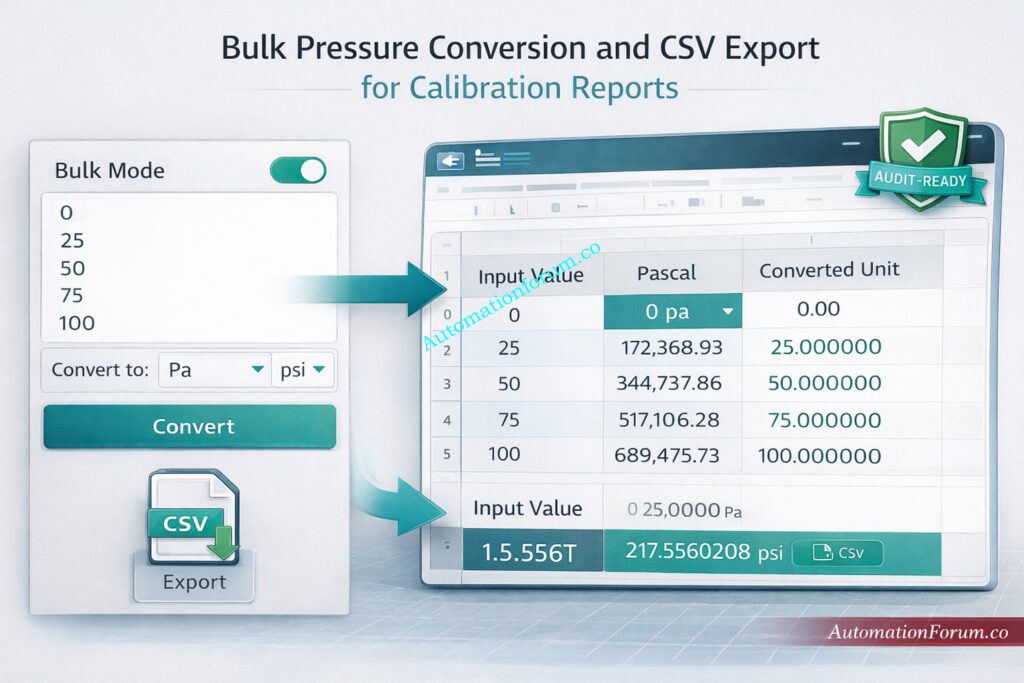
Bulk Conversion Mode
Bulk mode lets you change a lot of values at once. You can input values as lists that are separated by commas or new lines.
This feature is quite helpful for:
- Calibration data preparation
- Creating pressure conversion tables
- Migrating data between systems
- Preparing engineering documentation
You can export bulk findings as a CSV file to use in spreadsheets or calibration certifications.
Practical Guide to Calibrating HART Transmitters: HART pressure transmitter calibration procedure
Step by Step Pressure Conversion Display for Audit and Training
One thing that makes this pressure calculator stand out is that you can see full procedures for converting.
The output shows:
- Original input value
- Conversion to Pascal
- Intermediate Pascal value
- Final conversion to target unit
This transparency is extremely useful for:
- Training junior engineers
- Audit documentation
- Quality assurance reviews
- Calibration traceability
The calculator doesn’t just show a number; it shows how it got there.
Understanding Different Pressure Calibrator Types: What are various Pressure calibrators and how to use them?
Practical Engineering Examples of Pressure Unit Conversion
Example 1 Convert 150 psi to bar
150 psi multiplied by 6894.757293 equals 1034213.59 Pascal.
1034213.59 Pascal divided by 100000 equals 10.342 bar.
This type of conversion is common in hydraulic systems and pressure testing.
Example 2 Convert 101.325 kPa to atm
101.325 kPa multiplied by 1000 equals 101325 Pascal.
101325 Pascal divided by 101325 equals 1 atm.
This example is often used in laboratory calibration and atmospheric reference calculations.
How to Size a PLC Power Supply Correctly: PLC Power Supply Calculator – Complete Guide for Accurate PLC Power Sizing
Example 3 Bulk Conversion for Transmitter Calibration
Suppose a transmitter is calibrated at 0, 25, 50, 75, and 100 psi.
Using bulk mode, these values can be converted to kilopascal instantly and exported to CSV for inclusion in a calibration report.
Importance of Cv in Valve Performance: Why Measuring Control Valve Cv is Essential for Proper Valve Sizing ?
Industrial Applications of a Professional Pressure Unit Converter
This professional pressure unit converter can be used in many different fields.
- Oil and gas companies utilise it to measure wellhead pressure, pipeline pressure, and compressor systems.
- It is used in power plants for boiler pressure, steam drum pressure, and feedwater systems.
- Water treatment plants utilise it to measure the pressure of the pump discharge and the filter differential pressure.
- Chemical plants utilise it to figure out the pressure in reactors, storage tanks, and safety relief valves.
- HVAC experts use it to assess duct pressure and water column height.
- Calibration labs use it to compare deadweight testers and calibrate manometers.
Selecting the Correct Valve Actuator Size: Valve Actuator Sizing Calculator
User Experience and Engineering Focused Design
The interface was made to be useful for engineers. It has:
- Layout that works well on desktops, tablets, and phones.
- Display of clear results using big, easy-to-read numbers.
- Exporting to CSV for documentation.
- Local history storing for new changes.
The modern look makes it easy for consumers to focus on the math without becoming distracted.
Commissioning DP Transmitters in Steam Drum Applications: Commissioning Procedure for Differential Pressure Transmitters in Pressurized Boiler Steam Drums
Safety and Accuracy in Critical Process Industries
In safety instrumented systems and critical process industries, wrong pressure scaling can lead to:
- False alarms
- Missed trip signals
- Incorrect interlock activation
- Equipment damage
- Safety hazards
Using a pressure unit converter that is dependable and follows standards lowers these risks and makes documentation more reliable.
Flow Measurement DP Commissioning Checklist: Differential Pressure Transmitter Commissioning Checklist for Flow Measurement Applications
Future Expansion and Scalability
The system uses Pascal as the base unit, thus it’s easy to add more pressure units without changing the stability of the calculations.
Possible improvements in the future include:
- Integration with API for engineering software
- Expanded vacuum units
- Industry specific custom units
- Integration with calibration management systems
The modular design makes it easy to keep up with and use for a long time.
Standard Procedures for Pressure Instrument Testing: Calibration Procedures for Various Pressure Measuring Instruments
Professional Pressure Unit Conversion for Engineers
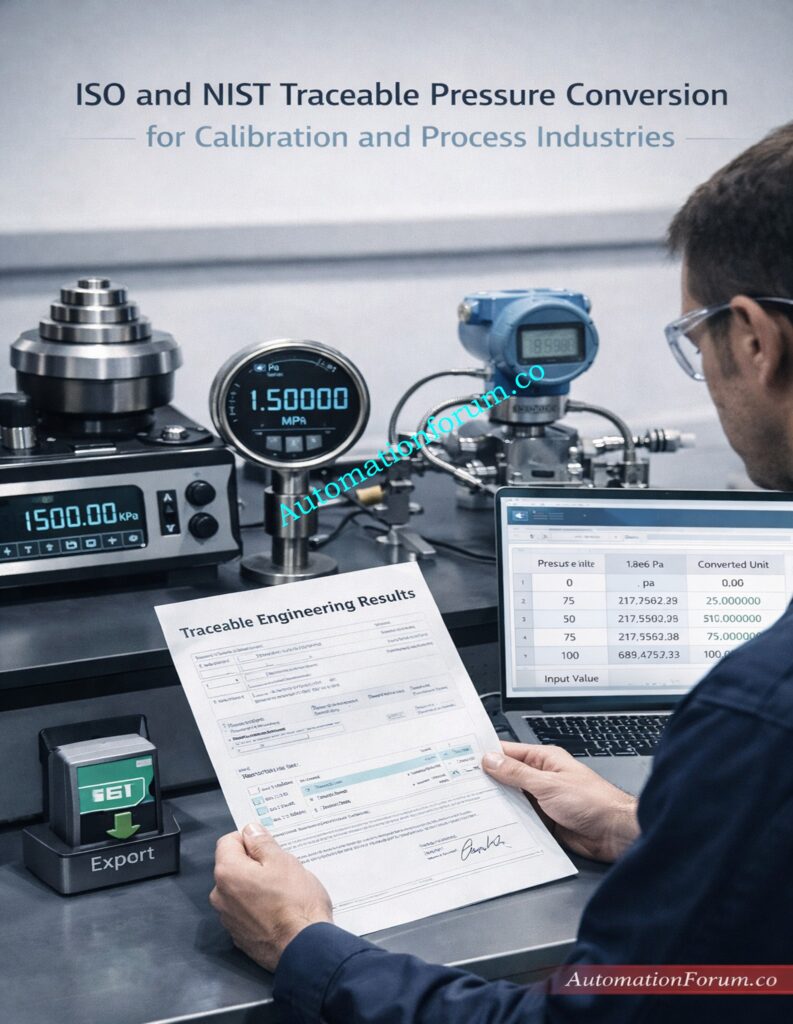
The Pressure Unit Converter is a strong engineering calculator that follows ISO and NIST standards and is made for use in real-world industrial settings. It has everything you need for professional pressure conversion, including support for more than 50 pressure units, high precision control, temperature-specific adjustments, single and bulk conversion modes, step-by-step computation transparency, and the ability to export to CSV.
This is more than just a simple converter for instrumentation engineers, calibration technicians, process engineers, and automation professionals. It is an engineering tool based on standards that was made to be accurate, compliant, operate well, and keep documentation reliable.
This pressure unit converter gives you the accuracy and traceability you need in current engineering settings if you work in industrial automation, process control, laboratory measurement, or calibration engineering.
Choosing the Right Master Pressure Calibrator: Master Pressure Calibrators: Precision Tools for Accurate Pressure Instrument Calibration
FAQ on Pressure Unit Converter
What is a Pressure Unit Converter?
A pressure unit converter is a professional engineering calculator used to convert pressure values between different units such as Pascal, bar, psi, kPa, atm, Torr, and mmHg.
It ensures accurate and standards-based conversion using SI definitions.
It is widely used in industrial automation, calibration labs, HVAC, and process engineering.
Why is an ISO and NIST compliant Pressure Unit Converter important?
An ISO and NIST compliant pressure converter follows internationally recognized unit standards and reference values.
This ensures traceable, reliable, and audit-ready results for calibration and engineering documentation.
It reduces errors caused by rounded or non-standard conversion factors.
Sizing Control Valves for Critical Flow Conditions: Control Valve Sizing Calculation Worksheet for Critical and Sub-Critical Flow: Excel Tool
How does a Pressure Unit Converter ensure high accuracy?
A professional pressure unit converter uses Pascal as the base SI unit for all calculations.
It converts input values to Pascal first and then converts to the target unit to avoid chained errors.
This method ensures mathematical stability and precision up to multiple decimal places.
How to convert unit of pressure?
To convert pressure units, first convert the given value into Pascal, the SI base unit of pressure.
Then divide the Pascal value by the conversion factor of the target unit.
Using a professional pressure unit converter eliminates rounding errors and ensures standards based accuracy.
What is 70 kg in psi?
Pressure cannot be converted directly from kilograms to psi because kilogram is a unit of mass, not pressure.
If you mean 70 kilogram force per square centimeter, then 70 kgf per square centimeter equals approximately 995 psi.
Always confirm whether the value refers to mass or pressure before converting.
How many psi is 2.5 pressure?
If 2.5 refers to 2.5 bar, then 2.5 bar equals approximately 36.26 psi.
If it refers to 2.5 MPa, then it equals about 362.6 psi.
The unit must be clearly specified before conversion.
Is 1 bar equal to 10 psi?
No, 1 bar is not exactly 10 psi.
1 bar equals approximately 14.5038 psi.
The value 10 psi is only a rough approximation and should not be used in engineering calculations.
What is 40 to 60 PSI in bar?
40 psi equals approximately 2.76 bar.
60 psi equals approximately 4.14 bar.
So the range 40 to 60 psi is roughly 2.76 to 4.14 bar.
What is a millibar?
A millibar is a metric unit of pressure equal to one thousandth of a bar.
1 millibar equals 100 Pascal in SI units.
It is commonly used in meteorology, laboratory work, and low pressure industrial applications.
Refer the below link for theFree Instruments Calibration Procedures: 60+ Step-by-Step Methods for Pressure, Temperature, Flow & Level
