
CORIOLIS MASS FLOW
AutomationForum.co
⚡ ADVANCED FLOW CALCULATIONS WITH VISUALIZATION ⚡
- Coriolis Mass Flow Measurement
- What is a Coriolis Mass Flow Calculator?
- Key Inputs Used in the Coriolis Mass Flow Calculator
- Coriolis Mass Flow Calculator Outputs
- Why Mass Flow Measurement Matters in Industry
- Why You Need This Coriolis Mass Flow Calculator
- Who Should Use This Coriolis Mass Flow Calculator?
- When Should You Use a Coriolis Mass Flow Calculator?
- How the Coriolis Mass Flow Calculation Works
- Step-by-Step Guide to Using the Coriolis Mass Flow Calculator
- Practical Example of Coriolis Mass Flow Calculation
- Best Practices for Accurate Mass Flow Calculation
- Limitations of the Coriolis Mass Flow Calculator
- Frequently Asked Questions on Coriolis Mass Flow Calculator
Coriolis Mass Flow Measurement
In modern process sectors like oil and gas, chemical processing, power generation, food and drink, water treatment, and pharmaceuticals, it is very important to quantify mass flow accurately. It is easy to measure and see volumetric flow, but it doesn’t show how much material is really moving through a system. Mass stays the same, but volume can change a lot when temperature, pressure, and density change.
For this reason, mass flow is the best process variable for figuring out material balance, energy accounting, custody transfer, batching operations, blending accuracy, and quality control.
The Coriolis Mass Flow Calculator was made to help engineers, technicians, and operators figure out corrected mass flow rates accurately utilizing real-world operating situations instead of perfect settings.
This guide tells you what the calculator does, why you need it, who should use it, when to use it, how to use it, and how the calculation works, all in a practical, field-oriented engineering way.
What is a Coriolis Mass Flow Calculator?
A Coriolis Mass Flow Calculator is an engineering tool that combines recorded volumetric flow with fluid characteristics and correction factors that reflect real operating conditions to find the accurate mass flow rate of a fluid.
This calculator takes into account the same factors that impact how well a real Coriolis flowmeter works in an industrial setting, unlike simple volume-to-mass converters.
Maximum PSF Calculator for Coriolis Flow Meters – Pulse Scaling Made Easy: Maximum PSF( Pulse Scaling Factor) Calculator for Coriolis Flow Meters
Key Inputs Used in the Coriolis Mass Flow Calculator
Volumetric Flow Rate
This shows the amount of flow measured per unit of time, like m³/s, L/s, or GPM. You can usually get this from process data, design calculations, or temporary flow measurements taken during commissioning.
Fluid Density
The real density of the process fluid at the temperature and pressure it is running at. Density has a direct effect on mass flow and is one of the most important factors in how accurate Coriolis measurements are.
Reference Density
The density at which the factory set the Coriolis meter. Any difference between the operational density and the reference density needs to be fixed.
Temperature Correction Factor
Takes into account changes in fluid characteristics caused by temperature, sensor material expansion, and tube stiffness variations.
Viscosity Correction Factor
Fluids with a lot of viscosity slow down the vibration of tubes in Coriolis meters. This factor makes up for the impacts of lower sensitivity and phase shift.
Phase Correction Factor
This is used when there is a little bit of gas entrainment, aeration, or flow that is close to two phases. These conditions can affect the stability of the meter.
Meter Calibration (K) Factor
The meter calibration (K) factor is an adjustment factor that comes from calibration certifications and is used to make sure that measured values match traceable standards.
Compressibility Factor (for gases)
Fixes the way real gases act when their density fluctuates a much with pressure and temperature.
Coriolis Flow Meter Output Frequency Calculator for Accurate Signal Scaling: Coriolis Flow Meter Output Frequency Calculator
Coriolis Mass Flow Calculator Outputs
The calculator provides:
- Mass flow in kg/s
- Mass flow in kg/h
- Raw mass flow (before correction)
- Density correction factor
- Total correction factor applied
This layered output helps engineers not only see the final result, but also understand why it changed.
How to Maintain Coriolis Mass Flowmeters for Long-Term Accuracy: How to Maintain Coriolis Mass Flowmeters ?
Why Mass Flow Measurement Matters in Industry
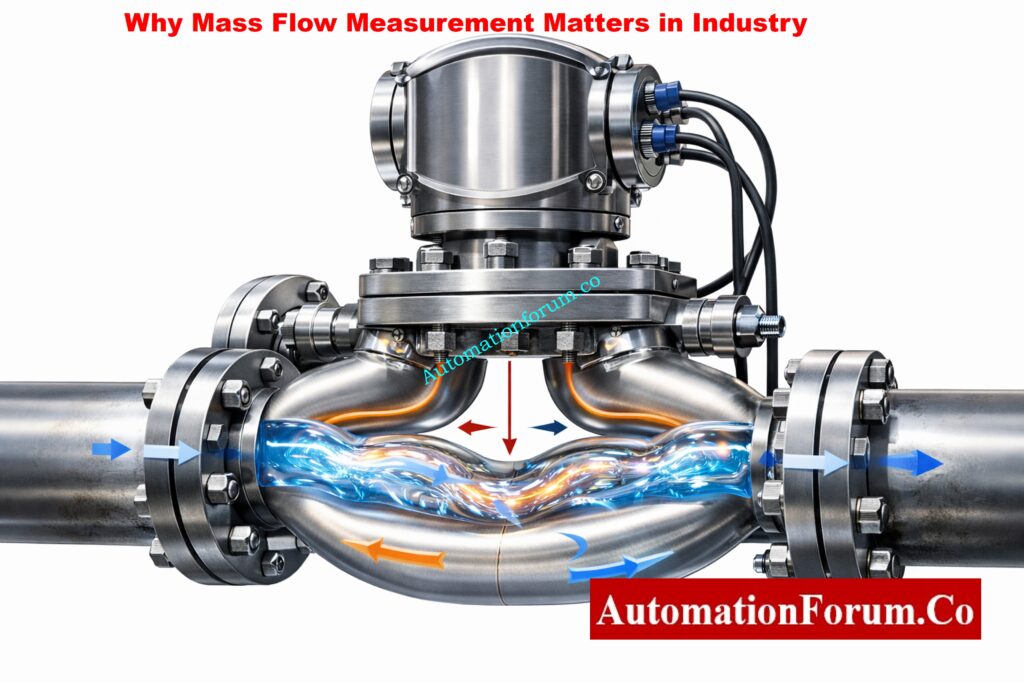
In industrial process control, mass, not volume, is what defines how efficient production is, how much energy is used, and how much money is made. Mass flow stays the same, while volumetric flow vary depending on the surroundings.
Important Reasons Mass flow is very important for process efficiency.
Key Reasons Mass Flow Is Critical
Process Efficiency
Accurate mass flow makes ensuring that reactors, furnaces, and separators get the right amount of material, which keeps them from being underfed or overfed.
Product Consistency
Mass accuracy is important for batching and blending processes to keep the quality and composition of the products the same.
Energy Balance
For accurate energy accounting, steam, fuel gas, and thermal oil calculations depend on mass flow.
Regulatory Compliance
Calculations based on mass are commonly needed for environmental reporting and emissions monitoring.
Billing and Custody Transfer
Mass is utilized in business deals to avoid problems that can come up when density or temperature changes.
Coriolis flowmeters measure mass flow directly, but engineers still need to do their own calculations throughout design, commissioning, troubleshooting, and audits. This is where the calculator becomes quite useful.
Coriolis Flow Meter Installation Guide – Best Practices for High Accuracy: Coriolis Flow Meter Installation: Best Practices for Accuracy
Why You Need This Coriolis Mass Flow Calculator
Eliminates Manual Errors
When you do calculations by hand or with spreadsheets, you often make mistakes because of:
- Incorrect unit conversion
- Missed correction factors
- Inconsistent formulas between engineers
This calculator ensures:
- Automatic unit normalization
- Correct application of all correction factors
- Consistent and repeatable results across teams
Saves Time During Commissioning
Time is very important during plant setup, FAT, and SAT. The calculator lets engineers:
- Quickly compare expected vs actual mass flow
- Check the adjustment for temperature and density.
- Check the transmitter’s settings without having to recalculate them over and over.
Improves Troubleshooting Accuracy
If a Coriolis meter gives readings that are not what you anticipate, the calculator can assist you figure out if the problem is
- Wrong density input
- Wrong temperature adjustment
- Wrong data for the K-factor or calibration
- Changes in process conditions instead of instrument failure
Supports Engineering Documentation
Calculated results can be confidently used in:
- Calibration certificates
- Commissioning dossiers
- Process design calculations
- Performance validation and audit reports
What Is a Coriolis Flowmeter? Working Principle Explained: What is a Coriolis flowmeter and how does it work
Who Should Use This Coriolis Mass Flow Calculator?
Instrumentation Engineers
Instrumentation professionals use the calculator for:
- Choosing the right Coriolis flowmeter and checking its size
- Checking the transmitter’s setup settings
- Checking calibration and factory settings against each other
Process Engineers
Process engineers rely on it for:
- Calculations for mass balance
- Looking at how fluid properties affect flow measurement
- Finding the best operating conditions for steady flow control
Commissioning & Maintenance Engineers
During site activities, the calculator helps with:
- Checking the loop and making sure it works
- Finding configuration mistakes quickly
- Putting design values next to field measurements
Operations & Production Teams
Operations teams benefit by:
- Knowing how variations in temperature and density affect things
- Checking the flow of mass during grade changes
- Making better decisions about control when things go wrong
Students & Trainees
For learning purposes, the calculator helps:
- Imagine how viscosity and density change the flow of mass.
- Learn how Coriolis flowmeters work in the real world.
- Bridge theory and real-world use
Coriolis Mass Flowmeter Basics – A Complete Beginner-to-Engineer Guide: Coriolis mass flowmeter basics
When Should You Use a Coriolis Mass Flow Calculator?
During Design & Engineering
- Turn volumetric flow into mass flow that is correct
- Make sure the Coriolis meter is right for the job.
- Look at the worst-case fluid property scenarios
During Installation & Commissioning
- Check that the transmitter settings match the process conditions.
- Check the calculated mass flow against the output of the live meter.
- Find scaling or setup mistakes early on.
During Normal Operation
- Look into changes in mass flow
- Look at how variations in process temperature or density affect things.
- Help with attempts to optimize production
During Calibration & Maintenance
- Check the accuracy of the meter after maintenance.
- Re-confirm the things that need to be changed
- Help with audits inside and outside the company
Differential Pressure to Flow Calculator for Process Engineers: Differential Pressure to Flow Calculator – Complete Interactive Tool for Process Engineers
How the Coriolis Mass Flow Calculation Works
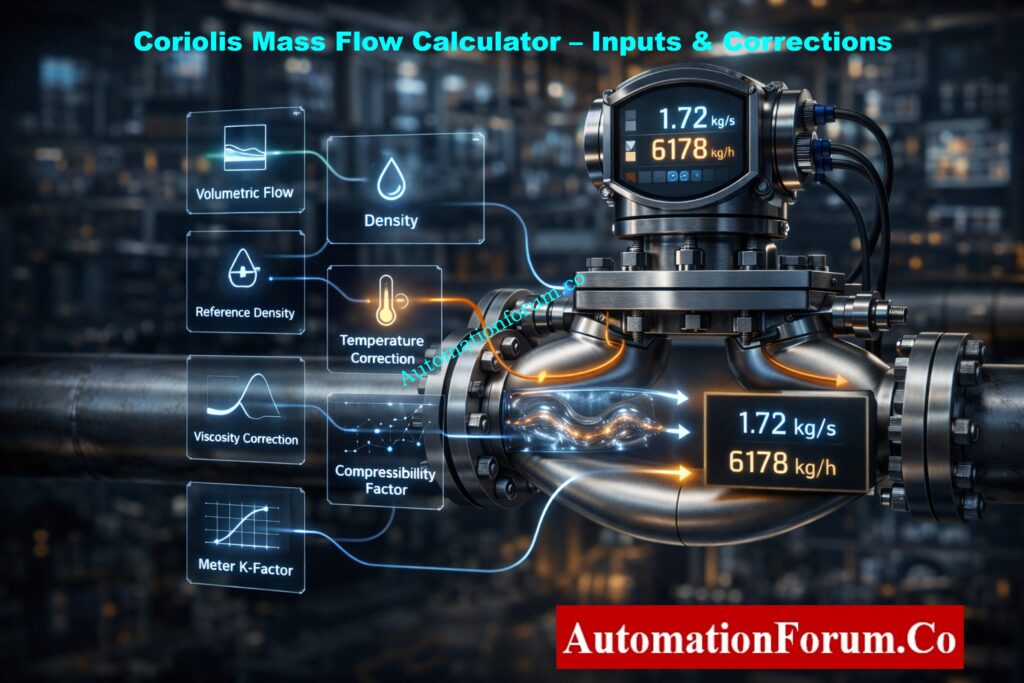
Step 1: Volumetric Flow Normalization
All volumetric flow inputs are changed to m³/s to keep the calculations consistent and eliminate errors caused by mismatched units.
Step 2: Raw Mass Flow Calculation
To find out how much raw mass flows, use this formula:
Mass Flow (kg/s) = Volumetric Flow (m³/s) × Operating Density (kg/m³)
This number shows the mass flow without any changes.
Step 3: Density Correction Factor
Because Coriolis meters are set up to work at a certain density, a correction is needed when the operating density is different:
Density Factor = Operating Density / Reference Density
This makes the conditions in the field match those in the lab.
Step 4: Apply Engineering Correction Factors
The calculator applies:
- Temperature correction
- Viscosity correction
- Phase correction
- Meter K-factor
- Compressibility factor (for gases)
All of these numbers are multiplied together to provide a Total Correction Factor, which shows what the real operating circumstances are like.
Step 5: Final Corrected Mass Flow
Corrected Mass Flow (kg/s) = Raw Mass Flow × Total Correction Factor
The value is also converted into kg/h for operational convenience.
Mass Flow Unit Converter – lb/h to kg/h Calculator: Mass Flow Unit Conversion: Pounds per Hour (lb/h) to Kilograms per Hour (kg/h)
Step-by-Step Guide to Using the Coriolis Mass Flow Calculator
- Type in the flow rate and choose a unit
- Put in the operating and reference density.
- Enter correction factors from datasheets or calibration certificates.
- Click on “calculate.”
- Look over the raw mass flow, the correction factors, and the final mass flow values.
- Use the results to compare, keep records, or fix problems.
Mass Flow Controller Calibration Procedure – Step-by-Step Guide: Mass Flow Controller Calibration Procedure
Practical Example of Coriolis Mass Flow Calculation
Given:
- Volumetric Flow: 0.1 m³/s
- Operating Density: 980 kg/m³
- Reference Density: 1000 kg/m³
- Temperature Correction: 0.99
- Viscosity Correction: 1.01
- Meter Factor: 1.02
Results:
- Raw Mass Flow = 98 kg/s
- Density Factor = 0.98
- Total Correction Factor ≈ 1.00
- Final Mass Flow ≈ 98 kg/s or 352,800 kg/h
This example shows how correction factors can cancel each other out, which shows how important it is to have accurate inputs.
Thermal Mass Flow Controller Troubleshooting – Complete Practical Guide: Mastering Thermal Mass Flow Controller Troubleshooting: A Comprehensive Guide
Best Practices for Accurate Mass Flow Calculation
- Always utilize the real density when working
- Keep reference density in line with calibration data and don’t assume correction factors.
- Write down all of your assumptions clearly.
- Check the calculated values against the output from the transmitter.
Thermal Mass Flow Controllers Explained – Precision Flow Control Science: Precision Control: The Science Behind Thermal Mass Flow Controllers
Limitations of the Coriolis Mass Flow Calculator
- It may not be possible to fully model extreme two-phase flow situations.
- The values for custody transfer must follow the rules set out in the contract.
The Coriolis Mass Flow Calculator is a helpful tool for engineers that connects theoretical concepts to real-world industrial situations. By putting volumetric flow, density, and correction factors into a clear computation, it helps people make good choices about design, commissioning, operation, and maintenance.
This calculator gives you clarity, accuracy, and consistency, which is exactly what modern process companies need. You can use it to fix a flow problem, check a meter, improve a process, or train future engineers.
What Is a Mass Flow Meter? Types, Working & Applications Explained: What is mass flow meter? What are the types of mass flow meter
Frequently Asked Questions on Coriolis Mass Flow Calculator
How does a Coriolis mass flowmeter work?
What is the range of a Coriolis mass flowmeter?
The size and design of a Coriolis mass flowmeter affect how far it can work. It can usually measure flow rates from extremely low (a few grams per hour) to very high (thousands of tons per hour). Most Coriolis meters can handle both low-flow and high-flow applications since they have a turndown ratio of 20:1 to 100:1.
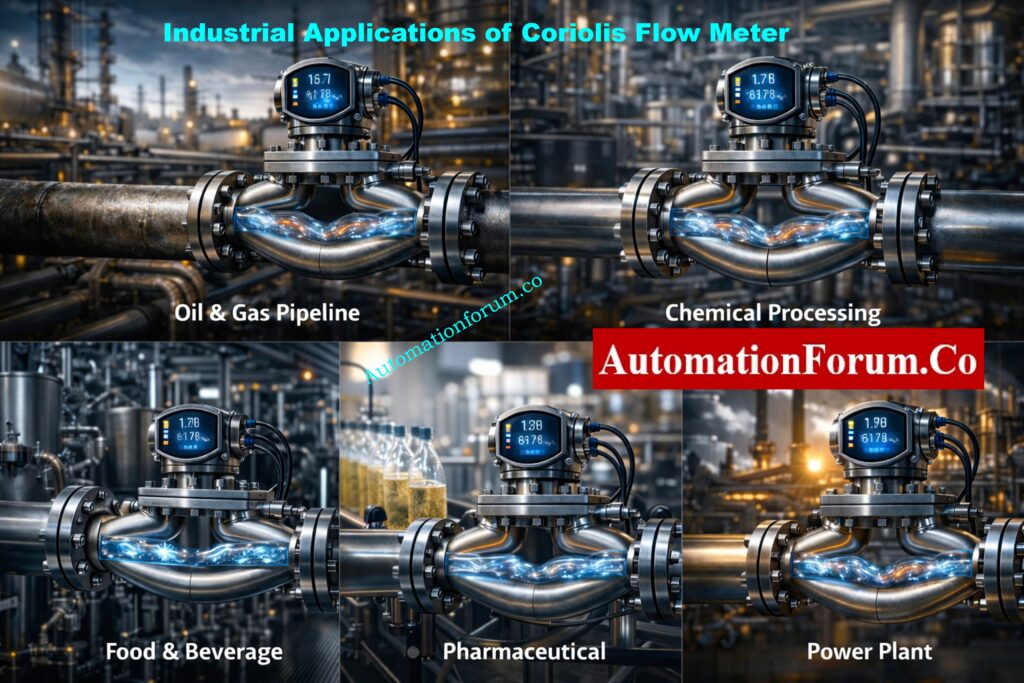
What are the applications of a Coriolis flow meter?
Coriolis flow meters are commonly utilized in situations necessitating high precision and direct mass measurement, including:
- Oil and gas custody transfer
- Chemical dosing and batching
- Food and beverage processing
- Pharmaceutical manufacturing
- Slurry and viscous fluid measurement
- Fuel, steam condensate, and gas flow measurement
What is the difference between a Coriolis flow meter and a mass flow meter?
A Coriolis flow meter is one kind of mass flow meter. Not all mass flow meters apply the Coriolis principle, but all Coriolis meters measure mass flow directly. Thermal mass flow meters and other mass flow technologies measure mass in a roundabout way. Most other mass flow meters can’t measure density, but Coriolis meters can.
When should you use a Coriolis flow meter?
A Coriolis flow meter should be used when:
- High accuracy is critical
- The control variable is mass flow.
- The density of a fluid changes with temperature or pressure.
- There is batching, blending, or custody transfer involved.
- There isn’t enough space, and there aren’t any straight pipe runs.
What is 10D and 5D in a flow meter?
10D and 5D are the suggested straight pipe lengths that need to be above and below specific flow meters. D is the diameter of the pipe. For instance, 10D denotes that the pipe is ten times wider upstream. Coriolis flow meters don’t usually need 10D or 5D straight runs, which makes them perfect for small spaces.
