
- Overview: Magnetic Flowmeter (Magmeter) & Turbine Flowmeter
- Magnetic Flowmeter vs Turbine Flowmeter – Comparison Table
- Working Principle Differences
- Conductivity & Fluid Compatibility
- Accuracy and Repeatability
- Pressure Drop by Flowmeter
- Installation Requirements
- Maintenance and Durability
- Advantages and Disadvantages of Magnetic Flowmeter
- Advantages and Disadvantages of Turbine Flowmeter
- When to Choose Magnetic Flowmeters
- When to Choose Turbine Flowmeters
- Cost and Lifecycle Considerations
- Common Mistakes in Flowmeter Selection
- Which is Better – Turbine Flow Meter or Electromagnetic Flow Meter?
- FAQs – Magnetic Flowmeter vs Turbine Flowmeter
- Test your knowledge on Electromagnetic Flowmeter
Magnetic flowmeters and turbine flowmeters are two of the most frequently used instruments for measuring flow in the water and wastewater, chemical, oil and gas, power generation, pharmaceuticals, and food and beverage industries. They both monitor flow rate, but their operating principles, how effectively they function for certain tasks, and how much they cost are all very different.
This guide gives you a full comparison, with more information, useful advice, and examples from the real world to help you choose the best solution for your procedure.
Overview: Magnetic Flowmeter (Magmeter) & Turbine Flowmeter
Faraday’s Law of Electromagnetic Induction is what magnetic flowmeters employ. An electric field is created when a conductive liquid flows through a magnetic field. Electrodes pick up this voltage and turn it into a flow rate.
- Ideal for: corrosive chemicals, conductive liquids, slurries, and wastewater.
- Limitations: Unable to monitor non-conductive substances such as gasses, fuels, oils, and hydrocarbons.
- Ideal for: Gases and liquids that are clean and have a low viscosity.
- Limitations: Unsuitable for slurries or unclean liquids; weakens easily in abrasive fluids..
Magnetic Flowmeter vs Turbine Flowmeter – Comparison Table
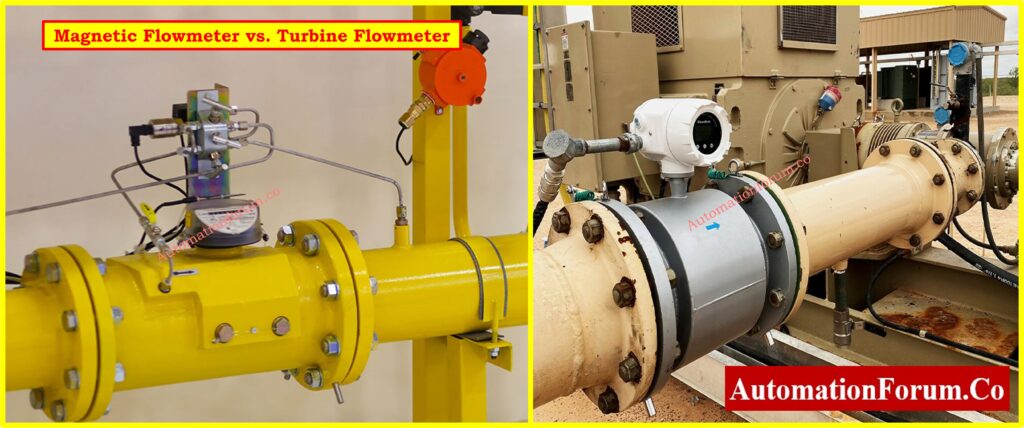
| S.No. | Feature | Magnetic Flowmeter | Turbine Flowmeter |
| 1 | Principle | Faraday’s Law; induced voltage proportional to flow velocity. | Mechanical; fluid rotates turbine blades, frequency measured. |
| 2 | Fluid Conductivity | Requires conductive liquids (>5 µS/cm). | No conductivity requirement; works with both conductive and non-conductive fluids. |
| 3 | Accuracy | ±0.2–0.5% of reading; stable over time. | ±0.5–1% of reading; affected by viscosity and wear. |
| 4 | Pressure Drop | Minimal due to no obstructions. | Moderate; turbine obstructs fluid path. |
| 5 | Flow Range (Turndown) | High turndown ratio; handles low and high flows accurately. | Limited turndown; poor at very low flow rates. |
| 6 | Maintenance | Low; occasional electrode cleaning. | High; rotor and bearings need replacement over time. |
| 7 | Installation Flexibility | Can be installed in any orientation; full pipe required. | Requires horizontal orientation with straight runs. |
| 8 | Suitable Fluids | Dirty, corrosive, abrasive fluids and slurries. | Clean, non-abrasive liquids or gases. |
| 9 | Energy Consumption | Requires electrical power for magnetic field generation. | Low energy; mainly mechanical. |
| 10 | Cost | Higher initial cost; low lifecycle cost. | Lower initial cost; maintenance adds to long-term cost. |
Working Principle Differences
Explore how it works: Electromagnetic Flowmeter Working Principle, Types Applications
Kinetic energy is used by turbine flowmeters. The rotor spins faster when the fluid flows faster, making a pulse frequency that is proportionate to the volumetric flow.
Explore how turbine meters work: Turbine Flow Meter Working Principle
Important point: Turbine meters can measure fluids that don’t conduct electricity, such oil, fuel, and cryogenic gasses. Magmeters can’t.
Conductivity & Fluid Compatibility
- Magmeters work well with fluids that conduct electricity, corrode, or are unclean, including slurries and wastewater.
- Turbine meters work best with clean, non-conductive, and low-viscosity fluids including hydrocarbons, light oils, LNG, and clean gases.
Accuracy and Repeatability
- Magmeters don’t need to be recalibrated because they don’t have any moving parts, which keeps their accuracy high.
- Turbine meters are precise at first, but wear and tear on the parts and variations in viscosity can make them less accurate. Calibration needs to be done on a regular basis.
Pressure Drop by Flowmeter
- Because they don’t get in the way, magmeters don’t lose much pressure.
- Turbine meters have a bigger drop in pressure since they have moving pieces inside.
Read about its components: Construction of Electromagnetic flowmeter
Installation Requirements
- Magmeters can be mounted in a variety of ways, including vertically or horizontally. For accurate measurements, the pipe must be totally full.
- To get reliable readings, turbine meters must be mounted horizontally with straight pipe lengths both upstream and downstream.
Refer the below link to learn step-by-step setup: Electromagnetic Flow Meter Installation – Step-by-Step Guide and Checklist for Accurate Measurements
Maintenance and Durability
- Magmeters don’t need a lot of care. Cleaning the electrodes only needs to be done every so often, especially when there are a lot of solids.
- Over time, turbine meters need new bearings and rotors, and they are more sensitive to dirt and other small things.
Learn how to calibrate now: Electromagnetic flowmeter Calibration procedure
Advantages and Disadvantages of Magnetic Flowmeter
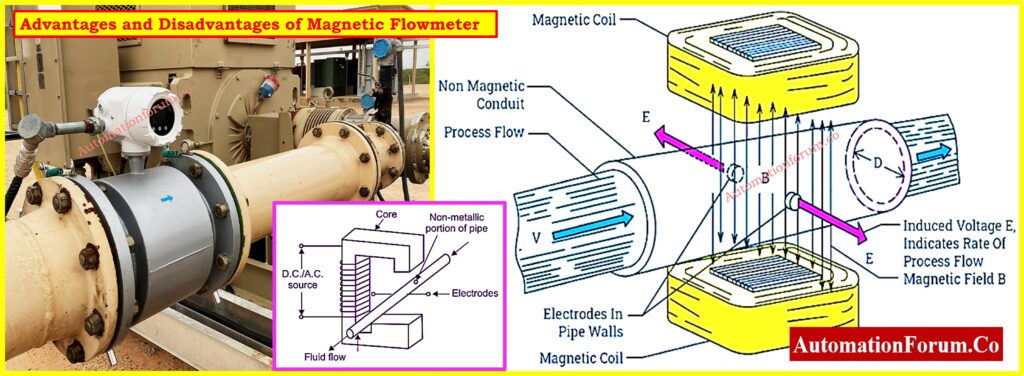
Pros:
Handles dirty, corrosive, and abrasive liquids
- No moving parts that touch the fluid make it good for slurries, wastewater, and chemicals.
- Liners made of PTFE, rubber, and other materials protect against wear and tear and rust.
Minimal pressure loss
- Straight, clear flow channel – very little drop in pressure
- Helps keep the system’s pressure stable and lowers the energy needed to pump.
Long-term accuracy without recalibration
- No wear on the parts means steady calibration for years.
- Not influenced by changes in temperature, pressure, density, or viscosity
High turndown ratio
- Accurately measures a wide variety of flow rates
- No need for more than one flowmeter in different flow conditions
Cons:
Cannot measure non-conductive fluids
- Needs a minimum conductivity of about 5 µS/cm, therefore it can’t be used with hydrocarbons, oils, gasses, or deionized water.
Higher initial cost
- They cost more than mechanical meters, but they last longer and need less maintenance.
Needs power supply
- Needs a steady supply of electricity to create magnetic fields and process signals
- Could be a problem for applications that are far away or run on batteries.
Refer the below link to learn minimum length rules: Electro Magnetic Flow Meter Installation Calculator: Minimum Length for Reducing Joint
Advantages and Disadvantages of Turbine Flowmeter
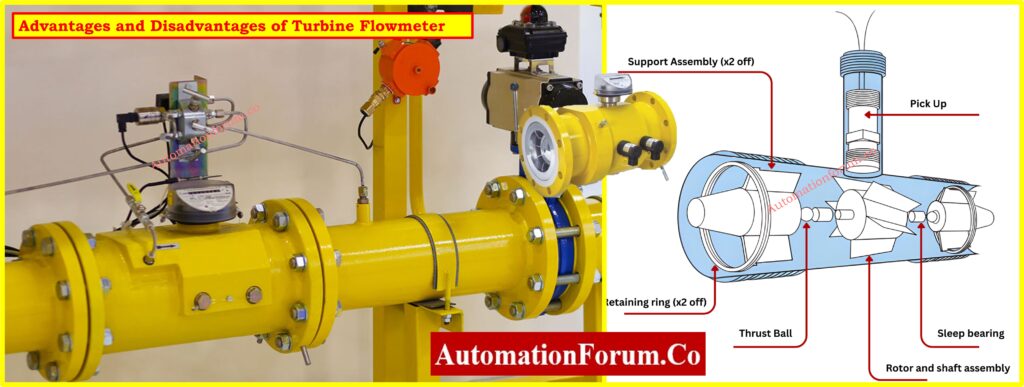
Pros:
Works with both conductive and non-conductive fluids
- Works well with hydrocarbons, oils, fuels, cryogenic liquids, and clean gasses
- Because it doesn’t require conductivity, it can be used in a variety of settings.
Lower initial cost
- Not as expensive to buy as magnetic and Coriolis flowmeters
- A good choice for projects with limited funds
Compact and lightweight
- Small installation footprint makes it perfect for systems with limited space.
- Easy to move, set up, and add to skid-mounted equipment.
Cons:
Sensitive to dirt, particles, and fluid viscosity
- Needs fluids that are clean and have a low viscosity to work well
- Debris or solids can hurt turbine blades and make them less accurate.
Requires straight runs and frequent calibration
- Needs enough straight pipe lengths both upstream and downstream to get accurate readings
- Calibration may shift because of mechanical wear, so it needs to be done again and again.
Moving parts can fail in harsh service
- Moving parts can break down in tough conditions.
- Bearings and rotors can wear out quickly, especially when they are used in rough or corrosive conditions.
When to Choose Magnetic Flowmeters
Measuring wastewater, slurries, and corrosive chemicals
- Magmeters work quite well in tough fluid conditions and can easily handle suspended solids, abrasive particles, and corrosive chemicals without any problems.
Applications requiring low maintenance and high turndown ratio
- Magmeters are reliable over time because they don’t have any moving parts. They can also measure a wide variety of flow rates in different process settings.
Fluids containing solids or impurities
- They don’t get harmed by buildup, filth, or scaling, therefore they are great for unclean liquid and wastewater applications.
Processes where pressure drop must be avoided
- Their obstruction-free design eliminates excessive pressure loss, lowering energy usage and safeguarding upstream equipment.
Refer the below link and Read how to determine scaling: Turbine Flow Meter Coefficient and Scaling Factor Calculator
When to Choose Turbine Flowmeters
Clean, non-abrasive liquids and gases
- To keep turbine meters accurate over time and protect the rotors, they need clean servicing fluids.
Custody transfer applications (fuel, LNG, petroleum products)
- Known for excellent precision, turbine meters are generally trusted for legal metrology and billing applications.
Cryogenic liquids
- They are strong and flexible, which makes them good for very cold fluids like LNG and liquid nitrogen.
Lower initial cost is a priority
- Turbine flowmeters are usually cheaper at first, which makes them great for projects with limited funds.
Learn installation procedures: Turbine flow meter installation guidelines
Cost and Lifecycle Considerations
Magnetic flowmeters:
- These cost more up front since they feature more advanced circuitry and are made of stronger materials.
- But they are cost-effective during their lifetime because they don’t need much maintenance and can handle fluids that are abrasive or corrosive.
- Great for businesses where downtime costs a lot of money because they are very reliable and don’t need to be recalibrated very often.
Turbine flowmeters:
- Turbine meters usually cost less up front, but they cost more to keep running over time.
- Frequent recalibration, replacing bearings, and wear on moving parts can add a lot to the entire lifespan cost, especially in tough situations.
Tip: Instead of only looking at the purchase price, always figure out the Total Cost of Ownership (TCO). Over a ten-year period, a magmeter that costs a little more can often save money compared to a turbine meter that costs less.
Common Mistakes in Flowmeter Selection
Ignoring fluid conductivity:
- If you choose a magnetic flowmeter for oils, hydrocarbons, or other fluids that don’t conduct electricity, it will give you zero readings and cause your process to fail.
Poor installation practices:
- For accurate readings, turbine flowmeters need straight pipe runs both upstream and downstream. Incorrect installation causes flow problems and makes things less accurate.
Overlooking maintenance:
- Turbine meters need to be checked and calibrated on a regular basis. If you don’t do these things, your measurements could drift and you could make expensive mistakes in billing or process control.
Undervaluing lifecycle cost:
- If you factor in the costs of maintenance, recalibration, and downtime, a low-cost turbine meter may end up costing more in the long run.
Explore the selection guide: Streamlining Your Flowmeter Selection Process: Tips and Insights
Which is Better – Turbine Flow Meter or Electromagnetic Flow Meter?
The answer depends on the application, the type of fluid, and the conditions under which it will be used, since each have their own strengths:
Electromagnetic (Magnetic) Flow Meters:
- These meters work well with dirty liquids, slurries, and corrosive fluids since they don’t need the fluid to be very clean.
- Changes in the viscosity, density, or temperature of the fluid have less of an effect on them, therefore they stay accurate even when the process conditions vary.
- Their design doesn’t block anything, which means they lose very little pressure and don’t need any maintenance. This makes them good for settings that are abrasive or corrosive.
Turbine Flow Meters:
- Turbine meters are particularly sensitive to how clean the fluid is. Any debris or particles might hurt the rotor or bearings, which can cause readings to be wrong.
- Fluid viscosity has a bigger effect on them because thicker or variable-viscosity fluids can slow down the rotor, which makes measurements less accurate.
- Turbine meters work best with fuels, oils, and cryogenic liquids that are clean and have a low viscosity.
Which is better?
- Electromagnetic flow meters are preferable for unclean, rough, or corrosive liquids and when minimum maintenance is important.
- Turbine flow meters might be an excellent choice for clean, stable fluids, custody transfer or situations where the initial cost is important.
Learn about turndown ratio: Why Turndown Ratio is Important when Selecting a Flow Meter ?
Magnetic flowmeters and turbine flowmeters are both tried-and-true ways to monitor flow in industry. There isn’t one “best” solution; the choice depends on the type of fluid, the conditions of the process, the level of accuracy needed, and the ability of maintaining it up.
- Magnetic flowmeters are the best choice if you need to measure filthy fluids, keep pressure low, and be accurate over time.
- If you wish to measure clean, non-conductive fluids or gases accurately and at a reasonable cost, choose turbine flowmeters.
- What kind of fluid it is decides: Magnetic flowmeter for unclean liquids that conduct electricity; turbine flowmeter for clean liquids and gasses that don’t conduct electricity.
- Magmeters don’t need any maintenance and work well with wastewater, slurries, and chemicals.
- Turbine meters are small and cheap, making them great for moving fuel, cryogenic liquids, and clean service.
- Before making a choice, think about the cost of installation, the turndown ratio, and the overall cost of ownership.
Choosing the proper option makes the process more efficient, the product better, and the plant more reliable as a whole.
FAQs – Magnetic Flowmeter vs Turbine Flowmeter
Which is more durable in harsh environments?
Magnetic flowmeters are generally more durable because they have no moving parts. This design makes them resistant to abrasive wear, corrosion, and solid particles in the fluid, ensuring a longer service life in harsh operating conditions.
Can turbine flowmeters handle dirty liquids?
Not recommended. Turbine rotors and bearings can clog, wear out, or be damaged quickly when exposed to fluids with dirt, scale, or solids. They are best suited for clean, non-abrasive liquids and gases.
Which has a higher turndown ratio?
Magnetic flowmeters offer a wider flow range (turndown ratio up to 100:1), making them suitable for applications with varying flow rates. Turbine meters have a more limited turndown ratio and can struggle at extremely low flow rates.
Can magmeters measure gases?
No. Magmeters can only measure conductive liquids. They cannot measure non-conductive fluids, oils, hydrocarbons, or gases because these do not generate the necessary induced voltage.
Which option has a lower lifecycle cost?
While magmeters cost more upfront, they generally offer lower total ownership cost in abrasive, corrosive, or dirty fluid conditions due to minimal maintenance and longer service life.
Test your knowledge on Electromagnetic Flowmeter
Refer the below link expertise your knowledge on Electromagnetic Flowmeter
