
- Instrument Index Generator for Efficient Instrumentation Documentation Management
- What is an Instrument Index Generator
- What Is an Instrument Index in Instrumentation Engineering?
- Why Is an Instrument Index Important in EPC Projects?
- Core Features of the Instrument Index Generator
- How Instrument Index Generator Supports EPC Documentation
- Real World Use Cases in EPC and Instrumentation Projects
- Benefits of Using an Instrument Index Generator
- Best Practices for Maintaining an Accurate Instrument Index
- Common Mistakes to Avoid in Instrument Index Management
- FAQ About Instrument Index
- What is an instrument index?
- Why is an instrument index important?
- What information is included in an instrument index?
- Who uses an instrument index?
- How does an instrument index support engineering design?
- How does an instrument index help during procurement?
- How is an instrument index used during construction?
- How does an instrument index help commissioning teams?
- Why should instrument tags be unique in an instrument index?
- What is the relationship between an instrument index and a P and ID?
- How often should an instrument index be updated?
- How does an instrument index support maintenance activities?
- What problems can occur without an accurate instrument index?
- Is an instrument index required for EPC projects?
- What is the difference between an instrument index and a loop diagram?
- Conclusion: Streamline EPC Documentation with a Reliable Instrument Index Generator
Instrument Index Generator
Powered by AutomationForum.co
0
Total Instruments0
Analog Inputs0
Analog Outputs0
Digital Inputs0
Digital OutputsAdd Instrument
| S.No | Tag | Description | Type | Service | Loop | PID | Location | Signal | IO | Control System | Action |
|---|
ISA Reference
PT, TT, FT, LT, PDT, CV, LIC, TIC, FICEngineering Notes
Maintain unique tags and verified IO assignments.Instrument Index Generator for Efficient Instrumentation Documentation Management
An instrument index generator is one of the most useful practical tools in EPC instrumentation engineering because it turns scattered tag details into a structured project database. In real projects, instrumentation teams must manage tag numbers, descriptions, types, services, loop numbers, PID references, locations, signal types, IO types, and control system allocation with accuracy. A small error in any one of these fields can affect design, procurement, wiring, FAT, SAT, pre commissioning, and final handover. The uploaded tool supports exactly these project needs with searchable instrument records, delete row control, clear all control, CSV export, local storage, and built in statistics for instrument counts and IO distribution. It also supports ISA style tag conventions and basic engineering discipline for unique tag management and verified IO assignment.
Avoid Costly PLC Integration Errors With This Guide: I/O List Preparation Guide for PLC, DCS and SIS Projects
What is an Instrument Index Generator
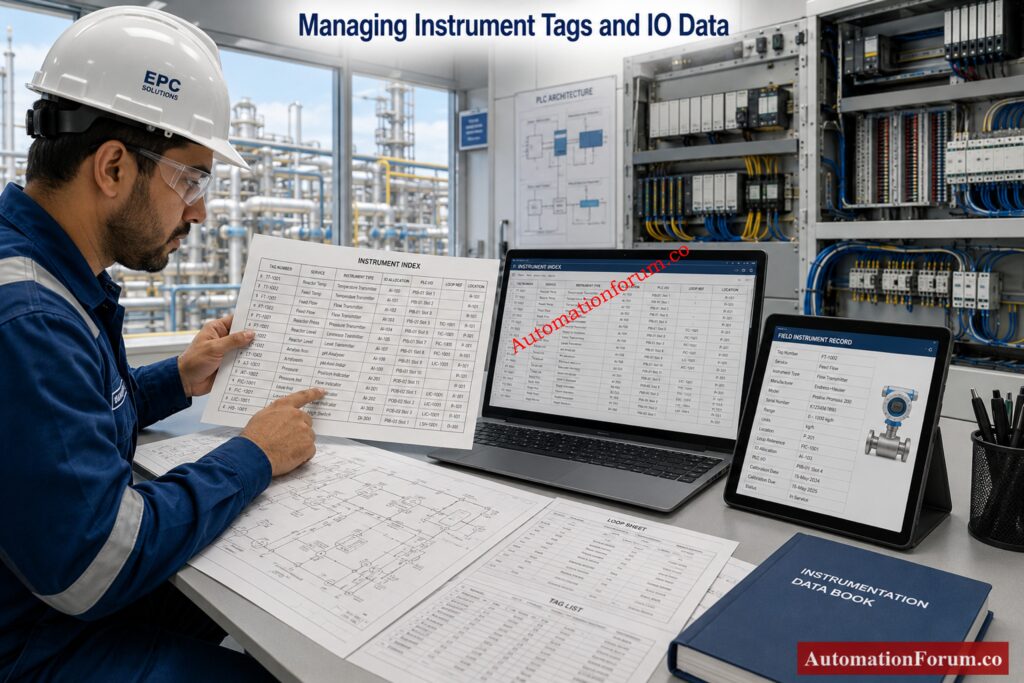
Instrument Index as a Digital Master Register
An instrument index generator is an EPC instrumentation tool used to create, maintain, and review the complete list of instruments in a project. It works as a digital instrument index template and also functions as an instrument index spreadsheet replacement for smaller teams that need a faster and more reliable way to manage data.
How an Instrument Index Generator Works
For instrumentation engineers, this is more than documentation. It is a daily working register for design integrity and field execution.
The Cable Schedule Method That Prevents Rework Fast: Instrument Cable Schedule Explained with Practical Examples
What Is an Instrument Index in Instrumentation Engineering?
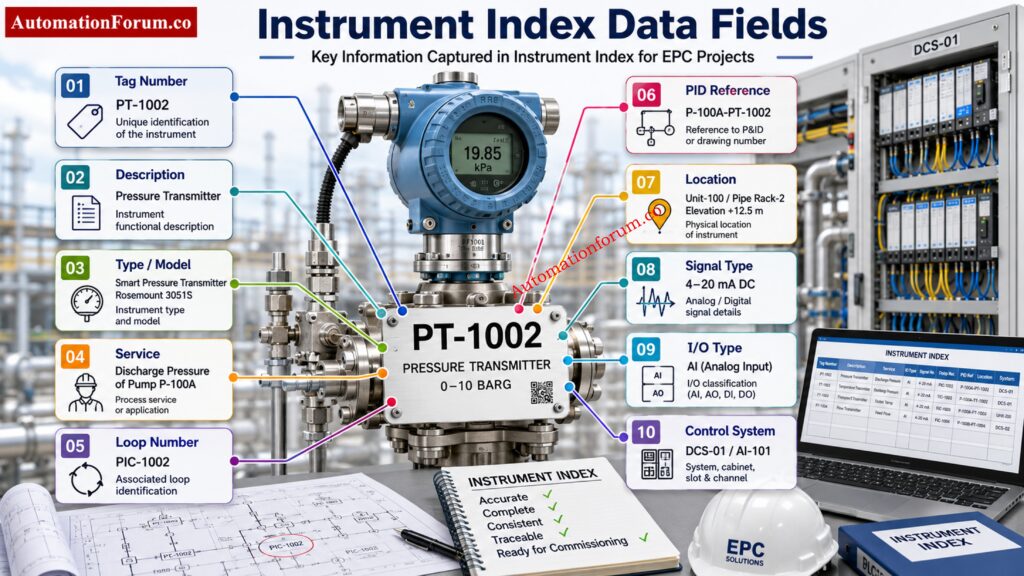
Instrument Index Definition
Instrument Index is a master document of instrumentation and control engineering to keep a complete record of all the instruments in a plant or project. It is a central repository of key data such as instrument tag numbers, description, instrument type, services, loop numbers, P and ID references, locations, signal types, IO classifications and control system assignments.
Role of the Instrument Index in EPC Projects
The instrument index is the basis for many of the technical deliverables including instrument datasheets, IO lists, loop diagrams, cable schedules, hook up drawings and control system database in EPC projects. It’s also useful in ensuring that all instruments are uniquely recognized and tracked appropriately throughout the project lifecycle.
The instrument index helps Instrumentation Engineers to cross check the tag details, to ensure uniformity of documentation and co-ordinate with Process, Electrical, Automation & commissioning teams. The main uses for control system engineers are IO allocation and system integration, and the main uses for commissioning teams are loop verification, calibration and startup activities.
A correctly kept instrument index increases accuracy of the project, avoids documentation errors, prevents duplicate tag assignments, and provides complete traceability from design through operation. It is one of the most important texts in EPC instrumentation engineering because of its importance.
The instrument index is the backbone of the instrumentation documentation in simple words. It helps the engineers in managing, tracking and controlling all the instruments of the plant efficiently throughout the project life cycle.
Critical Engineering Documents Every Instrument Engineer Needs: 82 Essential Drawings and Documents for Instrumentation and Control Engineers
Why Is an Instrument Index Important in EPC Projects?
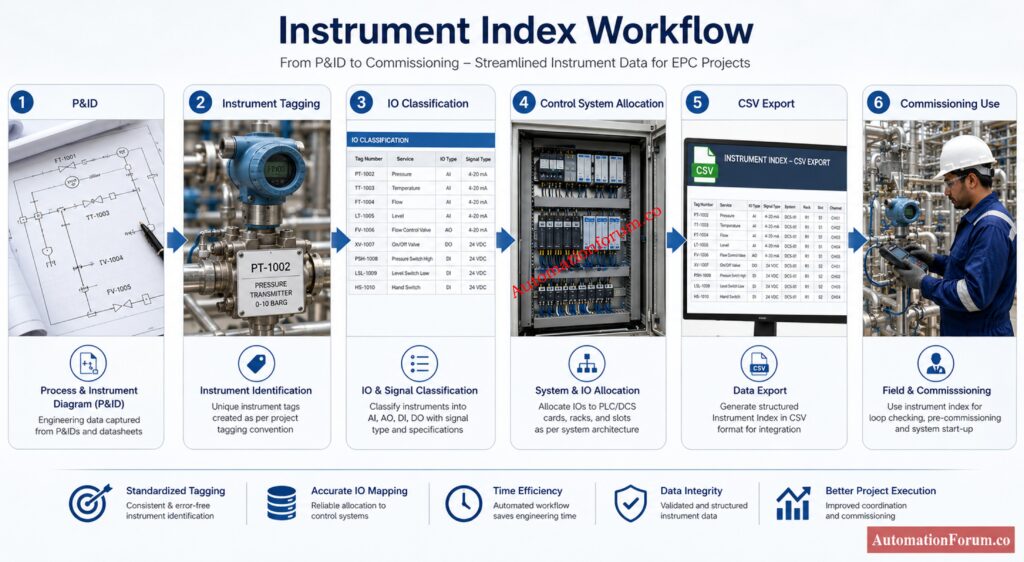
Design Phase Benefits
Procurement Phase Benefits
Instrument Index: Contains material requisitions, vendor coordination, purchase orders and instrument tracking to ensure the proper instruments are obtained for the project.
Construction Phase Benefits
During site execution, construction teams use the instrument index to validate tag numbers, installation positions, cable routing information and field instrument details.
Commissioning Phase Benefits
The instrument index is used during pre commissioning and commissioning for loop checking, calibration verification, IO validation, functional testing and starting readiness checks.
Maintenance Phase Benefits
After the project is complete, the maintenance team uses the instrument index to troubleshoot, plan calibrations, equipment replacement, asset management and future plant improvements.
An accurate instrument index improves project coordination, reduces engineering errors, and provides complete instrument traceability from initial design to long term plant operation.
Refer the below link for the Types of Engineering Drawings and Documents Used in Instrumentation
Core Features of the Instrument Index Generator
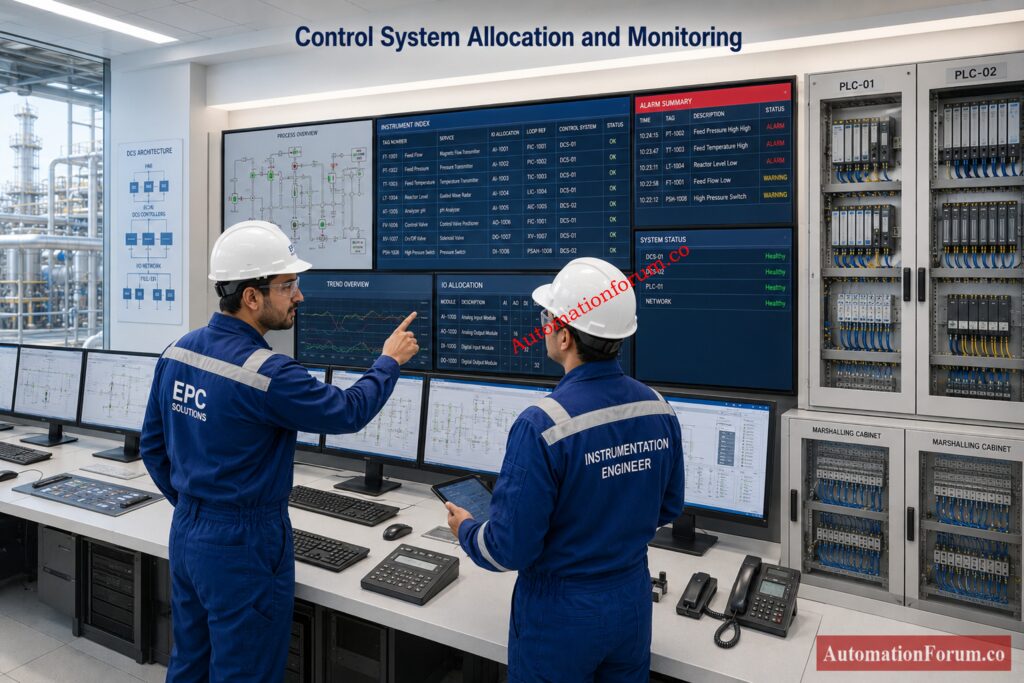
Add Instrument Data
The tool allows engineers to add instrument records directly into the index. This is useful when the project team is building the list from datasheets, P and IDs, hook up drawings, cause and effect documents, and IO schedules.
Each record can include the main fields required for practical EPC documentation, making the tool suitable for both design phase and site execution phase work.
Tag Number and ISA Style Tagging
This is important because tag consistency helps engineers quickly identify the function of the instrument. For example, PT indicates a pressure transmitter, TT indicates a temperature transmitter, FT indicates a flow transmitter, and LIC indicates a level indicating controller.
Using standard tag structures also reduces confusion during interdisciplinary review meetings and site walkdowns.
Description, Type, Service, Loop Number, PID Number and Location
These fields make the tool practical for real EPC use.
Description explains what the instrument does.
Type defines the instrument classification.
Service identifies the process duty.
Loop number connects the tag to its loop folder and loop drawing.
PID number links the instrument to the process diagram.
Location helps field teams understand where the instrument is installed.
Together these fields create a clear engineering reference that can be used by design, construction, and commissioning teams.
Signal Type and IO Type
The tool supports key signal types used in process industries, including 4 to 20 mA, HART, Foundation Fieldbus, Profibus PA, Modbus, and Digital.
It also supports IO type classification such as Analog Input, Analog Output, Digital Input, and Digital Output.
This is especially valuable for IO list development and for mapping field instruments to marshaling, remote IO, PLC cards, DCS channels, and SIS points. A clean control system IO list depends on this type of classification, and the tool supports that discipline in a simple and direct way.
Control System Field
The control system field allows the user to classify each instrument under DCS, PLC, or SIS.
That may sound simple, but it is very important in project documentation. A transmitter tied to a DCS loop is not handled the same way as a switch tied to a SIS shutdown function. Clear system allocation helps avoid late stage confusion during control philosophy review, cause and effect verification, and loop checking.
Search Function
The search function allows users to quickly find a tag, service, loop, or description without scanning a long spreadsheet manually.
Delete Row Function
The delete row function makes correction work practical. During EPC execution, wrong entries can happen because of revised datasheets, tag renaming, or vendor changes.
Instead of leaving outdated data inside the index, the engineer can remove the incorrect row and maintain a cleaner master list.
Clear All Function
The clear all function is useful when a team wants to reset the index and restart with a fresh project dataset.
This can be helpful in training, sample preparation, or when a team wants to rebuild the instrument list after a major scope revision.
Download CSV Function
A CSV instrument list tool is highly useful for project handover, review meetings, procurement coordination, and document control updates. It gives the team a portable output that can be filtered, audited, and distributed quickly.
Local Storage Support
Local storage support means the data remains available in the browser even after the page is closed and reopened.
For day to day engineering use, this is valuable because the team does not need to rebuild the instrument list every time. It behaves like a lightweight instrument index spreadsheet with persistence, which makes it more practical for repeated use during project execution.
Read Loop Diagrams Like a Senior Instrument Engineer: How to Read and Understand Instrument Loop Diagrams
Built In Stats
The built in stats section gives the user a fast overview of total instruments, analog inputs, analog outputs, digital inputs, and digital outputs.
This is extremely useful for engineering review because the team can instantly see whether the IO distribution looks balanced and whether the index aligns with the expected control system scope.
For example, if the project suddenly shows a much higher number of digital inputs than expected, it may indicate missing signal classification, unreviewed cause and effect items, or duplicated device entries.
Master Instrument Index Secrets Every EPC Engineer Must Know: Instrument Index: Definition, Example, Template, Columns and Preparation Guide
How Instrument Index Generator Supports EPC Documentation
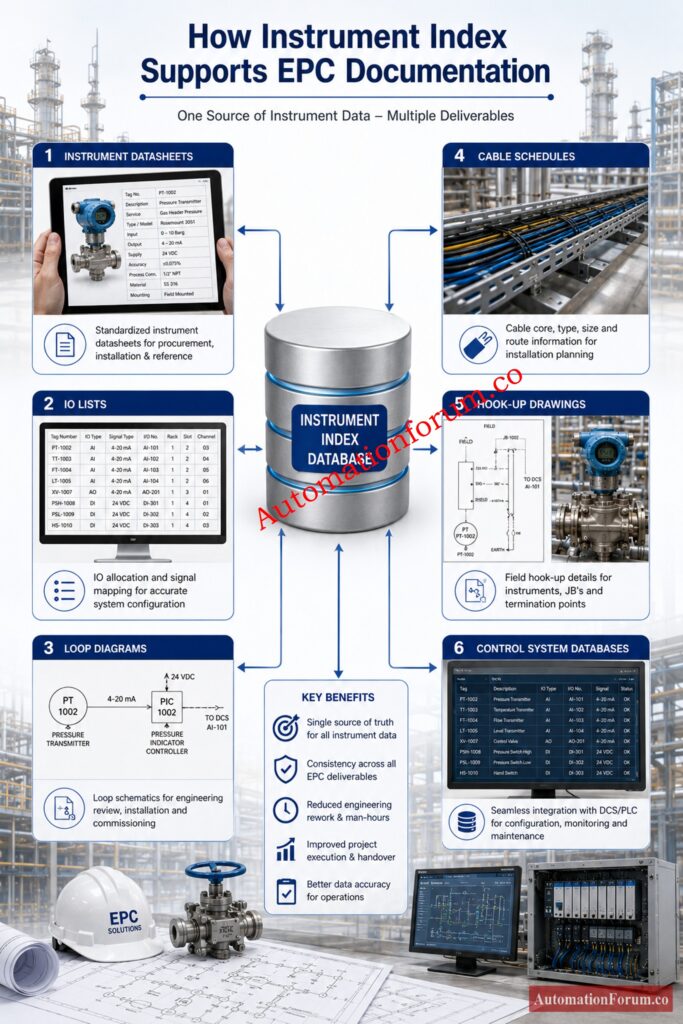
The Instrument Index Generator plays an important role in EPC projects by acting as a central source of instrument information. Instead of shuffling data around in a variety of spreadsheets and papers, engineers may use a single, organized database that can handle a wide variety of technical deliverables throughout the project lifecycle.
Instrument Datasheets
IO Lists
Signal kinds and IO classifications are part of the instrument index and can be a useful reference when building IO lists. This is to assist system engineers in accurately assigning Analog Inputs, Analog Outputs, Digital Inputs and Digital Outputs in PLC, DCS and SIS systems.
Loop Diagrams
Loop diagrams require proper tag numbers, loop numbers and signal information. The index of instruments is a great resource for engineers in designing and checking loop drawings, and for ensuring uniformity among project documentation.
Cable Schedules
The instrument index provides information to identify and locate instruments for the purpose of preparing cable schedules. This ensures that the wires are accurately assigned and linked to the respective field devices during installation.
Build Reliable PLC And DCS I/O Lists Faster: PLC and DCS I/O List Development Best Practices
Hook-Up Drawings
Accurate instrument information is required for hook-up drawings to establish installation needs. The instrument index also assists engineers in checking instrument services, locations and tag details and enhances the efficiency of field installation activities.
Control System Databases
Instrument data is used to configure and integrate control system databases. Instrument index information assists automation engineers to create dependable PLC, DCS and SIS databases and support testing, commissioning and startup.
The Instrument Index Generator supports these critical engineering documents to increase documentation consistency, decrease manual errors and assist project teams better control instrumentation data from design to commissioning.
Stop Misreading P&IDs With These Proven Techniques: Step-by-Step Guide: Reading and Interpreting Piping and Instrumentation Diagrams (P&ID)
Real World Use Cases in EPC and Instrumentation Projects
EPC Design Phase
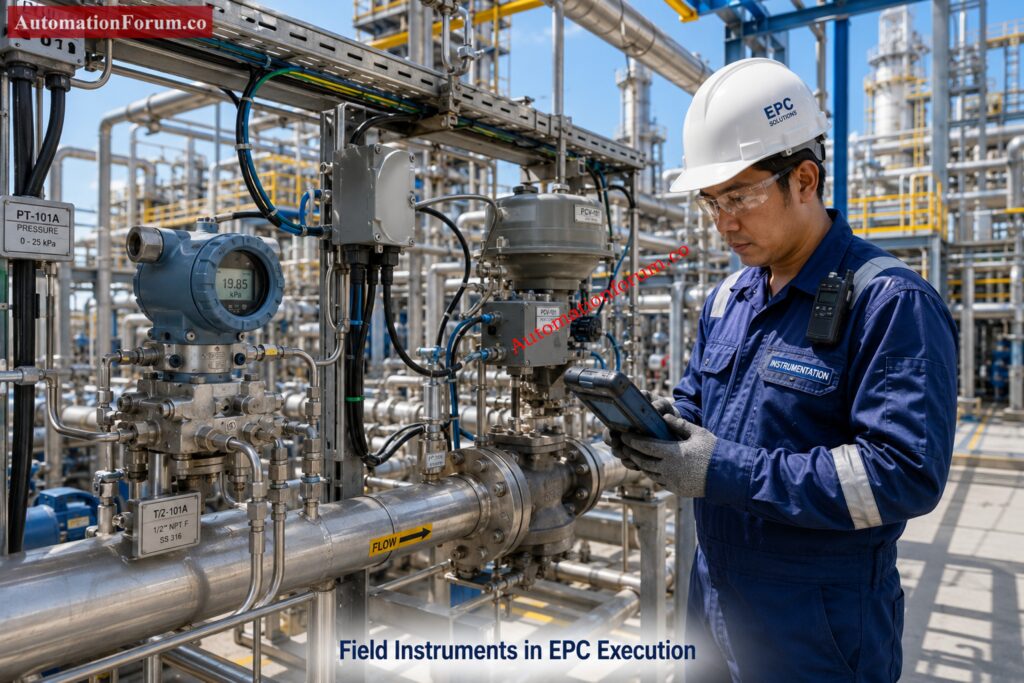
The instrument index generator is a key reference during design for producing the control system IO list, preparing instrument datasheets, and aligning field device data with the P&ID.
Shutdown and Turnaround Jobs
Pre Commissioning
During pre commissioning, the instrument index helps verify that all devices are installed, tagged, and mapped to the correct loop and IO channel.
Commissioning and Loop Checking
Commissioning teams can use the index to check signal type, IO type, and control system assignment before starting loop checks, simulation tests, and cause and effect validation.
Refer the below link for the Cold and Hot Loop Checking in Automation: Key Differences and Step-by-Step Procedures
Documentation Control
Document controllers and lead engineers can use the CSV output as a controlled working file for review cycles, revision tracking, and final handover packages.
Why Accurate Hook-Up Drawings Save Project Costs: Instrument Hook-Up Drawings: Purpose and Applications
Benefits of Using an Instrument Index Generator
- For instrumentation engineers, the tool eliminates manual work and maintains tag discipline.
- It gives the lead engineers a better view of project status and IO allocation.
- For EPC teams, it reinforces the coordination between process, instrumentation, electrical, automation and commissioning activities.
- It makes record keeping easier for documentation specialists and offers revision control.
- It reduces mistakes in loop identification and field verification by the commissioning teams.
- Consistency is the main value. A uniform index of instruments makes the overall project easier to handle.
The Datasheet Mistakes That Trigger Major Project Delays: Instrument Datasheet Preparation and Interpretation Guide
Best Practices for Maintaining an Accurate Instrument Index
- Use a unique tag for each instrument and eliminate duplicate entries.
- Compare the tag against the P and ID before finishing the record.
- Keep the loop number and the PID number the same as the latest revision of the project.
- Check the signal type for the real device and communication protocol.
- Check IO type and direction of signal flow versus control method.
- Update index when datasheet, loop drawing or cause and effect document is changed.
- Export the CSV as a review copy, but preserve a restricted master record for project approval.
Master Cause And Effect Logic For Safer Operations: Cause and Effect Diagram in Instrumentation and Control Systems
Common Mistakes to Avoid in Instrument Index Management
- Another error is mixing up signal type with IO type.
- Sometimes teams also mis-assign a transmitter to the wrong control system, especially in cases when DCS, PLC and SIS scopes overlap.
- Another common problem is missing loop numbers which causes confusion at commissioning.
- Poor description quality is also a problem because vague names make the index harder to use in the field.
- The best instrument index is not the longest one. It is the most accurate one.
Improve Junction Box Design Using Proven Grouping Methods: Junction Box Grouping in Industrial Instrumentation Projects
FAQ About Instrument Index
What is an instrument index?
An instrument index is a master document which provides details of all instruments utilized in a plant of project. It is the primary reference for instrumentation engineering work.
Why is an instrument index important?
What information is included in an instrument index?
A typical instrument index includes tag number, description, services, location, loop number, and P and ID references. Other information can include signal types and control system assignments.
Who uses an instrument index?
Instrumentation Engineers, Control Engineers, Project Managers, Commissioning teams and maintenance staff use the instrument index. It is the common reference point throughout the project lifecycle.
How does an instrument index support engineering design?
It helps engineers arrange instrument data and maintain consistency across drawings, datasheets and requirements. This leads to a better design and enhanced project collaboration.
Loop Check Steps Every Commissioning Engineer Should Follow: Instrument Loop Check Procedure for Commissioning Engineers
How does an instrument index help during procurement?
It offers instrument details for material requisitions and purchase orders. This helps make sure the right instruments are bought and tracked..
How is an instrument index used during construction?
Construction teams utilize to verify instrument identifiers, placement and installation requirements. It is also useful for field inspections and progress tracking.
How does an instrument index help commissioning teams?
It is helpful to check instrument identification, loop numbers and field device information prior to testing. This reduces the overhead of loop checking and start-up.
Why should instrument tags be unique in an instrument index?
What is the relationship between an instrument index and a P and ID?
The instrument index references instruments shown on P and IDs. Together they provide complete information about process measurement and control devices.
How often should an instrument index be updated?
It should be updated whenever instruments are added, modified, removed, or reassigned. Regular revisions ensure that the project documentation is valid and reliable.
Marshalling Cabinet Functions Every Control Engineer Should Understand: Marshalling Cabinet in Instrumentation and Control Systems
How does an instrument index support maintenance activities?
Provides easy access to instrument data for troubleshooting and calibration. It also facilitates asset management and future plant changes.
What problems can occur without an accurate instrument index?
Projects can be double tagged, have paperwork discrepancies and commissioning delays. Such difficulties might cause re-work, additional expenditures and operational risk.
Is an instrument index required for EPC projects?
Yes, it is one of the most critical documents in EPC projects from instrumentation point of view. It supports activities of engineering, procurement, construction, commissioning and maintenance.
Pre-Commissioning Essentials That Prevent Startup Failures: Instrumentation Pre-Commissioning Checklist and Guidelines
What is the difference between an instrument index and a loop diagram?
Instrument index Summary information about all instruments in a project. A loop diagram shows precise wiring and signal information for a given control loop.
Conclusion: Streamline EPC Documentation with a Reliable Instrument Index Generator
A practical instrument index generator is not just a convenience tool. In EPC instrumentation engineering, it supports tag discipline, IO control, loop tracking, and project documentation quality from design through commissioning. The uploaded tool brings together the core functions that engineers actually need, including data entry, search, deletion, clear all, CSV export, local storage, and built in statistics. It is especially useful when the project team needs a reliable instrument tag generator, an instrumentation project tool, or a simple CSV instrument list tool for day to day use. For better project control, every instrument index should be accurate, unique, verified, and aligned with the latest control system scope.
Refer the below link for the Instrument Calibration Procedure and Best Practices
