
- Introduction to Turndown Ratio in Process Industries
- What is Turndown Ratio?
- Why Turndown Ratio is Important in Process Industries
- How the Turndown Ratio Calculator Works
- Turndown Ratio Calculation Formula
- Example Calculation Using the Turndown Ratio Calculator
- Typical Turndown Ratios of Different Instruments
- Orifice Plate Turndown Ratio
- Venturi Meter Turndown Ratio
- Vortex Meter Turndown Ratio
- Turbine Meter Turndown Ratio
- Magnetic Flowmeter Turndown Ratio
- Coriolis Flowmeter Turndown Ratio
- Ultrasonic Flowmeter Turndown Ratio
- Rotameter Turndown Ratio
- Pressure Transmitter Turndown Ratio
- Control Valve Turndown Considerations
- Turndown Ratio vs Rangeability
- Common Mistakes in Instrument Turndown Selection
- Best Practices for Instrument Selection
- Applications of Turndown Ratio in Process Industries
- Advantages of Using a Turndown Ratio Calculator
- Frequently Asked Questions About Turndown Ratio
- What is a good turndown ratio for a flow meter?
- What is the difference between rangeability and turndown ratio?
- Why is turndown ratio important?
- Which flow meter has the highest turndown ratio?
- How does turndown ratio affect accuracy?
- What is the turndown ratio of a Coriolis flow meter?
- How do you calculate instrument rangeability?
- What happens if turndown ratio is too low?
- What is the best flow meter for low flow applications?
- Why do orifice plates have lower turndown ratio?
- Key engineering takeaways: Why the calculator is useful for process engineers
⚙️ Turndown Ratio Calculator
Calculate turndown ratio, operating utilization, minimum measurable value, and instrument suitability for your process
📝 Input Parameters
Introduction to Turndown Ratio in Process Industries
What Turndown Ratio Means In Instrumentation
Turndown ratio is one of those engineering terms that looks simple on paper but becomes very important once a plant starts operating in the real world. In process industries, every instrument is expected to perform across a range of operating conditions, not just at one ideal point. That is where turndown ratio matters. It tells you how much you can move an instrument away from its maximum measurement limit, and still get reliable readings at the low end.
Why Turndown Ratio Matters For Flow Measurement Accuracy
For instrumentation engineers, control engineers, design engineers and maintenance teams, turndown ratio is more than just a spec. It affects flow measurement accuracy, process stability, control loop behavior, and even safety performance. In oil and gas, refinery, chemical, power generation, water treatment, and pharmaceutical plants, a wrong selection can create poor Why Engineers Use A Turndown Ratio Calculator accuracy, false readings, unstable control, and wasted energy. A meter or transmitter that looks acceptable at maximum flow may perform badly at low flow, where many processes actually spend much of their time.
Why Engineers Use A Turndown Ratio Calculator
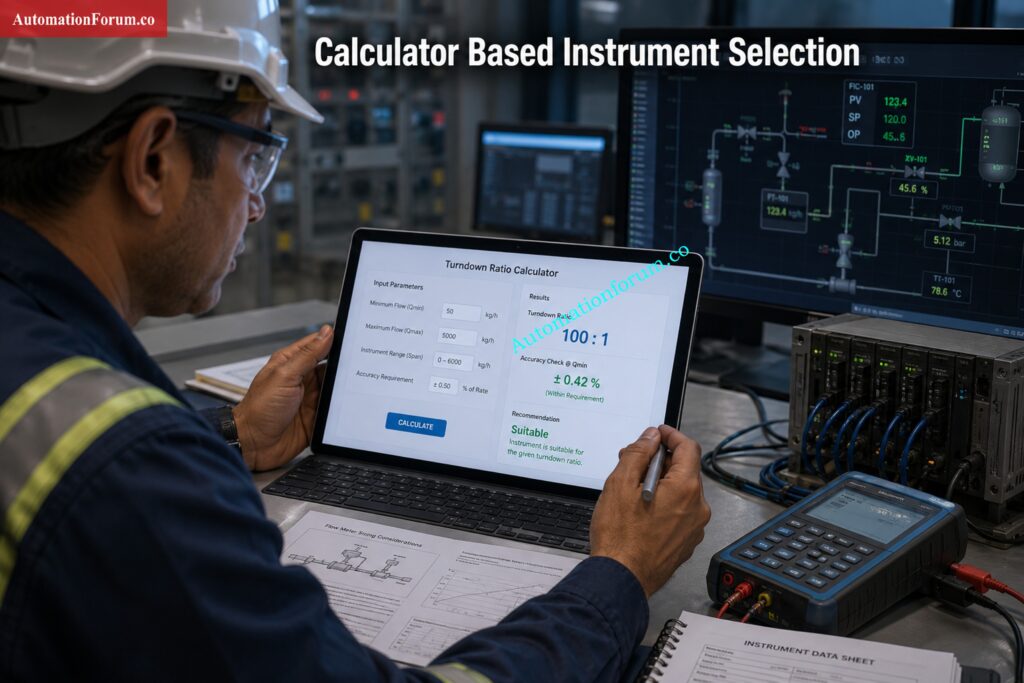
The attached calculator is useful because it turns this selection problem into a practical engineering check. By entering process minimum and maximum values, instrument range, turndown, and required accuracy, an engineer can quickly see whether the instrument is excellent, marginal, or not suitable for the duty. That saves time during design and reduces the chance of sizing mistakes during procurement and commissioning.
Refer the below link for the Understanding Rangeability vs Turndown Ratio in Control Valve Sizing
What is Turndown Ratio?
Turndown Ratio Definition
Turndown ratio is the ratio between the maximum measurable value and the minimum measurable value of an instrument while still maintaining useful performance. In simple terms, it shows how wide the measuring window is.
A practical way to read it is this:
Turndown Ratio = Maximum Measurable Value / Minimum Measurable Value
Difference Between Turndown Ratio, Span And Rangeability
If an instrument has a turndown ratio of 10 to 1, it means the instrument can measure down to one tenth of its full scale while still remaining useful. A 20 to 1 instrument can go lower, and a 100 to 1 instrument can handle an even wider operating window.
This is not the same as span. Span is the difference between the upper and lower process values, while turndown describes the usable measuring flexibility. In process plants, that difference matters a lot. An instrument may have a large span, but poor low end performance. That is why engineers must think beyond simple range and look at real rangeability.
For example, a Coriolis meter with strong turndown can work well over changing flow conditions. A pressure transmitter may also have good turndown depending on the sensing technology and installed range. On the other hand, a basic orifice plate usually has limited turndown because the differential pressure signal becomes weak at low flow.
Calculate Minimum Flow Rate Correctly Using Turndown Ratio Method: How to Calculate Minimum Flow Rate for Flow Meters from Turndown Ratio?
Why Turndown Ratio is Important in Process Industries
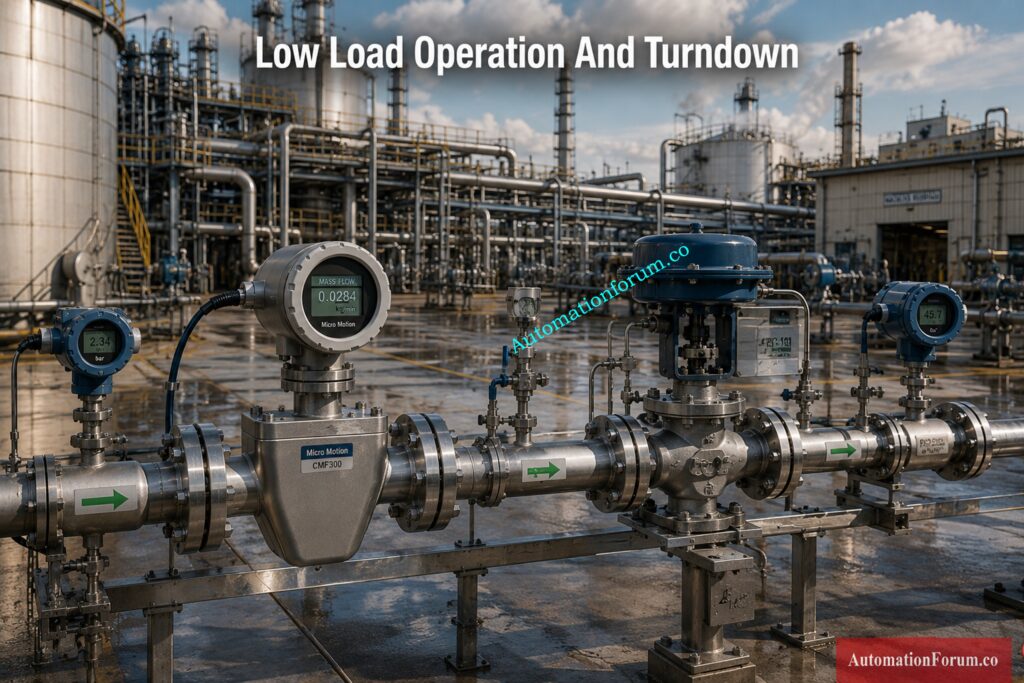
Effect On Low Flow Measurement
Turndown ratio directly affects how useful an instrument will be across real operating conditions. Many plants do not run at one fixed load. They start up, shut down, ramp up, reduce output, switch products, or handle seasonal demand. A good turndown ratio helps the instrument remain accurate during those changes.
Effect On Control Loop Stability
It improves low flow measurement, especially where the process often sits far below maximum capacity. It supports better control stability because the control system receives a cleaner measurement signal. It also improves energy efficiency, because the plant can run closer to the real process demand instead of forcing equipment into an oversized operating window.
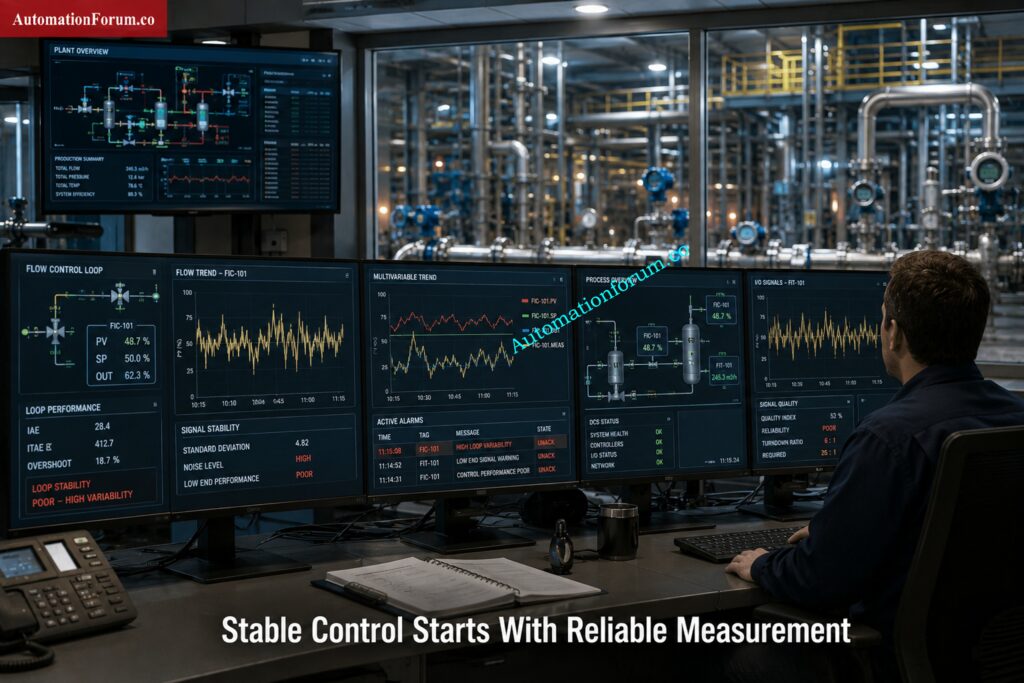
Effect On DCS,PLC And SCADA Performance
In DCS, PLC, SCADA, and PID loops, an instrument with poor turndown can cause noisy input values, poor controller response, and hunting. In safety systems, weak low end measurement may lead to incorrect status interpretation. In critical operations, that is not acceptable.
Ignoring Turndown Ratio Can Destroy Your Flow Measurement Accuracy: Why Turndown Ratio is Important when Selecting a Flow Meter ?
How the Turndown Ratio Calculator Works
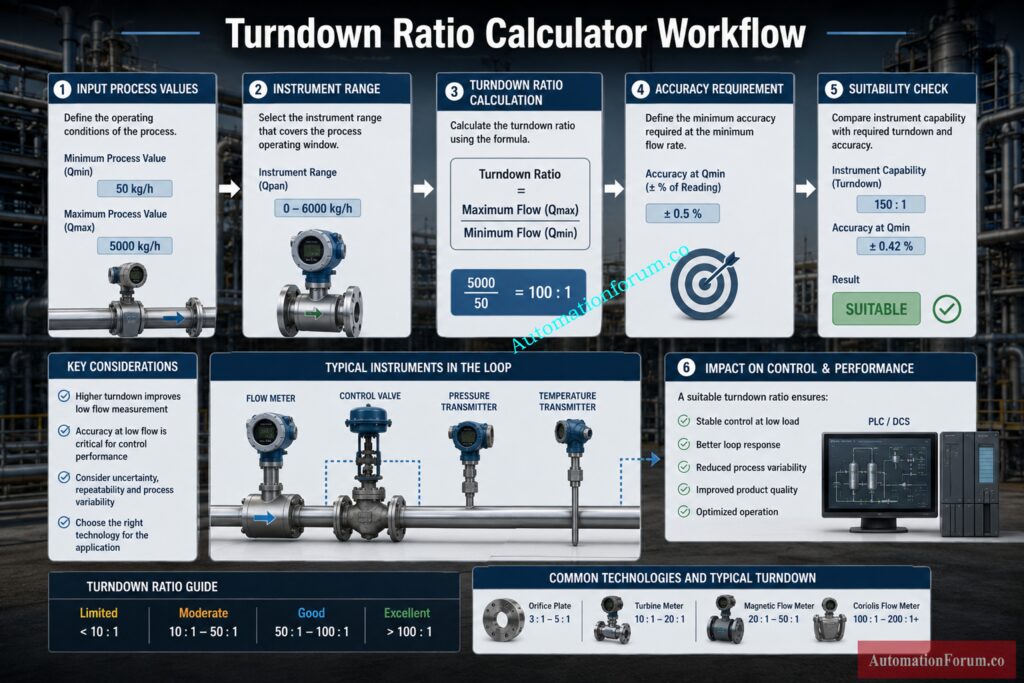
The calculator in the attached file is designed as a practical engineering aid. It considers the process duty, instrument range, instrument turndown, and accuracy requirement, then gives a suitability judgment.
Measurement Type Selection
Measurement type matters because flow, pressure, temperature, analytical concentration, and level each behave differently. Flow applications often demand the most attention because process flow can vary widely. Pressure and temperature usually have their own measurement constraints. Analytical measurements may need tighter low end control, while level systems may require a different interpretation of span and usable range.
Meter Type Selection
Meter type strongly influences rangeability. Orifice plates and some differential pressure systems are often limited at the low end. Turbine meters can be good for some clean liquid applications, but may not work well at lower flows. Magnetic flow meters usually offer good rangeability for conductive liquids. Coriolis meters are often preferred where both mass flow accuracy and wide turndown are important. Pressure or temperature transmitters rely on sensor design, calibration range, and application conditions.
Poor Valve Characteristics Create Unstable and Inefficient Control: Why Control Valve Characteristics Matter in EPC Instrumentation and Control Engineering
Industry Selection And Application Relevance
Industry matters because the same instrument behaves differently in different plants. A refinery may value custody style reliability and broad load changes. A pharmaceutical plant may value precision and repeatability. A water treatment plant may value cost and durability. A power plant may care about stable operation across load swings. The calculator reflects this practical engineering reality.
SIL Level Selection And Safety Considerations
Safety Integrity Level affects how selection is viewed from a risk perspective. SIL 1, SIL 2, and SIL 3 applications usually need more careful engineering judgment, proof testing, and reliability consideration. A process instrument selected only for range without considering safety performance can become a weak point in the loop.
Minimum Process Value And Maximum Process Value
These values define the actual operating window of the plant. The minimum tells you the lowest expected flow, pressure, or other process value. The maximum tells you the highest expected value. Their relationship defines the process span and the true duty profile.
Instrument Range And Sensor Span
Instrument range describes the calibration window and sensing capability of the device. An instrument can only be trusted within its practical calibration limits. Oversizing the range may reduce effective resolution, especially near the bottom of the scale.
Instrument Turndown Ratio Input
This value comes from manufacturer capability and real field performance. The datasheet may show a wide ratio, but the plant environment determines whether that ratio is truly useful. Fluid type, installation, line size, vibration, temperature variation, and signal quality all matter.
Accuracy Requirement Input
Accuracy levels such as plus or minus 0.5 percent, 1 percent, 2 percent, or 5 percent are not just catalog figures. They change the low end performance expectation. A high accuracy requirement generally pushes the engineer toward a more capable meter or a tighter sizing decision.
Wrong Turndown Selection Creates Major Pressure Transmitter Errors: Rangeability vs. Turndown Ratio and their Implications for Pressure Transmitter Selection
Turndown Ratio Calculation Formula
Process Span Formula
The calculator uses a few practical checks.
Minimum Measurable Value Formula
Process Span = Maximum Process Value minus Minimum Process Value
Calculated Turndown Ratio = Maximum Process Value divided by Minimum Process Value
Minimum Measurable Value = Instrument Range divided by Instrument Turndown
Coriolis Flow Calculations Every Process Engineer Should Understand: Coriolis Mass Flow Calculator – Complete Guide for Instrumentation & Process Engineers
Operating Utilization Formula
Operating Utilization = Maximum Process Value divided by Instrument Range multiplied by 100
Low End Accuracy Formula
Low End Accuracy = Accuracy multiplied by Instrument Range divided by Minimum Process Value
How To Interpret The Calculation Result
In practice, these formulas help answer one key question: does the instrument stay reliable across the actual process window, or does it only look good at the upper end?
For example, a large instrument range may seem impressive, but if the minimum process value is too small compared with that range, low end accuracy can become weak. That is why range alone is not enough. The relationship between process demand and instrument capability is the real decision point.
Prevent Compressor Trips with Proper Anti Surge Valve Sizing: Anti-Surge Control Valve Selection and Sizing – Complete Engineering Guide
Example Calculation Using the Turndown Ratio Calculator
Step by step calculation
Consider a refinery application using a Coriolis flow meter.
Minimum flow = 10 m3 per hour
Maximum flow = 100 m3 per hour
Instrument range = 120 m3 per hour
Turndown ratio = 20 to 1
First, the process span is 90 m3 per hour.
The calculated turndown ratio is 100 divided by 10, which equals 10 to 1. That is within the selected instrument capability of 20 to 1, so the meter is technically suitable from a rangeability point of view.
The minimum measurable value based on the instrument turndown is 120 divided by 20, which equals 6 m3 per hour. Since the process minimum is 10 m3 per hour, the instrument can still measure below the lowest expected flow. That gives margin.
Operating utilization is 100 divided by 120 times 100, which equals 83.33 percent. That means the meter is being used effectively.
Suitability analysis of the selected instrument
If accuracy is 2 percent, low end accuracy by the calculator logic becomes 2 multiplied by 120 divided by 10, which indicates that the low end must be evaluated carefully. In a real refinery, this is where engineering judgment matters. The meter may be acceptable, but the low flow operating period should still be reviewed against the required control and custody needs.
The engineering recommendation is clear: the selected Coriolis meter is suitable, but the designer should still confirm start up flow, shutdown flow, and any possible low load conditions before final approval.
Avoid Cable Tray Design Mistakes Using IEC NEC Standards: Cable Tray Sizing Calculator: Complete Engineering Guide for IEC 61537 and NEC 392 Compliance
Typical Turndown Ratios of Different Instruments
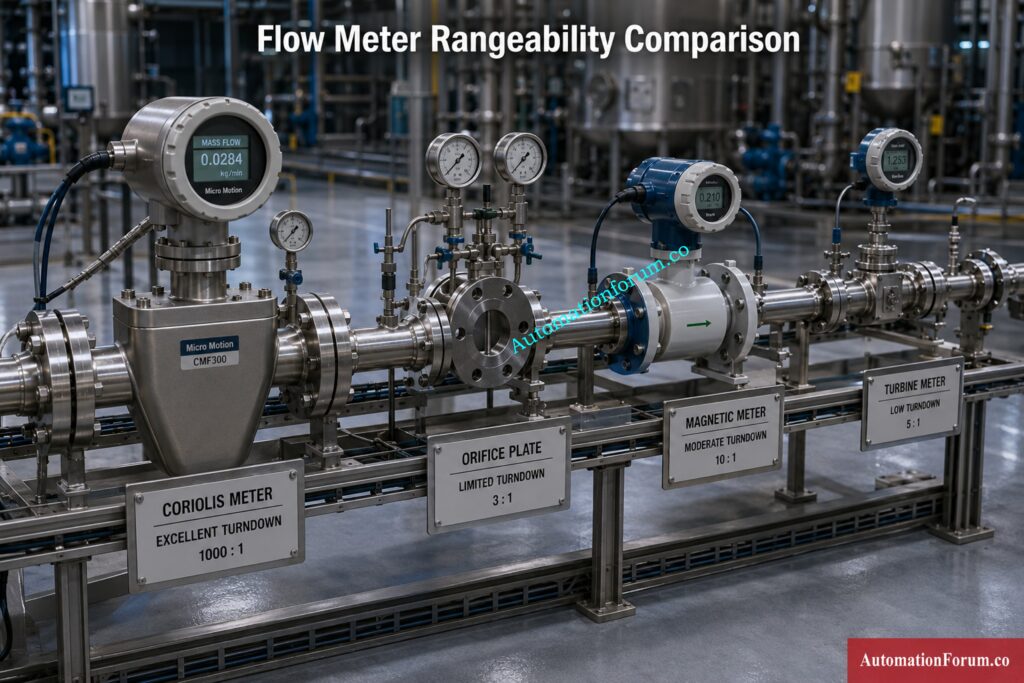
Orifice Plate Turndown Ratio
Orifice plates usually have the most limited practical turndown because they rely on differential pressure, and the signal weakens quickly at low flow. They are economical and widely used, but low flow performance is not their strongest point.
Venturi Tube Flow Calculations Simplified for Industrial Engineers: Advanced Venturi Tube Flow Calculator – Formula, Working & Applications
Venturi Meter Turndown Ratio
Venturi meters generally perform better than orifice plates in terms of pressure loss and rangeability, which makes them useful where energy loss must be reduced.
Vortex Meter Turndown Ratio
Vortex meters can offer good performance in certain liquid, steam, and gas duties, but the minimum flow requirement must be checked carefully.
Turbine Meter Turndown Ratio
Turbine meters can provide good accuracy in clean fluids, yet they are more sensitive to viscosity, contamination, and low flow conditions.
Magnetic Flowmeter Turndown Ratio
Magnetic flow meters usually provide strong rangeability for conductive liquids and are often preferred in water and wastewater service.
Coriolis Flowmeter Turndown Ratio
Coriolis meters are widely valued for excellent mass flow measurement, high accuracy, and strong turndown in many applications.
Ultrasonic Flowmeter Turndown Ratio
Ultrasonic meters can offer wide rangeability, especially in large line sizes and gas or liquid services, although installation quality is important.
Rotameter Turndown Ratio
Rotameters are simple and useful for local indication, but their practical turndown is usually limited.
Pressure Transmitter Turndown Ratio
Pressure transmitters can have useful rangeability when properly selected, but calibration range and process noise must be considered.
Control Valve Turndown Considerations
Wrong Valve Selection Can Destroy Process Control Performance: Globe vs Ball vs Butterfly Control Valves Complete Comparison Guide for Flow Control Selection
Turndown Ratio vs Rangeability
What Turndown Ratio Tells You
Turndown ratio and rangeability are often used together, but they are not exactly the same idea. Turndown ratio usually describes the ratio of maximum to minimum measurable value.
What Rangeability Tells You
Rangeability is the broader practical ability of an instrument to remain accurate and stable across changing operating conditions.
Bench Performance Versus Real Field Performance
A device may look excellent on paper, but its bench performance may not match field performance. A smart transmitter may show a wide calibration window, but if the process has vibration, pulsation, or unstable flow profile, practical rangeability becomes lower.
Impact On Control Performance And Measurement Quality
That is why control system implications matter. A transmitter that loses clarity at low end will affect the PID loop. A flow meter that becomes noisy at lower flow can make the controller overreact. The result is more variation, more wear, and less process quality.
Refer the below link for When to Choose Forward and Reverse Acting Control Valves for Design Engineer
Common Mistakes in Instrument Turndown Selection
- One common mistake is oversizing the meter. Engineers sometimes choose a larger device for future growth, but the immediate effect can be weak low end resolution.
- Another mistake is ignoring low flow conditions. Many processes spend a large portion of their time at reduced load, so the minimum operating point must be checked carefully.
- Wrong transmitter calibration is also a frequent issue. A transmitter calibrated too broadly may lose useful resolution.
- Incorrect pressure drop assumptions can distort selection for DP devices and control valves.
- Ignoring process variability is another problem. Real duty is influenced by batch fluctuations, seasonal changes, and changes in operating mode.
- SIL mismatch can create a safety concern when the selected instrument does not fit the protection function.
- A good troubleshooting method is to compare the real process minimum with the practical minimum measurable value, then review accuracy and control stability before final selection.
Most ISO Calibration Audits Fail Due to These Missing Checks: Internal Audit Checklist for ISO Process Instrument Calibration in Process Industries
Best Practices for Instrument Selection
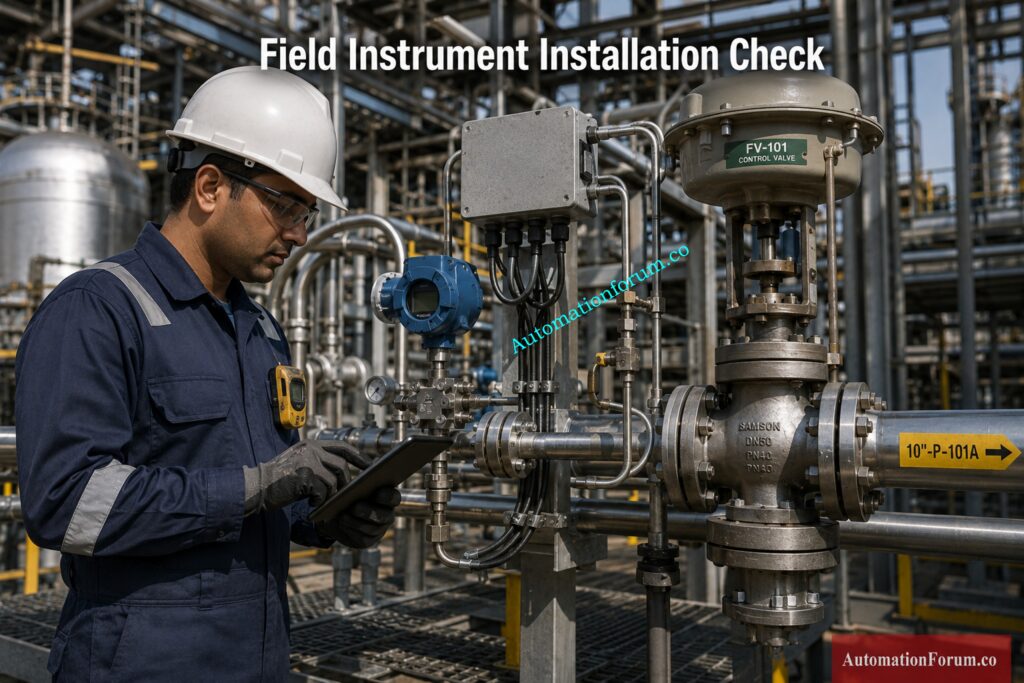
- Always start with the real process data, not only the nominal design value. Use normal, minimum, maximum, start up, and upset conditions.
- Choose an instrument with enough safety margin, but do not oversize it so much that low end performance disappears.
- Plan for future expansion only when it is realistic and documented.
- Consider redundancy where process criticality is high.
- Review calibration and maintenance access early, because the best instrument on paper can become difficult to maintain in the field.
Wrong Valve Body Material Causes Expensive Process Failures: Control Valve Body Material Selection Guide for EPC Design Instrumentation Engineers
Applications of Turndown Ratio in Process Industries
- In oil and gas, turndown ratio is important for changing production rates, separator duties, and utility services.
- In refineries it is important for blending, fuel gas, process unit variability and steam systems.
- Chemical factories create wide demand variations with variable recipes and batch cycles.
- Flow in water treatment varies with demand, tank level and pump operation.
- Accurate assessment of the low end is critical in pharmaceutical facilities for dosing, batch control.
- Rangeability is important in food processing where line flexibility and product modifications are required.
- In power generation, load swings and utility balancing make strong turndown valuable for stable operation.
Incorrect Cv Sizing Leads to Serious Control Valve Problems: Control Valve Sizing Calculator: Complete ISA S75.01 Cv Calculation Guide for Instrumentation Engineers
Advantages of Using a Turndown Ratio Calculator
A calculator like this speeds up engineering decisions. It improves selection quality, reduces errors, and gives a more realistic view of instrument behavior.
It supports better accuracy, better process reliability, fewer commissioning problems, and improved safety. It also reduces the risk of late stage changes during procurement or installation.
For engineers working under time pressure, that is a major advantage.
Control Valve Hunting Problems Every Instrument Engineer Must Solve: Control Valve Hunting Due to PID Controller: Causes, Effects, Root Analysis and Complete
Frequently Asked Questions About Turndown Ratio
What is a good turndown ratio for a flow meter?
A good turndown ratio depends on the process. For many general duties, 10 to 1 may be acceptable. For more demanding and variable processes, 20 to 1 or higher may be better.
What is the difference between rangeability and turndown ratio?
Turndown ratio is the numerical relationship between maximum and minimum measurable values. Rangeability is the broader practical ability to measure accurately across that range.
Why is turndown ratio important?
It affects low flow accuracy, process stability, and the overall usefulness of the instrument in real plant conditions.
Which flow meter has the highest turndown ratio?
Coriolis and some ultrasonic meters often provide very strong turndown, depending on application and installation.
How does turndown ratio affect accuracy?
When flow or signal moves near the low end, poor turndown can reduce accuracy and increase noise or instability.
What is the turndown ratio of a Coriolis flow meter?
It is often high compared with many other flow technologies, which is one reason Coriolis meters are valued in demanding process duties.
How do you calculate instrument rangeability?
Compare the maximum measurable value with the minimum reliable measurable value, then assess whether the process falls inside that practical window.
Convert Any Mass Flow Unit Without Calculation Mistakes Instantly: Mass Flow Rate Converter : Convert kg/s, lb/min, SCFM, L/h and 50+ Units
What happens if turndown ratio is too low?
The instrument may lose accuracy, give unstable results and become unsuitable for low flow operation.
What is the best flow meter for low flow applications?
The best choice depends on fluid type and accuracy needs, but Coriolis, magnetic, and some ultrasonic options are often strong candidates.
Why do orifice plates have lower turndown ratio?
It depends on the fluid and accuracy . Often Coriolis , magnetic , and some ultrasonic options are good choices .
Advanced Flow Measurement MCQs That Test Real Engineering Skills: Advanced Flow Measurement Selection MCQs for EPC Instrumentation Design Engineers
Key engineering takeaways: Why the calculator is useful for process engineers
Turndown ratio is a core selection parameter in modern process instrumentation. It affects measurement quality, control stability, safety performance, and overall plant efficiency. Proper sizing is not only about choosing a device that can read the maximum process value. It is about selecting an instrument that remains dependable across the real operating range, especially at low flow or low signal conditions.
The calculator attached here makes that decision more practical. By checking process span, instrument range, turndown, utilization, and low end accuracy, engineers can quickly judge whether an instrument is a strong fit or a weak one.
For instrumentation and control engineers in process industries, this is exactly the kind of tool that supports smarter design decisions. Use the calculator to verify selection, avoid oversizing, and improve measurement confidence across the full operating range.
Refer the below link for the 4-20 mA Loop Troubleshooting with Loop Calibrators
