
- Introduction to Dry Calibration of Displacer Level Transmitters
- Level Troll Weight Loss Calculator (Interactive Tool)
- Understanding the Working Principle of a Displacer Level Transmitter
- Archimedes’ Principle in Instrumentation Context
- Why Dry Calibration is Preferred in EPC & Shutdown Projects
- What the Level Troll Weight Loss Calculator Does
- Level Troll Worked Example – Practical Field Calculation
- 4-20 mA Calibration Table (Example)
- Complete Step-by-Step Dry Calibration Procedure (Field Checklist)
- Common Mistakes in Dry Calibration (and How to Avoid Them)
- Advantages of Using a Weight Loss Calculator
- Dry Calibration vs Wet Calibration Detailed Comparison Table
- Troubleshooting Common Errors (Field Diagnostics)
- Safety Considerations During Dry Calibration
- Best Practices for EPC Engineers
- Frequently Asked Questions (FAQ) on Leveltrol Weight Loss Calculation
- Mastering Dry Calibration Using Weight Loss Calculation
Introduction to Dry Calibration of Displacer Level Transmitters
In the oil and gas, petrochemical, refinery, chemical, and power plant industries, dry calibration of a displacer-type level transmitter, often known as a Level Troll, is a regular part of commissioning and maintenance. The calibration is done by mimicking buoyancy using computed weight loss data instead of actually filling the container with liquid.
Who this Guide is For
This approach is used a lot in EPC projects where process liquid might not be accessible before commissioning. A solid Level Troll Weight Loss Calculator makes sure that the results are correct and can be repeated without making mistakes in calculation by hand.
In this complete guide, you will learn:
- The working principle of displacer level transmitters
- Archimedes’ principle explained for instrumentation engineers
- Step-by-step dry calibration procedure
- A fully worked numerical example
- 4-20 mA calibration table preparation
- Common field mistakes and troubleshooting
- Practical EPC and commissioning insights
This article is structured for instrumentation engineers, control engineers, DCS engineers, and commissioning professionals working in process industries.
Level Transmitter Selection Checklist for EPC Engineers: Level Transmitter Selection Checklist for EPC Engineers – Step-by-Step Guide
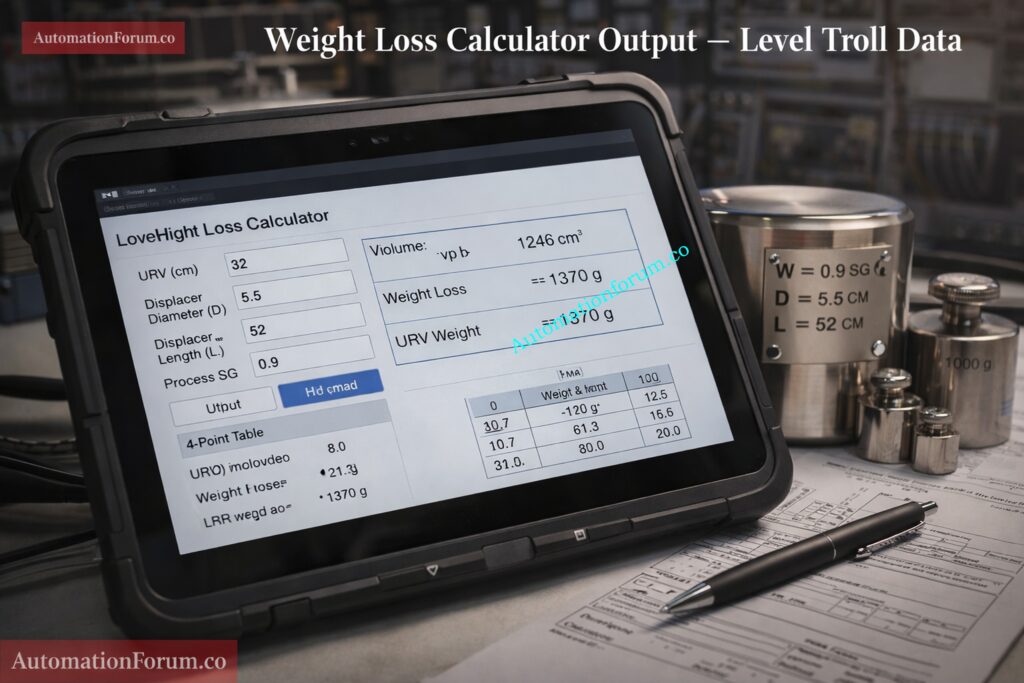
Level Troll Weight Loss Calculator (Interactive Tool)
A precise engineering tool for dry calibration of displacer-type level transmitters. Compute buoyancy weight loss, LRV / URV calibration weights & full 4–20 mA linearity check values — no process liquid needed.
| Level % | Signal | Cal. Weight | Tag | Description |
|---|
A Level Troll (displacer-type transmitter) works on Archimedes' principle. The cylindrical displacer hangs from a torque tube arm. As liquid rises, buoyancy causes a weight loss that the torque tube converts to a proportional 4–20 mA signal.
2025 Interface Level Measurement Selection Guide: Interface Level Measurement Selection Procedure – Complete 2025 Guide for Process Engineers
Understanding the Working Principle of a Displacer Level Transmitter
A displacer level transmitter uses the theory of buoyancy to work. The displacer is a metal cylinder that hangs inside a chamber. As liquid level rises, more portion of the displacer gets immersed, generating an upward buoyant force.
Open Tank Level Transmitter Calculator: Open Tank Level Transmitter Calculator – Complete Guide for EPC Instrumentation Engineers
Archimedes’ Principle in Instrumentation Context
According to Archimedes’ principle:
The buoyant force acting on a body immersed in a fluid is equal to the weight of the fluid displaced by that body.
in terms of practical calibration:
Weight Loss = Volume of Displacer × Specific Gravity of Liquid
As immersion increases:
- Effective weight decreases
- Torque reduces
- Output signal changes in a proportionate way (4-20 mA)
So, instead of physically immersing the displacer, we use calibrated weights to lower the equivalent weight to imitate the buoyant force.
This is the foundation of dry calibration of a displacer level transmitter.
Complete Wet-Leg Level Calculation Guide: Wet-Leg Level Calculation for DP Transmitters: Complete Guide for Instrumentation Design Engineers
Why Dry Calibration is Preferred in EPC & Shutdown Projects
Dry calibration is extensively used because:
- Tanks cannot be filled during commissioning
- Process fluid is hazardous or expensive
- Hydrotesting is not complete
- Time constraints during shutdown
- Offshore or remote installations
In major refinery or petrochemical EPC projects, hundreds of level instruments may require calibration before start-up. Using a standardized calculator-based method significantly reduces calculation errors and speeds up execution.
Field Calibration Guide for DP Level Transmitters: Calibration of DP level transmitter at field
What the Level Troll Weight Loss Calculator Does
The Level Troll weight loss calculator (embedded on AutomationForum.co) accepts four instrument dataplate values and produces every number an engineer needs for a complete dry calibration displacer procedure without requiring a single litre of process fluid.
Parameters Required for Level Troll Weight Loss Calculation
Calculator Inputs
- Displacer Weight (W): The dead weight of the displacer in air. Read directly from the instrument dataplate. Supports grams (metric) or pounds (imperial).
- Specific Gravity (SG): The SG of the process liquid at operating temperature. Obtain from the process data sheet or fluid analysis. Water = 1.0; light hydrocarbons ≈ 0.65-0.80; heavy brines > 1.10.
- Displacer Diameter (D): The outer diameter of the cylindrical displacer. From the dataplate, in centimetres or inches.
- Displacer Length (L): The active length of the displacer - equal to the calibrated level range. From the dataplate, in centimetres or inches.
- Output Weight Unit: Select grams, kilograms, pounds, or ounces to match your calibration weights or workshop preference.
Refer the below link for the 15+ Collection of Level Measurement Calculators for Industrial Instrumentation
Calculator Outputs
- Volume (cm³ or in³): The geometric volume of the displacer cylinder.
- Weight Loss: The buoyancy force at 100% submersion is the most important calibration span value.
- 100% Calibration Weight (URV): The weight that needs to be put on the torque tube to make it feel like it's at 100% level.
- 5-Point Calibration Table: Table shows the LRV (0%) to URV (100%) range, together with the mA signal and physical weight for each checkpoint.
- Step-by-Step Working: A full description of the calculations for peer review and an audit trail.
Download Ready-to-Use Calibration Report Templates: Downloadable Instrumentation Calibration Report Preparation Templates
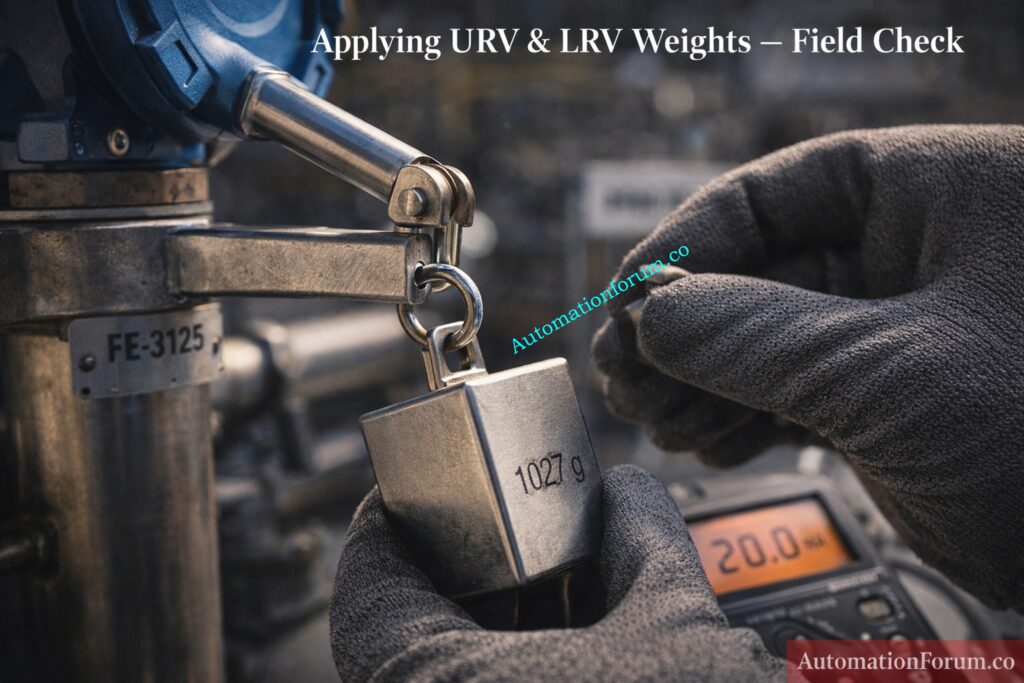
Level Troll Worked Example - Practical Field Calculation
Let's look at a real-life example from the commissioning of a refinery.
Example - Input Values
- Displacer Weight (W) = 2400 grams
- Specific Gravity (SG) = 1.1
- Displacer Diameter (D) = 7.0 cm
- Displacer Length (L) = 32.42 cm
- Unit = grams
Step 1 - Calculate Displacer Volume
The displacer is cylindrical.
Volume formula:
Volume = π × (D/2)² × L
Using the calculator:
Volume ≈ 1246 cubic centimeters
Step 2 - Calculate Weight Loss Due to Buoyancy
Weight Loss = Volume × SG
Weight Loss ≈ 1246 × 1.1
Weight Loss ≈ 1370 grams
This means that when it is fully submerged, the displacer will lose about 1370 grams of weight.
Step 3 - Determine 0% (LRV) and 100% (URV) Calibration Weights
At 0% Level (LRV - 4 mA)
Full displacer weight is applied:
2400 grams
At 100% Level (URV - 20 mA)
Effective weight:
2400 − 1370 = 1030 grams
Thus:
- 4 mA → 2400 g
- 20 mA → 1030 g
Step 4 - Prepare 4-Point (or 5-Point) Calibration Table
For linear 4-20 mA output:
Weight change is uniformly distributed.
Weight loss per 25%:
1370 / 4 = 342.5 grams
60+ Free Instrument Calibration Procedures: Free Instruments Calibration Procedures: 60+ Step-by-Step Methods for Pressure, Temperature, Flow & Level
4-20 mA Calibration Table (Example)
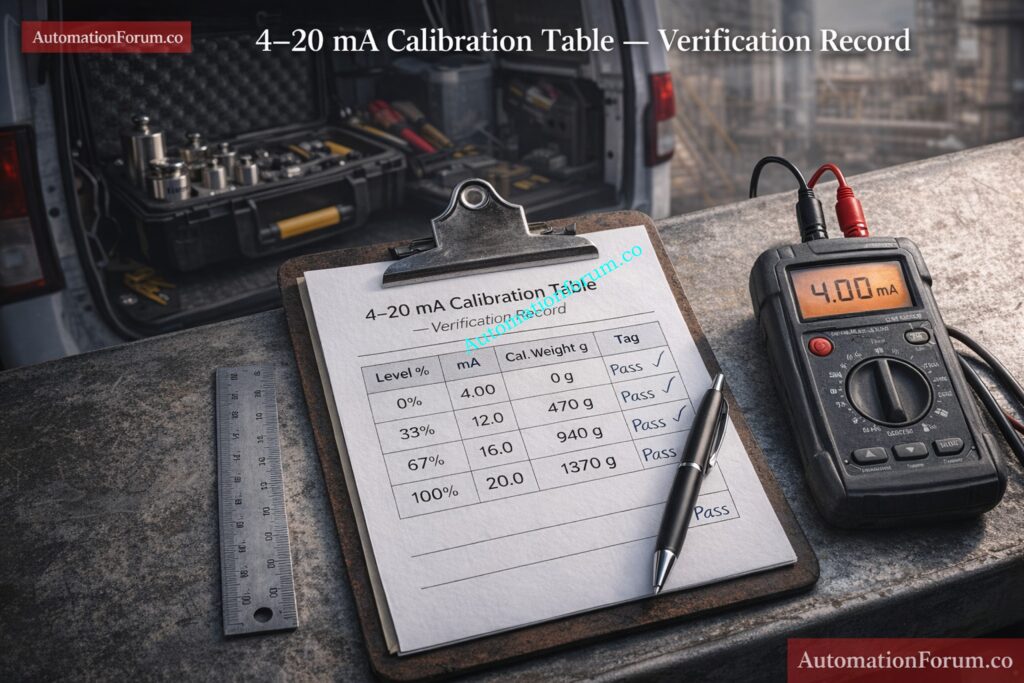
This is what the Level Troll weight loss calculator gave us for this example. Put each weight on the torque tube arm and check that the transmitter reads the right mA signal within the permissible range (usually ±0.1 mA).
| Level % | Signal (mA) | Cal. Weight (g) | Cal. Weight (kg) | Tag | Description |
| 0% | 4.0 mA | 2400.00 g | 2.400 kg | LRV | Empty vessel / displacer in air |
| 25% | 8.0 mA | 2056.89 g | 2.057 kg | MID | 25% linearity check |
| 50% | 12.0 mA | 1713.78 g | 1.714 kg | MID | 50% linearity check |
| 75% | 16.0 mA | 1370.67 g | 1.371 kg | MID | 75% linearity check |
| 100% | 20.0 mA | 1027.57 g | 1.028 kg | URV | Fully submerged / full level |
Table note: Each calibration weight = W − (level% / 100) × Weight Loss, clamped to zero. The formula is consistent with the displacer buoyancy calculation used in ISA-RP3.2 and IEC 60770.
Level Measurement Calibration Procedures: Calibration Procedures for Level Measurement Devices
Complete Step-by-Step Dry Calibration Procedure (Field Checklist)
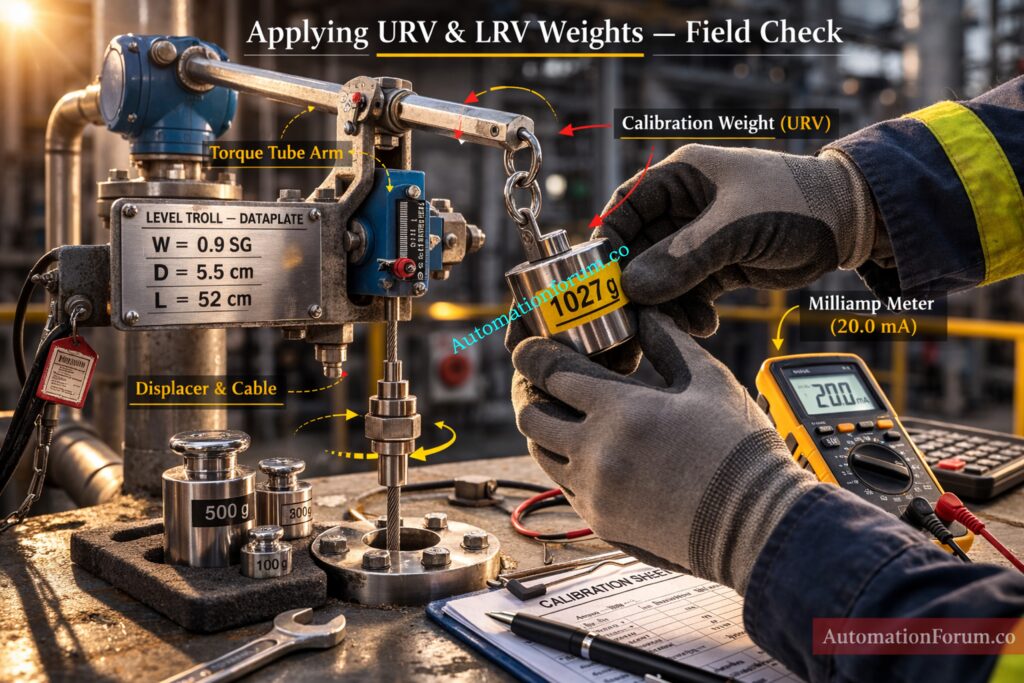
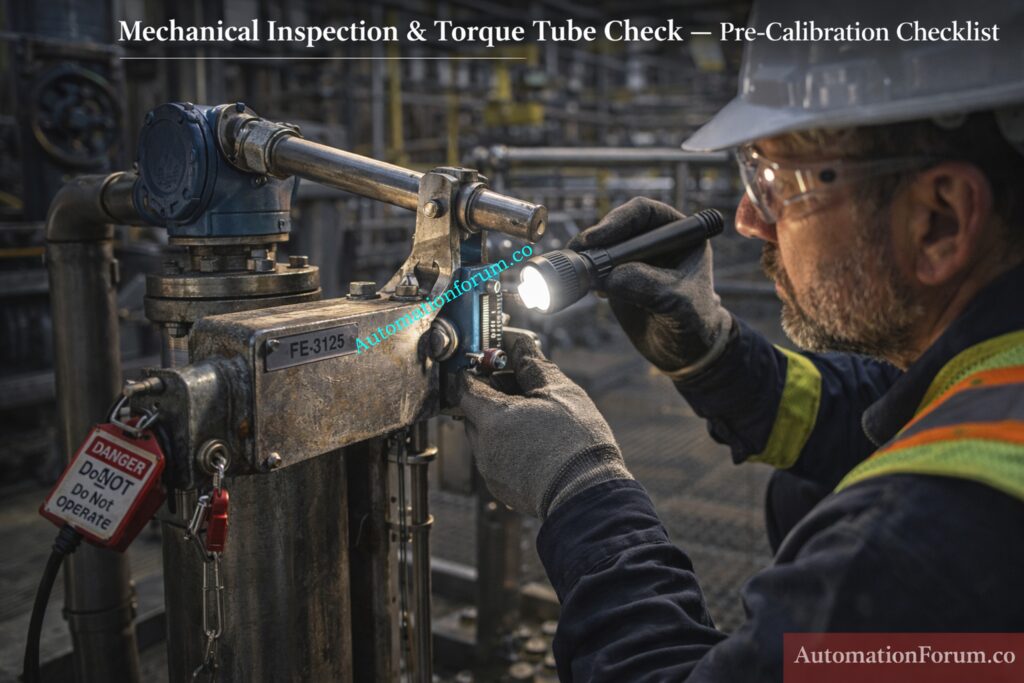
Step 1 - Mechanical Inspection
- Isolate transmitter
- Take away the pressure in the chamber
- Check the integrity of the torque tube
- Check the displacer for dents or rust.
Step 2 - Verify Dimensions and Weight
- Length and diameter should be measured.
- Check the weight on the certificate
- Check with the datasheet again
If the dimensions are wrong, the weight loss computation will also be wrong.
Step 3 - Use the Weight Loss Calculator (Data Entry / Save Outputs)
Enter:
- Displacer Weight
- SG
- Diameter
- Length
- Unit
Click calculate.
Note down:
- Volume
- Weight Loss
- 100% Weight
- 4-point table
Step 4 - Connect Loop Calibrator (Loop Integrity & 24 VDC)
- Provide 24 VDC
- Connect milliamp meter
- Check loop integrity
Step 5 - Apply Weights and Adjust Zero (LRV = 4 mA)
At 0%:
Attach full weight → adjust zero to 4 mA.
Step 6 - Adjust Span (URV = 20 mA)
At 100%:
Apply 1030 grams → adjust span to 20 mA.
Step 7 - Verify Intermediate Points (25%, 50%, 75%)
Check 25%, 50%, 75%.
Tolerance typically ±0.5% or project specified.
All-in-One Calibration Calculators Hub: Calibration Calculators
Common Mistakes in Dry Calibration (and How to Avoid Them)
Incorrect Specific Gravity
Always use operating SG, not design SG.
Ignoring Temperature Effect
If density changes with temperature, calibration error occurs.
Unit Conversion Errors
Mixing grams and kilograms causes span shift.
Mechanical Friction
Sticking torque tube affects linearity.
Quick Checklist for Dry Calibration of a Displacer
Pin this to your calibration procedure or pre-job safety brief:
- Confirm the instrument dataplate: W, D, and L match the loop diagram and instrument index.
- Verify the process fluid SG against the current process data sheet not the original design value.
- Isolate the displacer from process pressure and drain / purge the cage before attaching calibration weights.
- Use certified calibration weights traceable to a national standard; record certificate numbers in the dossier.
- Check transmitter zero with displacer hanging freely in air before applying any calibration weight.
- Perform a 5-point linearity check (0%, 25%, 50%, 75%, 100%) and document the mA deviation at each point reject if any point exceeds ±0.1 mA of the expected value.
Try the Best PID Tuning Simulation Tool: Best PID Controller Tuning Simulation Tool for Engineers
Advantages of Using a Weight Loss Calculator
- Eliminates manual calculation errors
- Saves commissioning time
- Ensures standardized documentation
- Reduces field rework
- Improves accuracy
In large refinery EPC projects, this tool improves productivity significantly.
Hybrid Level Measurement Selection for EPC Engineers: Hybrid Level Measurement Selection Procedure for EPC Instrumentation Engineers
Dry Calibration vs Wet Calibration Detailed Comparison Table
Below is the expanded comparison table written clearly and professionally without hyphens so you can directly insert it into your article or procedure.
| Parameter | Dry Calibration | Wet Calibration |
| Speed | Fast. No need to fill or drain vessels. Weights are applied directly to simulate buoyancy. Suitable when many instruments must be calibrated in a short time. | Slow. Requires filling the chamber or vessel with fluid. Time is needed for stabilization and drainage after testing. |
| Liquid Required | No. Buoyancy is simulated using calculated weight loss values and certified calibration weights. | Yes. Uses actual process fluid or suitable test fluid for calibration verification. |
| Practical Accuracy | High when correct specific gravity, displacer dimensions, and certified weights are used. Accuracy depends on correct calculations and mechanical condition. | Very high because the displacer interacts with real fluid at operating density and temperature. |
| Repeatability | High when procedure and weights are consistent. Mechanical friction or torque tube issues may affect repeatability. | High to very high when fluid conditions are stable and controlled. |
| Commissioning Application | Preferred during pre commissioning, EPC projects, shop calibration, and shutdown maintenance. | Used mainly for final performance validation after process fluid is available. |
| Validation Level | Functional validation of zero, span, and linearity based on calculated buoyancy. | Performance validation under actual operating conditions including pressure and temperature. |
| Equipment Required | Certified calibration weights, weight loss calculator or spreadsheet, loop calibrator, milliamp meter, mechanical fixtures. | Process or test fluid, pumping or filling arrangement, temperature control if required, loop calibrator and measurement tools. |
| Traceability and Documentation | Good. Weight certificates and calculation records provide clear audit trail. | Excellent. Includes fluid condition records along with calibration data for stronger acceptance documentation. |
| Safety and Environmental Risk | Lower risk since no handling of hazardous fluids. Reduced spill and contamination risk. | There is a higher risk while working with dangerous or hot process fluids. Needs further safety measures. |
| Suitability for Hazardous or Expensive Fluids | Highly suitable. Avoids exposure and waste of costly or dangerous liquids. | Limited suitability unless fluid is already safely present in the system. |
| Effect of Temperature and Density Variation | Sensitive to specific gravity input. Incorrect operating density can introduce error. | Automatically accounts for real operating density and temperature conditions. |
| Ability to Detect Fluid Interaction Issues | Limited. Can't find effects of wetting, coating accumulation, or trapped air. | Comprehensive. Reveals issues related to wetting, deposits, stratification, or trapped air. |
| Cost and Time Efficiency | Lower cost and time requirement. Good for big commissioning projects. | Costs more because of handling fluids, preparation time, and extra safety procedures. |
| When to Select | Before commissioning, during remote installations, offshore projects, hazardous fluid applications, and bench testing. | During final acceptance testing, custody transfer loops, safety-critical systems, and verification after repairs. |
| Limitations | Dependent on accurate calculation of specific gravity and displacer geometry. Unit conversion errors can affect results. | Time consuming and sometimes impractical when fluid is not available or safe to handle. |
| Typical Acceptance Tolerance | Typically within project specified tolerance such as plus or minus 0.1 to 0.5 milliamp depending on specification. | Often tighter tolerance depending on application and client specification. |
| Documentation Deliverables | Calculator output, certified weight certificate copies, as found and as left readings, signed calibration report. | Includes all dry calibration records plus fluid condition record and process confirmation documentation. |
Practical Recommendation
Wet calibration is preferred for final performance validation where the highest confidence level is required under real operating conditions.
Test Your Level Troll Troubleshooting Skills: Level Troll Troubleshooting and Calibration Quiz
Troubleshooting Common Errors (Field Diagnostics)
Weight Loss exceeds Displacer Weight:
Transmitter reads above 20 mA at 100% weight:
Indicates the span pot / HART trim has drifted or the torque tube is damaged. Re-zero with displacer in air, then re-apply URV weight and adjust span.
Linearity error > 0.1 mA at midpoints:
Check that calibration weights used match the calculator output exactly. A common source of error is using the "per 25% step" increment rather than the absolute weight for each point the calculator outputs absolute weights, not increments.
Single Liquid Displacer Calibration with Weights: How to calibrate the displacer type level transmitter with weight in single liquid applications?
Safety Considerations During Dry Calibration
- Ensure no pressure in chamber
- Use calibrated weights
- Wear PPE during removal
- Follow plant lockout procedures
Safety is always priority during instrumentation calibration activities.
Refer the below link for the How to calibrate displacer type level transmitter – Interface liquid application
Best Practices for EPC Engineers
- Prepare weight tables in advance
- Cross-check calculations before site work
- Document as-found and as-left readings
- Seal adjustments after calibration
- Tag instrument after completion
Standardization improves commissioning quality and audit compliance.
Complete Level Troll Calibration Guide: Calibration of level troll – Displacer level meter calibration
Frequently Asked Questions (FAQ) on Leveltrol Weight Loss Calculation
What is the displacer level measurement?
Displacer level measurement works on Archimedes’ principle, measuring the buoyant force acting on a submerged displacer. As liquid level rises, the apparent weight of the displacer decreases, and this change is converted into a proportional output signal (typically 4–20 mA).
What is the difference between a float and a displacer?
A float moves up and down with the liquid surface, directly following the level. A displacer stays suspended and monitors level by detecting changes in buoyant force, which makes it better for use in high-pressure, high-temperature, and interface situations.
How to calibrate displacer type level transmitter?
To calibrate, you figure out the weight loss based on buoyancy and then use weights that are equal to those levels to replicate 0% and 100% levels. Zero and span are then adjusted while verifying intermediate points for linear 4–20 mA output.
What is a displacer level transmitter?
A displacer level transmitter is a device that continuously measures levels by using a submerged cylindrical element to find changes in level by changes in buoyancy. It turns the difference in apparent weight into an electrical signal that comes out.
How often should displacer transmitters be calibrated?
Usually during shutdown cycles or once a year, depending on the plant's maintenance plan.
How do I find the correct Specific Gravity (SG) for my process fluid?
Use the SG at the temperature at which it is working, not the temperature in the lab. Get it from the Process Data Sheet (PDS) or the Fluid Analysis Report that comes with the instrument data sheet. For applications that work at the interface level (like oil/water), use the SG of the denser phase. If the fluid SG varies with throughput or season, calibrate for the worst-case SG (highest) and note the range in the calibration dossier.
When should I use wet calibration instead of dry calibration?
Use wet calibration when: (a) the process fluid is already in the vessel and a flush-and-fill is straightforward; (b) the instrument SG or torque tube characteristics are suspect after a repair; or (c) a custody-transfer or safety-critical loop requires process-fluid verification per the applicable standard. For pre-commissioning, regular maintenance, post-repair shop bench testing, and any other time when you can't get to liquid, use 4-20 mA dry calibration.
Displacer Dry Calibration Weight Calculator: Displacer type level transmitter dry calibration weight calculator
Mastering Dry Calibration Using Weight Loss Calculation
Instrumentation engineers that work in the oil and gas, refinery, petrochemical, and power industries need to know how to calibrate a Level Troll displacer transmitter without using water. Knowing how buoyancy works and doing the right weight loss calculations make sure that level measuring works correctly.
By using the Level Troll Weight Loss Calculator , engineers can:
- Instantly calculate volume
- Determine weight loss
- Generate 100% calibration weight
- Prepare 4-point calibration table
When used with adequate mechanical inspection, loop verification, and documentation, this procedure makes sure that the transmitter works reliably during plant startup and operation.
Mastering this process not only makes technical accuracy better, but it also makes commissioning faster and gives EPC projects more professional credibility.
Calculate Interface Displacer Dry Weight Instantly: Displacer type interface level transmitter dry calibration weight calculator
