
- What is Fire Alarm Detector Coverage?
- Why Detector Coverage Important in Fire Alarm Systems?
- Types of Fire Alarm Detectors and their Coverage
- Detector Installation Guidelines
- Download Fire Alarm Detector Coverage Excel Tool
- How to Calculate Fire Alarm Detector Coverage (Step-by-Step) ?
- Excel Calculator for Fire Alarm Detector Coverage
- Supported Standards for Fire Alarm System Design
- Use Cases Across Building Types
- FAQs on Fire Alarm Detector Coverage
Fire alarm systems must meet international requirements for detector spacing and coverage in order to protect lives. NFPA 72, BS 5839, IS 2189, and EN 54 are examples of codes that say how much floor space a smoke or heat detector can cover. Getting the right coverage for your detectors helps you prevent blind areas, find fires early, and stay within the rules for your project designs.
What is Fire Alarm Detector Coverage?
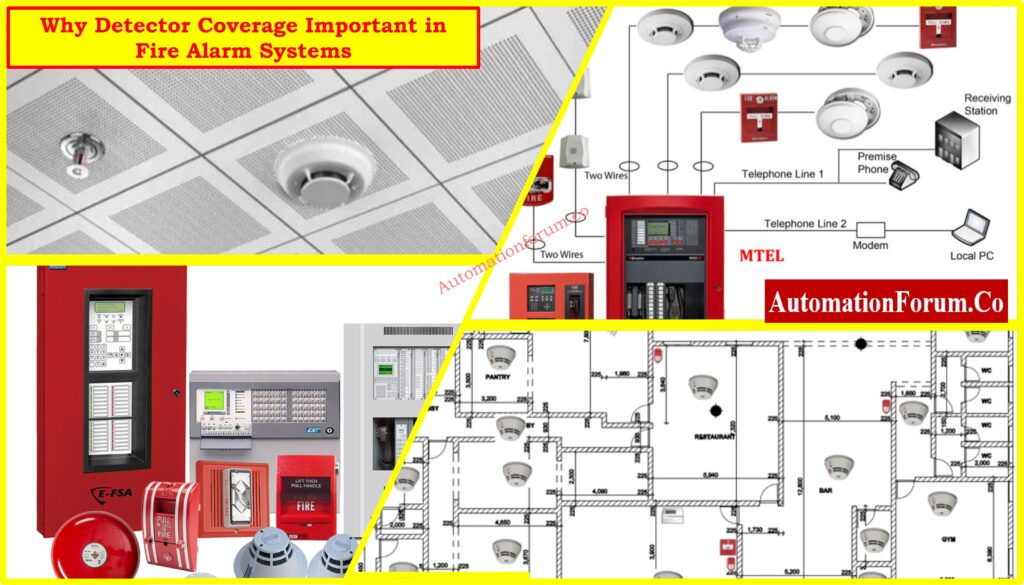
The area of protection that a single detector (smoke, heat, or beam) in a fire alarm system covers is called its “fire alarm detector coverage.” Depending on the type of detector and the surroundings, standards set the maximum floor area for each one.
- Smoke Detectors: Usually cover 37 to 60 square meters, depending on the height of the ceiling and the code requirements.
- Heat Detectors: Heat detectors cover smaller areas, usually between 25 and 50 square meters.
- Beam Detectors: These are used in big rooms, warehouses, and atriums to cover a lot of ground.
Proper spacing makes sure that every area is watched over, which lowers the risk of fire and speeds up reaction times.
Discover VESDA Smoke Detection: VESDA Smoke Detection: Advanced Fire Protection with Early Warning Technology
Why Detector Coverage Important in Fire Alarm Systems?
- Improved System Design: Stops under-coverage (unsafe) or over-coverage (wasted cost).
- Ready for an audit and commissioning: It is easy to keep track of the number of detectors and where they are placed.
- Failsafe Protection: Makes sure that all rooms, hallways, and important areas are within detection range.
Why Fire & Gas Detection Matters: Importance of Fire & Gas Detection System
Types of Fire Alarm Detectors and their Coverage
- Smoke Detectors: Smoke detectors are needed in offices, control rooms, and tall structures.
- Heat Detectors: Heat detectors are used in kitchens, generator rooms, and switchgear rooms.
- Beam Detectors: Beam Detectors are used in warehouses, atriums, and big halls.
- Flame Detectors: Flame detectors are used in hazardous and industrial settings including oil and gas plants and chemical industries.
Complete Guide: Types of Fire Detectors
Detector Installation Guidelines
Where are Detectors Installed?
- Inside the Fire Alarm Control Panel, there are zones like Zone 1 and Zone 2.
- They are attached to the ceilings of rooms, hallways, and open spaces.
- In rooms with equipment like transformers, generators, and switchgear.
- In structures that are far away from the primary fire alarm system.
Best Practices for Fire Alarm Detector Design
- Follow the manufacturer’s datasheets because coverage numbers vary from model to model.
- Don’t put detectors near beams, vents, or ducts, and don’t put them in the way of other things.
- Follow the rules for ceiling height and change the covering for ceilings higher than 3.5 meters.
- Always choose the next greater number to round up detector counts.
- Clearly mark zones to make it easier to find problems and get people out.
Common Mistakes to Avoid
- Not paying attention to things in the room that could block your view.
- Using default coverage without making any changes, which could break the rules.
- Forgetting to round up by hand, which could lead to not enough protection.
- Ignoring zone mapping, which makes commissioning harder.
Learn the Basics: Basics of Fire Detection System
Download Fire Alarm Detector Coverage Excel Tool
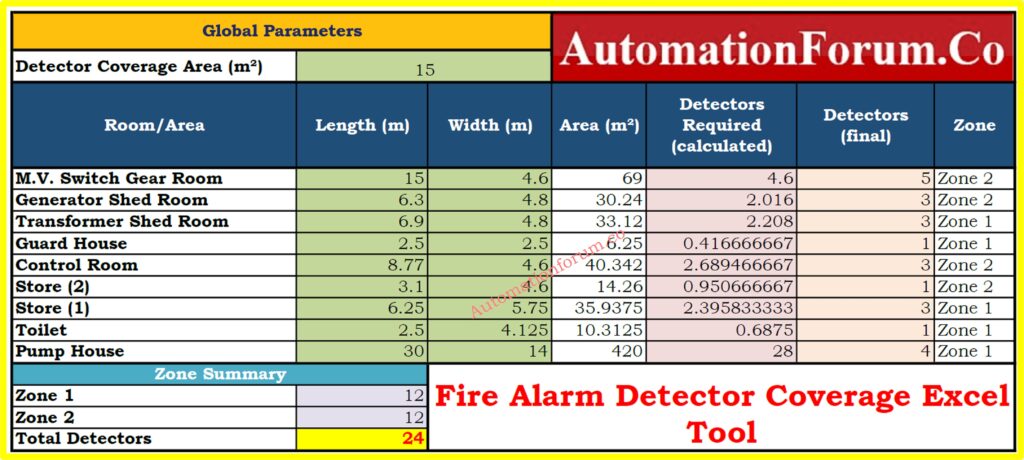
This calculator helps you:
- Quickly figure out how many detectors each room needs.
- For system drawings, give detectors to zones.
- Follow the NFPA, BS, IS, and EN codes to stay in compliance.
Click here for more Instrumentation excel Tool Resource
How to Calculate Fire Alarm Detector Coverage (Step-by-Step) ?
The Fire Alarm Detector Coverage Calculator (Excel Tool) is made for system designers, electrical engineers, and fire safety consultants. It figures out how many detectors each room or zone needs.
Step 1: Define Global Parameters
Enter the area in square meters that the detector will cover, like 15 square meters by default.
Step 2: Enter Room Dimensions
Tell us how long and wide each room or area is.
The calculator multiplies the length by the width to find the total area.
Step 3: Calculate Required Detectors
To find out how many detectors you need, divide the room’s area by the coverage area for each detector.
For safety, the calculator rounds up the answer.
Step 4: Enter Final Detector Count
If the design needs further coverage or redundancy, make changes by hand.
Step 5: Assign Zones
Put detectors in Zone 1, Zone 2, or any other zone that the project has set up.
Detailed Explanation: What is a Fire alarm control panel and how does it work?
Excel Calculator for Fire Alarm Detector Coverage
Purpose of the Detector Coverage Calculator
The calculator ensures:
- The calculator makes sure that the detector sizes are correct and meet NFPA, BS, IS, and EN regulations.
- Documentation that is free of errors and cuts down on mistakes made by hand when making a BOQ.
- Automating repetitious computations speeds up engineering design.
- Reports that are ready for an audit and pass compliance inspections by AHJ and safety inspectors.
Key Inputs Required for Accurate Detector Sizing
- Room or area dimensions (length and width).
- Coverage area per detector (default 15 square meters, adjustable).
- Room type such as control room, switchgear room, or storage.
- Zone allocation for detectors.
Outputs Delivered by the Excel Calculator
- Room area in square meters.
- The number of detectors needed is the area divided by the coverage.
- Final number of detectors with manual adjustment.
- Zone allocation set up for design drawings.
Refer the below link for the Fire Alarm Battery Size Calculator – Professional Tool for Accurate Backup Power Sizing
Supported Standards for Fire Alarm System Design
| Standard | Smoke Detector Coverage | Heat Detector Coverage | Alarm Duration Requirement |
| NFPA 72 | 37 square meters typical per smoke detector | 50 square meters per heat detector | 24 hours standby plus 5 minutes alarm |
| BS 5839 | 60 square meters per smoke detector | 50 square meters per heat detector | 24 to 72 hours standby plus 30 minutes alarm |
| IS 2189 | Mirrors BS 5839 | Mirrors BS 5839 | As per Indian fire codes |
| EN 54 | 60 square meters per smoke detector | 50 square meters per heat detector | Defines spacing and installation |
Fire Alarm Control Panel Overview: What is an FACP? (Fire Alarm Control Panel)
Use Cases Across Building Types
- High-Rise Buildings: Detectors are spread out over several levels.
- Industrial Plants: MCC, switchgear, substations, and equipment rooms.
- Hospitals have patient wards, ICUs, and diagnostic centers.
- Schools, hostels, classrooms, and labs are all examples of educational institutions.
- Shopping centers, malls, multiplexes, and IT offices are all examples of commercial complexes.
Refer the below link for the Why 3-Wire Type Fire and Gas Detectors are the Preferred Choice in Industrial Safety?
FAQs on Fire Alarm Detector Coverage
How to calculate detector coverage in a fire alarm system?
To find out how many detectors you need, divide the room area by the coverage per detector (in square meters).
For instance, a room that is 45 square meters and has 15 square meters per detector needs three detectors.
Fire Alarm System Essentials: What are the components involved in a Fire Alarm system?
What is the coverage area of a smoke detector?
- NFPA 72 says about 37 square meters.
- BS 5839 and EN 54 say that the area should be about 60 square meters.
- IS 2189 is based on BS 5839.
How many detectors are required for a 100 square meter room?
If each detector covers 15 square meters, then 100 divided by 15 = 6.66. After rounding up, this means that 7 detectors are needed.
Do standards allow adjustment for high ceilings?
Yes. As the ceiling becomes higher, the coverage is worse, therefore you might need more detectors.
Why should detectors be zone-assigned?
Zones help in troubleshooting, fire location identification, and evacuation planning.
What is the NFPA 72 coverage for smoke detectors?
In a normal setting, NFPA 72 says that one smoke detector usually covers around 37 m² (400 sq ft). The coverage may be less because of things like the height of the ceiling, things in the room, or specific uses, which means more detectors are needed.
What is the coverage of fire detection?
Fire detection coverage is the most floor space that one detector can watch over. Depending on the type of detector and the rules:
- Smoke detectors: 37 to 60 square meters
- Heat detectors cover 25 to 50 square meters.
- Beam detectors: 15 to 100 m spans in big open halls
What is the distance between fire alarm detectors?
The distance between them depends on the code:
- NFPA 72 says that smoke detectors can be up to 9 m (30 ft) apart.
- BS 5839 and EN 54 say that each smoke detector can cover an area up to 7.5 meters in radius.
- Heat detectors need to be closer together, usually 5 to 7 meters apart.
Click here for 200+ Online Instrumentation Calculators Collections
