
- What is 4-20 mA to 3-15 psi Conversion?
- Formula for Electrical-to-Pneumatic Signal Conversion
- Break down the formula:
- Example calculation
- Online Signal Conversion Calculator
- 4 – 20 mA to 3 -15 Psi Signal Conversion Chart
- Troubleshooting Common Conversion Issues
- Industry Standards for Signal Conversion
- FAQs on 4-20 mA to 3-15 psi Conversion
An instrumentation calculator for converting a standard 4-20mA signal to a 3-15 psi signal is a tool used in industrial automation and control systems. This conversion is commonly required in process control applications where different types of instruments are used to measure and control variables such as pressure, level, or flow.
The 4-20mA signal is widely used in industrial instrumentation due to its robustness and ability to transmit analog data over long distances without significant loss or interference. On the other hand, the 3-15 psi signal is a common range for pneumatic instruments, where pressure is used to transmit and control signals.
What is 4-20 mA to 3-15 psi Conversion?
- 4-20 mA signal: The industry standard for analog electrical communication between sensors, transmitters, and control systems (PLC, DCS, SCADA).
- 3-15 psi signal: The pneumatic standard used to control actuators, positioners, and legacy instruments.
The conversion ensures compatibility between electronic transmitters and pneumatic final control elements. An I/P transducer converts current (I) into pressure (P) based on a linear scale.
Formula for Electrical-to-Pneumatic Signal Conversion
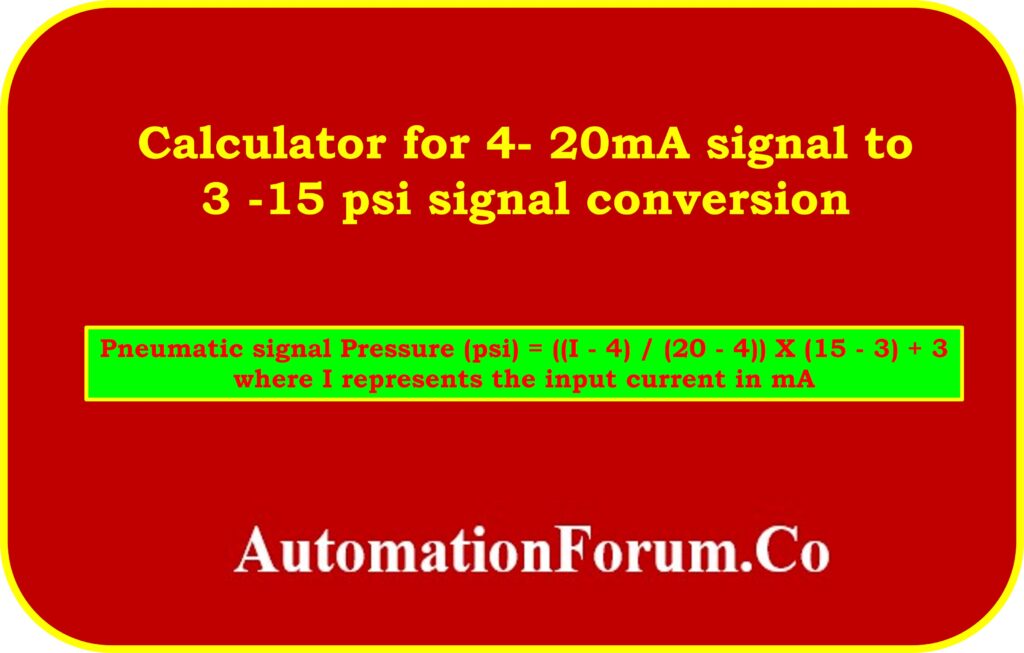
To convert the 4-20mA signal to a 3-15 psi signal, a linear conversion can be applied using the following formula:
Pressure (psi) = ((I – 4) / (20 – 4)) X (15 – 3) + 3
Where, I represent the input current in mA.
This formula calculates the corresponding pneumatic pressure signal value within the 3-15 psi range based on the input current.
Break down the formula:
- Subtracting 4 from the input current (I – 4) shifts the range from 4-20mA to 0-16mA.
- Dividing the shifted current value by the range of the input signal (20 – 4) normalizes the value between 0 and 1.
- Multiplying the normalized value by the range of the output signal (15 – 3) scales the value to the desired range.
- Finally, adding the minimum value of the output signal (3) gives the converted pressure value in psi.
Example calculation
For example, if the input current is 12.20mA, we can substitute it into the formula:
Pressure (psi) = ((12.2 – 4) / (20 – 4)) * (15 – 3) + 3
Pressure (psi) = (8.2 / 16) * 12 + 3
Pressure (psi) = 0.513 * 12 + 3
Pressure (psi) = 6.15 + 3
Pressure (psi) = 9.15 psi
Therefore, for an input current of 12.20mA, the corresponding pressure value would be 9.15 psi.
This instrumentation calculator simplifies the conversion process by automating the calculation for various input current values, allowing engineers and technicians to easily determine the corresponding pressure values in psi. This conversion enables seamless integration between instruments using different signal types and ensures accurate measurement and control in industrial processes.
Online Signal Conversion Calculator
The following instrumentation calculator will convert standard 4- 20mA signals to 3-15 psi signals.
4 – 20 mA to 3 -15 Psi Signal Conversion Chart
The below table showing the conversion of a 4-20 mA current signal to pneumatic pressure signal(3-15 psi).
| Input Current (mA) | Output Pressure (psi) | Percentage of Signal |
| 4 | 3 | 0% |
| 6 | 4.5 | 12.5% |
| 8 | 6 | 25% |
| 10 | 7.5 | 37.5% |
| 12 | 9 | 50% |
| 14 | 10.5 | 62.5% |
| 16 | 12 | 75% |
| 18 | 13.5 | 87.5% |
| 20 | 15 | 100% |
Troubleshooting Common Conversion Issues
| Problem | Possible Cause | Solution |
| Output pressure not linear | I/P converter calibration error | Recalibrate converter as per manufacturer’s instructions |
| Zero shift (incorrect 3 psi at 4 mA) | Incorrect zero adjustment | Adjust zero screw on I/P |
| Signal fluctuation | Electrical noise or pneumatic leak | Check shielding/grounding and inspect tubing |
| No output | Power supply failure or clogged nozzle in I/P | Verify loop voltage and clean air supply |
Industry Standards for Signal Conversion
- ISA S50.1 – Defines standard ranges for analog electrical signals (4–20 mA).
- ANSI/ISA-75.05.01 – Covers pneumatic instrument signals (3–15 psi).
- IEC 60381-1 – Standard for analog current signals in industrial process measurement.
- ISO 6358 – Standards for pneumatic instrumentation systems.
These standards ensure interoperability and accuracy across manufacturers.
FAQs on 4-20 mA to 3-15 psi Conversion
Why do we use 4-20 mA instead of 0-20 mA?
Because 4 mA provides a live zero, allowing fault detection (e.g., 0 mA = broken wire).
Why 3-15 psi and not 0-15 psi?
The 3 psi offset prevents valve stiction and allows for zero-checking in pneumatic systems.
How do I check if my I/P converter is calibrated?
Inject a known current (e.g., 12 mA) and verify output pressure (e.g., 9 psi). Adjust calibration if needed.
Can I directly connect a 4–20 mA signal to a pneumatic actuator?
No. You need an I/P transducer for conversion.
What happens if the loop supply voltage is unstable?
The I/P converter output will fluctuate, causing valve hunting or instability.
