Home Blog Page 14

Heartbeat Technology in Process Instrumentation – Complete Working, Diagnostics, Verification & Predictive Maintenance Guide

0
Heartbeat Technology in Process Instrumentation - Complete Working, Diagnostics, Verification & Predictive Maintenance Guide

Heartbeat Technology in Smart Instrumentation

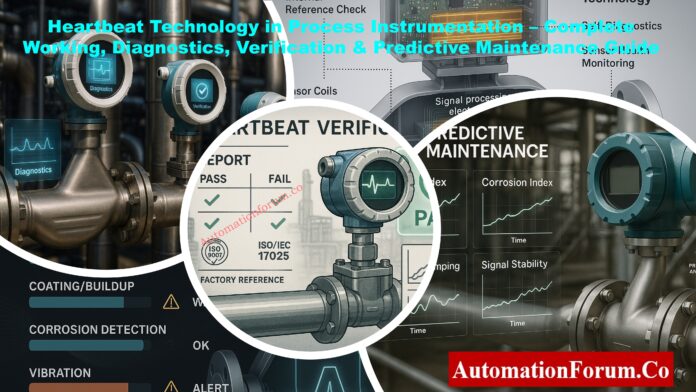
Endress+Hauser’s Heartbeat Technology is a sophisticated self-diagnostic and verification framework integrated into contemporary flow, level, analytical, and pressure instruments. Predictive maintenance, automated integrity verification, and continuous internal monitoring are made possible without removing the device from the process or disrupting plant operations.

Three Core Pillars of Heartbeat Technology
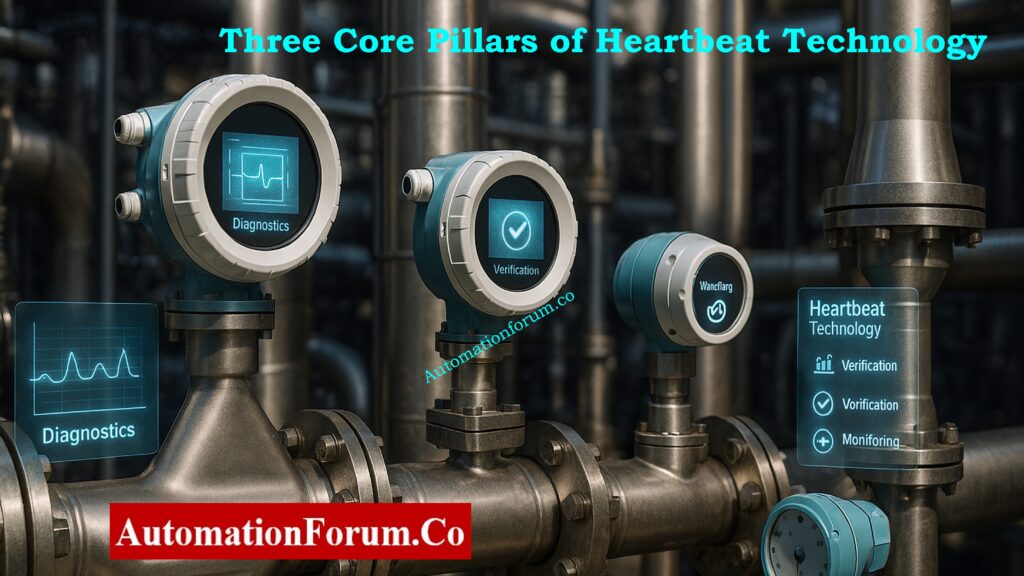
A system that constantly checks itself and automatically analyzes the health of a device, finds abnormal signals, finds installation problems, and warns maintenance teams before a measurement failure gets worse.

A built-in, traceable way to check that an instrument is still working properly and meets its original factory specifications without needing calibration tools or stopping the process.

Predictive, condition-based insights using long-term trend analysis of buildup, corrosion, sensor drift, and mechanical wear. This lets you plan maintenance before problems happen.

Instant Failure Rate (λ) Calculation – Smart Tool for Instrumentation Engineers: Failure Rate (λ) Calculator for Process Instrumentation and Industrial Maintenance

Working Principle of Heartbeat Technology
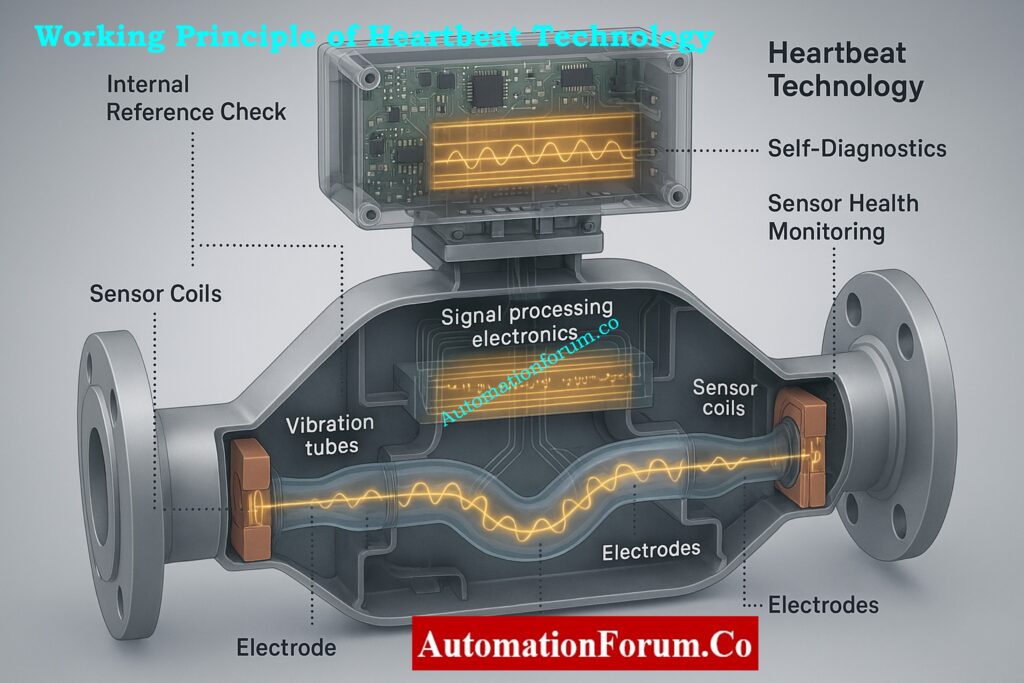
Internal, traceable reference values that reflect optimal sensor conditions are used in the manufacture of every instrument. The device can do the following thanks to these reference signatures:

  • By comparing real-time inductive characteristics to baseline values that represent factory-calibrated conditions, you can assess sensor coil performance.
  • To find early indications of coating, corrosion, or insulation failure, keep an eye on electrode and contact conductivity.
  • By comparing signal processing chains, A/D converters, and internal amplifiers to predetermined benchmark responses, you can monitor the stability of electronic circuits.
  • To guarantee measurement accuracy under fluctuating thermal loads, evaluate temperature compensation components.

Heartbeat-enabled devices perform ongoing internal diagnostics, frequently assessing over 80 to 150 internal parameters, enabling them to:

  • Determine early-stage sensor degradation before it compromises safety-critical loops or measurement accuracy.
  • Find anomalous signal patterns that point to electrode contamination, buildup, entrained air, or process turbulence.
  • Check the stability of the internal mechanical assemblies, coils, electrodes, and pick-up sensors.
  • Analyze noise levels and electrical interference patterns to verify the health of the wiring and grounding.
  • To identify mechanical stress, resonance shifts, or outside forces affecting the instrument, keep an eye on the vibration modes.

When initiated locally or via DCS/AMS:

  • The device performs a structured, algorithm-driven verification routine that checks the entire measurement chain from sensor to electronics.
  • To make sure the device still functions as it did when it was first manufactured, internal reference signals are compared to factory signatures.
  • Tube stiffness, electrode condition, coil inductance, and signal amplification response are all assessed in terms of mechanical and electronic integrity.
  • A fully traceable digital PASS/FAIL report that complies with ISO 9001, ISO 17025, and NAMUR NE 107 standards is produced.
  • Pharmaceutical, chemical, and energy applications benefit greatly from verification since it doesn’t disrupt or halt the process.

Predictive maintenance is made possible by long-term trend analysis by tracking:

  • Over time, buildup and coating accumulation raise measurement error and signal the need for cleaning.
  • corrosion development within electrodes or sensor surfaces, which aids in prioritizing replacement prior to catastrophic failures.
  • Changes in Coriolis tube stiffness and vibration damping frequently indicate wear and tear or an approaching mechanical fracture.
  • anomalies associated with the process, such as entrained gas, variations in viscosity, temperature instability, or variations in density.
Heartbeat Diagnostics - Continuous Monitoring and Early Fault Detection
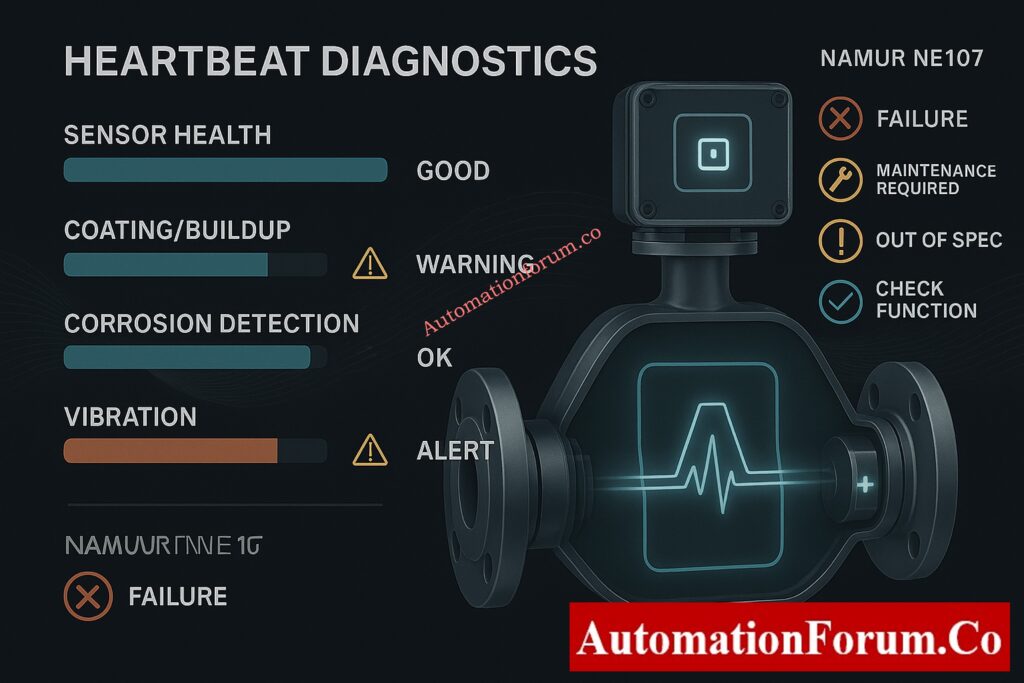
  • Buildup or coating on electrodes or sensing components that progressively lowers measurement accuracy and indicates cleaning is necessary.
  • Gas pockets or air entrainment within the flow path can skew readings and possibly harm downstream equipment or pumps.
  • Sensor surface corrosion or chemical attack can lead to progressive signal degradation and possible safety-loop malfunctions.
  • deterioration of electronics or unstable circuitry brought on by aging hardware, heat, or vibration.
  • Thermal stress or temperature overload may have an impact on sensor longevity or measurement linearity.
  • Inadequate grounding, excessive vibration, or improper sensor orientation are examples of improper installation conditions.
  • Signal quality abnormalities can be used to identify electrical noise, electromagnetic interference, or grounding problems.
  • prompt identification of unusual device and process conditions, avoiding unplanned shutdowns and failures.
  • Internal sensor health is continuously visible, allowing for quicker troubleshooting and more intelligent maintenance choices.
  • decreased possibility of measurement errors, particularly in applications involving safety instruments, dosage, and custody transfer.
  • Message classification that is unambiguous and consistent (Failure, Out of Specification, Maintenance Required, Check Function).
  • Comprehensive diagnostic logs are kept for performance analysis, compliance, and audits.

Ultimate Smart Plant Instrument Reliability & Cyber-Secure Maintenance Checklist: Advanced Integrated Field Instrument Reliability & Cyber-Secure Maintenance Checklist for Smart Process Plants

Heartbeat Verification - Online Integrity Proof Without Process Shutdown
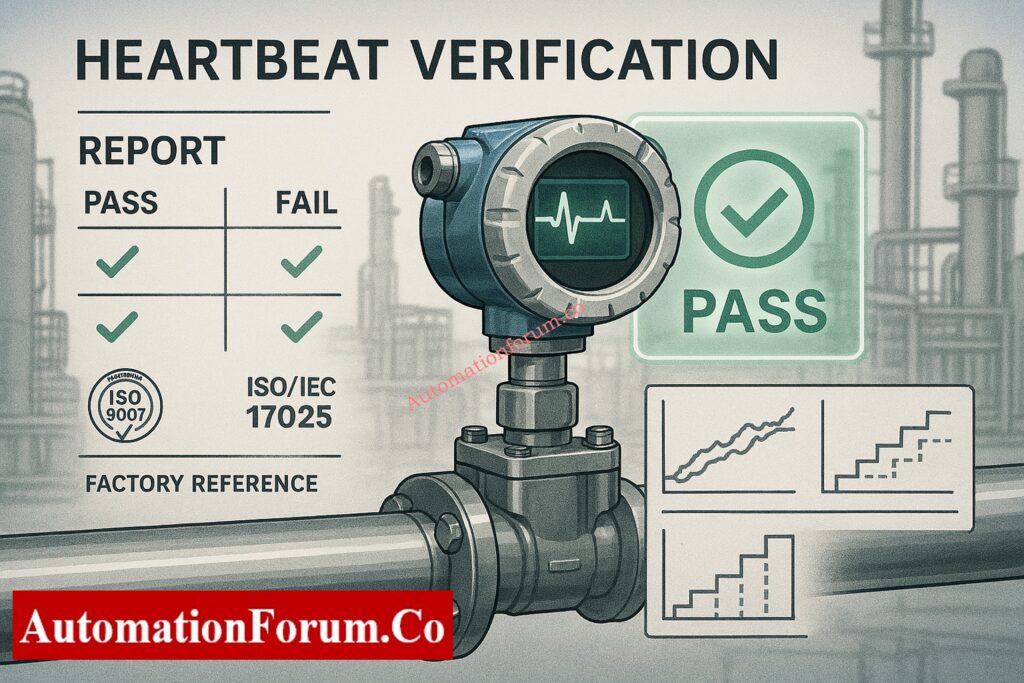
  • makes sure the device still satisfies the original manufacturer’s requirements without taking it out of service.
  • It is perfect for continuous processes because it saves time and does not require calibration setup.
  • supports GMP, FDA, and regulated industry compliance by offering fully traceable verification documents.
  • lowers lifecycle costs by reducing calibration frequency and maintenance workload.
  • enhances process reliability by supporting risk-based calibration techniques.
  • If left unnoticed, sensor fatigue or mechanical wear can develop into catastrophic failures.
  • Deviations in tube stiffness in Coriolis meters that point to corrosion, fatigue, or stress from the process.
  • Conductivity measurements are impacted by electrode wear or coating formation in magmeters.
  • Engineers can identify early electronic degradation with the aid of analog and digital signal path drift.
  • mechanical or structural abnormalities, especially in hostile or hot conditions.
Heartbeat Monitoring - Predictive, Condition-Based Optimization
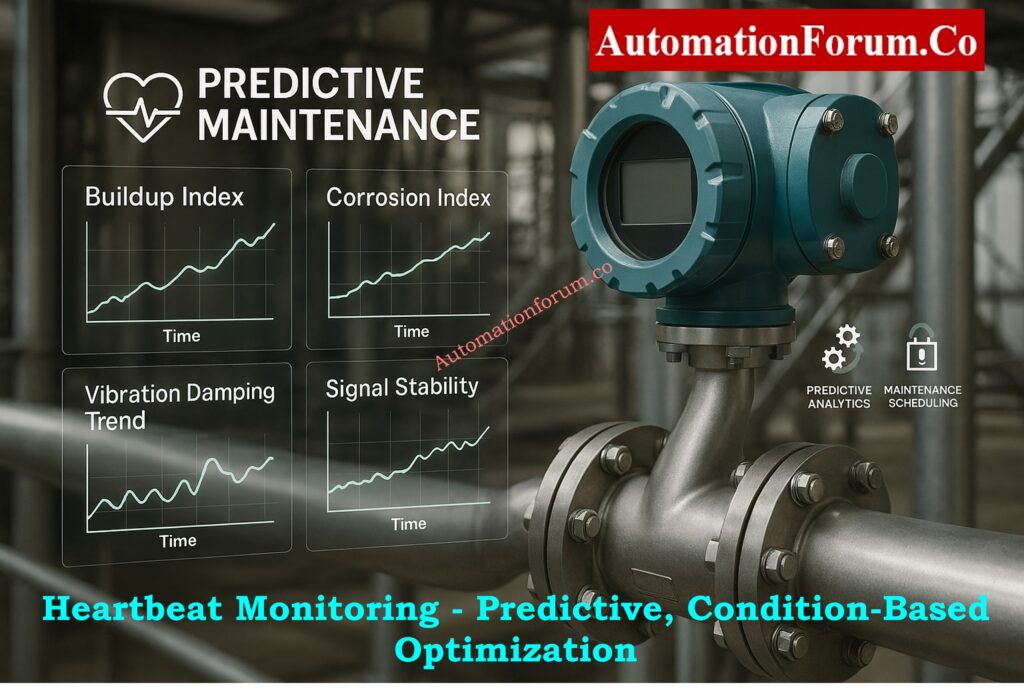
  • Buildup Index: Monitors scaling and fouling patterns that affect energy consumption and flow accuracy.
  • Corrosion Index: Extends equipment life and prevents failures by giving an early warning of chemical wear.
  • Signal Stability Index: Process disruptions such as entrained gas, cavitation, or turbulence are identified by the Signal Stability Index.
  • Process Health Indicators: Examine density, viscosity, flow behavior, and other dynamic process parameters as process health indicators.
  • reduces downtime and prevents product contamination by enabling plants to proactively plan cleaning schedules.
  • ensures that maintenance is only carried out when necessary by optimizing turnaround planning.
  • allows for early sensor replacement, avoiding unplanned shutdowns or measurement failures.
  • lowers the cost of spare inventory because instrument wear is more predictable.
  • enhances process stability and operational efficiency, particularly in environments with continuous production.

Boost Plant Reliability – Expert Cyber-Secure Instrument Maintenance Checklist: Advanced Integrated Field Instrument Reliability & Cyber-Secure Maintenance Checklist for Smart Process Plants

  • Deep-level embedded diagnostics for failure prediction and real-time device condition visibility.
  • Online verification that guarantees production continuity and audit readiness while requiring no process interruption.
  • traceable reports that support documentation and regulatory compliance and are compatible with international quality systems.
  • Future-ready maintenance strategies are made possible by the device’s built-in predictive analytics.
  • Long-term internal reference signatures guarantee consistent performance over the course of the instrument’s life.
  • NAMUR NE 107 standardized diagnostics, guaranteeing uniformity among various systems and assets.
  • seamless integration of asset management, DCS, and PLC that enhances system visibility.
  • greatly increased measurement accuracy, lowering risk in crucial processes.
  • significant decrease in unscheduled downtime due to early fault detection and repair.
  • reduced maintenance costs by doing away with pointless field service and calibration visits.
  • longer calibration intervals, particularly in regulated sectors where documentation is crucial.
  • increased safety, especially in situations where a malfunctioning instrument could endanger people or the environment.
  • Improved process transparency allows operators to swiftly make well-informed decisions.

Perfect Your Fieldbus Installations – EPC Engineer’s Complete Best Practices Guide: Foundation Fieldbus Installation and Best Practices – Complete Guide for EPC and Maintenance Engineers

Applications of Heartbeat Technology Across Industries
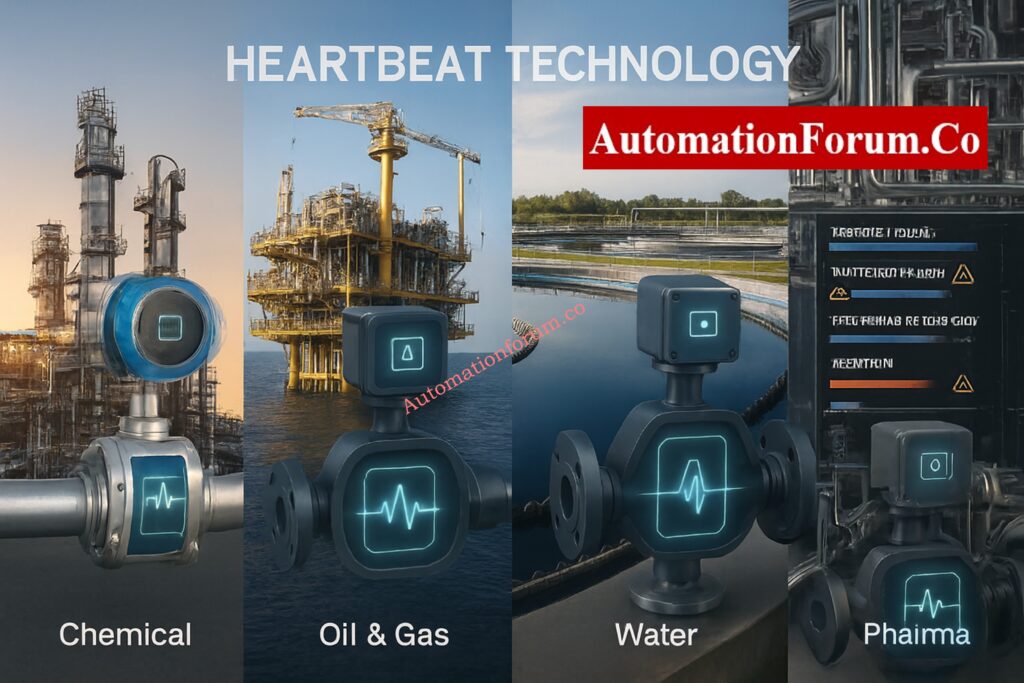
Chemical & Petrochemical

  • In aggressive media, accurate measurements are maintained through real-time buildup and corrosion monitoring.
  • Safety instrumented functions (SIF) are more reliable when sensor drift is detected early.

Oil & Gas

  • Continuous verification signals ensure the accuracy of oil and gas custody transfers.
  • Predictive diagnostics is useful for offshore installations because maintenance access is restricted.

Water & Wastewater

  • Measurement deviation is avoided by flowmeters that detect sediment accumulation.
  • In high-volume metering applications, fewer calibration requirements result in lower costs.

Food & Beverage

  • Strict adherence to quality standards is ensured by hygienic process monitoring.
  • Forecasting fouling in milk, syrup, and viscous products decreases downtime and increases batch consistency.

Pharmaceutical

  • Regulatory audits are easily supported by pharmaceutical GMP-compliant verification reports.
  • Product integrity is guaranteed by accurate ultrapure media measurement.

Power & Energy

  • Monitoring cooling water flow guarantees boiler and turbine safety.
  • Pump failures and system outages can be avoided with the use of predictive alerts.

Calculate PFDavg Fast – Complete SIL Verification Guide + Free Online Tool: SIF PFDavg / SIL Verification – Complete Guide + Online Calculator

  • Verification checks integrity but not absolute accuracy, so it is not a complete replacement for calibration.
  • Multi-brand interoperability is limited because it is only available in Endress+Hauser devices.
  • higher initial cost, but investment is usually outweighed by lifecycle savings.

PLC Control Panel Health Check – Essential Running Inspection Checklist: Running Inspection Checklist of PLC Components in Control Panels

  • Additionally, Heartbeat Monitoring allowed the maintenance team to minimize needless manual inspections and optimize cleaning schedules by quantifying the rate of buildup progression.
  • Changes in vibration stiffness signaled approaching tube fatigue, allowing for a safe replacement prior to failure.
  • Additionally, the diagnostics showed unusual vibration patterns brought on by upstream process disruptions, which enabled engineers to fix piping vibration problems and increase the new sensor’s lifespan.
  • Verification reports made it possible to increase calibration intervals from six months to twenty-four months, which significantly decreased costs.
  • By offering traceable evidence of instrument integrity and cutting down on audit preparation time, the digital verification history improved GMP audit documentation.
  • preventing pump trips and unplanned outages by keeping an eye on detected entrained air and particulate load.

Decode HART Transmitter Health – What Your Field Device is Really Saying: HART Transmitter Diagnostics: What Your Field Device is Telling You

Plants need the following tools as industrial automation advances toward Industry 4.0:

  • Self-diagnosing
  • Predictive and smart
  • Capable of real-time reporting
  • Easily integrated into digital ecosystems

Digital twins, sophisticated analytics, and intelligent maintenance systems are all supported by Heartbeat Technology, which turns instruments into self-verifying, health-aware assets.

By combining diagnostics, verification, and predictive monitoring into a single intelligence layer, Heartbeat Technology makes it possible for plants to run more safely, reliably, and affordably. It is a fundamental technology for both the future digitalized process industries and contemporary smart instrumentation.

Test Your Temperature Transmitter Skills – Advanced Troubleshooting Challenge: Temperature Transmitter Troubleshooting Quiz – Advanced Diagnostics for Industrial Applications

Heartbeat Technology in Process Instrumentation
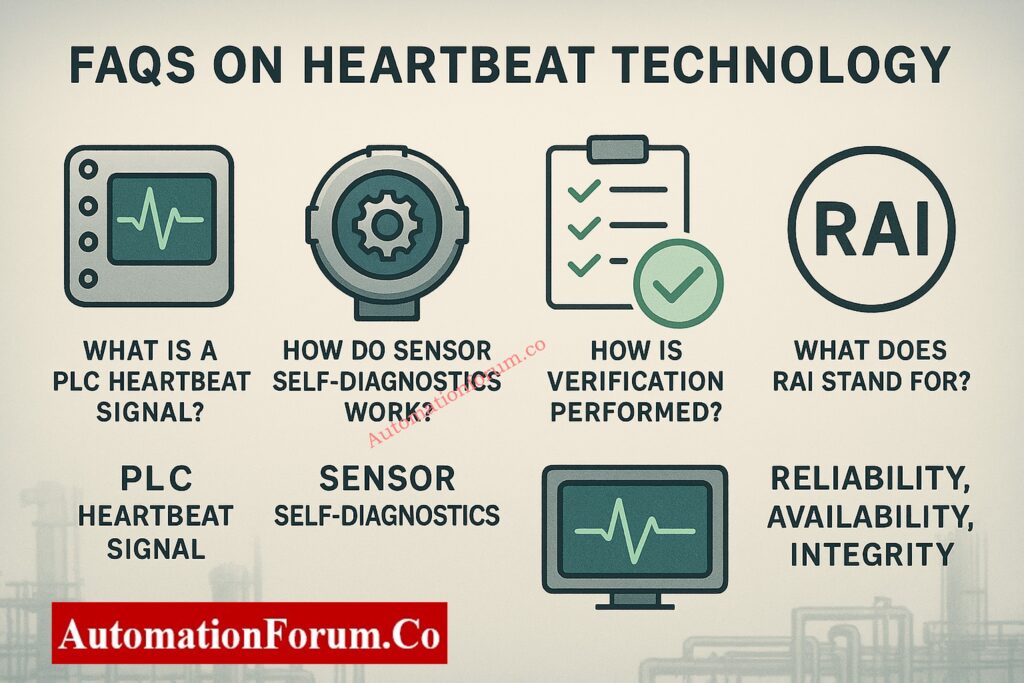
Endress+Hauser created Heartbeat Technology, a sophisticated built-in diagnostics and verification system that continuously checks an instrument’s internal health, confirms its integrity when needed, and provides predictive maintenance information without interfering with measurement.

Key performance goals in process industries are referred to as RAI (Reliability, Availability, and Integrity). By enhancing instrument reliability through self-diagnostics, expanding availability through online verification, and preserving integrity through traceable internal reference checks, Heartbeat Technology directly supports RAI.

In a PLC, a heartbeat signal is an alternating, periodic digital signal that verifies the integrity of communication between two systems or devices. Alarms or safety measures are triggered if the heartbeat stops, indicating a communication breakdown or device malfunction.

The term “heartbeat detector technology” describes devices (typically infrared, microwave, or radar-based) that use micro-vibrations from breathing and heartbeats to identify the presence of a living person. The phrase can also refer to algorithms used in instrumentation that use periodic diagnostic pulses to determine the “presence” or status of a device.

The key signal, parameter, or diagnostic indicator that represents the machine’s operational health such as vibration trend, temperature stability, or critical process variable is referred to as the “heartbeat” of a process machine. The phrase also describes ongoing self-diagnostics that maintain the machine’s safe operation in contemporary smart instrumentation.
Master Control Valve Fault-Finding Advanced HART & Fieldbus Diagnostics Quiz: Closed-Loop Control Valve Troubleshooting: HART, Fieldbus and Diagnostics Skills Quiz
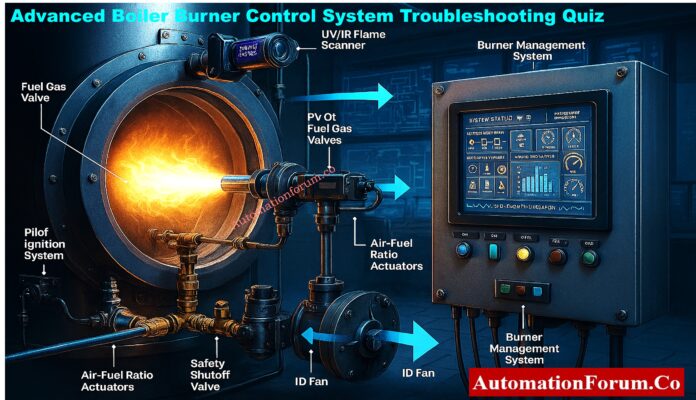
Advanced Boiler Burner Control System Troubleshooting Quiz
0
Boiler Burner Control System Troubleshooting - quiz

In process plants, boiler burner control systems are the most important parts for safety and optimizing combustion. They make sure that ignition is reliable, flame monitoring is consistent, fuel–air ratios are accurate, purge execution is done, and safe shutdown measures are taken. It’s important to fix these systems because problems like flame loss, scanner faults, false trips, air/fuel imbalance, or interlock issues can make things unsafe, cause unscheduled shutdowns, and lower efficiency. Engineers need to be able to read BMS logic, adjust combustion parameters, find permissive failures, check the integrity of the purge, and deal with problems with ignition or flame instability right away. Learning how to fix burners makes the factory safer, keeps it running, and makes sure it follows strict industrial safety rules.

Boiler Burner Control System Troubleshooting

Advanced Boiler Burner Control System Troubleshooting Quiz
Get ready to put your boiler burner troubleshooting skills to the test with real-life situations that even experienced engineers find hard. This quiz goes into great detail about BMS logic, flame detection, purge cycles, and problems with combustion sequencing. These questions will help you become more accurate at diagnosing problems with utility or process boilers and give you more confidence in fixing burner problems that are very important.
1 / 25

Burner shuts down due to low atomizing pressure. Why is this critical?

2 / 25

Excess O₂ at low loads. Why?

3 / 25

A BMS with redundant scanners rejects both signals. Likely issue?

4 / 25

Boiler refuses to restart after trip due to purge not available. Which cause fits?

5 / 25

No flame signal despite stable combustion. Which fault applies?

6 / 25

CO spikes during quick load reduction. Key cause?

7 / 25

Pilot flame trips at high load. Why?

8 / 25

Boiler fails to reach high fire. What best explains this?

9 / 25

Burner modulating motor oscillates continuously. Root cause?

10 / 25

Purge time completes too quickly. Likely issue?

11 / 25

Boiler trips due to “False Flame” before startup. What is the most common cause?

12 / 25

Main flame proven, but BMS shows flame instability. Most probable cause?

13 / 25

Pilot flame establishes but main flame fails. Which scenario fits?

14 / 25

BMS cannot prove airflow even though FD fan is at full speed. What could cause this?

15 / 25

A Low-NOx burner shows high CO emissions. Which issue is most likely?

16 / 25

The boiler trips immediately after main flame establishment due to high furnace pressure. Root cause?

17 / 25

Flame flicker occurs during load changes. What is a typical cause?

18 / 25

A boiler refuses to ignite even though pilot gas pressure is normal. Which key element is suspect?

19 / 25

During purge, airflow is proven but purge does not start. Which scenario fits?

20 / 25

A burner with parallel positioning system shows rich combustion. Which fault is most likely?

21 / 25

The main gas valve fails to open during the light-off sequence. Which BMS permissive is most critical?

22 / 25

A boiler repeatedly trips on low furnace draft. Which root cause is most common?

23 / 25

The BMS trips after ignition because the flame is not proven within the required time. Which issue is most likely?

24 / 25

A UV flame scanner shows intermittent flame failure during stable operation. What is the most probable cause?

25 / 25

During startup, a boiler fails to enter the purge sequence. Which condition is most likely missing?

Your score is

The average score is 56%

0%

Access 1000+ MCQs tailored for instrumentation engineers: Instrumentation and Process Control Quiz Hub – 1000+ MCQs for Engineers
#BoilerMaintenance #BurnerManagementSystem #BMS #CombustionControl #IndustrialBoilers #ProcessIndustry #FlameScanner #PurgeCycle #Instrumentation #PlantSafety #UtilityOperations #AutomationEngineering

Why Control Valve Characteristics Matter in EPC Instrumentation and Control Engineering

0
Why Control Valve Characteristics Matter in EPC Instrumentation and Control Engineering

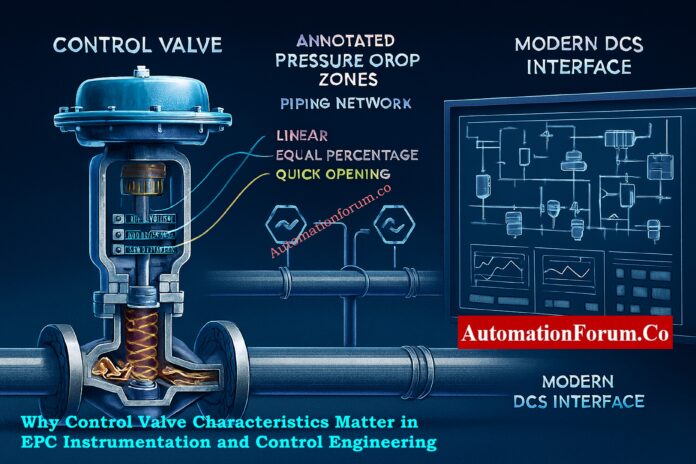
Many engineers don’t realize how important it is to choose the right control valve characteristic for process performance. EPC teams commonly focus on things like the right size of the valve, the right material for the actuator, the right torque for the actuator, and the right positioner. However, the characteristic curve is often not given as much attention. But in the end, the characteristic determines how the valve works under different conditions, how the flow varies when its path changes, and how the whole control loop works over time.

A PID controller that is finely tuned can’t make up for a valve characteristic that was chosen incorrectly. When the characteristic and the system dynamics don’t match, the valve acts in an unpredictable way, which can cause oscillations, overshoot, slow response, unstable control, higher energy use, and shorter equipment life.

Understanding What Valve Characteristics Actually Represent

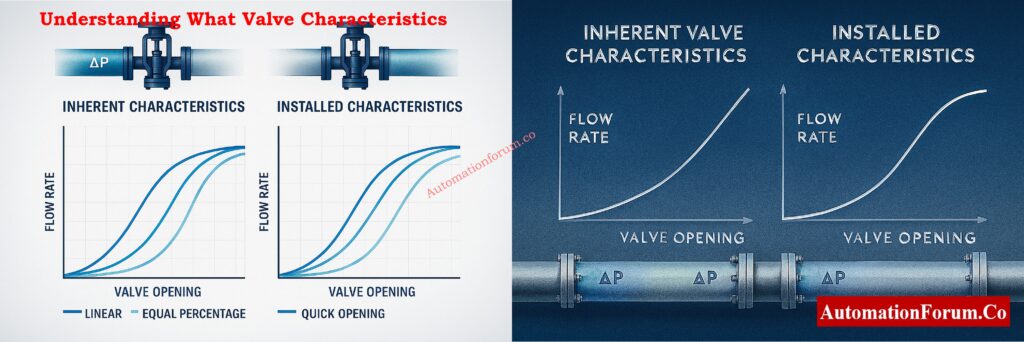
A control valve characteristic describes the relationship between valve travel and flow through the valve. Manufacturers provide inherent characteristics measured under laboratory conditions. These intrinsic curves assume that the differential pressure across the valve stays the same, which is not usually the case in real industrial processes.

Once a valve is installed in a pipeline, pump system, or steam distribution header, the pressure drop across it changes continuously with the process flow, equipment conditions, and control demand. These dynamic variations reshape the valve response into what is known as the installed characteristic.

For EPC engineers, the installed characteristic is the reality. It determines actual process stability, loop gain, resolution near the seat, and the ability to maintain control across the operating range. Therefore, characteristic selection must be based on installed behavior rather than catalog curves.
Correct Sizing Steps, Efficiency-Driven Sizing Guide, Cv Sizing Simplified: How to Properly Size Control Valves for Maximum Efficiency?

Inherent characteristics represent the geometric relationship between valve plug position and flow under constant pressure. Installed characteristics represent the real functional response under varying system pressures.

A linear valve may appear predictable in the vendor’s datasheet. Yet in a system where pump head increases at lower flow rates or where friction losses change significantly with flow, the same linear valve may behave as if it were quick opening. This makes the flow alter suddenly and makes the loop less stable.An equal percentage valve may also seem like a logarithmic function in its natural state. However, when put in a steam system where the pressure drop changes a lot with the load, its logarithmic behavior works well with the system’s dynamics and keeps control stable.

Understanding this difference is fundamental for EPC designers who must predict the actual installed response during the design phase.
Download Ready Tools, Must-Have Calculators, Essential Engineering Excel Sheets: Top Essential Control Valve Calculators and Excel Tools for Instrumentation Engineers

Exploring the Three Main Control Valve Characteristics in Depth

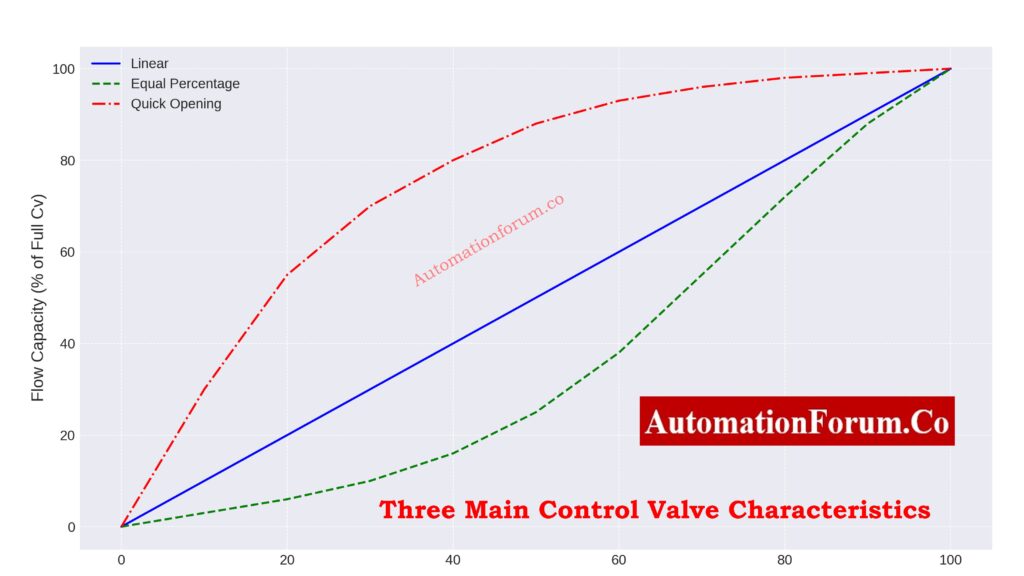
A linear characteristic provides equal increments in flow for each incremental change in valve travel. If the valve opens thirty percent, flow increases roughly thirty percent.This characteristic works best when pressure drop across the valve remains relatively stable.

Linear valve trims are commonly used in balanced water circuits, level control systems, and applications where pressure variations are small. They provide predictable and proportional control, making them suitable for processes with stable hydraulics.

But linear trims don’t work well in systems where the pressure difference across the valve changes a lot with flow. In these situations, linear trims act strangely when the apertures are small.

The equal percentage characteristic is the most widely applicable for modern process control. With this curve, each incremental valve travel produces a constant percentage increase in flow. This gives you a logarithmic performance that lets you control the flow very precisely near the seat and lets you make bigger flow changes as the valve opens wider.

Equal percentage valves are preferred for steam systems, gas flow control, heating applications, wide turndown processes, and applications where differential pressure varies significantly with flow. They naturally compensate for the changing pressure drop across the valve.

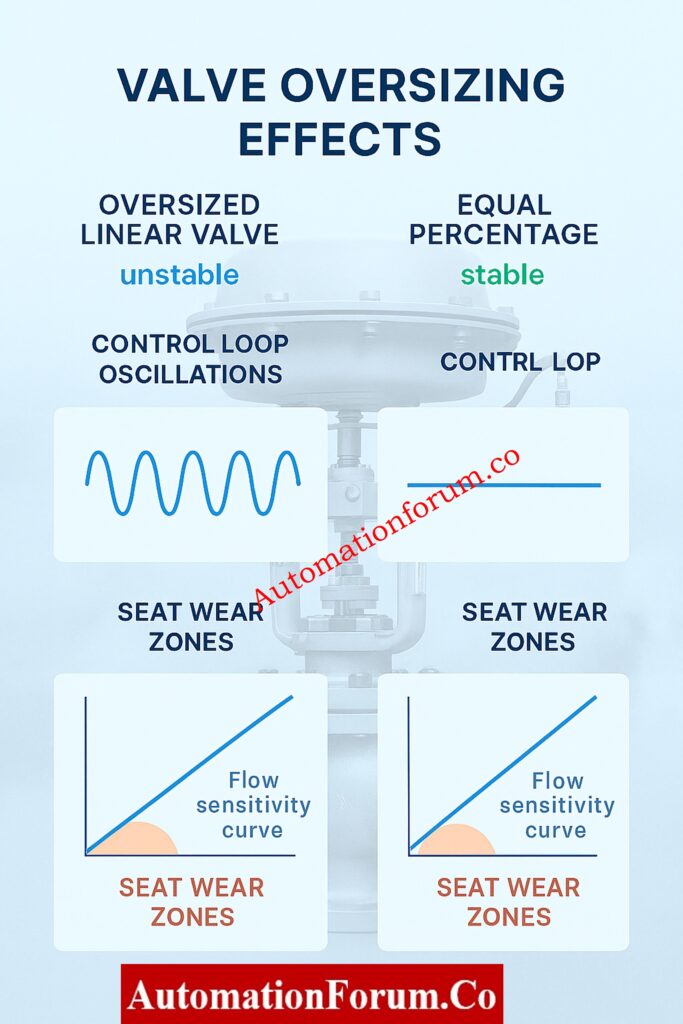
One of the strongest engineering advantages of equal percentage valves is their tolerance to oversizing. EPC engineers often end up selecting the next standard valve size due to fouling margins, safety factors, or limited availability. Equal percentage valves maintain controllability even when oversized, unlike linear valves which tend to lose stability.

Quick opening trims deliver maximum flow with very little valve travel. They are designed for on off service, emergency shutdowns, bypasses, relief applications, and rapid discharge requirements. Quick opening valves are not suitable for modulating control loops because their extreme sensitivity at small openings makes precise regulation impossible.

EPC engineers typically specify quick opening trims only for isolation, safety instrumented functions, depressurization tasks, and other applications where modulating control is not required.
Bench Set Importance, Actuator Setup Essentials, Why Bench Set Matters: Why is Control Valve Actuator Bench Set Important ?

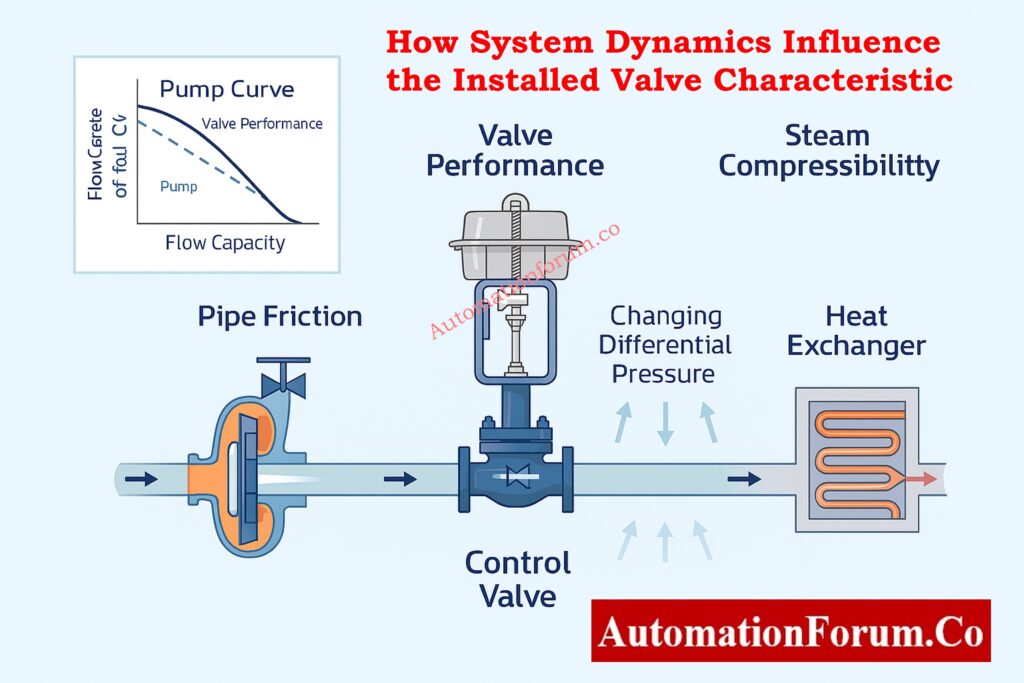
System dynamics play an enormous role in shaping the final installed characteristic. Ignoring these dynamics almost always results in incorrect characteristic selection.

Dynamics Influence the Installed Valve Characteristic

In centrifugal pump systems, head decreases with increasing flow and increases at lower flows. This means the differential pressure across the control valve increases as flow decreases. This effect can turn a linear valve into an extremely sensitive device at low loads.

As the flow varies, frictional losses in the pipeline modify the available pressure drop at the valve in a big way. This changes how the control works and moves the installed curve.

PST Explained Simply, Safety Valve Testing Guide, Ultimate PST Overview: What is Partial Stroke Test (PST)? A Complete Guide for Shutdown and Control Valves

Steam is a fluid that can be compressed and whose pressure changes with the load.  The pressure drop across the control valve reduces as heat load increases. Equal percentage valves closely align with these variations, producing smooth control in steam temperature applications.

Heat exchangers cause large variations in primary side pressure as secondary load changes. Equal percentage valves complement these changes by maintaining stable loop gain.

Valve authority represents how much of the system pressure drop is actually available across the valve. Low authority indicates an oversized or weakly dominant valve. Equal percentage valves are more stable in low authority systems.
Positioner Benefits, Boost Accuracy Instantly, Why Every Valve Needs One: Why You Should Use Control Valve Positioners?

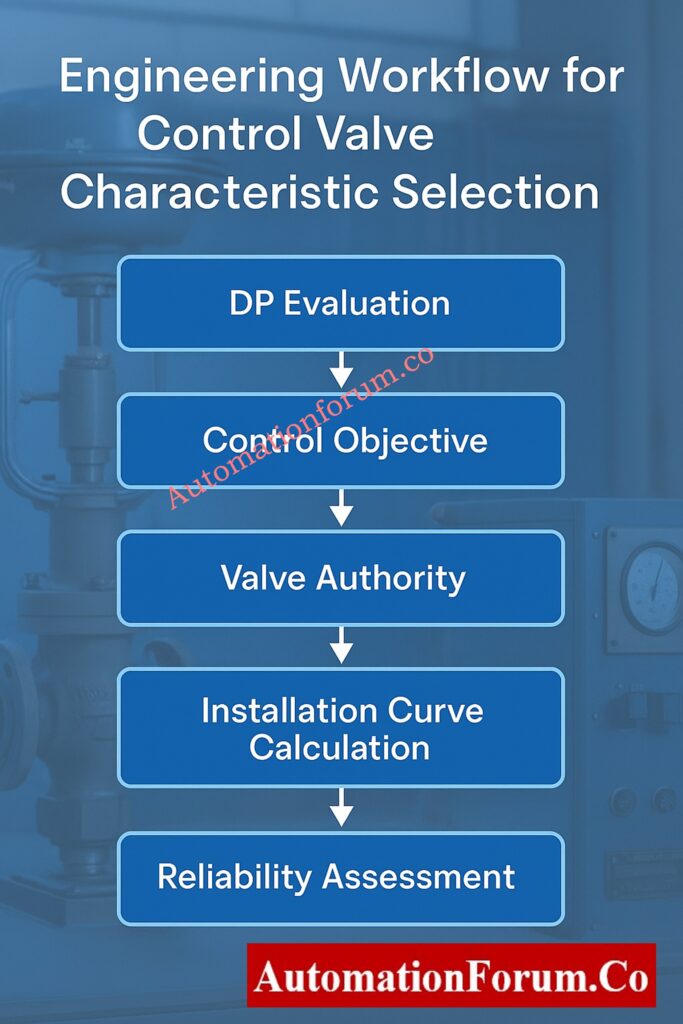
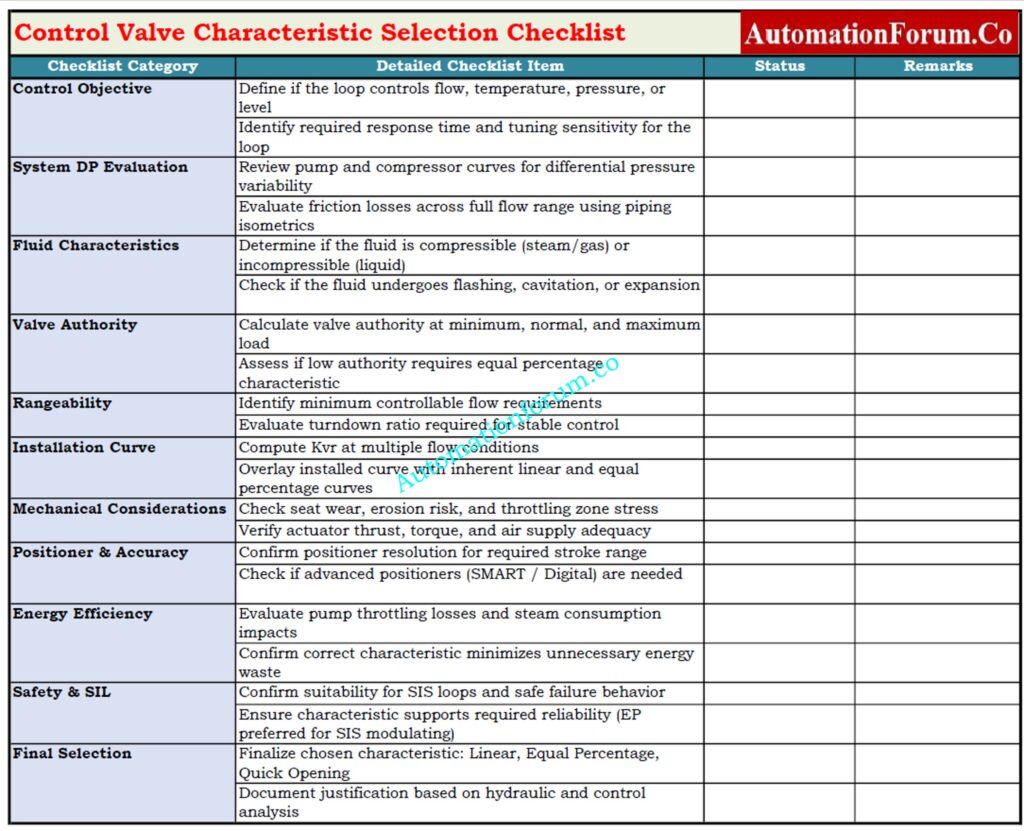
Engineering Workflow for Selecting the Correct Control Valve Characteristic

Understand how differential pressure across the valve changes with flow by reviewing pump curves, steam pressures, and friction losses.
This helps you guess whether the valve will work well or become too sensitive in certain situations.

To figure out the right modulation style and accuracy, you need to know what the control loop is for.

Matching the characteristic to the process variable keeps the dynamics stable and makes tuning easier.

Must-Have Accessories, Boost Valve Reliability, Process-Critical Add-Ons: Essential Control Valve Accessories for Reliable Process Control

Conditions

To find out how much control the valve has over the total system pressure drop, calculate its authority.

Equal percentage trims are good for low authority loops because they keep the gain the same even when the ΔP changes.

To get a better idea of how well something works, calculate Kvr at different flow rates.

When you compare these values to built-in trim curves, you can find the one that gives you the most proportional response.

Before you finish the trim, check the risk of seat wear, the risk of erosion, the size of the actuator, and the accuracy of the positioner.

In applications with high energy or changing pressure, equal percentage trims usually last longer.
Stop Valve Hunting, Root Causes Identified, Hunting Explained Clearly: What are the main causes of control valve hunting?

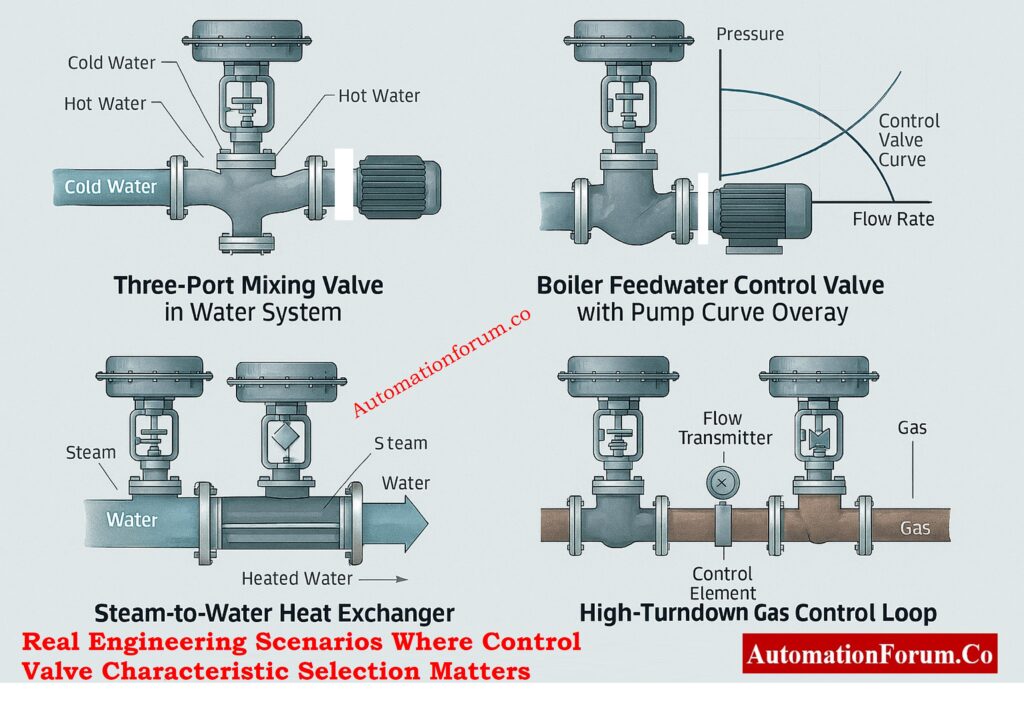
Real Engineering Scenarios Where Control Valve Characteristic Selection Matters

Most of the time, these systems work with a stable ΔP, so linear characteristic valves are best for predictable modulation.

A linear trim makes sure that the temperature is controlled smoothly and that the control loop isn’t too sensitive.

At low flows, the pump head rises quickly, which causes big changes in ΔP across the valve.

Equal percentage trims give you more control in the low-lift area and stop instability near the seat.
Instant Fix Guide, Real-World Troubleshooting, Solve Non-Responsive Valves Fast: Field Troubleshooting Guide: Control Valve Not Responding in Process Area

As the load changes, the pressure of the steam changes all the time, which has a big effect on ΔP across the valve.

Equal percentage trims match these changes and help keep the outlet temperature stable without any fluctuations.

ΔP is hard to predict across the whole operating envelope because gas can be compressed and flows can be very wide.

Equal percentage trims give you precise control at both very low and very high flows, which keeps the loop running smoothly.
Cv Importance Explained, Why Cv Matters, Accurate Sizing Starts Here: Why Measuring Control Valve Cv is Essential for Proper Valve Sizing ?

Oversizing Affects Linear and Equal Percentage Valves Differently

In EPC work, it is common to oversize things.When linear valves are too big, they lose their fine resolution. Small changes in the valve can cause big changes in the flow. This leads to cycle hunting, overshooting, and loops that aren’t stable

Even when they are too big, equal percentage valves keep great resolution close to the seat. The logarithmic shape makes it easy to control low flows and wide flows. This makes equal percentage much stronger in real plant conditions.
Leakage Class Guide, Full Testing Standards, Leakage Type Breakdown: Control Valve Leakage Testing, Types, and Calculation Standards

The characteristics of the control valve have a direct effect on the loop gain, which is what decides how quickly the control valve reacts to changes in the process variable. When the characteristic doesn’t match, loop gain changes in an unpredictable way across the operating range. This makes the system behave erratically when the setpoint changes or there are disturbances.Equal percentage trims make the gain profile more even, which is especially helpful in systems with changing pressure drop. This helps keep proportional-integral-derivative control performance stable. Linear trims only work well when the loop gain is stable and predictable for all loads.

Choosing the right characteristic for liquid services with big pressure drops can help keep cavitation or flashing from happening. Equal percentage valves let you control the flow reduction better when you throttle, which lowers the chance of a sudden pressure drop inside the valve body. If you use linear trims in areas with a lot of pressure drop, the valve may get too close to cavitating conditions, especially when it is moving slowly. Choosing the right characteristic reduces mechanical damage and makes the valve last longer.

Engineers can use predictive modeling tools like installed gain curves, dynamic simulations, and Kvs-to-Kvr mapping to figure out how the valve will work across the whole range. Installed gain analysis is essential in EPC projects because it reveals nonlinearities, dead zones, excessive sensitivity, or poor resolution before the valve is installed. This makes commissioning easier, keeps loop tuning stable, and cuts down on the need for later redesign or rework.

The control system has to make up for wrong valve characteristics by using aggressive PID tuning.This causes the system to oscillate a lot, go too far, and become unstable during transients. Control engineers often change the tuning instead of fixing the real problem, which is that the valve characteristic doesn’t match. Choosing the right characteristic makes tuning much easier and helps the loop work faster and more consistently.

Practical Checklist for EPC Engineers Before Finalizing Valve Characteristics

A structured checklist makes sure that the same characteristics are chosen for all EPC projects. Engineers should verify system pressure variation, fluid type, control objective, turndown requirements, installed gain profile, authority level, actuator capability, process dynamics, and maintenance constraints. Using this checklist prevents overreliance on vendor defaults and ensures each valve is matched precisely to its operational environment.

Control valve selection depends on fluid type, operating pressure and temperature, required flow rate, valve authority, rangeability, and the process control objective. Engineers also consider pressure drop, material compatibility, actuator capability, trim design, and the valve’s ability to avoid cavitation, flashing, or noise issues.

A valve characteristic defines how flow changes in relation to valve travel. It shows the percentage change in flow for a given percentage change in opening. Linear, equal percentage, and quick opening are all common types of valves. Each one works best with a different type of system pressure.

A characterized control valve uses a plug, ball, or trim that is shaped in a certain way to create a flow curve that is easy to predict, like equal percentage or linear. This ensures stable modulation even when the valve body alone would not produce an ideal control characteristic.

Stop Valve Passing, Post-Overhaul Troubleshooting, Full Root-Cause Breakdown: How to Troubleshoot a Control Valve Passing Problem after Overhauling: Complete Root Cause Analysi

Choose a valve based on the control goal, the expected pressure drop, the properties of the fluid, the accuracy needed, and the turndown.Make sure that the valve’s characteristics match how the system works and that the actuator is the right size, made of the right materials, and works well when installed.

Control valve sizing uses Cv (or Kv) equations that relate flow rate, fluid properties, and differential pressure. After calculating the required Cv, engineers select a valve with a catalog Cv slightly higher and verify pressure drop, noise, cavitation risk, and control range.
Key Performance Metrics, Critical Valve Parameters, Engineer’s Performance Guide: Essential Control Valve Performance Parameters

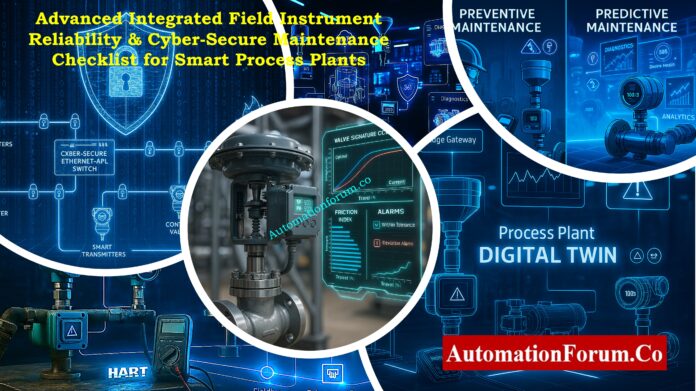
Advanced Integrated Field Instrument Reliability & Cyber-Secure Maintenance Checklist for Smart Process Plants

0
Advanced Integrated Field Instrument Reliability & Cyber-Secure Maintenance Checklist for Smart Process Plants
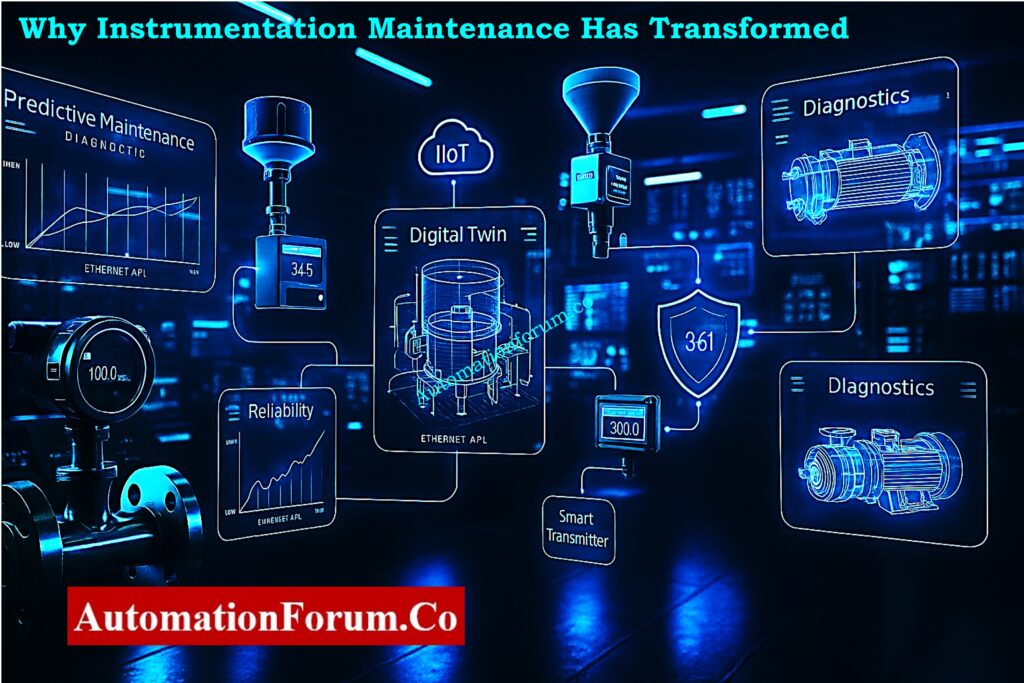
Why Instrumentation Maintenance Has Transformed

The fast digital revolution of process industries has made a big difference in how instrumentation maintenance is done. Calibration, loop checks, and troubleshooting were the only things that traditional maintenance techniques focused on. Today’s smart plants need a single approach that includes predictive diagnostics, compliance with cybersecurity standards, digital twins, IIoT-enabled sensors, cloud analytics, remote monitoring, and SIL lifecycle management.
Is Your DCS Truly Secure? Here’s What Every Engineer Must Check Today: DCS Cybersecurity: Mitigating Risks in Industrial Automation

Instrumentation maintenance teams are now responsible for smart transmitters, digital positioners, radar level devices, Coriolis mass flowmeters, wireless instruments, devices that work with HART-IP/PROFINET/Modbus TCP, and new technologies like AI-powered anomaly detection, condition-based maintenance (CBM), and built-in self-diagnostics (NE107). As machines get smarter, the ways we keep them running must change as well.

This article has a full deep-dive guide called “Advanced Integrated Field Instrument Reliability & Cyber-Secure Maintenance Checklist for Smart Process Plants (2025 Edition).” A modern framework that helps professionals who work on instrumentation improve dependability, avoid unplanned downtime, keep cybersecurity intact, and make sure they follow standards for a long time.

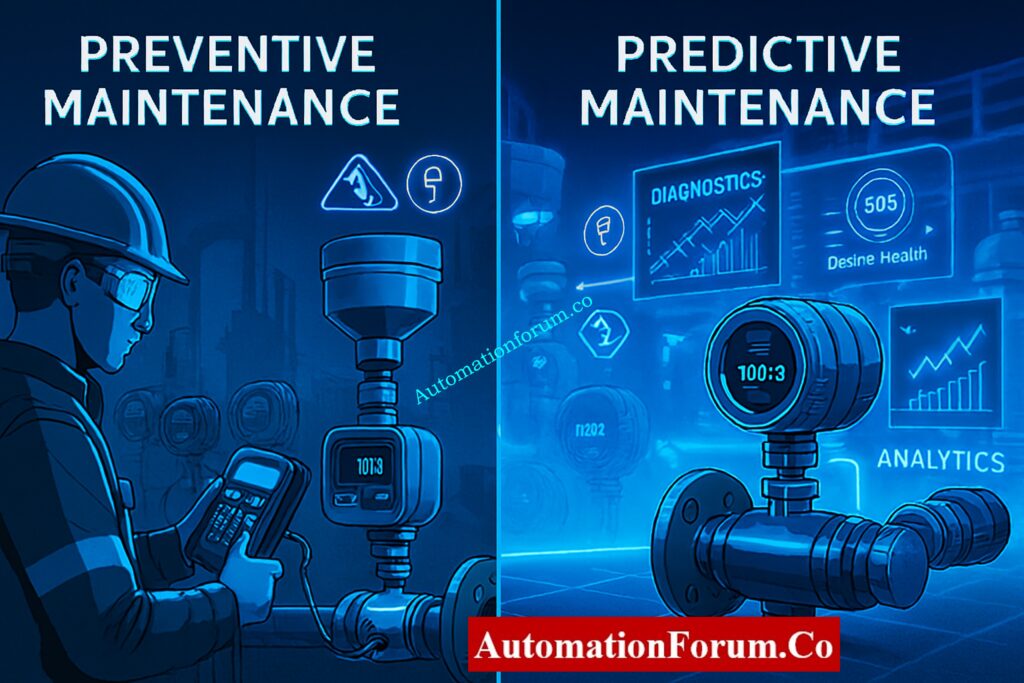
From Preventive to Predictive Maintenance

In the past, maintenance was mostly done with specified calibration intervals and regular overhauls. This made sure that the system was generally reliable, but it also meant that maintenance was often needed when it wasn’t needed or breakdowns were ignored between intervals. 

Modern smart instruments now offer: 

  • Advanced diagnostics that can find drift, process influence, sensor blockage, and changes in internal health.
  • Onboard analytics that can look at how stable measurements are, how quickly they respond to changes, and how changes in the environment affect them.
  • Digital signatures that check the integrity of the device and make sure that the configuration parameters have not been changed.
  • Performance indications based on firmware that show possible memory problems, aging components, and signal-processing errors.

Because of these improvements, facilities can move toward predictive and condition-based maintenance, where real-time health data guides decisions. This will cut down on downtime and wasteful calibration tasks.
PLCs Are the New Target – Protect Them Before Hackers Find You: How to Safeguard PLCs Against Cyber Attacks in Industrial Networks ?

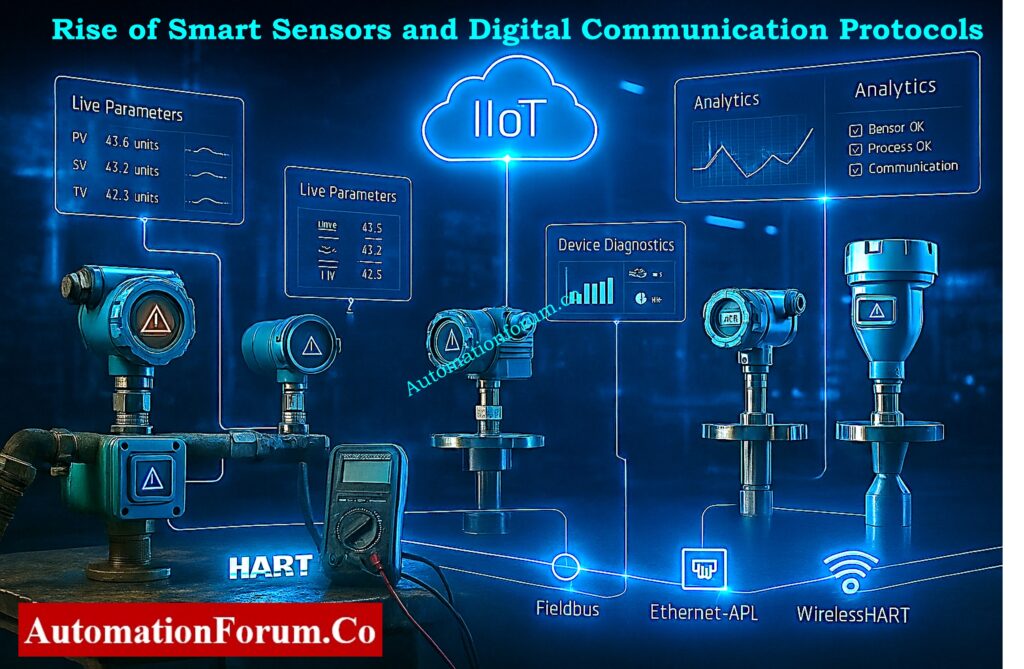
Rise of Smart Sensors and Digital Communication Protocols
  • Remote configuration and diagnostics, reducing field exposure and enabling centralized troubleshooting.
  • High-resolution data lets you keep a close eye on how processes work and how well devices work.
  • Better asset analytics that give reliability teams useful information about failures and energy use.

Now, maintenance engineers need to know more than just how sensors work. They also need to know about digital communication problems, parameter mapping, power distribution, and network diagnostics.
SCADA Attack Surface Is Growing – Secure It With This 30-Point Checklist: SCADA Security Checklist: 30+ Essential Tips for Securing Critical Infrastructure

Integration with IIoT, Edge, and Cloud Ecosystems

More and more, modern factories are using IIoT ecosystems that include edge gateways, cloud analytics, data historians, and digital twins.
These technologies depend on:

  • Accurate, validated device data to make sure that analytics and predictions are reliable.
  • Stable instrument configuration stops tags from acting differently or data quality problems.
  • Cyber-secure device communication protects plant networks against illegal access.

As IIoT grows, keeping instruments in good shape is very important for making sure that data is reliable, devices work well, and field equipment can connect to digital platforms without any problems.
Your I/O Modules Are Failing Silently – Prevent It With These Tips: Proactive Maintenance Strategies for PLC I/O Modules: Reduce Downtime & Improve Reliability

Unplanned downtime caused by broken or inaccurate tools can have a big effect on the safety, quality, and continuity of production. Because of this, modern maintenance plans put more emphasis on:

  • Stable signal quality, which means that measurements are not affected by noise, grounding problems, or electrical interference.
  • Getting rid of drift by employing internal diagnostics and verification features to find deviations before they harm the process.
  • Early failure detection is possible thanks to smart transmitters and asset management systems that constantly check for problems.
  • Digital records, electronic signatures, and traceable calibration certifications help keep calibration integrity.
  • Keeping track of configuration history so that engineers can find recent changes, restore settings, and avoid errors that are caused by configuration.
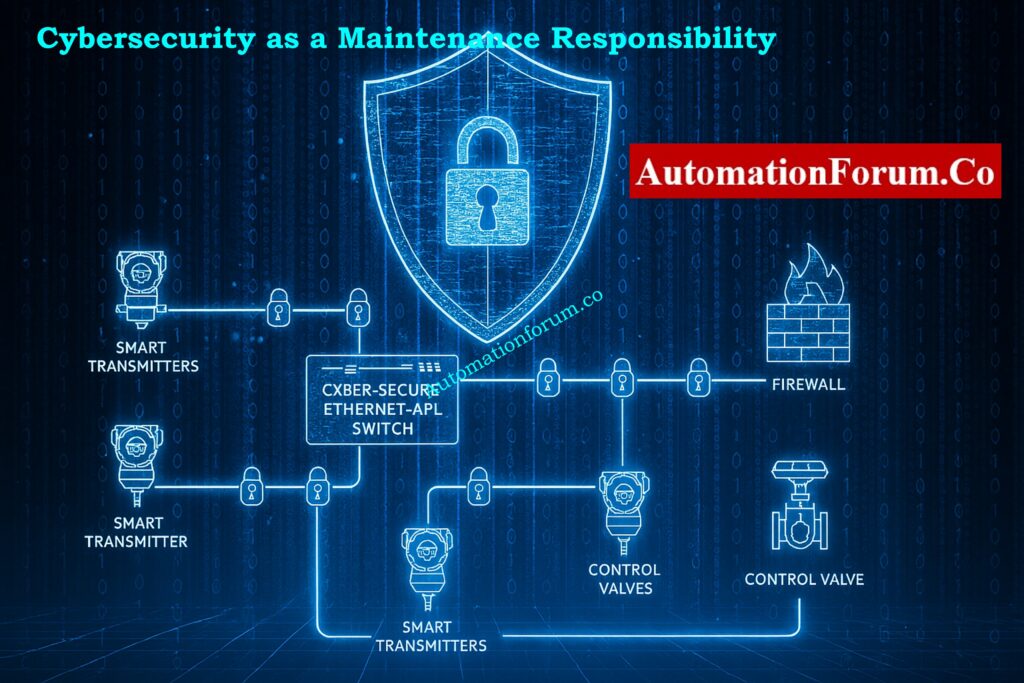
Cybersecurity as a Maintenance Responsibility

Cybersecurity is becoming increasingly important as more field equipment start talking to each other using Ethernet-APL, Wi-Fi, and wireless mesh networks. Proper cyber-secure maintenance makes sure that:

  • Firmware that you can trust, is not corrupted, and is updated through secure OEM channels.
  • Controlled access, which means utilizing robust authentication, role-based access, and limited rights to change settings.
  • Removing default credentials lowers the likelihood of basic intrusion attempts.
  • Monitoring device traffic can assist find scans that aren’t allowed or communication patterns that are out of the ordinary.

Instrumentation is no longer only a way to take measurements; it is also a possible attack surface, therefore cybersecurity is now a key part of maintenance.
Working Remote? These Cyber Risks Are Hidden in Plain Sight: Remote Work Cybersecurity: Common Vulnerabilities and How to Prevent Attacks

Instrumentation teams must make sure they follow modern rules, such as: 

  • IEC 61511, which covers the whole life cycle of safety instrumented systems and proof-testing activities.
  • API/ASME best practices that affect how accurate flow, level, and pressure measurements are.
  • ISA/IEC 62443 sets the rules for cybersecurity controls for industrial automation systems.
  • NAMUR NE107 diagnostics, which give devices the same status categories to make them easy to understand.
  • OEM advisories and service bulletins, which give important information about safety and dependability.

Stop PLC Failures – Use This Preventive Maintenance Checklist: Checklist to Carry out PLC Preventive Maintenance Activity

Smart transmitters come with self-diagnostics and verification tools that make it less necessary to calibrate them by hand all the time. Maintenance should:

  • Use digital as-found/as-left logs to keep track of how accurate the measurements are over time.
  • Use heartbeat or built-in verification mechanisms to cut down on the requirement to physically remove something or stop the process.
  • Combine calibration schedules with CMMS/EAM to make planning and tracking easier.
  • Follow the OEM’s dry-calibration steps, especially for radar and ultrasonic equipment that don’t need to be exposed to the process.
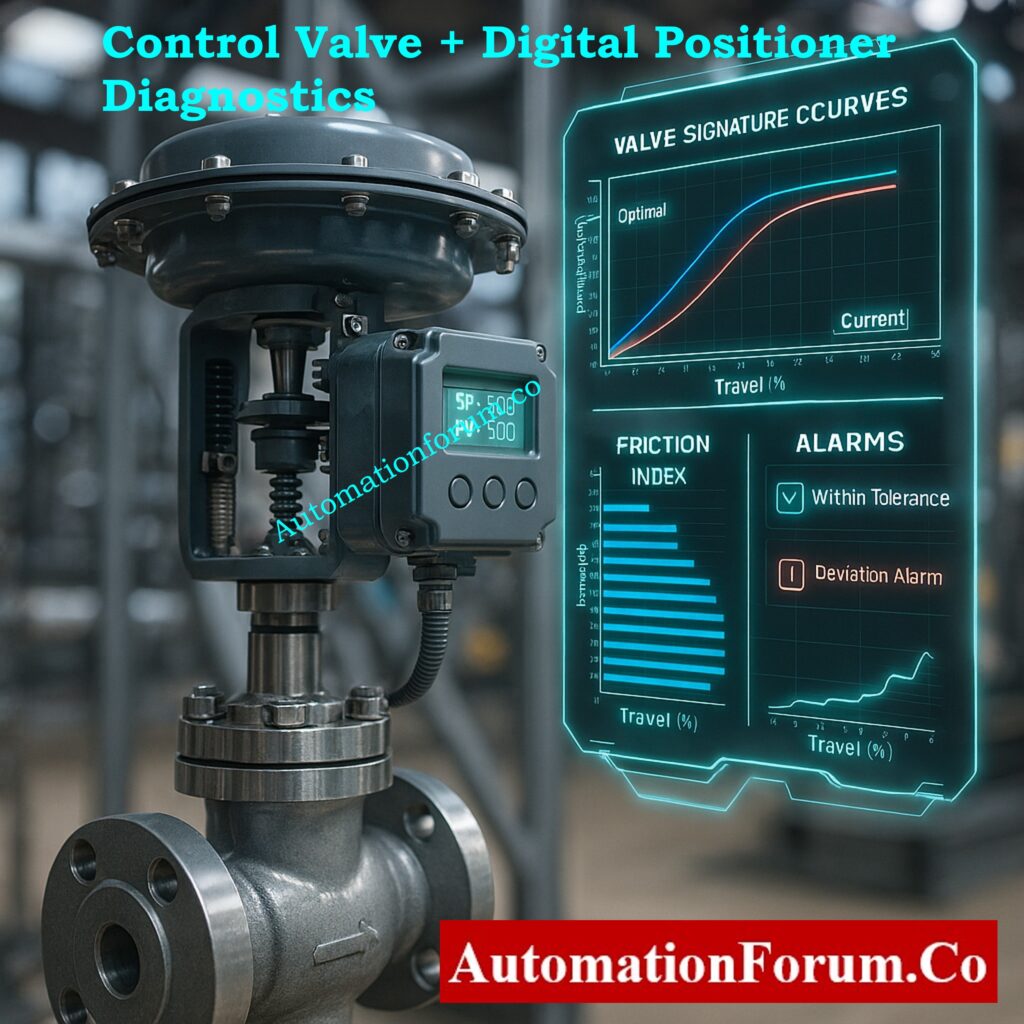
Control Valve + Digital Positioner Diagnostics

Modern positioners provide us more information about how valves work. Maintenance staff should check on a regular basis:

  • Auto-tuning results that make sure the system responds best in all situations.
  • Friction and stiction analysis, which helps find early packing or mechanical problems.
  • Valve characteristic curves that show wear and tear or strange movement patterns.
  • Travel deviation alarms, which show that the performance is drifting or the actuator isn’t working right.

These diagnostics cut down on unanticipated valve failures by a lot.

Wireless equipment need specific care, such as:

  • Regularly checking the health of the battery and figuring out when it will need to be replaced.
  • Signal quality checks to make sure the antenna is pointing in the right direction and the mesh is routing correctly.
  • Interference analysis, which finds RF congestion or physical barriers.
  • Secure firmware updates stop weaknesses in the wireless network.

High-speed APL networks need special attention to:

  • Power availability is making sure that devices get the right amount of loop power across the APL network.
  • Network loading, which stops delays or communication problems.
  • Diagnosing switches by looking at CRC errors, retries, and throughput.
  • To control EMI in tough industrial settings, you need to use the right shielding and grounding.

Don’t Start a Shift Without This PLC Panel Inspection Checklist: Running Inspection Checklist of PLC Components in Control Panels

Firmware is very important for modern equipment. When they are old or broken, they may show:

  • Calculations for measurements that are wrong
  • Drift that keeps getting worse even after calibrating
  • Communication that isn’t stable
  • Bad diagnostics or false alerts

Managing firmware is now a big element of preparing for maintenance.

Typical digital communication failures include:

  • HART burst mode interrupts caused by loops that are too loud
  • Fieldbus segment noise, which is commonly produced by bad shielding
  • Problems with grounding that cause signals to change or resets to happen randomly

To fix current devices, you need to know how the digital layer works.

Even with built-in diagnostics, field sensors naturally break down over time due to:

  • RTD lead wear and tear
  • Coriolis tube coating that changes resonance
  • Contamination of the radar horn, which makes the signal less reflective
  • Corrosion or too much pressure can destroy the DP cell diaphragm.

Diagnostics are helpful, but you still have to look at the physical object.

Some examples of cyber threats are:

  • Unauthorized handheld configurators getting to important device settings
  • Engineering laptops that have been infected with malware are transferring it to field networks.
  • Switches that aren’t set up correctly leave open ports open to attack.
  • Default passwords that don’t change, making it easy to get in

Cyber hygiene is increasingly a prerequisite for technical maintenance.

Confused About PV, SV, TV & QV? This Guide Makes It Crystal Clear: Explained: The Four Main Process Variables (PV, SV, TV, QV) in HART Transmitters

Modern plants require:

  • Advanced DTM/EDD systems for real-time health monitoring
  • Dashboards that display early warning signs and predictions
  • Modeling failures by comparing past failures to current patterns
  • AI-based anomaly detection for better, earlier failure prediction

Digital twins allow maintenance teams to simulate:

  • Progression of measurement drift
  • Effect of fouling or coating

This makes planning much more accurate.

Remote maintenance offers major benefits when supported by:

  • Zero-trust networks or VPN tunnels
  • Encrypted communication tools
  • Digital certificates for device authentication

This keeps strong cybersecurity protections in place while lowering field exposure.

Good lifecycle management includes:

  • Full records of commissioning
  • Regular checks of calibration
  • Regular audits of configurations
  • Planned replacement of old smart devices in a structured way

This makes sure that the measurements are stable and reliable throughout time. 

How Secure Is Your OT? Run This Simple NIST-Based Check: ICS/SCADA OT Cybersecurity Self-Assessment: NIST-Based Procedure for Critical Infrastructure

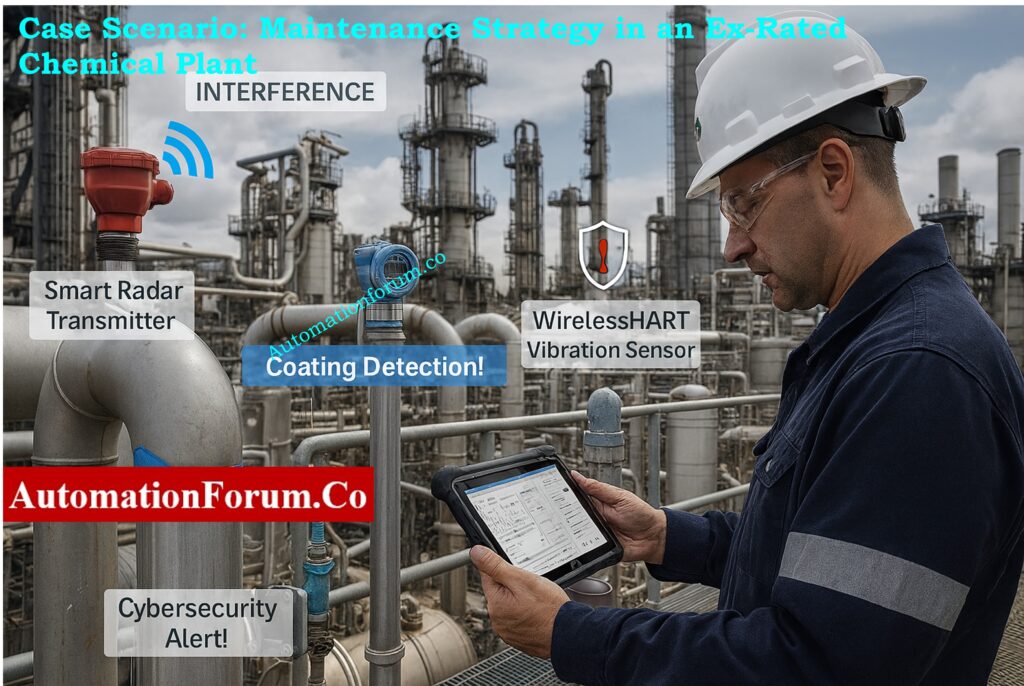
Case Scenario: Maintenance Strategy in an Ex-Rated Chemical Plant

Smart radar level transmitters, SIL-rated pressure transmitters, HART digital positioners, and WirelessHART vibration sensors are all used in a chemical plant. Sensor fouling, gas compatibility problems, cybersecurity constraints, and temporary communication failures are some of the problems that come up during maintenance.

  1. Radar level transmitter:
    Maintenance engineers check the built-in verification (Heartbeat/Device Verification) and find accumulation on the antenna. Plant automatically sets up tank cleaning and sends out signals for recalibration.
  2. Coriolis mass flowmeter:
    AI predictive diagnostics show a modest attenuation of tube oscillation, which means there is coating. Maintenance checks the cleaning schedule and makes plans for when to stop cleaning.
  3. SIL pressure transmitters:
    Engineers view partial-stroke test logs for SIS actuators. They detect a small increase in travel deviation and schedule valve maintenance.
  4. Wireless vibration sensor:
    The gateway logs high interference. Maintenance repositions the sensor and adjusts mesh routing.
  5. Cybersecurity event:
    Device audit logs show failed SSH login attempts. Maintenance locks access, updates the firmware, and reviews firewall settings.

Your OT Network Isn’t Safe Without These Protocol Protections: Protocols and Standards in Industrial Automation: A Guide to OT Cybersecurity

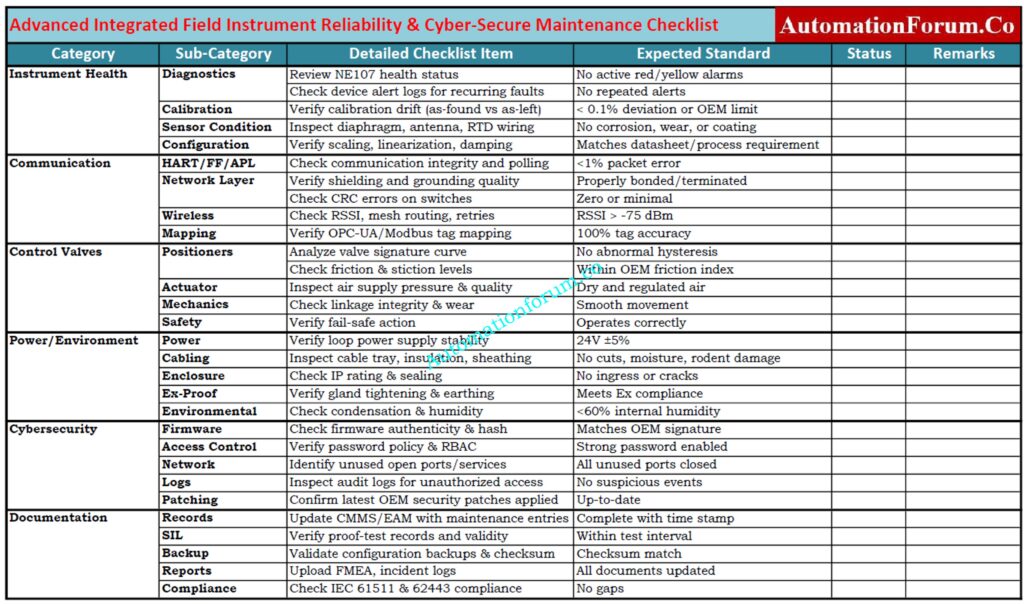
A well-designed maintenance checklist ensures that field teams systematically check every critical aspect mechanical, electrical, diagnostic, communication, cybersecurity, and documentation. The checklist provided below is specifically designed for the latest generation of smart, SIL-rated, IIoT-enabled instrumentation used in today’s process industries.

Are Your PLCs Compliant? Benchmark Them Against Global Cyber Standards: Cybersecurity Standards for PLCs

  1. Check the NE107 status, alert logs, and fault history for the device.
  2. Use the built-in verification tools (Heartbeat, FieldCheck, and DVC signature) to check if the calibration is correct.
  3. Check “as-found” vs “as-left” calibration drift records.
  4. Examine sensor element condition (DP diaphragm, radar antenna, RTD leads).
  5. Check the parameters for temperature and pressure in the environment.
  6. Check that the range, scaling, linearization, and units are all accurate.
  7. Validate sensor redundancy logic (2oo3, 1oo2).
  8. Inspect local indicators and backlit LCDs for pixel issues.
  1. Validate HART/Fieldbus/Ethernet-APL communication parameters.
  2. Check physical layer: shielding, grounding, terminations, segment load.
  3. Review device communication error logs.
  4. Confirm update rate, burst mode, and polling accuracy.
  5. Check the integrity of the OPC-UA/Modbus TCP mappings and tags.

Your HART Device Talks – Here’s How to Decode Its Hidden Messages: HART Transmitter Diagnostics: What Your Field Device is Telling You

  1. Look over the digital positioner’s diagnostics, such as the friction index and valve signature.
  2. Check the logs for trip deviation alarms and partial-stroke tests.
  3. Check the quality of the air supply to the actuator (filter, regulator, tubing).
  4. Check that fail-safe mode is active (fail-open/close).
  1. Check the stability of the power supply, the state of the UPS, and the load sharing.
  2. Check the health of the cables, the resistance of the insulation, and the condition of the trays.
  3. Check the IP rating, sunshields, and condensation traps to make sure they protect against the weather.
  4. Check that the glands, seals, and earthing continuity are all in line with the Ex-zone.
  5. Check the integrity of the enclosure and the protection against water and dust.
  1. Check the legitimacy of the firmware and its revision history.
  2. Check the rules for access control: passwords, RBAC, and audit logs.
  3. Make sure that remote access is safe (VPN/zero trust).
  4. Turn off services and protocols that you don’t utilize.
  5. Check with the OEM to be sure the security patches are real.
  1. Update CMMS/EAM records for every maintenance task.
  2. Review SIL proof-test intervals and completion logs.
  3. Confirm device configuration backups and checksum verification.
  4. Record failure reports, incident logs, and FMEAs.
  5. Make sure that you follow the rules set out in IEC 61511 and 62443.
  1. Connect device data to cloud and edge analytics platforms.
  2. Check the alarms for predictive maintenance.
  3. Make that the digital twin model matches up with the field data.
  4. Check the thresholds for finding anomalies.
  1. Check that SIL loops work in a safe condition.
  2. Confirm interlocks, permissives, and override integrity.
  3. Verify hot-cutover procedures for smart network devices.
  4. Inspect bypass logs and override duration.
  5. Make sure that all maintenance operations are logged and approved.

New to Cybersecurity? Start With These Must-Know Threats: Cybersecurity Basics: Types, Threats, and Protection Tips

In modern process facilities, instrument maintenance goes much beyond just checking devices. It now includes keeping track of digital diagnostics, making sure that cybersecurity rules are followed, checking the health of networks, using smart analytics, and using predictive technologies. The Advanced Integrated Field Instrument Reliability & Cyber-Secure Maintenance Checklist (2025 Edition) gives maintenance workers a complete framework that is in line with the newest equipment and international requirements.

This complex checklist makes sure that maintenance is always done safely, consistently, and reliably, which helps keep uptime high, meet regulations, and improve process performance. It is an essential tool for every instrumentation maintenance engineer working in today’s changing industrial world.

Advanced Integrated Instrument Reliability & Cyber-Secure Maintenance Checklist (Excel)

To keep current smart instruments working, you need more than just calibrating and fixing them. You need an organized, predictive, and cyber-secure method. This is a completely structured Excel checklist for dependability and uptime that will enable instrumentation maintenance teams keep track of IIoT devices, Ethernet-APL systems, SIL equipment, and digital diagnostics.

Advanced Integrated Field Instrument Reliability & Cyber-Secure Maintenance Checklist – 2025 Edition

Types of Flame Detectors and Their Uses in Industrial Fire Prevention (Complete Engineer’s Guide)

0
Types of Flame Detectors and Their Uses in Industrial Fire Prevention (Complete Engineer’s Guide)

Industrial buildings, especially oil and gas plants, chemical units, LNG terminals, offshore platforms, warehouses, and power stations, are at risk of fires that may quickly grow out of control. Flame detectors are one of the most important parts of any Fire & Gas (F&G) system. They are made to find fires as soon as they start.

This article goes over how flame detectors operate, the many types where they can be used, how to install them correctly, and how to keep them in good shape. It is specifically written to help Instrumentation, Electrical & F&G engineers select the correct flame detector for any industrial environment.

Flame detectors are optical fire detection devices that sense electromagnetic radiation produced by flames. They provide rapid fire identification long before heat or smoke detectors activate.

Fire & Gas Detector Types Explained: Types of Fire and Gas Detectors – Working Principles and Industrial Applications

  • Detect fire when it first starts to stop it from getting worse.
  • Trigger alarms, shut off ESD, put out fires, and start deluge systems in less than a second.
  • Capable of detecting clean-burning fires (hydrogen, alcohol, solvents) invisible to the human eye.
  • Operate in outdoor, dusty, foggy, vibrating, high-temperature, and hazardous areas.
  • Required for ATEX, IECEx, SIL2/SIL3, NFPA, API and OSHA compliance.
  • Provide dependable detection where smoke detectors fail due to airflow or ventilation.
  • Reduce risk of asset loss, environmental disaster, and human injury.

VESDA Smoke Detection Explained: VESDA Smoke Detection: Advanced Fire Protection with Early Warning Technology

This section covers the four major flame detection technologies used worldwide in oil & gas, chemicals, power, marine, and high-risk industrial environments.

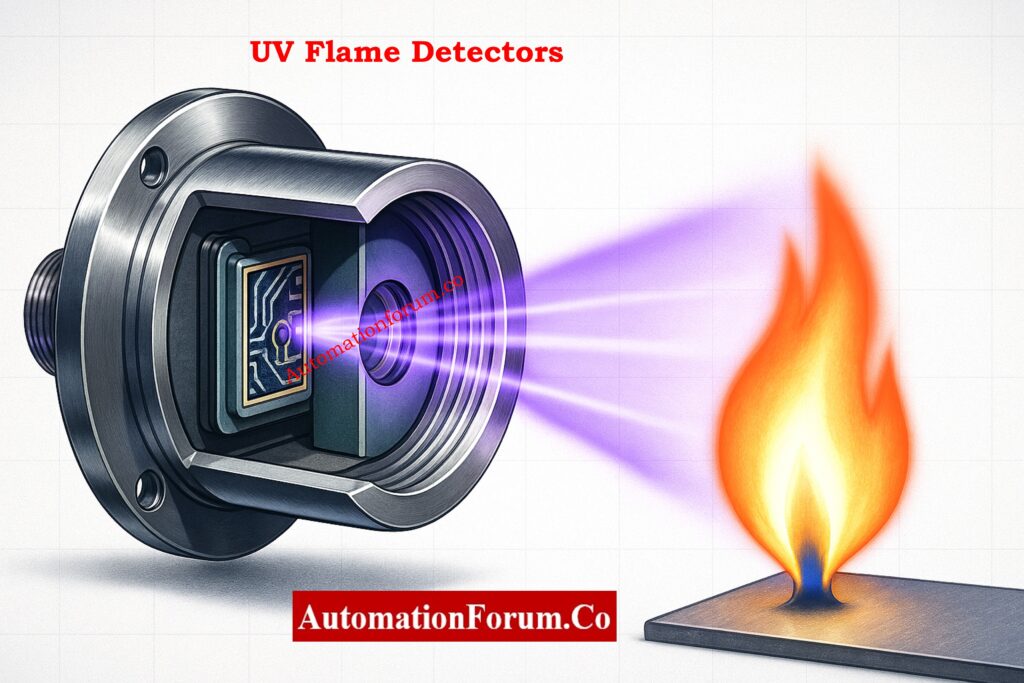
UV Flame Detectors (Ultraviolet Flame Detection Technology)
  • Detect UV radiation emitted instantly during combustion, allowing the detector to react before smoke or heat is produced. This is critical for catching fires that ignite rapidly or burn cleanly.
  • Operate within the 180–260 nm ultraviolet wavelength band, an energy range where flames emit strongly but most ambient sources do not, making detection more specific.
  • Respond almost instantly, usually within milliseconds, so that alarms may be switched on right away and important equipment can be turned off quickly.
  • They don’t need smoke, heat, or a visible flame, therefore they’re great for flames involving gasses like hydrogen or alcohol that don’t burn with a lot of visible flame.
  • One of the quickest ways to find flames, able to find ignition flashes nearly instantaneously. This is helpful in places where explosions are likely to happen.
  • Great for hydrogen fires, which give off a lot of UV radiation but not much visible light or IR radiation. This makes UV sensors very effective.
  • UV detectors don’t respond to heat-based infrared energy, therefore they won’t go off when hot surfaces, furnaces, or sunshine reflections are present.
  • Works well in clean, closed industrial spaces like indoor process rooms or instrumentation shelters where sources of UV interference are kept in check.
  • Good for finding flash fires and explosions early on, especially in places where gasses can catch fire quickly.
  • Sensitive to UV sources that aren’t fires, which might set off false alarms if not handled correctly, such as:
    • Arc welding gives off very strong UV rays.
    • Lightning strikes that send off brief bursts of UV
    • High-voltage equipment can cause electrical corona discharge.
    • UV lamps used to kill germs or cure things
  • Only works indoors or in the shade since UV rays in natural sunlight can mess with how well the detector works.
  • The range of detection is shorter (usually 15 to 50 feet), thus you may need more than one device for bigger rooms or locations.
  • Hydrogen storage, filling, and compressor stations, where it is very important to find invisible hydrogen flames early.
  • Battery charging rooms such as UPS banks, EV charging bays, and forklift charging stations, which are at risk of electrical sparking and gas release.
  • Analyzer shelters and instrumentation labs, especially where solvents and flammable test gases are used.
  • Pharmaceutical cleanrooms and electronics assembly lines, where smoke detection is unreliable due to air filtration systems.
  • Gas cabinets, fume hood areas, and enclosed process zones, which need quick detection in confined spaces.

Why Fire & Gas Detection Matters: Importance of Fire & Gas Detection System

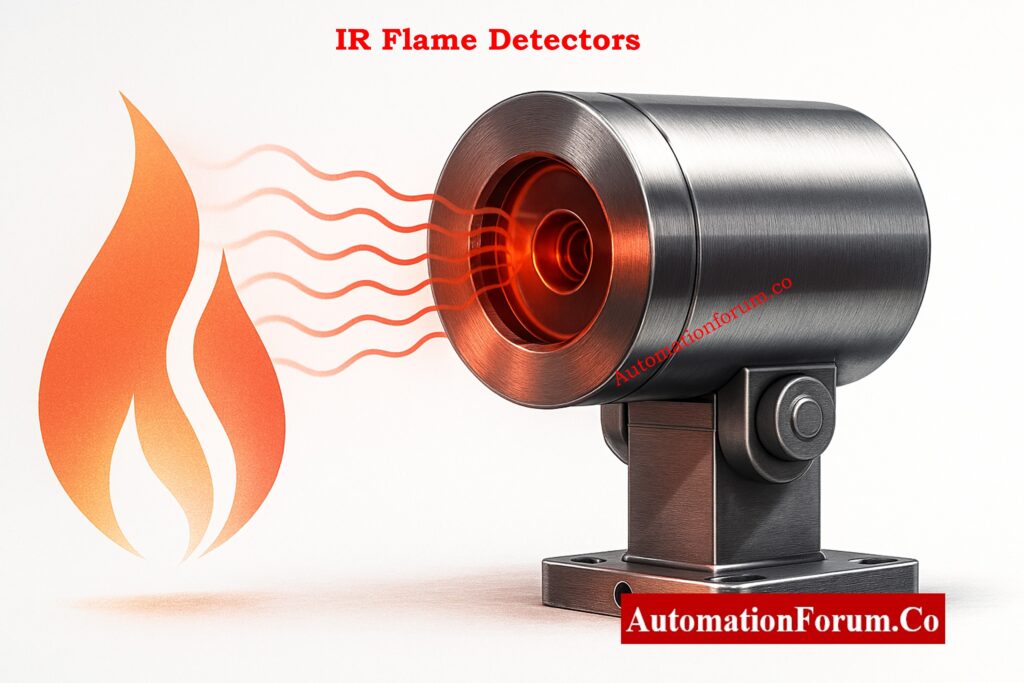
IR Flame Detectors (Infrared Flame Detection Technology)
  • Detect IR radiation emitted by combustion gases, particularly the distinctive CO₂ peak at 4.3 µm which is present in most hydrocarbon fires.
  • Analyze flame flicker frequency, allowing them to distinguish between dynamic flame activity and static hot objects.
  • Effective through smoke, dust, mist, and moderate vapor clouds, making them reliable in process environments with poor visibility.
  • Very good for outdoor settings with direct sunshine because IR detection may be set up to ignore continuous sunlight interference.
  • Long detection ranges—up to 150–200 ft—mean that fewer detectors are needed for broad open regions.
  • Stable in bright light and sunlight, which makes it easy to find in outdoor refinery units and tank farms.
  • Works very well for fires involving hydrocarbons like diesel, gasoline, LPG, LNG, crude oil, and solvents that give out intense IR radiation.
  • UV-based interference sources like welding or corona discharge make false alarms less likely.
  • Safe operation even in high-temperature process units, such as furnaces and reactors, as long as flicker recognition is allowed.
  • Can be challenged by hot machinery, whose thermal emissions may resemble IR signatures, including:
    • Heaters and process stoves
    • Gas turbines with high exhaust temperatures
    • Boilers operating at firing conditions
    • Exhaust stacks emitting hot gases
  • Slightly slower response time than UV and MSIR, as IR detectors require pattern confirmation.
  • Lens contamination (oil, dust, sand, moisture) can reduce signal clarity and must be cleaned regularly.
  • Oil tank farms, loading gantries, ship berthing areas, and marine terminals, where hydrocarbon fire risk is extremely high.
  • Fuel pump houses and large petrochemical process areas, which require long-range coverage.
  • Gas compressor skids, LNG vaporizers, and regasification plants, where methane and hydrocarbon combustion are concerns.
  • Warehouses storing flammable solvents, aerosols, adhesives, coatings, and chemical drums.
  • Outdoor refinery areas that are open to the sun and dust, where UV detectors wouldn’t work.

Fire Alarm Control Panel Overview: What is an FACP? (Fire Alarm Control Panel)

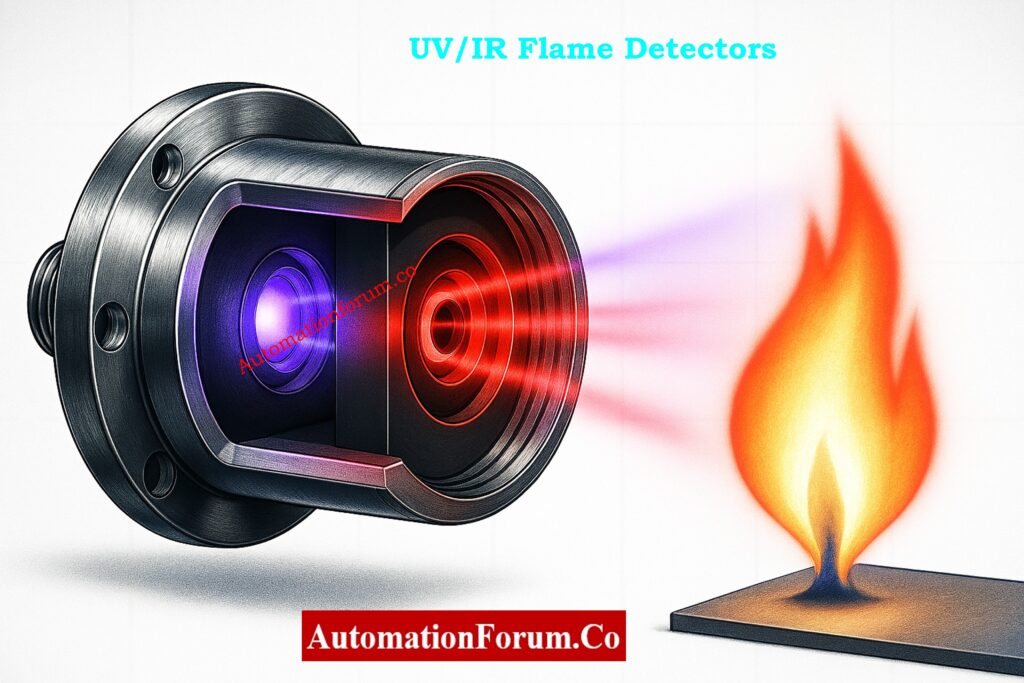
UV/IR Flame Detectors (Combined Dual-Wavelength Detection)
  • Use UV and IR sensors simultaneously to provide cross-verification of flame activity.
  • Reduce false alarms because both wavelengths must match known flame characteristics.
  • Each sensor channel independently checks flame signatures, increasing reliability in mixed environments.
  • Balanced performance in both indoor and outdoor environments, suitable for many general industrial applications.
  • Much lower rates of false alarms than detectors that just use one wavelength.
  • Detect fires that are both hydrocarbons and non-hydrocarbons, giving you versatile protection.
  • Good for places with moderate welding, sunshine, or electrical noise, where single-spectrum detectors would not work.
  • Used a lot in a wide range of process plants, such as those that make chemicals, drugs, food, and other things.
  • Not good for hydrogen fires since they give off a lot of UV light but very little IR light.
  • Both channels need to be lined up appropriately and have clean optics to make sure they both see flames.
  • Dust, chemical vapors, and moisture are examples of environmental pollutants that can damage one channel and make it less accurate.
  • Chemical plants with mixed fuel hazards, including solvents, resins, and gases.
  • Gas turbine enclosures and rotating machinery spaces, where welding and movement may occur.
  • Pharmaceutical facilities and healthcare environments, where balanced detection is required.
  • Hydrocarbon fuels are utilized in aircraft hangars, automobile bays, and repair workshops.
  • Industrial structures that are locked off and need to be able to detect flames over a wide range of frequencies.

Fire Detection System Basics: Basics of Fire Detection System

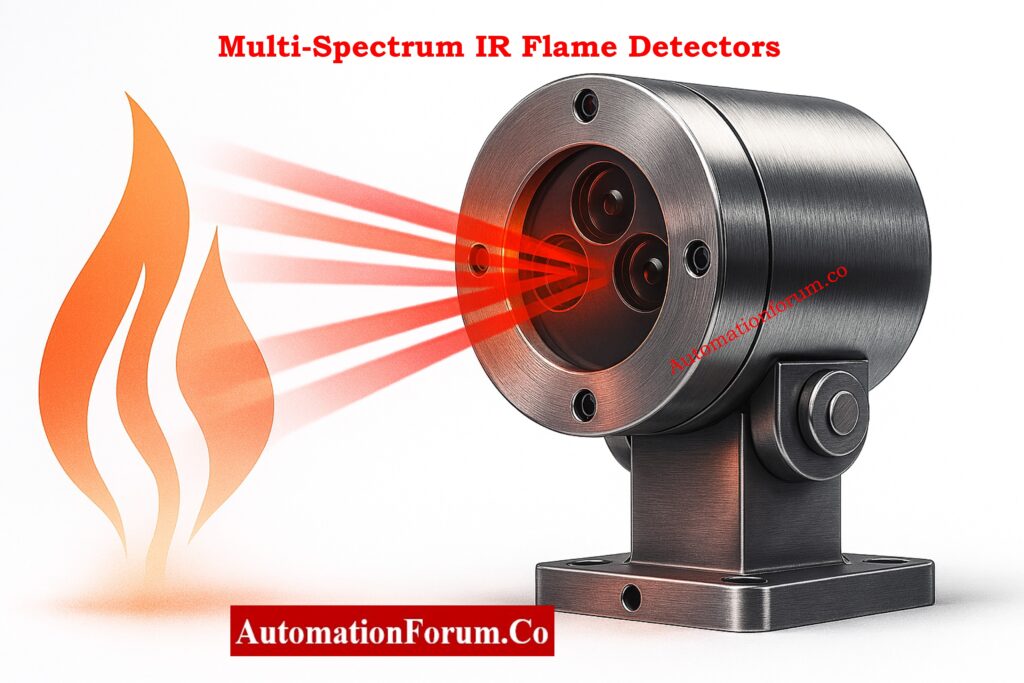
Multi-Spectrum IR Flame Detectors (MSIR – Advanced Multi-Wavelength IR Technology)
  • Use 3 to 5 IR sensors that work at different wavelengths so they can pick up on complicated flame dynamics.
  • Examine flame flicker, energy distribution, and spectral pattern identification to make detection more accurate.
  • Eliminate false alarms from sunlight, equipment reflections, flare stacks, and exhaust gases by identifying only flame-specific signatures.
  • Offer high immunity against environmental disturbances, including fog, dust, rain, snow, and sandstorms.
  • Highest reliability and lowest false alarm rate within all industrial flame detection technologies.
  • Long detection range—up to 200 meters, making them ideal for large and open industrial zones.
  • Works with safety systems that are rated SIL2 or SIL3, making sure they meet functional safety standards.
  • Great for hazardous outside circumstances, like offshore sites and refineries with harsh conditions.
  • Finds many kinds of fires, including chemical, hydrogen, and hydrocarbon flames.
  • Works well even when the equipment is heated, the sun is shining, and there are shiny surfaces.
  • The fact that they use complex technology, multi-sensor arrays, and processing algorithms makes them more expensive.
  • Needs to be professionally aligned since if it’s not, it can lose range or make blind spots bigger.
  • Needs clean optics to work best in places that are dusty or oily.
  • Some installations need to have their firmware updated from time to time to work at their best.
  • Offshore oil rigs, FPSOs, and rough marine settings, where high winds, salt spray, and bright sunshine are always a problem.
  • Refineries, petrochemical plants, cracking furnaces, cat-reformers, and systems that make high-value fuel.
  • LNG liquefaction and regasification terminals, areas for handling vapor, and loading stations at the jetty.
  • Pumping stations for long-distance pipelines, especially in isolated areas with very hot or very cold weather.
  • Power plants, such as gas turbines, hydrogen-cooled generators, and furnace fronts.
  • Large storage tank farms and explosive processing zones that need long-range, high-reliability flame detection.

What Lower Explosive Limit Means: Understanding Lower Explosive Limit (LEL)

Oil & Gas Refineries

  • Unit heaters, crude units, reformers, and hydrocracker units.
  • Gas compressor buildings and fuel pump houses.
  • Tank farms storing gasoline, diesel, kerosene, and naphtha.

Offshore Platforms

  • Most detectors are MSIR due to extreme sunlight and salt fog.
  • Used around helidecks, wellheads, separators, and flare booms.

Chemical & Petrochemical Plants

  • UV/IR ideal in areas with mixed chemicals and solvents.
  • IR used in tank farms and process reactors.

Power Generation Plants

  • MSIR detectors protect turbines, hydrogen cabinets, cable tunnels.
  • Used around boiler fronts and burner fronts.

Warehouse & Logistic Facilities

  • IR detectors can see fires in pallets, boxes, and packaging across a large area.

Food & Beverage Factories

  • IR detectors that work in kitchens, fryers, and ovens without going off when the food is cooking.

Pharmaceutical Production

  • UV/IR detectors suitable for cleanrooms with strict safety compliance.

How to Test Heat Detectors: Heat Detector Testing Procedure

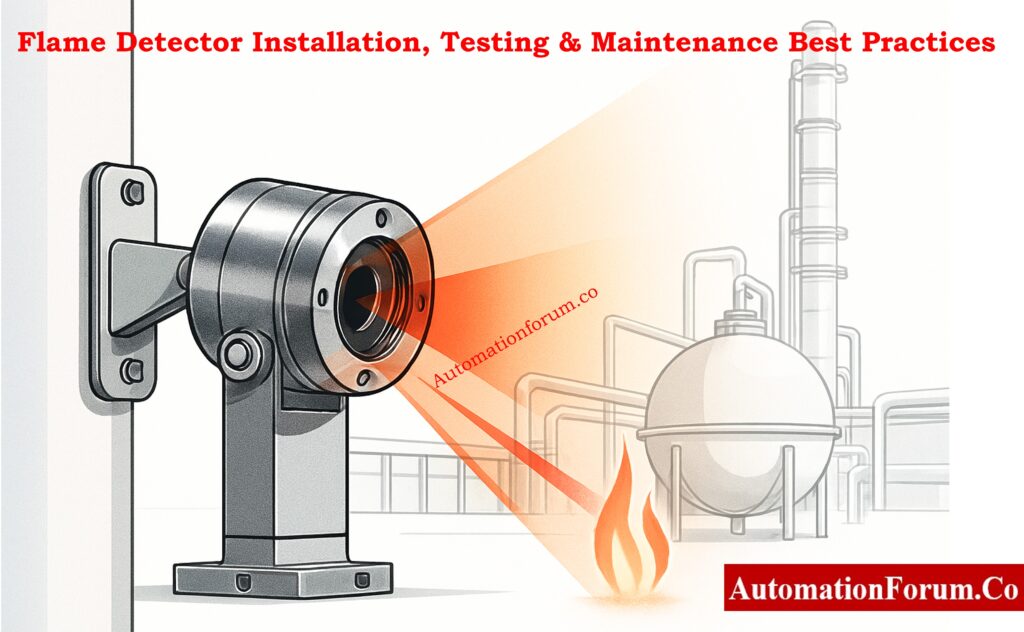
Flame Detector Installation, Testing & Maintenance Best Practices
  • Check for corrosion, mechanical damage, or misalignment.
  • Verify field-of-view is unobstructed by new equipment.
  • Inspect housing seals, cable glands, and mounting brackets.
  • Remove dirt, sand, salt deposits, oil films, or condensation.
  • Use non-abrasive optical wipes or manufacturer-approved cleaning kits.
  • Test using certified flame simulators—not real flames.
  • Verify alarm activation, latch reset, and output statuses.
  • Test relays, 4–20 mA, HART, and Modbus communication.
  • Some detectors require periodic verification during turnarounds.
  • Check alignment, especially in places where equipment vibrates.
  • Check that everything is working right during plant shutdowns and F&G audits.
  • Keep records for NFPA 72, OSHA, insurance, and internal safety audits.
  • Write down the dates of tests, failures, replacements, and maintenance.

Bump Testing Explained Simply: What is Bump Testing? 

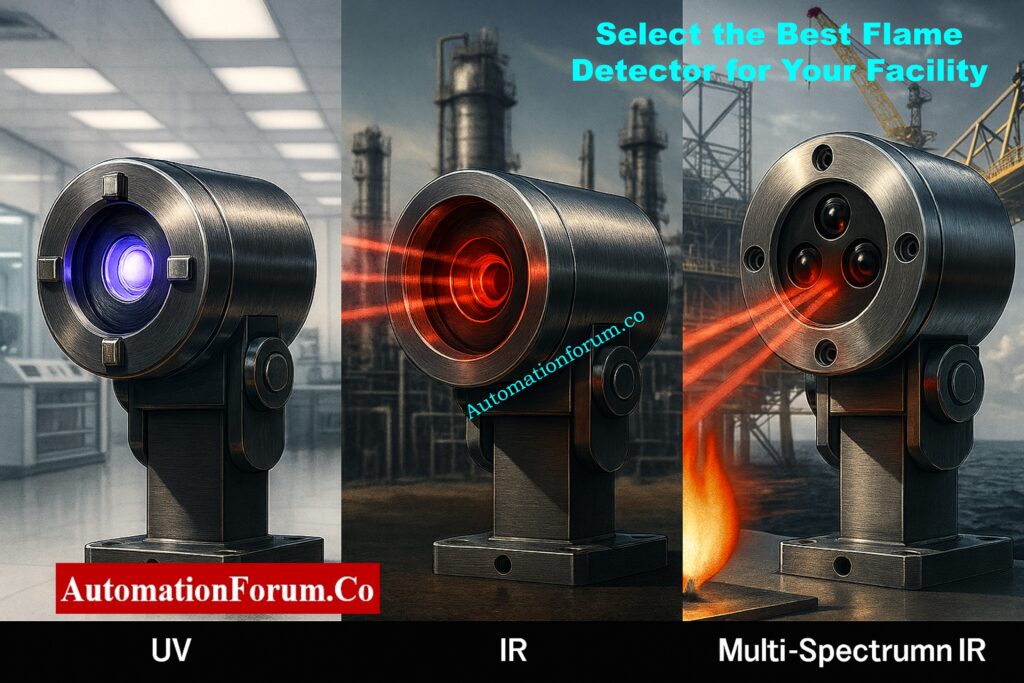
How to Select the Best Flame Detector for Your Facility (Engineering Criteria)

Choosing the correct flame detector depends on several engineering and operational parameters. Below are the key selection criteria explained clearly without using arrows and with full technical detail.

  • Hydrogen fires are best detected using UV flame detectors or Multi-Spectrum IR (MSIR) detectors, because hydrogen flames emit strong ultraviolet radiation and can be nearly invisible to the human eye.
  • IR flame detectors or MSIR detectors work well for finding hydrocarbon fuels including diesel, gasoline, kerosene, LPG, LNG, solvents, and crude oil. This is because they respond strongly to the CO₂ emission pattern that happens when hydrocarbons combustion occurs.
  • UV/IR combination detectors are the greatest way to protect mixed chemical processes that contain both hydrocarbon and non-hydrocarbon compounds. This is because they are sensitive but don’t give false alarms.
  • Harsh outdoor areas, such as offshore platforms, open refinery units, tank farms, and oil loading terminals, require MSIR flame detectors due to their high immunity to sunlight, weather, reflections, and environmental extremes.
  • Controlled indoor environments, including cleanrooms, analyzer shelters, battery charging rooms, and enclosed industrial spaces, are well-suited for UV detectors or UV/IR detectors, which excel in environments with minimal interference.
  • Locations with high-temperature process equipment, such as gas turbine enclosures, boiler fronts, reformers, and furnace areas, are best protected using UV/IR detectors or MSIR detectors, because they can discriminate between hot surfaces and real flames.
  • Small or confined rooms, including equipment cabinets, small compressor enclosures, and tight industrial spaces, typically require UV detectors, which are optimized for short-range, rapid flame detection.
  • Large tank farms, long pump houses, big warehouses, or broad process units benefit from IR detectors or MSIR detectors, as both technologies offer long detection distances ranging from several dozen feet to over a hundred meters.
  • Offshore decks and wide open marine areas, where very long-range and high-reliability flame detection is required, are strongly suited to MSIR flame detectors, which maintain performance even during fog, mist, dust, and marine atmospheric conditions.
  • High-activity zones, such as welding areas, fabrication zones, compressor halls, rotating machinery spaces, and turbine modules, demand the use of MSIR detectors, which provide the strongest immunity against false alarms generated by hot surfaces, sparks, reflections, and rapid movement.
  • Indoor clean facilities, like pharmaceutical buildings, electronics manufacturing, and controlled storage areas, operate reliably with UV detectors or UV/IR detectors, which provide accurate detection without unnecessary nuisance alarms.
  • Many industrial locations need to meet certification standards including ATEX, IECEx, UL, FM, and CE. This means that it is necessary to use flame detectors that meet the required hazardous-area categories.
  • MSIR flame detectors should be the first choice for facilities that need SIL2 or SIL3 functional safety levels, such as petrochemical units, offshore assets, or high-value processing lines. This is because they have SIL-certified detection reliability.
  • Companies that follow NFPA, API, or OSHA rules must make sure that the flame detectors they use meet all fire safety and performance standards for installation, maintenance, and being ready to use.

How to Test Flame Detectors: Testing Procedure of Flame Detector

In industries with a lot of risk, flame detectors can save lives. Engineers can create the safest and most dependable fire protection system if they know the pros and cons of UV, IR, UV/IR, and MSIR detectors. The system will work perfectly in real crises if it is installed, aligned, and maintained correctly.

Questions and Answers about Flame Detectors

Gas Detector Issues & Fixes: Gas Detectors Practical Problems and Troubleshooting

There are four primary kinds of industrial flame detectors: UV (ultraviolet), IR (infrared), UV/IR (mixed), and Multi-Spectrum IR (MSIR). These detectors use distinct optical wavelengths to find flames. They are used in oil and gas, chemicals, power, and other high-risk industrial settings where quick flame detection is very important.

The three most prevalent kinds of fire detectors are smoke detectors, heat detectors, and flame detectors. Smoke detectors pick up particles in the air, heat detectors react to high temperatures or quick rises in temperature, and flame detectors find fires by picking up UV or IR radiation that flames give out.

A Type 4 fire alarm system has both automatic smoke detectors and manual call points. The system is set up to send alarm signals to a remote monitoring or receiving center on its own. It makes it easier to find things and respond quickly to emergencies in public and commercial buildings.

Flame detectors are unique optical sensors that can tell if there are open flames by monitoring the ultraviolet (UV) or infrared (IR) light that is given off when anything burns. They provide extremely fast fire detection and are widely used in refineries, chemical plants, fuel storage areas, turbine enclosures, and other high-risk industrial zones.

An IR flame detector finds fires by picking up infrared radiation that hot combustion gasses give off. Modern IR detectors sometimes use more than one IR wavelength (dual-IR or triple-IR) to tell the difference between genuine flames and heated surfaces or sunshine. This makes them more accurate and cuts down on false alarms.

L-level fire alarm systems tell you how much automatic fire detection there is in a building:

  • L1: Automatic detection in all areas (maximum life protection).
  • L2: Detection in escape routes and high-risk rooms.
  • L3: Detection in escape routes and all rooms that open onto them.
  • L4: Detection only in escape routes and circulation areas.

SIF PFDavg / SIL Verification – Complete Guide + Online Calculator (IEC 61508 / 61511)

0
SIF PFDavg / SIL Verification - Complete Guide + Online Calculator (IEC 61508 / 61511) 1

In industries including oil and gas, petrochemicals, pharmaceuticals, power plants, and manufacturing, functional safety is very important. If Safety Instrumented Functions (SIFs) don’t work right, a minor problem with any type of equipment might turn into a big problem. To verify the reliability of a SIF, engineers use PFDavg (Probability of Failure on Demand average) and classify systems according to Safety Integrity Level (SIL).

This complete guide walks you through the fundamentals of SIL verification and includes a powerful online calculator that dynamically computes PFDavg, SIL levels, diagnostic coverage effects, proof-test intervals, and more.
All calculations comply with IEC 61508 and IEC 61511 standards.

Instant Engineering Tool: Failure Rate (λ) Calculator for Process Instrumentation and Industrial Maintenance

SIF PFDavg / SIL Verification — Animated Upgrade
AUTOMATIONFORUM.CO Your Trusted Source for Automation Power Tools & Solutions

SIF PFDavg / SIL Verification

IEC 61508 / 61511 — simplified + extended

Input Parameters

? Low demand: <1 demand/year. High/continuous: ≥1 demand/year.

Results

SIF PFDavg
SIL Classification
Performance Bar Gauge
Green=Good (SIL3) • Yellow=SIL1 • Orange=SIL2 • Red=Below SIL
Reference: IEC 61508-6:2010, IEC 61511-1:2016 — For engineering reference only.
AUTOMATIONFORUM.CO Your Trusted Source for Automation Power Tools & Solutions

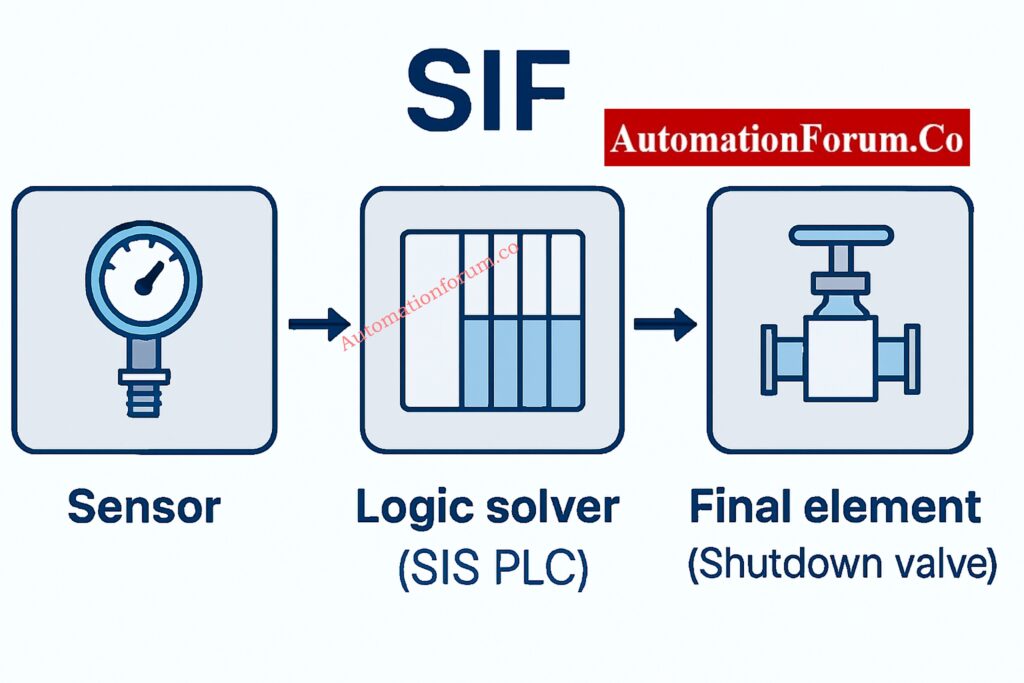
A SIF is a protective safety loop that detects hazardous conditions and brings a process to a safe state. It consists of:

What is a Safety Instrumented Function (SIF)?

Each SIF is assigned a target SIL level based on risk analysis.
In-Depth IEC Guide: Testing and Repair Deferral – IEC Guidelines, Procedure, and Best Practices

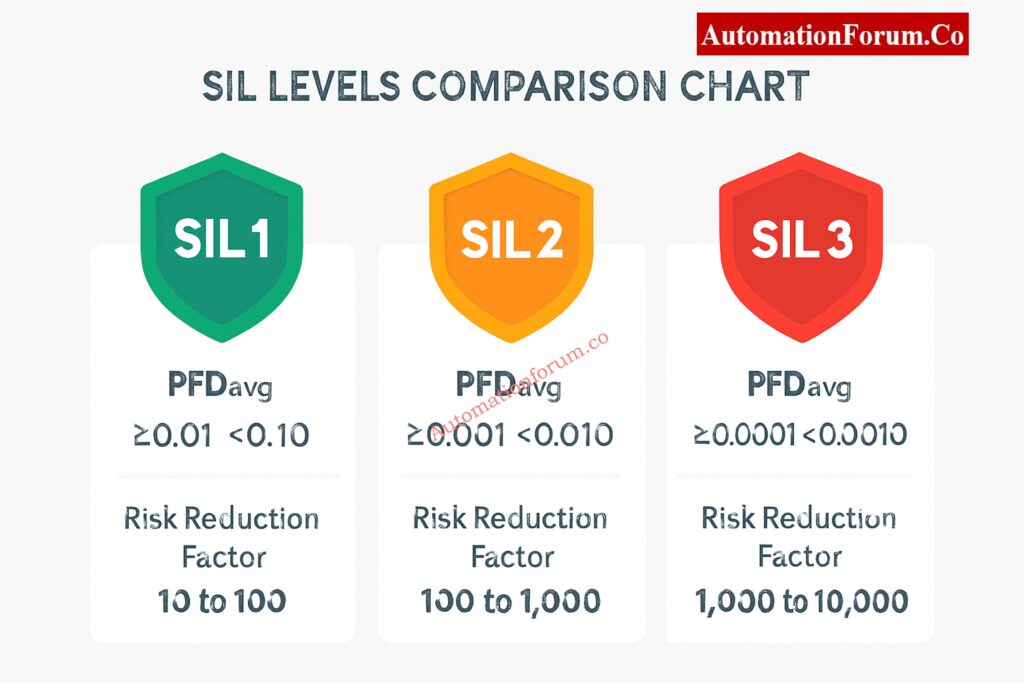
Understanding SIL Levels (SIL 1, SIL 2, SIL 3)

Safety Integrity Levels measure risk reduction capability:

SIL LevelTarget PFDavgRisk Reduction Factor (RRF)
SIL 110⁻² – 10⁻¹10–100
SIL 210⁻³ – 10⁻²100–1,000
SIL 310⁻⁴ – 10⁻³1,000–10,000

A SIF must achieve a PFDavg lower than the maximum acceptable for its assigned SIL.

What is PFDavg? (Probability of Failure on Demand Average)

PFDavg (Average Probability of Failure on Demand) represents the likelihood that a safety function will fail when needed. Lower PFDavg = safer SIF.

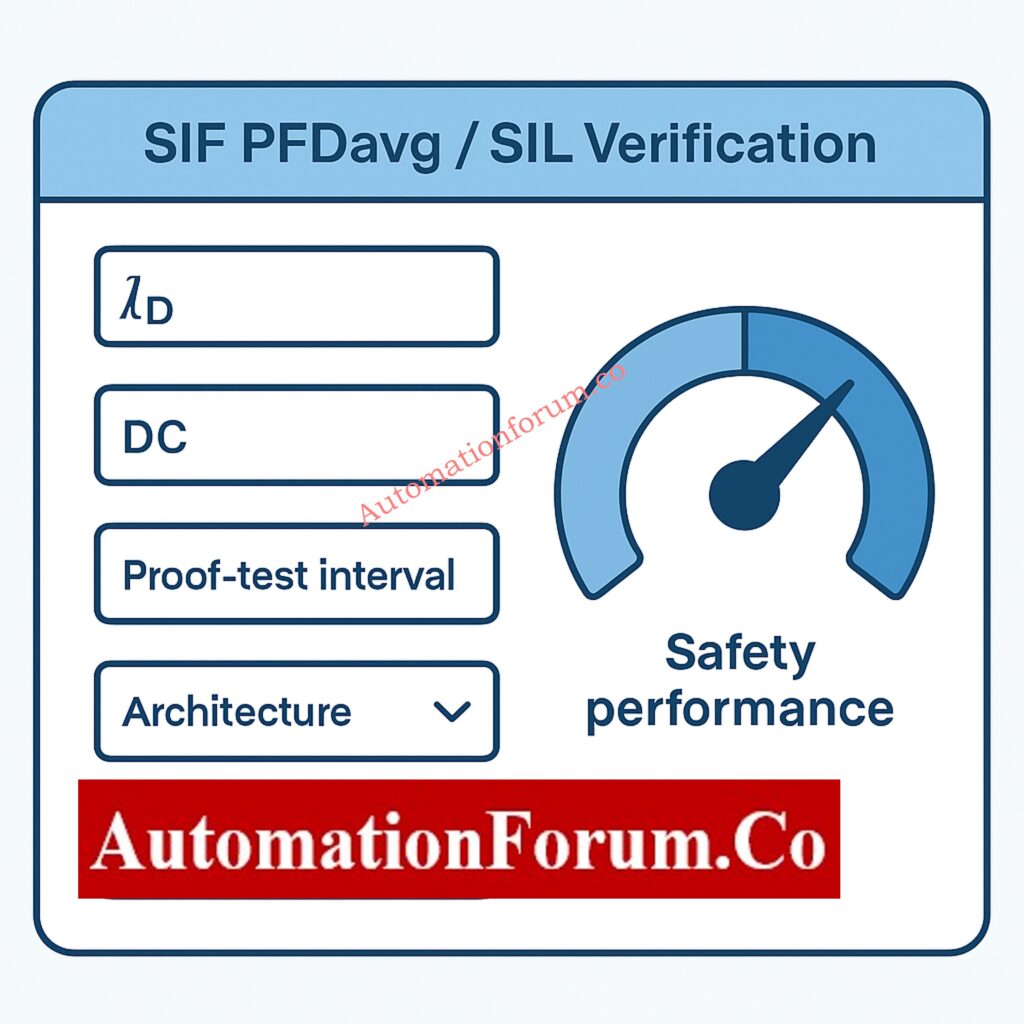
Critical factors affecting PFDavg:

  • Dangerous failure rate (λD)
  • Diagnostic coverage (DC)
  • Proof test coverage (PTC)
  • Proof test interval (T)
  • Mean time to repair (MTTR)
  • Architecture (1oo1, 1oo2, 2oo3, 1oo3)
  • Common cause failures (β factor)

Download the Complete Pack: Functional Safety Terminology – Excel Download for Industrial Automation

SIL verification ensures:

  • Compliance with IEC 61508 / IEC 61511
  • Risk reduction targets are met
  • Safety loops perform reliably
  • Regulatory acceptance
  • Safe plant operation

This calculator performs the full SIL verification process automatically, saving hours of manual work.
Engineer Knowledge Challenge: Test Your Expertise in Safety Instrumented Systems (SIS): Knowledge Quiz
This tool follows IEC 61508/61511 formulas, including:

To handle engineering flexibility, λD may be entered as:

  • FIT
  • Per year
  • Per hour

Proof-test intervals can be entered as years, months, or days.

The calculator internally converts everything to yearly units.

How the SIF PFDavg Calculator Performs SIL Verification

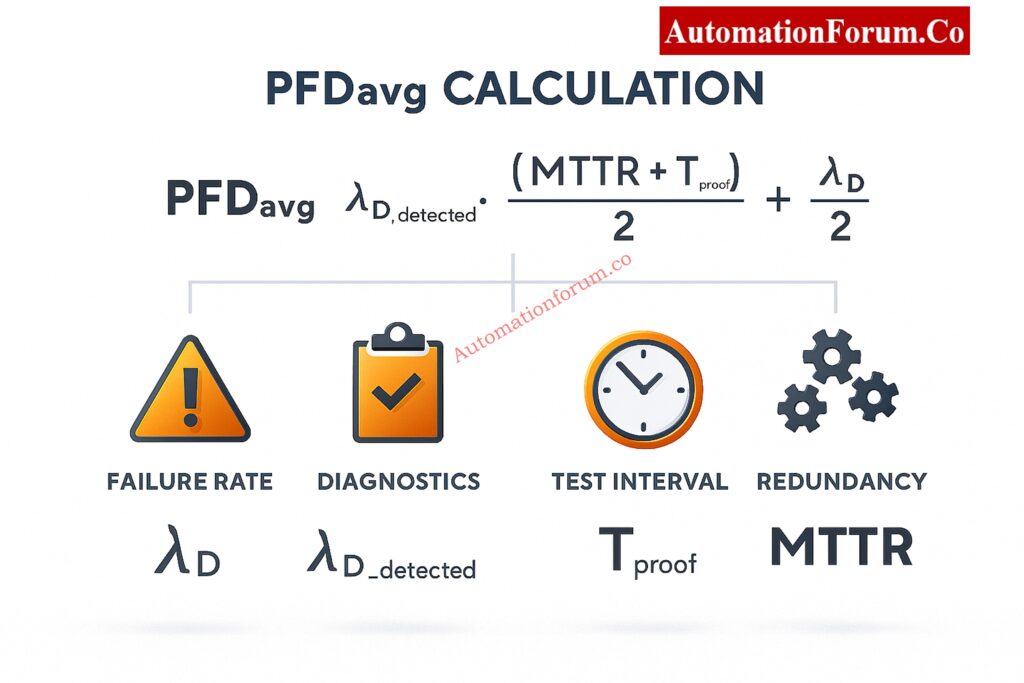
Detected dangerous failures:

λD_detected = λD × DC

Undetected dangerous failures:

λD_undetected = λD × (1 – DC)

For 1oo1:

PFD_DD = λD_detected × MTTR

PFD_DU = λD_undetected × (T/2 when fully tested)

PFDavg = PFD_DD + PFD_DU

For 1oo2:

PFD_independent = (λDU² × T²) / 3

PFD_CCF = β × λDU × T / 2

Total = PFD_independent + PFD_CCF + PFD_DD

For 2oo3 and 1oo3 architectures, similar redundancy models are applied.

SIF PFDavg / SIL Verification - Complete Guide + Online Calculator (IEC 61508 / 61511)

The tool automatically ranks the SIL level:

PFDavgSIL Classification
≤ 10⁻⁴SIL 3
≤ 10⁻³SIL 2
≤ 10⁻²SIL 1
> 10⁻²Below SIL 1

You also get:

  • Color-coded SIL badge
  • Gauge meter
  • Performance bar indicator
  • Safety margin (%)

Master Your SIS Interview: Safety Instrumented System(SIS) Interview Questions and Answers

IEC-Compliant Calculations

Follows IEC 61508 Part 6 and IEC 61511 guidelines.

Supports All Common Architectures

  • 1oo1
  • 1oo2
  • 2oo3
  • 1oo3

Includes Diagnostic Coverage & Proof Testing

Full CCF Support (β Factor)

Animated Results & Gauges

  • Radial gauge
  • Bar gauge
  • Visual indicator of PFD performance

Calculation Steps Display

Good for:

Export Options

Export results as:

  • CSV
  • JSON

Excellent for reporting process safety teams or government agencies about problems.
Step-By-Step Engineering Breakdown: Understanding 2 out of 2 SOV: Working & Configuration

Safety Instrumented System (SIS)

A safety automation system that runs SIFs to keep things running safely.

A periodic test to reveal hidden dangerous failures.

Failures caused by shared external influences; β-factor models this.

RRF = 1 / PFDavg
Higher RRF = better safety performance.

Defines how many channels must operate successfully to complete the safety action.
Comprehensive Comparison Guide: Difference Between Triconex PLC and Other PLCs: A Complete Guide

  1. Use λD values that have been certified by the manufacturer when you can.
  2. Change the proof test intervals based on how you want to maintain the plant.
  3. Consider environmental conditions that affect common-cause failures.
  4. Ensure the architecture aligns with risk reduction requirements.
  5. Add the findings of SIL verification to your Safety Requirements Specification (SRS).

Must-Read Engineering Standards: Key Instrumentation & Control (I&C) Standards Every Engineer Should Know

This calculator is a quick, accurate, and compliant tool for engineers, safety experts, and automation professionals to figure out PFDavg and check SIL levels. Using this tool ensures better documentation, safer system design, and full compliance with functional safety standards.

Future Technologies Explained: Emerging and Future Concepts in Functional Safety: AI, Digital Twins and Industry 4.0

SIL verification is the engineering analysis that proves a Safety Instrumented Function (SIF) meets its required Safety Integrity Level. 

It checks failure rates, architecture, diagnostics, proof-test intervals, and reliability data.
The goal is to confirm the SIF achieves the target PFDavg or PFH.
It is usually done independently.
It ensures the design is quantitatively capable of reducing risk to the required level.

Verification checks whether the SIF design, calculations, and documentation meet SIL requirements.
Validation checks whether the installed and operational system performs the safety function correctly.
Verification = analytical proof; Validation = real-world testing.
Verification happens during design; Validation happens after installation.
Both are required by IEC 61508/61511.

SIL calculation estimates the probability that a safety function fails dangerously. 

It uses failure rates, proof-test interval, diagnostics, redundancy, and repair times.
Metrics include PFDavg for low-demand and PFH for high-demand systems.
The result is compared against SIL thresholds.

It forms the quantitative backbone of SIL verification.

Basic low-demand PFDavg ≈ (dangerous undetected failure rate × proof-test interval) / 2.
More advanced models include redundancy, diagnostics, partial-stroke tests, and common-cause failures.
It requires accurate failure data for sensors, logic solvers, and final elements.
The PFDs of subsystem components are summed.
The final result is compared with SIL limits.

PFDavg expresses the chance a safety function fails when demanded (low-demand mode).
PFH expresses the probability of failure per hour (high/continuous-demand).
PFDavg is used when demands are rare; PFH when demands can be frequent.
They serve different operating modes defined in standards.
Both measure dangerous failures but in different contexts.

SIL defines the required risk-reduction capability of a Safety Instrumented Function.
It ensures process hazards are reduced to tolerable levels.
Higher SIL means higher reliability and lower failure probability.
Used in design, operation, and maintenance of safety systems.
Ensures safety loops perform correctly to prevent major incidents.

Troubleshooting PLC Digital Output Signals – Advanced Industrial Quiz for Automation Engineers

0
Troubleshooting PLC Digital Output Signals - Advanced Industrial Quiz for Automation Engineers

In process industries, where solenoids, motor starters, interposing relays, and field valves all depend on reliable command execution, troubleshooting PLC digital output (DO) signals is an important ability. Failures happen a lot because of things like DO card channel degradation, blown fuses, wiring shorts, ground leakage, generated noise, or wrong sourcing-sinking combinations. Engineers need to look at real-time diagnostics including how the module LEDs behave, the history of output forcing, field voltage drops, relay chatter, and diode suppression health. It is important to know how PLC scan cycles affect the timing of output refreshes and how broken snubber circuits create back-EMF spikes. This quiz tests your ability to figure out complicated DO problems in real plants.

Troubleshooting PLC Digital Output Signals

Troubleshooting PLC Digital Output Signals
Prepare to put your troubleshooting skills to the test. This quiz puts you in tough situations with plants where digital outputs act strangely, stop working from time to time, or break field instruments. Every question makes you think like a senior controls engineer who is fixing a live problem. Jump in, do a detailed analysis, and make sure you know how to do PLC DO diagnostics.

1 / 25

Slow DO Degradation After Lightning Event
A lightning surge hit the plant. weeks later, 3 DO channels intermittently fail under load.

2 / 25

Incorrect Interlocking Behavior
DO-controlled motor starter fails to start because an interlock relay does not energize despite correct command.

3 / 25

DO Output Oscillates with Plant Earth Fault
A nearby MCC earth fault causes intermittent activation of DO equipment.

4 / 25

Valve Not Closing Fully
Valve remains slightly energized after OFF command. Voltage measured at coil is 4V.

5 / 25

Two DOs Interfering Electrically
Two outputs appear coupled; energizing one produces a weak activation of another.

6 / 25

Module LED Flashing Fast
A fast-blinking DO LED typically indicates:

7 / 25

DO Not Switching Due to Wrong Load Type
A new field device does not energize though voltage is present.

8 / 25

DO Response Delayed by 50 -70 ms
Field device activates noticeably later than PLC commanding ON.

9 / 25

Interposing Relay Coil Burnout
Relay coil burns frequently although DO voltage is stable at 24V.

10 / 25

False Activation of Solenoid
Solenoid occasionally energizes without DO logic ON.

11 / 25

DO Card Not Powering Up
Module remains offline though PLC backplane is powered.

12 / 25

DO Acting Like PWM Output
An ON command produces rapid pulsing (oscillation) seen on a relay.

13 / 25

Isolated Channel Failure
Only one DO channel fails; others work perfectly. Module diagnostics show “channel shorted.”

14 / 25

Device Not Responding After Panel Shutdown
After a maintenance shutdown, several DOs fail to energize devices though PLC logic is fine.

15 / 25

DO Module Overheating
A DO module overheats, particularly around one channel. Current is within permissible limits.

16 / 25

Intermittent Trip of an ON–OFF Valve
Valve loses power randomly though DO remains ON. Field measurement shows sudden voltage drops to 10–12V.

17 / 25

DO Channel Bleeds Voltage
A de-energized DO shows 3–5V at the field terminals. Why?

18 / 25

Solenoid Extremely Slow to Act
A solenoid driven by a PLC DO responds slowly though DO switching is correct. Coil voltage is 22V instead of 24V.

19 / 25

DO LED ON but No Field Voltage
The DO module LED turns ON, but multimeter shows zero volts at the terminal.

20 / 25

DO Works Only During Day Shift
Intermittent DO failure only occurs during day shift when large motors operate. DO voltage dips to 12–14V intermittently.

21 / 25

Blown Fuse Pattern
Every time a specific DO energizes a solenoid, the 24V supply fuse blows instantly. What is the most likely issue?

22 / 25

Output Remains ON After Forcing Removed
An engineer forced ON a DO for testing. After releasing the force, the field output remains energized. PLC logic shows output false. Why?

23 / 25

Solenoid Coil Heating Excessively
A solenoid controlled by a DO is overheating and eventually failing. Current measured at 1.3× rated value.

24 / 25

Interposing Relay Not Picking Up
A DO energizes an interposing relay, but the relay flickers continuously. Module LED stays ON steadily. Most likely cause?

25 / 25

DO Channel Failing Under Load
A PLC DO channel energizes a solenoid only when disconnected from the field. Once connected, the output drops to 5V instead of 24V. What is the most likely cause?

Your score is

The average score is 47%

0%

Access 1000+ MCQs tailored for instrumentation engineers: Instrumentation and Process Control Quiz Hub – 1000+ MCQs for Engineers

Thermocouple Wire vs. Thermocouple Extension Wire: The Complete Guide for Instrumentation Engineers

0
Thermocouple Wire vs. Thermocouple Extension Wire: The Complete Guide for Instrumentation Engineers

In industries like oil and gas, pharmaceuticals, power plants, chemical plants, steel, cement, and food processing, process control depends on being able to measure temperature accurately. Thermocouples are the best temperature sensors because they are easy to use, tough, and can monitor very high temperatures.

But one mistake that happens a lot in the field is mixing together thermocouple wire and thermocouple extension wire. Even though they may seem the same and have the same color coding, they do very distinct things. Using the improper wire can cause big mistakes in measurements, drift, and expensive repairs.

This article explains the distinction in a simple, easy-to-understand way that is great for technicians, engineers, and maintenance workers.

What Is Thermocouple Wire? (Thermocouple-Grade Wire)

Thermocouple wire is the actual sensing material that makes up the thermocouple junction. The Seebeck effect turns temperature into a tiny voltage (EMF). This cable is what makes the temperature readout precise, steady, and dependable. Because of this, thermocouple wire is made from high-purity alloys that are very carefully monitored and meet tight performance standards.
Quick Thermocouple Troubleshooting Guide: Check List: How to Troubleshoot a Thermocouple?

Characteristics of Thermocouple Wire
  • Made from alloys with a high level of purity and control: Even little changes in the alloy’s makeup can vary the EMF output. Examples:
    • Type K: Chromel & Alumel
    • Type J: Iron & Constantan
    • Type T: Copper & Constantan
    • Type N: Nicrosil & Nisil
  • Made with very precise metallurgical tolerances: Keeps the relationship between EMF and temperature stable and in line with IEC/ANSI regulations.
  • Made for use in high-temperature settings: Thermocouple wires can handle temperatures of up to 1000°C or higher, depending on the kind. This makes them good for very hot process conditions.
  • Used right at the point of sensing: Installed in thermowells, MI cables, probes, furnaces, reactors, kilns, and any other hot zone where the wire is exposed to genuine process temperatures.
  • Cost goes up because of the quality of the alloy: Thermocouple wire costs more than extension wire because it has to be made to exacting standards and can handle high temperatures.
  • Makes EMF output that is stable and correct: High-quality thermocouple wire reduces drift, oxidation errors, and instability over time.
  • Available in a number of tolerance classes: For example, IEC Class 1, Class 2, or ANSI Special Limits of Error let engineers pick how accurate they need to be dependent on the process.
  • Good resistance to oxidation: This is especially true for Type K and Type N, which are often utilized in tough, oxidizing settings.

Complete Thermocouple Commissioning Checklist: Thermocouple Commissioning Checklist

  • In the thermocouple probe or mineral insulated (MI) cable.
  • At the heated junction, which is the place of measurement.
  • To make or fix thermocouple sensors.
  • In high-temperature situations where extension wire won’t survive.

The wire that makes the temperature indication is thermocouple-grade wire.

Because the whole measuring loop depends on it, it has to be pure, steady, and able to handle high temperatures.
Simulate Sensors Using Calibrator: How to simulate RTDs and Thermocouples using Multifunction calibrator?

What is Thermocouple Extension Wire?

A thermocouple extension wire is a unique type of cable that sends the EMF signal from a thermocouple sensor to a measuring device. It doesn’t make voltage that changes with temperature; instead, it makes sure that the small voltage that comes from the thermocouple junction gets to the instrument correctly and without distortion. 

Extension wire connects thermocouples to devices like :

  • Temperature transmitters
  • PLC or DCS input cards
  • Temperature indicators and recorders
  • Data acquisition or historian systems

Thermocouples are commonly put in hazardous or high-temperature places, and measuring instruments are usually in remote control rooms. Because of this, extension wire is needed for long-distance, noise-free, and cheap signal transmission.
Choose the Right Thermocouple Easily: How to Select the Right Thermocouple for Temperature Measurement Applications?

  • Made from alloys that act like thermocouples: The thermoelectric properties of extension wire alloys are quite similar to those of thermocouples, but only over a small temperature range (typically 80°C–200°C).
  • Not made for places with high temperatures: Do not put extension lines close to hot areas, reactors, or furnaces. They are for cooler paths, like cable trays and junction boxes.
  • Standardized color coding (IEC/ANSI): Technicians can immediately tell what sort of wire and polarity it is by looking at the clear color markings. This eliminates wiring mistakes.
  • Available in a range of industrial settings: Includes twisted pair, shielded, armored, and multi-core designs that can handle tough environments, places with a lot of electromagnetic interference (EMI), or the need for mechanical protection.
  • Less expensive than thermocouple-grade wire: Their cheaper alloys make long-distance routing possible without losing the accuracy of measurements.
  • Stops undesired thermocouple junctions: Using the right extension wire makes sure that no additional junctions of different metals are created.
  • Good for sending signals across great distances: Extension wire can safely deliver microvolt signals across distances of tens to hundreds of meters.
  • When insulated, it has good noise immunity: In plants with VFDs, high-power connections, motors, and EMI sources, shielded versions are very necessary.
  • Lower temperature rating: Made just for colder places like control panels, marshalling rooms, and cable trays.

Easy Millivolt Conversion Method: Converting Thermocouple Millivolts to Temperature: Methods and Examples

Extension wire doesn’t make the thermocouple signal; it just carries it. It also makes sure that the signal is accurate and stable over extended distances.

One of the most common and harmful mistakes people make while measuring temperature is using copper cable instead of thermocouple extension wire.

Copper wire and thermocouple metals make thermoelectric connections by accident. Each connection makes its own EMF, which changes the initial reading.

  • Adds more metal connections that change the EMF signal
  • Causes voltage discrepancies that are hard to predict as the temperature changes
  • Causes readings drift and be unstable
  • Causes noise and poor signal quality to make transmitter measurements change.
  • Leads to wrong control responses, which degrades the quality and safety of the process.
  • Adds 5 to 10 degrees or more of inaccuracy to sensitive processes
  • The problem is hidden in the wiring, which makes it hard to fix.

Instant Thermocouple Conversion Tool: Thermocouple Voltage ↔ Temperature Calculator

  • At the instrument’s input terminals
  • Inside transmitters or PLC cards that have CJC (Cold Junction Compensation)

Bottom line:
Never use copper in the thermocouple circuit at all, except at the ends of the measuring instrument.
Check Your Sensor Selection Skills: Quiz on RTD and Thermocouple Selection for Instrumentation Design Engineers

Importance of Cold Junction Compensation (CJC)

Every thermocouple circuit needs a reference junction that is at a known temperature. Most of the time, this is given by:

  • Transmitter terminals
  • Temperature input cards
  • Dedicated thermocouple input modules

If CJC isn’t working right:

  • A thermocouple loop that is fitted correctly will nonetheless give you the wrong results.
  • The temperature measurements will change when the temperature around them changes.
  • Over time, mistakes can add up, especially in control panels that don’t get enough air.
  • Make sure that terminals are clear of dirt and rust.
  • Only use the right thermocouple terminal blocks.
  • Don’t put transmitters in enclosures that get too hot.
  • Make sure that grounding and shielding are done correctly.

Learn Millivolt Conversion Steps: How to Convert Thermocouple Millivolts to Temperature: A Step-by-Step Guide

To make sure that process plants can accurately measure temperature, undertake these steps:

  • Only use extension wire in places where the temperature is low, like cable trays and panels.
  • Always use the same type of thermocouple throughout the loop (K with KX, J with JX, T with TX, etc.).
  • Follow color coding rules to keep the right polarity.
  • Don’t combine different types of wire or use the wrong alloys, as this can change the readings.
  • Make sure that the connections are strong and safe from moisture, rust, and vibration.
  • Keep track of the wire type and route for each loop in the right way.
  • To reduce electrical noise, use the right grounding and shielding methods.
  • To keep extension wire accurate, keep junction boxes away from places that get very hot.
  • Periodically recalibrate the whole loop, especially when it is used in applications with high temperatures.

Step-By-Step Transmitter Calibration: How to calibrate Thermocouple Transmitter?

Core Differences Thermocouple Wire and Extension Wires
FeatureThermocouple WireExtension Wire
PurposeThe actual measurement connection (hot junction) where the temperature is measured is made of thermocouple wire. It makes the EMF that matches the temperature of the process immediately.The only job of the extension wire is to convey the EMF signal from the thermocouple sensor to the device. It doesn’t measure temperature; it only sends data.
Alloy QualityMade from high-purity alloys that are rigorously regulated to match the specific Seebeck properties needed for precise temperature measurement. Any change influences the EMF output.Uses cheaper alloys that act like the thermocouple’s EMF, but only in a small range of temperatures. Not good for sensing at high temperatures or with great accuracy.
Temperature RangeDepending on the kind, they can handle very high temperatures. For example, kind K and Type N can work at temperatures above 800°C to 1200°C or higher. Great for direct exposure to the process.Works only in places where the temperature is low, usually between 80 and 200 degrees Celsius. Put in places that are cooler, like cable trays and control rooms, where temperature changes don’t have much of an effect.
Accuracy RequirementMust fulfill exceedingly strict standards for accuracy (IEC Class 1, ANSI Special Limits). The temperature readout changes when the alloy composition changes.Needs to be moderately accurate, just enough to send the EMF without making big mistakes. The accuracy stays the same as long as the wire stays within its rated temperature range.
CostIt costs a lot more since it has a high-purity alloy composition, good metallurgical control, and can handle high temperatures.It costs a lot less, which makes it possible to route great distances between field locations and instrumentation panels.
LocationThermocouples can be installed in places like thermowells, probes, furnace walls, reactors, or any other place where the tip is exposed to process temperature.Installed in places where the temperature is low, like cable trays, marshalling cabinets, field junction boxes, and control panels.
EMF GenerationYes. The Seebeck effect makes the thermoelectric voltage happen in the thermocouple wire. Any change in the alloy will affect the EMF, which will modify the temperature reading.No. Extension wire doesn’t make EMF; it only carries the voltage that the thermocouple makes. Its only job is to send signals without making any unwanted connections.

Understand CJC for Accurate Measurement: Why Thermocouple Reference Junction Compensation(CJC) is Essential for Accurate Temperature Measurement ?

The thermocouple wire is the part that senses temperature and makes the hot junction. It makes EMF based on the temperature. Extension wire doesn’t monitor temperature; it just sends the EMF signal from the sensor to the instrument. Thermocouple wire can handle high temperatures, however extension wire is only good for routing cables at low temperatures.

A compensating cable is made of cheap alloys that are similar to the EMF properties of a thermocouple. It only works in a small range of temperatures. Extension cables use alloys that are similar to the materials used in thermocouples, which makes them more accurate and stable. Extension cables are more accurate, while compensating cables cost less.

To make the Seebeck effect, which makes a voltage that changes with temperature, you need two different metals. There would be no voltage and no way to detect temperature if both cables were the same.

A thermocouple extension cable is a low-temperature-rated cable that extends the thermocouple signal from the sensor head to the measuring instrument without losing accuracy or causing undesired junctions.

Yes, but only if you use the right extension wire that works with the thermocouple type. Using the wrong sort of wire (like J-type extension wire for a K-type sensor) or copper wire will make your measurements very wrong.

The objective of extension wire is to send the thermocouple’s EMF signal across long distances without adding more thermoelectric junctions or mistakes. It makes sure that the sensor and the instrument detect the temperature correctly.
Complete Field Guide for Engineers: Testing a Thermocouple With a Multimeter: A Complete Field Guide for Instrumentation Engineers

How to Properly Vent a Pressure or DP Transmitter in Liquid Service

0
How to Properly Vent a Pressure or DP Transmitter in Liquid Service

To get accurate and steady pressure readings in liquid service, you need to do one thing that is often overlooked: venting the transmitter and impulse lines properly. Even a small pocket of trapped air can make the transmitter act in ways that are hard to predict, whether it is being used to measure level, flow, or pressure.

This in-depth article goes over why venting is important, how to do it right, and the best ways to do it in real industrial settings. It is made just for instrumentation engineers and technicians who operate in chemical plants, refineries, power stations, pharmaceutical units, and water treatment plants.

When measuring liquids using a pressure or differential pressure transmitter, the sensor cavity and impulse lines must always be full with liquid. Any air or gas that is trapped will make the reading less accurate because:

Errors like these happen when air pockets get trapped:

  • The transmitter took longer to respond because the gas was compressible and could alter pressure.
  • Readings that are erratic or unstable and jump when the load changes
  • Wrong values for differential pressure, notably in DP transmitters
  • Drift in measurement or a movement to zero
  • In DP level applications, levels that are too high or too low are wrong.
  • In orifice, venturi, or pitot tube systems, flow measurements are not trustworthy. Also, it is not possible to get consistent calibration findings.
  • Noisy feedback signals cause poor tuning and unstable control loops.

venting is one small act that has a direct effect on the health and accuracy of the whole measurement loop.

Gauge vs Transmitter – Accuracy Explained: Pressure Gauge vs Pressure Transmitter: When Readings Don’t Match, Who Should You Trust?

This method works with practically all manufacturers and models of transmitters, such as Emerson, Yokogawa, ABB, Honeywell, Endress+Hauser, Siemens, WIKA, and VEGA.

 Before you do anything else:

  • Find the vent screws or plugs that are only for the transmitter..
  • Most transmitters have vent ports on:
    • The high-pressure (HP) side
    • The low-pressure (LP) side
    • The top of the sensor housing
  • Vent location varies depending on:
  • For DP transmitters:
    • To get the right differential measurement, both the HP and LP sides need to be vented.

Extended caution:

  • Vent screws can be small and fragile, so be careful when you handle them so you don’t damage the threads.
  • Some transmitters contain vent valves instead of plugs. These are meant to make venting safer while the transmitter is running.
Isolate the Transmitter Safely Using the Manifold Valves - How to Properly Vent a Pressure or DP Transmitter in Liquid Service

Safe venting is only possible with proper isolation. Do these things:

  • To separate the transmitter from the process line, close both block valves on the manifold.
  • During the first isolation, keep the equalizing valve completely shut.
  • Check to make sure that isolation doesn’t influence control loops or interlocks.
  • Tell the control room if the transmitter is part of a safety system or a critical loop.
  • Make sure the line is safe and not under too much pressure or heat.

precautions:

  • Residual pressure may still be trapped inside the transmitter cavity even after shutting the block valves.
  • Until the instrument is fully vented, treat it as if it is pressured.

Once the transmitter is separate:

  • put a clean rag, absorbent cloth, or small container beneath the vent point to capture any liquid that comes out.
  • Loosen the HP-side vent plug a little at a time.
  • Slowly loosen the HP-side vent plug.
  • Only crack open the plug slightly – do not remove it completely.
  • Watch for Sudden blasts of air, Discharge of foam or mixed air and liquid, Sputtering at first, then a constant flow

Extended best practices:

  • If you open it too hastily, the pressurized liquid could suddenly come out.
  • Don’t put your body or face right in front of the vent point.
  • Wear the right PPE, like gloves, an apron, goggles, and a face shield, when working with hot or corrosive fluids.
Bleed the Transmitter Until a Consistent, Bubble-Free Stream Appears  - How to Properly Vent a Pressure or DP Transmitter in Liquid Service

This is the most crucial element of letting air out:

  • Allow the fluid to flow freely.
  • Pay close attention to the discharge.
  • You may initially see Air pockets mixed with liquid, Fluctuating or foamy flow, Irregular spurts indicating trapped gas
  • Keep venting until the liquid flow is: Clear, Continuous, Bubble-free. Stable in pressure and flow rate

What this indicates:

  • The detecting diaphragm chambers are full with liquid all the way through.
  • There are no longer any air pockets trapped inside the housing.
  • The accuracy of measurements will get a lot better.

notes:

  • This procedure may take longer when working with thick liquids.
  • In cold places, air may move liquid more slowly because the fluid is denser.

Gently but firmly tighten the vent plug when the flow is free of air bubbles. 

DP Transmitter 3-Valve Manifold Safety Guide: Safe Commissioning & Removal of DP Transmitters with a 3-Way Valve Manifold

Repeat the Venting Procedure for the Low-Pressure Side (Only for DP Transmitters) - - How to Properly Vent a Pressure or DP Transmitter in Liquid Service

For differential pressure applications:

  • do the same slow venting technique on the LP side.
  • The LP side often traps air more often because it is normally higher up.  It may have longer impulse tubing, Air naturally rises into the LP leg during shutdown

Extended effects of not venting the LP side:

  • Incorrect differential pressure readings
  • Zero point errors
  • False level or flow calculations
  • Drift is caused by an imbalance between the HP and LP legs.

Making ensuring that both sides are adequately vented brings back the right way to detect differential pressure.

Pressure Transmitter Installation – Step-by-Step:  Step by Step Pressure Transmitter Installation Procedure

A common mistake in the field is rapidly applying pressure to the transmitter after venting. This must be avoided.

  • First, open the equalizing valve so that the transmitter sees zero DP.
  • Then, carefully open both block valves to let process pressure in.
  • Finally, close the equalizing valve to get the DP measurement back to normal.

Why this matters:

  • Stops abrupt pressure shocks that can hurt diaphragms
  • Keeps sensing membranes from getting stressed out inside
  • Ensures zero stability
  • Lessens the chance of having trapped pressure pockets inside. changing

Reminders:

  • After putting the transmitter back into action, check the live signal from the control system or handheld device to make sure the readings are reliable.

DP Transmitter 5-Valve Manifold Installation Guide: Step-by-Step Guide: Installing & Removing a DP Transmitter with a 5-Way Valve Manifold

Instrumentation engineers typically have problems that come up in the field. These basic practices make sure that the venting procedure is clean and complete:

  • For horizontal impulse lines, always vent at the highest point where air gathers.
  • For vertical impulse lines, let air out at the top of the transmitter body.
  • For vessels with top-mounted transmitters, look for vapor pockets accumulating below the tapping points.
  • For thick liquids, vent slowly so that the fluid has time to push the air out.
  • For fluids that are corrosive or poisonous, wear the right PPE and take the right steps to clean up spills.
  • For hot liquids, step back and very carefully manage the opening.
  • Long impulse lines tend to gather air when they first start up.
  • Repeated air trapping happens when impulse lines are poorly sloped or drooping.
  • Level applications have fewer problems with air when you use vertical wet legs.

Pressure Transmitter Commissioning Checklist:  Pressure Transmitter Commissioning Checklist 

Never start venting at the transmitter if the impulse lines are full of sealing liquid like glycol. This will drain the liquid and mess up the wet-leg reference height. Always vent from the highest point in the impulse line or seal pot to get rid of trapped air without changing the glycol column. Before you touch the transmitter vents, make sure both legs are completely full and equal. When the wet legs are clear of bubbles, separate the transmitter and carefully vent just the sensor cavity. If you lose any glycol, fill both legs back up equally to avoid making permanent level errors.

Smart Transmitter Sensor Trim – Full Guide: Smart Pressure Transmitter Sensor Trim Guide with Diagrams & Calibration Steps

Common Problems Caused by Improper Venting

Common Problems Caused by Improper Venting -  - How to Properly Vent a Pressure or DP Transmitter in Liquid Service

If the transmitter isn’t ventilated properly, you might see:

  • Unstable or noisy readings
  • Slow response or “spongy” behavior
  • Wrong level measurement in DP systems
  • Fluctuating flow measurements
  • Zero shift during calibration
  • Frequent alarms on DCS
  • Inconsistent output even after calibration

Extended impact:

  • Controllers may search since the measurements aren’t stable.
  • Safety interlocks can go off by accident.
  • Maintenance personnel could spend too much time fixing equipment that isn’t broken.

Pressure Transmitter Hookup Reading Made Easy: How to Read Pressure Transmitter Hookup Drawings ?

You can check to see if the venting method works by:

  • Output from the transmitter that is smooth and steady
  • No rapid changes in reading or oscillations
  • No strange delay in response
  • Output accuracy checked against reference gauges
  • Value of zero stays the same during equalization
  • The last reading matches what was expected for the process.
Safety Considerations for Instrument Technicians -  - How to Properly Vent a Pressure or DP Transmitter in Liquid Service

Always prioritize safety:

  • Put on the right PPE for the service fluid.
  • Follow the steps for isolating plants.
  • Drip trays can help keep spills and slips from happening.
  • Don’t let your face or body get near the vent.
  • To keep the threads safe, don’t over-tighten the vent plugs.
  • Don’t ever think a transmitter is depressurized without checking first.

For reliable, precise, and safe measurement in liquid service, pressure and differential pressure transmitters must be vented correctly. Instrumentation staff can do the following by following the right protocols for isolation, controlled venting, and returning to service:

  • Get rid of air pockets
  • Make the transmitter respond better
  • Stop measurement drift
  • Improve the performance of the whole loop
  • Cut down on troubleshooting that isn’t needed
  • Make plants more reliable

By mastering this easy but important chore, you can make sure that your transmitters work at their best, which will help you control your processes consistently and accurately.

DP Flow Transmitter Commissioning Checklist:  Differential Pressure Transmitter Commissioning Checklist for Flow Measurement Applications

To vent a pressure transmitter that is in liquid service, use the manifold block valves to isolate it, put a container under the vent plug, and slowly open the vent screw. Let the fluid run until you see a clear stream with no bubbles. This gets rid of air pockets that can mess up measurements. After venting, carefully close the screw and put the transmitter back into use in the right order.

To maintain the transmitter fully flooded, put it below the tapping point, make sure the impulse lines slope down toward the transmitter, stay away from high locations where air can accumulate, and use the right block valves and a manifold. After putting it in, open the transmitter to allow out air and make sure the sensor chamber is full of liquid.

To drain a transmitter, use the manifold to separate it from the rest of the system. Then, open the drain or vent plug at the bottom of the housing and let the liquid flow out fully. Follow plant safety rules, use a catch container, and make sure the process is depressurized if necessary. Usually, draining is done before maintenance, calibration, or when the service circumstances change.

To bleed a DP transmitter, you need to isolate it, put a container beneath the vent plugs, and progressively open the high-pressure vent first. This will let out all of the air and let a stream of liquid flow without bubbles. Do the same thing on the low-pressure side. Make sure that both sides are thoroughly vented before putting the transmitter back into service using the equalizing valve procedure.

separated and at real zero pressure. After shutting off the block valves and opening the equalizing valve, plug in a communicator or configuration tool, go to the “Zero Trim” or “Sensor Trim” menu, and do the trim. This changes the output of the transmitter to match the real zero pressure circumstances.

A normal 5-point calibration has:

  1. 0% (As-Found) – Check the first zero.
  2. 25%-Use and record the output.
  3. 50%-Verification in the middle range.
  4. 75%-Check the near-upper range.
  5. 100% (As-Found) – Full-scale confirmation.

After making changes, go over the same five points for As-Left. This makes sure that the whole range of measurements is linear, accurate, and repeatable.

Pressure Transmitter HART Wiring Explained: Wiring Diagram for Pressure Transmitter Calibration in Workbench using HART

Best PID Controller Tuning Simulation Tool for Engineers

0
PID Controller Tuning Simulation Tool for Engineers
PID Tuning Toolbox
automationforum.co
Trusted source of automation tools

🎛️ PID Tuning Toolbox

Advanced Controller Design with Multiple Tuning Methods

📊 Configuration

automationforum.co
Trusted source of automation tools

PID (Proportional–Integral–Derivative) controllers are the most extensively utilized control algorithms in modern industrial automation. PID controllers are essential for maintaining consistent, dependable process performance. They manage everything from temperature control in heat exchangers to pressure stabilization in pipelines and flow regulation in chemical dosing systems. Tuning a PID controller, however, presents a significant hurdle for instrumentation and control engineers. This is particularly true in dynamic and nonlinear process contexts, where the task becomes even more complex.

The PID Controller Tuning Simulation Calculator offers a simplified, interactive, and effective approach for designing, adjusting, and testing PID settings before using them in real-world applications. This online application gives engineers the ability to model how a process will behave, figure out the best PID gains using established tuning techniques, and immediately see how well the closed loop performs, thanks to real-time charts.

This article provides an in-depth and highly valuable explanation of how the PID tuning simulation calculator works, its features, tuning methods, applications, and advantages for instrumentation professionals working in process industries.
Open Loop vs Closed Loop Control Explained: What are Open Loop & Closed Loop system

A PID tuning simulation calculator is an online computational and visualization tool that assists engineers in determining the appropriate controller parameters (Kp, Ki, Kd) based on given process characteristics. The calculator gives instant, accurate, and graphically validated results, eliminating the need for lengthy manual calculations or field trial-and-error adjustment.

The calculator contains features such as:

  • PID tuning methods include Ziegler-Nichols, Cohen-Coon, IMC, and Relay Autotuning.
  • Automatic calculation of Kp, Ki, Kd, Ti, and Td.
  • Real-time depiction of closed-loop step responses.
  • Live process simulation includes disturbance, noise, and controller output limits.
  • The UI is simple to use and works well on both desktop and mobile devices.

This makes it an effective tool for engineers who require dependable tweaking but do not want to deal with sophisticated software.
Adaptive Control and Its Real-Time Benefits: What is an adaptive control?

The functioning of a PID loop has a direct impact on product quality, energy efficiency, equipment life, and safety. Poorly adjusted controllers usually exhibit:

  • Excessive oscillations
  • Long settling time
  • Overshoot or undershoot
  • Instability
  • Integral wind-up
  • Frequent cycling of control valves or actuators

On the other hand, a properly tuned PID controller ensures:

  • Fast response with minimal overshoot
  • Stable control with low variability
  • Improved process consistency
  • Better disturbance rejection
  • Reduced wear and tear on control valves
  • Increased safety and reliability

The PID tuning simulation calculator makes this process easier by providing tested tuning options supported by real-time simulation.

Refer the below link for the Simple and Effective PID Tuning Tips:

The calculator provides a variety of conventional tuning procedures suitable for a wide range of industrial applications. Understanding each strategy allows engineers to select the most appropriate one for their process.

The Ziegler-Nichols open-loop method was one of the first and most commonly utilized tuning procedures. It necessitates determining three critical process parameters:

  • Process Gain (K)
  • Dead Time (L)
  • Process Time Constant (T)

Using these data, the calculator uses ZN tuning principles to calculate the PID parameters. This approach is especially useful for systems with first-order plus dead time (FOPDT) behavior.

Best suited for:

What Offset Means in Process Control: What is offset in Process control?

This method includes increasing the proportional gain until the loop enters continuous oscillation. The two primary parameters are:

  • Ultimate Gain (Ku)
  • Oscillation Period (Pu)

The calculator utilizes these numbers to calculate the optimal Kp, Ki, and Kd. This strategy is useful when the process cannot be stopped for open-loop testing.

Best suited for:

  • Fast dynamic systems
  • Compact control loops
  • Systems where step response testing is difficult

Quick Troubleshooting Guide for Temperature Controllers: Troubleshooting of Temperature Controllers

Because of its durability and stability, IMC tuning is quite common in today's industries. It considers:

  • Process Gain (K)
  • Time Constant (τ)
  • Dead Time (θ)
  • Tuning parameter Lambda (λ)

Lambda specifies how aggressive or conservative the control should be. Lower lambda values result in a speedier response, whilst higher values promote stability.

Best suited for:

  • Chemical and refinery processes
  • Systems with long dead time
  • Processes requiring smooth, robust control

Three-Element Control for Boiler Drum Level: Three Element Control

Cohen-Coon tuning improves ZN when dead time is significant. It employs the same parameters (K, T, and L), but with a more precise computation to accommodate huge L/T ratios.

Best suited for:

  • Slow responding systems
  • Industrial heating processes
  • Systems with moderate to high dead time

Advanced Process Control (APC) Explained Simply: Advanced Process Control (APC)

Relay autotuning is utilized when process data is absent or manually inducing oscillations is hazardous. The calculator uses:

  • Relay amplitude
  • Oscillation amplitude
  • Oscillation period
  • Hysteresis

It uses these to estimate Ku and Pu, and then applies PID equations.

Ideal for: 

Understanding Core PID Control Actions: What is a PID control action?

The calculator produces a closed-loop step response plot, which clearly shows:

  • Rise time
  • Overshoot
  • Settling time
  • Final steady state
  • Stability

This step response chart allows engineers to examine the performance of several tuning methods and select the one that provides the best control behavior.
Step-by-Step Temperature Controller Installation: Step-by-Step Procedure for Installing a Temperature Controller in a Process Plant : Checklist

The ability to do dynamic simulation is one of the PID Controller Tuning Simulation Calculator's most advanced capabilities. The simulation responds rapidly to input changes, providing real-time insights into controller behavior.

Adjustable parameters include

  • Setpoint (SP)
  • Noise level
  • Disturbance
  • Controller output limits
  • Simulation speed

The live graph displays:

  • Process Value (PV)
  • Setpoint (SP)
  • Controller Output (CV)

This enables engineers to simulate real-world conditions such as disruptions, noise, abrupt setpoint changes, and saturation limits without endangering genuine plant equipment.

Clear Comparison: PLC vs PID Controller: What is the difference between PLC and PID controller?

The PID Tuning Calculator is utilized in a variety of industries, including oil and gas, chemicals, water treatment, pharmaceuticals, HVAC, food processing, manufacturing, and power generation.

It helps in the optimization of loops for flow, pressure, temperature, level, speed, and pH management.

This makes it valuable for instrumentation and control engineers, maintenance crews, and students.
How to Select the Right Process Controller: How to choose the Proper Process Controller: A Comprehensive Guide

The calculator provides various advantages over manual adjustment and other static tools.

  • User-friendly Interface: Designed for field engineers that need quick results without using sophisticated software.
  • Multiple Tuning Methods: This platform incorporates all of the key tuning approaches.
  • Real-Time Simulation: Engineers can test how a loop responds under different conditions before applying parameters.
  • No installation required: The program works with any browser, making it portable and versatile.
  • Educational value: Suitable for training, demonstrations, and academic reasons.
  • How to Use the PID Tuning Calculator (Expanded Guide)

Reliable Mass Flow Controller Calibration Guide: Mass Flow Controller Calibration Procedure

Using the PID Tuning Simulation Calculator is simple, even for engineers who are new to controller tuning. The tool's clear style, logical workflow, and real-time visualization speed up and improve the accuracy of the tuning process. The following is a step-by-step explanation of how to properly utilize the calculator to obtain precise PID settings and test system performance before applying them to a real-world industrial operation.

PID Tuning Method

The first step is to select a tuning method from the available options. Each tuning approach is intended for a specific type of process behavior, and using the correct one produces more consistent outcomes.

The calculator includes these common methods:

  • Ziegler-Nichols Open Loop is ideal for first-order systems with dead time.
  • Ziegler-Nichols Closed Loop - Used to safely create oscillations.
  • Cohen-Coon Method is ideal for processes having a substantial amount of dead time.
  • Internal Model Control (IMC) is a reliable, industry-standard tuning approach.
  • Relay Autotuning - Useful when manual testing is dangerous or the process dynamics are unclear.

The settings you enter in the following step are determined by your decision here.

Depending on selected tuning method, the calculator will prompt you to enter the appropriate process data. These quantities are required for proper calculations of Kp, Ki, and Kd.

Typical parameters are:

  • Process Gain (K) denotes how much the process output varies in response to a change in input.
  • Dead Time (L) is the amount of time that passes before the process begins to respond.
  • Time Constant (T) - The system's normal reaction rate.
  • Ultimate Gain (Ku) and Ultimate Period (Pu) are used for closed-loop ZN tuning.
  • Lambda (λ) represents the required closed-loop aggressiveness in IMC tuning.
  • Relay amplitude, hysteresis, and oscillation characteristics are required for relay autotuning.

Accurate measurements or plant data produce the best tuning outcomes. When the parameters are entered, the calculator prepares the system for adjustment.

PID Tuning Method -

After entering process information, simply click the calculation button. The tool instantly calculates:

  • Proportional Gain (Kp) determines the instant response to an error.
  • Integral Gain (Ki) - Removes steady-state errors.
  • Derivative Gain (Kd) - Predicts changes while reducing overshoot.

Depending on the tuning method used, additional values such as Ti (Integral Time) and Td (Derivative Time) are presented.

These numerical results serve as the foundation for your PID controller settings, which are adapted to your system's measured dynamics.

PID Tuning Method - - Analyze the Closed-Loop Step Response

Once the PID settings have been determined, the calculator will generate a closed-loop response graphic. This graph is important because it visually depicts how your tuned PID controller will respond to a sudden change in setpoint.

The plot exposes what:

  • Response speed
  • Overshoot percentage
  • Rise time
  • Settling time
  • Stability behavior
  • Final steady-state accuracy

You can compare tuning approaches by recalculating and analyzing how they impact the curve. This allows you to select the method that best meets your individual process requirements, whether you demand speed, stability, or robustness.

Excel PID Loop Simulator Guide: Excel based PID Loop Simulator

After examining the closed-loop answer, switch to real-time simulation mode. This is where the calculator comes in handy since it allows you to simulate how the PID controller will behave in real-world scenarios like noise, disturbances, and saturation limits.

The simulation screen allows you to dynamically adjust:

  • Setpoint (SP):  Introduce step changes or ramps.
  • Disturbance input:  Evaluate disturbance rejection performance.
  • Noise level: Test how the controller handles measurement noise.
  • Controller Output Limits (CV min/max):  Assess saturation behavior.
  • Simulation speed: Observe the loop in slow motion or fast-forward.

The real-time graph shows:

  • Process Value (PV)
  • Setpoint (SP)
  • Control Output (CV)

This allows you to quickly determine whether your tuning is aggressive, sluggish, oscillatory, or stable.

Testing scenarios such as:

  • Sudden load changes
  • Noise spikes
  • Flow disturbances
  • Dead-time effects
  • Valve travel limits
  • Slow sensor feedback

ensures that estimated parameters are applicable in real plant conditions. 

After testing both the closed-loop step response and the live simulation, you can finalize the PID parameters with confidence. Engineers typically:

  • Compare multiple tuning methods
  • Adjust process parameters for refinement
  • Validate control speed vs. stability
  • Ensure acceptable overshoot levels
  • Confirm no integral windup occurs
  • Check controller output stays within limits

This ensures the PID settings you transfer to your PLC, DCS, or controller hardware are robust and field-ready.

The PID Controller Tuning Simulation Calculator is one of the most powerful, user-friendly, and feature-rich tools available to modern control engineers. Its complete tuning options, dynamic simulation engine, and detailed visualization tools enable professionals to confidently and precisely build and test PID controllers.

Whether you're optimizing flow, pressure, temperature, or level loops, this tool makes PID tuning easier and provides detailed insights into system performance. It comes highly recommended for anyone working in process control, automation, or instrumentation engineering.

Essential PLC Program Backup Checklist: Programmable Logic Controller (PLC) Program Backup Checklist

There is no single strategy that works best for every process, but Internal Model Control (IMC) is often regarded as one of the most effective overall. It provides a consistent, smooth response, performs well in processes with dead time, and is simple to configure. Many modern industries like IMC because it strikes a fair mix between quick reaction and safe operation.

The Ziegler-Nichols tuning method is the most commonly utilized worldwide. It is easy, quick to use, and gives appropriate tuning values for the majority of general-purpose control loops. Because it is simple to understand and applies to a wide range of systems, it is frequently taught in engineering schools and utilized in field commissioning.

To improve PID controller accuracy,

  • use appropriate tuning methods based on process behavior.
  • Ensure that the process gain, dead time, and time constant quantities are appropriately measured.
  • Reduce noise by utilizing filters or higher-quality sensors.
  • Reduce dead time due to long pipelines or slow sensors.
  • Adjust the derivative action (Kd) to reduce overshoot and increase stability.

Small adjustments to measurement quality and tuning can dramatically enhance accuracy.

Yes. Proper PID tuning can greatly increase process efficiency. When a loop is correctly tuned, it achieves the setpoint faster, eliminates extraneous oscillations, and consumes less energy. It also reduces wear on control valves, pumps, and actuators, lowering maintenance costs and increasing overall system reliability.

When the proportional gain (Kp) is set too high, the controller reacts excessively to errors. This usually leads to:

  • Continuous oscillations
  • Overshoot of the setpoint
  • Instability
  • Extreme movement of the control valve or actuator

In extreme circumstances, the loop may become fully unstable. Reducing Kp or increasing damping via Ki/Kd helps to stabilize the system.

Refer the below link for the Accurate Temperature Controller Calibration Procedure