
- Introduction to Industrial Communication Protocols in Process Automation
- What Are Industrial Communication Protocols and How Do They Work?
- Top 9 Industrial Communication Protocols Every Automation Engineer Should Know
- Industrial Communication Protocol Comparison: Features, Applications and Limitations
- Other Important Industrial Communication Protocols Used in SCADA and Safety Systems
- How to Select the Right Industrial Communication Protocol for Process Automation
- Industrial Communication Protocol Troubleshooting: Common Problems and Solutions
- Industrial Communication Protocol Commissioning and Maintenance Best Practices
- Future Trends in Industrial Communication Technologies
- Frequently Asked Questions About Industrial Communication Protocols
- Conclusion: Choosing the Right Industrial Communication Protocol for Reliable Process Automation
Introduction to Industrial Communication Protocols in Process Automation
Industrial communication protocols form the backbone of modern process automation. They enable field instruments, PLCs, DCS, remote I/O, SCADA systems and industrial applications to exchange process information reliably.
In an EPC project, selecting the correct communication protocol affects system integration, commissioning time, plant availability, troubleshooting and future expansion. Understanding the differences between field communication, controller networks and supervisory integration is essential for instrumentation and automation engineers.
What Are Industrial Communication Protocols and How Do They Work?
Industrial communication protocols are standardized rules that define how automation devices exchange data, identify equipment, manage communication and interpret information.
Some protocols connect field transmitters to control systems, while others support PLC communication, industrial Ethernet, supervisory monitoring and cloud integration.
Refer the below link for the Protocols and Standards in Industrial Automation: A Guide to OT Cybersecurity
Top 9 Industrial Communication Protocols Every Automation Engineer Should Know
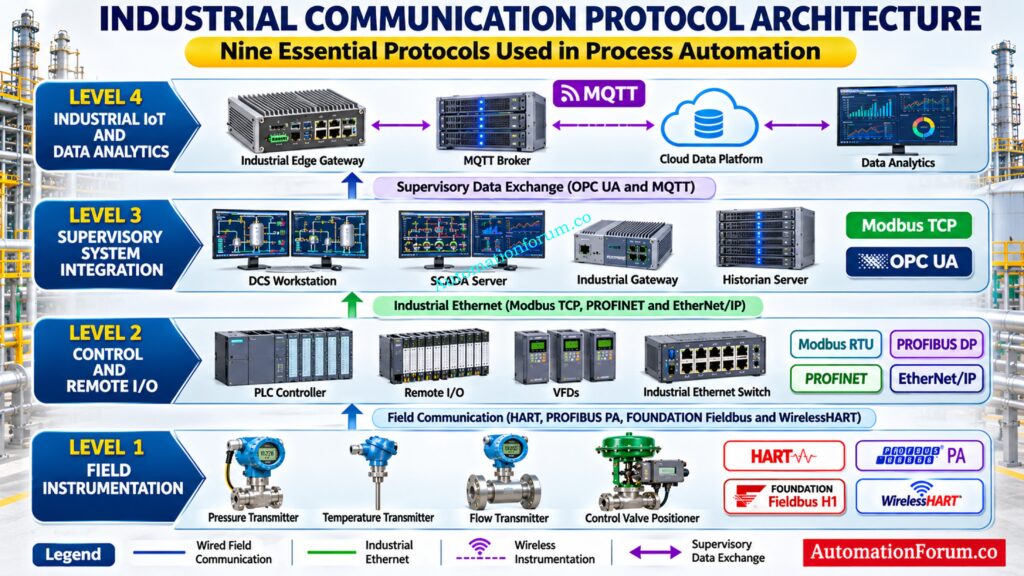
HART Communication Protocol: Digital Communication for Smart Field Instruments
Full form: Highway Addressable Remote Transducer.
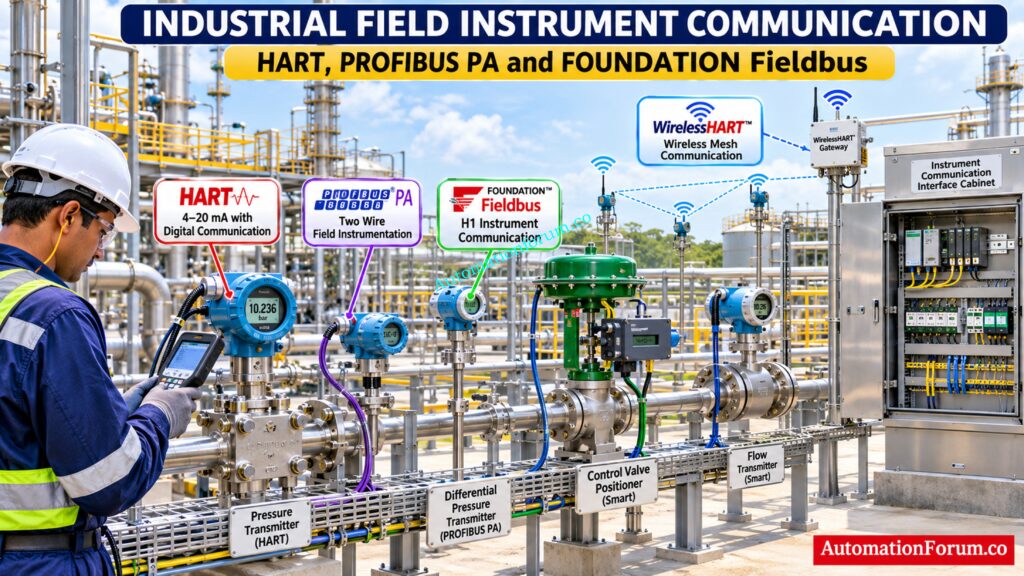
HART enables digital communication over conventional 4 to 20 mA instrumentation loops using Frequency Shift Keying. The analog signal carries the primary process measurement, while digital communication provides configuration, secondary variables and instrument diagnostics.
It is commonly used with pressure transmitters, differential pressure transmitters, temperature transmitters and smart valve positioners.
Engineering example: A smart pressure transmitter sends its primary pressure measurement to the DCS through the analog input card. A HART multiplexer or compatible HART interface allows engineers to access diagnostics and configure the instrument through an asset management system.
Commissioning consideration: Verify HART compatibility, loop resistance, device address and communication configuration. Incorrect loop resistance or unsuitable input card settings can prevent reliable digital communication.
Explore the essential networks powering reliable industrial data exchange: Industrial communication protocols
Modbus RTU and Modbus TCP/IP: PLC and DCS Communication Protocols
Full form: Modbus is an industrial communication protocol originally developed by Modicon.
Modbus RTU uses serial communication, commonly over RS485, while Modbus TCP/IP exchanges data over Ethernet using TCP. Both use client and server communication models.
Data is organized using coils, discrete inputs, input registers and holding registers. Engineers must verify register addresses, data types, scaling and byte order.
Engineering example: A PLC communicates with an energy meter using Modbus RTU over RS485. A separate PLC can exchange packaged equipment operating data with the plant DCS through Modbus TCP.
Commissioning consideration: Verify baud rate, parity, stop bits, slave address, register mapping, communication timeout and RS485 termination. Incorrect register interpretation can produce incorrect process values even when communication is healthy.
Discover migration shortcuts that protect valuable PLC programs: PLC Conversion Tools: Popular PLC Migration Tools for Automation Engineers
PROFIBUS DP and PROFIBUS PA: Industrial Fieldbus Communication
Full form: Process Field Bus.
PROFIBUS DP supports communication with remote I/O, drives and automation equipment using RS485. PROFIBUS PA is designed for process instrumentation and uses Manchester Bus Powered physical layer technology.
PA devices can receive power and exchange digital information over the same two wire bus. Segment couplers or linking devices connect PA segments with DP networks.
Engineering example: Pressure, temperature and flow transmitters communicate through PROFIBUS PA, while the DCS connects to the instrument network through an appropriate interface.
Commissioning consideration: Check device addresses, GSD files, segment loading, bus termination, cable shielding and segment coupler configuration. Hazardous area installations require approved segment and intrinsic safety design.
Uncover the critical differences before selecting your field network: Difference Between Fieldbus and HART Communication Protocols: Complete Comparison Guide for Process Automation Engineers
FOUNDATION Fieldbus: Digital Field Instrumentation and Distributed Process Control
FOUNDATION Fieldbus is a fully digital communication technology for process automation.
H1 operates at 31.25 kbit/s over a two wire fieldbus and supports device communication and bus power. HSE provides higher speed Ethernet communication.
Its important feature is control in the field. Function blocks such as analog input, PID and analog output can execute across field devices. The Link Active Scheduler manages scheduled communication.
Engineering example: A pressure transmitter executes an analog input function block, which communicates with a PID function block and a smart control valve positioner. This arrangement can support distributed control through the DCS.
Commissioning consideration: Verify segment power, terminators, device descriptions, function block configuration, schedule and Link Active Scheduler operation.
See how connected systems keep modern factories communicating: Connecting the Industrial World: An Exploration of Communication Protocols in Automation and Instrumentation
PROFINET Protocol: Industrial Ethernet Communication for PLC and Remote I/O
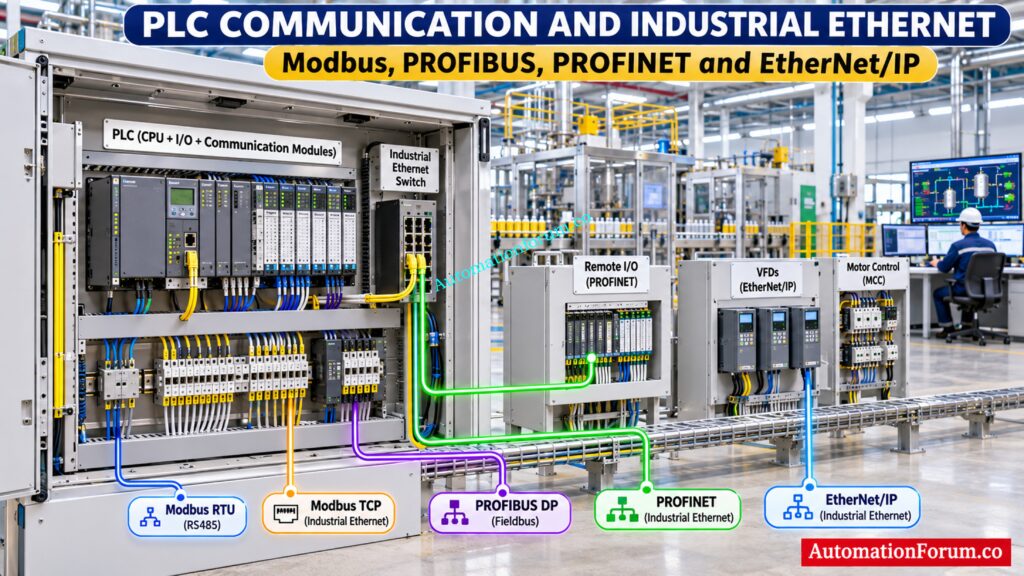
PROFINET is an industrial Ethernet communication technology developed for real time automation.
It uses controller and device architecture to exchange cyclic process data and diagnostic information. PROFINET RT supports real time communication, while IRT supports applications requiring more precise synchronization.
GSDML files describe device capabilities and configuration parameters.
Engineering example: A PLC communicates with distributed remote I/O stations and VFDs through industrial Ethernet switches. Field signals are transferred to the controller for process control.
Commissioning consideration: Verify IP addresses, device names, GSDML compatibility, network topology, update times and switch diagnostics.
Plan wireless coverage accurately before deploying field devices: WirelessHART Network Planning Tool for Automation Engineers
EtherNet/IP Protocol: Ethernet Communication for Industrial Automation
EtherNet/IP means Ethernet Industrial Protocol. It uses standard Ethernet and TCP/IP technologies with the Common Industrial Protocol.
It supports explicit messaging for configuration and diagnostic requests and implicit messaging for regular I/O data exchange. Its producer and consumer architecture allows devices to exchange data efficiently.
Engineering example: A PLC communicates with remote I/O, motor control centres and VFDs using EtherNet/IP. Third party package equipment can also
exchange data through compatible CIP interfaces.
Commissioning consideration: Check IP addressing, device electronic data sheets, assembly instances, connection parameters, requested packet interval and connection limits.
Identify the hardware that keeps remote plants connected: Understanding the Devices Used in Remote Industrial Networking in Process Industries
OPC UA Protocol: Secure PLC, DCS and SCADA System Integration
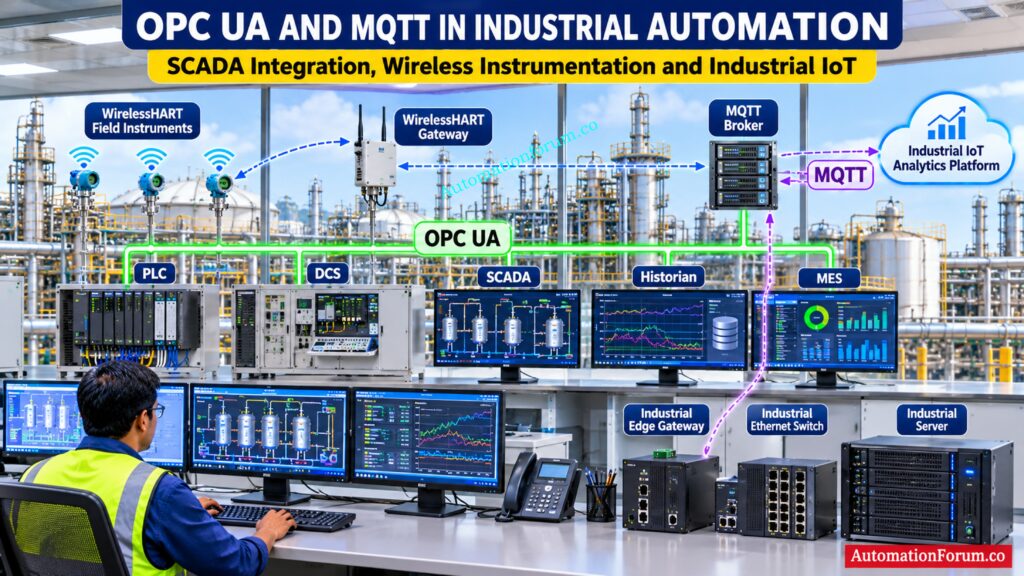
OPC UA means Open Platform Communications Unified Architecture.
It provides secure, platform independent communication between industrial systems. Its client server architecture supports structured information exchange, while PubSub provides another communication model.
OPC UA supports information modelling, security certificates, authentication, encryption and access control.
Engineering example: A PLC exposes production values through an OPC UA server. SCADA and historian applications act as clients to collect equipment status, process measurements and production information.
Commissioning consideration: Verify server endpoints, certificates, security policies, user permissions, namespaces and data types.
Find communication faults faster with a disciplined diagnostic approach: PROFIBUS Communication Failure Step by Step Diagnosis
WirelessHART Protocol: Wireless Communication for Industrial Field Instruments
WirelessHART is a wireless communication technology for industrial field instrumentation based on HART technology.
It uses a self organizing mesh network in which devices can forward messages through other devices. A gateway connects field instruments to the host system, while the network manager handles routing, scheduling and network management.
Engineering example: Wireless tank level transmitters communicate through a gateway to the DCS. This is useful for remote tank farms and locations where conventional instrument cabling is expensive.
Commissioning consideration: Check network identification, join keys, gateway placement, signal strength, routing and network health.
Protect critical control systems with proven security expertise: Top Companies in Industrial Cyber Security: Best OT Security Vendors for Industrial Automation
MQTT Protocol: Industrial IoT Communication for Remote Monitoring and Data Exchange
MQTT means Message Queuing Telemetry Transport.
It is a lightweight publish and subscribe messaging protocol used extensively in industrial IoT applications. Publishers send information to a broker under defined topics, and subscribers receive information from the topics they follow.
It supports three Quality of Service levels, retained messages and persistent sessions.
Engineering example: An edge gateway collects PLC and DCS operating data and publishes selected information to an MQTT broker. An IIoT platform uses this information for remote monitoring and predictive maintenance.
Commissioning consideration: Verify broker connectivity, topic structure, authentication, TLS configuration, QoS settings and message handling during network interruptions.
Industrial Communication Protocol Comparison: Features, Applications and Limitations
| Protocol | Communication type | Physical medium | Architecture | Main application |
| HART | Hybrid analog and digital | 4 to 20 mA loop | Point to point or multidrop | Smart instrumentation |
| Modbus RTU | Serial | RS485 | Client and server | Meters and PLC integration |
| Modbus TCP | Ethernet | Ethernet | Client and server | PLC and DCS integration |
| PROFIBUS DP | Digital fieldbus | RS485 | Master and slave | Remote I/O and drives |
| PROFIBUS PA | Digital fieldbus | Two wire bus | Cyclic field communication | Process instruments |
| FOUNDATION Fieldbus | Digital fieldbus | H1 and HSE | Distributed function blocks | Process control |
| PROFINET | Industrial Ethernet | Ethernet | Controller and device | PLC and remote I/O |
| EtherNet/IP | Industrial Ethernet | Ethernet | Producer and consumer | PLC and equipment integration |
| OPC UA | Application communication | Ethernet and supported transports | Client and server or PubSub | SCADA and historian |
| WirelessHART | Wireless field communication | Wireless mesh | Gateway and mesh network | Remote instrumentation |
| MQTT | Publish and subscribe messaging | TCP/IP | Broker based | Industrial IoT |
These protocols serve different levels of industrial automation. HART, PROFIBUS PA and FOUNDATION Fieldbus primarily support field instrumentation, while Modbus, PROFIBUS DP, PROFINET and EtherNet/IP support controller and equipment communication. OPC UA and MQTT are particularly useful for supervisory integration, industrial data exchange and higher level applications. WirelessHART addresses field instrumentation applications where conventional cabling is difficult or expensive.
Other Important Industrial Communication Protocols Used in SCADA and Safety Systems
Apart from the nine protocols discussed above, DNP3 and IEC 60870 5 104 are widely used in electrical utility SCADA, power distribution and remote telemetry applications. They support communication between control centres, substations and remote terminal units.
PROFIsafe is another important technology used in industrial safety systems. It is a functional safety communication profile operating over compatible PROFIBUS and PROFINET networks, rather than a conventional standalone communication protocol.
Engineers should also understand that Ethernet is a networking technology and RS485 is a physical layer standard. Neither should be classified as an application protocol equivalent to Modbus or OPC UA.
Refer the below link for the PLC Interface Converter vs Protocol Converter: Key Differences and Industrial Applications
How to Select the Right Industrial Communication Protocol for Process Automation
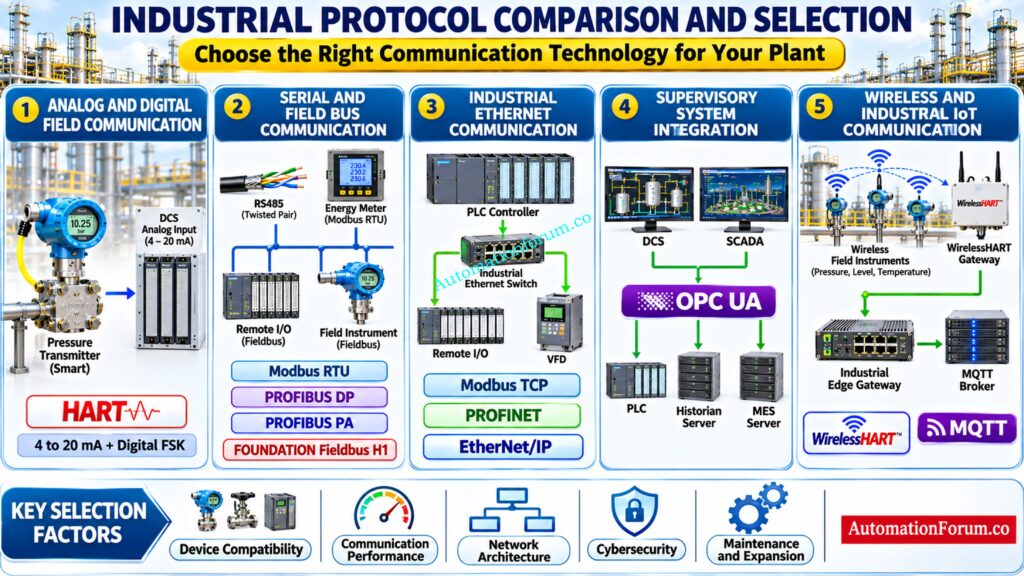
Protocol selection should begin during FEED and continue through detailed engineering and EPC execution.
Consider these engineering factors:
- PLC and DCS compatibility with the selected protocol.
- Availability of vendor supported communication interfaces.
- Required communication distance and network topology.
- Process data update rates and response requirements.
- Redundancy, network loading and future expansion.
- Hazardous area requirements and approved installation methods.
- Cybersecurity, access control and network segmentation.
- Availability of engineering tools, spares and maintenance expertise.
Industrial Communication Protocol Selection for Greenfield and Brownfield Projects
For greenfield plants, standardizing the control platform and network architecture simplifies engineering. For brownfield plants, compatibility with existing equipment and carefully tested gateways may be more economical than replacing operational systems.
Decode register mapping errors before Modbus data goes wrong: Understanding the Four Types of Registers in Modbus Protocol
Industrial Communication Protocol Troubleshooting: Common Problems and Solutions
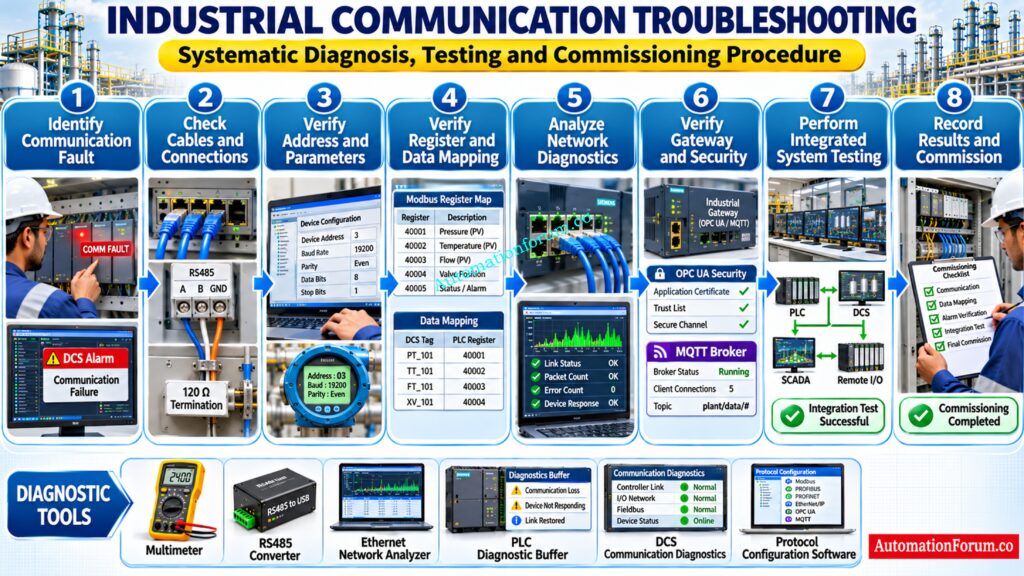
Communication failures frequently occur because of incorrect configuration, physical wiring or interface mapping.
| Communication problem | Possible cause | Recommended corrective action |
| HART device not responding | Insufficient loop resistance or incompatible input | Check loop configuration and HART interface |
| Modbus timeout | Incorrect address or serial settings | Verify baud rate, parity and device address |
| Incorrect Modbus value | Wrong register or data type | Check register map, scaling and word order |
| PROFIBUS device failure | Bus termination or segment fault | Check termination, cable and segment diagnostics |
| PROFINET device unavailable | Incorrect device name or IP configuration | Verify device identity and controller configuration |
| EtherNet/IP connection failure | Incorrect assembly or connection settings | Verify device configuration and connection parameters |
| OPC UA connection rejected | Certificate or authentication error | Check trust list and security configuration |
| WirelessHART device offline | Weak mesh connectivity | Check network routing and gateway placement |
| MQTT data unavailable | Broker or topic configuration problem | Verify broker connection, topics and authentication |
Use multimeters, serial communication converters, network analyzers, protocol diagnostic software, PLC diagnostic buffers and DCS communication diagnostics to isolate faults systematically.
Restore instrument discovery when handheld communication suddenly fails: HART Communicator Unable to Detect Instrument: Complete Troubleshooting Guide (No Device Found Error)
Industrial Communication Protocol Commissioning and Maintenance Best Practices
Successful industrial network commissioning requires documented interface ownership and systematic testing.
Prepare a communication interface list, device compatibility matrix, network addressing schedule and Modbus register mapping document before configuration.
During FAT, verify communication between representative devices and controllers. During SAT, confirm actual field wiring, network configuration, diagnostics and system integration. Complete integrated system testing before plant startup.
Maintain configuration backups, gateway settings, device descriptions and network diagrams. Implement network segmentation and appropriate cybersecurity controls in accordance with the plant OT security requirements.
Expose attack paths early and strengthen your security response: Top Cybersecurity Threat Identification Methods Every Security Professional Should Know
Future Trends in Industrial Communication Technologies
Industrial communication is moving towards Ethernet Advanced Physical Layer, Time Sensitive Networking, OPC UA PubSub and more integrated industrial IoT architectures.
These technologies are improving field connectivity, data availability and system interoperability. However, engineering selection must continue to consider process reliability, cybersecurity, device compatibility and lifecycle support.
Stop recurring fieldbus faults from disrupting process measurements: Profibus PA Communication Problems: Causes, Symptoms and Troubleshooting Guide
Frequently Asked Questions About Industrial Communication Protocols
What are the most commonly used industrial communication protocols?
HART, Modbus, PROFIBUS, FOUNDATION Fieldbus, PROFINET and EtherNet/IP are widely used in industrial automation. OPC UA, WirelessHART and MQTT support modern system integration and industrial data exchange.
Which protocols are used in process automation?
Process plants commonly use HART, PROFIBUS PA, FOUNDATION Fieldbus, Modbus, PROFINET and OPC UA. Selection depends on instrumentation requirements, control system compatibility and communication architecture.
What is the difference between Modbus RTU and Modbus TCP?
Modbus RTU uses serial communication, generally over RS485, whereas Modbus TCP uses Ethernet and TCP/IP. Both exchange data using Modbus registers, but their network configuration and communication methods differ.
What is the difference between PROFIBUS and PROFINET?
PROFIBUS is a fieldbus technology that uses serial communication, while PROFINET uses industrial Ethernet. PROFIBUS DP and PA support field and remote I/O applications, whereas PROFINET supports real time industrial automation.
Restore remote rack connectivity and prevent unexpected production interruptions: PLC Troubleshooting Remote IO Rack Communication Failure Complete Troubleshooting Guide for Industrial Automation Engineers
Which protocol is used between PLC and DCS?
Modbus TCP, OPC UA, PROFINET and EtherNet/IP can connect PLC and DCS systems. The final selection depends on controller compatibility, communication requirements and available vendor interfaces.
What is the difference between HART and FOUNDATION Fieldbus?
HART combines digital communication with a conventional 4 to 20 mA analog signal. FOUNDATION Fieldbus provides fully digital field communication and supports distributed function block execution.
Verify loop compatibility before commissioning smart field instruments: Advanced HART Loop Calculator for Reliable 4 to 20 mA and HART Communication
Why is OPC UA important in industrial automation?
OPC UA provides secure and structured data exchange between PLCs, DCS, SCADA, historians and MES applications. It improves interoperability between automation equipment from different manufacturers.
What are communication protocols?
Communication protocols are standardized rules that define how electronic devices exchange information. They specify data formats, addressing, communication timing and error handling.
What are the main types of industrial communication networks?
Industrial communication networks include serial fieldbus networks, industrial Ethernet networks, wireless instrumentation networks and supervisory data communication networks. Examples include RS485 based Modbus, PROFIBUS, PROFINET, WirelessHART and OPC UA based integration.
Build stronger industrial defenses with standards based security practices: OT Cybersecurity Norms: Complete Guide to IEC 62443, NIST SP 800 82
What are the seven network protocols and examples?
There is no universally defined list of seven industrial network protocols. Common examples include Modbus, PROFIBUS, PROFINET, EtherNet/IP, HART, FOUNDATION Fieldbus and OPC UA, each serving different automation applications.
Is Modbus a SCADA protocol?
Modbus is an industrial communication protocol frequently used for exchanging data between SCADA systems, PLCs, meters and other equipment. It is not exclusively a SCADA protocol.
Understand which network delivers better performance for your application: PROFIBUS vs PROFINET: Complete Industrial Network Comparison
What is the difference between Modbus ASCII and Modbus RTU?
Modbus ASCII represents data using ASCII hexadecimal characters, whereas Modbus RTU transmits data in a compact binary format. Both are serial Modbus communication modes, but RTU generally provides better communication efficiency.
Is Modbus faster than Ethernet?
Modbus is a communication protocol, whereas Ethernet is a networking technology, so they are not directly comparable. Modbus TCP uses Ethernet, and actual performance depends on network configuration, device capability and communication load.
Which is better, Modbus or PROFIBUS?
Modbus is generally simpler for integrating meters, drives and third party equipment, while PROFIBUS offers structured fieldbus communication for automation devices. The better choice depends on system compatibility, application requirements and engineering complexity.
Avoid unstable networks by understanding proper signal termination: Why 75 Ohm Termination Resistor is Used in ControlNet?
What are the two types of Modbus?
The two commonly used Modbus communication implementations are Modbus RTU and Modbus TCP. Modbus RTU uses serial communication, whereas Modbus TCP uses Ethernet and TCP/IP.
What type of cable is used for Modbus?
Modbus RTU over RS485 typically uses shielded twisted pair cable with suitable characteristic impedance. Modbus TCP uses industrial Ethernet cables such as shielded twisted pair Cat5e or higher, depending on the installation requirements.
Calculate segment limits before expanding your fieldbus installation: Profibus Segment Calculator for DP and PA Network Design
Conclusion: Choosing the Right Industrial Communication Protocol for Reliable Process Automation
Understanding industrial communication protocols is essential for designing reliable automation systems and integrating equipment from multiple manufacturers. Each protocol has a specific role, from smart field instrumentation and controller communication to supervisory integration and industrial IoT.
For instrumentation and control engineers, the right decision is not simply choosing the fastest protocol. It is selecting a compatible, secure, maintainable and technically suitable communication architecture that supports the entire plant lifecycle.
Refer the below link for the Vendor Document for Project Systems Architecture: Complete Engineering Guide for Instrumentation, Automation and Control
