
- Introduction to Cloud Based SCADA in Industry
- What Is Cloud Based SCADA?
- Why Cloud Based SCADA Matters in Industry
- Benefits of Cloud Based SCADA for Instrumentation and Control Engineers
- Cloud Based SCADA Architecture Explained
- Role of Cloud Based SCADA in Industry 4.0
- Industrial Use Cases of Cloud Based SCADA
- Simple Case Study: Cloud Based SCADA in a Water Treatment Network
- Cloud SCADA Security Challenges and Best Practices
- Best Practices for Cloud Based SCADA Implementation
- Future Trends in Cloud Based SCADA
- Frequently Asked Questions About Cloud Based SCADA
- Conclusion: The Future of Cloud Based SCADA in Industry
Introduction to Cloud Based SCADA in Industry
What Is SCADA in Industrial Automation?
SCADA, or Supervisory Control and Data Acquisition, has been a key aspect of industrial automation for many years. It helps engineers keep an eye on process variables, regulate equipment, gather alarms, and see what’s going on in a plant or distant location. In the early days of automation, SCADA systems were mostly local. They relied on on site servers, proprietary networks, and operator workstations inside the plant boundary. That model worked well when operations were simpler and data volumes were lower.
How SCADA Has Evolved from Local to Cloud Based Systems
Industrial operations have changed. Plants are now larger, more connected, and more data driven. A single organization may run multiple production sites, remote utility stations, pipeline assets, treatment plants, or manufacturing lines across different locations. At the same time, operations teams expect faster access to process data, maintenance teams want better fault diagnosis, and management wants better reporting and performance visibility. These expectations have pushed SCADA into a new era.
Why Cloud Based SCADA Is Becoming Important in Modern Industry
Cloud based SCADA in industry is one of the most important developments in this evolution. It combines traditional SCADA functions with cloud computing, industrial IoT, advanced analytics, and remote access. Instead of keeping all data inside a local server room, a cloud SCADA platform can collect process information from PLCs, RTUs, and edge gateways, then store, visualize, and analyze it in a secure cloud environment. This allows industries to move beyond basic monitoring and use their operational data in a far more strategic way.
Refer the below link for the SCADA Communication Problems and How to Fix Them – A Complete Troubleshooting Guide for Automation Engineers
What Is Cloud Based SCADA?
Cloud Based SCADA Meaning in Practical Industrial Terms
To understand cloud based SCADA properly, it is important to think in terms of plant operation rather than software marketing. A traditional SCADA system receives signals from transmitters, switches, analyzers, motors, and control valves. PLCs and RTUs process that data and execute the control logic. Operator stations show alarms, trends, and values for the process. Engineers utilize the system to keep an eye on things, fix problems, and make reports.
HART Configuration Mistakes That Break Your DCS: Best Practices for Configuring HART Parameters in DCS Software
Cloud SCADA vs Traditional SCADA
Cloud based SCADA keeps that foundation, but adds another layer of intelligence and accessibility. Field data is collected in the plant, sent through secure industrial communication channels, and then made available on a cloud platform. That platform may include dashboards, historians, alarm management tools, analytics engines, mobile access, and enterprise integrations.
How Cloud SCADA Works with PLCs, RTUs, and Edge Gateways
In many plants, an edge gateway sits between the control network and the cloud. It gathers data, translates protocols, filters unnecessary traffic, and protects the control system from direct exposure.
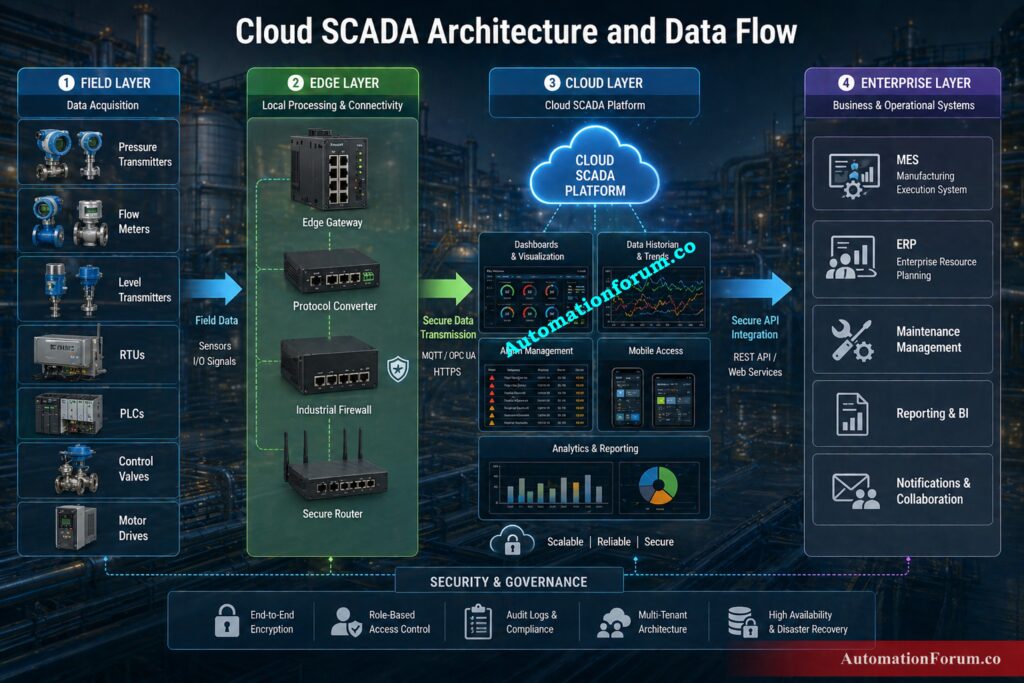
This is why cloud SCADA should be viewed as an architecture, not just a product. It connects the field layer, the edge layer, the cloud layer, and the enterprise layer into one information flow. The result is better visibility, better reporting, and better decision making.
30+ SCADA Security Mistakes You Must Eliminate: SCADA Security Checklist: 30+ Essential Tips for Securing Critical Infrastructure
Why Cloud Based SCADA Matters in Industry
When you look at how plants really work, you can see what cloud-based SCADA does in industry.
Centralized Monitoring of Distributed Assets
Real Time Remote Access to Process Data
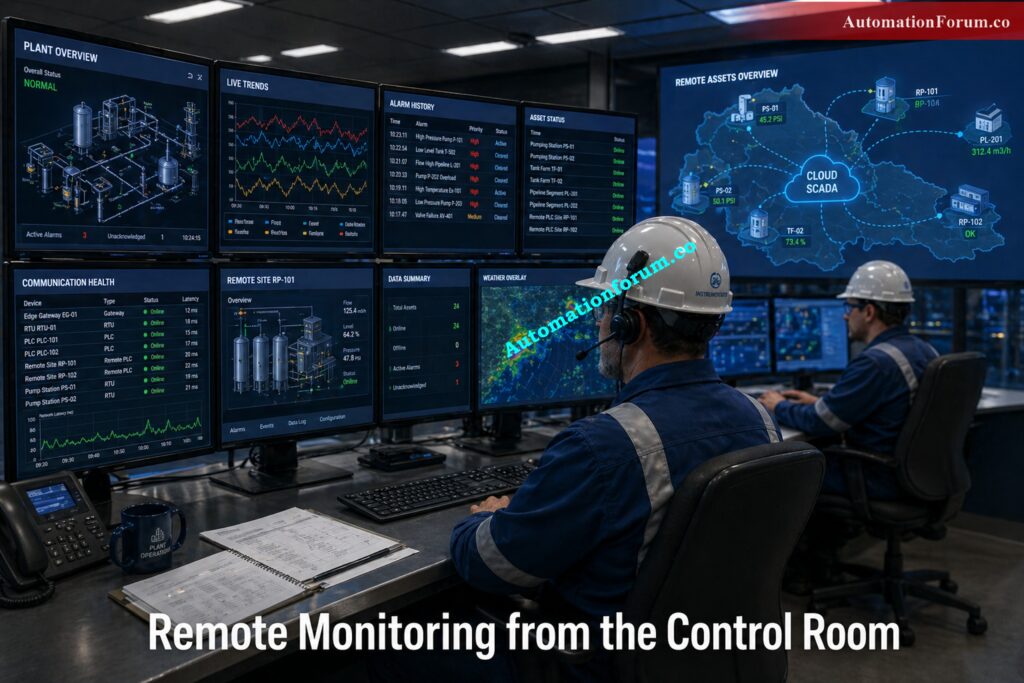
Second, it improves real time data accessibility. A plant manager, maintenance engineer, or process specialist does not always need to be physically present at the site to understand what is happening. If a level transmitter starts drifting, if a pump trips, or if a compressor shows unusual vibration, the relevant data can be reviewed from a remote location. This is especially valuable for unmanned stations, distributed utilities, and multi shift operations. It also supports faster response during abnormal events.
Modbus vs Profinet: Choose Wrong, Pay Later: Modbus TCP/IP vs Profinet: Which Protocol Suits your Industrial Network Best?
Support for Industry 4.0 and Industrial IoT
Third, cloud based SCADA supports Industry 4.0 and industrial IoT integration. Modern plants generate large amounts of operational data from sensors, analyzers, smart instruments, and machinery. Cloud systems are made to handle a lot of data and bring together data from different places. This makes it easy to employ machine learning, pattern recognition, and sophisticated analytics. Instead of only seeing current process values, engineers can also study trends, detect anomalies, and predict equipment behavior.
From Reactive Monitoring to Proactive Decision Making
Fourth, it helps decision making move from reactive to proactive. Traditional SCADA often tells you what happened. Cloud SCADA can help explain why it happened and what may happen next. That change is extremely important for maintenance planning, energy optimization, quality control, and production efficiency.
SCADA vs. HMI: Stop Confusing These Systems: SCADA vs. HMI: Complete Guide to Differences, Functions and Applications
Benefits of Cloud Based SCADA for Instrumentation and Control Engineers
Reduced Infrastructure Burden
For instrumentation and control engineers, cloud based SCADA offers practical benefits that go far beyond convenience.
One major benefit is reduced infrastructure burden. Local servers, database storage, backup hardware, patch management, and regular upgrades are all things that traditional SCADA systems need. That means higher capital cost and ongoing maintenance work. With cloud based SCADA, some of that burden shifts away from the plant. The organization no longer needs to build and maintain a large on site server setup for every remote application. This can reduce costs and simplify long term support.
SCADA Interview Questions That Will Test You: Top 15 SCADA interview Questions
Scalability for Multi Site Operations
Another benefit is scalability. Industrial locations don’t stay the same for long. As demand rises, new manufacturing lines are introduced, remote assets are put into service, and utilities grow. It is easier to scale a cloud SCADA platform than a fixed local design. When new equipment is added, data points and dashboards can often be extended with less disruption. This is especially useful for companies growing across multiple sites.
Predictive Maintenance and Condition Monitoring
Cloud SCADA also improves maintenance planning. When systems continuously collect data over time, they create the basis for predictive maintenance. A motor that slowly draws more current, a valve that begins to respond sluggishly, or a transmitter that shows repeated drift can be identified before a serious failure occurs. This is where cloud analytics becomes very powerful. Engineers can move from emergency repair to planned intervention. That saves time, reduces downtime, and improves reliability.
Remote Troubleshooting and Faster Fault Diagnosis
Remote troubleshooting is another clear advantage. When there is a site issue, the first challenge is often not the physical repair. The challenge is understanding what actually failed. Cloud SCADA helps engineers review trends, alarm history, communication status, and event logs from anywhere. That means experts can support local teams more quickly, even when they are not physically present. For organizations with limited specialist manpower, this is extremely valuable.
Better Historian, Reporting, and Data Storage
Reporting and historian functions are also improved. Local SCADA systems may store only limited historical data because of storage and server constraints. Cloud platforms can retain much larger data sets and make them available for dashboards, compliance reports, energy audits, production studies, and asset performance analysis. This gives engineers better evidence when solving recurring problems or presenting recommendations to management.
Test Your OT Security Before Attackers Do: ICS/SCADA OT Cybersecurity Self-Assessment: NIST-Based Procedure for Critical Infrastructure
Cloud Based SCADA Architecture Explained
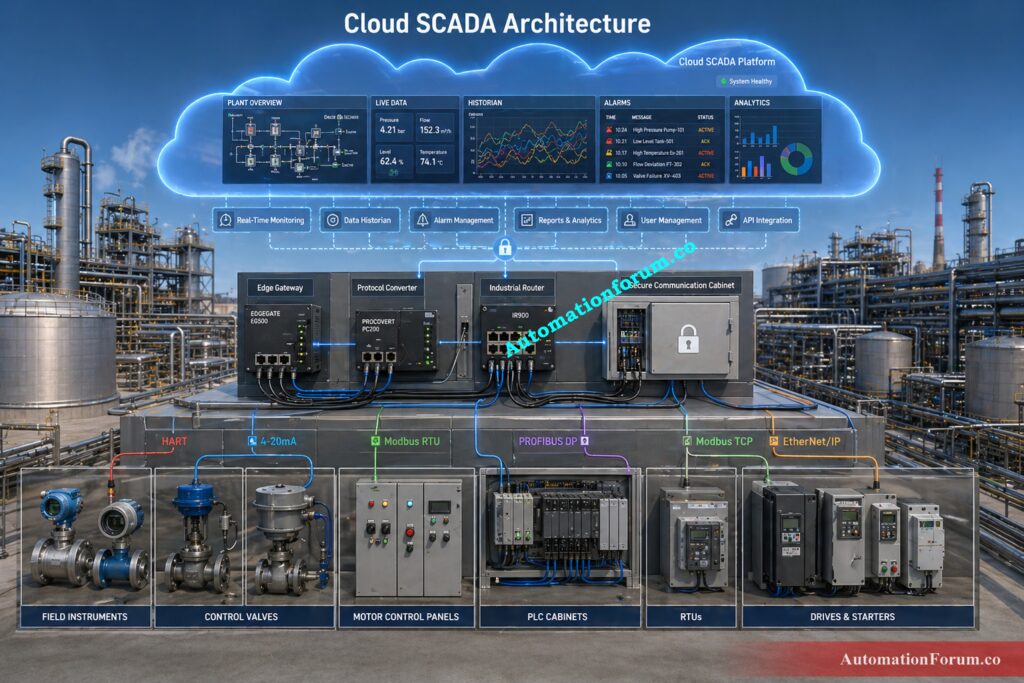
Field Layer in Cloud SCADA Systems
A clear architecture is essential when designing a cloud based SCADA system.
The field layer contains the process instruments and control devices. Some of them are temperature sensors, pressure transmitters, flow meters, level instruments, actuators, analyzers, PLCs, RTUs, motor starters, and variable speed drives. This layer is closest to the process and is in charge of measuring and controlling things locally.
Edge Layer: Gateways, Protocol Conversion, and Data Filtering
The edge layer is in the middle of the field devices and the cloud. It could have industrial gateways, communication servers, protocol converters, and computers on the edge. This layer gathers information from industrial protocols like Modbus, OPC UA, Profibus, Ethernet-based systems, and other device networks. It can filter data, do basic logic, store data when the network goes down, and get data ready to be sent to the cloud.
DCS, PLC, SCADA: Know the Real Differences: DIFFERENCE BETWEEN DCS ,PLC AND SCADA
Cloud Layer: Dashboards, Historians and Analytics
The system gets stronger in the cloud layer. It keeps track of process data, shows dashboards, handles alarms, lets people access it from afar, and does analytics. It might also have tools for historians, reporting engines, mobile apps, and machine learning. For many fields, this layer is where data from plants turns into business intelligence.
Enterprise Layer: MES, ERP and Asset Management Integration
The enterprise layer links SCADA data to other corporate systems. This may include MES, ERP, maintenance platforms, energy management systems, or quality systems. When these layers are connected properly, plant data becomes useful outside the control room as well. Production, maintenance, planning, and management teams can all use the same data source.
Open Loop vs Closed Loop Cloud SCADA Architecture
In practice, the cloud SCADA architecture may be used in open loop or closed loop form. In an open loop arrangement, the cloud receives data, analyzes it, and provides visibility and recommendations, but control remains local. This is the safer and more common approach for most industrial applications.
In a closed loop arrangement, cloud intelligence may influence control decisions more directly. This can work in certain optimized applications, but it must be handled carefully because cloud communication introduces latency and dependency on network availability. For critical process control, local control remains the best choice. The cloud should support supervision, analytics, and optimization, not replace safety or fast control functions.
FAT for SCADA: Catch Failures Before Startup: Factory Acceptance Test (FAT) Activities for SCADA System: Step-by-Step Checklist
Role of Cloud Based SCADA in Industry 4.0
Connecting Physical Systems with Digital Intelligence
Cloud based SCADA plays a major role in Industry 4.0 because it connects physical systems with digital intelligence. Industrial IoT devices generate data continuously from machines, utilities, process lines, and field assets. A cloud platform can collect this data from many sites and present it in a unified way.
Industrial IoT Data Collection and Visualization
This matters because modern industry depends on data driven operation. Engineers no longer want only alarms and current values. They want trend behavior, equipment health indicators, consumption patterns, and cross site comparisons. Cloud SCADA supports that requirement well.
Machine Learning and Advanced Analytics in SCADA
It also enables machine learning and advanced analytics. A system can learn normal operating patterns and flag deviations. It can help identify unusual energy use, detect drifting instruments, or predict component wear. In a power plant, cloud analytics may help monitor turbine efficiency. In a manufacturing plant, it may reveal which line has the highest downtime. In a water treatment system, it may show when chemical dosing is becoming unstable.
SCADA Applications Running Critical Industries Today: Applications of SCADA
Why Cloud SCADA Supports Digital Transformation
This is one reason traditional SCADA often struggles in modern digital environments. It was designed mainly for local visibility and control. Cloud SCADA is designed for scale, data sharing, and long term analytics. That makes it a better fit for the digital transformation strategies many industries are now pursuing.
Think You Know SCADA? Prove It Now: Advanced SCADA Systems Quiz
Industrial Use Cases of Cloud Based SCADA
Cloud Based SCADA in Oil and Gas Pipelines
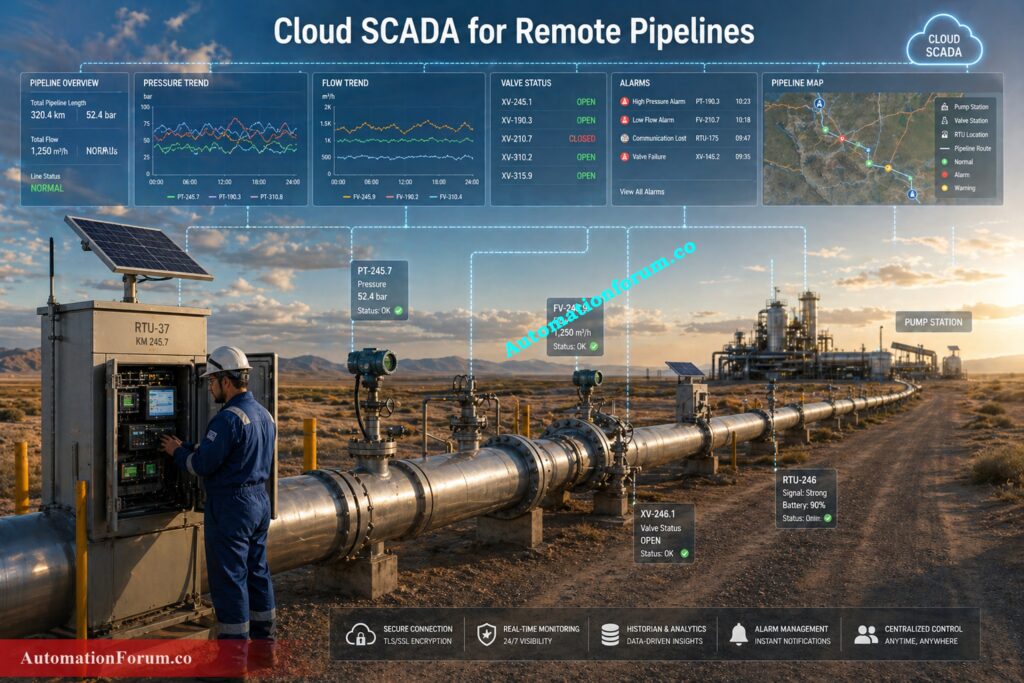
In oil and gas operations, cloud based SCADA is often used for remote pipeline monitoring. Long pipelines may include pumping stations, pressure points, valve stations, and unmanned locations. Cloud visibility helps operators track pressure, flow, and equipment status from a central control center. The staff can swiftly look into a pressure drop or an irregular valve. This makes things safer, speeds up response times, and helps keep an eye on assets in faraway areas.
Cloud SCADA in Power Plants
Cloud SCADA helps power plants keep an eye on more than one generation unit or facility from a single location. Engineers can look at boiler trends, turbine performance, auxiliary systems, and alarm history from a distance. This is quite helpful for businesses that own a lot of assets and want all of their facilities to report the same way. It also helps find efficiency losses before they turn into big problems with the way things work.
Cloud SCADA in Water Treatment Plants
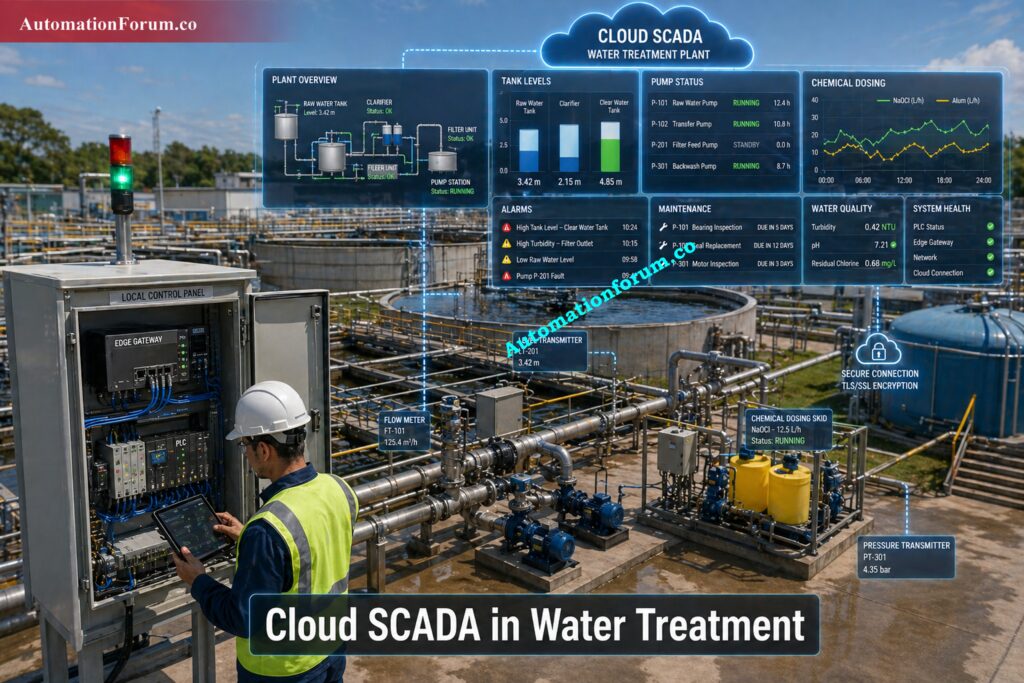
Cloud-based SCADA is very helpful for remote stations, pumping systems, reservoirs, and chemical dosing units in water treatment plants. From a central dashboard, operators can see the levels in the tanks, the status of the pumps, and the trends in dosing. You can find the problem early if the chlorine dose wanders or the pump starts cycling too often. This helps keep the water clean and cuts down on unnecessary trips to the field.
Wrong Network Switch Can Break Your SCADA System: Network Switches requirements in “SCADA” and “DCS” Architecture
Cloud Based SCADA in Manufacturing Plants
In manufacturing, cloud SCADA is often used to build multi plant dashboards. A company can compare machine utilization, downtime, production rate, alarm frequency, and energy consumption across different facilities. That gives management a clearer picture of how the whole operation is performing. It also supports benchmark based improvement because plant performance can be compared in a consistent way.
Choose the Right SCADA Architecture or Regret Later: Different Types of SCADA System Architecture
Simple Case Study: Cloud Based SCADA in a Water Treatment Network
Background of the Water Utility
A municipal water utility operated five water pumping stations and one central treatment plant spread across different locations. Each station had local PLC based control, but the monitoring system was limited to each site. Operators often didn’t find out about a pump failure at a remote station until a customer complained or someone went to the site.
The utility wanted to be able to keep an eye on all of its stations from one place, cut down on downtime, and make planning for maintenance easier. They chose a cloud-based SCADA solution to connect all of the facilities into one dashboard.
Problems Before Cloud SCADA Implementation
Before the upgrade, the utility had these problems:
- Not one view of all the pumping stations
- Alarm response was slow during pump trips.
- Going to the site often by hand to fix problems
- Not enough historical data to analyze
- It’s hard to compare how well stations are doing.
For instance, one pump station started drawing more current than usual for a few weeks. The problem wasn’t found early since the data wasn’t easy to find. The pump finally tripped during high demand, which caused low pressure in several parts of the network.
Cloud SCADA Solution for Remote Monitoring
The utility put in industrial gateways at each location to get data from PLCs and transmitters. These gateways relayed real-time data to a secure cloud-based SCADA platform.
The cloud system kept an eye on:
- Pump run status
- Motor current
- Tank level
- Flow rate
- Pressure
- Alarm history
- Energy consumption
Now, engineers and supervisors could connect in securely from the head office or from anywhere else and see the whole network on one dashboard.
DCS Components Breakdown Every Engineer Should Know: Understanding the Difference Between DCS Components: ES, OS, and AS
How Cloud SCADA Improved Daily Operations
After the system was put in place, the control team could quickly tell whether a station had a problem, like a low tank level, an unusual pressure, or a loss of contact. Maintenance engineers also used historical trends to compare the behavior of each pump.
One important improvement was early fault detection. The cloud SCADA trend showed that one pump at Station 3 was slowly consuming more current and running hotter than normal. Maintenance staff inspected the unit and found partial wear in the bearing assembly. The pump was repaired during planned maintenance instead of failing unexpectedly.
Results and Operational Benefits
Within a few months, the utility reported the following improvements:
- Faster alarm response
- Fewer emergency site visits
- Better pump maintenance planning
- Improved water supply continuity
- Better visibility across all stations
- Easier reporting for management
Key Lesson from the Case Study
This case shows how cloud based SCADA is useful when assets are spread across multiple locations. It gives engineers centralized monitoring, better data analysis, and faster decision making without changing the local control logic at each station.
Cloud SCADA Security Challenges and Best Practices
Why Cybersecurity Is Critical in Cloud SCADA
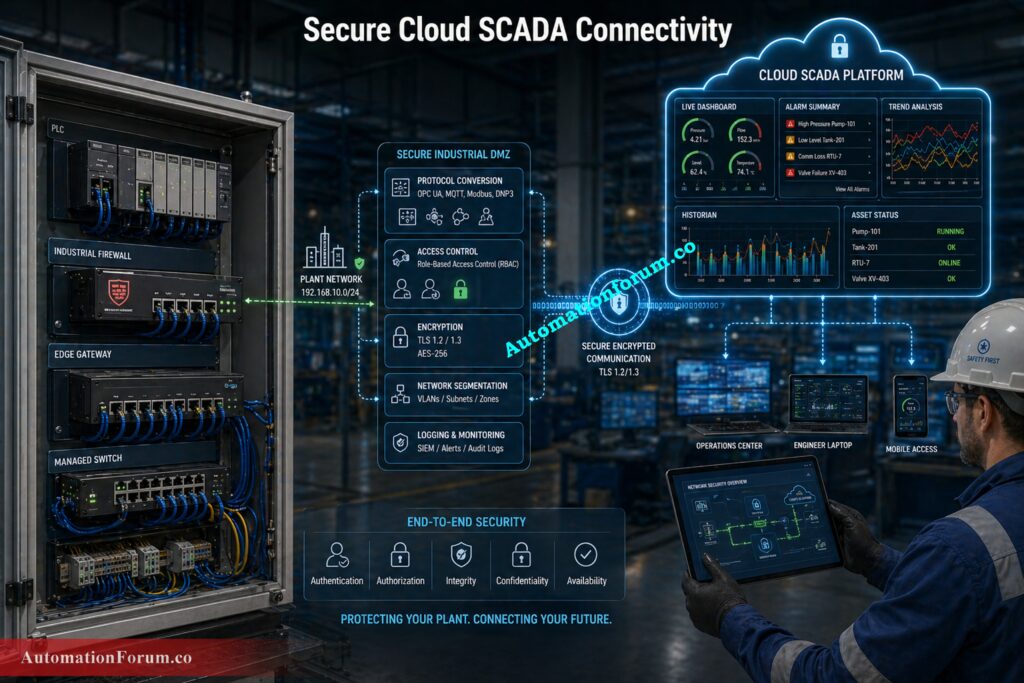
Cloud connectivity adds powerful capabilities, but it also adds risk. Cybersecurity must therefore be part of the design from the beginning.
The first concern is network dependency. A plant must not rely on the cloud for critical control or protective functions. If the communication path goes down, the process should still continue safely at the local level. That is why PLCs and RTUs must keep control logic locally. Cloud services should support monitoring and analytics, not replace local protection.
PLC vs DCS vs SCADA: Stop Guessing: Comparison between PLC, DCS, and SCADA
Network Dependency and Latency Concerns
The second concern is latency. Some industrial actions require very fast response. Cloud communication is not suitable for every control loop. Engineers must decide carefully which signals can travel to the cloud and which should remain inside the control network.
Industrial Cybersecurity Risks and Threat Exposure
The third concern is exposure to external threats. Once a system is connected beyond the plant boundary, the security design must be much stronger. Access control, encryption, authentication, segmentation, logging, and secure remote access become essential.
ISA/IEC 62443 and Secure SCADA Design
ISA IEC 62443 is highly important here since it presents an organized way to think about industrial cybersecurity zones, conduits, and how to construct secure systems.
Duplicate Modbus Address That Shut Down Plant: Duplicate Modbus Address in Temperature Multiplexers Causes Plant Shutdown – Real Incident & Root Cause
Industrial DMZ, Encryption, and Access Control
It’s also crucial to protect your data and follow the rules. Businesses need to know where their data is, who can get to it, and how it is safe. Legacy integration can be another challenge because older systems may not support modern protocols or secure communication methods easily.
A safe cloud SCADA setup should have an industrial DMZ, limited access rights, robust identity control, encrypted communication, backup plans, and a clear plan on how to respond to incidents. Security is not an optional extra; it is a design requirement.
SCADA Simulator: Practice Without Risking Real Systems: What is a SCADA simulator?
Best Practices for Cloud Based SCADA Implementation
Define What Data Should Go to the Cloud
Successful cloud SCADA projects start with a proper engineering assessment. The first step is to define the process needs clearly. Not every signal belongs in the cloud. Engineers should decide what is needed for monitoring, what is needed for reporting, and what must stay local.
Perform a Cybersecurity Risk Assessment
A cybersecurity risk assessment should be performed before deployment. This helps identify critical assets, communication paths, and vulnerabilities. The architecture should then be built around segmentation and secure access. An industrial DMZ can protect the plant network from direct exposure.
Use Secure Communication and Authentication
Communication should use secure protocols and authenticated devices. Remove default settings, limit user rights, and keep a close eye on who can access the system from afar. You should also plan for redundancy. Local systems should continue operating even when cloud links fail.
Plan Redundancy and Local Control
Data ownership and access control must be clearly defined. Operations, maintenance, engineering, and management may all need the data, but they don’t necessarily need the same level of access. Clear regulations keep things from getting confusing and make things safer.
Test Failure Scenarios Before Deployment
12 Free SCADA Tools Engineers Actually Use: Best 12 Free SCADA Software for Industrial Automation (2026 Guide)
Future Trends in Cloud Based SCADA
AI Driven SCADA Systems
The future of cloud based SCADA in industry will likely be shaped by several major trends.
More and more SCADA systems will be powered by AI. These systems will not only provide data, but they will also find unusual patterns, offer possible causes, and suggest what to do next. This will help engineers get things done faster and more correctly.
Hybrid Edge and Cloud Architecture
The hybrid edge and cloud architecture will also keep getting bigger. Critical functions will stay near the plant, while cloud services handle analytics, reporting, and fleet level visibility. This balanced model is practical and safer for industrial use.
Ethernet-APL Explained for Modern Process Automation:Ethernet-APL (Advanced Physical Layer): Practical Guide for EPC Instrumentation & Process Automation Engineers
Digital Twin Integration
Digital twin integration will become more important as industries seek better simulation and optimization. A digital twin can use live plant data to model process behavior and help teams test changes before they are applied in the field.
5G and High Speed Industrial Connectivity
5G-enabled industrial connectivity could also make it easier to monitor and transfer data from a distance, especially for mobile and scattered assets. It will be easier to use cloud-based monitoring in more places as transmission speeds up and becomes more dependable.
Third-Party Integration Mistakes That Break DCS Systems: Integrating Third-Party Systems with a Distributed Control System (DCS): Checklist
Frequently Asked Questions About Cloud Based SCADA
What is cloud based SCADA in industry?
It is a SCADA system that connects industrial field data to a cloud platform so that process values, alarms, trends, and reports can be accessed and analyzed remotely.
Is cloud SCADA safe for industrial control systems?
Yes, it can be safe when designed properly. Critical control should stay local, and the cloud should be used for monitoring, reporting, analytics, and supervised functions. Strong cybersecurity architecture is essential.
Can cloud SCADA replace traditional SCADA?
In most industrial plants, it does not fully replace traditional SCADA. It extends it. Local control still remains necessary, while the cloud adds remote access and data intelligence.
What are the main benefits of cloud SCADA?
The main benefits are remote visibility, better reporting, easier scaling, reduced infrastructure burden, predictive maintenance support, and improved decision making.
Where is cloud SCADA most useful?
It is extremely valuable for businesses that have assets that are spread out or far away, such oil and gas, water treatment, power generating, manufacturing, utilities, and any other business.
DCS Cybersecurity Risks You Cannot Afford Ignoring: DCS Cybersecurity: Mitigating Risks in Industrial Automation
Conclusion: The Future of Cloud Based SCADA in Industry
In industry, cloud-based SCADA is more than just an improvement to the technology. This is a useful step toward making industrial operations smarter, more connected, and more efficient. Industries get better visibility, stronger reporting, faster troubleshooting, and more informed decision making when they combine traditional SCADA with cloud computing, IIoT, and analytics.
It’s evident to instrumentation and control engineers what the benefit is. Cloud SCADA makes infrastructure less of a burden, enables predictive maintenance, makes remote assistance better, and lets companies run their operations across numerous sites. It also creates a stronger foundation for Industry 4.0 transformation.
At the same time, the system must be designed with care. Security, latency, architecture, and local control strategy all matter. The best implementations don’t migrate everything to the cloud; instead, they employ the cloud where it really helps and maintain important control functions local and stable.
Cloud-based SCADA is becoming more than just a tool for monitoring; it’s becoming a strategic advantage for modern factories. It gives the plant more information, more flexibility, and more long-term efficiency.
Refer the below link for the Understanding Permissive Logic and Trip Interlocks in Industrial Systems
