
- Introduction to OT Cybersecurity Norms and Industrial Control System Security
- What Is OT Cybersecurity?
- Why OT Cybersecurity Norms Are Important for Industrial Facilities
- Major OT Cybersecurity Standards and Frameworks
- OT Cybersecurity Norms for Industrial Facilities
- Network Segmentation Best Practices for OT Security
- Purdue Model Architecture for Industrial Cybersecurity
- Security Zones and Conduits in IEC 62443
- Firewalls and Industrial DMZ Implementation
- Access Control and Identity Management
- Asset Inventory Management for Operational Technology
- Vulnerability Management in Industrial Control Systems
- Incident Response Planning for OT Environments
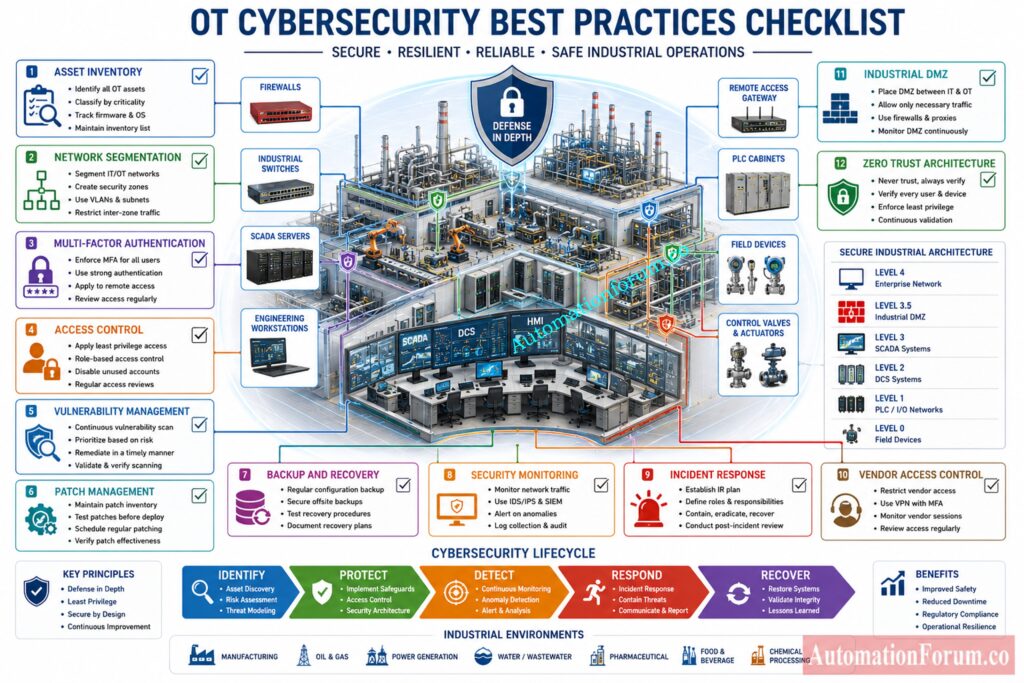
- OT Cybersecurity Best Practices for Industrial Control Systems
- Common OT Cybersecurity Challenges and Security Risks
- Legacy PLC and Control System Security Challenges
- Risks of Unsupported Operating Systems
- Limited Maintenance Windows in Industrial Plants
- Third Party Vendor and Supply Chain Risks
- Cybersecurity Challenges in Converged IT OT Environments
- Industrial IoT Expansion and Emerging Threats
- Supply Chain Security Threats in Industrial Operations
- OT Cybersecurity Compliance Checklist for Industrial Organizations
- Future Trends in OT Cybersecurity and Industrial Security
- Zero Trust Architecture for Operational Technology
- AI Driven Threat Detection and Response
- Industrial Security Operations Centers
- OT SIEM Integration and Security Analytics
- Secure Industrial IoT Deployments
- Digital Twins for Cybersecurity Testing
- Growing Adoption of IEC 62443 Standards
- Regulatory Evolution and Future Compliance Requirements
- Frequently Asked Questions About OT Cybersecurity
- What is the OT Cybersecurity Framework?
- What is OT in Cybersecurity?
- What are OT Cybersecurity Best Practices?
- What is the IEC Standard for OT Cybersecurity?
- What is the ISO Standard for OT Security?
- What is ISO 31000 vs NIST 800 37?
- What is OT Cybersecurity?
- What is IEC 62443?
- What is NIST SP 800 82?
- How is OT Security Different from IT Security?
- Why is Network Segmentation Important?
- What are Security Zones and Conduits?
- What is the Purdue Model?
- What are Common OT Cyber Threats?
- What is Zero Trust in OT?
- Conclusion: Building a Strong OT Cybersecurity Program with IEC 62443 and NIST SP 800 82
Introduction to OT Cybersecurity Norms and Industrial Control System Security
Operational Technology, or OT, is the systems that control, monitor and automate physical industrial operations. These systems are used in manufacturing plants, power stations, oil and gas facilities, water treatment plants, chemical units, utilities and other critical infrastructure environments. OT includes PLCs, DCS, SCADA systems, RTUs, industrial networks, engineering workstations, sensors, actuators, HMIs, and connected field devices.
OT cybersecurity is different from general IT cybersecurity because the main priority is not only confidentiality. In industrial environments, availability, safety, reliability, and process continuity are often more important than anything else. A security event in an office network may cause data loss or downtime. A security event in a plant can stop production, damage equipment, create unsafe conditions, affect environmental compliance, and in some cases threaten human life.
That is why OT cybersecurity norms are becoming mandatory worldwide. Industrial organizations now understand that cybersecurity is not only an IT issue. It is an operational issue, a safety issue, a reliability issue, and a business continuity issue. Modern plants are more connected than ever before, which means the attack surface is expanding. Remote access, cloud integration, vendor support, industrial IoT, wireless systems, and IT OT convergence have all increased the need for strong protection.
For automation professionals, the practical goal is clear. OT cybersecurity has to be implemented in such a way that safeguards the facility and doesn’t hinder production. It has to honor maintenance periods, support legacy equipment, maintain control performance, and work with plant operations. That’s why standards like IEC 62443, NIST SP 800 82, and the NIST Cybersecurity Framework are so vital.
What Is OT Cybersecurity?
Definition of Operational Technology Security
Key Components of OT Cybersecurity
Which means:
- PLCs (programmable logic controllers) that do logic and control equipment
- DCS platforms for process control of large installations
- SCADA systems for remote site monitoring and field operations
- Remote and dispersed control sites with RTUs
- Operator HMIs for process monitoring and control
- Industrial switches, routers and firewalls to facilitate plant communication
- Workstations for control system configuration & maintenance
- Historians, gateways, protocol converters, and remote access technologies
- Industrial IoT devices connecting to maintenance and process systems
Why OT Cybersecurity Is Critical for Critical Infrastructure Protection
Much of the OT cybersecurity is critical infrastructure protection as many industrial environments support critical services. If power, water, oil, gas, transportation, or manufacturing systems are disrupted, the effect can spread beyond one facility. That is why OT security must be viewed as part of national and organizational resilience.
Real World Examples of Operational Technology Security Risks
In practical terms, OT cybersecurity means asking questions such as:
- Who can change the PLC logic?
- Who can connect remotely to the plant?
- How is vendor access controlled?
- What happens if one machine becomes infected?
- How is a control network separated from business systems?
- How is a safety system protected from accidental or malicious access?
These are not theoretical questions. They are daily engineering questions in modern industrial environments.
Fix SCADA and DCS Switch Requirements Fast: Network Switches requirements in “SCADA” and “DCS” Architecture
Why OT Cybersecurity Norms Are Important for Industrial Facilities
Impact of Cyberattacks on Industrial Control Systems
OT cybersecurity norms matter because industrial systems are increasingly targeted by cyber attackers. Attackers know that industrial organizations are highly sensitive to downtime. They also know that many industrial systems were designed before cybersecurity became a major concern. Older systems may have inadequate authentication, low visibility, unsupported software or extensive maintenance cycles.
A successful attack on OT can result in:
- Production downtime
- Loss of product quality
- Equipment damage
- Safety incidents
- Environmental release
- Supply chain disruption
- Financial loss
- Regulatory penalties
- Reputation damage
Allocate Switch Ports Before Topology Problems Begin: Network switch port allocation details
Lessons Learned from Stuxnet and Colonial Pipeline Attacks
One of the main reasons why OT cybersecurity regulations are increasingly relevant is the increase in cyber incidents affecting physical operations. Stuxnet shown that malware may be built to target industrial equipment and physical processes. The Colonial Pipeline incident highlighted how ransomware may have a significant operational impact and cause enterprises to shutdown or curtail key services. These cases changed how industries think about cyber risk.
Another reason is compliance. Governments, regulators, insurers, and customers increasingly expect industrial organizations to prove that they are protecting operational systems. Security is no longer optional. It is part of responsible operation.
Another important factor is the growing connection between IT and OT. In the past, many plants were isolated. Today, many control systems are connected to enterprise networks, cloud platforms, analytics tools, vendors, and centralized monitoring systems. That connectivity improves efficiency, but it also increases exposure. A weak point in one network can become a pathway into another.
OT cybersecurity standards provide a rigorous framework for automation teams. They describe what needs to be secured, how systems should be separated, who should be granted access, how incidents should be handled, and how security should be maintained over time.
Prove Your Control Security Skills With This Challenge: Advanced Quiz on Control System Cybersecurity in Process Industries – Test Your Expertise
Major OT Cybersecurity Standards and Frameworks
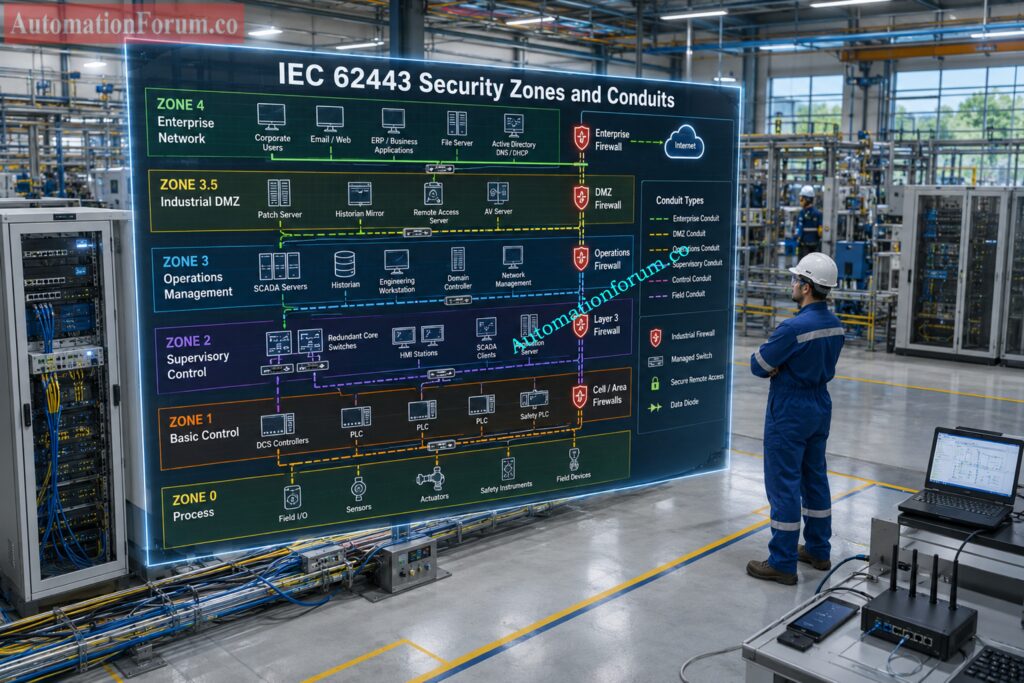
IEC 62443 Standard for Industrial Cybersecurity
One of the key standards for industrial cybersecurity is IEC 62443. It is made specifically for industrial automation and control systems. It is a technique of securing OT settings from the design and procurement to operation and maintenance phases of the lifecycle.
One of the most useful ideas in IEC 62443 is the idea of security tiers. These levels let organizations determine how much protection is needed based on risk.
Not every system needs the same level of security. A high risk process area will need stronger controls than a low risk utility network.
Another important concept is zones and conduits. A zone is a group of systems with similar security requirements. A conduit is the controlled communication path between zones. This is highly practical for industrial network design. This helps engineers break up systems into logical pieces and govern the flow of traffic between them.
The roles of different groups are also defined in the IEC 62443.
Asset owners are accountable for security standards, risk management and for the secure operation of the plant.
System integrators are responsible for secure design, secure implementation and correct setup.
Product providers produce secure goods and provide security support.
Refer the below link for the Stop DCS Attack Paths Before They Spread:
Practical Industrial Applications of IEC 62443
Practical industrial examples of IEC 62443 include:
- Separating packaging lines into different zones
- Using firewalls between the plant network and the enterprise network
- Restricting vendor access to a jump server
- Defining security requirements in engineering projects before commissioning
- Monitoring communication between PLC networks and supervisory systems
IEC 62443 is widely adopted because it fits the way real industrial systems are built and operated. It gives organizations a common language for OT cybersecurity.
Choose Baud Rates Correctly Before Signal Errors Grow: Key Factors to Consider When Setting Baud Rate in Modbus Networks
NIST SP 800 82 Guidelines for ICS Security
NIST SP 800 82 is a foundational guide for securing industrial control systems. Particularities of OT and ICS contexts are the main focus. NIST recognizes that control systems are not office IT systems. These systems frequently enable continuous operations, involve legacy technology, and have safety and reliability limits.
This guidance covers topics such as:
- ICS architecture
- Threats and vulnerabilities
- Network segmentation
- Access control
- Patch management
- Monitoring
- Incident response
- Risk management
- Recovery planning
What makes NIST SP 800 82 so useful is it does not consider OT security as an IT checklist. It understands that security controls should be applied with an awareness of the impact on operations. In industrial plants, a security change that causes downtime can create more damage than the vulnerability itself if it is not managed properly.
NIST SP 800 82 is valuable for:
- Instrumentation engineers
- Control system engineers
- Automation engineers
- Cybersecurity professionals
- Plant managers
- Maintenance teams
- System integrators
It helps the organization build practical protection while preserving reliability and safety.
NIST Cybersecurity Framework for Operational Technology
The NIST Cybersecurity Framework provides a high level structure for cybersecurity risk management. It is popular since it is easy to grasp and works well in many sectors.
The core functions are as follows:
- Identify
- Protect
- Detect
- Respond
- Recover
In OT contexts these functions can be interpreted extremely practically.
Identify is about recognizing your assets, risks and crucial dependencies. •
Protect involves implementing access control, segmentation, hardening and secure configuration .
Detect means looking for anomalous traffic, unlawful access or suspicious activity.
Respond means to contain a situation safely and quickly.
Recover means to resume operations and check systems are safe to return to normal production.
This approach is particularly effective for plant companies who seek a management level structure to security without compromising operational emphasis. It helps connect cybersecurity with business risk.
See How Remote Work Opens Cyber Doors: Remote Work Cybersecurity: Common Vulnerabilities and How to Prevent Attacks
ISA IEC 62443 Framework and Defense in Depth Strategy
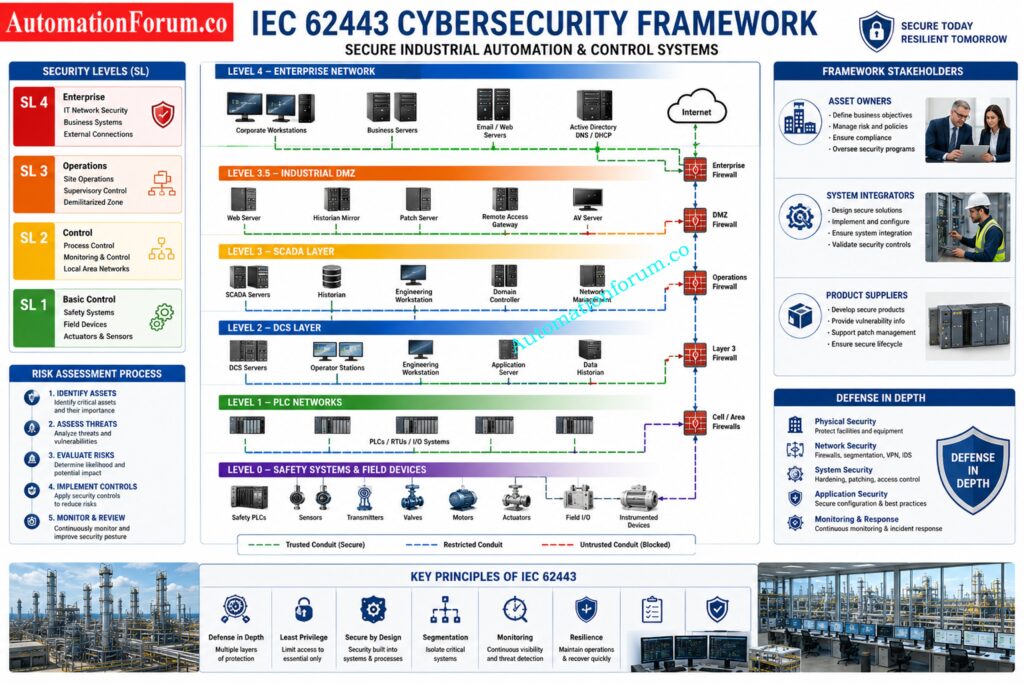
ISA IEC 62443 is widely respected in industrial automation because it combines theory and practical implementation. It is more than a technical document. It is a lifecycle based framework for secure industrial operations.
Its main strengths include:
- Defense in depth
- Secure lifecycle approach
- Risk based protection
- Continuous monitoring
This framework is useful for new plants, brownfield modernization, system upgrades, and vendor management. It lets firms set security requirements early, instead of trying to bolt on security after commissioning.
ISA IEC 62443 is extremely useful to the automation specialist since it speaks the language of the industrial project. It supports engineering decision, supplier needs and operational security planning.
Learn the Core Cybersecurity Facts Everyone Skips: Cybersecurity Basics: Types, Threats, and Protection Tips
OT Cybersecurity Norms for Industrial Facilities
Network Segmentation Best Practices for OT Security
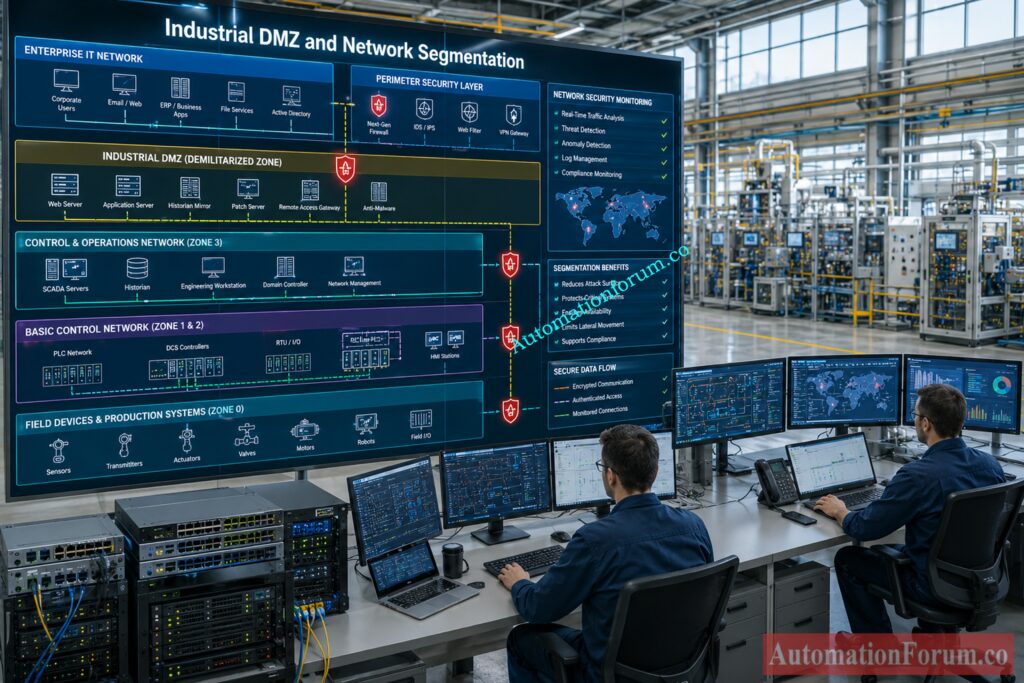
Network segmentation is one of the most critical OT security procedures. It prevents the transmission of threats and assists in segregating systems by risk and function. In industrial environments, segmentation should not be treated as a nice extra. It should be a core design principle.
A strong segmentation strategy may separate:
- Enterprise IT systems
- Industrial DMZ
- Supervisory systems
- Control system networks
- Vendor remote access zones
- Wireless and IIoT zones
- Different production areas or units
This kind of separation reduces the chance that one compromised system can reach the entire plant. It also makes troubleshooting and monitoring easier.
Lock Down PLCs Before Attackers Move In: Cybersecurity Standards for PLCs
Purdue Model Architecture for Industrial Cybersecurity
The Purdue Model is commonly used as a reference for structuring industrial networks. It helps teams think in layers—from the enterprise system down to the field device. It is not a complete security solution on its own but is nevertheless a valuable framework to understand trust boundaries and flow of communication.
The Purdue Model is still used in many industrial security initiatives because it provides a recognizable structure for operations and engineering teams. This is particularly useful when used with current controls such as firewalls, access gateways and monitoring tools.
Security Zones and Conduits in IEC 62443
Security zones and conduits are key ideas within IEC 62443. A zone groups assets with similar security needs. A conduit controls how data moves between zones.
For example, one production line may be one zone, with its own PLCs, HMIs, and I O modules. Another line may be another zone. The connection between them should be controlled, monitored, and limited to necessary traffic only.
This approach reduces risk and provides the business with a clean architecture for access control and monitoring.
Refer the below link for -Why 75 Ohm Termination Resistor is Used in ControlNet?
Firewalls and Industrial DMZ Implementation
A DMZ in an industrial environment is a managed buffer between the IT side and OT side. It can host systems that need to communicate with both environments, such as historians, file transfer services, patch relay servers, and remote access brokers.
Firewalls should be configured to allow only required traffic. Open access should be avoided. Default allow rules should not be used in sensitive OT environments. Every allowed connection should have a reason.
A properly designed DMZ reduces direct exposure of control systems and creates a safer path for communication between enterprise and operational networks.
Access Control and Identity Management
Access control is one of the simplest and strongest security measures available. That means only the right individuals can get to the right systems at the right time.
Best practices include:
- Role based access control
- Least privilege
- Unique user accounts
- Multi factor authentication
- Temporary vendor access
- Account review and revocation
Test Your ICS Defense Readiness Before Crisis Hits: ICS/SCADA OT Cybersecurity Self-Assessment: NIST-Based Procedure for Critical Infrastructure
Asset Inventory Management for Operational Technology
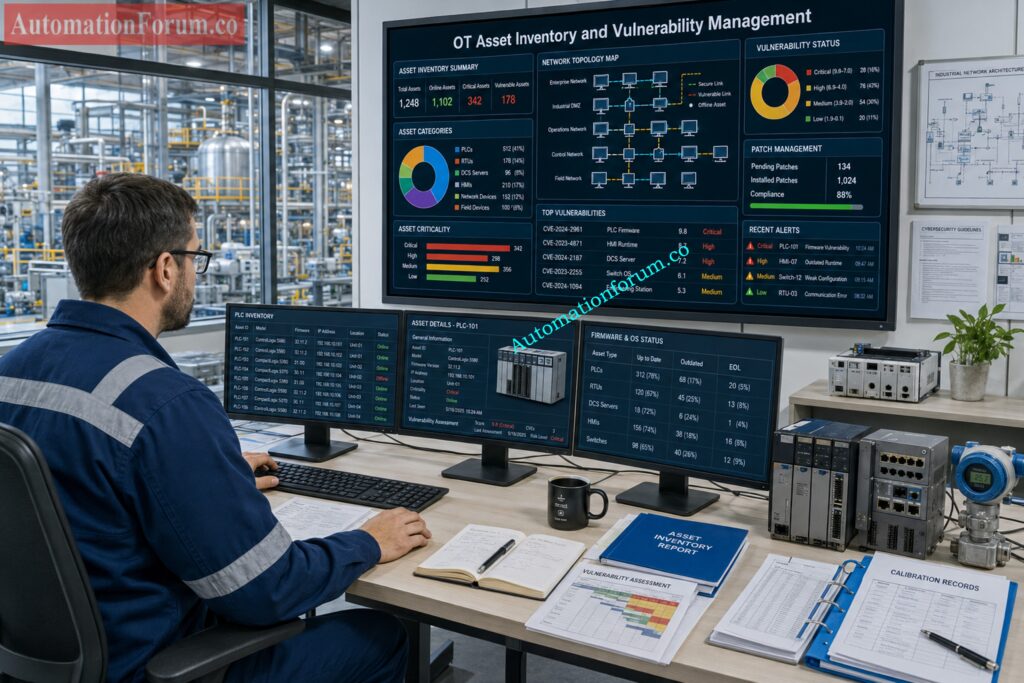
You cannot protect what you do not know exists. A complete OT asset inventory is essential for cybersecurity.
The inventory should include:
- Device name
- Device type
- Location
- Network address
- Firmware version
- Operating system
- Owner
- Criticality
- Support status
- Maintenance schedule
Vulnerability Management in Industrial Control Systems
OT vulnerability management must be risk based. In a plant, not every vulnerability can be patched immediately. Some systems may be too critical to restart without planning. Some devices may no longer be supported by the vendor. Some patches may require testing before deployment.
That is why OT vulnerability management should include:
- Risk assessment
- Vendor consultation
- Patch testing
- Maintenance planning
- Compensating controls
- Temporary isolation when needed
The goal is not only to patch quickly. The goal is to reduce risk without creating operational instability.
Incident Response Planning for OT Environments
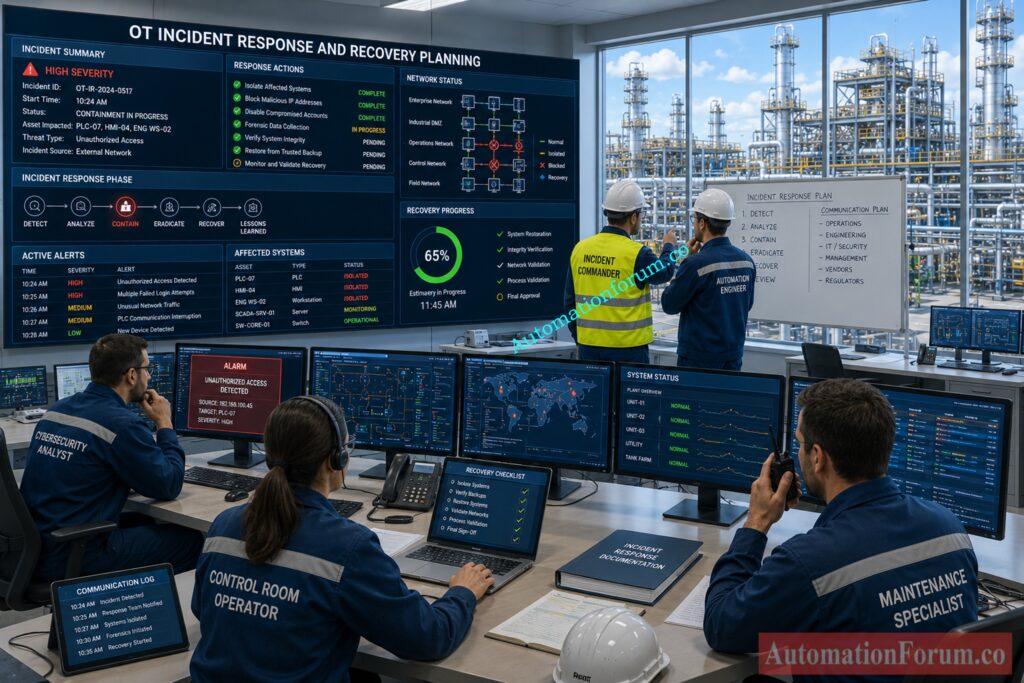
Incident response in OT must be designed for industrial reality. A containment action that is appropriate for IT may not be safe in OT. For example, disconnecting a critical system without planning may cause a process upset.
An OT incident response plan should include:
- Detection
- Escalation
- Containment
- Safety verification
- Communication
- Recovery
- Post incident review
Decode OT Security Protocols Before Your Plant Pays: Protocols and Standards in Industrial Automation: A Guide to OT Cybersecurity
OT Cybersecurity Best Practices for Industrial Control Systems
Operational discipline is the foundation of robust OT cybersecurity. Some of the more effective practices are:
- Change default credentials immediately and use strong passwords.
- Apply multi factor authentication to remote access and privileged accounts.
- Control vendor access through approved, monitored, and time limited paths.
- Use network monitoring to discover abnormal communication or unrecognized devices.
- Back up logic, recipes, configuration files and project data on a regular basis.
- Train engineers, operators and maintenance staff to be alert to cybersecurity.
- Use formal change management to control all changes. Document and approve all changes.
- Use configuration baselines for controllers, servers, firewalls and workstations.
- Secure engineering workstations with endpoint restrictions and limited access.
- Review and eliminate any unneeded accounts and privileges.
- Minimize removable media and scan USB devices before usage.
- Look for unlawful activity of software or protocols.
- Test recovery techniques in advance of a genuine incident.
- Conduct frequent risk reviews as the plant develops.
These techniques are not difficult, but they demand discipline. In OT generally the simpler is more consistent.
Compare PROFIBUS and PROFINET Before Choosing Anything: PROFIBUS vs PROFINET: Complete Industrial Network Comparison
Common OT Cybersecurity Challenges and Security Risks
Legacy PLC and Control System Security Challenges
Many industrial plants are still running on obsolete PLCs, controllers and HMI platforms that were not designed with cybersecurity in mind. These systems might have inadequate authentication, outdated protocols or restricted support for updates.
Risks of Unsupported Operating Systems
The engineering workstations and supervisory systems still run on unsupported operating systems. This is a danger because there may not be anymore security updates and vendor support.
Limited Maintenance Windows in Industrial Plants
Many plants cannot be halted on command. There are also times when security updates have to wait for a planned shutdown, outage or maintenance window. That makes patching/upgrading more complex.
Third Party Vendor and Supply Chain Risks
Remote support and vendor connectivity might be a weak spot if access is not strictly managed. Vendors typically require access but that should be managed carefully.
Cybersecurity Challenges in Converged IT OT Environments
With IT/OT convergence, security advancements in one sector might impact the other. This introduces complexity that must be coordinated amongst teams.
Industrial IoT Expansion and Emerging Threats
More sensors, smart instruments and monitoring devices boost visibility and efficiency, but also present new attack avenues.
Supply Chain Security Threats in Industrial Operations
OT systems depend on hardware, software, integrators, and suppliers. A weakness in the supply chain can affect the plant even if internal controls are strong.
These challenges are common in industry. The answer is not to avoid all technology. The answer is to manage risk intelligently.
Calculate Segment Limits Before Your Network Breaks: Profibus Segment Calculator for DP and PA Network Design
OT Cybersecurity Compliance Checklist for Industrial Organizations
| Security Area | Compliance Status | Recommended Action |
| Asset inventory | Not started | Create a complete list of OT assets |
| Network segmentation | Partial | Separate IT and OT networks properly |
| DMZ architecture | Partial | Build a controlled industrial DMZ |
| Remote access | Partial | Use MFA and jump server access |
| Password policy | Partial | Remove default and shared passwords |
| Privileged accounts | Not started | Restrict admin rights |
| Backup strategy | Partial | Verify backups for logic and configurations |
| Patch management | Partial | Test and approve patches before deployment |
| Vulnerability review | Not started | Build a risk based review process |
| Logging | Partial | Collect and review event logs |
| Monitoring | Partial | Track unusual OT traffic |
| Incident response plan | Not started | Create OT specific response procedures |
| Vendor management | Partial | Control and record vendor access |
| Configuration management | Partial | Maintain secure baselines |
| Removable media control | Not started | Restrict USB and external media use |
| Security training | Partial | Train plant and maintenance staff |
| Recovery testing | Not started | Test restoration and failover procedures |
This checklist is most useful when it becomes part of regular plant audits, maintenance planning, and management review. It should not remain a paper exercise.
Understand CC-Link Architecture Before Deployment Starts: CC-Link Industrial Network Protocol: Architecture, Variants, and Applications
Future Trends in OT Cybersecurity and Industrial Security
OT cybersecurity is changing quickly. Several trends are shaping the future of industrial protection.
Zero Trust Architecture for Operational Technology
Zero trust is gaining momentum because it assumes no device or user should be trusted automatically. Every access request must be verified. In OT, this must be implemented carefully, but it offers a strong model for reducing unnecessary trust.
AI Driven Threat Detection and Response
Artificial Intelligence and advanced analytics are being increasingly employed to detect anomalies in traffic, access behavior and process data. This may also help to detect threats sooner than manual screening alone.
Industrial Security Operations Centers
More organizations are building security operations capabilities specifically for industrial environments. These teams understand both cyber risk and process impact.
OT SIEM Integration and Security Analytics
Secure Industrial IoT Deployments
Industrial IoT will continue to grow, but future deployments will need stronger identity, secure communication, lifecycle control, and device visibility.
Digital Twins for Cybersecurity Testing
Digital twins and simulation environments can be used to test security scenarios, validate defenses and train teams in a way that does not impact live production.
Growing Adoption of IEC 62443 Standards
More enterprises are moving to IEC 62443 as it presents a practical foundation for lifecycle based OT security.
Regulatory Evolution and Future Compliance Requirements
We expect governments and regulators to continue to enhance standards for industrial cyber resilience, reporting and critical infrastructure security.
The future of OT security will be more linked, more watched and more regulated. The more an organization prepares, the better it will be able to sustain its resilience.
Pick the Right Protocol Before Downtime Costs Rise: Modbus TCP/IP vs Profinet: Which Protocol Suits your Industrial Network Best?
Frequently Asked Questions About OT Cybersecurity
What is the OT Cybersecurity Framework?
The OT Cybersecurity Framework is a methodical strategy to safeguard industrial control systems through risk management, asset visibility, threat detection, incident response and recovery processes. NIST SP 800 82 and IEC 62443 standards often consistent with NIST Cybersecurity Framework.
What is OT in Cybersecurity?
OT (Operational Technology) is the hardware and software that monitors and controls physical industrial processes. This includes PLCs, DCS, SCADA systems, RTUs and industrial networks. OT security aims to secure these systems from cyber attacks while guaranteeing safety and ongoing reliable operation.
What are OT Cybersecurity Best Practices?
Best practices for OT cybersecurity include: Network segmentation Multi factor authentication Asset inventory management Continuous monitoring Secure remote access Vulnerability management Regular backups These techniques enhance Industrial Control System Security and minimize cyber risk.
What is the IEC Standard for OT Cybersecurity?
IEC 62443 is the worldwide standard for cybersecurity designed primarily for Industrial Automation and Control Systems. It establishes requirements for asset owners, system integrators and product suppliers to safeguard OT environments across their lifecycle.
What is the ISO Standard for OT Security?
There is no single ISO standard that is solely focused on OT security. What Standards are used by Organizations? ISO 27001 for Information Security Management IEC 62443 for Industrial Control System and Operational Technology Security
What is ISO 31000 vs NIST 800 37?
ISO 31000 is broad organizational risk management principles that can be applied across many industries. NIST 800 37 is the Risk Management Framework for information systems and cybersecurity activities. The NIST 800 37 is more specific in security control implementation and risk assessment operations.
What is OT Cybersecurity?
OT cybersecurity is the safeguarding of industrial control systems, operational networks, and physical processes from cyberattacks, unlawful access, and operational interruption. It guarantees safety, availability, dependability and business continuity in industrial plants.
What is IEC 62443?
IEC 62443 is a holistic cybersecurity standard for Industrial Automation and Control Systems that includes security standards, risk management methods, zones and conduits, and secure lifecycle approaches. It’s frequently used in industrial, energy and critical infrastructure industries.
What is NIST SP 800 82?
NIST SP 800 82 is a cybersecurity guidance document that outlines recommended practices for safeguarding Operational Technology and Industrial Control Systems such as PLCs, SCADA systems, and DCS platforms. It satisfies the particular safety, reliability and availability needs of industrial contexts.
How is OT Security Different from IT Security?
OT security focuses on operational availability, process safety, and equipment reliability, while IT security focuses on ensuring the confidentiality and integrity of data. An OT cybersecurity event can have direct impacts on physical operations and manufacturing systems.
Why is Network Segmentation Important?
Network segmentation separates important industrial assets and confines the spread of cyber threats across OT environments. It increases Industrial Network Security by managing the flow of communications between business systems and control networks.
What are Security Zones and Conduits?
Security zones are collections of assets that have comparable cybersecurity needs, and conduits are regulated communication paths between security zones. This IEC 62443 concept guides enterprises in establishing safe and managed OT network infrastructures.
What is the Purdue Model?
The Purdue Model is a layered architecture which is used to divide business systems, supervisory systems, control systems and field devices in industrial networks. It also helps in secure network architecture and reducing cyber security threats in Operational Technology environments.
What are Common OT Cyber Threats?
OT cyber threats include ransomware, malware, external remote access, insider threats, supply chain assaults, phishing campaigns, and attacks on PLCs, SCADA systems, and industrial communication networks.
What is Zero Trust in OT?
OT “Zero Trust” is a cybersecurity method that does not trust any user, device, or connection by default. All access requests should be continuously checked, authenticated and permitted before interacting with industrial systems.
Conclusion: Building a Strong OT Cybersecurity Program with IEC 62443 and NIST SP 800 82
OT cybersecurity standards are necessary for current industrial operations. But as facilities become increasingly networked, the possibility of cyber disruption increases. Industrial enterprises need security strategies that protect data, equipment, process integrity, safety and uptime.
IEC 62443, NIST SP 800 82 and NIST Cybersecurity Framework provide a solid framework for industrial cybersecurity. They assist firms develop secure infrastructures, manage risk, protect vital assets and respond efficiently to incidents.
For automation professionals, the most effective approach is practical and disciplined. Know your assets. Segment your networks. Control access. Monitor continuously. Test recovery. Train the team. Review risk often. That is how OT cybersecurity becomes part of operational excellence.
Refer the below link for – How to Safeguard PLCs Against Cyber Attacks in Industrial Networks ?
